Frogs boil up out of the Nile; gnats rise from the dust; flies fill the air of Egypt. Plagues two, three, and four escalate the contest — and the magicians who once kept pace now fail and confess, “This is the finger of God.” God draws a line his people live behind, sparing Goshen “that you may know that I am the Lord in the midst of the earth.” And Pharaoh reveals the anatomy of a hard heart: soft under the plague, stone in the respite, forever bargaining. This study works Exodus 8:1–32. See the method →
Exodus 8:2, 15, 19, 22–23 (selections)
Hebrew · LXX · ESVThe Shape of the Passage
Parallel panelsThree plagues, one lesson learned three ways: the powers that mimic God reach a wall he does not, God draws a line his people live behind, and a hard heart bargains in the plague and reneges in the relief. Read on from the first plague toward the fifth through seventh.
Author
The Torah of Moses carries the contest forward from blood (7:14–25) into a rising trio. Frogs boil up out of the Nile into houses, beds, and ovens (8:3); the חַרְטֻמִּים (court magicians) can add to the plague but cannot lift it, so Pharaoh — for the first time — asks Moses to pray, and promises release (8:8). Moses even lets Pharaoh name the hour, “that you may know that there is no one like the Lord our God” (8:10). The frogs die on schedule; and then the pattern that will define the whole narrative appears in a single sentence: “when Pharaoh saw that there was a respite, he hardened his heart” (8:15).
The finger of God. The gnats come from the very dust of Egypt (8:16–17), and here the magicians simply fail: “they could not” (8:18). The men who had counterfeited the earlier signs now break ranks and tell Pharaoh the truth — “This is the finger of God” (8:19; אֶצְבַּע אֱלֹהִים, ordinary Elohim, not the covenant name). Egypt’s own experts name the true power — and Pharaoh still will not listen. Then the flies (8:20–32) bring the plagues’ great turn: God announces he will “set apart the land of Goshen… that you may know that I am the Lord in the midst of the earth” (8:22). Judgment now discriminates — it falls on Egypt and spares Israel — not as favoritism but as revelation: the plagues exist so that Egypt and Israel alike “may know.”
Audience
Israel — still enslaved as this unfolds — is being taught to read its own rescue. The plagues are not raw wrath but polemic and self-disclosure: strike against strike, they expose the impotence of Egypt’s gods (the Nile of Hapi, the frog-goddess Heqet, the sun of Ra) and answer the recurring refrain, “that you may know that I am the Lord” (8:10, 22). And the sparing of Goshen tells the slaves something they will need for the rest of the story: the God who judges also protects, drawing a line his people live behind.
The anatomy of a hard heart. For every reader, chapter 8 is a clinical study in self-hardening. Pharaoh is soft under pressure and stone in relief (8:8, 15); he tries to manage God with partial obedience — “sacrifice within the land” (8:25), then “you must not go very far away” (8:28) — the perennial bargain of a will that wants relief without surrender. Through these early plagues the text says Pharaoh hardens his own heart (8:15, 32); only later (from 9:12) will it say the Lord hardened him — judicial confirmation of a defiance long since chosen, held together with Pharaoh’s real and answerable guilt (Rom 9:17–18). The Egyptians themselves are never caricatured: their sorcerers speak the truest line in the chapter, and later some of them will fear the Lord (9:20).
Orient on the plagues, the Egyptian magicians, and the hardening of Pharaoh.
Search by topic: plagues of Egypt, magicians (hartummim), Heqet / Egyptian gods, hardening of Pharaoh’s heart, Goshen, signs and wonders.
Which articles are relevant?
- Anchor Bible Dictionary — “Plagues of Egypt,” “Magic (OT),” “Goshen,” “Pharaoh,” “Hardening of Heart.”
- Dictionary of the OT: Pentateuch — “Plagues,” “Signs and Wonders,” “Egypt, Egyptians,” “Hardening.”
- NIDOTTE / TDOT — צְפַרְדֵּעַ (ṣəp̄ardēaʿ, frog), כִּנִּים (kinnîm, gnats), עָרֹב (ʿārōḇ, swarm), חַרְטֹם (ḥarṭōm, magician), כָּבֵד / חָזַק (harden, be heavy/strong).
Bibliography surfaced:
- Brevard Childs, The Book of Exodus (OTL); Douglas Stuart, Exodus (NAC); John Durham, Exodus (WBC); Peter Enns, Exodus (NIVAC).
- John Currid, Ancient Egypt and the Old Testament — the plagues as polemic against Egyptian deities.
- Studies on the hardening of Pharaoh (the kaved / chazaq verbs) and on ancient Egyptian magic.
Egypt’s gods on trial, the magicians who mimic then fail, and the plagues retold.
Read the three plagues against Egyptian religion and magic, then note how the Second-Temple world retold the plague narrative.
Which parallels shed light on religion and worldview?
The plagues as polemic. Egypt’s life ran on the Nile and its gods, and the plagues strike precisely there. The frog was sacred to Heqet, the frog-headed goddess of fertility and birth — so a suffocating superabundance of frogs, dying in stinking heaps (8:13–14), turns a symbol of life into a plague of death. The gnats and flies rise from the very dust and air of Egypt, mocking any claim its deities made over land and sky. The narrator is explicit about the aim: not destruction for its own sake but knowledge — “that you may know that there is no one like the Lord our God” (8:10); “that I am the Lord in the midst of the earth” (8:22).
The magicians who reach their limit. Pharaoh’s חַרְטֻמִּים (ḥarṭummîm) had matched the blood and the frogs by their “secret arts,” adding to the misery they could not remove. At the gnats they collapse — “they could not” (8:18) — and, remarkably, it is they, not Moses, who name the true power: “This is the finger of God” (8:19). Counterfeit power can imitate a sign for a while; it cannot create life from dust, and it cannot undo judgment. Later Jewish and Christian tradition even named these opponents — Jannes and Jambres (2 Tim 3:8) — as the type of those who “oppose the truth” until “their folly will be plain to all.”
- Egyptian religion — Heqet (frog-goddess of birth), Hapi (the Nile’s bounty), and the sun-god Ra: the deities the plagues expose as powerless (see John Currid, Ancient Egypt and the OT).
- Wisdom of Solomon 11–19 (a Second-Temple Jewish book — witness, not Scripture) — a meditation on the plagues as measure-for-measure justice, Egypt punished “by the very things by which it sinned.”
- Psalm 78:44–51; 105:28–36 (the plague psalms — Scripture) — Israel’s own liturgical retelling: “he sent among them swarms of flies… and frogs.”
- Jubilees 48; Josephus, Antiquities 2.14; Philo, Life of Moses 1.19–25; Artapanus (Second-Temple witnesses, not Scripture) — expansive retellings of the plague contest.
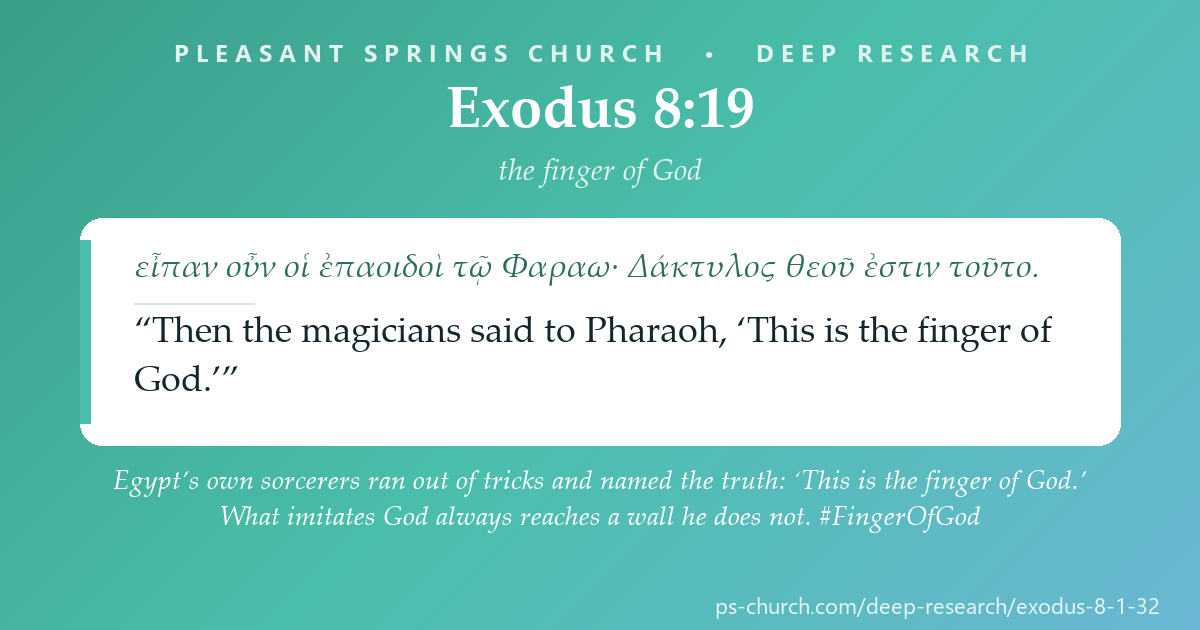
The most arresting line in the chapter is spoken by the losing side. Egypt’s own sorcerers — the professional rivals of Moses — run out of tricks at the third plague and tell their king the plain truth: δάκτυλος Θεοῦ ἐστι τοῦτο, “This is the finger of God” (8:19). It is a confession of a bounded, hostile expertise: mimicry has a ceiling, and they have hit it. Scripture lets the phrase travel. The same “finger of God” writes the Ten Words on stone (Exod 31:18; Deut 9:10), and centuries later Jesus takes it up: “But if it is by the finger of God that I cast out demons, then the kingdom of God has come upon you” (Luke 11:20; cf. Matt 12:28, “the Spirit of God”). The finger that broke Egypt’s magicians and inscribed the law is the finger that casts out the powers of darkness in the ministry of Jesus — the light, unhurried touch of an omnipotence that never has to strain. Pharaoh heard the diagnosis from his own men and hardened anyway; the tragedy of the hard heart is that it can be told the truth by its own experts and still refuse it.
The vocabulary of the contest: frogs, magicians, the finger of God, and the line God draws.
Watch the doomed frog-god, the sorcerers’ ceiling, the “finger of God” (Elohim, not the covenant name), the fly-swarm, the fatal “respite,” and the Goshen distinction.
“Frog” — sacred to Heqet, the frog-headed goddess of birth. A symbol of life multiplied into a plague of death, dying in reeking heaps (8:14): Egypt’s fertility-god turned inside out.
“Magicians” — the court sorcerers. They copy the frogs by “secret arts,” but at the gnats “they could not” and confess the truth. Counterfeit power imitates a sign; it cannot make life or lift judgment (2 Tim 3:8).
“The finger of God” — ordinary Elohim on pagan lips. The same “finger” writes the Law (Exod 31:18) and, in Jesus, casts out demons (Luke 11:20). Omnipotence with an effortless touch.
“Swarm” — of flies (the LXX reads κυνόμυια, “dog-fly”). The plague that first spares Goshen: judgment learns to discriminate between Egypt and Israel.
“Respite, relief” — a breathing-space. The hinge of the hard heart: Pharaoh melts under the plague and re-freezes the moment the pressure lifts. Relief without repentance hardens.
“I will set apart… a division” — God draws a line: Goshen spared, “that you may know that I am the Lord in the midst of the earth.” The LXX renders it παραδοξάσω / διαστολήν — a marvelous distinction.
How the rest of Scripture picks up the threads:
- Exodus 31:18; Deuteronomy 9:10 — “the finger of God” writes the tablets of the Law: the same phrase, now creative and covenantal.
- Luke 11:20; Matthew 12:28 — Jesus casts out demons “by the finger of God” / “the Spirit of God”: the kingdom breaking Egypt’s deeper bondage.
- Psalm 78:44–51; 105:28–36 — the plague psalms: frogs and flies remembered as the Lord’s mighty acts.
- Exodus 9:16; Romans 9:17–18 — “that my name may be proclaimed in all the earth”: the purpose of the hardening and the plagues named by Paul.
From the finger of God and the divided land to the gospel.
Trace the hardening, the “that you may know,” and the distinction God draws toward their New Testament resolution — with Paul on Pharaoh at Romans 9.
Which cross-references matter?
- Exodus 7:14–25 — the first plague: blood in the Nile, where the magicians still keep pace; chapter 8 shows the counterfeit beginning to fail.
- Exodus 8:22–23; 9:4–6, 26; 10:23; 11:7 — the widening distinction: God repeatedly “sets apart” his people from the judgment on Egypt, climaxing at the Passover (see the Passover instituted).
- Exodus 9:16; Romans 9:17–18 — Paul quotes the plague-purpose (“that my name may be proclaimed in all the earth”) and the hardening: God’s righteous freedom over a self-made vessel of wrath, not the arbitrary reprobation of the innocent.
- Luke 11:20; Revelation 16:2–14 — the “finger of God” in Jesus’ exorcisms; the bowl-plagues (sores, frogs) echoing Exodus at the end.
Chapter 8 is careful about who does the hardening. Three times the plagues break Pharaoh’s resolve, and three times, in the relief, he hardens his own heart (8:15, 32; the verb is kaved, “to make heavy”). Only later — from 9:12 — will the text say “the Lord hardened Pharaoh’s heart,” and by then the man has hardened himself through plague after plague. This is judicial hardening: God’s confirming of a defiance long since chosen, giving a settled rebel over to what he has repeatedly preferred (cf. Rom 1:24–28). When Paul reaches for this at Romans 9:17–18, his point is not that God arbitrarily damns the innocent but that God is righteously free over a vessel that has made itself fit for wrath — and that even Pharaoh’s defiance is bent to a merciful end: “that my name may be proclaimed in all the earth.” Held within a view that honors real human choices, the plagues neither excuse Pharaoh nor accuse God: the tyrant who drowned Hebrew infants (1:22) is answered by a patient, escalating justice that keeps offering him the door — and keeps recording that he shut it himself.
The scholarship on the plagues, the magicians, and the hard heart.
Childs and Stuart for the exegesis; Currid on the Egyptian polemic; the studies on the hardening verbs and on the plague sequence.
Commentaries & studies:
- Brevard Childs, The Book of Exodus (OTL); Douglas Stuart, Exodus (NAC); John Durham, Exodus (WBC); Peter Enns, Exodus (NIVAC); Nahum Sarna, Exodus (JPS).
- John D. Currid, Ancient Egypt and the Old Testament; studies on the plague narrative’s structure and its polemic against Egyptian deities.
- On the hardening of Pharaoh: the near-synonymous hardening verbs kaved and chazaq (both appear agentlessly through chs. 7–8, incl. 8:19), and the narrative turn at 9:12 where the Lord first becomes the explicit subject; and its use at Romans 9.
Interpretation notes worth keeping:
- Who hardens whom. In chapters 7–8 Pharaoh hardens his own heart (8:15, 32); only from 9:12 does the Lord harden him. The order matters: judicial hardening confirms a defiance already chosen; it does not manufacture an innocent’s guilt.
- The magicians’ confession (8:19). “The finger of God” is Elohim, not the covenant name — a pagan acknowledgment of divine power, not yet the knowledge of the Lord the plagues aim to produce (8:10, 22).
- The distinction (8:22–23). The sparing of Goshen is protective grace held soberly, not tribal favoritism: its stated purpose is revelation (“that you may know”), and it sets the pattern that culminates in the Passover’s blood-marked doors.
- Partial obedience (8:25–28). Pharaoh’s “sacrifice within the land” and “you must not go very far away” are the classic bargain of a will seeking relief without surrender — a compromise Moses rightly refuses.
- Typology, labeled. Reading the frogs, darkness, and blood-marked door as figures of a greater redemption is devotional analogy built on real textual patterns (1 Cor 5:7), not the passage’s literal sense — the house discipline for this library.
From the finger of God and the sheltered land to your own hard or softened heart.
Name what you learned, why it matters, and one concrete response.
What should we carry away — and do?
- Counterfeit power has a ceiling. The magicians could copy the frogs but not lift them, and could not make gnats at all. What imitates God always reaches a wall he does not: “This is the finger of God.”
- Relief is not repentance. Pharaoh softened under the plague and hardened in the respite (8:15). Watch your own heart in the moment the pressure lifts — that is where resolve is kept or lost.
- God draws a line — and it is grace. He set Goshen apart “that you may know that I am the Lord.” His protecting distinction is not favoritism but revelation, and it points to a blood-marked door still to come.
Step in response: refuse the partial-obedience bargain. Name one place where you are offering God “sacrifice within the land” — obedience on your terms, not far from Egypt — and go the whole way. And in your next stretch of relief, do the thing you promised under pressure, before the softness fades.
Exodus 8:19 · to share
LXX + ESVEvery Deep Research page traces its passage across the whole sweep — the Old Testament, the Second-Temple world between the testaments (historical witnesses, not Scripture), and the New Testament. Follow the thread:
Pleasant Springs Church — Deep Research
Research method after Michael S. Heiser’s Bible Research Method (examine dictionaries → ancient literature → important words → textual connections → academic publications → share), with the Pleasant Springs “Author & Audience” foundation. Scripture set in the Hebrew, the Greek editions named on each page and the ESV (Old Testament), and the Greek New Testament and the ESV (New Testament), per the practice of Pleasant Springs Church. Exodus 8:1–32 research grounded in Childs, Stuart, Durham, Enns, and Sarna, with Currid on the plagues as polemic against Egypt’s gods (Heqet, Hapi, Ra); the versification noted (MT/LXX place the frog-threat of ESV 8:1–4 at 7:26–29); the magicians’ confession “the finger of God” (8:19, Elohim) traced to Exod 31:18 and Luke 11:20; the hardening handled as self-hardening in chs. 7–8 (kaved, 8:15, 32) confirmed judicially from 9:12 (chazaq) and read with Romans 9:17–18 as God’s righteous freedom over a self-made vessel of wrath, not the reprobation of the innocent; the Goshen distinction held as protecting grace ordered to revelation; Wisdom of Solomon, Jubilees, Josephus, and Philo cited as Second-Temple witnesses, not Scripture; and Passover/exodus typology labeled as devotional analogy (1 Cor 5:7).
Scripture quotations marked ESV are from the ESV® Bible (The Holy Bible, English Standard Version®), © 2001 by Crossway, a publishing ministry of Good News Publishers. ESV Text Edition: 2016. Used by permission. All rights reserved. The ESV text may not be quoted in any publication made available to the public by a Creative Commons license, and the ESV may not be translated in whole or in part into any other language. www.esv.org
|
Did this study bless you today? 💚 Give to Support PS Church100% of gifts go to the General Fund — thank you. |