Three plagues deepen the reckoning — pestilence on the livestock, boils that fell even the magicians, and hail with fire — and Egypt’s herds die while “not one of the livestock of the people of Israel died.” Here for the first time the text says “the Lord hardened the heart of Pharaoh” (9:12), confirming a king who had hardened himself; and here God states the plagues’ purpose: “that my name may be proclaimed in all the earth” (9:16, quoted at Romans 9:17). Mercy is offered even so — those who “feared the word of the Lord” were spared — and Pharaoh’s remorse (“I have sinned”) proves not to be repentance. This study works Exodus 9:1–35. See the method →
Exodus 9:6, 12, 16, 20, 27, 30
Hebrew · LXX · ESVThe Shape of the Passage
Parallel panelsThe middle triad of plagues carries the whole theology of the exodus: a widening distinction (Goshen spared), the hinge of the hardening (9:12), the stated purpose (9:16), and mercy held out even in judgment (9:20). Read them soberly — this is God contending with a genocidal power, not a cartoon.
Author
The Torah of Moses gives us plagues five, six, and seven, each heavier than the last. Pestilence falls on Egypt’s livestock (9:1–7) — a blow at the herds Egypt half-worshiped (the bull Apis, the cow Hathor) — yet “not one of the livestock of the people of Israel died”: the distinction of the earlier plagues holds and widens. Boils follow (9:8–12): soot flung to the sky becomes festering sores on man and beast, and — a quiet humiliation — the magicians who once mimicked Moses “could not stand before Moses because of the boils.” And here, for the first time, the narrator says the Lord hardened the heart of Pharaoh (9:12).
The hinge of the hardening. Through the early plagues Pharaoh hardened his own heart (7:13, 22; 8:15, 32). From 9:12 the text says God did the hardening — not the arbitrary crushing of an innocent, but judicial hardening: God confirming a tyrant in the defiance he has freely chosen, giving him over to what he has repeatedly willed (cf. Rom 1:24, 26, 28). Both are held together and neither is denied: Pharaoh is fully culpable, and God is sovereign over him. Paul reads exactly this text and refuses to soften either side (Rom 9:17–18).
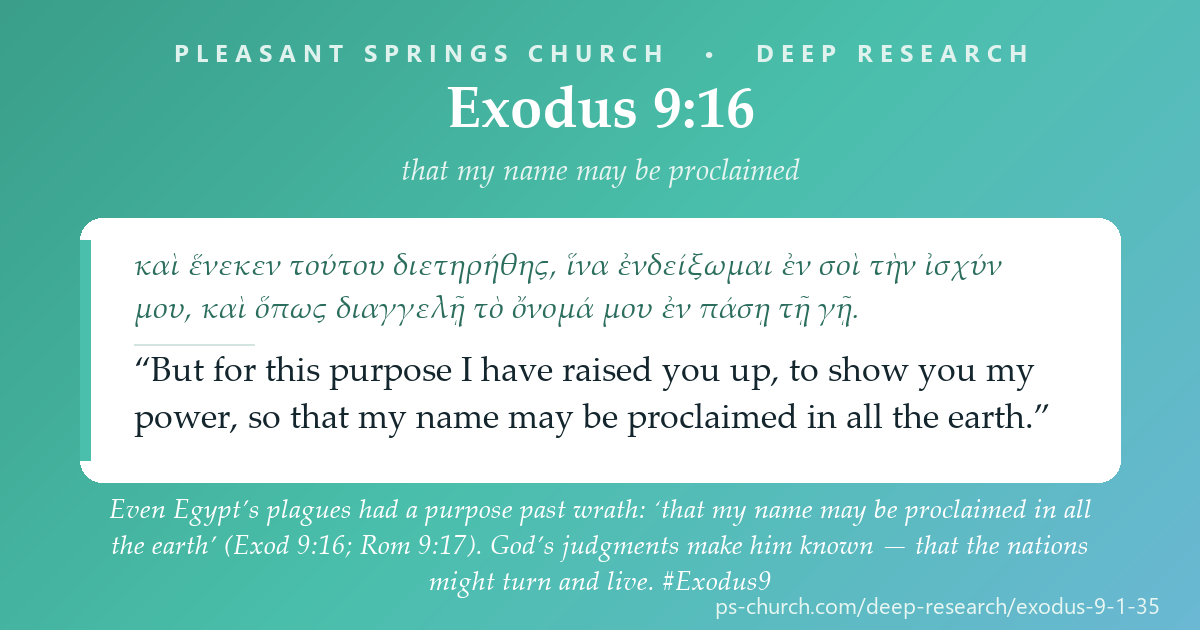
The purpose stated. Then comes the most theological plague-speech yet, before the hail: “For this purpose I have raised you up, to show you my power, so that my name may be proclaimed in all the earth” (9:16). The plagues are not wrath for wrath’s sake; they are revelation — “that you may know that there is none like me in all the earth” (9:14). The God who could have wiped Egypt out in a moment (9:15) instead stretches the contest out so that his name is published to the nations.
Audience
Israel, enslaved and told their God had forgotten them, heard in these chapters that the Lord was fighting for them plague by plague — and that Goshen’s exemption was not luck but covenant care. But the hail account also plants something Israel must not miss: mercy inside judgment. Moses warns Pharaoh before the hail falls (9:18–19), and “whoever feared the word of the Lord among the servants of Pharaoh” sheltered his people and animals (9:20) — the first Egyptians in the story to believe. The judgment is discriminating; grace is on offer even here, and some Egyptians take it.
Remorse is not repentance. The hail — fire flashing in the midst of it — ruins Egypt but spares Goshen (9:26), and it breaks Pharaoh into the story’s first confession: “This time I have sinned; the Lord is in the right, and I and my people are in the wrong” (9:27). It sounds like conversion. But Moses is not fooled: “I know that you do not yet fear the Lord God” (9:30) — and the moment the pressure lifts, Pharaoh hardens again (9:34–35). The church hears the warning plainly: fright under judgment that vanishes when the sky clears is remorse, not the fear of the Lord. And the sober comfort beneath it all — the God who makes a distinction, who shelters those who heed his word, who proclaims his name that all the earth might turn and live — runs straight to the Passover night and the Lamb (ch. 12).
Orient on the plague cycle, hardening, and the theology of judgment.
Search by topic: plagues of Egypt, hardening of Pharaoh’s heart, judgment, the fear of the LORD, Egyptian religion / gods.
Which articles are relevant?
- Anchor Bible Dictionary — “Plagues of Egypt,” “Pharaoh,” “Moses,” “Hardening of the Heart.”
- Dictionary of the OT: Pentateuch — “Plagues,” “Signs and Wonders,” “Hardening,” “Egypt, Egyptians.”
- NIDOTTE / TDOT — חָזַק / כָּבֵד (ḥāzaq / kāḇēḏ, to make strong/heavy = harden), מִקְנֶה (miqneh, livestock), שְׁחִין (šeḥîn, boils), יָרֵא (yārēʾ, to fear).
Bibliography surfaced:
- Brevard Childs, The Book of Exodus (OTL); Douglas Stuart, Exodus (NAC); John Durham, Exodus (WBC); Peter Enns, Exodus (NIVAC).
- Nahum Sarna, Exploring Exodus — the plagues as a structured polemic against Egypt and its gods.
- Studies on the hardening motif (e.g., Beale) and on Paul’s use of Exodus 9:16 in Romans 9.
The plagues as polemic, the retold judgments, and the hardened king.
Read the middle triad against Egypt’s own religion, then hear how later Scripture and the Second-Temple world retold the plagues.
Which parallels shed light on religion and worldview?
War on the gods of Egypt. The plagues are not random disasters but a targeted polemic: “on all the gods of Egypt I will execute judgments” (12:12). The Nile that was Hapi turns to blood; the sun that was Ra is blotted in darkness; and here the livestock that Egypt half-deified (Apis the bull, Hathor the cow) die in the field, while boils fall on priests and magicians who trafficked in Egypt’s sacral purity. Each plague topples an Egyptian claim to divine power and answers Pharaoh’s scornful “Who is the Lord?” (5:2) with the refrain: “that you may know that I am the Lord.”
The hardened heart in an Egyptian key. Egyptians pictured judgment after death as the weighing of the heart against ma’at (truth/order); a heavy heart failed the test. There is a grim irony, then, in a Pharaoh whose heart is repeatedly made heavy (כָּבֵד) and hard — the god-king weighed in his own scales and found wanting, self-condemned before the true Judge.
- Wisdom of Solomon 11–19 (deuterocanonical, Second-Temple — a witness, not part of the Protestant canon) — an extended meditation on the plagues: Egypt punished “by the very things through which it sinned,” with God’s restraint and Israel’s sparing underscored.
- Jubilees 48 (Second-Temple; witness, not Scripture) — retells the exodus with Mastema (the accuser) behind Egypt’s resistance; note how it dramatizes the conflict without denying Pharaoh’s guilt.
- Josephus, Antiquities 2.14; Philo, Life of Moses 1. — Hellenistic-Jewish retellings that heighten the wonders and defend God’s justice to a Greek readership.
- Psalm 78:43–51; 105:26–36 (Scripture — the “plague psalms”) — Israel’s own liturgical memory of the signs, though each psalm selects and orders them freely for worship.
The purpose-clause of 9:16 lifts the whole contest above Egypt. God tells Pharaoh he could have struck him and his people with pestilence and wiped them from the earth (9:15) — and did not. Instead he “raised up” and endured this particular king so that, through a drawn-out public reckoning, “my name may be proclaimed in all the earth.” The plagues are missionary as well as judicial: their aim is that the nations should know the Lord. This is why Paul reaches for the verse in Romans 9:17—18 — God’s freedom to show mercy and to harden is not the caprice of a tyrant but the righteous liberty of the Creator over a vessel that has made itself fit for wrath (Rom 9:22); the same God is even now “making known the riches of his glory for vessels of mercy” (9:23). Read with the grain of the story, the hardening of a self-hardened oppressor and the sparing of Goshen and of the God-fearing Egyptian (9:20) are one act of a God whose settled purpose is that his saving name should fill the earth — the purpose that reaches its end in the gospel.
The vocabulary of distinction, hardening, purpose, and fear.
Watch the “distinction” verb, the shift to God as the one who hardens (9:12), the “raised you up” of the purpose-clause, and the two kinds of “fear” — the servant’s heeding (9:20) and Pharaoh’s lack of it (9:30).
“The Lord will make a distinction” (also 8:22; 11:7) — God sets a boundary between Egypt’s livestock and Israel’s. The distinction of the plagues: judgment that discriminates, and grace that shelters.
“The Lord hardened the heart” — the first time God is the subject (Pharaoh hardened his own, 8:15, 32). Judicial hardening: God confirming a settled defiance, Pharaoh still fully culpable (Rom 9:17–18).
“Boils” — festering sores on man and beast; the magicians “could not stand before Moses.” The imitators of Egypt’s power are the first felled by it.
“I have raised you up” / caused you to stand — God’s sovereign purpose in enduring this Pharaoh. LXX renders διετηρήθης (“you were preserved”); Paul writes ἐξήγειρά σε (Rom 9:17), nearer the Hebrew.
“My name proclaimed in all the earth” — the stated purpose of the plagues: not wrath alone but revelation, that the nations may know the Lord (cf. 9:14; Rom 9:17).
“Whoever feared the word of the Lord” — the God-fearing Egyptians who heeded the warning and sheltered their servants. Mercy in judgment; the first Egyptian believers — contrast Pharaoh, who “did not yet fear” (9:30).
How the rest of Scripture reads the hardening and the purpose:
- Romans 9:14–18 — Paul quotes Exodus 9:16 (“For this very purpose I have raised you up… that my name might be proclaimed in all the earth”): God’s righteous freedom to show mercy and to harden, over a vessel that made itself fit for wrath.
- Exodus 4:21; 7:3; 8:15, 32; 10:1, 20, 27; 14:4 — the full hardening sequence: Pharaoh hardens himself early; from 9:12 the Lord hardens the self-hardened.
- 1 Samuel 6:6 — the Philistines warned: “Why should you harden your hearts as the Egyptians and Pharaoh hardened their hearts?” — the deed named as their own.
- Proverbs 28:14; Hebrews 3:7–15 — “Today, if you hear his voice, do not harden your hearts”: the plague narrative preached to the church as warning.
From the widening distinction to the Passover and the gospel.
Trace the distinction, the hardening, and the stated purpose forward — then note the Beale & Carson trajectory at Romans 9.
Which cross-references matter?
- Exodus 8:22–23; 9:4, 26; 10:23; 11:7 — the distinction of Goshen, widening plague by plague to the Passover night: God “makes a difference between Egypt and Israel.”
- Exodus 12:12–13 — “on all the gods of Egypt I will execute judgments”; the blood by which the destroyer passes over — the distinction made a shelter, and the plagues’ goal.
- Exodus 9:14, 16, 29; 8:10 — the refrain of purpose: “that you may know there is none like me… that the earth is the Lord’s… that my name may be proclaimed in all the earth.”
- Romans 9:14–24 — Exodus 9:16 as the charter of God’s righteous freedom; mercy and hardening within one saving purpose (cf. Romans 8:31–39).
- Psalm 78:47–48; 105:32–33; Revelation 8:7; 16:21 — the hail remembered in Israel’s worship, and echoed in the last plagues of the Apocalypse.
The commentary’s treatment of Romans 9 insists that Paul is reading Exodus rightly, not against the grain. Pharaoh is never an innocent whom God arbitrarily damns; he is a genocidal tyrant — the king who ordered Hebrew infants drowned in the Nile (Exod 1:22) — who hardens his own heart again and again before the text ever says God hardened him. When God does harden, it is judicial: the just giving-over of a man to the defiance he has chosen, the same dark mercy withdrawn that Romans 1 describes. And the stated end is not Pharaoh’s ruin for its own sake but the proclamation of God’s name in all the earth (9:16) — the missionary purpose that makes Egypt’s plagues the seedbed of the nations’ knowing the Lord. Held in the Molinist frame this library keeps: God, knowing all that this free king would do in every circumstance, sovereignly ordained a history in which a self-made vessel of wrath serves the salvation of a world — without God authoring the man’s sin or coercing his will. The comfort is not that God plays favorites but that his freedom runs toward mercy: “that my name may be proclaimed in all the earth” is, in the end, gospel.
The scholarship on the plagues and the hardening.
Childs and Durham for the exegesis; Sarna on the plagues as polemic; the studies of the hardening motif and of Romans 9’s use of Exodus.
Commentaries & studies:
- Brevard Childs, The Book of Exodus (OTL); John Durham, Exodus (WBC); Douglas Stuart, Exodus (NAC); Peter Enns, Exodus (NIVAC).
- Nahum Sarna, Exploring Exodus; Ziony Zevit and others on the structure and targets of the plague cycle.
- On Romans 9: G. K. Beale & D. A. Carson, eds., Commentary on the NT Use of the OT; the standard Romans commentaries (Moo, Schreiner) on 9:14–18.
Interpretation notes worth keeping:
- Whose hand hardened? The book distributes the verbs deliberately: Pharaoh hardens himself through plagues 1–5 (7:13, 22; 8:15, 32); from the boils (9:12) the Lord hardens him. Neither cancels the other — culpability and sovereignty stand together; God gives a defiant man over to his chosen course.
- The livestock “all died” (9:6) yet reappear (9:19–25). “All” is the Hebrew idiom of comprehensive scope within the affected class (the field herds), not a claim that no animal remained in Egypt; the hail warning presumes surviving livestock — ancient hyperbole read as ancient hyperbole.
- The first God-fearing Egyptians (9:20). The narrative is careful not to caricature Egypt: some servants heed the word of the Lord and are spared — a foretaste of the “mixed multitude” that leaves with Israel (12:38). Judgment discriminates; grace is genuinely offered.
- “This time I have sinned” (9:27). Pharaoh’s confession is real remorse under pressure, not repentance; Moses names the difference (9:30), and 9:34–35 confirm it. A caution against mistaking relief-seeking for the fear of the Lord.
From the hardened king to the fear of the LORD that saves.
Name what you learned, why it matters, and one concrete response.
What should we carry away — and do?
- God’s judgments have a purpose. “That my name may be proclaimed in all the earth” (9:16). The plagues aim past wrath at revelation — that a watching world might know the Lord. Nothing God does is finally purposeless.
- There is mercy in the middle of judgment. A warning was given, and “whoever feared the word of the Lord” was sheltered (9:20). Even against Egypt, grace was on offer — and some Egyptians took it. Judgment discriminates; the door of heeding stands open.
- Beware remorse that isn’t repentance. Pharaoh said “I have sinned” — and hardened again when the sky cleared. Fright that fades with the storm is not the fear of the Lord. Test your sorrow by whether it outlasts relief.
Step in response: where God has warned you — through Scripture, conscience, or consequence — do not wait for the pressure to lift before you obey. Be one who fears the word of the Lord today (9:20; Heb 3:15), and let your repentance be the kind that stands when the hail stops.
Exodus 9:16 · to share
LXX + ESVEvery Deep Research page traces its passage across the whole sweep — the Old Testament, the Second-Temple world between the testaments (historical witnesses, not Scripture), and the New Testament. Follow the thread:
Pleasant Springs Church — Deep Research
Research method after Michael S. Heiser’s Bible Research Method (examine dictionaries → ancient literature → important words → textual connections → academic publications → share), with the Pleasant Springs “Author & Audience” foundation. Scripture set in the Hebrew, the Greek editions named on each page and the ESV (Old Testament), and the Greek New Testament and the ESV (New Testament), per the practice of Pleasant Springs Church. Exodus 9:1–35 research grounded in Childs, Durham, Stuart, Enns, and Sarna; the plagues read as a structured polemic against the gods of Egypt (12:12) with a widening distinction (Goshen spared, 9:4, 26); the hardening handled per the house doctrine — Pharaoh self-hardened through the early plagues (8:15, 32), the Lord confirming him from 9:12 in judicial hardening held together with his real culpability (Rom 9:17–18), in the Molinist frame, not arbitrary reprobation; the stated purpose “that my name may be proclaimed in all the earth” (9:16) as revelation and mercy, not wrath alone; the God-fearing Egyptians of 9:20 and Pharaoh’s remorse-not-repentance (9:27–30) noted soberly; Wisdom of Solomon 11–19, Jubilees 48, Josephus, and the plague psalms (78; 105) read as witnesses and Scripture cross-references, not conflated.
Scripture quotations marked ESV are from the ESV® Bible (The Holy Bible, English Standard Version®), © 2001 by Crossway, a publishing ministry of Good News Publishers. ESV Text Edition: 2016. Used by permission. All rights reserved. The ESV text may not be quoted in any publication made available to the public by a Creative Commons license, and the ESV may not be translated in whole or in part into any other language. www.esv.org
|
Did this study bless you today? 💚 Give to Support PS Church100% of gifts go to the General Fund — thank you. |