Two plagues fall — locusts that strip the fields bare, then a darkness so thick it can be felt — and the chapter opens by telling us why: “that you may tell in the hearing of your son and of your grandson… that you may know that I am the Lord” (10:2). Pharaoh’s own officials break first (“Egypt is ruined”); Pharaoh keeps bargaining the obedience down — the men only, then all but the flocks — and Moses will not yield a hoof. The darkness strikes straight at Ra the sun-god, yet “all the people of Israel had light where they lived.” It ends in a threat and a farewell. This study works Exodus 10:1–29. See the method →
Exodus 10:2, 7, 9, 21, 23, 26, 28–29
Hebrew · LXX · ESVThe Shape of the Passage
Parallel panelsTwo more blows fall — locusts, then a darkness that can be felt — but the chapter opens by telling us their point: a story to be handed down, so that a people yet unborn will “know that I am the Lord.”
Author
The Torah of Moses presses the eighth and ninth plagues, and frames them with a purpose statement of startling tenderness. God has hardened Pharaoh’s heart (10:1) — not to crush an innocent man, but so that the signs will pile up into a testimony: “that you may tell in the hearing of your son and of your grandson… that you may know that I am the Lord” (10:2). The plagues are being written to be recited — the first curriculum of the future Passover table (cf. 12:26–27; 13:8–14; Ps 78:5–7). Judgment on Egypt is, at the same time, catechesis for Israel and self-revelation to the world (9:16).
The locusts (10:1–20). Even Pharaoh’s own officials break first: “How long shall this man be a snare to us?… Do you not yet understand that Egypt is ruined?” (10:7). Pharaoh half-relents, then springs the first bargaining trap — the men may go, but not the families (10:8–11). Moses refuses: “We will go with our young and our old… for we must hold a feast to the Lord” (10:9). The locusts come on an east wind and eat “every plant… nothing green remained” (10:15); Pharaoh confesses in a hurry — “I have sinned… forgive my sin” (10:16–17) — the west wind drives the swarm into the sea, and his heart hardens again the moment relief comes.
The darkness (10:21–29). Without warning this time, a darkness “to be felt” (וְיָמֵשׁ חֹשֶׁךְ) blankets Egypt three days — a frontal assault on Ra, the sun-god at the head of Egypt’s pantheon, and on Pharaoh who claimed to be his son. No one rises, no one sees his neighbor — “but all the people of Israel had light where they lived” (10:23), the distinction of Goshen once more. Pharaoh bargains a last time: go, but leave the flocks (10:24). Moses will not surrender a hoof (10:26). The audience with Pharaoh ends in a death-threat and Moses’ grave “As you say! I will not see your face again” (10:28–29) — the door closing before the last and heaviest blow.
Audience
Israel — and every generation after — was meant to rehearse this. “That you may tell” makes the chapter a parent’s script: the plagues become the Passover haggadah, the reason children ask “what do you mean by this service?” (12:26). A slave people learned here that their God is no local deity but the Lord over sun and storm and swarm — sovereign where Egypt’s gods were said to rule, and able to draw a line of light through the middle of a plague and set his people on the bright side of it.
Reading the hardening rightly. Through the early plagues Pharaoh hardened his own heart; from 9:12 the text says the Lord hardened him — judicial hardening that confirms a settled, self-made defiance, held together with Pharaoh’s real and repeated guilt (he keeps choosing; he keeps lying). Paul reads exactly this in Romans 9:17–18 (quoting Exod 9:16): God’s righteous freedom over a vessel that has made itself wrath, so that his name is “proclaimed in all the earth” — not the arbitrary damning of the innocent. And the bargaining is a warning: the men only… leave the flocks… — every offer a partial obedience, a negotiated surrender that keeps something back. Moses names the counterfeit for what it is: not a hoof. God will have all of us, or the feast is not held.
Orient on the plague cycle, the locust and darkness, and the polemic against Egypt’s gods.
Search by topic: plagues of Egypt, locust, darkness, hardening of the heart, signs and wonders, Ra / Egyptian religion, Passover catechesis.
Which articles are relevant?
- Anchor Bible Dictionary — “Plagues of Egypt,” “Locust,” “Darkness,” “Egypt (Religion),” “Pharaoh.”
- Dictionary of the OT: Pentateuch — “Plagues,” “Signs and Wonders,” “Hardening,” “Egypt, Egyptians.”
- NIDOTTE / TDOT — אַרְבֶּה (ʾarbeh, locust), חֹשֶׁךְ (ḥōšek, darkness), מָשַׁשׁ (māšaš, grope/feel), סָפַר (sāpar, recount).
Bibliography surfaced:
- Brevard Childs, The Book of Exodus (OTL); Douglas Stuart, Exodus (NAC); John Durham, Exodus (WBC); Peter Enns, Exodus (NIVAC).
- John Currid, Ancient Egypt and the Old Testament — the plagues as polemic against Egyptian deities.
- Ziony Zevit and others on the plague sequence; studies of the “that you may know” recognition formula.
Locust and sun, the war on Egypt’s gods, and the plagues remembered.
Read the two plagues against Egyptian religion and agriculture, then hear how Israel’s own Scripture and the Second-Temple writers retold them.
Which parallels shed light on religion and worldview?
A war on the gods of Egypt. Israel’s narrator says the exodus judgments fell “on all the gods of Egypt” (12:12; Num 33:4), and chapter 10 aims two of them well. Egypt’s economy was its fields; a locust plague that leaves “nothing green” (10:15) humiliates the deities of grain and harvest and the fertile black land itself. And the ninth plague strikes the summit of the pantheon: Ra, the sun, whose light was the daily proof of cosmic order and of Pharaoh’s divine sonship. For the sun to fail three days — while Goshen stays bright — is to announce that the Lord, not Ra, holds the light. Egyptians are not caricatured here; some had already “feared the word of the Lord” and sheltered their servants and livestock in the hail (9:20).
The darkness that can be felt. The Hebrew is vivid and strange: וְיָמֵשׁ חֹשֶׁךְ, “and let there be a darkness one gropes” — the LXX catches it exactly, ψηλαφητὸν σκότος, “a palpable darkness.” It is more than the absence of sun; it is a smothering, tangible dread — a de-creation, night swallowing a land where a god of light was supposed to reign (cf. Gen 1:2–3, where God’s first act over the dark is “let there be light”).
- Wisdom of Solomon 17:1–18:4 (Second-Temple Jewish wisdom — a witness, not Scripture in the Protestant canon) — a whole meditation on the plague of darkness: the wicked “imprisoned… each shut up in the prison of darkness,” terrified by their own consciences, “while for your holy ones there was very great light.”
- Psalm 105:28, 34–35 — “He sent darkness, and made the land dark… he spoke, and the locusts came… they devoured all the vegetation.” The plague-psalm sings chapter 10 back to God.
- Psalm 78:46 — “He gave their crops to the destroying locust”: the wisdom-teacher’s retelling “that the next generation might know” (78:6) — 10:2 obeyed.
- Jubilees 48; Josephus, Antiquities 2.14; Philo, Life of Moses 1.120–146 — later Jewish retellings of the plague sequence (witnesses to how Israel remembered, not Scripture).
The most surprising verse in the chapter is not about locusts or darkness at all; it is about grandchildren. Before either plague falls, God tells Moses why: “that you may tell in the hearing of your son and of your grandson… and that you may know that I am the Lord” (10:2). The signs are being composed for recitation. This is the seed of the Passover liturgy — “when your children say to you, ‘What do you mean by this service?’… you shall say” (12:26–27; 13:8) — and of the whole biblical pattern of handing faith down a generation (Deut 6:20–25; Ps 78:1–7; Josh 4:6–7). It reframes the plagues themselves: they are not divine tantrums but a story God is telling on purpose, so that a child not yet born will know his name. The judgment on Egypt and the education of Israel are the same act. Which means the point of every rescue you have witnessed is that it be told — that the next voice at the table can say, “I know that he is the Lord, because of what he did.”
The vocabulary of the eighth and ninth plagues.
Watch the “tell it to your children” verb, the locust and the palpable darkness, the officials’ “snare,” and the “not a hoof” of undivided obedience.
“That you may tell / recount” — the root sāpar (to recount, number). The plague’s purpose is catechesis: a story handed to the next generation, the seed of the Passover haggadah (12:26–27; Ps 78:4 / LXX Ps 77:4).
“Locust” (LXX ἀκρίς) — the eighth plague, borne on an east wind to eat “every plant… nothing green remained” (10:15). Ruin of the fields that were Egypt’s wealth and its harvest-gods’ glory.
“Darkness” — the ninth plague, three days over Egypt while Goshen keeps its light (10:23). A frontal blow at Ra the sun-god, and a de-creation echo of Genesis 1:2 before “let there be light.”
“A darkness that can be groped” — the LXX’s rendering of MT וְיָמֵשׁ חֹשֶׁךְ (verb māšaš, to feel/grope). Not mere night but a smothering, tangible dread (cf. Wisdom 17).
“Snare” — what Pharaoh’s own officials call Moses: “How long shall this man be a snare to us?” Even the court sees that “Egypt is ruined” before Pharaoh will.
“Hoof” — “not a hoof shall be left behind.” Moses refuses the last bargain (leave the flocks): worship cannot be paid in part. God will have all, or the feast is not held.
How the rest of Scripture retells these plagues:
- Psalm 105:28, 34–35; Psalm 78:46 — the plague-psalms singing the darkness and the locusts back to God, “that the next generation might know” (78:6): 10:2 obeyed in Israel’s worship.
- Exodus 12:12; Numbers 33:4 — “on all the gods of Egypt I will execute judgments”: the plagues named as polemic against Egypt’s deities (the sun, the harvest, the Nile).
- Deuteronomy 6:20–25; Joshua 4:6–7; Exodus 13:8–14 — “when your son asks you… you shall tell him”: the catechesis of 10:2 built into the covenant’s memory.
- Joel 1–2; Revelation 9:1–11 — the locust as an image of the Day of the Lord’s judgment, drawn from the eighth plague.
From the darkness over Egypt to the darkness at the cross.
Trace the recognition formula, the light/darkness distinction, and the partial-obedience bargaining across the canon; then measure every link against the Greek, which this shelf has held for Exodus only since 30 August 2026; then note the devotional foretaste of Calvary.
Which cross-references matter?
- Exodus 9:1–35 — the preceding plagues and the turn to divine hardening (9:12); “that my name may be proclaimed in all the earth” (9:16), the theme continued in chapter 10.
- Exodus 11:1–10 and 12:1–14 — the last plague and the Passover this breach sets up: the door shut with Pharaoh (10:29) opens onto the night of the firstborn and the blood of the lamb.
- Romans 9:17–18 — Paul’s reading of the hardening (quoting Exod 9:16): God’s righteous freedom over a self-made vessel of wrath, that his name be proclaimed — not the reprobation of the innocent.
- Wisdom of Solomon 17:1–18:4; Psalm 105:28 — the darkness as terror to the guilty and light to God’s people: “for your holy ones there was very great light.”
- John 8:12; Colossians 1:13; 1 Peter 2:9 — Christ the light, and the people “called out of darkness” into his light: the Goshen distinction fulfilled.
This page was written while the Greek of Exodus was NOT on this disk. Every cross-reference above was traced by reading, because the shelf could not screen a book it did not hold. The Greek Old Testament corpus went from 44 CATSS files, 23,061 verse units to 64 files, 30,637 verse units on 30 August 2026, and Exodus, Leviticus, Numbers, Joshua and the deuterocanon came with it. The measurements below are the ones this page could not previously run, and they are printed here whether or not they flatter the page.
Greek Exodus 10 never reaches five words into the Greek New Testament. All 29 rows of CATSS Exodus 10 screened against all 7,927 verses of the Greek New Testament: all 29 reach two, 24 reach three, 7 reach four, and nothing reaches five. And every one of the seven fours is a formula, not a citation — καὶ εἶπεν πρὸς αὐτούς (band 7), εἰς τὸν οὐρανὸν καί (band 3 and 4), ἐπὶ τὴν γῆν καί (band 2). The tie band is printed beside every run, because a run without a band is not reportable.
And the four passages this stage names all measure at one or two words. Now that both sides are on the disk, the connections above can be checked instead of asserted, and they are connections of subject, not of wording:
| the link this page draws | longest shared run |
|---|---|
| Exodus 10:21–22 → Matthew 27:45, the darkness at noon | 2 — ἐπὶ πᾶσαν, over all |
| Exodus 10:23 → 1 Peter 2:9, out of darkness into his light | 1 |
| Exodus 10 → Psalm 104:28 LXX (MT/English 105:28), he sent darkness | 1 — and the one word is σκότος itself |
| Exodus 10 → Wisdom of Solomon 17:1–18:4, the whole Second-Temple meditation on this plague (a witness, not Scripture) | 2, across all 45 of its rows — and every two is a pair of function words |
⚠️ What this measures and what it does not. Contiguous runs of whole word FORMS, never lemmas, Greek against Greek: CATSS against MorphGNT, both sides lowercased with accents and breathings dropped and final sigma folded. It finds verbatim contact. It does not find allusion, and Exodus 10 is a good demonstration of the difference. Exhaustive and deterministic; nothing sampled.
Held as devotional analogy rather than the text’s plain sense, the ninth plague casts a long shadow forward. At Calvary, “from the sixth hour there was darkness over all the land until the ninth hour” (Matt 27:45; Luke 23:44–45) — the sun failing at midday as it failed over Egypt. But the direction is reversed: over Egypt the darkness fell on the guilty and the light rested on God’s people; at the cross the darkness falls on the sinless Son, so that light might rest on the guilty. Egypt’s firstborn will die under judgment (chapter 11); at Passover a lamb dies in the firstborn’s place (chapter 12); and on a later Passover the true Firstborn goes into the dark himself, “that we might be brought… out of darkness into his marvelous light” (1 Pet 2:9; Col 1:13). The chapter that ends “I will not see your face again” is, in the long story, answered by a face that shines — the light no plague can put out (John 1:5; Rev 21:23). This is resonance the gospel makes hard to miss, offered as analogy, not as the literal burden of Exodus 10.
⚠️ The Greek printed above is not the Greek this shelf measures
Now that CATSS Exodus is on the disk, the Greek column on this page can be compared with it — and the two are not the same text. The differences are printed rather than quietly harmonised.
The Greek typeset in the passage above is the ecclesiastical (Brenton-family) text. The measurements in stage 4 run over CATSS, which digitises Rahlfs’ Septuaginta. Across the seven verses printed here they diverge in seven places, in three classes:
| verse | printed above | CATSS / Rahlfs | what kind of difference |
|---|---|---|---|
| 10:7 | λατρεύσωσι | λατρεύσωσιν | the movable nu — no difference in sense, and this shelf’s normalisation folds it away before any run is counted |
| 10:9 | ἔστι | ἔστιν | |
| 10:21 | Εἶπε | εἶπεν | |
| 10:7 | βούλῃ | βούλει | spelling and word division — the same words, written differently |
| 10:29 | οὐκ ἔτι | οὐκέτι | |
| 10:21 | ἐπὶ γῆς Αἰγύπτου (genitive) | ἐπὶ γῆν Αἰγύπτου (accusative) | a real difference in the text — case in one, word order in the other |
| 10:23 | φῶς ἦν | ἦν φῶς |
Neither of the last two changes the meaning — darkness upon the land of Egypt either way, and there was light either way. But the word order at 10:23 is the one that a run-length measurement can see, and it is not hypothetical: the two-word contact between Wisdom 18:1 and Exodus 10:23 reported in stage 4 is ἦν φῶς in the CATSS order. Measured against the order printed above, that contact would not be there.
The house rule this follows. A statement about the Greek Old Testament on this shelf is a statement about the CATSS files. A different Greek edition can differ, and where this page can show that it does, it shows it rather than asserting an agreement it has not checked. Until 30 August 2026 this comparison could not be made at all, because Greek Exodus was not held.
The scholarship on the plague narrative.
Childs, Durham, and Stuart for the exegesis; Currid on the Egyptian-religion polemic; the studies of hardening and the recognition formula.
Commentaries & studies:
- Brevard Childs, The Book of Exodus (OTL); John Durham, Exodus (WBC); Douglas Stuart, Exodus (NAC); Peter Enns, Exodus (NIVAC).
- John D. Currid, Ancient Egypt and the Old Testament; studies of the plagues as judgments on Egypt’s gods (12:12; Num 33:4).
- Studies of the “that you may know” recognition formula and of the hardening motif (own-heart / divine hardening across chapters 4–14).
Interpretation notes worth keeping:
- The hardening. Through chapters 7–8 Pharaoh hardens his own heart; from 9:12 the Lord hardens him — judicial confirmation of a settled defiance, held together with his genuine, repeated guilt (his hurried “I have sinned,” 10:16, is bargaining, not repentance).
- Partial obedience (10:8–11, 24–26). Pharaoh’s offers — the men only, then all but the flocks — are a strategy of negotiated, incomplete surrender. Moses’ “not a hoof” makes the point: worship withheld in part is worship refused.
- Polemic, not myth. The locust (harvest) and darkness (sun) plagues answer Egypt’s religion directly; but Scripture keeps them historical and moral judgments, not a nature-myth — and it notices the God-fearing Egyptians (9:20).
- The recognition formula. “That you may know that I am the Lord” (10:2; cf. 7:5; 8:22; 14:4) makes revelation, not mere wrath, the plagues’ goal — for Israel, for Egypt, and “in all the earth” (9:16; Rom 9:17).
From a story told to your children to a light that darkness cannot hold.
Name what you learned, why it matters, and one concrete response.
What should we carry away — and do?
- Rescue is meant to be told. “That you may tell… that you may know” (10:2). God works deliverances not only to save but to be recited — the plague becomes a catechism, the exodus a table-story for grandchildren.
- Beware the partial ‘yes.’ The men only… leave the flocks… every offer keeps something back. “Not a hoof” is the shape of real obedience: God asks for all of us, not a negotiated remainder.
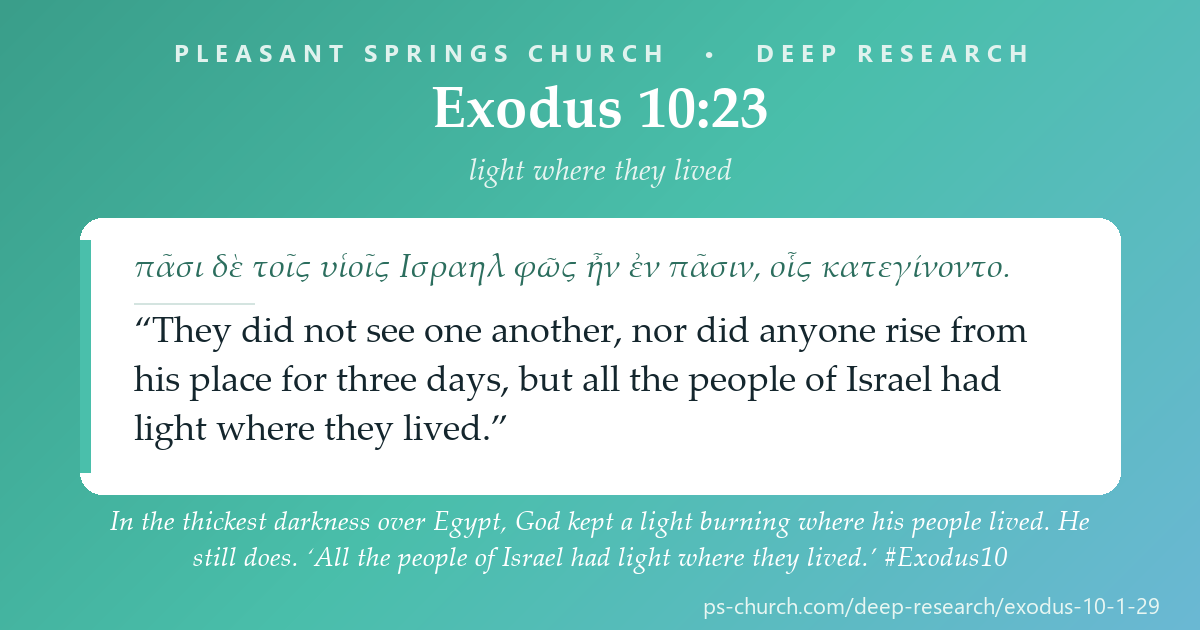
- He puts light where his people live. In the thickest dark over Egypt, “all the people of Israel had light where they lived” (10:23). The God who divided light from dark still shelters his own — and the true Light went into the darkness to bring us out (1 Pet 2:9).
Step in response: tell someone younger than you one true thing God has done — obey 10:2 this week. Then take an area where you have been bargaining a partial obedience and give God the last hoof of it. And when you sit in a dark stretch, remember Goshen: the Lord keeps a light burning where his people live.
Exodus 10:23 · to share
LXX + ESVEvery Deep Research page traces its passage across the whole sweep — the Old Testament, the Second-Temple world between the testaments (historical witnesses, not Scripture), and the New Testament. Follow the thread:
Pleasant Springs Church — Deep Research
Research method after Michael S. Heiser’s Bible Research Method (examine dictionaries → ancient literature → important words → textual connections → academic publications → share), with the Pleasant Springs “Author & Audience” foundation. Scripture set in the Hebrew, the Greek editions named on each page and the ESV (Old Testament), and the Greek New Testament and the ESV (New Testament), per the practice of Pleasant Springs Church. Exodus 10:1–29 research grounded in Childs, Durham, Stuart, and Enns, with Currid on the plagues as polemic against Egypt’s gods (the locust against the harvest deities, the darkness against Ra the sun-god; 12:12; Num 33:4); the recognition formula (“that you may know… that you may tell,” 10:2) as catechesis for the generations (Ps 78:1–7; Deut 6:20–25); the hardening read with Romans 9:17–18 as God’s righteous freedom over a self-made vessel of wrath, held with Pharaoh’s real guilt, not the reprobation of the innocent; the partial-obedience bargaining (10:8–11, 24–26) exposed by Moses’ “not a hoof”; Wisdom of Solomon 17 and Psalms 78 & 105 heard as Israel’s own retelling; and the darkness-at-the-cross resonance (Matt 27:45; 1 Pet 2:9) held as devotional analogy, not the literal sense — per the house discipline for typology.
Scripture quotations marked ESV are from the ESV® Bible (The Holy Bible, English Standard Version®), © 2001 by Crossway, a publishing ministry of Good News Publishers. ESV Text Edition: 2016. Used by permission. All rights reserved. The ESV text may not be quoted in any publication made available to the public by a Creative Commons license, and the ESV may not be translated in whole or in part into any other language. www.esv.org
|
Did this study bless you today? 💚 Give to Support PS Church100% of gifts go to the General Fund — thank you. |