Four things happen in this chapter, and they are one argument. A blemished animal is refused at the altar — in Hebrew, “any bad thing” (17:1). A capital charge is fenced with restraints: inquire diligently, and never act on one voice, for “on the evidence of two witnesses or of three” a matter is established, and the witnesses’ own hands go first (17:2–7). A case too hard for the local court goes up, to the Levitical priests and the judge at the place God chooses — the seed of an appeal (17:8–13). And then the heart of it: Israel may have a king, and God says so in advance, before Samuel, without either commanding it or condemning it — but the king must not multiply horses, or wives, or silver and gold, and he must write for himself a copy of this law in a book and read in it all the days of his life, “that his heart may not be lifted up above his brothers” (17:14–20). A king under the law, not above it. This study works Deuteronomy 17:1–20 in Hebrew, Septuagint and ESV. See the method →
Deuteronomy 17:1–20 (selections) — MT = LXX = English
Hebrew · LXX · ESVThe Shape of the Passage
SequenceDeuteronomy 17 sits inside the “law of the offices” (16:18–18:22), the stretch of the code that hands Israel its public institutions one at a time: judge (16:18–17:13), king (17:14–20), priest and prophet (18:1–22, whose closing paragraph has its own study, the prophet like Moses). Behind it lie the one chosen place (ch 12) and the law of the enticer with its demand to “inquire… diligently” (ch 13); ahead of it, the law of witnesses at 19:15–21.
Author
Moses, preaching on the plains of Moab. This is not a constitution drafted in committee; it is preached law, delivered forty years on to the children of the generation that died in the wilderness. The book’s shape follows the ancient suzerainty treaty — preamble, historical prologue, stipulations, witnesses, blessings and curses — and chapter 17 belongs to the stipulations. That observation is about the form of the book; scholars on both sides of the dating question have used it, so we report the shape, and the book’s own setting is Moses on the plains of Moab; the composition question we name and do not settle.
Why a king is legislated before there is one. The startling thing about 17:14–20 is its tense. Long before Samuel, long before the elders at Ramah, God tells Israel in advance what to do when it asks for a king — and he neither commands the monarchy nor forbids it. He anticipates the request, quotes it back (“like all the nations that are around me,” the very words the elders will use in 1 Samuel 8:5, 20), and then fences it. Israel may have a king. What Israel may not have is a king who is a law to himself.
Audience
People who had watched a king up close. Everyone hearing this sermon was descended from slaves of a god-king. Pharaoh was the law in Egypt; his word did not answer to a text. So when Moses says the king must not send the people back to Egypt to buy horses (17:16), he is not making a point about cavalry procurement. He is saying: the road out is not to be walked backwards. A standing army bought with a chariot trade is the beginning of the brickyard again — conscription, taxation, and a throne that needs the people more than it serves them, which is exactly the warning Samuel will give in 1 Samuel 8:11–18.
And ordinary people who would stand in court. The first half of the chapter is addressed to a village. You hear a report; you inquire diligently; you may not act on one voice; and if the case is beyond you, you go up and ask. Deuteronomy assumes a public that can be trusted with a procedure and warns it about the ways procedure gets abused — rumour, a single accuser, a mob that never had to touch what it demanded. Every safeguard in 17:2–7 is aimed at the people holding the stones.
Orient on sacrifice without blemish, witnesses and evidence, the higher court, and kingship in Israel.
Search by topic: blemish (mum) and unblemished sacrifice, abomination (toebah), witness and testimony, evidence, capital punishment in Israelite law, elders and the gate, Sanhedrin, appeal, king / kingship, monarchy in Israel, Torah scroll, Deuteronomic law of the king.
Which articles are relevant?
- Anchor Bible Dictionary — “Blemish,” “Abomination,” “Witness,” “Punishments and Crimes,” “Judge,” “Sanhedrin,” “King and Kingship,” “Law, Biblical and ANE.”
- Dictionary of the OT: Pentateuch — “Law,” “Judges,” “Kingship,” “Sacrifices and Offerings,” “Priests and Levites,” “Deuteronomy, Book of.”
- NIDOTTE / TDOT — מוּם (mūm, blemish), תּוֹעֵבָה (tôʿēḇāh, abomination), עֵד (ʿēḏ, witness), בָּחַר (bāḥar, choose), רָבָה (rāḇāh, multiply), תּוֹרָה (tôrāh, instruction, law).
Bibliography surfaced:
- Peter C. Craigie (NICOT), Daniel I. Block (NIVAC), J. G. McConville (Apollos), Jeffrey H. Tigay (JPS), Duane Christensen (WBC), Richard Nelson (OTL), S. R. Driver (ICC), Eugene Merrill (NAC) on Deuteronomy.
- Bernard M. Levinson on Deuteronomy’s legal revision and on 17:14–20 as a constitutional text; Meredith G. Kline on the treaty form.
- Studies of the “law of the offices” (16:18–18:22) and of the Deuteronomic judiciary; the Temple Scroll’s rewriting of the law of the king.
- Beale & Carson, Commentary on the NT Use of the OT (Matthew; 1 Corinthians; 2 Corinthians; Hebrews).
Kings who were the law, treaty tablets read aloud, and a throne with a book on it.
Read 17:14–20 against what an ancient reader expected a king to be, and read 17:18–19 against the treaty practice of depositing a tablet and reading it aloud at intervals. Then hear how Second-Temple Jews handled the same law.
Which parallels shed light on religion and worldview?
A king who is the source of law. In Egypt Pharaoh was divine and his word was right order; there is no Egyptian law code because there did not need to be one. In Mesopotamia the king was not a god but he was the lawgiver: Hammurabi’s stele ends with his own claim to have “written my precious words on my stela” so that “the strong might not oppress the weak” (ANET 178). Be fair to it — that epilogue does bind a king: “let the king who appears in the land observe the words of justice which I wrote on my stela; let him not alter the law of the land which I enacted… let him not rescind my statutes!” (ANET 178). But look at whose words they are. Hammurabi binds his successors to Hammurabi. And the man told to come and “read carefully my inscribed stela” is not the king but “any oppressed man who has a cause” (ANET 178). Deuteronomy inverts both halves: the law is not the king’s, it is God’s and it is held by the priests; and the man commanded to read it every day of his life is the king.
The tablet that had to be read out. Ancient treaties did not merely get signed; they got deposited in a sanctuary and read aloud on a schedule, so that no one could plead forgetfulness. The Hittite treaty between Suppiluliumas and Kurtiwaza says it plainly: “A duplicate of this tablet has been deposited before the Sun-goddess of Arinna… In the Mitanni land (a duplicate) has been deposited before Tessub… At regular intervals shall they read it in the presence of the king of the Mitanni land” (ANET 205). That is the practice standing behind Deuteronomy’s own arrangements — the book laid up beside the ark and read to all Israel every seventh year (Deut 31:9–13, 24–26). Deuteronomy 17:18–19 takes the practice and tightens it to one man and to every day: he copies it out himself, keeps it with him, and reads “all the days of his life.”
What no ANE law collection has. Hammurabi, Eshnunna, Lipit-Ishtar, the Middle Assyrian and Hittite laws all legislate at length for priests, soldiers, merchants, farmers, wives, slaves and oxen. None of them contains a law about the king — a paragraph telling the monarch what he may not own and what he must read. Deuteronomy 17:14–20 appears to be the first text in world literature that puts the ruler under a written law he did not write, and this is why it keeps turning up in the history of constitutional thought (a point pressed by Bernard Levinson, who calls it a constitutional text in embryo).
- Code of Hammurabi, epilogue (ANET 178; an ancient witness, not Scripture) — “Let any oppressed man who has a cause come into the presence of the statue of me, the king of justice, and then read carefully my inscribed stela”; and to future kings, “let him not alter the law of the land which I enacted.” The king as author and guarantor of the law, binding his successors to his own words.
- Suppiluliumas–Kurtiwaza treaty (ANET 205; Hittite — a witness, not Scripture) — the treaty tablet deposited in two sanctuaries, to be read “at regular intervals… in the presence of the king of the Mitanni land.” Compare the wider Hittite treaty corpus (ANET 199–206) and the Neo-Assyrian Vassal-Treaties of Esarhaddon (ANET 534–541), whose curse repertoire stands close to Deuteronomy 28.
- The ANE law collections — Hammurabi (ANET 163–180), Eshnunna (161), Lipit-Ishtar (159), Middle Assyrian (180–188), Hittite (188–197). Comparanda for the casuistic form of 17:2–13; and, by their silence, comparanda for 17:14–20.
- Temple Scroll (11Q19) cols. 56–59 (Dead Sea Scrolls — a witness, not Scripture) — the law of the king rewritten at length and in God’s own voice: the king taken “from among your brothers,” never a foreigner; a council of twelve princes, twelve priests and twelve Levites seated with him “for judgment and for the law”; a guard of twelve thousand, a thousand from each tribe; and a marriage rule stricter than Deuteronomy’s — one wife, and no other while she lives. Widely read as a protest against the Hasmonean priest-kings of the writer’s own day. Deuteronomy is among the most-copied books at Qumran (the 4QDeut manuscripts).
- Josephus, Antiquities 4.223–224 (Second Temple — a witness, not Scripture) — “Aristocracy… is the best constitution,” and if Israel must have a king, let him be of their own nation, subject to the law, the high priest and the council; “let him not have a great number of wives, nor pursue after abundance of riches, nor a multitude of horses, whereby he may grow too proud to submit to the laws” (Whiston).
- Philo, Special Laws 4.157–169 (Second Temple — a witness, not Scripture) — the appointment of rulers, and the ruler required to copy out the laws and study them, so that office is schooled by the text rather than the text by the office.
- Mishnah, Sanhedrin 2:4 (rabbinic-era — a witness, not Scripture) — the law of the king turned into practical rules: not more than eighteen wives; horses only enough for his chariot; silver and gold only enough to pay his troops; and he “writes himself a Torah scroll for his sake,” carried with him to war, to court, and to the table, “as it is stated: It shall be with him and he shall read it all the days of his life.”
- Mishnah, Sanhedrin 1:4; 4–5 and Makkot 1 (rabbinic-era — witnesses, not Scripture) — the machinery built on 17:4–7: capital cases heard by twenty-three judges (m. Sanh. 1:4), witnesses cross-examined by a sevenfold interrogation derived from Deuteronomy’s repeated “you shall inquire diligently” (13:14 · MT/LXX 13:15; 17:4; 19:18), and a settled bias toward acquittal.
Set the three prohibitions beside the one positive command and the emphasis is unmistakable. Horses get one verse; wives and silver and gold share the next. The book gets three — and they are the last three. The king’s first recorded royal act in this law is not a decree, a census, a campaign or a building project. It is to sit down and copy out a text, in his own hand, from the master copy the priests hold, so that the words go through him one letter at a time before they ever come out of his mouth as policy. Then he keeps the copy and reads it, not at his coronation, not annually, but “all the days of his life.”
And the stated purpose is not competence but posture: “that he may learn to fear the Lord his God… that his heart may not be lifted up above his brothers” (17:19–20). Note the word for his subjects. Not servants, not my people — brothers, the same word used of him in 17:15, “one from among your brothers.” He came out of the crowd and he is to stay level with it. Humility is written into the office as a job requirement, and the appointed means of keeping it is a daily habit of reading something he did not write and cannot amend.
A bad thing, two mouths, a choosing God, a multiplying verb, a copied book, and a rising heart.
Watch davar ra (the phrase that binds the altar to the town), edim (witnesses — “at the mouth of”), yivchar (the LORD chooses the place and the king with one clause), yarbeh (multiply — three times), mishneh hattorah (the copy that named the book), and rum levavo (the lifted heart). Verse numbers here need no conversion: Hebrew, Rahlfs LXX and English agree throughout Deuteronomy 17.
“An evil thing / a bad thing” — the phrase that ties the altar to the courtroom. A defective animal is kol dāḇār rāʿ, “any bad thing” (17:1; ESV smooths it to “any defect whatever”), and the idolater has done haddāḇār hārāʿ hazzeh, “this evil thing” (17:5). The LXX keeps the thread with πονηρός at 17:1, 2, 7 and 12. What is refused at the altar is what is purged from the town: not two subjects, one.
“Witnesses.” The Hebrew idiom is physical: ʿal-pî, “at the mouth of two witnesses” — a life may not turn on one mouth. The LXX renders it ἐπὶ δυσὶν μάρτυσιν ἢ ἐπὶ τρισὶν μάρτυσιν, and from μάρτυς the church would later get the word martyr: one whose testimony costs him. 17:7 then makes testimony expensive on the spot — the witness’s own hand goes first.
“He will choose” (root bāḥar) — Deuteronomy’s signature verb for divine election, usually of the place (12:5, 11, 14…). Here it crosses over: the court sits at “the place which the Lord your God will choose in it” (17:8), and the king is the man “whom the Lord your God will choose in him” (17:15) — the same clause, word for word. A throne is not seized; it is given, like an altar.
“He shall multiply” (hiphil of rāḇāh, to become many) — hammered three times in two verses: not horses, not wives, not silver and gold. The verb is not “have” but “multiply for himself” — the little lô, “for himself,” is hung on all three. The line is not between owning and not owning but between what serves the people and what a man accumulates until he is no longer one of them.
“A copy of this law” — literally “a second/duplicate of the instruction.” The LXX took it as τὸ δευτερονόμιον τοῦτο, “this second law,” and that Greek word, borrowed for the whole book, is why the fifth book of Moses is called Deuteronomy in English at all. The name of the book comes from the verse that tells a king to write one out by hand.
“His heart lifted up” (LXX ὑψωθῇ ἡ καρδία αὐτοῦ) — the named danger of the crown. Deuteronomy has already used the same root of the whole nation in prosperity — “then your heart be lifted up, and you forget the Lord” (Deut 8:14; see Deuteronomy 8) — and Daniel says it in Aramaic of Nebuchadnezzar: “when his heart was lifted up… he was brought down from his kingly throne” (Dan 5:20). (Chronicles indicts Uzziah and Hezekiah with the close synonym gāḇah, “grew high”: 2 Chr 26:16; 32:25.) The king’s temptation is the people’s temptation with a bigger budget.
Where the New Testament picks these words up:
- Matthew 18:16 — “take one or two others along with you, that every charge may be established by the evidence of two or three witnesses.” Jesus puts Deuteronomy’s evidentiary rule at the centre of how his people are to handle an accusation against a brother.
- 2 Corinthians 13:1 — “Every charge must be established by the evidence of two or three witnesses.” Paul quotes it to a congregation that had been listening to accusations about him.
- 1 Timothy 5:19 — “Do not admit a charge against an elder except on the evidence of two or three witnesses.” The rule aimed squarely at church leadership, where a single accuser is most likely to be believed or most likely to be silenced.
- Hebrews 10:28 — “Anyone who has set aside the law of Moses dies without mercy on the evidence of two or three witnesses” — an explicit citation of Deut 17:6, used in an argument a fortiori about the greater seriousness of despising Christ.
- 1 Corinthians 5:13 — “Purge the evil person from among you,” the closing formula of Deut 17:7 in the LXX’s own words (Paul turns the singular future ἐξαρεῖς into the plural imperative ἐξάρατε, and the phrase recurs at Deut 19:19; 22:21, 24; 24:7). Note carefully what he does with it: the sanction he draws from a capital text is exclusion from the table, not death — and it is aimed at restoration (2 Cor 2:6–8). See the note in Stage 5.
- John 8:7 — “Let him who is without sin among you be the first to throw a stone at her,” which reaches for 17:7 (the witness’s hand first) and turns it into a mirror. (The passage’s place in the manuscript tradition is disputed; the allusion is worth noting either way.)
The chapter’s afterlife: courts, kings, and a book on a throne.
Run three threads. First the evidentiary rule across the canon. Then the appellate court — where 17:8–13 actually landed in Israel’s history. Then the law of the king, and the canon’s own quiet commentary on it.
Which cross-references matter?
- Leviticus 22:17–25; Deuteronomy 15:21; Malachi 1:6–14 — the unblemished offering, and the prophet’s scorn for the blind and lame animal brought to the altar: “Present that to your governor; will he accept you or show you favor?” The logic of 17:1 (see Leviticus 21–22 and Leviticus 1).
- Deuteronomy 13:12–18 · MT/LXX 13:13–19 — the same procedure in the same words: “then you shall inquire and make search and ask diligently.” Chapter 17 is not inventing due process; it is repeating it (see Deuteronomy 13).
- Numbers 35:30; Deuteronomy 19:15–21 — “no person shall be put to death on the testimony of one witness”; and the fuller law, “a single witness shall not suffice… only on the evidence of two witnesses or of three,” with the malicious witness made to bear the penalty he intended (see Numbers 34–35).
- Deuteronomy 1:9–18; 16:18–20 — judges appointed at every level, and the hard case brought to Moses: “the case that is too hard for you, you shall bring to me, and I will hear it.” 17:8–13 is that arrangement institutionalized after Moses is gone (see Deuteronomy 1 and Deuteronomy 16).
- 2 Chronicles 19:4–11 — the clearest case of this law actually being kept. Jehoshaphat appoints judges “city by city,” then sets Levites, priests and family heads in Jerusalem “to decide disputed cases” coming up “from your brothers who live in their cities, concerning bloodshed, law or commandment” — Deuteronomy 17:8 in administrative prose, with divided jurisdiction: Amariah the chief priest over matters of the Lord, Zebadiah over the king’s matters.
- 1 Samuel 8:1–22; 10:17–25; 12:12–25 — the request arrives exactly as Deuteronomy predicted it (“like all the nations”), Samuel warns what a king will take, and then — strikingly — he “told the people the rights and duties of the kingship, and he wrote them in a book and laid it up before the Lord” (10:25).
- 1 Kings 10:14–29; 11:1–13 — the canon’s own commentary, and it is not subtle: silver “as common in Jerusalem as stone,” chariots and horses imported from Egypt, and seven hundred wives and three hundred concubines, so that “his wives turned away his heart.” Three prohibitions, three verbs, one reign. The narrator states it and moves on; so do we.
- 2 Kings 22:8–13; 23:1–3 — the opposite picture. The book of the law is found, read aloud to a king, and the king tears his clothes, then stands and reads it to all the people. Josiah is what 17:18–20 looks like when it happens.
- Psalm 1:2; Joshua 1:8 — the same discipline prescribed for a leader and then for everyone: the book “shall not depart from your mouth, but you shall meditate on it day and night.” What Deuteronomy required of a king, the Psalter offers to any reader (see the research method, built on Psalm 1).
Deuteronomy 17:6 is one of the Old Testament’s most-quoted procedural rules, and every New Testament writer who picks it up picks it up as a brake. Jesus builds it into the church’s handling of an offence — go alone first, then “take one or two others… that every charge may be established by the evidence of two or three witnesses” (Matt 18:16). Paul quotes it in his own defence against a congregation’s gossip (2 Cor 13:1) and again to protect an elder from a lone accuser (1 Tim 5:19). Hebrews cites Deut 17:6 explicitly (Heb 10:28). The consistent use is not “here is how to convict” but “here is how not to be stampeded.”
And then there is 17:7. Paul ends 1 Corinthians 5 by quoting its closing formula in the LXX’s own words — ἐξάρατε τὸν πονηρὸν ἐξ ὑμῶν αὐτῶν, “Purge the evil person from among you” (1 Cor 5:13; Deuteronomy’s singular future ἐξαρεῖς becomes a plural imperative addressed to a congregation). That single verse is the clearest available answer to the question this chapter raises. The apostle takes the sentence that once ended a capital case in a covenant nation and applies it to a church — and the sanction he derives from it is exclusion from the table, aimed at repentance and reversed the moment repentance comes (2 Cor 2:6–8). Nobody is stoned. The New Testament’s own handling of Deuteronomy 17:7 is the fence around it.
The scholarship — and the hard questions this chapter puts to a modern reader.
Craigie, Block, McConville, Tigay, Christensen, Nelson, Driver and Merrill on Deuteronomy; Levinson on the law of the king; Kline on the treaty form; Beale & Carson for the New Testament use; ANET for the ANE comparanda.
Commentaries & studies:
- Peter C. Craigie, The Book of Deuteronomy (NICOT); Daniel I. Block, Deuteronomy (NIVAC); J. G. McConville, Deuteronomy (Apollos); Jeffrey H. Tigay, Deuteronomy (JPS); Duane L. Christensen (WBC); Richard D. Nelson (OTL); S. R. Driver (ICC); Eugene H. Merrill (NAC); Patrick D. Miller (Interpretation).
- Bernard M. Levinson on Deuteronomy’s legal revision and on 17:14–20 — the argument that this passage, by subordinating the king to a text he must copy and to institutions he does not control, is an early ancestor of constitutionalism and of the separation of powers.
- Meredith G. Kline, Treaty of the Great King, on the suzerainty-treaty shape of the book, including the deposit-and-public-reading clause behind 17:18–19 and 31:9–13 (reported as literary form; the dating debate is not settled by it).
- Studies of Deut 16:18–18:22 as the “law of the offices”; and of the Temple Scroll’s law of the king (11Q19 56–59) as a Hasmonean-era reading of this chapter.
- J. B. Pritchard, ed., Ancient Near Eastern Texts (ANET) — the Code of Hammurabi and its epilogue (163–180, esp. 178), the Hittite treaties (199–206, esp. 205), the Vassal-Treaties of Esarhaddon (534–541).
- G. K. Beale & D. A. Carson, eds., Commentary on the New Testament Use of the Old Testament (Matthew; 1 Corinthians; 2 Corinthians; Hebrews).
Interpretation notes worth keeping:
- The capital law here is theocratic criminal law, and it is not a template. 17:2–7 prescribes death for covenant apostasy in a nation whose immediate King was God and whose land was held on covenant tenure, at a bounded moment in redemptive history. Report it plainly; do not soften it into something it does not say. And then say what the New Testament says: the church’s weapons “are not of the flesh” (2 Cor 10:4), our struggle is “not against flesh and blood” (Eph 6:12), Jesus rebuked the disciples who wanted fire from heaven (Luke 9:54–55) and told Peter to put up the sword (Matt 26:52), and Paul’s own application of this very verse is exclusion from the Lord’s Table with a view to restoration (1 Cor 5; 2 Cor 2:6–8). This text licenses no violence, no coercion and no shunning by anyone today — not by a church, not by a state, not by an individual.
- The restraints are part of the text, not an apology for it. A report is not enough; there must be diligent inquiry. One accuser is never enough. The witnesses must throw first, which means an accusation you would not stake your own hands on is an accusation you may not bring. And the difficulty of the whole passage is real — Scripture does not explain why this penalty and not another, and where it gives no reason we should not manufacture one.
- 17:8–13 is the seed of an appeal, not of a clerisy. The local court in the gate (16:18) is not the last word, and the higher court is not a bench of unaccountable experts either: it is bound by the same Torah, and its ruling is a declaration of the law rather than a new law. Jehoshaphat’s reform (2 Chr 19) shows the system working; the later Sanhedrin traced its warrant to this passage.
- The law of the king neither commands nor condemns monarchy. It permits it, and immediately limits it. Reading it as an endorsement of kings misses the fences; reading it as a condemnation misses “you may indeed set a king over you.” Deuteronomy makes room for a form of government it does not need and will not flatter.
- Do not turn 1 Kings 10–11 into a sermon illustration and stop there. The correspondence is exact and the narrator clearly means it — horses from Egypt, seven hundred wives, silver like stones — but the point is not that Solomon was uniquely bad. It is that the wisest man in Israel broke all three fences, which is what fences are for. Say it and move on.
- The transferable substance is real, and it is not a party platform. What abides is that authority is under the word of God and not over it; that the powerful are answerable to a text they did not write and cannot amend; that leaders should be readers; and that humility toward one’s “brothers” is a qualification for office rather than a personal virtue on the side. The constitutional arrangements of a covenant nation in its land do not transfer, and the New Testament does not transfer them.
- A Christological note, stated once and not stretched. The king of this law is “one from among your brothers” (17:15) whose heart must not be lifted up above them (17:20). The New Testament says of Christ that “he is not ashamed to call them brothers” and that he “had to be made like his brothers in every respect” (Heb 2:11, 17) — the King who came out from among us, who kept this law perfectly, and who did not turn aside from it to the right hand or to the left. That is a note, not a key: 17:14–20 is first of all legislation for Israel’s throne, and it should be read as such before it is read as prophecy.
- A pastoral use, before a political one. Every reader of this page holds some authority — over a household, a class, a crew, a congregation. The chapter’s question is the same at every scale: what has your heart been lifted up above lately, and what are you reading daily that could tell you so?
From two witnesses to a king with a book in his lap.
Name what you learned, why it matters, and one concrete response.
What should we carry away — and do?
- Never on one voice. “A person shall not be put to death on the evidence of one witness” (17:6). Jesus and Paul both reach for that rule, and both use it the same way — to slow an accusation down. Before you repeat a story about someone, ask what the second witness actually is.
- Would you throw first? The witness’s hand goes before the crowd’s (17:7). It is a test of costly testimony: an accusation you would not put your own name and hands behind is one you have no business circulating.
- Some cases are above your pay grade. “If any case… is too difficult for you” (17:8), you go up and ask. Deuteronomy builds the humility of not-knowing into the system. It is not weakness to say a matter is beyond you and to take it to people who can help.
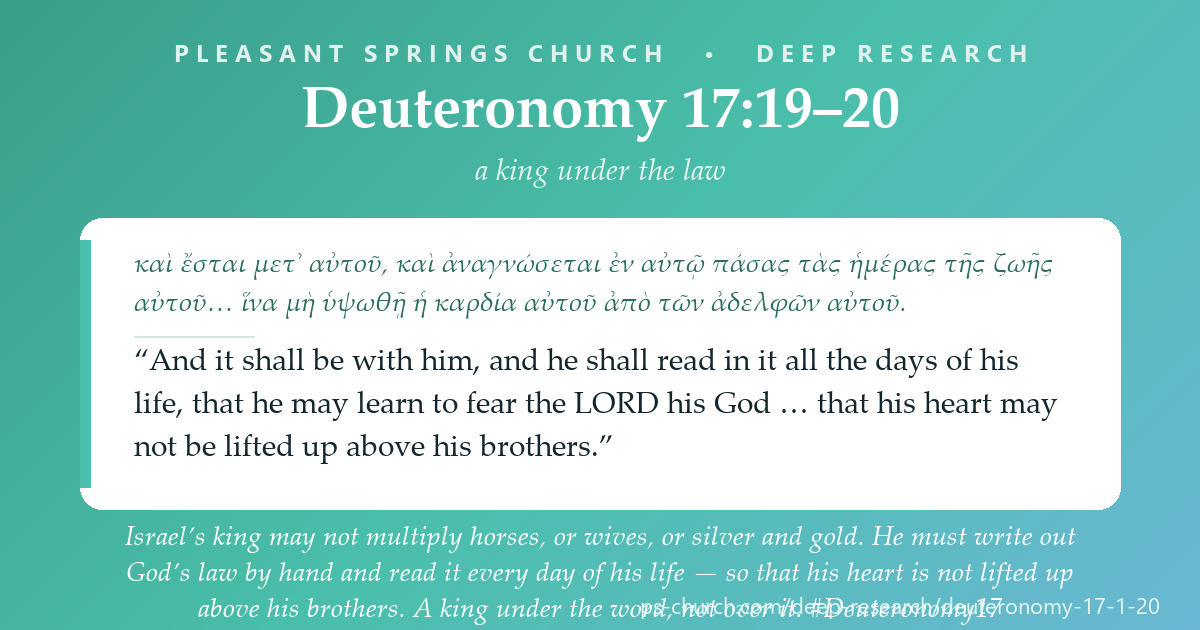
- Leaders are readers. The king’s first act is to copy out a book by hand and then read it every day for the rest of his life (17:18–19). Not to master it — to be mastered by it. Whatever you lead, the question is what text is forming you daily that you did not write.
- Humility is in the job description. The stated goal of the daily reading is “that his heart may not be lifted up above his brothers” (17:20). He is called their brother, not their owner. Authority in Scripture never stops being answerable and never stops being kin.
Step in response: pick one place where you hold authority this week and do two things — put a short daily reading of Scripture in front of the decisions you make there (not as preparation for teaching, but as being taught), and find one person under that authority whom you have quietly stopped treating as a brother or sister, and treat them like one.
Deuteronomy 17:19–20 · to share
LXX + ESVEvery Deep Research page traces its passage across the whole sweep — the Old Testament, the Second-Temple world between the testaments (historical witnesses, not Scripture), and the New Testament. Follow the thread:
Pleasant Springs Church — Deep Research
Research method after Michael S. Heiser’s Bible Research Method (examine dictionaries → ancient literature → important words → textual connections → academic publications → share), with the Pleasant Springs “Author & Audience” foundation. Scripture set in the Hebrew, the Greek editions named on each page and the ESV (Old Testament), and the Greek New Testament and the ESV (New Testament), per the practice of Pleasant Springs Church. Deuteronomy 17 research grounded in Craigie, Block, McConville, Tigay, Christensen, Nelson, Driver and Merrill, with Bernard Levinson on 17:14–20 as a constitutional text and Kline on the treaty form (reported as the book’s literary shape, not as a settled argument about its date), and Beale & Carson on the New Testament use (Matthew; 1–2 Corinthians; Hebrews). ANE comparanda from the Code of Hammurabi and its epilogue (ANET 163–180, esp. 178), the Suppiluliumas–Kurtiwaza treaty with its deposit-and-reading clause (ANET 205), the wider Hittite treaties (ANET 199–206) and the Vassal-Treaties of Esarhaddon (ANET 534–541); Second-Temple and rabbinic witnesses from the Temple Scroll (11Q19 56–59), Josephus (Ant. 4.223–224), Philo (Special Laws 4.157–169) and the Mishnah (Sanhedrin 2:4; 4–5; Makkot 1) — all read as witnesses, never leveled with Scripture. Versification: Deuteronomy 17 has no MT/LXX offset — Hebrew, Rahlfs LXX and English all number 17:1–20 alike, and chapters 17–21 are offset-free throughout; the offsets in this book lie elsewhere (English 12:32 = MT/LXX 13:1, so English 13:1–18 = MT/LXX 13:2–19; English 22:30 = MT/LXX 23:1, so English 23:1–25 = MT/LXX 23:2–26; English 29:1 = MT/LXX 28:69). The Greek is Rahlfs; where Codex B (Swete) shortens 17:9 by dropping the Levitical priests, Rahlfs and the Hebrew are followed. The capital legislation of 17:2–7 is read as theocratic criminal law for a covenant nation at a bounded moment in redemptive history — reported plainly, its difficulty owned, and stated to be no template for the church or any modern state and no licence for violence, coercion or shunning by anyone today (2 Cor 10:4; Eph 6:12; Luke 9:54–55; Matt 26:52; 1 Cor 5). Its abiding substance — required investigation, two or three witnesses, a costly testimony, an appeal, and power fenced by the word of God — is held as enduring.
Scripture quotations marked ESV are from the ESV® Bible (The Holy Bible, English Standard Version®), © 2001 by Crossway, a publishing ministry of Good News Publishers. ESV Text Edition: 2016. Used by permission. All rights reserved. The ESV text may not be quoted in any publication made available to the public by a Creative Commons license, and the ESV may not be translated in whole or in part into any other language. www.esv.org
|
Did this study bless you today? 💚 Give to Support PS Church100% of gifts go to the General Fund — thank you. |