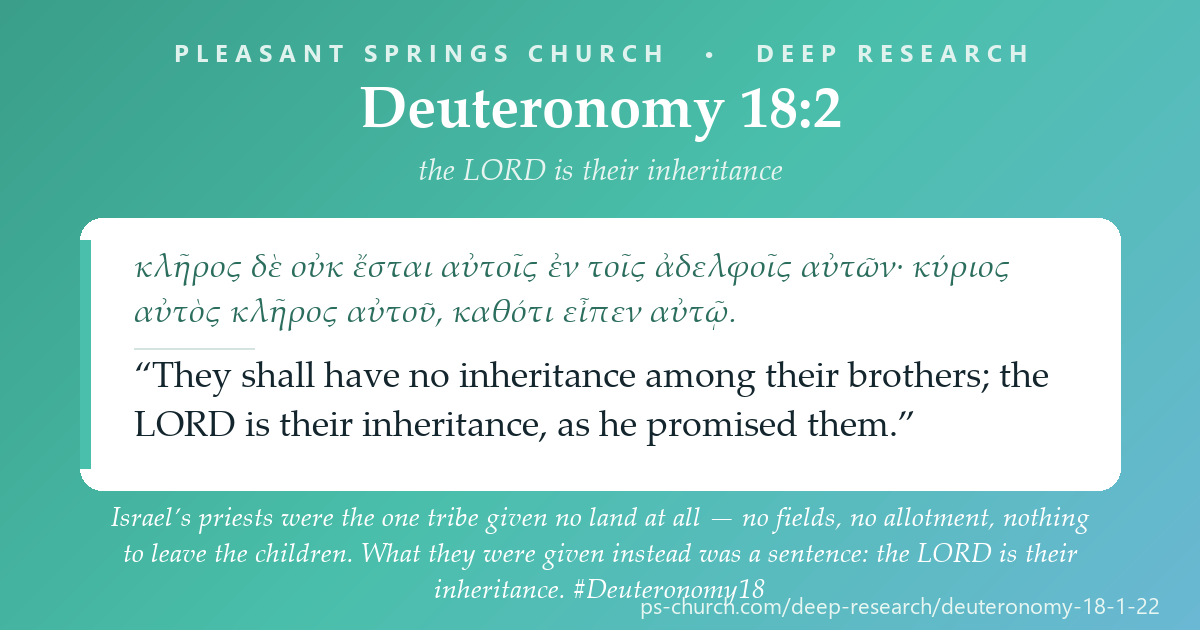
One tribe in Israel was handed no tribal inheritance. No allotment, nothing to leave the children — “no portion or inheritance with Israel” (18:1). What the Levites were given instead is one of the boldest sentences in the Torah: “the Lord is their inheritance” (18:2). Then the chapter turns to the nations Israel is about to live beside and names what they do — the child burned as an offering, and the whole trade in divination, omens, sorcery, mediums and the dead (18:9–12) — and answers it not with a warning but with a promise. Israel need not grope after hidden knowledge, because God speaks: “the Lord your God will raise up for you a prophet like me… it is to him you shall listen” (18:15). This study works Deuteronomy 18:1–22 — ministry with no inheritance but God himself, a God who talks instead of a silence you have to manipulate, and the test that keeps prophecy accountable. See the method →
Deuteronomy 18:1–22 (selections) — MT = LXX = English
Hebrew · LXX · ESVThe Shape of the Passage
SequenceDeuteronomy 18 completes a block that begins at 16:18 and is often called the law of the offices: judges in every gate (16:18–20), the court of appeal and the king who must copy out the law (ch 17), then the priests and Levites, then the prophet. For the Levites’ portion from the sanctuary side see Numbers 18; for the mediums and the child in the fire, Leviticus 20; for the false prophet whose sign does come true, Deuteronomy 13. — 18:15–19 has its own study on this site: The Prophet Like Moses. The full messianic treatment lives there; this page reads the same verses in this chapter’s frame.
Author
Moses, preaching on the plains of Moab. Deuteronomy is not a statute book read out by a clerk; it is preached law, delivered forty years on to the children of the generation that died in the wilderness. Its verbs are remember, hear, love, choose, today. The book as a whole carries the shape of an ancient suzerainty treaty (preamble, historical prologue, stipulations, witnesses, blessings and curses), and chapter 18 belongs to the stipulations; that is an observation about the form of the book, and scholars on every side of the dating question have used it, so we report the shape and leave the date where the text leaves it.
Four offices, and the fourth is the point. From 16:18 Moses has been building a constitution for a nation that will not have him. Judges are seated in every gate; a supreme court is set at the chosen place; a king is permitted but hedged about and put under the law he must copy out by hand; the priests are provided for but given no land. Each office is limited. Then comes the fourth, and it alone is described not as a permission or a restriction but as a promise: “the Lord your God will raise up for you a prophet like me.” The judges Israel appoints, and the king Israel may set — even there, only the man the Lord chooses (17:15) — and the priest Israel is told to provide for, though he too is God’s choice (18:5). But the prophet is not appointed, permitted or provisioned at all: he is raised up. Which is exactly why the chapter puts him where it does: right after the list of everything the nations do to pry a word out of the dark.
Audience
People about to live next door to Canaan. “When you come into the land… you shall not learn to follow the abominable practices of those nations” (18:9). The verb is learn, not invent. Nobody in Israel was going to wake up and devise necromancy from scratch; they were going to pick it up from neighbours, the way people always do — at a bad harvest, at a sickbed, at a war council, when someone says quietly that there is a woman two villages over who can find things out. Deuteronomy is legislating against the ordinary human reflex to get information from the unseen world on our own terms.
And a tribe with no fields. The other audience of this chapter is the Levite, who is told in the flattest possible terms that he will never own the thing every other Israelite is about to receive. Deuteronomy states his loss twice before it states his provision: no portion, no inheritance. What he is given instead is not a stipend but a sentence — the Lord is his inheritance. Read the chapter as a whole and the two halves rhyme: a man with no land who has God, and a people with no divination who have God’s voice. Both are asked to live on what cannot be secured or stockpiled.
Orient on the priestly dues, the practices named in 18:10–11, and the prophetic office.
Search by topic: priests and Levites, priestly dues, inheritance and portion, Molech and child sacrifice, divination, magic and sorcery, medium and necromancer, prophet and prophecy, false prophecy, Deuteronomy.
Which articles are relevant?
- Anchor Bible Dictionary — “Priests and Levites,” “Levitical Cities,” “Inheritance,” “Molech,” “Divination,” “Magic (OT),” “Necromancy,” “Prophecy (Ancient Near Eastern and Israelite),” “False Prophecy.”
- Dictionary of the OT: Pentateuch — “Priests and Levites,” “Prophets and Prophecy,” “Magic and Divination,” “Sacrifice and Offerings,” “Land,” “Deuteronomy: Book of.”
- NIDOTTE / TDOT — נַחֲלָה (naḥălāh, inheritance), חֵלֶק (ḥēleq, portion), תּוֹעֵבָה (tôʿēḇāh, abomination), תָּמִים (tāmîm, blameless), נָבִיא (nāḇîʾ, prophet), שָׁמַע (šāmaʿ, hear/heed), זָדוֹן (zāḏôn, presumption).
Bibliography surfaced:
- Peter C. Craigie (NICOT), Daniel I. Block (NIVAC), J. G. McConville (Apollos), Jeffrey H. Tigay (JPS), Duane Christensen (WBC), Richard Nelson (OTL), S. R. Driver (ICC) on Deuteronomy.
- Studies of Deut 16:18–18:22 as the “law of the offices”; of the Levite’s status and support in Deuteronomy; and of Israelite prophecy against its ANE background.
- Beale & Carson, Commentary on the New Testament Use of the Old Testament (Acts).
How the ancient world got information — and how a priest got dinner.
Two backgrounds, one for each half of the chapter: the ANE temple economy that fed its clergy, and the ANE science of divination that the chapter refuses. Report both accurately; the biblical law is not always the outlier, and where it is, show it from the text.
Which parallels shed light on religion and worldview?
Feeding the clergy. Every ancient sanctuary had to answer the same practical question, and most answered it the same way: the temple held land. Egyptian and Mesopotamian temples were among the largest landowners in their societies. Deuteronomy takes the opposite route and says so out loud — the priestly tribe holds no territory, and eats from the altar and from the firstfruits its neighbours bring (18:1–5). The arrangement makes the clergy structurally dependent on the ordinary obedience of ordinary farmers, which is a design decision, not an oversight. The Hittite Instructions for Temple Officials (ANET 207–210) shows the temptation the arrangement creates from the other side: temple staff are warned at length not to keep back what was set before the gods, not to let wives, children or servants eat it, and not to make deals with those who supply it. Israel’s law addresses the same pressure by defining the priest’s share — the shoulder, the two cheeks, the stomach (18:3) — so that what is his is not what he can take.
Divination was the ancient world’s information technology. The practices named in 18:10–11 were not fringe. Reading livers and lungs, watching birds and oil on water, interpreting dreams and omens and the movements of the heavens — these were learned professions with libraries, apprenticeships and royal patronage; kings did not go to war without them. Two ANE laws show how seriously the boundary around them was policed. Code of Hammurabi §2 (ANET 166) handles an unproven accusation of sorcery by sending the accused into the river: if the river takes him the accuser inherits his estate; if he comes out alive, the accuser is put to death. Middle Assyrian Laws A §47 (ANET 184) provides that a man or woman found with “magical preparations,” once prosecuted and convicted, is put to death — with an elaborate procedure for the witness who says he saw it. So the difference between Israel and its neighbours is not that the neighbours were relaxed about this. It is what is offered instead. Babylon answers an accusation of sorcery with another ordeal — one more technique for extracting a verdict from the unseen. Deuteronomy answers the whole enterprise with a voice: “the Lord your God will raise up for you a prophet… and I will put my words in his mouth” (18:15, 18).
Prophets elsewhere, and what is different here. Israel was not the only place where someone claimed to speak for a god. The Mari letters preserve messages in which an ecstatic or a temple functionary delivers a word to the king in the name of a deity, sometimes unbidden and sometimes unwelcome, and Akkadian and Egyptian collections of oracles and prophecies survive as well. The genuine parallel is worth stating plainly: the form — a human being speaking in the first person for a god — is shared. What Deuteronomy 18 adds is an accountability that the parallels do not have: a stated test that anyone can apply (18:21–22), and a prophet whose office exists precisely so that the people will not need the diviner’s trade.
- Code of Hammurabi §2 (ANET 166; a witness, not Scripture) — a charge of sorcery settled by the river ordeal: the accused throws himself in, and the river decides. Divination used to adjudicate divination.
- Middle Assyrian Laws A §47 (ANET 184; a witness, not Scripture) — a man or woman found with “magical preparations” is put to death on conviction; ANET’s own note here points the reader to Exod 22:18 and Lev 20:27.
- Hittite Instructions for Temple Officials (ANET 207–210; a witness, not Scripture) — temple personnel warned not to consume or divert what has been set before the gods: the same pressure Deut 18:3–5 meets by fixing the priest’s share.
- Mari prophetic letters and the ANE oracle and omen collections (ANET: Letters, 482, 623; Oracles and Prophecies, Egyptian 441, Akkadian 449 — witnesses, not Scripture) — speaking for a god in the first person is an ANE form: the Akkadian oracles (ANET 449) speak in the god’s own first person, while the Egyptian material (441, Ipu-wer and Nefer-rohu) is a related genre — admonition and pseudo-prophecy addressed to a king — not the same form. The stated test of 18:21–22 has no parallel in either.
- Temple Scroll (11Q19) cols. 60–61 (Dead Sea Scrolls — a witness, not Scripture) — a Second-Temple community rewriting this whole chapter: the priests’ and Levites’ shares, the forbidden practices, and the prophet, recast in God’s own first-person voice.
- 4Q175 (Testimonia); 1QS 9:11; 1 Maccabees 4:46; 14:41 (Second Temple — witnesses, not Scripture) — Deut 18:18–19 copied out among a community’s core expectations, and decisions deferred “until a trustworthy prophet should arise.”
- Josephus, Antiquities 4.196–301; Philo, Special Laws 1 and 4 (Second Temple — witnesses, not Scripture) — systematic restatements of these laws for outside readers: the priests’ dues and the ban on soothsaying (and in Philo, the marks of a true prophet).
- Mishnah, Ḥullin 10 (rabbinic-era — a witness, not Scripture) — a whole chapter on “the shoulder, the two cheeks and the maw,” working out exactly which animals and which cuts Deut 18:3 covers; and Sanhedrin 11 on the prophet who speaks what he has not heard.
The list in 18:10–11 is usually read as a warning about the occult. It is that, and the text is not shy: these things are an abomination, and the nations are being dispossessed because of them (18:12). But notice what the chapter does with the list — it does not analyse it, rank it, or teach Israel how to recognise it. It names it in two verses and moves on, and the very next thing it says is not “beware” but “be blameless” (18:13), and then, immediately, that God will send someone to talk to you. The whole passage is arranged so that the negative is brief and the positive is the point.
And the positive is more demanding than it looks. Divination is attractive because it is controllable: you go when you want, you ask what you want, you pay, and you get an answer on the spot. A prophet is none of those things. He comes when he is sent, says what he was given, and frequently says the one thing nobody wanted to hear. To live by 18:15 instead of 18:10 is to trade a service you can summon for a Person who speaks on his own initiative — which is why the arrangement requires trust rather than technique. The nations grope; Israel waits and listens. That is a harder discipline, and it is the one the chapter commands.
Inheritance, equal shares, abomination, wholeness, listening, and presumption.
Watch nachalah (the land-share Levi will never have), cheleq kecheleq (share for share), toevah (what makes a land unlivable), tamim (whole rather than merely clean), shama (the chapter’s hinge verb), and zadon (presumption, the mark of the false prophet). Verse numbers here need no conversion: Hebrew, Rahlfs LXX and English agree throughout Deuteronomy 18.
“Inheritance, allotted possession” — in the Torah the technical word for a family’s permanent share of the land, the thing that made an Israelite household viable across generations. It is said of Levi twice in two verses, both times negated, and then re-aimed: the Lord himself is his inheritance (cf. Num 18:20; Josh 13:33). The LXX keeps the pair distinct in 18:1 — μερὶς οὐδὲ κλῆρος, portion and lot — and renders naḥălāh throughout with κλῆρος, “the lot that falls to you” — from which comes the English clergy.
“Portion like portion” — the Hebrew is as plain as it looks: share for share, equal terms. It governs the Levite who arrives from a country town at the central sanctuary, where the resident staff already have a rota and a claim: he ministers, and he eats the same as they do (18:6–8). A small provision, and a pointed one — the law anticipates the guild closing ranks and forbids it in advance.
“Abomination” (LXX βδέλυγμα) — not merely something distasteful but something that ruptures a relationship; Deuteronomy uses it for what makes a land unlivable before God. The word frames the middle panel at both ends (18:9, 12), and 18:12 supplies the reason the nations are being dispossessed: “because of these abominations.” Dispossession in this book is never presented as ethnic preference.
Literally “one who makes his son or his daughter pass through the fire” — the ESV renders it for what it was, “burns his son or his daughter as an offering.” It stands first in the list, before every kind of divination, and the same practice is named with Molech in Lev 18:21; 20:2–5 and grieved over in Jer 7:31 (“which I did not command, nor did it come into my mind”). The LXX renders it περικαθαίρων, “purifying” — a translator’s word choice, and a chilling one, since it is the language of cleansing.
“Blameless, whole, without defect” (LXX τέλειος) — the word used of an unblemished sacrificial animal, of Noah (Gen 6:9) and of Abraham’s charge, “walk before me, and be blameless” (Gen 17:1). Its opposite here is not impurity but divided allegiance: a man consulting a medium on the side is not partly holy, he is not whole. The Greek is the same adjective in Jesus’ “you therefore must be perfect” (Matt 5:48).
“To hear” — and in Hebrew, to hear is to heed; it is the verb of the Shema. It is this chapter’s Leitwort. The nations listen to fortune-tellers (18:14); “to him you shall listen” (18:15); “let me not hear again the voice” (18:16); “whoever will not listen to my words… I myself will require it” (18:19). The chapter never asks whether you will listen. It asks to whom.
“Presumption / to presume, act arrogantly” — the root behind the boiling-over of the pot; it describes swollen self-will, not honest error. Deuteronomy does not define the false prophet as a man who got something wrong but as one who presumed to speak when he had not been sent. The test in 18:22 is offered to ordinary Israelites, not to a board of examiners: watch, and see whether it comes to pass.
Where the New Testament picks this chapter up:
- Acts 3:22–23 and Acts 7:37 — Peter in the temple and Stephen before the council both quote Deut 18:15–19 and apply it to Jesus. This is the New Testament’s own reading of the promise, and it is the ground on which the church has read it messianically ever since — the full treatment is on the companion study, The Prophet Like Moses.
- John 1:21, 25; 6:14; 7:40 — “Are you the Prophet?” The question put to John the Baptist, and the crowd’s verdict after the feeding: “This is indeed the Prophet who is to come into the world!” The expectation this chapter created was still live in the first century.
- Hebrews 1:1–2 — “God spoke to our fathers by the prophets… but in these last days he has spoken to us by his Son.” The same argument as Deuteronomy 18, carried to its end: the character of this God is that he speaks (see Hebrews 1).
- 1 Corinthians 9:13–14 — “those who serve at the altar share in the sacrificial offerings… the Lord commanded that those who proclaim the gospel should get their living by the gospel.” Paul reasons from the same arrangement — the servants of the altar live from the altar.
- 1 Thessalonians 5:19–21; 1 John 4:1 — “Do not despise prophecies, but test everything”; “test the spirits.” The instinct of Deut 18:21–22, carried into the church: neither credulity nor contempt, but testing.
- Matthew 5:48 — “You therefore must be perfect (τέλειοι)…” the same Greek adjective the LXX uses to render tāmîm in 18:13. A verbal echo worth noticing, not a citation formula.
The tribe with no land, the practices Israel kept returning to, and the office that answers them.
Run three threads: the Levite’s portion across the Torah; the forbidden practices across the law and the histories; and the prophetic office from Horeb to the last page of the Old Testament.
Which cross-references matter?
- Numbers 18:20–24 — “You shall have no inheritance in their land… I am your portion and your inheritance among the people of Israel.” Stated from the sanctuary side, and the sentence Deuteronomy 18 is preaching — though the two accounts are not simply interchangeable (the tithe of Num 18:21–24 works differently from Deut 14:22–29, and the priest’s portion in Deut 18:3 is not the breast and thigh of Lev 7:31–34) (see Numbers 18–19).
- Numbers 3–4; Deuteronomy 10:8–9; Joshua 13:14, 33; 18:7 — the tribe taken in place of the firstborn, set apart to carry and to stand and to bless, and given no allotment because “the Lord God of Israel is their inheritance” (see Numbers 3–4). Say it precisely: no allotted territory — the forty-eight Levitical cities and their pasturelands (Num 35:1–8; Josh 21; held inalienably, Lev 25:32–34) are a place to live, not an inheritance to farm and bequeath, and Deut 18:6 itself assumes Levites resident in the towns.
- Deuteronomy 12:12, 18–19; 14:27–29; 16:11, 14; 26:11–13 — “take care that you do not neglect the Levite as long as you live in your land.” The landless minister is written into the tithe, the feast and the table, again and again (see Deut 12 and Deut 14–15).
- Leviticus 18:21; 19:26, 31; 20:1–6, 27; Exodus 22:18 — the same prohibitions in the Holiness Code: no child given to Molech, no omens, no mediums or necromancers, “do not turn to them… I am the Lord your God” (see Leviticus 19 and Leviticus 20).
- 2 Kings 17:16–18; 21:6; 23:24; Jeremiah 7:31; 19:5; 32:35; Isaiah 8:19–20 — the histories and the prophets record Israel doing every single thing on this list, and name it as the reason for the exile. Isaiah puts the contrast in exactly Deuteronomy’s terms: “Should not a people inquire of their God? Should they inquire of the dead on behalf of the living? To the teaching and to the testimony!”
- Exodus 20:18–21; Deuteronomy 5:23–31 — the day of the assembly at Horeb, when the people said “you speak to us… but do not let God speak to us, lest we die,” and God answered, “they are right in all that they have spoken.” Deuteronomy 18:16–17 is quoting that scene (see Deuteronomy 5).
- Deuteronomy 13:1–5 — the harder half of the test: a prophet whose sign does come true, and who then says “let us go after other gods.” Fulfilment alone is not the whole criterion; 13:1–5 supplies the other one, loyalty to the Lord (see Deuteronomy 13). Read 18:21–22 without 13:1–5 and you will get it wrong.
- Jeremiah 28; 1 Kings 22:1–28; Ezekiel 13 — the test’s limits, shown in real time: Hananiah against Jeremiah, Micaiah against four hundred, and the prophets “who follow their own spirit and have seen nothing.” In both scenes the hearers had to decide before anything came to pass — Micaiah is jailed before the battle settles it, and Jeremiah simply walks away (28:11) until a later word comes. The test is retrospective, and that is its honest difficulty. The Old Testament shows what it costs to be the one who waits for the word to come true.
- Deuteronomy 34:10–12 — the book’s own last word on the promise: “there has not arisen a prophet since in Israel like Moses.” The office was filled many times over; the promise stayed open.
The New Testament’s use of this chapter is concentrated and explicit. Peter, preaching in Solomon’s Portico, quotes Deuteronomy 18 and names Jesus as its subject: “Moses said, ‘The Lord God will raise up for you a prophet like me from your brothers. You shall listen to him in whatever he tells you’” (Acts 3:22); Stephen repeats the citation in his defence (Acts 7:37). Both are reading the singular language of 18:15 and 18:18 the way Second-Temple Judaism had already learned to read it — forward — and both press the warning of 18:19. That is the ground on which any messianic reading of this text stands: the New Testament’s own reading, made in public and in argument. We do not need to reach past it, and this page does not try to. The companion study, The Prophet Like Moses, works it out in full.
What belongs to this chapter is the setting the apostles inherited along with the verse. The promise of a prophet is not given in a vacuum; it is given as the alternative to 18:10–11, in a world where everyone had a method for getting a word out of the dark. Read that way, Acts 3 is not merely a proof-text about Jesus’ identity. It is the claim that the long argument of Deuteronomy 18 has reached its end — that the God who refused to let his people go groping has said everything he has to say in a Son (Heb 1:1–2), and that the only remaining question is the chapter’s own: to whom are you listening?
The scholarship on the law of the offices, the Levite’s portion, and prophecy true and false.
Craigie, Block, McConville, Tigay, Christensen, Nelson and Driver on Deuteronomy; Kline on the treaty form; Levinson on Deuteronomy’s legal revision; Beale & Carson on Acts; ANET for the comparanda.
Commentaries & studies:
- Peter C. Craigie, The Book of Deuteronomy (NICOT); Daniel I. Block, Deuteronomy (NIVAC); J. G. McConville, Deuteronomy (Apollos); Jeffrey H. Tigay, Deuteronomy (JPS); Duane L. Christensen (WBC); Richard D. Nelson (OTL); S. R. Driver (ICC); Patrick D. Miller (Interpretation); Eugene H. Merrill (NAC).
- Meredith G. Kline, Treaty of the Great King, on the suzerainty-treaty shape of the book (reported as literary form; the dating debate is not settled by it). Bernard M. Levinson on Deuteronomy’s revision of earlier legal material, including the law of the offices.
- Studies of Deut 16:18–18:22 as a constitutional block, and of the place and support of the Levites in Deuteronomy; studies of true and false prophecy in Israel and its ANE setting.
- J. B. Pritchard, ed., Ancient Near Eastern Texts (ANET) — Code of Hammurabi (163–180, esp. §2 at 166), Middle Assyrian Laws (180–188, esp. A §47 at 184), Hittite Instructions for Temple Officials (207–210), Letters (Mari, 482, 623), Oracles and Prophecies (Egyptian 441; Akkadian 449).
- G. K. Beale & D. A. Carson, eds., Commentary on the New Testament Use of the Old Testament (Acts).
Interpretation notes worth keeping:
- ‘The Lord is his inheritance’ is a provision, not a consolation prize. The sentence is not a pious way of saying “you get nothing.” Deuteronomy immediately spells out what it means in food and firstfruits (18:3–5) and then binds the rest of Israel to it in the tithe and the feast (12:19; 14:27; 16:11). A community that quotes 18:2 at its ministers while ignoring 18:3–5 has read half a verse. How the Deuteronomic and Priestly provisions relate — including Deuteronomy’s “the Levitical priests, all the tribe of Levi” beside the Aaronide/Levite division of Num 18:1–7 and 2 Kgs 23:9, where the high-place priests did not come up to the altar — is a long-standing and unsettled question. We report both and do not adjudicate.
- The occult list is short on purpose — keep it short. Two verses name nine practices and the chapter moves straight to “be blameless” and to the promise of a prophet. Preaching that inverts those proportions — a long taxonomy of the demonic and a short mention of God’s speech — has reversed the text’s own emphasis and, worse, has made the dark side sound more interesting than the voice of God. Name it, refuse it, and go where the chapter goes.
- 18:10 is about children, and should be said plainly and once. The list is headed by a parent burning a child. Scripture never explains it, never softens it, and treats it as the reason a civilization forfeited its land (18:12; Jer 7:31 — “nor did it come into my mind”). Say it soberly, do not linger over it, and do not use it for effect.
- Two tests, not one. 18:21–22 gives the test of fulfilment; 13:1–5 gives the test of loyalty, for the prophet whose sign does come true. Neither works alone. Applied to modern claims, the pair is deflationary in both directions: it rules out both the credulity that accepts any confident speaker and the cynicism that will not test anything (1 Thess 5:19–21). Note also that a word which does not come to pass is not automatically presumption: Scripture itself records prophecy that is conditional and is averted by repentance (Jonah 3:4–10; Jer 18:7–10). And the test is retrospective — it gives no help at the moment of decision, which is exactly the bind Jeremiah’s hearers were in at Hananiah’s word. The test is real, and it is blunter than we would like.
- The death penalty in 18:20 is theocratic criminal law, and is not a template. Report it as it stands: in a covenant nation with God as its immediate King, a man who claimed God’s voice falsely or spoke for another god was put to death by that nation’s courts. It belongs to a bounded moment in redemptive history; it licenses no violence, coercion, harassment or shunning by any Christian, church or state today. The church’s own remedy for a false teacher is teaching, warning and at most exclusion from the table (2 Cor 10:4; Eph 6:12; Luke 9:54–55; Matt 26:52; 1 Cor 5). Note too what the text does not do: it gives no procedure for hunting anyone, and its closing word to the ordinary Israelite is simply “you need not be afraid of him.”
- Do not over-read the messianic claim — and do not under-read it either. In its first sense 18:15–22 founds the ongoing office of the prophet in Israel, complete with a test that only makes sense for an ongoing succession. The New Testament then reads the singular promise of one final Prophet as fulfilled in Jesus (Acts 3:22–23; 7:37). That reading is the apostles’, made explicitly; we stand on it, and we do not go further than they did.
- The four offices are a constitution, not a church order. Judge, king, priest, prophet — each limited, none absolute, and every one of them under a written law that the king himself has to copy out by hand (17:18–19). It is a remarkable political arrangement and it has had a long afterlife in Western thought. It is still legislation for a covenant nation in its land; its moral substance carries, its constitutional machinery does not transfer, and the New Testament does not transfer it.
From a tribe with no land to a people with a voice.
Name what you learned, why it matters, and one concrete response.
What should we carry away — and do?
- The one tribe that served God full-time was the one tribe with nothing to fall back on. No fields, no allotment, no equity — and a sentence instead: the Lord is their inheritance. That is either the best deal in the book or the worst, and which one it is depends entirely on whether God is real.
- ‘Portion like portion.’ The Levite who walked in from a small town got the same share as the men already on the rota (18:6–8). Insiders keep what they have; this law says the newcomer eats the same. Look at the tables you set and ask who is quietly getting a smaller portion.
- Everyone is listening to something. The chapter’s hinge is a verb, not a doctrine: the nations listen to fortune-tellers; you shall listen to him. The modern equivalents of 18:10–11 are rarely candlelit — they are whatever we consult, at 2 a.m., to get certainty about the future on our own terms.
- Blameless means whole, not spotless. Tamim is the word for an unblemished animal and for Noah — undivided, all of a piece. Its opposite in this chapter is not failure but hedging: trusting God, and keeping a second source of information in reserve.
- Test the word; do not fear the speaker. Deuteronomy hands the test to ordinary people (18:21–22) and ends with a kindness: “you need not be afraid of him.” Confidence is not evidence. Neither is volume.
Step in response: name the thing you consult when you want to know how it will turn out — the forecast you refresh, the person whose read you trust more than prayer, the private ritual that makes you feel like the future is handled. Set it down for a week and put the time into the place God has actually promised to speak: the Scriptures, read slowly, in company. Then do one thing for a minister with no land — a pastor, a missionary, a chaplain, a volunteer — who is living on 18:2 in a world with a very different retirement plan.
Deuteronomy 18:2 · to share
LXX + ESVEvery Deep Research page traces its passage across the whole sweep — the Old Testament, the Second-Temple world between the testaments (historical witnesses, not Scripture), and the New Testament. Follow the thread:
Pleasant Springs Church — Deep Research
Research method after Michael S. Heiser’s Bible Research Method (examine dictionaries → ancient literature → important words → textual connections → academic publications → share), with the Pleasant Springs “Author & Audience” foundation. Scripture set in the Hebrew, the Greek editions named on each page and the ESV (Old Testament), and the Greek New Testament and the ESV (New Testament), per the practice of Pleasant Springs Church. Deuteronomy 18 research grounded in Craigie, Block, McConville, Tigay, Christensen, Nelson and Driver, with Kline on the treaty form (reported as the book’s literary shape, not as a settled argument about its date), Levinson on Deuteronomy’s legal revision, and Beale & Carson on the New Testament use (Acts). ANE comparanda verified page by page against ANET: Code of Hammurabi §2 (ANET 166), Middle Assyrian Laws A §47 (ANET 184), Hittite Instructions for Temple Officials (ANET 207–210); the Mari letters and the Akkadian and Egyptian oracle collections are cited by ANET section (Letters, 482, 623; Oracles and Prophecies, Egyptian 441, Akkadian 449), plus Second-Temple and rabbinic witnesses (Temple Scroll 11Q19 60–61; 4Q175; 1QS 9:11; 1 Maccabees; Josephus; Philo; Mishnah Ḥullin 10 and Sanhedrin 11) — all read as witnesses, never leveled with Scripture. Greek is the Rahlfs LXX; Hebrew is the Masoretic Text; English is the ESV (2016). Versification: Deuteronomy 18 has no MT/LXX offset — Hebrew, Rahlfs LXX and English all number 18:1–22 alike, and chapters 17–21 are clear throughout; the offsets in this book lie elsewhere (English 12:32 = MT/LXX 13:1, so English 13:1–18 = MT/LXX 13:2–19; English 22:30 = MT/LXX 23:1, so English 23:1–25 = MT/LXX 23:2–26; English 29:1 = MT/LXX 28:69). The messianic reading of 18:15–19 is taken from the New Testament’s own use of the text (Acts 3:22–23; 7:37) and is developed in the companion study at /deep-research/deuteronomy-18-15-19; nothing here is claimed beyond it. The capital sanction of 18:20 is read as theocratic criminal law belonging to a bounded moment in redemptive history — not a template for the church or any modern state, and no warrant for coercion of any kind.
Scripture quotations marked ESV are from the ESV® Bible (The Holy Bible, English Standard Version®), © 2001 by Crossway, a publishing ministry of Good News Publishers. ESV Text Edition: 2016. Used by permission. All rights reserved. The ESV text may not be quoted in any publication made available to the public by a Creative Commons license, and the ESV may not be translated in whole or in part into any other language. www.esv.org
|
Did this study bless you today? 💚 Give to Support PS Church100% of gifts go to the General Fund — thank you. |