The Book of the Covenant closes with justice, worship, and promise. God’s law reaches past the tribe — return your enemy’s straying ox, take no bribe, never oppress the sojourner, “for you know the heart of a sojourner.” Mercy is written into time: the seventh-year land-rest for the poor, the weekly Sabbath so even the servant and the beast may breathe again, three feasts of joy before the Lord. And at the head of the march goes the Angel who bears the Name: “Behold, I send an angel before you… my name is in him.” This study works Exodus 23:1–33 — the character of God taking civic form, and the Presence that goes before. See the method →
Exodus 23:2, 9, 12, 17, 19, 20–21
Hebrew · LXX · ESVThe Shape of the Passage
Ring compositionSame Author and audience as the Ten Commandments — but now the moral law is bent toward real life: courts and crops, feasts and enemies, and the Presence that goes before.
Author
The Torah of Moses gathers the covenant’s case laws into a single scroll Israel called the Book of the Covenant (24:7), and chapter 23 is its close. These are the civil and judicial applications of the Ten Words to the life of a specific nation — Israel’s theocracy in its land. They are not a timeless civil code binding on every state, and the church is not a civil enforcer; rather, the church reads them for the enduring moral principles they embody — impartial justice, care for the vulnerable, honesty, restitution, and the dignity of every image-bearer — principles fulfilled and deepened, not abolished, in Christ (Matt 5:17).
The shape of the chapter. It moves in three movements and a promise. First, justice (23:1–9): no false report, no crowd-driven evil, no perverting a case — whether for a bribe or, remarkably, out of pity for the poor (23:3, 6): truth is not to be bent in either direction. And love of enemy is written into the Law itself — return your enemy’s straying ox, lift up the donkey of “one who hates you” groaning under its load (23:4–5). Then the Sabbaths (23:10–13): the seventh-year land-rest so “the poor of your people may eat,” and the weekly rest so “your ox and your donkey… and the son of your servant woman, and the alien, may be refreshed” — mercy built into the calendar. Then the feasts (23:14–19): three yearly pilgrimages of joy before the Lord. And the promise of the Angel (23:20–33) who guards the way and bears the Name.
Audience
Israel — a freed-slave people, standing at Sinai, being formed into a just and worshiping nation. The engine of these laws is memory: “you know the heart of a sojourner, for you were sojourners in Egypt” (23:9). Having been the oppressed, Israel is now forbidden to oppress. God’s own compassion — the God who “heard their groaning” (2:24) — is to become the reflex of the redeemed. The widow, the orphan, the poor, and the stranger have a special place under this law precisely because they had a special place in the heart of the God who rescued Israel (22:21–27; cf. Deut 10:18–19).
How they heard it — and how we do. A covenant people is known not by ritual alone but by how it treats the powerless and the enemy. The impartial court, the rested land, the fed poor, the refreshed servant, the joyful feast — all of it is the character of God taking civic form. And at the head of the march goes the Angel of the Lord, in whom “my name is in him” (23:21) — the mediating Presence that led Israel from the bush (ch. 3) and the sea (ch. 14) and will lead them still. The church has long heard in this Name-bearing Angel a foreshadowing of Christ; we hold that as devotional resonance, not forced proof, and let the text’s own claim stand: God himself goes before his people to bring them home.
Orient on the Book of the Covenant, justice, the sojourner, the festal calendar, and the Angel of the LORD.
Search by topic: Book of the Covenant / Covenant Code, law (OT), justice, bribery, sojourner (ger), Sabbath year, feasts / pilgrimage festivals, Angel of the LORD.
Which articles are relevant?
- Anchor Bible Dictionary — “Covenant, Book of the,” “Law (OT),” “Sojourner,” “Sabbatical Year,” “Feasts and Festivals,” “Angel of Yahweh.”
- Dictionary of the OT: Pentateuch — “Book of the Covenant,” “Law,” “Justice and Righteousness,” “Festivals and Feasts,” “Aliens and Strangers.”
- NIDOTTE / TDOT — גֵּר (gēr, sojourner), מִשְׁפָּט (mišpāṭ, justice), שֹׁחַד (šōḥaḏ, bribe), מַלְאָךְ (mal’āḵ, angel/messenger).
Bibliography surfaced:
- Childs (OTL), Durham (WBC), Stuart (NAC), Sarna (JPS) on Exodus; Joe Sprinkle, The Book of the Covenant: A Literary Approach.
- Christopher J. H. Wright, Old Testament Ethics for the People of God; Bruce Wells & F. Rachel Magdalene, ed., Law from the Tigris to the Tiber.
- On the Angel of the Lord: Michael S. Heiser, The Unseen Realm; studies of the Name-bearing angel in Second-Temple texts.
Case law in the ancient world, humane justice, and the angel who carries the Name.
Read the Covenant Code against ANE law collections, then note how its justice runs past the tribe — even to the enemy — and how the Name-bearing Angel fits the ancient world of divine messengers.
Which parallels shed light on religion and worldview?
Case law, ANE style. The Covenant Code shares the casuistic form of the great collections — the Code of Hammurabi, the laws of Eshnunna, Lipit-Ishtar, Ur-Nammu — “if a man… then…” rulings on oxen, thieves, deposits, and injuries. But Exodus bends the form toward the covenant God. Where Hammurabi’s penalties often scale with social class, Israel’s law insists on one impartial standard — neither favoring the great nor even the poor in judgment (23:3, 6). Where other codes protect property, Israel’s law reaches past property to the heart: return the ox of the one who hates you (23:4). This is justice grounded not in the king’s honor but in the Lord’s character and Israel’s own rescue.
Love of enemy — in the Torah. Long before the Sermon on the Mount, the Law commands active good to a personal enemy: not just refraining from harm but helping — catching his wandering animal, hoisting his fallen donkey’s load (23:4–5; cf. Prov 25:21–22). Jesus’ “Love your enemies” (Matt 5:44) does not overturn the Law here; it draws out its deepest intent. Israel’s later interpreters saw it too: Philo devotes a long section of On the Virtues to exactly these humane laws — kindness even to a foe’s beasts, and mercy to animals (including the strange command not to boil a kid in its mother’s milk), reading them all as the Torah’s school of gentleness.
The Angel who bears the Name. The ancient world was full of divine messengers, but 23:20–21 says something startling: obey this Angel, “for my name is in him” — the very Presence and authority of the Lord carried in the messenger, such that to rebel against him is to rebel against God. This is the same figure who appeared in the bush (3:2–6) and went before the camp at the sea (14:19), and whom Israel would follow toward the land (32:34; 33:2). Second-Temple Judaism pondered this Name-bearing angel intently: in the Apocalypse of Abraham the angel Yahoel — whose very name embeds the divine Name — is “a power in virtue of the ineffable Name that dwells in me” (Apoc. Ab. 10). The mystery of a mediator who is and yet is sent by the Lord runs straight through the Old Testament.
- Code of Hammurabi; laws of Eshnunna, Lipit-Ishtar, Ur-Nammu — the casuistic (“if… then”) form shared with the Covenant Code, but class-tiered penalties versus Israel’s one impartial standard.
- Philo, On the Virtues 116–160 — the humane laws expounded: kindness to an enemy’s straying animal, mercy to beasts, the kid and its mother’s milk.
- Josephus, Antiquities 4.266–280; Against Apion 2.211–214 — the returned lost animal and mercy even to enemies retold as the Mosaic constitution’s humanity.
- Apocalypse of Abraham 10; cf. 1 Enoch, the “Angel of the Presence” — the Second-Temple angel in whom the divine Name dwells (witnesses, not Scripture).
The genius of Exodus 23 is that it does not leave compassion to the mood of the merciful; it schedules it. Every seventh year the land itself must rest, and its unharvested growth belongs by right to “the poor of your people,” and after them “the beasts of the field” (23:11) — a whole year in which the ground’s bounty flows first to those with no field of their own. Every seventh day the rest reaches all the way down the household — not only the master but the ox, the donkey, the servant’s son, and the resident foreigner “may be refreshed” (23:12), the Hebrew yinnāfēš meaning literally to catch one’s breath, to be re-souled. And three times a year the whole nation stops working to rejoice before the Lord (23:14–17). Rest for the exhausted, food for the poor, breath for the beast, joy for everyone — time itself is bent toward the vulnerable. A society reveals its god by what it does with its calendar; Israel’s calendar reveals a God whose justice is inseparable from mercy. The writer of Hebrews will see the whole rhythm reaching toward its rest in Christ (Heb 4:9–11), and the church still keeps the principle even as it debates the day: the God who freed slaves will not build a world that runs them ragged.
The vocabulary of just courts, rested time, and the Name-bearing Angel.
Watch the sojourner remembered, the bribe refused, the breath restored, the Angel sent, the Name indwelling, and the patient “little by little.”
“Sojourner / resident alien” — the vulnerable outsider without land or clan-protection. Israel must never oppress him, “for you were sojourners in Egypt”: the memory of Egypt is the engine of Israel’s mercy (Deut 10:19).
“Bribe” — the gift that “blinds the clear-sighted and subverts the cause of those who are in the right.” Impartial justice is God’s own, for “he is not partial and takes no bribe” (Deut 10:17).
“May be refreshed” — lit. to catch one’s breath, be re-souled (root nāp̄aš, cf. nep̄eš, life). Sabbath rest reaching down to the servant, the alien, and the beast.
“Angel / messenger” — the Presence sent to guard the way and go before Israel. The same figure of the bush (3:2) and the sea (14:19); the mediating Presence of the Lord.
“My name is in him” — lit. “my name is in his midst.” To disobey this Angel is to rebel against God: the Name, the very Presence and authority of the Lord, dwells in the messenger.
“Little by little” — God will drive out the nations gradually, “until you have increased and possess the land” (23:30) — unhurried faithfulness, restraint even in judgment (cf. Deut 7:22).
How the rest of Scripture takes up these commands:
- Deuteronomy 10:17–19; 16:18–20; 24:17–22 — impartial justice, no bribe, no perverting the sojourner’s or orphan’s cause: the Covenant Code re-preached for the land.
- Leviticus 19:33–34; 25:1–7 — love the sojourner as yourself; the sabbatical land-rest expanded into the Jubilee.
- Matthew 5:43–48; Romans 12:20 (Prov 25:21–22) — love of enemy, latent in 23:4–5, brought to full flame in Christ’s teaching.
- Exodus 3:2; 14:19; 32:34; 33:2, 14 — the Angel / Presence of the Lord before, beside, and among his people (see ‘My presence will go with you’).
From the Covenant Code to the Sermon on the Mount, the feast fulfilled, and the Presence made flesh.
Trace the justice, the Sabbaths, the feasts, and the Angel toward their New Testament horizon — then note the Beale & Carson trajectory.
Which cross-references matter?
- Deuteronomy 5:12–15; 15:1–18; Leviticus 25 — the Sabbath, sabbatical release, and Jubilee: rest and liberation as the rhythm of a redeemed people.
- Leviticus 23; Deuteronomy 16:1–17 — the three pilgrim feasts fully laid out: Unleavened Bread (Passover), Weeks (Harvest / firstfruits), and Booths (Ingathering).
- 1 Corinthians 5:7–8; Acts 2:1–4; John 7:2, 37–39 — Christ our Passover; the Spirit poured out at Weeks (Pentecost); the living water at Booths: the feasts finding their fullness.
- Matthew 5:17, 43–48; James 2:1–9 — the law fulfilled and deepened; enemy-love; the sin of partiality named in the church.
- Exodus 3:1–15; 33:12–34:9; John 1:14; 1 Corinthians 10:1–4 — the guarding Presence: the Word who “tabernacled” among us; “the Rock was Christ” (held as devotional resonance).
Read across the canon, Exodus 23 keeps opening forward. Its justice — impartial, tribe-transcending, reaching even the enemy’s ox — is not a lower ethic than the gospel’s but its seedbed; Jesus’ “love your enemies” (Matt 5:44) is the flower of what the Torah planted at 23:4–5, and James’ rebuke of partiality (Jas 2) is 23:3–6 preached to the church. Its Sabbaths and feasts are, in Paul’s phrase, “a shadow of the things to come, but the substance belongs to Christ” (Col 2:16–17): the Passover fulfilled in the Lamb (1 Cor 5:7), the Feast of Weeks in the Spirit poured out at Pentecost (Acts 2), the ingathering harvest in the gathering of the nations. And its Angel — the messenger in whom “my name is” — is the Old Testament’s deepest puzzle and its truest promise: the Lord present with his people in a mediating figure who is both sent by God and bears God’s own Name. The church has long read this Christ-ward, and rightly held it as devotional analogy rather than strict proof; but the text’s own claim — that God himself goes before to guard the way and bring his people home — is fulfilled without strain in the One who is “God with us,” who tabernacled among us full of grace and truth (John 1:14). The Covenant Code ends not with a threat but with a promise of Presence: you will not walk to the land alone.
The scholarship on the Covenant Code and the Angel of the LORD.
The commentators on Exodus 23; the studies of ANE law, biblical justice, the festal calendar, and the Name-bearing angel — with the house discipline on the herem read soberly.
Commentaries & studies:
- Brevard Childs (OTL), John Durham (WBC), Douglas Stuart (NAC), Nahum Sarna (JPS), Peter Enns (NIVAC) on Exodus.
- Joe M. Sprinkle, ‘The Book of the Covenant’: A Literary Approach; Christopher J. H. Wright, Old Testament Ethics for the People of God.
- G. K. Beale & D. A. Carson, eds., Commentary on the NT Use of the OT; Michael S. Heiser, The Unseen Realm (on the Angel and the Name).
Interpretation notes worth keeping:
- Impartiality cuts both ways (23:3, 6). Justice is not to be bent against the poor by bribery, nor for the poor by sentiment — truth is truth. Compassion for the vulnerable (22:21–27) and honesty in court are complementary, not rivals.
- The kid in its mother’s milk (23:19). Ancient and modern readers propose several senses — a humane refusal to mingle life-giving milk with the death of its young, a rejection of a Canaanite fertility practice (the Ugaritic reading is now much disputed), or a boundary of holiness; later Judaism built the separation of meat and milk on it. The enduring note is reverence for the order of life.
- The Angel ‘in whom my name is’ (23:20–21). Neither a mere created messenger flattened out, nor to be forced into a proof-text: the text presents a genuine mediating Presence of the Lord. The church’s Christ-ward reading is ancient and fitting, held as resonance built on the text’s own claim (cf. John 1:14).
- ‘Drive out’ and the herem (23:23–33) — read soberly. This language belongs to a unique redemptive-historical moment: judgment on entrenched Canaanite wickedness whose “iniquity” was, at last, “complete” (Gen 15:16), executed by a theocracy under God’s direct command. It is emphatically not a template for violence, conquest, or the treatment of any people today; the church wages no such war (2 Cor 10:3–4; John 18:36). The enduring principle is exclusive loyalty to God — make no covenant with idolatry (23:32–33) — and even here the driving-out is restrained and gradual (“little by little,” 23:29–30), never a license for cruelty.
From the Book of the Covenant to your own justice, rest, and trust.
Name what you learned, why it matters, and one concrete response.
What should we carry away — and do?
- Justice runs past the tribe. Return your enemy’s ox; take no bribe; do not oppress the stranger — because you know his heart, having been one. The memory of your own rescue is meant to make you merciful.
- Mercy belongs on the calendar. Rest, provision for the poor, breath for the weary and the beast, joyful feasts — God schedules compassion so it does not depend on our moods. Build rhythms of rest and generosity into your weeks and years.
- The Presence goes before you. “Behold, I send an angel before you… my name is in him.” You do not walk toward the promise alone; the guarding, guiding Presence — God with us in Christ — goes ahead. And he drives out the old enemies of the soul “little by little”: be patient with his unhurried faithfulness.
Step in response: pick one — do an active good this week to someone you would rather avoid (the “enemy’s ox”); or guard a genuine day of rest that reaches the people who serve you; or take the “place I have prepared” on trust, following the Presence one step at a time even when the driving-out feels slow. Let the God who “heard their groaning” make your justice look like his mercy.
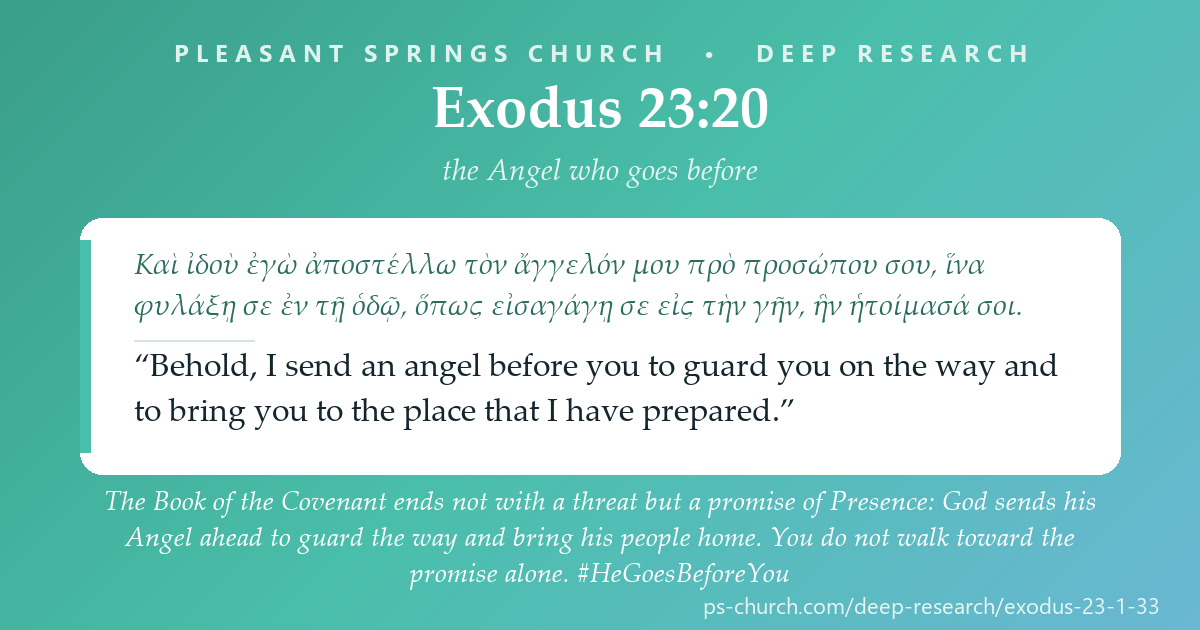
Exodus 23:20 · to share
LXX + ESVEvery Deep Research page traces its passage across the whole sweep — the Old Testament, the Second-Temple world between the testaments (historical witnesses, not Scripture), and the New Testament. Follow the thread:
Pleasant Springs Church — Deep Research
Research method after Michael S. Heiser’s Bible Research Method (examine dictionaries → ancient literature → important words → textual connections → academic publications → share), with the Pleasant Springs “Author & Audience” foundation. Scripture set in the Hebrew, the Greek editions named on each page and the ESV (Old Testament), and the Greek New Testament and the ESV (New Testament), per the practice of Pleasant Springs Church. Exodus 23:1–33 research grounded in Childs, Durham, Stuart, Sarna, Enns, Sprinkle, and C. J. H. Wright, with ANE law-collection background (Hammurabi, Eshnunna, Lipit-Ishtar); the Covenant Code read as the civil/judicial application of the moral law to Israel’s theocracy — enduring in its moral principles (impartial justice, care for the vulnerable, enemy-love, honesty, restitution), fulfilled and deepened in Christ (Matt 5:17), not a binding civil code; the humane laws attested in Philo, On the Virtues, and Josephus; the Name-bearing Angel (23:20–21) held as the mediating Presence of the Lord, with the Second-Temple Yahoel (Apoc. Abraham 10) as parallel and the Christ-ward reading held as devotional analogy (John 1:14), not forced; and the herem / “drive out” language (23:23–33) read soberly as judgment within a unique redemptive-historical moment (Gen 15:16), never a template for violence today.
Scripture quotations marked ESV are from the ESV® Bible (The Holy Bible, English Standard Version®), © 2001 by Crossway, a publishing ministry of Good News Publishers. ESV Text Edition: 2016. Used by permission. All rights reserved. The ESV text may not be quoted in any publication made available to the public by a Creative Commons license, and the ESV may not be translated in whole or in part into any other language. www.esv.org
|
Did this study bless you today? 💚 Give to Support PS Church100% of gifts go to the General Fund — thank you. |