The great powers around Israel worshiped the sun. Babylon charted the stars as destiny; Egypt sailed Ra across the sky. Then comes day four — and the Bible will not even name them: a greater lamp, a lesser lamp, “and the stars,” all hung like sanctuary fixtures to keep the feasts on schedule. This study follows Days Two & Three into the sky’s great demotion — and the calendar wars it started. See the method →
Genesis 1:14–19
Hebrew · LXX · ESVThe Shape of the Passage
Parallel panelsSame Author and audience as Genesis 1:1 — and on day four the polemic reaches the top of the neighbors’ pantheons: the sun and the moon.
Author
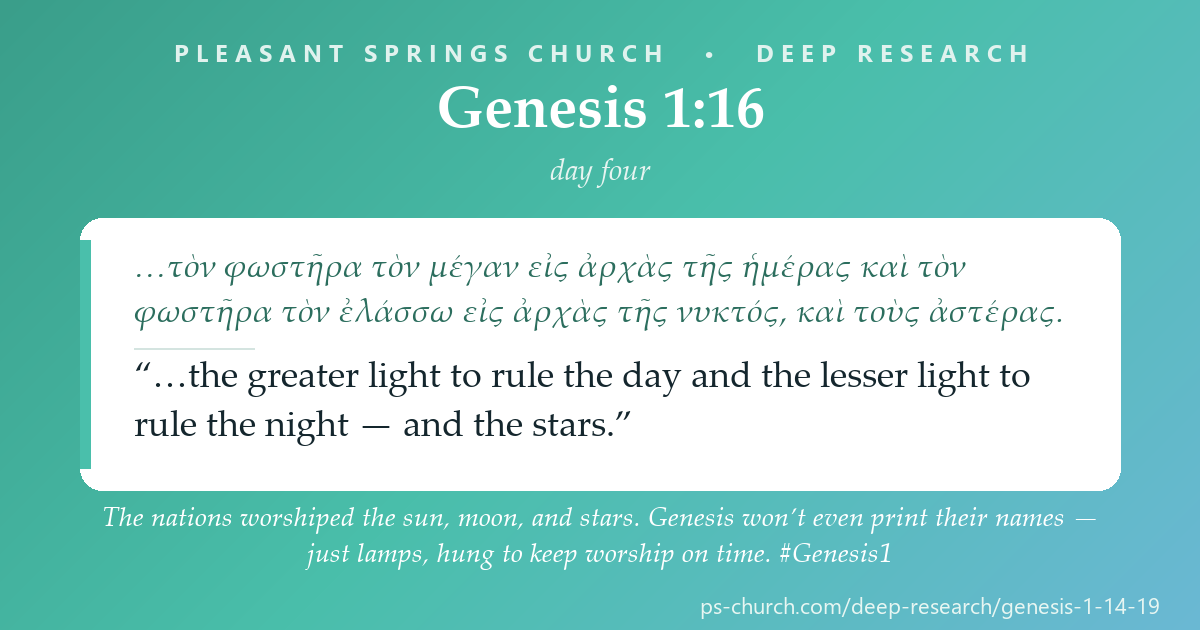
The Torah of Moses now begins the “filling” days: day four populates day one’s light-and-darkness with governors. But the Author writes with studied restraint — he refuses to name the sun and moon, calling them only “the greater light” and “the lesser light,” and he spends exactly two Hebrew words on the entire starry host: וְאֵת הַכּוֹכָבִים, “and the stars.”
Why the silence? In Hebrew, שֶׁמֶשׁ (sun) and יָרֵחַ (moon) sound like the divine names Shamash and Yarikh — the sun-god and moon-god worshiped across Mesopotamia and Canaan. Most commentators (so Wenham, Sarna) hear deliberate polemic in the avoidance: the text will not even lend the neighbors’ gods their names. They are lamps (מְאֹרֹת), not lords.
Audience
Israel lived surrounded by astral religion — Egypt’s Ra, Babylon’s Shamash and Sin, the “host of heaven” whose worship would later infiltrate Israel itself (2 Kgs 21:3–5; 23:5, 11). Deuteronomy 4:19 warns them directly: when you see sun, moon, and stars, do not “be drawn away and bow down to them.”
How they heard it. Day four is that warning in creation form. The beings their neighbors feared as fate-writing deities are here appointed civil servants — installed by God to keep the calendar: “for signs and for seasons” (מוֹעֲדִים, the same word as Israel’s appointed feasts, Lev 23:2). The lights exist to get God’s people to worship on time — not to be worshiped.
Orient on the luminaries, calendars, and astral religion.
Search by topic: sun, moon, stars, host of heaven, calendars, festivals/moʿadim.
Which articles are relevant?
- Anchor Bible Dictionary — “Sun,” “Moon,” “Stars,” “Host of Heaven,” “Calendars (Ancient Israelite and Early Jewish).”
- Dictionary of Deities and Demons in the Bible (DDD) — “Shemesh,” “Yarikh,” “Host of Heaven”: the divine names the text avoids.
- TDOT / NIDOTTE — מָאוֹר (māʾôr), אוֹת (ʾôṯ), מוֹעֵד (môʿēḏ), מָשַׁל (māšal).
Bibliography surfaced:
- Wenham, Genesis 1–15; Sarna, Genesis (JPS) — both strong on the unnamed-luminaries polemic.
- Gerhard Hasel, “The Polemic Nature of the Genesis Cosmology,” Evangelical Quarterly 46 (1974).
- James VanderKam, Calendars in the Dead Sea Scrolls — the Second-Temple calendar wars this verse fed.
The demoted gods — and the Second-Temple calendar wars.
Set day four beside the astral religion it answers, then follow “for signs and seasons” into the fierce Second-Temple debate about whose calendar the lights keep.
Which parallels shed light on religion and worldview?
The demotion. In Enuma Elish Marduk stations the stars as the gods’ images and sets the moon to rule the night as a god; in Egypt the sun crosses the sky as Ra himself. Genesis grants the same architecture — lights ruling day and night — while stripping every ounce of divinity: unnamed lamps, installed fixtures, an afterthought clause for the stars Babylon charted as destiny.
- Jubilees 2:8–10 (Pseudepigrapha — a Second-Temple witness, not Scripture) — reads day four as the charter of its sun-only 364-day calendar: the sun is “a great sign… for days and for sabbaths and for months and for feasts,” and the moon is pointedly dropped from calendar duty.
- 1 Enoch 72–82, the “Astronomical Book” (Pseudepigrapha, likewise non-canonical) — a whole treatise on the luminaries’ gates and courses, underwriting the same solar year; among the oldest Enochic material at Qumran.
- Sirach 43:1–10 (Apocrypha/Deuterocanon — a valued witness, not Scripture) — praises sun and moon as creatures, the moon “a sign for festal seasons” — the mainstream lunisolar reading Jubilees was fighting.
- Qumran calendar texts (4QMMT’s milieu; the mishmarot — sectarian scrolls, not Scripture) — priestly courses run on the 364-day year: which lights govern the feasts was a live, communion-breaking dispute in Jesus’ era.
Both sides of the Second-Temple calendar war read this verse — “for signs and for seasons” — as the luminaries’ job description. They disagreed on the math, but agreed on the theology Genesis taught them: sun and moon are not gods who write fate but servants who keep sacred time. The New Testament then relativizes even the timekeeping: festivals and new moons are “a shadow of the things to come, but the substance belongs to Christ” (Col 2:16–17).
The vocabulary of demotion and appointment.
Watch the sanctuary echo in מְאֹרֹת, the feast-word מוֹעֲדִים, and the LXX’s φωστῆρες on its way to Philippians.
“Lights, lamps” — the same word as the sanctuary lampstand’s light (Exod 25:6; 35:14). The cosmos gets fixtures, as a temple gets lamps.
“Signs” — markers that point beyond themselves (cf. the rainbow, Gen 9:12–13) — not omens that compel. Astrology is demoted to signage.
“Appointed times” — the very word for Israel’s feasts (Lev 23:2, 4). The lights are liturgical clockwork: they exist so worship happens on time.
“Rule, dominion” — delegated governance, the same noun Psalm 136:8–9 sings over sun and moon. Ruling is a creature’s stewardship, never divinity.
“…and the stars.” Two Hebrew words for the host Babylon worshiped and charted — the Bible’s driest demotion.
The LXX’s word for the lights — picked up in Phil 2:15 (“shine as lights in the world”), with Daniel 12:3’s shining wise in between. Day four’s vocabulary becomes the church’s job description.
How the New Testament reuses day four:
- Philippians 2:15 — “you shine as lights (φωστῆρες) in the world”: the LXX’s day-four word, routed through Daniel 12:3’s shining wise — God’s people installed as the world’s luminaries, “holding fast to the word of life.”
- Colossians 2:16–17 — festival, new moon, sabbath: the calendar the lights keep is “a shadow… the substance belongs to Christ.”
- James 1:17 — every good gift comes from “the Father of lights, with whom there is no variation or shadow due to change”: the Maker outshines his lamps.
- Revelation 21:23; 22:5 — the city has “no need of sun or moon… for the glory of God gives it light”: day four’s fixtures honorably retired.
Where day four echoes across the canon.
Trace the anti-astral texts, the praise the luminaries do get, and the calendar thread into the New Testament.
Which cross-references matter?
- Deuteronomy 4:19; 17:3 — the ban on worshiping “the sun or the moon or any of the host of heaven”; 2 Kings 23:5, 11 — Josiah tearing astral worship out of the temple.
- Psalm 136:7–9 — day four sung as covenant love: “the moon and stars to rule over the night, for his steadfast love endures forever.”
- Psalm 19:1–6; 148:3 — the right response: the heavens declare and the lights praise — witnesses, not objects, of worship.
- Joel 2:31; Mark 13:24–25 — on the Day of the Lord the lamps flicker: darkened sun and falling stars announce the Ruler’s arrival, not the gods’ deaths.
- Genesis 1:3–5 — light exists three days before the sun: the fixture never was the source (cf. Rev 22:5).
Day four turns the ancient world’s highest gods into calendar servants for the worship of the true God — the Second-Temple debates fought over their timetable, and the New Testament announces the Light the lamps were always pointing to (John 1:4–5).
The scholarship on the luminaries and the calendars.
Wenham and Sarna for the polemic; Hasel for the classic article; VanderKam for the Second-Temple calendars.
Commentaries & studies:
- Wenham (WBC), Sarna (JPS), Westermann, Hamilton (NICOT), Mathews (NAC).
- Gerhard Hasel, “The Polemic Nature of the Genesis Cosmology” (EQ 46, 1974) — the standard case that Genesis 1 answers the neighbors’ theologies.
- James VanderKam, Calendars in the Dead Sea Scrolls: Measuring Time — the 364-day system and its texts.
- John Walton, Genesis 1 as Ancient Cosmology — day four as functional appointment (“for signs, for seasons”).
Interpretation notes worth keeping:
- Light before luminaries (day one vs. day four) is an old question; the framework observation — day four fills day one’s form — plus the polemic reading (the source of light is God, never the sun) are the load-bearing answers.
- “For signs and for seasons” is purpose language: the text defines the luminaries entirely by function — a point Walton generalizes and even the ancient calendar-warriors assumed.
From demoted gods to shining lights.
Name what you learned, why it matters, and one concrete response.
What should we carry away — and do?
- Nothing created writes your fate. The stars the ancients feared get two Hebrew words. Horoscopes read the janitorial staff of heaven as if they were the Board.
- Time is liturgical. The lights exist “for moʿadim” — appointed worship. A calendar with no appointed time for God misuses the sun.
- You are day four’s successor. “Shine as φωστῆρες in the world” (Phil 2:15) — the church is now the installed light-bearer, reflecting a Light it does not generate (John 1).
Step in response: put one immovable moʿed on next week’s calendar — an appointed, sun-marked time for worship and the Word — and let the lamps do the job they were hung for.
Genesis 1:16 · to share
LXX + ESVEvery Deep Research page traces its passage across the whole sweep — the Old Testament, the Second-Temple world between the testaments (historical witnesses, not Scripture), and the New Testament. Follow the thread:
Pleasant Springs Church — Deep Research
Research method after Michael S. Heiser’s Bible Research Method (examine dictionaries → ancient literature → important words → textual connections → academic publications → share), with the Pleasant Springs “Author & Audience” foundation. Scripture set in the Hebrew, the Greek editions named on each page and the ESV (Old Testament), and the Greek New Testament and the ESV (New Testament), per the practice of Pleasant Springs Church. Genesis 1:14–19 research grounded in Wenham, Sarna, Hasel, Walton, and VanderKam; Second-Temple calendar material per Jubilees 2, 1 Enoch 72–82, Sirach 43, and the Qumran calendar texts (all read as witnesses, not Scripture).
Scripture quotations marked ESV are from the ESV® Bible (The Holy Bible, English Standard Version®), © 2001 by Crossway, a publishing ministry of Good News Publishers. ESV Text Edition: 2016. Used by permission. All rights reserved. The ESV text may not be quoted in any publication made available to the public by a Creative Commons license, and the ESV may not be translated in whole or in part into any other language. www.esv.org
|
Did this study bless you today? 💚 Give to Support PS Church100% of gifts go to the General Fund — thank you. |