Sixty-eight verses — the longest chapter in Deuteronomy, and the hardest to preach. Fourteen of them bless (28:1–14) and fifty-four curse (28:15–68). But the two halves are one design: the curse list is the blessing list read backwards, clause by clause, and you can check it with a finger on the page. “Blessed shall you be in the city, and blessed shall you be in the field” becomes “Cursed shall you be in the city, and cursed shall you be in the field.” Your basket and your kneading bowl. The fruit of your womb. Coming in and going out. The head and not the tail — and then the tail and not the head. Then the futility curses (build a house and not live in it, betroth a wife and see her taken by another man, plant a vineyard and never taste it), a sky of bronze over a soil of iron, groping at noonday like a blind man in the dark, and at last the exodus itself run in reverse: back to Egypt in ships, offering yourselves for sale, “but there will be no buyer” (28:68). This study works Deuteronomy 28:1–68 plainly — and fences it just as plainly. These are covenant sanctions, sworn by one nation about itself, and no reader may aim them at anyone. See the method →
Deuteronomy 28:1–68 (selections) — MT = LXX = English
Hebrew · LXX · ESVThe Shape of the Passage
Parallel panelsDeuteronomy 28 is the sanctions section of a covenant document. Behind it: the mutual oath of 26:16–19 and the liturgy of the two mountains with its twelve Amens in chapter 27. Ahead of it: the covenant made in Moab and the promise that answers the curse — chapters 29–30. The nearest parallel in the Torah is Leviticus 26, and the theme was announced back at 11:26–29: “See, I am setting before you today a blessing and a curse.”
Author
Moses, preaching on the plains of Moab. This is not a prediction and it is not a threat thrown at strangers. It is the sanctions clause of a covenant, and every ancient covenant had one. Deuteronomy carries the shape of an ancient suzerainty treaty — preamble, historical prologue, stipulations, deposit and public reading, witnesses, and at the end blessings and curses (Kline, Mendenhall, Weinfeld) — and chapter 28 is the last of those elements. That observation is about the form of the book; scholars on every side of the dating question have used it, so we report the shape and leave the date where the text leaves it.
Why sanctions are published in advance. A curse list at the end of a treaty is not a wish. It is disclosure. Nobody hides the penalty clause — the whole point is that the vassal reads it before he signs, so that the penalty need never be applied. Moses is not consigning Israel to this; he is preaching it to a people God is trying to keep. That is why the same book, two chapters later, tells them what to do when the worst of it has happened: “when all these things come upon you… and you return… then the Lord your God will restore your fortunes” (30:1–3), and will himself “circumcise your heart… so that you will love the Lord your God” (30:6). The curse chapter has an answer chapter, and the answer is God’s own act.
Audience
Israel, by Israel’s own oath. Two chapters earlier this people said yes with their own mouths: “You have declared today that the Lord is your God… and the Lord has declared today that you are a people for his treasured possession” (26:17–18). One chapter earlier they stood on two mountains and answered “Amen” twelve times to a list of curses (27:15–26). Chapter 28 is what they had just agreed to. Every verb in it is second person — you, singular, the covenant partner — and there is no third party anywhere in the chapter.
⚠ A fence, stated plainly and kept for the whole page. This chapter has been misused, badly and for centuries, to explain other people’s suffering — to read a nation’s catastrophe, a family’s poverty, a body’s illness, or a people’s enslavement as the visible operation of these verses. It has been turned against the Jewish people, and it has been turned by prosperity preaching into a diagnosis of the sick and the poor. Both are abuses of the text, not applications of it. Deuteronomy 28 is a covenant document addressed to one covenant nation by that nation’s own sworn oath. In the whole of Scripture it is never aimed outward; it is only ever taken up in the first person, as confession, by the people it was addressed to (Dan 9:11–13; Neh 9:32–37; Ezra 9:6–7; and, among the Second-Temple witnesses, Baruch 1:20–2:2). No reader of this page may aim it at anyone. If you cannot read this chapter with your own name in the second person and nobody else’s, put it down.
Orient on blessing and curse, covenant sanctions, the treaty form, and futility curses.
Search by topic: blessing, curse, covenant, treaty (suzerainty / vassal), sanctions, oath, retribution, futility curse, siege, exile, disease and plague in the OT, Deuteronomistic theology.
Which articles are relevant?
- Anchor Bible Dictionary — “Blessings and Curses,” “Covenant,” “Treaty,” “Oath,” “Deuteronomy,” “Retribution,” “Siege,” “Exile.”
- Dictionary of the OT: Pentateuch — “Blessings and Curses,” “Covenant,” “Ancient Near Eastern Background,” “Deuteronomy, Book of,” “Land,” “Theology of the Pentateuch.”
- NIDOTTE / TDOT — בָּרַךְ (bāraḵ, bless), אָרַר (ʾārar, curse), קְלָלָה (qəlālāh, curse, the noun used at 28:15), שָׁמַע (šāmaʿ, hear/obey), עָבַד (ʿāḇaḏ, serve).
- Dictionary of Biblical Imagery — “Curse,” “Blindness,” “Iron,” “Bronze,” “Locust,” “Yoke” — useful for 28:23, 28:28–29, 28:38 and 28:48.
Bibliography surfaced:
- Peter C. Craigie (NICOT), Daniel I. Block (NIVAC), J. G. McConville (Apollos), Jeffrey H. Tigay (JPS), Duane L. Christensen (WBC), Richard D. Nelson (OTL), S. R. Driver (ICC), Patrick D. Miller (Interpretation), Eugene H. Merrill (NAC) on Deuteronomy — and Moshe Weinfeld (Anchor, Deuteronomy 1–11 only; the second volume was never published, so for chapter 28 see instead his Deuteronomy and the Deuteronomic School).
- Meredith G. Kline, Treaty of the Great King; George Mendenhall on the covenant form; Moshe Weinfeld, Deuteronomy and the Deuteronomic School.
- Hans Ulrich Steymans, Deuteronomium 28 und die adê zur Thronfolgeregelung Asarhaddons (1995) — the book-length study of this chapter beside the Assyrian treaty curses.
- G. K. Beale & D. A. Carson, eds., Commentary on the New Testament Use of the Old Testament (Galatians).
Curse lists at the end of treaties — and what the parallel does and does not settle.
Read Deuteronomy 28 beside the ANE documents that end the same way. Cite what can be verified in the printed translations; hedge what cannot; and refuse to let a literary parallel do doctrinal work it cannot bear.
Which parallels shed light on religion and worldview?
Every treaty ended like this. In the ancient Near East a treaty closed with a list of gods called as witnesses and then a set of curses to be executed if the oath was broken. The Hittite treaty between Mursilis and Duppi-Tessub of Amurru ends with a section headed, in the standard translation, “Curses and Blessings”: if Duppi-Tessub does not honour the words of the treaty, “may these gods of the oath destroy Duppi-Tessub together with his person, his wife, his son, his grandson, his house, his land”; if he does honour them, may the same gods protect exactly the same list (ANET 205). The longer Suppiluliumas–Kurtiwaza document spells the curses out at length — the throne overturned, misery and poverty, a name exterminated from the earth, a soil made “a hardened quagmire so that you break in, but never get across” (ANET 205–206). The epilogue of the Code of Hammurabi does the same for a law collection, god by god: may Enlil decree “a reign of woe, days few in number, years of famine, darkness without light”; may Enki “deprive him of knowledge and understanding, and constantly lead him astray”; may Adad “deprive him of the rains from heaven… bring his land to destruction through want and hunger” (ANET 178–180). A reader meeting Deuteronomy 28 for the first time should know: this is the shape a covenant document had. Israel is not being addressed in a private language.
The Assyrian parallel, reported and hedged. The most discussed comparison is the Succession Treaty of Esarhaddon (the “Vassal-Treaties,” VTE / adê, 672 BC), whose long curse section is printed among the Akkadian treaties in ANET. (Our local scan of ANET does not reach those pages, so no page number is cited here.) Since Rintje Frankena and Moshe Weinfeld in 1965 it has been observed that Deut 28:27–35 runs through the same afflictions in the same order as VTE §§39–42 — skin disease, then blindness and groping in the dark, then the wife taken, the house built and not lived in — an order that in the Assyrian text is dictated by the sequence of its own gods (Sin the moon-god, Shamash the sun-god, and Venus), which is precisely why the agreement in sequence is thought to mean something. The same treaty asks that the ground be made like iron and that rain not fall from a sky of bronze, which is the exact pairing of Deut 28:23 — and note that Leviticus 26:19 assigns the metals the other way round. Hans Ulrich Steymans devoted a monograph to the correspondence; Jacob Lauinger’s publication of a copy of the treaty excavated at Tell Tayinat in the Levant (2012) showed that such documents were imposed and stored in the west, not only in Assyria.
- Treaty between Mursilis and Duppi-Tessub of Amurru, §§20–21, “Curses and Blessings” (ANET 205; Hittite, 14th c. BC — an ancient witness, not Scripture) — one sentence of curse and one of blessing, over the same list of persons and possessions.
- God List, Blessings and Curses of the Treaty between Suppiluliumas and Kurtiwaza (ANET 205–206 — a witness, not Scripture) — an extended curse list: no seed, misery and poverty, the throne overturned, the name exterminated, the soil turned treacherous.
- The epilogue of the Code of Hammurabi (ANET 178–180 — a witness, not Scripture) — famine, darkness without light, rains withheld, understanding taken away: the ANE curse repertoire in its classic form.
- Succession Treaty of Esarhaddon (VTE), 672 BC (printed among the Akkadian treaties in ANET; page not verified against our local scan — a witness, not Scripture) — the closest and most-argued parallel to Deut 28:20–44. See Frankena (1965), Weinfeld (1965), Steymans (1995), and Lauinger on the Tell Tayinat copy (2012).
- The Sefire treaty inscriptions (Aramaic, 8th c. BC; in ANET’s Aramaic section — page not verified locally) — a Northwest Semitic curse formula close to Israel’s own language and geography.
- Philo, On Rewards and Punishments (Second Temple — a witness, not Scripture) — a whole treatise on the blessings and the curses of Deut 28 and Lev 26, which ends where Deuteronomy’s sanctions end (30:1–10): not with the curse but with restoration.
- The Community Rule, 1QS 2:1–18 (Dead Sea Scrolls — a witness, not Scripture) — an annual covenant ceremony in which priests bless, Levites curse, and those entering answer “Amen, amen”: Deuteronomy 27–28 still being enacted as liturgy centuries later.
- Josephus, Antiquities 4.302–308 (Second Temple — a witness, not Scripture) — Moses delivering the book with its blessings and curses, and the ceremony appointed for the two mountains.
It settles the genre. Deuteronomy 28 is a sanctions list, and sanctions lists looked like this; the vocabulary of ruined crops, withheld rain, disease, defeat and exile was the standard repertoire, and several of Deuteronomy’s items sit in the same order as an Assyrian treaty’s. Knowing that keeps a reader from two errors at once: from treating the chapter as an eccentric outburst, and from treating it as a general theory of why bad things happen. It is neither. It is a covenant penalty clause in the form its own century used.
It does not settle the date, and it is not an escape hatch. The correspondence has been read as evidence that Deuteronomy was composed in the seventh century under Assyrian influence, and equally as evidence that Israel used a treaty form attested from the Hittite period onward — Kline and, more recently, Kenneth Kitchen and Joshua Berman press that side. We report the parallel and decline to adjudicate. And a parallel of form does not soften the content: saying that the curse list is conventional does not make it less serious, and it does not make it less God’s word. What the form does establish is the direction the words point — inward, at the sworn party, and nowhere else.
Blessed and cursed; basket and bowl; madness and metal; and the reason the chapter actually gives.
Watch baruch and arur (the same grammar, opposite verdict), tene and mishereth (the kitchen, not the throne), nechoshet and barzel (a sky and a soil you cannot get through), and simchah in 28:47 — the one motive the chapter names. Verse numbers need no conversion anywhere in this chapter: Hebrew, Rahlfs LXX and English all run 28:1–68 alike.
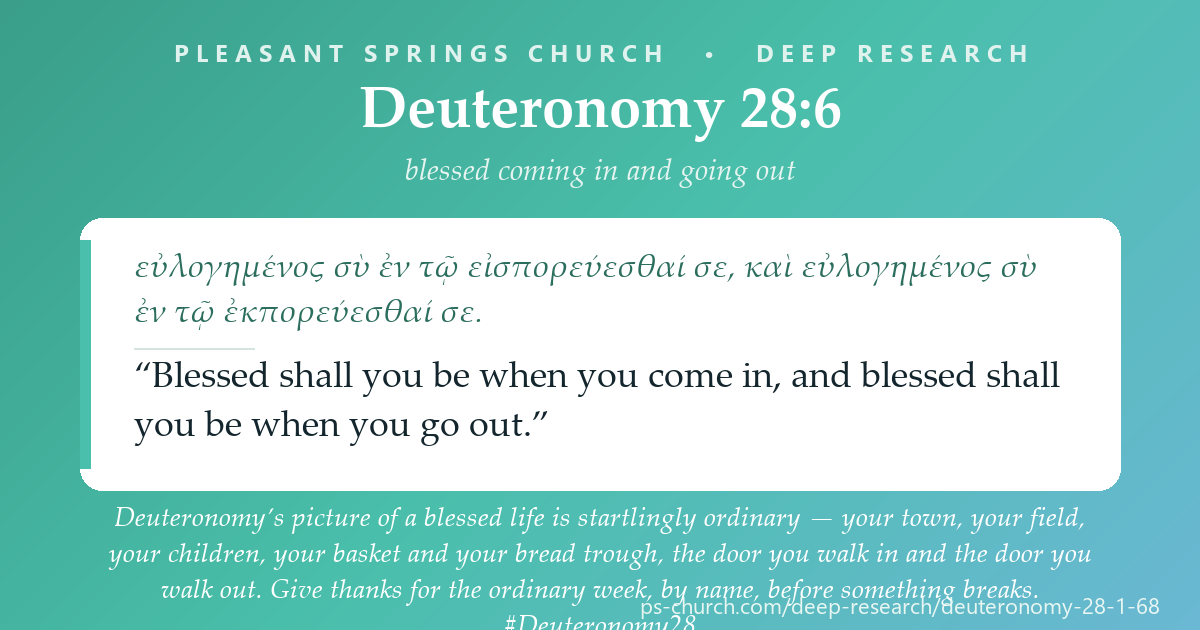
“Blessed” — a passive participle, not a wish: this one has been blessed. Six times in four verses, always fronted, so the sentence begins with the word before you learn who or what it lands on (LXX εὐλογημένος). The list is deliberately domestic — town, field, children, livestock, the basket you carry produce in and the trough you knead dough in. Nothing grand. The blessing of Deuteronomy is an ordinary week that works.
“Cursed” — the exact counterpart, the same participial form, the same six slots, fronted the same way (LXX ἐπικατάρατος). It is the word that rang twelve times from Mount Ebal in chapter 27, and ἐπικατάρατος is the Greek word Paul has in front of him when he writes Gal 3:10 and Gal 3:13. A curse in the OT is not a spell; it is a sentence pronounced by a judge who is also the covenant partner.
“Basket and kneading bowl” — the two commonest objects in a peasant kitchen: the carrying basket that brings the harvest in, and the wooden trough where dough is worked. Between them they cover the whole distance from field to table. The LXX loses the picture and generalizes, ἀποθῆκαι (“storehouses”) and ἐγκαταλείμματα (“leftovers”), which is what happens when a farm word crosses into a city language.
“Madness, blindness, and confusion of mind” — three abstract nouns in a row, the last literally “bewilderment of heart.” The LXX’s middle term is ἀορασία, the same word used of the blindness that struck the men at Lot’s door (Gen 19:11) — not loss of eyesight so much as loss of the ability to find what is right in front of you. Hence 28:29: groping at noon, when the light could not be better.
“Bronze… iron” — sky and soil, both turned to metal: nothing comes down and nothing comes up. Leviticus 26:19 uses the identical image with the metals swapped (heavens like iron, earth like bronze), and the Assyrian treaty curse pairs them as Deuteronomy does. Two inspired texts, one picture, opposite assignments — which is a useful reminder that the image is the message, not the metallurgy.
“With joyfulness and gladness of heart” — one of the chapter’s two stated diagnoses (the other is 28:20, “because you have forsaken me”): joyless service, offered “because of the abundance of all things.” The verb is עָבַד (ʿāḇaḏ, serve), and 28:48 answers it with the same verb: you shall serve your enemies. The LXX keeps the play exactly — οὐκ ἐλάτρευσας… then καὶ λατρεύσεις τοῖς ἐχθροῖς σου. You will serve something. The question the chapter puts is what, and with what face.
Where the New Testament takes this chapter:
- Galatians 3:10–14 — Paul quotes the Ebal liturgy (Deut 27:26) to establish that the law’s curse is real, and then: “Christ redeemed us from the curse of the law by becoming a curse for us—for it is written, ‘Cursed is everyone who is hanged on a tree’” (Deut 21:23). This is the canon’s own answer to Deuteronomy 28, and it is the only place a Christian is permitted to point the curse: at the cross.
- John 9:1–3 — “Rabbi, who sinned, this man or his parents, that he was born blind?” Jesus answers, “It was not that this man sinned, or his parents.” The disciples were reasoning from a chapter like this one, and he told them plainly that they had it wrong.
- Luke 13:1–5 — the Galileans and the tower of Siloam: “Do you think that they were worse offenders…? No, I tell you.” Jesus refuses to read anyone else’s catastrophe as a verdict, and turns the question back on the questioner.
- Job, whole — the book the canon put in place precisely so that the friends’ use of covenant logic on an individual sufferer could be answered by God himself: “you have not spoken of me what is right” (Job 42:7).
- Romans 8:31–39 — where the accounting finally lands for those in Christ: nothing in creation “will be able to separate us from the love of God in Christ Jesus our Lord” (see Romans 8).
The curse across the canon — and who is allowed to say it about whom.
Run three threads. First the inversion inside the chapter itself. Then the exodus, run backwards. Then the way the rest of Scripture actually uses this chapter — which turns out to be the strongest fence anyone could build around it.
Which cross-references matter?
- Leviticus 26:1–46 — the Torah’s other sanctions chapter: the same blessings, a curse list that escalates in five waves, four of them introduced by the “sevenfold” formula (26:18, 21, 24, 28), and an ending Deuteronomy 28 does not have — “yet for all that… I will not spurn them… I will remember the covenant” (26:44–45). Read them together (see Leviticus 26).
- Deuteronomy 11:26–29 — “See, I am setting before you today a blessing and a curse,” with Gerizim and Ebal already named: chapter 28 is the cashing of that cheque (see Deuteronomy 11).
- Deuteronomy 26:16–19; 27:9–26 — the mutual declaration and then the twelve Amens. The people said yes before they heard chapter 28, and chapter 28 is what they said yes to (see Deuteronomy 26 and Deuteronomy 27).
- Deuteronomy 29:1–30:20 — the covenant in Moab and the turn the whole book has been driving toward: “when all these things come upon you… and you return… the Lord your God will circumcise your heart” (30:1–6). The curse chapter is not the last word in its own book (see Deuteronomy 29–30).
- Exodus 9:8–12; 10:21–23 — the boils and the darkness that could be felt. Deuteronomy 28:27 and 28:60 promise Israel “the boils of Egypt… all the diseases of Egypt,” 28:29 puts them groping in the dark, and 28:68 sends them back to Egypt in ships. The curse section is the exodus run in reverse (see Exodus 9 and Exodus 10).
- Daniel 9:11–13 — “the curse and oath that are written in the Law of Moses the servant of God have been poured out upon us, because we have sinned against him.” Note the pronoun. Daniel, who is not personally guilty of any of it, says us (our page covers the vision that follows, Daniel 9:24–27).
- Nehemiah 9:32–37; Ezra 9:6–7; 1 Kings 8:33–40 — the same move: the chapter taken up as confession by the covenant people about themselves, never as a verdict on outsiders.
- Jeremiah 31:31–34; Ezekiel 36:24–28 — the prophets’ answer to a covenant that could be broken: a law written on the heart, a heart of flesh, a Spirit given (see Jeremiah 31 and Ezekiel 36).
- Isaiah 52:13–53:12 — “he was pierced for our transgressions… the Lord has laid on him the iniquity of us all.” The line Galatians will draw runs from here (see Isaiah 53).
Lay the two halves side by side and the correspondence is not a scholar’s hunch; it is on the page. City and field (28:3 ↔ 28:16). The fruit of the womb, the ground, the herd, the flock (28:4 ↔ 28:18). Basket and kneading bowl (28:5 ↔ 28:17). Coming in and going out (28:6 ↔ 28:19). Enemies who come out one way and flee seven (28:7) ↔ you go out one way and flee seven (28:25). The Lord opening his good treasury, the heavens, to give rain (28:12) ↔ a sky of bronze and a soil of iron, and rain turned to powder and dust (28:23–24). Lending to many nations and borrowing from none (28:12) ↔ the sojourner lending to you (28:43–44). The head and not the tail (28:13) ↔ the tail and not the head (28:44). A people holy to himself, and the nations afraid of them (28:9–10) ↔ a horror, a proverb and a byword among all peoples (28:37).
Then read what the reversal is made of. Much of it is not exotic at all: a house you built and cannot sleep in, a vineyard tended and never tasted, seed carried out by the sackful and brought back by the handful (28:30, 38–40) — the futility curses, which do not take the good things away so much as sever the thread between work and harvest, promise and possession. But 28:30 goes further than futility, and the verse must be read as it stands: “You shall betroth a wife, but another man shall ravish her.” It is also a father watching his children marched away — “your sons and your daughters shall be given to another people, while your eyes look on and fail with longing for them all day long, but you shall be helpless” (28:32; cf. 28:41). Not exotic, and not small. And it ends where the whole Bible said Israel would never have to go again: on a ship, back to Egypt, offering themselves for sale “but there will be no buyer” (28:68). Not even worth owning. The exodus undone, and the last word of the chapter is a market with nobody in it.
Between those two poles sits the siege (28:52–57), where the text describes the actual horror of ancient siege warfare — a starvation so total that it destroys what parents are. Scripture states it; describing is not commending; and we do not linger.
The commentaries, the treaty debate, and the interpretive rules this chapter needs.
Craigie, Block, McConville, Tigay, Christensen, Nelson, Driver, Miller and Merrill on Deuteronomy; Kline and Mendenhall on the treaty form; Frankena, Weinfeld, Steymans and Lauinger on the Assyrian comparison, with Kitchen and Berman on the other side; Beale & Carson on Galatians.
Commentaries & studies:
- Peter C. Craigie, The Book of Deuteronomy (NICOT); Daniel I. Block, Deuteronomy (NIVAC); J. G. McConville, Deuteronomy (Apollos); Jeffrey H. Tigay, Deuteronomy (JPS); Duane L. Christensen (WBC); Richard D. Nelson (OTL); S. R. Driver (ICC); Patrick D. Miller (Interpretation); Eugene H. Merrill (NAC). (Moshe Weinfeld’s Anchor volume is Deuteronomy 1–11 (AB 5, 1991) and stops short of this chapter; for ch. 28 his contribution is Deuteronomy and the Deuteronomic School and the 1965 Biblica article, cited below.)
- Meredith G. Kline, Treaty of the Great King; George E. Mendenhall, Law and Covenant in Israel and the Ancient Near East — the covenant-form argument, reported as literary shape.
- Rintje Frankena, “The Vassal-Treaties of Esarhaddon and the Dating of Deuteronomy” (OTS 14, 1965); Moshe Weinfeld, “Traces of Assyrian Treaty Formulae in Deuteronomy” (Biblica 46, 1965) and Deuteronomy and the Deuteronomic School (1972).
- Hans Ulrich Steymans, Deuteronomium 28 und die adê zur Thronfolgeregelung Asarhaddons (OBO 145, 1995) — the fullest treatment of this chapter and VTE.
- Jacob Lauinger, “Esarhaddon’s Succession Treaty at Tell Tayinat: Text and Commentary” (JCS 64, 2012) — the western copy.
- K. A. Kitchen & P. J. N. Lawrence, Treaty, Law and Covenant in the Ancient Near East (2012); Joshua Berman on the Hittite-period comparanda — the case against straightforward seventh-century dependence.
- J. B. Pritchard, ed., Ancient Near Eastern Texts (ANET) — the Hittite treaty curses (205–206), the epilogue of the Code of Hammurabi (178–180); the Esarhaddon and Sefire texts are in the same volume but past the pages verified against our local copy.
- G. K. Beale & D. A. Carson, eds., Commentary on the New Testament Use of the Old Testament (Galatians — Moisés Silva on Gal 3:10–14).
Interpretation notes worth keeping:
- ⚠ This chapter may not be pointed at anyone. It is covenant sanctions, sworn by one nation about itself. Reading it as an explanation of a modern nation’s catastrophe, a neighbour’s illness, a family’s poverty, or any people’s enslavement is not application but abuse — and it has done real historical harm, most notoriously in centuries of Christian contempt for the Jewish people, and again wherever prosperity preaching turns 28:1–14 into a formula and 28:15–68 into a diagnosis of the suffering. Scripture never uses it that way. It is only ever taken up as confession, in the first person plural, by the people it addresses.
- ⚠ 28:63 is the hardest line in the chapter and must not be skipped. “And as the Lord took delight in doing you good and multiplying you, so the Lord will take delight in bringing ruin upon you and destroying you.” Every curse here is God’s own act — the chapter says so again and again (28:20, 21, 22, 24, 25, 27, 28, 35, 36, 48, 49, 59, 61, 63) — not an impersonal consequence, and the text will not let us make it one. Deuteronomy itself is the only thing that answers it: the same God who says this says 30:6, and Ezek 33:11 says he takes no pleasure in the death of the wicked. Hold both; do not resolve either.
- The proportions are part of the message, and they are not a proportion of God. Fourteen verses of blessing and fifty-four of curse tell you what a covenant mediator is afraid of. They are not a measurement of God — 28:63 and 30:6 stand in the same book. Deuteronomy itself supplies the corrective four verses earlier and two chapters later: “the Lord your God will set you high…” (28:1) and “the Lord your God will circumcise your heart” (30:6). Preach chapter 28 without chapter 30 and you have preached half a sermon by a man who did not stop there.
- Do not run the logic backwards. The chapter says: if the covenant is broken, this follows. It does not license the inference: this has happened, therefore that person broke the covenant. Job’s friends made exactly that inversion, and God’s verdict on it is recorded (Job 42:7). Jesus refused it twice, in John 9:1–3 and Luke 13:1–5.
- The chapter gives its reason twice, and they belong together. 28:20: “on account of the evil of your deeds, because you have forsaken me” — covenant abandonment, the thing the whole book has been warning about, and 28:36 and 28:64 name serving other gods. And 28:47: they served “without joyfulness and gladness of heart, because of the abundance of all things.” The second is not a different diagnosis but the road to the first: abundance received without gladness toward the giver is how forsaking begins — which is a warning that lands at least as naturally on a comfortable church as on a suffering one.
- The covenant is national and land-tenured; it is not a contract for individual outcomes. The blessings and curses concern Israel’s life in a particular land under a particular covenant. The New Testament does not transfer that arrangement to the church or to any modern state, and it does not promise believers exemption from loss — it promises that no loss separates (Rom 8:35–39).
- End where the canon ends it. “Christ redeemed us from the curse of the law by becoming a curse for us” (Gal 3:13). Not the curse explained away, not the curse denied, and not the curse redirected at somebody else — the curse absorbed. That is the only Christian use of Deuteronomy 28 that is not a misuse.
From a basket and a kneading bowl to a curse carried away by someone else.
Name what you learned, why it matters, and one concrete response.
What should we carry away — and do?
- The blessing is domestic. Town, field, children, herds, the basket, the bread trough, walking in the door and walking out of it. Deuteronomy does not describe a blessed life as a spectacular one. It describes an ordinary week in which everything holds together — which is exactly the thing we notice only after it stops.
- The curse is the same list, unmade. The futility curses sever the thread between work and harvest — 28:38–40, seed carried out by the sackful and brought back by the handful. And 28:30 goes further than futility: it names a violence done to a person, and the chapter treats it as grief, not rhetoric.
- ⚠ You do not get to hand this chapter to anyone. In Scripture it is only ever taken up in the first person: we have sinned, us the curse has overtaken (Dan 9:11). The moment it becomes an explanation of somebody else’s hard life, it has been stolen. Say it about yourself or say nothing.
- The reason includes joylessness, not only failure. “Because you did not serve the Lord your God with joyfulness and gladness of heart, because of the abundance of all things” (28:47). Abundance is named as the danger. Ask honestly which of the two Israels you resemble more — the one in the curse, or the one with too much and no gladness.
- Sanctions are published so they need not be applied. Nobody reads a penalty clause aloud to a people they have given up on. This chapter is preached to people God is trying to keep, and two chapters later he promises to do to their hearts what they could not do (30:6).
Step in response: take the blessing list of 28:3–6 and write down your own version — the six most ordinary working parts of your week — and give thanks for them by name, out loud, before something breaks. Then do the harder half: find one place where you have quietly used a chapter like this on someone else, in your head or out loud, about their money or their marriage or their health, and repent of it specifically. The curse of the law has already been carried, and not by them.
Deuteronomy 28:6 · to share
Hebrew + LXX + ESVEvery Deep Research page traces its passage across the whole sweep — the Old Testament, the Second-Temple world between the testaments (historical witnesses, not Scripture), and the New Testament. Follow the thread:
Pleasant Springs Church — Deep Research
Research method after Michael S. Heiser’s Bible Research Method (examine dictionaries → ancient literature → important words → textual connections → academic publications → share), with the Pleasant Springs “Author & Audience” foundation. Scripture set in the Hebrew, the Greek editions named on each page and the ESV (Old Testament), and the Greek New Testament and the ESV (New Testament), per the practice of Pleasant Springs Church. Deuteronomy 28 research grounded in Craigie, Block, McConville, Tigay, Christensen, Nelson, Driver, Miller and Merrill, with Kline and Mendenhall on the treaty form (reported as the book’s literary shape, not as a settled argument about its date) and Beale & Carson on the New Testament use (Galatians). ANE comparanda verified in ANET: the “Curses and Blessings” of the Mursilis–Duppi-Tessub treaty and the Suppiluliumas–Kurtiwaza god list (ANET 205–206) and the epilogue of the Code of Hammurabi (ANET 178–180); the much-discussed Succession Treaty of Esarhaddon (VTE) and the Sefire inscriptions are cited without page numbers, since those pages lie outside the copy checked here — the parallel of literary form is reported (Frankena, Weinfeld, Steymans, Lauinger) and is deliberately not allowed to settle the dating question, on which Kitchen, Lawrence and Berman argue the other way. Second-Temple and rabbinic-era material (Philo, On Rewards and Punishments; 1QS 2; Josephus, Ant. 4.302–308; Baruch) is read as witness, never leveled with Scripture. Versification: Deuteronomy 28 has no MT/LXX offset — Hebrew, Rahlfs LXX and English all number 28:1–68 alike; the offset begins in the next verse, where English 29:1 = MT/LXX 28:69. Doctrinally, the chapter is handled as covenant sanctions on a covenant nation sworn by that nation’s own oath; it is never applied to any modern person, people or nation as an explanation of their suffering, a misuse the page names and refuses; the siege verses are stated once and not narrated; and the canon’s own resolution is allowed to stand — the promised heart-circumcision of Deut 30:6, and the curse borne by Christ in Gal 3:13.
Scripture quotations marked ESV are from the ESV® Bible (The Holy Bible, English Standard Version®), © 2001 by Crossway, a publishing ministry of Good News Publishers. ESV Text Edition: 2016. Used by permission. All rights reserved. The ESV text may not be quoted in any publication made available to the public by a Creative Commons license, and the ESV may not be translated in whole or in part into any other language. www.esv.org
|
Did this study bless you today? 💚 Give to Support PS Church100% of gifts go to the General Fund — thank you. |