One hundred and twenty years old, and finished. “I am no longer able to go out and come in. The Lord has said to me, ‘You shall not go over this Jordan’” (31:2). What Moses does with his last working day is worth watching closely, because almost none of it is about him. He gives the charge twice — once to the whole nation and once to Joshua in their sight: “Be strong and courageous… it is the Lord your God who goes with you. He will not leave you or forsake you” (31:6, 8). He finishes the manuscript and hands it to the priests who carry the ark, with orders that every seventh year, at the Feast of Booths in the year of release, it be read out loud to everybody — “men, women, and little ones, and the sojourner within your towns… that their children, who have not known it, may hear and learn” (31:12–13). Then the tent of meeting and the pillar of cloud (31:14–15); God’s own blunt forecast that they will break the covenant (31:16–18); a Song given as a witness and put in their mouths before the failure it describes (31:19–22); and the finished book laid beside the ark (31:24–26). This study works Deuteronomy 31:1–30 — succession handled well and in public, Scripture written down, deposited and read aloud, and a God who commissions a people he already knows will fail. See the method →
Deuteronomy 31:1–30 (selections) — MT = LXX = English
Hebrew · LXX · ESVThe Shape of the Passage
Parallel panelsChapter 31 begins the book’s closing movement. Behind it: the central law code (chs 12–26, ending with the firstfruits liturgy of ch 26), the mountains and the twelve Amens of ch 27, the blessings and curses of ch 28, and the covenant in Moab with its “choose life” of chs 29–30. Ahead of it: the Song itself (ch 32) and the blessing and the death of Moses (chs 33–34). Joshua was first set apart in Numbers 27:12–23, and Moses was told to “charge Joshua, and encourage and strengthen him” back at Deut 3:28.
Author
Moses, on the last day of his work. Deuteronomy has been preached law from the start — sermons on the plains of Moab, forty years on, to the children of the generation that died. Chapter 31 is where the preaching stops and the handing-over starts. Notice how much of it is administrative: a successor named in public, a manuscript finished and delivered to named custodians, a reading schedule fixed to the calendar, a text deposited in a specific place with a specific purpose. Nothing here is left to sentiment or to whoever happens to be standing closest when he dies.
“I am no longer able to go out and come in.” The phrase (31:2) is not a complaint about knees. To go out and come in is the standing Hebrew idiom for leading an army in the field — it is exactly what Moses had asked God to provide when he prayed for a successor, “who shall go out before them and come in before them” (Num 27:17), and it is what is later said of David (1 Sam 18:13, 16). So 31:2 is a resignation from command, not a medical bulletin — which is why Deut 34:7 can still say his eye was undimmed and his vigour unabated. And the real reason is given in the same breath, without softening: the Lord has said to me, “You shall not go over this Jordan.”
A book shaped like a treaty. Deuteronomy as a whole follows the ancient Near Eastern suzerainty-treaty pattern — preamble, historical prologue, stipulations, witnesses, blessings and curses — a genuine observation about the shape of the book (Kline, Weinfeld) that has been pressed on both sides of the dating debate, and we are not going to settle that here. What is striking is that chapter 31 supplies the two treaty clauses the rest of the book had not yet used: deposit (the document placed in the sanctuary) and periodic public reading. Ancient treaties really did end that way. So does this one.
Audience
A people about to lose the only leader they have ever had. Everyone standing there was born in the wilderness or came out of Egypt as a child. Moses is the constant. And the answer given to their anxiety is not “he was only a man” and not “Joshua is just as good” — it is a sentence about somebody else entirely: the Lord your God is the one who goes with you. The succession is handled well precisely because it is not made to carry more than it can.
And a nation almost none of whom could read. This is the point most modern readers walk past. In the ancient Levant writing was a craft, not a common skill; scribes wrote and everybody else listened. That is why 31:11 says “you shall read this law before all Israel in their hearing” — literally in their ears — and why 31:12 spells out the guest list rather than assuming it: men, women, and little ones, and the sojourner within your towns. Four groups, and three of them are people no ancient legal system would have troubled to inform. The whole nation, including everyone who could not read a word of it, is deliberately put in earshot of the text.
Why they were told they would fail. The hardest thing in the chapter is that God commissions this people while saying plainly what they will do (31:16–21) — and that Moses says it too, in his own voice and to their faces: “I know how rebellious and stubborn you are… how much more after my death!” (31:27; cf. 31:29). It would be easy to hear that as cynicism. It is the opposite. Notice the order: the Song is written, taught and lodged in their mouths before the failure it describes. Nobody is set up. The generation that breaks the covenant will find that the words explaining what happened to them, and the God who is still there to be turned back to, were put into their children’s memories in advance. That is not a trap. That is provision.
Orient on succession, the ark and the Book of the Law, public reading, the Song, and covenant witnesses.
Search by topic: Joshua son of Nun, succession and leadership, laying on of hands, tent of meeting, pillar of cloud, ark of the covenant, Book of the Law, scribes and literacy in ancient Israel, public reading of Scripture, Hakhel, sabbatical year (shemittah), Feast of Booths, song and poetry in the OT, witness (ʿed), hiding the face of God.
Which articles are relevant?
- Anchor Bible Dictionary — “Joshua (person),” “Ark of the Covenant,” “Tent of Meeting,” “Book of the Law,” “Writing and Writing Materials,” “Literacy,” “Sabbatical Year,” “Booths, Feast of,” “Witness,” “Song of Moses.”
- Dictionary of the OT: Pentateuch — “Deuteronomy, Book of,” “Moses,” “Joshua,” “Leadership,” “Song of Moses,” “Poetry,” “Covenant,” “Worship,” “Aliens and Strangers,” “Children.”
- NIDOTTE / TDOT — חָזַק (ḥāzaq, be strong), אָמַץ (ʾāmaṣ, be courageous), רָפָה (rāp̄āh, let go, slacken), עָזַב (ʿāzaḇ, forsake), קָהַל (qāhal, assemble), עֵד (ʿēḏ, witness), שִׁירָה (šîrāh, song).
Bibliography surfaced:
- Peter C. Craigie (NICOT), Daniel I. Block (NIVAC), J. G. McConville (Apollos), Jeffrey H. Tigay (JPS), Duane L. Christensen (WBC), Richard D. Nelson (OTL), S. R. Driver (ICC), Patrick D. Miller (Interpretation), Eugene H. Merrill (NAC) on Deuteronomy.
- Meredith G. Kline, Treaty of the Great King and The Structure of Biblical Authority — the treaty deposit-and-reading clauses and what they imply about a canon (reported as literary form; the dating debate is not settled by it).
- Studies of literacy, scribes and the public reading of texts in ancient Israel; of the septennial Hakhel assembly; and of Deut 31 as the narrative frame around the Song of ch 32.
- G. K. Beale & D. A. Carson, eds., Commentary on the NT Use of the OT (Hebrews, by G. H. Guthrie).
A sworn succession, a document deposited in a temple, and a text read out loud at fixed intervals.
Read 31:9–13 and 31:24–26 against the treaty clauses they most resemble — deposit, periodic reading, divine witnesses — then against the way an oral culture actually kept a text, and then against how Second-Temple and rabbinic readers remembered this command.
Which parallels shed light on religion and worldview?
Succession, sworn in public. The Hittite treaties handle exactly this problem. In the treaty between Mursilis and Duppi-Tessub of Amurru the dying vassal commends his son — “[… When I die, accept my son] Duppi-Tessub as your vassal” (ANET’s brackets mark a restoration) — and the great king then confirms him in the treaty document itself: “I, the Sun, put you in the place of your father and took your brothers (and) sisters and the Amurru land in oath for you” (ANET 203–204). The mechanism is the one Deuteronomy 31 uses: the successor is installed by the sovereign, not left to be settled after the fact. Deuteronomy adds what the treaty does not narrate — the installation is done in the sight of all Israel (31:7), in public, so that no one afterwards can argue about it, and the commissioning is repeated at the tent of meeting with the cloud standing at the door (31:14–15, 23). A private handover would have been faster. It would also have been useless.
Deposit and periodic reading. This is the closest and most checkable parallel in the chapter. The god-list of the treaty between Suppiluliumas and Kurtiwaza states plainly: “A duplicate of this tablet has been deposited before the Sun-goddess of Arinna… In the Mitanni land (a duplicate) has been deposited before Tessub, the lord of the kurinnu of Kahat. At regular intervals shall they read it in the presence of the king of the Mitanni land and in the presence of the sons of the Hurri country” (ANET 205). Two copies, lodged in two sanctuaries, read out on a schedule. Deuteronomy does both: the book goes beside the ark in the sanctuary (31:26) and is read to the assembly every seventh year (31:10–11). And where the treaty summons the gods — “let them be present, let them listen and let them serve as witnesses” (ANET 206) — Deuteronomy summons heaven and earth (31:28), because in this covenant there is no second god available to swear by.
A text kept by ear. Writing in the ancient Levant was a specialist craft. The document existed, and it mattered that it existed — but almost nobody in the crowd of 31:12 was going to read it privately. So the text was engineered for the ear: a book read aloud on a fixed cycle (31:11), and a song deliberately put “in their mouths” because a song survives where a scroll does not (31:19, 21). Poetry is not decoration here; it is a storage medium. A people can lose a library in one fire and still have a song.
How later readers kept the command. Josephus, writing for a Roman readership, describes the septennial reading almost exactly as Deuteronomy gives it, and presses the guest list harder than his source: the High Priest is to stand “upon an high desk, whence he may be heard,” and “let neither the women, nor the children be hindred from hearing; no nor the servants neither” (Ant. 4.209–211). Of the Song he says Moses “read to them a poetick song, which was composed in Hexameter verse; and left it to them in the holy Book,” and then “delivered these books to the Priests, with the ark” (Ant. 4.303–304). The rabbis gave the assembly a name from the Hebrew imperative of 31:12, haqhēl, and assigned the reading to the king (m. Sotah 7:8).
- Treaty between Mursilis and Duppi-Tessub of Amurru (ANET 203–205; ANE document — a witness, not Scripture) — the preamble, historical prologue and stipulations, the dying vassal’s request at 203 (printed as a restoration) and at 204 the installation of the named successor by the sovereign.
- God list, blessings and curses of the treaty between Suppiluliumas and Kurtiwaza (ANET 205–206; ANE document — a witness, not Scripture) — the deposit clause (“a duplicate of this tablet has been deposited before the Sun-goddess of Arinna”), the reading clause (“at regular intervals shall they read it”), and the witness clause (“let them be present, let them listen and let them serve as witnesses”).
- Vassal-Treaties of Esarhaddon (ANET 534–541; ANE document — a witness, not Scripture) — a first-millennium loyalty oath imposed on a whole population, with a curse repertoire that runs parallel to Deut 28. Cited here for form only; that section lies beyond our local copy, so the page does not lean on its page numbers.
- Josephus, Antiquities 4.209–211 (Second Temple — a witness, not Scripture) — the septennial reading at Booths, with women, children and servants explicitly not to be hindered from hearing, “that so it may not be possible to blot them out.”
- Josephus, Antiquities 4.303–304 (Second Temple — a witness, not Scripture) — Moses reads out the Song, which Josephus calls a poem in hexameter verse, leaves it in the holy book, and delivers the books to the priests with the ark. His “hexameter” is a Greek costume put on Hebrew poetry for Roman readers; the observation that it is verse, and was kept as verse, is sound.
- Mishnah, Sotah 7:8 (rabbinic-era — a witness, not Scripture) — the Hakhel assembly at the close of the seventh year, with the king reading set portions of Deuteronomy to the people at Booths: the command of 31:10–13 turned into a liturgy with a named reader.
- b. Bava Batra 14a–b (rabbinic-era — a witness, not Scripture) — the old debate over 31:26, whether the scroll lay inside the ark alongside the tablets or on a ledge projecting from its side. The Hebrew says miṣṣaḏ, “at the side”; the Greek ἐκ πλαγίων agrees. The rabbis argued about the shelf; the text is more interested in the proximity.
- The 4QDeut manuscripts (Dead Sea Scrolls — witnesses, not Scripture) — Deuteronomy is among the most-copied books at Qumran, which is itself a datum about 31:9–13: a community organized around hearing this text read.
Read the list in 31:12 slowly, because it is doing something. Men — expected. Women — not assumed anywhere else in the ancient legal world. Little ones (ṭap̄, the toddlers, the ones who will fidget and understand almost nothing). And the sojourner within your towns — the resident foreigner, who is not a party to this covenant by birth at all and is summoned to hear it anyway. Then 31:13 adds the reason that covers the last two groups: “that their children, who have not known it, may hear and learn to fear the Lord your God.”
The command is not “make sure they understand.” It is “make sure they are there.” Israel’s method for keeping the faith across a generation gap was not a curriculum, a campaign, or a gifted communicator; it was the whole population standing within hearing distance of the text, on a schedule, forever. Every seven years, whether or not anyone felt it was working. It is the least impressive strategy imaginable and it is the one God commanded — and it is worth asking why a church with better lighting and better sound has so often decided that reading the Bible out loud in public is the part of the service to cut for time.
The charge, the grip that does not slacken, the verb that cuts both ways, the assembly, the witness, and the song.
Watch chizqu we-imtsu shift from plural to singular; raphah, the hand that will not let go; ʿazav, “forsake,” running from promise to threat; haqhel, the word behind both Hakhel and ekklesia; ʿed, the three witnesses; and shirah, a song used as a filing system. Verse numbers here need no conversion: Hebrew, Rahlfs LXX and English agree throughout Deuteronomy 31.
“Be strong and be courageous” — two verbs, always paired, and the formula for handing a hard job to somebody. Watch the number: 31:6 is plural (all Israel), 31:7 and 31:23 are singular (Joshua alone). The Greek has the singular at all three, ἀνδρίζου καὶ ἴσχυε, “play the man and be strong.” The same words are laid on Joshua a fourth, fifth and sixth time at the start of his own book (Josh 1:6, 7, 9) — a commission repeated until it stuck.
“To slacken, let drop, let go” — in the causative, to loosen one’s grip on someone. ESV’s “he will not leave you” is right, but the picture underneath it is a hand: he will not let you slip. The LXX chose the exactly matching Greek verb, ἀνίημι, “to relax, let go” — and that is the verb that resurfaces in Hebrews 13:5.
“To forsake, abandon” (LXX ἐγκαταλείπω at 31:6, 8, 16; the simplex καταλείπω at 31:17) — the chapter’s key word, and the one that makes it ache. God will not forsake Joshua or Israel going in (31:6, 8); this people will forsake God once they are settled (31:16); and God says he will then forsake them and hide his face (31:17). One verb, three subjects, and the whole covenant drama compressed into it.
“Assemble!” — the imperative of qāhal, from which comes qāhāl, “the assembly” (31:30). Judaism took the septennial gathering’s name straight from this word: Hakhel. The LXX renders the verb ἐκκλησιάσας and the noun ἐκκλησία — so Deuteronomy 31:30 says, in Greek, that Moses spoke “in the ears of all the ekklēsia of Israel.” The church did not invent its own name; it inherited it from a Torah reading.
“Witness” (LXX μαρτύριον) — a courtroom word, and this chapter appoints three of them: the Song (31:19, 21), the Book (31:26), and heaven and earth (31:28; cf. 4:26; 30:19; 32:1). A witness is not a punishment. A witness is what makes a later conversation possible — and each of these three is placed on the record before there is anything to testify about.
“Song” (LXX ᾠδή) — and God’s stated reason for choosing this form is memory: “it will live unforgotten in the mouths of their offspring” (31:21). Israel already had one šîrāh, sung at the sea (Exod 15). This one is not a celebration but a deposition — the same technology, aimed at a different job.
“I will surely hide” — the infinitive absolute doubled with the finite verb, Hebrew’s way of underlining. The face that shone in the Aaronic blessing (Num 6:25) is the face that turns away here. Note carefully what the hiding is for: 31:17 records the people’s own diagnosis — “Have not these evils come upon us because our God is not among us?” — which is exactly right, and is the beginning of the return promised in 30:1–6.
“He will never leave you nor forsake you” — what Hebrews 13:5 actually does:
This is one of the most-quoted promises in the Bible and it is routinely mis-sourced, so it is worth doing carefully. Hebrews 13:5 reads: “for he has said, Οὐ μή σε ἀνῶ οὐδ’ οὐ μή σε ἐγκαταλίπω” — “I will never leave you nor forsake you.” Now set the candidates beside it in Greek.
Deuteronomy 31:6 (LXX): οὐ μή σε ἀνῇ οὔτε μή σε ἐγκαταλίπῃ — the same two verbs, the same emphatic οὐ μή construction, but in the third person: he will not let you go. Deuteronomy 31:8 (LXX): οὐκ ἀνήσει σε οὐδὲ μὴ ἐγκαταλίπῃ σε — same again. Joshua 1:5 (LXX): οὐκ ἐγκαταλείψω σε οὐδὲ ὑπερόψομαί σε — now in the first person, God speaking directly, but with a different second verb. And 1 Chronicles 28:20, David to Solomon, is the same promise again in the same stream.
So the honest report is this: Hebrews’ wording is closest to a Greek form of the Deuteronomy 31 promise — its verb pair is Deuteronomy’s — carried in the first person, which is how Joshua 1:5 and Genesis 28:15 speak it. It is a promise the Greek-speaking synagogue evidently knew in more than one shape, and the writer of Hebrews cites it the way a preacher cites a text everybody already has by heart, without a reference. Do not say Hebrews quotes Deuteronomy 31:6 flatly; say that Deuteronomy 31 is where this promise comes from and Hebrews is where it lands.
And notice where it lands. In Deuteronomy the promise braces a man for a war. In Hebrews it is the answer to the love of money: “Keep your life free from love of money, and be content with what you have, for he has said…” The same sentence that made a soldier brave is used to make a congregation un-anxious about its bank balance — which tells you what the writer thought the promise was actually about. (That letter’s own handling of the wilderness generation is Heb 3:7–4:13; see Hebrews 4:14–16 for where the argument lands — the same letter’s answer to a people still on the way.)
Handovers, deposits, and the public reading of Scripture across the canon.
Run three threads. The succession: Joshua from Numbers 27 to Joshua 1. The book: written, deposited, lost, found, and read again. And the reading itself: from the seventh year at Booths to “devote yourself to the public reading of Scripture.”
Which cross-references matter?
- Numbers 27:12–23 — Joshua’s first commissioning: Moses asks for a shepherd “who shall go out before them and come in before them,” and lays his hand on Joshua before Eleazar and all the congregation (see Numbers 27). Deuteronomy 31 is the same handover, finished.
- Deuteronomy 3:21–28 — “charge Joshua, and encourage and strengthen him” — and the plainest statement of why Moses is not crossing (see Deut 1–3).
- Joshua 1:1–9 — “Be strong and courageous” three more times, “I will not leave you or forsake you,” and the Book of the Law that “shall not depart from your mouth.” The successor gets the same charge and the same book.
- Joshua 8:30–35 — the command of 31:11–12 actually carried out: Joshua reads all the words of the law “before all the assembly of Israel, and the women, and the little ones, and the sojourners who lived among them.” The guest list is copied verbatim, which is how you know somebody was paying attention.
- Deuteronomy 17:18–20 — the king must write himself a copy of this law and read in it all the days of his life (see Deut 17). The nation hears it every seven years; the man with the most power reads it every day.
- Deuteronomy 6:6–9; 11:18–21 — the same content in the household register: teach them to your children, talk of them when you sit and when you walk (see the Shema and Deut 11). Public reading and family teaching are the two halves of one strategy.
- Deuteronomy 15:1–11; 16:13–15 — why the reading falls where it does: the seventh year is the year of release, and Booths is the harvest feast where the whole nation is already gathered and already glad (see Deut 15 and Deut 16). The debts are cancelled and then the law is read — in that order.
- 2 Kings 22:8–23:3; 2 Chronicles 34:14–33 — the Book of the Law found in the temple, read aloud to the king and then to “all the people, both small and great,” and a covenant renewed. A text deposited in a sanctuary can be forgotten there. It can also be found there.
- Nehemiah 8:1–18 — the fullest picture of Deuteronomy 31 in action: Ezra reads the Book of the Law from early morning until midday “before the assembly, both men and women and all who could understand,” the Levites help the people understand it, everyone weeps and is told not to — and then they keep the Feast of Booths, in the seventh month, exactly where 31:10 put it.
- Exodus 33:7–11; 40:34–38 — the pillar of cloud standing at the door of the tent, the sign that God had come down to speak (see Exodus 33 and Exodus 40). The same sign attends the succession, which is the point of doing it there.
- Deuteronomy 9:9–11; 10:1–5 — the tablets inside the ark; 31:26 puts the book beside it (see Deut 9–10). Two documents, one relationship.
- Acts 15:21; 1 Timothy 4:13; Colossians 4:16; 1 Thessalonians 5:27; Revelation 1:3 — “Moses… is read every Sabbath in the synagogues”; “devote yourself to the public reading of Scripture”; “have this letter read…”; “blessed is the one who reads aloud… and blessed are those who hear.” The practice commanded in 31:11 never stopped.
The New Testament does not treat Deuteronomy 31 as a museum piece about a leadership transition in the fifteenth or seventh century BC. It treats the promise inside it as still being spoken. Hebrews 13:5 introduces it with a perfect tense — αὐτὸς γὰρ εἴρηκεν, “he has said,” a word once spoken that is still standing — and then puts it in God’s own mouth in the first person. The commentators on Hebrews in Beale & Carson (G. H. Guthrie) note how characteristic this is of that letter: the Old Testament is quoted as living speech rather than as ancient testimony, and its Greek form is the form the writer knows.
Which means the reader of 31:6 is standing in a real line. The sentence was said to a nation at a river, repeated to one frightened man in front of them all, said again by God at the door of the tent, said to Joshua at the start of his book, said by David to Solomon — and then said, in the first person, to a small congregation being told not to love money. Nothing in that chain is metaphor. It is one promise, kept moving from hand to hand, and it is still in circulation.
The scholarship on the succession narrative, the deposit of the law, and the Song’s frame.
Craigie, Block, McConville, Tigay, Christensen, Nelson, Driver, Miller and Merrill on Deuteronomy; Kline and Weinfeld on the treaty clauses; Beale & Carson (Guthrie) on Hebrews; ANET for the Hittite comparanda.
Commentaries & studies:
- Peter C. Craigie, The Book of Deuteronomy (NICOT); Daniel I. Block, Deuteronomy (NIVAC); J. G. McConville, Deuteronomy (Apollos); Jeffrey H. Tigay, Deuteronomy (JPS); Duane L. Christensen, Deuteronomy 21:10–34:12 (WBC); Richard D. Nelson, Deuteronomy (OTL); S. R. Driver, Deuteronomy (ICC); Patrick D. Miller, Deuteronomy (Interpretation); Eugene H. Merrill, Deuteronomy (NAC).
- Meredith G. Kline, The Structure of Biblical Authority — the argument that treaty deposit and periodic reading (31:9–13, 24–26) are the native soil of the idea of a canon: a covenant document, kept in the sanctuary, read to the whole people. Reported as an argument about form, which does not by itself settle the book’s date.
- Moshe Weinfeld, Deuteronomy and the Deuteronomic School — on the treaty background and the book’s scribal character.
- Studies of Deut 31 as the narrative frame around the Song of ch 32 — the alternation of succession material (31:1–8, 14–15, 23) with law-and-song material (31:9–13, 16–22, 24–30) is the standing literary question here. McConville (Apollos) argues the arrangement is deliberate; Nelson (OTL) reads the same alternation as evidence of composition history. We report the shape and do not adjudicate.
- J. B. Pritchard, ed., Ancient Near Eastern Texts (ANET) — the Hittite treaties at 199–206, including the succession clause (204) and the deposit, reading and witness clauses (205–206).
- G. K. Beale & D. A. Carson, eds., Commentary on the New Testament Use of the Old Testament (Hebrews, by G. H. Guthrie).
Interpretation notes worth keeping:
- “He will not forsake you” and “I will forsake them” are in the same chapter, and the tension is real. They are not the same speech-act: 31:6 and 31:8 are a promise of God’s presence with a people going in to do what he told them to do; 31:17 is the covenant sanction on a nation that has walked away. Deuteronomy does not harmonize them for us, and neither should a sermon. What it does is put the Song and the Book between them, and the chapter after next says the last word: even the hiding of the face is not the end, because “I kill and I make alive” (32:39), and the return of 30:1–6 was promised before any of it.
- God commissions a people he already knows will fail — and that is mercy, not cynicism. The order of events is the argument. The Song that will explain the disaster is written, taught and memorized before the disaster. Nobody is entrapped and nobody is written off; the words that will bring them home are put in their children’s mouths in advance. Any reading that makes 31:16–21 sound like God setting a trap has inverted the chapter.
- Succession is a spiritual discipline, not an administrative afterthought. Named successor, public installation, witnesses present, the outgoing leader doing the naming while he still has the authority to make it stick, and the whole thing anchored in a sentence about God rather than about either man. Churches that handle this badly usually skipped one of those five steps, and it is almost always the public one.
- Public reading is the ordinary means, and it is not a performance. 31:10–13 commands a schedule, an audience and a text — and says nothing whatever about the reader’s gifts. The command assumes people will not understand all of it (that is why the children are named separately in 31:13), and it commands the reading anyway. A congregation that never hears more of the Bible than the verses a sermon needs is not being fed the way Deuteronomy feeds people.
- The little ones and the sojourner are inside the command, not beside it. 31:12 names four groups and three of them had no legal standing to be informed of anything. Do not turn their inclusion into a nice application; it is the text.
- Do not read 31:2 as a note about Moses’ health. “Go out and come in” is military-leadership language. The reason he stops is stated in the same verse, and it is God’s word, not his knees — which is also why 34:7 is not a contradiction.
- Two documents, and the difference matters. The tablets of the Ten Words go inside the ark (10:1–5); the book of the law goes beside it (31:26). Read the placement as the text reads it — near enough to be permanent, distinct enough to be handled, taught and read — and leave the rabbinic argument about the shelf where it is.
- “A witness against you” is a legal category, not a mood. The Song and the Book testify. They do not condemn on their own, and they are not aimed at anyone outside the covenant that swore to them. Deuteronomy 31 is addressed by Israel’s own leader to Israel, under Israel’s own oath; it gives no reader any warrant to aim a word of it at another people.
From a handover done in public to a book read out loud to people who could not read it.
Name what you learned, why it matters, and one concrete response.
What should we carry away — and do?
- The promise is about God, not about the leader. Israel’s answer to losing Moses is not a better Moses. It is: “the Lord your God is the one who goes with you.” Every succession you will ever live through — a pastor, a parent, a founder — has to be handled with that sentence or it will be handled with flattery.
- Say it twice, and say it in front of everybody. Moses gives the charge to the whole nation and then repeats it to Joshua in their sight (31:7). Public commissioning is not ceremony; it is what stops the arguing later.
- Write it down and hand it to someone. The most practical verse in the chapter is 31:9: he finished the manuscript, and gave it to named custodians with a job attached. Good things die when nobody was told they were now theirs.
- Read it out loud, on a schedule, to everyone. Men, women, little ones, the outsider in town — and children who have not known it. Not because they will follow every line, but because a people keeps the faith by staying in earshot of the text.
- Learn something by heart. God’s stated reason for choosing a song was that it “will live unforgotten in the mouths of their offspring” (31:21). What you have memorized is what you will still have when you have lost everything else, including the book.
- He knows, and he is still sending you. The forecast in 31:16–18 is not a reason to hang back. It is the measure of how little God’s commissioning depends on his being pleasantly surprised by you.
Step in response: do the 31:9 thing this week — write down one thing you carry that nobody else knows how to do, and hand it to a specific person by name. Then do the 31:11 thing: read a whole chapter of Scripture out loud, to whoever is in the house, without commentary. And then take 31:8 and put it somewhere you will see it on the day you need it.
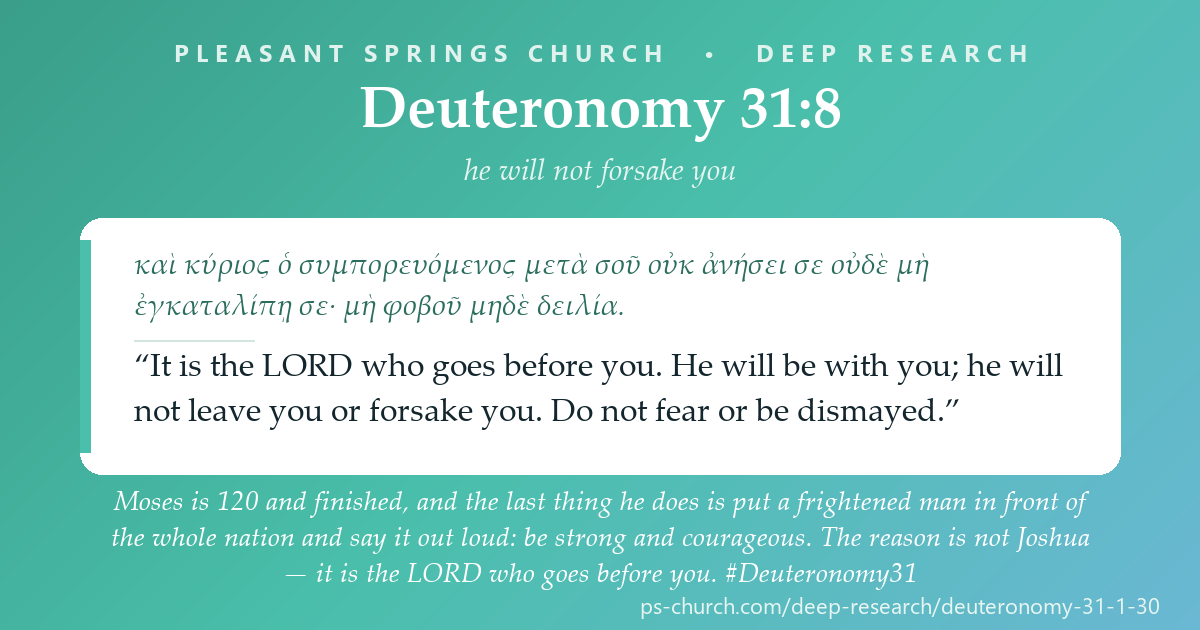
Deuteronomy 31:8 · to share
LXX + ESVEvery Deep Research page traces its passage across the whole sweep — the Old Testament, the Second-Temple world between the testaments (historical witnesses, not Scripture), and the New Testament. Follow the thread:
Pleasant Springs Church — Deep Research
Research method after Michael S. Heiser’s Bible Research Method (examine dictionaries → ancient literature → important words → textual connections → academic publications → share), with the Pleasant Springs “Author & Audience” foundation. Scripture set in the Hebrew, the Greek editions named on each page and the ESV (Old Testament), and the Greek New Testament and the ESV (New Testament), per the practice of Pleasant Springs Church. Deuteronomy 31 research grounded in Craigie, Block, McConville, Tigay, Christensen, Nelson, Driver, Miller and Merrill, with Kline (The Structure of Biblical Authority) and Weinfeld on the treaty deposit-and-reading clauses — reported as the book’s literary form, not as a verdict in the dating debate — and Beale & Carson (G. H. Guthrie on Hebrews) for the New Testament use. ANE comparanda verified against our copy of ANET: the Hittite treaty succession clause (ANET 204) and the deposit, periodic-reading and witness clauses of the Suppiluliumas–Kurtiwaza treaty (ANET 205–206); Esarhaddon’s vassal-treaties (534–541) are named for form only and no page-level claim is made about them. Second-Temple and rabbinic witnesses (Josephus, Ant. 4.209–211 and 4.303–304; m. Sotah 7:8; b. Bava Batra 14a–b; the 4QDeut manuscripts) are read as witnesses, never leveled with Scripture. Numbering: Deuteronomy 31 has no MT/LXX versification offset — Hebrew, Rahlfs LXX and English all number 31:1–30 alike, as do chs 30, 32, 33 and 34; the book’s one consequential offset lies immediately before this chapter, where English 29:1 = MT/LXX 28:69 and therefore English 29:2–29 = MT/LXX 29:1–28. Greek from Rahlfs; genuine divergences are flagged rather than smoothed — 31:1 συνετέλεσεν (“finished”) against MT “went,” the singular imperatives at 31:6, the added “in a book” at 31:9, and “Moses commissioned Joshua” at 31:23 where the Hebrew reads only “he.” The relation of Hebrews 13:5 to this chapter is reported precisely: Hebrews’ wording is closest to a Greek form of the promise of Deut 31:6, 8, carried in the first person as at Josh 1:5 and Gen 28:15 — not a bare quotation of any one verse. The chapter’s covenant sanctions are handled as sanctions on a covenant nation under its own oath, never as a commentary on any later people’s suffering.
Scripture quotations marked ESV are from the ESV® Bible (The Holy Bible, English Standard Version®), © 2001 by Crossway, a publishing ministry of Good News Publishers. ESV Text Edition: 2016. Used by permission. All rights reserved. The ESV text may not be quoted in any publication made available to the public by a Creative Commons license, and the ESV may not be translated in whole or in part into any other language. www.esv.org
|
Did this study bless you today? 💚 Give to Support PS Church100% of gifts go to the General Fund — thank you. |