The Torah ends with a poem and a grave. First the blessing — “the blessing with which Moses the man of God blessed the people of Israel before his death” (33:1) — opening with the Lord coming from Sinai, dawning from Seir, shining forth from Mount Paran, and then working down the roll of the tribes one by one. Simeon is not on it, and no reason is given. But at the end come two lines the church has never let go of: “The eternal God is your dwelling place, and underneath are the everlasting arms” (33:27), and “Happy are you, O Israel! Who is like you, a people saved by the Lord?” (33:29). Then chapter 34, and the climb. Up from the plains of Moab to Nebo, to the top of Pisgah, and God shows him all of it — Gilead as far as Dan, Naphtali, Ephraim and Manasseh, Judah to the western sea, the Negeb, the Valley of Jericho the city of palm trees, as far as Zoar — and then: “I have let you see it with your eyes, but you shall not go over there” (34:4). He dies there. He is buried — and the Hebrew leaves no one but God as the subject of the verb, which is how the rabbis and the church have read it. And nobody has ever found the place. His eye undimmed at 120, thirty days of weeping in the plains of Moab, Joshua with a leader’s hands still warm on his head — and the last sentence of the Pentateuch: “there has not arisen a prophet since in Israel like Moses, whom the Lord knew face to face” (34:10). This study works Deuteronomy 33:1–34:12 — and it closes a study of all five books. See the method →
Deuteronomy 33:1–34:12 (selections) — MT = LXX = English
Hebrew · LXX · ESVThe Shape of the Passage
InclusioAnd Then the Coda (chapter 34)
SequenceThese are the last two chapters of the Torah. Behind them stand the covenant at Moab and “choose life” (chs 29–30), the succession, the book laid beside the ark and the Song given as a witness (ch 31), and the Song itself with its closing order to climb Nebo (ch 32). Behind those, forty years and four books: Genesis, Exodus, Leviticus, Numbers. Ahead of them: nothing. The Pentateuch closes here, outside the land.
Author
Moses, and then somebody else. Deuteronomy is Moses’ preaching on the plains of Moab, and chapter 33 is presented as his own last words: “the blessing with which Moses the man of God blessed the people of Israel before his death” (33:1). Chapter 34 is not. It reports his death, his burial, the thirty days of mourning, and a verdict rendered from a distance — “there has not arisen a prophet since” (34:10) — which is not a sentence a man writes about himself.
This is an old and honest question, and it has an old and honest answer: we do not know. The rabbis argued it out plainly. In b. Bava Batra 15a the Sages ask the obvious question — is it possible that Moses wrote “and Moses died there”? — and Rabbi Yehuda (some say Rabbi Neḥemya) answers that Joshua wrote the last eight verses; Rabbi Shimon answers instead that God dictated and Moses wrote these last lines in tears. Philo, writing well before them, took a third road: Moses prophesied his own death while still alive (Life of Moses 2.291). Christian readers have held all three, and the church has never made the answer a test of anything. What matters for reading is what the chapter itself signals: the phrase “to this day” (34:6) is written by someone standing at a distance from the events, looking back — and looking, still, for the grave.
A book shaped like a treaty, ending like a funeral. Deuteronomy as a whole carries the shape of an ancient suzerainty treaty — preamble, historical prologue, stipulations, witnesses, blessings and curses (Kline, Weinfeld) — an observation about the book’s literary form that scholars have pressed on both sides of the dating debate, and which we report rather than adjudicate. What is unusual is the ending. Treaties do not end with the mediator’s obituary. This one does, and the effect is to leave the covenant standing while the man who carried it is buried in a field nobody can find.
Audience
A generation whose leader is about to die. Every person listening to chapter 33 knows what is coming; 31:2 and 32:50 have already said it out loud. They are hearing the blessing of a man who will not be there in the morning. That is an ordinary human situation — most of us have sat in a room like it — and the text does not hurry past it. Thirty days of weeping in the plains of Moab (34:8) is a number, but it is also permission.
And a reader much later. “No one knows the place of his burial to this day” (34:6) is addressed to somebody who might otherwise go looking. So is “there has not arisen a prophet since” (34:10). Those two phrases quietly hand the book to a reader living generations after the funeral — a reader who is in the land, or has lost it, and who is still waiting for the one Moses promised in 18:15–19. The Torah ends by telling its own audience that its greatest figure was not the answer.
Read it warmly. This page closes a five-book study, and the text closes five books of history, and both end the same way: outside. Moses sees the whole land and does not enter it. Israel is camped on the wrong side of a river. The promise is unkept, the grave is unmarked, and the very last clause of the Torah looks backward — “the great deeds of terror that Moses did in the sight of all Israel” — to things done forty years and a lifetime ago. That is not a failure of the book. It is the book pointing forward with both hands, and it is why God kept writing.
Orient on the tribal blessing, Jeshurun, the Urim and Thummim, Nebo and Pisgah, and the death of Moses.
Search by topic: blessing (deathbed / testament), tribes of Israel and tribal lists, Jeshurun, theophany, Sinai / Seir / Paran / Teman, Urim and Thummim, Levi and priesthood, Benjamin, Joseph and Ephraim / Manasseh, Simeon, Nebo, Pisgah, Beth-peor, Zoar, Jericho ‘city of palm trees,’ mourning customs, laying on of hands, prophet, Moses (death and later traditions).
Which articles are relevant?
- Anchor Bible Dictionary — “Blessings and Curses,” “Tribes of Israel,” “Jeshurun,” “Urim and Thummim,” “Levi, Levites,” “Simeon,” “Nebo, Mount,” “Pisgah,” “Beth-peor,” “Zoar,” “Moses,” “Assumption of Moses.”
- Dictionary of the OT: Pentateuch — “Blessing and Cursing,” “Blessing of Moses,” “Poetry,” “Theophany,” “Priests and Levites,” “Death,” “Moses,” “Prophets and Prophecy,” “Deuteronomy, Book of.”
- NIDOTTE / TDOT — בְּרָכָה (bərāḵāh, blessing), יְשֻׁרוּן (yəšurûn, Jeshurun), מָעוֹן (māʿôn, dwelling), זְרוֹעַ (zərôaʿ, arm), אַשְׁרֵי (ʾašrê, happy), עֶבֶד (ʿeḇeḏ, servant), קְבוּרָה (qəḇûrāh, burial).
Bibliography surfaced:
- Peter C. Craigie (NICOT), Daniel I. Block (NIVAC), J. G. McConville (Apollos), Jeffrey H. Tigay (JPS), Duane L. Christensen (WBC), Richard D. Nelson (OTL), S. R. Driver (ICC), Patrick D. Miller (Interpretation), Eugene H. Merrill (NAC) on Deuteronomy.
- Studies of the archaic tribal poems — Genesis 49, Deuteronomy 33, Judges 5 — and of the “southern theophany” tradition (Deut 33:2; Judg 5:4–5; Hab 3:3; Ps 68:7–8 · LXX 67:8–9).
- Studies of the ending of the Pentateuch: why the Torah closes outside the land, and how Deut 34:10–12 functions as a seal on the book and a hinge into the Prophets.
- Beale & Carson, Commentary on the NT Use of the OT (the Gospels; Acts; Jude).
A dying man’s testament, a God who comes from the south, and a grave that was never built.
Set the blessing beside the ancient genre it belongs to — the departing leader’s last word to his successor and his people — then set the burial beside what the ancient world actually did with the tombs of great men, and ask why this one is missing on purpose.
Which parallels shed light on religion and worldview?
The last words of a dying leader. The deathbed testament was a recognized ancient form, and Israel already had one: Jacob gathering his sons and blessing them tribe by tribe, “each with the blessing suitable to him” (Gen 49:28). Deuteronomy 33 is deliberately its twin — same twelve names, same poetic form, and a number of the same images (Joseph is the fruitful one in both; the wordplays on tribal names run through both). Egypt knew the form too: the Instruction of King Amen-em-het is framed as a dead pharaoh’s address to his son, and the Instruction for King Meri-ka-Re as a departing king’s counsel to his heir (both in Pritchard’s wisdom section; we do not cite a page here because our copy does not reach it). What is striking is the difference in content. The Egyptian testaments teach the successor how to hold power — whom to trust, how to manage nobles, how to survive an assassination. Moses says almost nothing about governing. He blesses.
A God who comes from the south. “Sinai… Seir… Mount Paran” (33:2) is not a random itinerary. It is a fixed poetic tradition: “Lord, when you went out from Seir, when you marched from the region of Edom” (Judg 5:4–5); “God came from Teman, and the Holy One from Mount Paran” (Hab 3:3); “O God, when you went out before your people, when you marched through the wilderness” (Ps 68:7–8 · LXX 67:8–9). Four texts, one memory: the Lord arrives from the desert south-east of Canaan, not from a temple. Two much-discussed archaeological items sit near this. Egyptian topographical lists from the fourteenth and thirteenth centuries BC (Soleb, Amara West) name a place or people group “Yhw in the land of the Shasu,” nomads of the Edom–Midian region; and painted storage jars from Kuntillet ʿAjrud in the northern Sinai (c. 800 BC) carry blessings by “YHWH of Teman” and “YHWH of Samaria.” Neither is a quotation of Deuteronomy and neither settles anything about origins — the readings and the meaning of both are debated. What they do show is that the association of the Lord with that southern country is old, external to the Bible, and not an invention of the poem.
The grave that was never built. Moses grew up in the civilization that spent more of its wealth on tombs than any other in human history. Egypt’s dead kings got pyramids, mortuary temples, endowed priesthoods, and daily offerings meant to run forever; Jacob was embalmed and mourned seventy days, and carried home to a family cave (Gen 50:1–13); Joseph’s bones were kept for four centuries so they could be buried in the land. Against all of that, Deuteronomy 34: thirty days of weeping, no embalming, no monument, and a burial site deliberately unrecorded. The ancient world made shrines out of the tombs of its great men, and Israel would prove entirely capable of it — within a few centuries Israel was burning incense to a bronze serpent Moses himself had made (2 Kgs 18:4; cf. Num 21:4–9). An unfindable grave is not carelessness. It is protection.
Urim and Thummim. Levi’s blessing hands him not a sword but an oracle (33:8). The whole ancient world wanted to know the will of heaven and had elaborate machinery for asking — Mesopotamian bārû priests reading sheep livers, omen collections running to thousands of entries, astrologers, dream interpreters. Israel’s equivalent is startlingly plain: two objects in the high priest’s breastpiece (Exod 28:30; Lev 8:8) that appear to have given yes-or-no answers, with the honest possibility of no answer at all (1 Sam 28:6). The Greek translators did not transliterate the words; they explained them — δῆλοι, “the things made clear,” and ἀλήθεια, “truth.”
- The Instruction of King Amen-em-het and The Instruction for King Meri-ka-Re (Egyptian, Middle Kingdom; in Pritchard’s ANET wisdom section — page not cited, as our copy of ANET does not reach it) — witnesses, not Scripture: the departing ruler’s testament to his successor. The form is shared with Deut 31–33; the content is not.
- Egyptian topographical lists at Soleb and Amara West (14th–13th c. BC) — “Yhw in the land of the Shasu.” An external, pre-monarchic association of that name with the Edom–Midian region. The reading is generally accepted; what it implies is genuinely disputed, and we make no claim beyond the geography.
- Kuntillet ʿAjrud inscriptions (c. 800 BC, northern Sinai) — blessings by “YHWH of Teman” and “YHWH of Samaria.” Discovered long after ANET was compiled, so no page reference exists. An ancient witness, not Scripture, and its wider religious implications are contested.
- Sirach 45:1–5 (Second Temple — a witness, not Scripture) — Ben Sira’s praise of Moses: “beloved of God and man… he chose him out of all flesh,” brought into the thick darkness and given the commandment, “the law of life and understanding,” to teach Jacob. The earliest sustained Jewish portrait of Moses outside the Torah.
- 4Q175 (Testimonia) (Dead Sea Scrolls — a witness, not Scripture) — a single sheet stringing together Deut 5:28–29 with 18:18–19 (the prophet like Moses), Num 24:15–17 (the star out of Jacob), and Deut 33:8–11 (the blessing of Levi). A Second-Temple community reading exactly the passages this page reads, and reading them forward.
- Josephus, Antiquities 4.320–331 (Second Temple — a witness, not Scripture) — and Josephus is careful. He narrates Moses embracing Eleazar and Joshua when “a cloud stood over him on the sudden, and he disappeared in a certain valley” (4.326) — and then immediately adds that Moses wrote in the sacred books that he died, precisely so that no one would claim he was taken up to God because of his virtue. Josephus tells the story of the cloud, and then reports that Moses himself wrote “he died” to stop anyone drawing that conclusion.
- Philo, On the Life of Moses 2.288–291 (Second Temple — a witness, not Scripture) — Moses, about to depart, prophesies to each tribe in turn (2.288: Philo’s reading of Deut 33), and then prophesies his own death while still alive, and his burial by no mortal hands, with no one knowing the tomb (2.291).
- The Assumption / Testament of Moses (Second Temple — a witness, not Scripture) — survives only in one damaged sixth-century Latin palimpsest found in Milan in 1861, and the ending is lost. The dispute over Moses’ body that Jude 9 alludes to is not extant in the surviving text; we know of the connection from Origen and other early writers. So nothing can honestly be quoted from it here, and we do not.
- Targum Pseudo-Jonathan on Deut 34:6; Sifre Deuteronomy 357; b. Sotah 13b–14a; b. Bava Batra 15a (rabbinic-era — witnesses, not Scripture) — the Jewish reading tradition takes the singular verb of 34:6 to mean that God himself buried Moses, draws from it the lesson that God clothes the naked and buries the dead so that we should do likewise, and debates openly who wrote the last eight verses.
Deuteronomy 34:6 is one of the few places in Scripture where a silence is reported as an act. God does not merely permit Moses to be buried; the Hebrew verb is singular with no other subject in sight, and the next clause makes a human burial party awkward — if men had dug the grave, men would know where it was. The rabbis drew the obvious inference and the church has generally followed them. And then, having buried him, God does not tell anyone where.
Consider what that prevents. A tomb is a place you can go, and a place you can go becomes a place you can venerate, and a place you can venerate becomes, in time, a rival. Israel had already made an idol out of Moses’ own bronze serpent (2 Kgs 18:4). It had made one out of gold at the foot of the mountain while he was still up it (Exod 32). The people who buried him would have built something, and their grandchildren would have burned incense in it.
So the greatest man in the Old Testament gets what no pharaoh would have accepted: an unmarked grave in a foreign country. It is a mercy to Israel, and it is a kindness to Moses, whose whole life’s work was pointing away from himself. The one thing he could not do for his people after he died, God did for him.
The pet name, the dwelling, the arms underneath, the happiness, and the servant.
Watch Jeshurun frame the poem; meonah and zeroth olam carry 33:27; ashrekha open 33:29 the way Psalm 1 opens the Psalter; and three small phrases carry the death — servant of the Lord, at the mouth of the Lord, and the rare word for sap that has not dried. Verse numbers need no conversion anywhere on this page: Hebrew, Rahlfs LXX and English agree throughout Deuteronomy 33 and 34.
“Jeshurun” — a pet name for Israel, formed from yāšār, “upright, straight,” with an affectionate ending: something like “little upright one.” It occurs four times in the Bible — twice here, once at 32:15 (“Jeshurun grew fat, and kicked”), and once at Isa 44:2. That is the range of it: the name is used once in irony and three times in love. The LXX does not transliterate it but interprets it — ὁ ἠγαπημένος, “the beloved.”
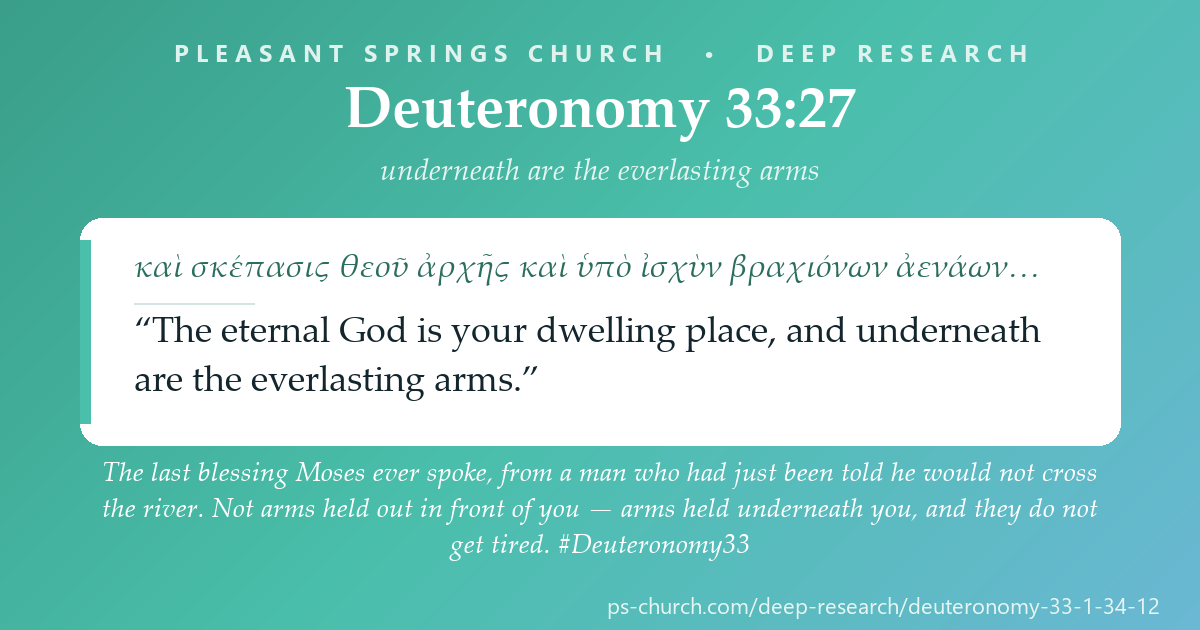
“Dwelling place, refuge” (LXX σκέπασις, “shelter”) — the noun is used for a lion’s lair and a bird’s nest as easily as for God’s habitation. The phrase here is məʿōnāh ʾəlōhê qeḏem, “a dwelling — the God of old.” The line is harder than the English suggests: the Hebrew has no “is” and no “your” — just those three words — and the ESV footnotes it twice, other versions reconstruct it differently (the NRSV prints “He subdues the ancient gods, and shatters the forces of old,” with “Meaning of Heb uncertain”), and the LXX went a third way (σκέπασις θεοῦ ἀρχῆς). The comfort of the verse does not depend on the crux, and it is honest to say the line is difficult. The same root turns up in the one psalm attributed to Moses: “Lord, you have been our dwelling place (māʿôn) in all generations” (Ps 90:1 · LXX Ps 89:1), whose title also calls him “the man of God” — the phrase that opens Deut 33:1.
“Everlasting arms” (LXX βραχιόνων ἀενάων) — zərôaʿ, the forearm, is the standard biblical image for God’s power to rescue: “with a mighty hand and an outstretched arm” (Deut 4:34; 26:8). Here the arms are not stretched out in front but held underneath — the posture of carrying, not of striking. ʿôlām is duration without a visible end. Put together: the oldest strength there is, positioned under you.
“Happy are you” (LXX μακάριος) — not a wish but an exclamation about a state of affairs: look at your situation. It is the word that opens the Psalter (“Blessed is the man,” Ps 1:1) and, in Greek, the word that opens the Beatitudes. It is not the ordinary word for “bless” (bāraḵ); it never has God as its object. And the ground of the happiness is given at once: ʿam nôšaʿ ba-YHWH, “a people saved by the Lord” — a passive. Nothing here is Israel’s achievement.
“Servant of the Lord” (LXX οἰκέτης κυρίου, “household servant”) — the title is given to Moses at the moment he dies, and the Torah gives it to no one else. It becomes the standard epithet afterward (Josh 1:1, 13; 8:31), it is applied to David and to prophets, and it is the title that carries into Isaiah’s Servant. A life summed up in one word, and the word is not leader.
“According to the word of the Lord” — literally at the mouth of the Lord (LXX διὰ ῥήματος κυρίου). The idiom is ordinary Hebrew for “by his command” and is used all through Numbers for the marching orders of the camp. The rabbis, hearing the literal sense, said Moses died by a kiss (b. Bava Batra 17a — a rabbinic reading, not the text’s plain sense, and we label it as such). The plain sense is enough: this death is not an accident, an illness, or a defeat. It is an appointment kept.
“Sap, moisture, freshness” — a rare word used of green wood that has not dried out (Gen 30:37 uses the related adjective for fresh-cut branches). The ESV’s “his vigor unabated” is exactly right: nothing in him had gone woody. The Greek translators evidently did not recognize the word and guessed at the anatomy — οὐδὲ ἐφθάρησαν τὰ χελύνια αὐτοῦ, “nor were his jaws wasted” — one of the small honest moments where you can watch an ancient translator working.
Where the New Testament takes these chapters up:
- Acts 3:22–23 — Peter, in the temple, quotes the promise of a prophet like Moses and names its fulfilment: “The Lord God will raise up for you a prophet like me from your brothers. You shall listen to him in whatever he tells you.” Deuteronomy 34:10 says there had not yet arisen one; Acts says who did. See Deut 18:15–19 and 18:1–22.
- Luke 9:28–36 (with Matt 17:1–8; Mark 9:2–8) — the Transfiguration. Moses stands and talks with Jesus about “his departure, which he was about to accomplish at Jerusalem” — the Greek is ἔξοδος, exodus. The Gospels do not name the mountain. Readers have long heard a devotional echo here — the man who was shown the land from Nebo now in conversation with the Lord of it — and it is worth hearing as an echo, not as a claim the text makes. What the text does say is plain: the voice from the cloud repeats what Deuteronomy 18 said, listen to him.
- Jude 9 — “when the archangel Michael, contending with the devil, was disputing about the body of Moses, he did not presume to pronounce a blasphemous judgment, but said, ‘The Lord rebuke you.’” That is the whole of what Jude says. The work he is drawing on does not survive at that point, so no one can honestly reconstruct the story; what Jude uses it for is plain enough — even an archangel does not trade insults with the devil.
- Hebrews 3:1–6 — “Moses was faithful in all God’s house as a servant… but Christ is faithful over God’s house as a son.” The servant-title Deuteronomy 34:5 gave him is honoured and then placed — though Hebrews’ actual wording (θεράπων) comes from Num 12:7, not from Deut 34:5 (LXX οἰκέτης). See Hebrews 1:1–4.
- Hebrews 11:23–28, 39–40 — the roll of those who “did not receive what was promised… that apart from us they should not be made perfect.” Nebo is the shape of that whole chapter: seeing from a distance, and dying in faith.
- Revelation 15:3 — “the song of Moses, the servant of God, and the song of the Lamb.” The last book of the Bible still knows him by the title Deuteronomy 34:5 gave him.
Jacob’s blessing, Pisgah, the succession, and the prophet who had not yet come.
Run four threads: the two great tribal blessings that bracket the Torah; the long story of why Moses could not cross; the careful handing over of leadership; and the promise of 18:15 left deliberately open by 34:10.
Which cross-references matter?
- Genesis 49:1–28 — Jacob’s deathbed blessing of the twelve, the poem Deuteronomy 33 is consciously answering (see Genesis 49). Read them side by side: the same names, the same form, and pointedly different verdicts — Levi is cursed for violence in Genesis 49:5–7 and given the oracle and the altar in Deuteronomy 33:8–11. Something happened in between (Exod 32:26–29), and the two poems know it.
- Genesis 49:29–50:26 — Jacob embalmed and carried back to the cave of Machpelah, and Joseph’s bones kept for the journey home (see Genesis 49:29–50:26). Both patriarchs get into the land in the end. Moses does not, and his grave is not even recorded — the sharpest deliberate contrast in the Pentateuch’s treatment of death.
- Numbers 20:1–13; Deuteronomy 32:48–52 — the water at Meribah, and the sentence: “you shall not bring this assembly into the land” (see Numbers 20 and Deuteronomy 32). Deuteronomy 34 carries it out without one word of complaint or explanation.
- Deuteronomy 3:23–29 — “Please let me go over and see the good land… But the Lord was angry with me because of you… Go up to the top of Pisgah” (see Deuteronomy 1–3). Chapter 34 is that command obeyed, thirty chapters later.
- Numbers 27:12–23 — the first version of this scene: Moses shown the land, told he will be gathered to his people, and told to lay his hands on Joshua “a man in whom is the Spirit” (see Numbers 27). Deut 34:9 reports the result: Joshua “full of the spirit of wisdom, for Moses had laid his hands on him.”
- Deuteronomy 31:1–8, 14–23 — “Be strong and courageous… he will not leave you or forsake you,” and the commissioning at the tent (see Deuteronomy 31). Joshua 1:1–9 then opens with “After the death of Moses the servant of the Lord” — the Prophets begin by quoting Deuteronomy 34:5.
- Deuteronomy 18:15–19 — “The Lord your God will raise up for you a prophet like me from among you… it is to him you shall listen” (see 18:15–19). Deuteronomy 34:10 tells us the promise is still outstanding. That is not an editorial slip; it is the book putting its own reader on watch.
- Psalm 90 · LXX Ps 89 — “A Prayer of Moses, the man of God” (the phrase of Deut 33:1), opening “Lord, you have been our dwelling place in all generations” — the same image as 33:27, and the same arithmetic of a life measured against God’s years.
- Judges 5:4–5; Habakkuk 3:3; Psalm 68:7–8 (· LXX Ps 67:8–9) — the southern theophany of 33:2 kept alive in Israel’s poetry for centuries.
Deuteronomy 34:10 is doing something unusual for a closing line. It does not say “and no prophet will ever be like Moses.” It says there has not arisen one yet — οὐκ ἀνέστη ἔτι προφήτης. Set against 18:15, where God promises to raise up a prophet like Moses and commands Israel to listen to him, the effect is to leave a door open on the last page of the Torah and hang a sign on it. The Pentateuch ends by naming an unfulfilled promise.
The New Testament walks straight through that door and says so out loud. Peter quotes 18:15–19 in the temple courts and applies it to the risen Jesus (Acts 3:22–23); Stephen quotes it again in his defence (Acts 7:37); the crowd in John’s Gospel asks whether Jesus is “the Prophet” (John 6:14; 7:40) because they were reading Deuteronomy and waiting. And then the Transfiguration stages it: Moses himself, on a mountain the Gospels do not name, discussing an exodus to be accomplished at Jerusalem — and the Father’s voice from the cloud giving Deuteronomy 18’s own imperative, listen to him (Luke 9:30–35).
Note what kind of reading this is. It is not an allegory imposed on Deuteronomy from outside; it is the answer to a question Deuteronomy itself asked in 18:15 and left standing in 34:10. And note also what it does not do. It never diminishes Moses. Hebrews calls him faithful in all God’s house (Heb 3:1–6); Revelation still sings his song (Rev 15:3). The prophet like Moses is not a replacement for Moses. He is what Moses was pointing at from the top of the mountain.
The scholarship on the Blessing, the death narrative, and the ending of the Pentateuch.
Craigie, Block, McConville, Tigay, Christensen, Nelson, Driver, Miller and Merrill on Deuteronomy; Kline on the treaty form; the archaic-poetry discussion for chapter 33; and Beale & Carson for the New Testament use.
Commentaries & studies:
- Peter C. Craigie, The Book of Deuteronomy (NICOT); Daniel I. Block, Deuteronomy (NIVAC); J. G. McConville, Deuteronomy (Apollos); Jeffrey H. Tigay, Deuteronomy (JPS Torah Commentary); Duane L. Christensen, Deuteronomy 21:10–34:12 (WBC); Richard D. Nelson, Deuteronomy (OTL); S. R. Driver, Deuteronomy (ICC); Patrick D. Miller, Deuteronomy (Interpretation); Eugene H. Merrill, Deuteronomy (NAC).
- The standing discussion of Deuteronomy 33 as archaic Hebrew poetry alongside Genesis 49, Exodus 15 and Judges 5 — its difficult vocabulary, its several unrecoverable lines, and the caution every commentator on it eventually prints: some of this poem cannot be translated with confidence, and honest editions say so.
- The text-critical literature on 33:2 (the ketiv אשדת, the Greek “angels,” and the Syriac’s verbal rendering, ‘he gave to them’) and on the LXX pluralization at 34:6; the Qumran Deuteronomy manuscripts, of which Deuteronomy is among the most-copied books at Qumran.
- Meredith G. Kline, Treaty of the Great King; Moshe Weinfeld, Deuteronomy and the Deuteronomic School — the suzerainty-treaty shape of the book, reported as literary form, not as a settled verdict on its date.
- G. K. Beale & D. A. Carson, eds., Commentary on the New Testament Use of the Old Testament (Luke; Acts; Hebrews; Jude).
Interpretation notes worth keeping:
- Simeon is missing, and the text does not say why. The list runs Reuben, Judah, Levi, Benjamin, Joseph (Ephraim and Manasseh), Zebulun, Issachar, Gad, Dan, Naphtali, Asher — eleven names for twelve tribes, and Simeon simply is not there. Explanations have been offered for centuries: that Simeon’s territory lay swallowed inside Judah’s (Josh 19:1–9), that the tribe was already dwindling, that the omission carries forward Genesis 49:5–7, or that a line dropped out in transmission — some Greek and Old Latin witnesses do give Simeon half of Reuben’s line at 33:6. None of these is stated by the text, and we do not choose among them. Where Scripture gives no reason, the honest thing is to report the silence and stop.
- 33:2b cannot be translated with confidence, and pretending otherwise is not reverence. The Hebrew consonants are unique in Scripture; the Masoretic qere, the Greek, the Syriac and the Latin all go different ways; the standard reference works say the history of the text is unclear. The ESV’s “with flaming fire at his right hand” is a defensible reading of a difficult line, not a certainty. Nothing in the faith rests on it, and a study that says so teaches its readers something worth knowing about how the Bible actually reaches us.
- The Blessing is prayer and promise, not prediction of individual destinies. These are tribal sayings — corporate, poetic, and often built on wordplay with the tribe’s name. They are not horoscopes for anyone’s bloodline, and they are not a warrant for ranking modern people or peoples. Levi’s reversal (cursed in Genesis 49, honoured here) is itself the proof that these sayings describe a history under God’s hand, not a fate fixed at birth.
- The sentence on Moses is carried out without softening and without moralizing. He asked to cross; he was told no (Deut 3:23–27). The reason given is Meribah (Num 20:12; Deut 32:51). Deuteronomy 34 does not relitigate it, does not excuse it, and does not use it to frighten anyone. It also does not treat it as the last word about him — the same chapter that records the refusal calls him the servant of the Lord and says no prophet since has been his equal. Both are true at once, and a sermon that drops either half is not preaching this chapter.
- The unmarked grave is a doctrine, not a curiosity. No relic, no shrine, no pilgrimage, no mediator to venerate. Whatever else Deuteronomy 34:6 does, it makes it impossible to turn Moses into an object of worship — which is exactly what he spent forty years preventing.
- The Torah ends outside the land on purpose. Five books, and the last verse is set in Moab. The promise to Abraham is unkept, the greatest prophet is dead, and the man leading them in is a lieutenant with borrowed hands laid on him. This is not a sad ending badly edited; it is a book that will not let its reader settle. Everything after it — Joshua, the prophets, the exile, the return, and the Gospels — is written by people who noticed.
- Do not build a doctrine of Moses’ afterlife out of Jude 9 or the Transfiguration. Jude reports a dispute and draws one moral from it: restraint in the face of the devil. The Transfiguration shows Moses alive and in conversation with Christ, which is a great comfort and a real datum. Neither text tells us the mechanics, and the works that claimed to are lost or legendary. Say what the New Testament says, and no more.
From a blessing spoken over people who could not repay it to a grave nobody can find.
Name what you learned, why it matters, and one concrete response.
What should we carry away — and do?
- Underneath. The arms in 33:27 are not stretched out in front of you like a barricade; they are underneath you, in the position of carrying. That is what “the eternal God is your dwelling place” means in practice: the oldest strength there is, positioned under the weight you are currently carrying, and it does not get tired.
- He blessed them anyway. Moses has just been told he will not enter the land, and he spends his last recorded breath naming the tribes one by one and asking good for every one of them — including the ones whose fathers had made his life unbearable. Blessing people who cost you something, on your way out, without settling scores: that is what the end of a faithful life looks like.
- Say ‘we do not know’ out loud. Simeon is missing and the text gives no reason. One line of 33:2 cannot be confidently translated. Who wrote the last eight verses is genuinely disputed. Learning to report a silence honestly, instead of filling it, is one of the most useful habits a Bible reader can build — and it is exactly what 29:29 taught.
- You will probably not see the end of your own work. Moses saw the whole land from Nebo and walked into none of it. Most useful lives are like that: you carry something as far as you can and hand it to somebody younger with your hands still on their head. Deuteronomy 34 refuses to call that a tragedy.
- The last word is a promise, not an epitaph. “There has not arisen a prophet since…” — yet. The Torah ends leaning forward. So should we.
Step in response: read Deuteronomy 33:26–29 and 34:1–12 out loud, slowly, in one sitting — it takes four minutes and it is the end of the Torah. Then do two things. Write out a blessing, in your own words, for one person who has been difficult and who cannot repay you, and find a way to say it to them. And name one piece of work you have been carrying that you will not finish yourself — then name the person you should be laying your hands on.
Deuteronomy 33:27 · to share
LXX + ESVEvery Deep Research page traces its passage across the whole sweep — the Old Testament, the Second-Temple world between the testaments (historical witnesses, not Scripture), and the New Testament. Follow the thread:
Pleasant Springs Church — Deep Research
Research method after Michael S. Heiser’s Bible Research Method (examine dictionaries → ancient literature → important words → textual connections → academic publications → share), with the Pleasant Springs “Author & Audience” foundation. Scripture set in the Hebrew, the Greek editions named on each page and the ESV (Old Testament), and the Greek New Testament and the ESV (New Testament), per the practice of Pleasant Springs Church. Deuteronomy 33–34 research grounded in Craigie, Block, McConville, Tigay, Christensen, Nelson, Driver, Miller and Merrill, with Kline and Weinfeld on the suzerainty-treaty shape of the book (reported as literary form, not as a verdict on its date) and Beale & Carson on the New Testament use (Luke; Acts; Hebrews; Jude). Second-Temple and rabbinic witnesses: Sirach 45:1–5; 4Q175 (Testimonia), which quotes Deut 33:8–11 alongside Deut 18:18–19 and Num 24:15–17; Josephus, Antiquities 4.320–331 — who reports the cloud and the disappearance at 4.326 and that Moses wrote in the sacred books that he died; Philo, Life of Moses 2.288–291; Targum Pseudo-Jonathan on 34:6; Sifre Deuteronomy 357; b. Sotah 13b–14a and b. Bava Batra 15a, 17a — all read as witnesses, never leveled with Scripture. The Assumption / Testament of Moses behind Jude 9 survives only in one damaged sixth-century Latin palimpsest whose ending is lost; the dispute over Moses’ body is not extant in it, so this page reports only what Jude actually says and quotes nothing from that work. ANE comparanda are named without page numbers where our copy of ANET does not reach them (the Egyptian royal testaments), and the Kuntillet ʿAjrud inscriptions post-date ANET entirely; both are presented as contested background, never as proof. Numbering: Deuteronomy 33 and 34 carry no versification offset — Hebrew, Rahlfs LXX and English agree throughout 33:1–29 and 34:1–12, so nothing on this page is renumbered; the book’s one offset (English 29:1 = MT/LXX 28:69, hence English 29:2–29 = MT/LXX 29:1–28) closes at the end of chapter 29 and the traditions run together again from chapter 30. Where a Psalm is cited, both numbers are given (Ps 90 · LXX 89; Ps 68 · LXX 67). Greek from Rahlfs; where Swete’s Vaticanus text differs materially (33:27) that is flagged rather than followed. The crux at 33:2b and the absence of Simeon from the tribal list are reported as genuinely unresolved, with the evidence laid out and no verdict rendered; the tribal sayings are read as corporate prayer and promise, never as fate fixed at birth or as a ranking of any modern people.
Scripture quotations marked ESV are from the ESV® Bible (The Holy Bible, English Standard Version®), © 2001 by Crossway, a publishing ministry of Good News Publishers. ESV Text Edition: 2016. Used by permission. All rights reserved. The ESV text may not be quoted in any publication made available to the public by a Creative Commons license, and the ESV may not be translated in whole or in part into any other language. www.esv.org
|
Did this study bless you today? 💚 Give to Support PS Church100% of gifts go to the General Fund — thank you. |