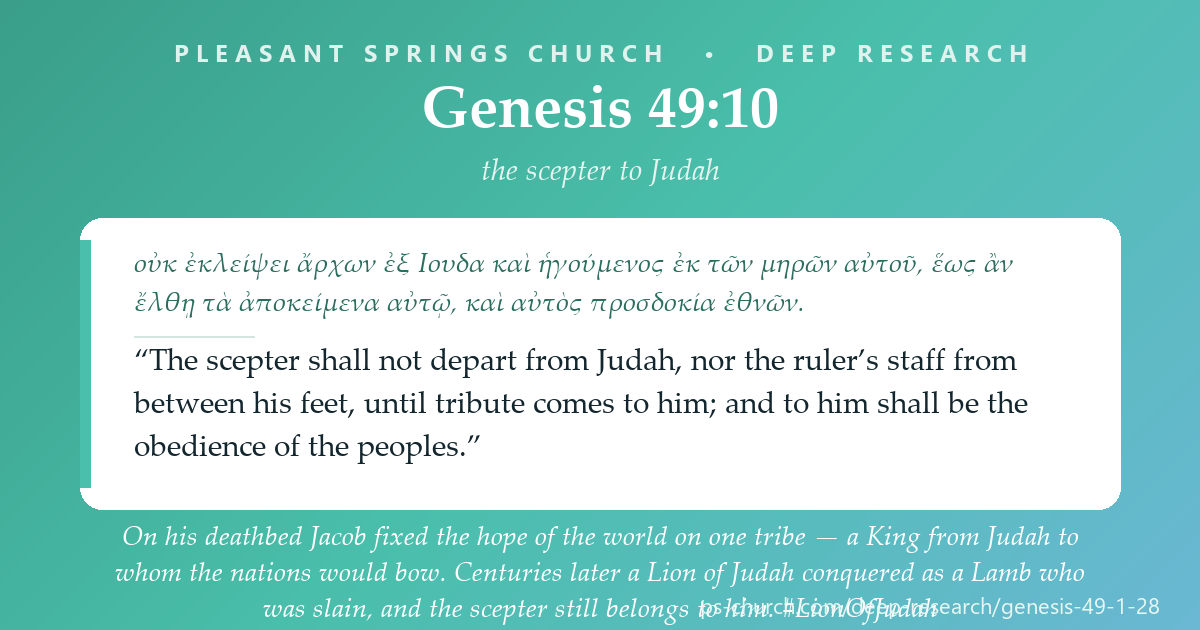
Jacob, dying, gathers his twelve sons to tell them “what shall happen… in days to come” — and the poem is prophecy. Reuben forfeits the firstborn’s place; Simeon and Levi are “scattered in Israel”; and on Judah the blessing lifts into royalty: “the scepter shall not depart from Judah… until tribute comes to him; and to him shall be the obedience of the peoples” — the Bible’s first messianic oracle, the seed of David’s greater Son. Mid-poem a prayer breaks out: “I wait for your salvation, O Lord.” A patriarch sees centuries ahead by faith and fixes the hope of the world on one tribe. This study works Genesis 49:1–28. See the method →
Genesis 49:4, 7, 10, 18, 25
Hebrew · LXX · ESVThe Shape of the Passage
Parallel panelsA dying man’s poem does what no army could: it locates the future of the whole world in a single tribe — and it does so by naming sins honestly, blessing without flattery, and waiting, mid-breath, for God’s salvation.
Author
Moses sets the “Blessing of Jacob” (49:1–28) as the patriarch’s last will — the longest poem in Genesis and one of the oldest strata of Hebrew verse, dense, archaic, and hard. Jacob calls it prophecy: “that I may tell you what shall happen to you in days to come” (49:1). Each oracle reads the son’s character and history forward into the tribe’s destiny — sometimes by a pun on the name, always by the logic of sowing and reaping. The three eldest are passed over for cause: Reuben forfeits the double portion by his sin against his father’s bed (49:3–4; cf. 35:22); Simeon and Levi are cursed in their anger and “scattered,” the massacre at Shechem coming home to roost (49:5–7; cf. Genesis 34). The firstborn’s blessing does not vanish — it splits: the birthright’s portion goes to Joseph (the double inheritance, Ephraim and Manasseh), and the birthright’s rule goes to Judah (1 Chr 5:1–2).
The scepter to Judah. On the fourth son the poem lifts into royalty. Judah — whose own record is checkered (Genesis 38) yet who learned self-substitution for his brother (44:33–34) — is a lion’s cub before whom the brothers bow, and from whom “the scepter shall not depart… until tribute comes to him; and to him shall be the obedience of the peoples” (49:8–10). Here is Scripture’s first fixed messianic hope: a ruler from Judah’s line to whom the nations will submit — the trajectory that runs to David (2 Sam 7) and past David to David’s Lord. The famous crux, the Hebrew word Shiloh (49:10), is handled below; on any reading, the sentence points beyond a mere dynasty to the one to whom the rule belongs.
A prayer, and a fruitful bough. Two touches reveal the man behind the poem. Mid-oracle, after Dan, Jacob suddenly stops blessing and prays: “I wait for your salvation, O Lord” (49:18) — the only utterance of the covenant name YHWH in the whole chapter, a dying breath of hope in the God who saves. And over Joseph the blessings run longest and warmest — a “fruitful bough by a spring,” bitterly attacked by archers yet held firm “by the hands of the Mighty One of Jacob… the Shepherd, the Stone of Israel” (49:22–24), blessed by “the God of your father” and “the Almighty” (49:25). The names for God here are El and Shaddai, not the covenant name — the ordinary titles of the God who helps and blesses.
Audience
Israel heard its own map in this poem. By the time the tribes were living in the land, every line had come true in the terrain: Reuben faded east of the Jordan; Simeon was absorbed into Judah’s territory (Josh 19:1–9); Levi received no land at all but was “scattered” among the tribes — the curse of 49:7 turned, by grace, into the mercy of priesthood after Levi’s later zeal for the Lord (Ex 32:26–29; Deut 33:8–11). And Judah rose to kingship. The nation could see that its founding patriarch had spoken true, and that the God who shaped its future had done so not around its ancestors’ sins but through and past them — sovereign good purpose working over real human failure without excusing it.
Judgment, mercy, and the coming King. For the church, Genesis 49 teaches three things at once. First, consequence is real: Reuben, Simeon, and Levi reap what they sowed, and Scripture never sanctions the deeds it records. Second, grace outruns consequence: the very tribe cursed with scattering becomes the priestly tribe; the tribe of a shameful episode (Judah) becomes the royal and messianic line — God delights to bring his best from repented failure. Third, and above all, the hope is a person: the scepter fixed on Judah, the tribute of the peoples, the Lion who conquers — these gather into Jesus, “the Lion of the tribe of Judah, the Root of David” (Rev 5:5), to whom the obedience of the nations belongs. Jacob’s dying prayer, “I wait for your salvation, O Lord,” is the whole Bible in miniature: faith, on its deathbed, looking centuries ahead to a salvation it will not live to see, and already sure of it.
Orient on tribal blessings, birthright, the Shiloh crux, and messianic prophecy.
Search by topic: Blessing of Jacob, tribes of Israel, birthright / firstborn, Judah, Shiloh, scepter, Messiah in the Pentateuch, Reuben / Simeon / Levi, Joseph.
Which articles are relevant?
- Anchor Bible Dictionary — “Blessing of Jacob,” “Judah (tribe),” “Shiloh,” “Birthright,” “Tribes of Israel.”
- Dictionary of the OT: Pentateuch — “Blessings,” “Messiah / Messianism,” “Tribes of Israel,” “Poetry.”
- NIDOTTE / TDOT — shevet (scepter/tribe), mechoqeq (ruler’s staff/commander), shiloh (49:10, the crux), yiqqehat (obedience), bekhorah (birthright).
Bibliography surfaced:
- Gordon Wenham (WBC), Victor Hamilton (NICOT), Kenneth Mathews (NAC), Bruce Waltke, Nahum Sarna (JPS) on Genesis 49.
- Studies of the “tribal blessing” genre (Gen 49; Deut 33) and of early Hebrew poetry; the standard treatments of the Shiloh crux and the messianic reading of 49:10.
- Beale & Carson, Commentary on the NT Use of the OT, and the messianic-trajectory literature (Alexander, Hamilton, Sailhamer).
Deathbed blessings, tribal destinies, and the crux at 49:10.
Read the poem as an ancient last testament — the binding deathbed word — and weigh the divergence of the versions at the Judah oracle.
Which parallels shed light on religion and worldview?
The deathbed blessing as binding word. In the patriarchal world a father’s final blessing was no mere well-wishing but a performative act, believed to set a course that could not simply be recalled — recall Isaac’s trembling once Jacob had the blessing (27:33–38). Genesis 49 is Jacob’s legally and spiritually weighty testament, spoken over all twelve at once, allotting not property but destiny. Ancient readers would feel the gravity: what the dying patriarch declares, God has bound the future to honor. The poem’s companion piece is the Blessing of Moses (Deut 33), which revisits the same tribes near the end of the wilderness — two deathbed poems bracketing the nation’s birth.
Character read forward into destiny. Each oracle works by a tight logic of correspondence, often through a pun on the name: Judah (yehudah) will be praised (yodukha, 49:8); Dan (dan) will judge (yadin, 49:16); Gad (gad) is raided and raids (gedud, 49:19). The three eldest are judged by deeds already done and recorded — Reuben’s violation (35:22), the Shechem massacre (Genesis 34) — so the poem is, in part, the moral bookkeeping of a family, sins named without euphemism and consequences assigned without vengeance. This is the Bible’s realism: the covenant advances through a household of real failures, and the narrator neither hides the failures nor lets them have the last word.
The Shiloh crux (49:10). The single hardest word in the poem is shiloh. The consonantal Hebrew has been read at least four ways, and the ancient versions themselves diverge: (1) as a place-name, “until he comes to Shiloh” (unlikely in context); (2) by dividing the letters, shai loh, “until tribute comes to him” (the ESV’s choice); (3) as she-lloh, “until he comes to whom it belongs” — precisely the phrasing Ezekiel echoes, “until he comes, the one to whom judgment belongs” (Ezek 21:27); (4) the traditional proper reading “until Shiloh comes.” The Septuagint renders it interpretively — “until the things reserved for him come, and he is the expectation of nations” — and the ancient Jewish paraphrases (the Targums) read it flatly, “until the Messiah comes, whose is the kingdom.” Every ancient stream, in other words, heard a coming ruler here. The crux touches a word, not the meaning: a scepter fixed on Judah until one comes to whom the nations owe obedience.
- Genesis 27:27–40; Deuteronomy 33; 2 Samuel 23:1–7 — deathbed and last-word blessings; the tribal-blessing genre bracketing Israel’s story.
- Ezekiel 21:27; Numbers 24:17–19 — “until he comes to whom it belongs” and the star-and-scepter of Jacob: the earliest echoes reading Genesis 49:10 as messianic (see Balaam’s oracle).
- 1 Chronicles 5:1–2 — the birthright divided: Joseph gets the double portion, Judah the rule — the Chronicler’s own reading of Genesis 49.
The Blessing of Jacob refuses both flattery and despair. It will not pretend Reuben did not defile his father’s bed, or that Simeon and Levi did not turn a covenant sign into a stratagem for slaughter; it names these things to the sons’ faces on the last day of the patriarch’s life, and it lets the consequences stand — the firstborn loses his primacy, the brothers of violence are scattered. Yet the poem is not a catalog of doom. The same scattering that begins as a curse on Levi’s violence God will one day convert into the blessing of a landless, priestly tribe distributed among all Israel to teach and to bless — judgment bent, by grace, toward mercy. And at the center the poem soars: the scepter is fixed forever on Judah, of all people — not the eldest, not the purest, but the one who had learned to offer himself in his brother’s place. The pattern is the gospel’s own: God locates the hope of the world not in the innocent but in the redeemed, and brings his King from a line marked by both failure and repentance. Jacob dies waiting — ‘I wait for your salvation, O Lord’ — and that single sentence, dropped into the middle of a prophecy about tribes, is the truest thing in the chapter: the whole poem, and the whole covenant, is finally a waiting for a salvation God alone will bring, in a King God alone will raise from Judah.
The vocabulary of destiny: the reckless water, the scattering, the scepter, and the wait for salvation.
Watch Reuben’s turbulence, Levi’s scattering-turned-mercy, Judah’s scepter and the Shiloh crux, the mid-poem prayer, and Joseph’s fruitful bough.
“Unstable as water” — pachaz is recklessness, turbulence, a boiling-over that cannot hold shape. Reuben’s uncontrolled passion (35:22) costs him the firstborn’s steady preeminence. The LXX reads it as insolence: “you were insolent… do not boil over” (ἐξύβρισας… μὴ ἐκζέσῃς).
“And I will scatter them” — the verdict on Simeon and Levi’s violence (Gen 34). Yet the scattering God turns to mercy for Levi: no land, but the priesthood, distributed to teach all Israel (Deut 33:8–11). Curse bent toward blessing.
“Scepter” (also “tribe,” “rod”) — the mark of rule that will not depart from Judah. Paired with mechoqeq, the ruler’s staff or commander’s baton. Kingship, once split from the firstborn, is fixed here permanently (Num 24:17; Ps 45:6).
The crux: read as a place, or “tribute to him” (shai loh, ESV), or “he to whom it belongs” (cf. Ezek 21:27), or “until Shiloh comes.” Every ancient version — LXX (“the things reserved for him”), Targums (“until the Messiah comes”) — heard a coming ruler. The word is uncertain; the King is not.
“For your salvation… O Lord” — a prayer erupting mid-poem, the only time the covenant name is spoken in the chapter. Yeshu’ah (salvation) shares the root of the name Jesus (Yeshua): the dying patriarch waits, by name, for the Lord’s deliverance.
“A fruitful son/bough” — Joseph, the bough by a spring whose branches climb the wall: fruitfulness under blessing after suffering. Attacked by archers, his bow yet held firm “by the hands of the Mighty One of Jacob… the Shepherd, the Stone of Israel” (49:24).
How the rest of Scripture fills out the scene:
- Genesis 35:22; 34:25–31 ↔ 49:3–7 — Reuben’s sin and the Shechem massacre come home in the blessing: deeds recorded become destinies assigned (see Genesis 34).
- Numbers 24:17–19; Psalm 2; Psalm 110; Micah 5:2 — the scepter and star of Jacob, the King and the ruler from Judah’s Bethlehem: the messianic line running from Genesis 49:10 (see Psalm 110).
- 2 Samuel 7:12–16; 1 Chronicles 5:1–2 — the birthright divided (Joseph’s portion, Judah’s rule) and the throne fixed forever in Judah’s David (see the Davidic covenant).
- Deuteronomy 33:8–11; Exodus 32:26–29 — Levi’s scattering redeemed into priesthood by later zeal: the curse of 49:7 turned to mercy.
- Revelation 5:5; Hebrews 7:14 — “the Lion of the tribe of Judah, the Root of David”; “our Lord was descended from Judah”: the oracle’s fulfillment (see the Lion and the Lamb).
From the scepter of Judah to the Lion who was slain.
Trace the messianic scepter, the divided birthright, and the wait for salvation toward their New Testament fulfillment.
Which cross-references matter?
- Genesis 49:8–12 → 2 Samuel 7; Psalm 2; Psalm 110 — the scepter of Judah becomes the throne of David, and David’s throne the seat of the anointed King to whom the nations are given.
- Ezekiel 21:27; Numbers 24:17 — “until he comes to whom it belongs” and the scepter that rises from Jacob: the prophets reading 49:10 forward (see Balaam’s star).
- Micah 5:2; Matthew 2:6; Hebrews 7:14 — the ruler from Judah’s Bethlehem; the Lord who “was descended from Judah”: the tribe’s hope arriving in a manger (see the ruler from Bethlehem).
- Revelation 5:5–6 — the elder announces “the Lion of the tribe of Judah” has conquered; John turns and sees “a Lamb standing, as though it had been slain”: the lion’s victory won by sacrifice.
- Genesis 49:18; Luke 2:29–32 — Jacob’s “I wait for your salvation” answered in Simeon’s “my eyes have seen your salvation”: two old men, one hope, fulfilled.
That the messianic scepter should be fixed on Judah is one of the quiet surprises of Scripture. He is not the firstborn; his hands are not clean — the man of the Tamar episode, the brother who first proposed selling Joseph for silver. And yet Judah is also the one who, standing before the Egyptian lord, offered to become a slave in his brother Benjamin’s place so that his father’s heart would not break — the first man in Genesis to lay down his freedom for another. It is on that Judah, the redeemed Judah, that the crown descends, and the choice is deliberate: the King of the world will come not from the tribe that never fell but from the tribe that fell and learned to give itself away. When the poem calls him a lion — couched, sovereign, not to be roused — it fixes an image the whole Bible will carry, until an elder in heaven announces that the Lion of the tribe of Judah has at last conquered and the seer turns to look. What he sees is not a beast of prey but a Lamb bearing the marks of slaughter, and the two images are one: the Lion conquers as the Lamb, the scepter is a cross, and the obedience of the peoples is drawn not by force but by a love that substituted itself in their place, exactly as Judah once did before the throne of Egypt. Read as devotional resonance rather than as the poem’s bare literal sense, the shape is unmistakable — the King promised to Judah is the Servant who dies for the tribe.
The scholarship on Genesis 49:1-28.
The commentators on the Blessing of Jacob; the studies of early Hebrew poetry, the tribal oracles, and the Shiloh crux.
Commentaries & studies:
- Gordon J. Wenham (WBC), Victor P. Hamilton (NICOT), Kenneth A. Mathews (NAC), Bruce K. Waltke, Nahum M. Sarna (JPS) on Genesis 49.
- Studies of the tribal-blessing genre and early Hebrew verse (Gen 49; Deut 33), and the standard surveys of the Shiloh crux and the messianic reading of 49:10.
- T. D. Alexander and John Sailhamer on the messianic trajectory of the Pentateuch; G. K. Beale & D. A. Carson, eds., Commentary on the NT Use of the OT (Rev 5).
Interpretation notes worth keeping:
- The firstborn’s blessing divided (1 Chr 5:1–2). Reuben’s forfeit does not erase the birthright; it splits it — the double portion to Joseph, the rule to Judah. Genesis 49 is where that division is decreed.
- ‘Shiloh’ (49:10). The consonants are read variously (“tribute to him,” “he to whom it belongs,” a place-name, or the proper name). The versions differ on the word but agree on the sense: a coming ruler owed the obedience of the nations. Hold the crux honestly and the hope firmly.
- Levi’s scattering (49:7). Pronounced as judgment on violence, it becomes, after Levi’s zeal (Ex 32), the geography of priesthood — a landless tribe among all tribes. A model of how God redeems a consequence without denying it.
- The mid-poem prayer (49:18). “I wait for your salvation, O Lord” interrupts the Dan oracle. Not an intrusion but the poem’s heart laid bare: prophecy is finally a form of waiting on God.
- Providence and human evil. The brothers’ sins are named and judged, never sanctioned; yet God builds his covenant — and its King — through and past them. Sovereign good purpose over real evil, neither cancelling the other.
From a deathbed poem to the Lion of Judah and the salvation we still await.
Name what you learned, why it matters, and one concrete response.
What should we carry away — and do?
- The hope is a person. The scepter fixed on Judah, the tribute of the peoples, the Lion who conquers — all of it gathers into Jesus, the Lion of Judah and the Root of David. Deathbed prophecy was aimed, across the centuries, at him.
- Consequence is real; grace outruns it. Reuben, Simeon, and Levi reap what they sowed — and yet Levi’s scattering becomes priesthood, and failure-marked Judah becomes the royal line. God brings his best from repented failure.
- Faith waits. “I wait for your salvation, O Lord” — a dying man, sure of a rescue he will not live to see. The truest posture of faith is patient hope in a salvation God alone will bring.
Step in response: take one honest inventory this week — a real failure of your own, named without euphemism as Jacob named his sons’ — and bring it not to despair but to the God who redeems consequences into mercy. Then lift Jacob’s prayer as your own over whatever future you cannot see: “I wait for your salvation, O Lord.” The Lion of Judah has already conquered as the Lamb who was slain (Rev 5:5–6); the obedience of the peoples is his; and the salvation the patriarch waited for has a name — wait for it, and rest in it.
Genesis 49:10 · to share
LXX + ESVEvery Deep Research page traces its passage across the whole sweep — the Old Testament, the Second-Temple world between the testaments (historical witnesses, not Scripture), and the New Testament. Follow the thread:
Pleasant Springs Church — Deep Research
Research method after Michael S. Heiser’s Bible Research Method (examine dictionaries → ancient literature → important words → textual connections → academic publications → share), with the Pleasant Springs “Author & Audience” foundation. Scripture set in the Hebrew, the Greek editions named on each page and the ESV (Old Testament), and the Greek New Testament and the ESV (New Testament), per the practice of Pleasant Springs Church. Genesis 49:1–28 research grounded in Wenham, Hamilton, Mathews, Waltke, and Sarna, with the tribal-blessing genre (Gen 49; Deut 33) and the messianic-trajectory scholarship (Alexander, Sailhamer); the poem read as Jacob’s binding deathbed testament — sins named and judged without euphemism (Reuben, 35:22; Simeon and Levi, Gen 34), consequences assigned, yet grace outrunning them (Levi’s scattering redeemed into priesthood, Deut 33:8–11); the scepter fixed on Judah (49:8–12) as Scripture’s first royal-messianic oracle running to David (2 Sam 7; 1 Chr 5:1–2) and to David’s Lord; the Shiloh crux (49:10) handled honestly — the versions differing on the word (LXX “the things reserved for him… the expectation of nations”; the Targums “until the Messiah comes”; cf. Ezek 21:27) but agreeing on a coming ruler owed the obedience of the peoples; the mid-poem prayer (49:18, the only Tetragrammaton in the chapter) as faith waiting on God’s salvation; and the Judah–Lion–Lamb reading (Rev 5:5–6) held as devotional resonance on the real messianic pattern, not a bare literal sense — per the house discipline for typology.
Scripture quotations marked ESV are from the ESV® Bible (The Holy Bible, English Standard Version®), © 2001 by Crossway, a publishing ministry of Good News Publishers. ESV Text Edition: 2016. Used by permission. All rights reserved. The ESV text may not be quoted in any publication made available to the public by a Creative Commons license, and the ESV may not be translated in whole or in part into any other language. www.esv.org
|
Did this study bless you today? 💚 Give to Support PS Church100% of gifts go to the General Fund — thank you. |