Genesis breaks off the drama of Joseph to follow his brother Judah in the other direction — “Judah went down from his brothers.” It is a hard chapter, told without flinching: two wicked sons, a widow wronged and trapped, a desperate stratagem, a proud man exposed. And it turns on a confession: “She is more righteous than I.” That crack of honesty is the first light in the man who will one day offer himself for his brother — and from this scandalous tangle comes Perez, ancestor of David and of the Messiah. Grace goes down into the worst of us, and gathers it in. This study works Genesis 38:1–30 soberly and with care. See the method →
Genesis 38:7, 10, 14, 26, 29
Hebrew · LXX · ESVThe Shape of the Passage
ConcentricThis is a hard chapter, told without flinching and without applause. Read it soberly: the sin is recorded, never sanctioned; a wronged woman’s struggle is vindicated; and the grace of God is shown reaching down into the very worst of the family it has chosen — to save it, and through it the world.
Author
Moses does something startling with his structure: at the height of the Joseph narrative — Joseph just sold into Egypt (37:36), the reader straining to follow him — the camera cuts away to Judah. “It happened at that time that Judah went down from his brothers” (38:1). The placement is the point. Chapter 38 is a study in descent: Judah, who devised the sale of Joseph (37:26–27), goes down, marries into Canaan, and slides into the darkness — while the very next chapter shows Joseph in Egypt refusing sin and holding integrity under far worse pressure (39:9). Two brothers, two directions. The narrator lets the contrast preach itself.
The wrong done to Tamar. Judah’s firstborn Er is “wicked in the sight of the Lord” — the text does not say how — and the Lord puts him to death (38:7). By the custom later codified as levirate marriage (Deut 25:5–10), the second son Onan owes his brother’s widow an heir who would carry Er’s name and inherit his portion. Onan takes the union but refuses the duty — deliberately, repeatedly, for his own gain — and “what he did was wicked in the sight of the Lord” (38:10). His sin is not a bodily act in isolation but a calculated theft: he uses Tamar while denying her and his dead brother a future. Then Judah, superstitiously fearing Tamar (38:11), withholds Shelah and consigns her to an indefinite widowhood in her father’s house — neither wife nor free, her life shelved. She is the injured party in every scene.
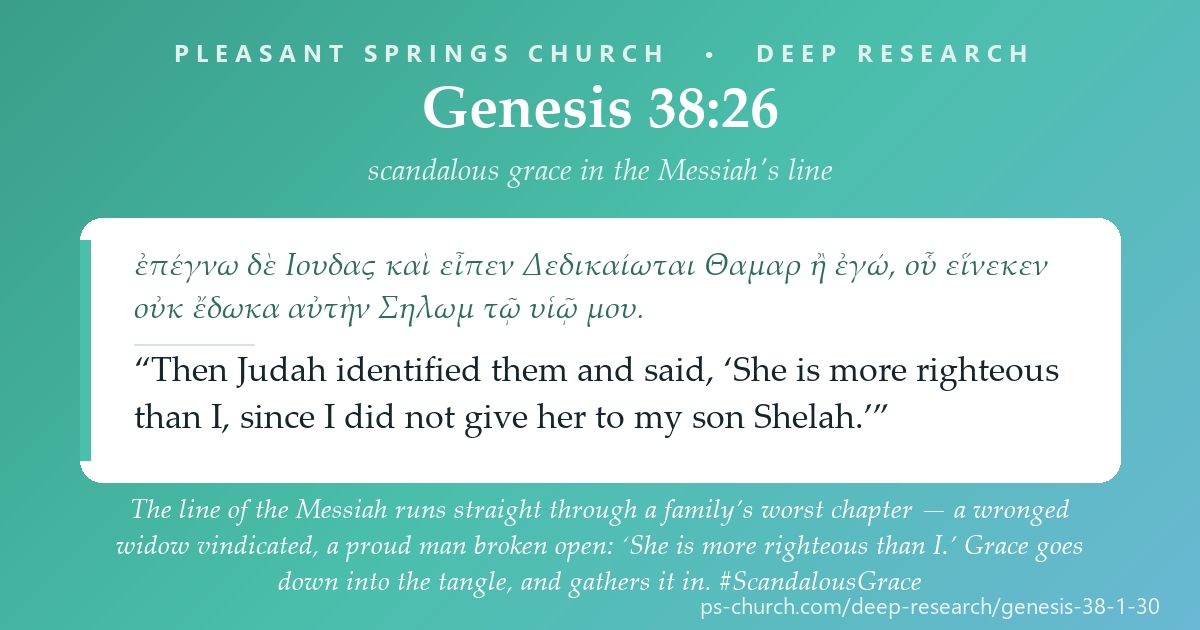
‘She is more righteous than I.’ Tamar’s response is desperate and calculated, and the narrator neither celebrates nor condemns the means: veiled at the roadside, she secures from the widowed Judah his signet, cord, and staff — his very identity in pledge (38:18). When word comes that the widow is pregnant, Judah, blind to his own guilt, demands the harsher penalty: “Let her be burned” (38:24). Then the pledges appear: “By the man to whom these belong, I am pregnant” (38:25). And Judah — who might have destroyed her to hide himself — does the opposite. He confesses: “She is more righteous than I, since I did not give her to my son Shelah” (38:26). It is the first crack of light in Judah’s character — a man owning his sin and a woman’s vindication at his own expense — and it is the seed of the Judah who will later offer his own body as a slave in place of Benjamin (44:33), the turn that saves the family.
Audience
Israel knew whose story this was: the tribe of Judah would become the royal tribe (49:8–10), and this chapter is the unvarnished account of its beginning. It would have been easy to bury — a patriarch’s Canaanite marriage, two sons struck dead, a daughter-in-law wronged, a roadside deception, twins born of it. Scripture refuses to hide it. The line of David and of the Messiah does not descend through spotless heroes but through sinners rescued and a wronged woman vindicated. Israel is taught to remember its own origins honestly, and to marvel that God builds his throne out of exactly such material.
Scandalous grace, and a real repentance. For the church, Genesis 38 guards two truths at once. First, that grace is scandalous: Perez, conceived in this tangle, heads the genealogy that runs through Boaz to David (Ruth 4:18–22), and Matthew, opening the New Testament, deliberately names “Judah the father of Perez and Zerah by Tamar” in the ancestry of Jesus (Matt 1:3) — one of four women, several with scandal attached, whom the Evangelist will not erase. The Messiah’s family tree runs straight through this chapter, and that is gospel: God is not ashamed to be called their God (Heb 11:16), nor ours. Second, that grace produces a real turning: Judah’s “she is more righteous than I” is no cheap sentiment but the beginning of a transformed man. The chapter is sober about sin and unembarrassed about mercy — and it warns the reader never to be quicker to burn others than to confess himself (Matt 7:3–5; Rom 2:1).
Orient on levirate marriage, the tribe of Judah, Tamar, and the genealogies of grace.
Search by topic: levirate marriage, Tamar, Judah (patriarch), Perez / Zerah, signet and seal, prostitution in the OT, genealogy of Jesus.
Which articles are relevant?
- Anchor Bible Dictionary — “Tamar,” “Judah (Son of Jacob),” “Levirate Marriage,” “Perez,” “Marriage (OT).”
- Dictionary of the OT: Pentateuch — “Judah,” “Marriage,” “Genealogies,” “Narrative Art of Genesis.”
- NIDOTTE / TDOT — yabam (levir / brother-in-law duty), tsadeq (be righteous / in the right), zanah (be a harlot), qedeshah (cult prostitute), parats (break out/through).
Bibliography surfaced:
- Gordon Wenham (WBC), Victor Hamilton (NICOT), Kenneth Mathews (NAC), Bruce Waltke, Nahum Sarna (JPS) on Genesis.
- Studies of levirate marriage (Deut 25:5–10; Ruth 4) and of the four women in Matthew’s genealogy (Tamar, Rahab, Ruth, “the wife of Uriah”).
- Beale & Carson, Commentary on the NT Use of the OT (Matthew 1); studies of the Judah story as the spine of Genesis 37–50.
Levirate duty, the widow’s trap, and the pledge that could not be denied.
Read the chapter against ancient family law: the levir’s obligation, the vulnerability of the childless widow, and the legal weight of a personal seal.
Which customs and parallels shed light on the story?
Levirate marriage and the widow’s survival. In the ancient Near East a woman’s security ran through her sons; a childless widow was among the most vulnerable people alive. The levirate custom — a brother raising up an heir for a dead man by the widow (later law, Deut 25:5–10; enacted in Ruth 4) — existed to preserve both the dead man’s name and the living woman’s future. This is the frame for everything Tamar does. Onan’s refusal is not a private matter of squeamishness but the theft of a family and a future from both his brother and his brother’s widow, taken while he took his own pleasure — “wicked in the sight of the Lord” (38:10). And Judah’s withholding of Shelah leaves Tamar legally frozen: still bound to his house, unable to remarry, without child or standing. She is trapped by the very custom meant to protect her.
The seal, the cord, and the staff. When Judah leaves his signet, its cord, and his staff as pledge (38:18), the narrator chooses the three most personal, identifying possessions a man carried. The cylinder-seal on its cord was a man’s legal signature, pressed into every contract; the staff bore his mark. To hold these was to hold his identity in one’s hand. Tamar does not ask for gold; she asks for proof. The irony is exact and deliberate: the man who had refused to recognize his obligation to her (the same Hebrew root, nakar, that runs through the Joseph story) is undone when he is forced to recognize his own seal — “Then Judah identified them” (38:26). The pledges he gave to hide a sin become the evidence that saves a life — her own, and the child’s.
Told soberly, judged honestly. Scripture reports the roadside encounter plainly and without a trace of relish — a discipline worth imitating. It does not excuse Tamar’s means, and it does not pretend Judah’s double standard is anything but hypocrisy: he would burn her for the very kind of act he had just committed (38:24–26). What the chapter does is measure both by righteousness — and Judah himself renders the verdict against himself. The Bible’s realism here is a mercy to the reader: it refuses to sanitize the ancestors of the King, so that no sinner reading it may think the grace of God too clean to reach him.
- Deuteronomy 25:5–10; Ruth 4:1–22 — the levirate duty codified and then honored: the custom Genesis 38 assumes, and its redemptive counter-image in Boaz and Ruth (Perez’s line restored).
- Genesis 37:32–33 ↔ 38:25–26 — “please identify whether it is your son’s robe” / “identify… whose these are”: Judah, who deceived his father with a token, is now brought to truth by one (the nakar hook binding the two chapters).
- Genesis 49:8–10; 44:18–34 — the royal tribe and Judah’s later self-offering for Benjamin: chapter 38 is where that transformation begins.
The reader who resents the interruption — wrenched from Joseph in Egypt back to a sordid family scandal in Canaan — has already felt exactly what the narrator intends. The two chapters are set side by side as deliberate opposites, and the seam between them is the whole argument. In chapter 38 the brother who is free, at home, and unpressured goes down, marries out, and falls into the dark; in chapter 39 the brother who is enslaved, exiled, and relentlessly tempted stands up and says ‘How then can I do this great wickedness and sin against God?’ The one has every advantage and squanders it; the other has every excuse and refuses it. Yet the wonder of Genesis is that grace does not merely reward Joseph and abandon Judah. It goes down after Judah. It meets him at the point of his exposure, and instead of destroying him it breaks him open — ‘she is more righteous than I’ — and begins to make of the schemer who sold his brother the man who will one day beg to be enslaved in his brother’s place. And then, as if to sign the work, it plants in this very chapter, out of this very tangle, the seed of David and of great David’s greater Son. Genesis will not let us keep our heroes clean or our villains hopeless. It insists, against all our neatness, that the line of the Messiah is a line of rescued sinners — and that the God who chose it is not ashamed.
The vocabulary of duty, wickedness, righteousness, recognition, and the breaking-out.
Watch the levirate yabbem, the doubled “wicked in the sight of the Lord,” Judah’s “she is more righteous than I,” the nakar recognition that binds ch. 37 and 38, the identifying pledge, and Perez’s name.
“Perform the duty of a brother-in-law” — the levirate obligation (yabam, Deut 25:5–10): raise up an heir for the dead and a future for his widow. Onan takes the marriage and refuses the duty — the sin the chapter names, not merely a bodily act.
“Wicked in the sight of the Lord” — said of Er, then of Onan’s deed. God is the moral center of a chapter with no visible miracles: he sees, and he acts. The LXX renders the killing with ho theos, “God.”
“She is more righteous than I” — literally “she is in the right, more than I” (tsadaq). Judah’s confession does not call the deception good; it declares that Tamar, denied her due, was justified in her cause, and he was the guilty one. The chapter’s hinge.
“Then he identified” — the verb nakar that Judah used to trick Jacob with Joseph’s robe (“identify… your son’s robe,” 37:32) now traps Judah with his own seal. The deceiver is brought to truth by a token, as his father was.
“Pledge” — the signet, cord, and staff Judah leaves in surety: his whole legal identity in a stranger’s hand. The same word Paul takes up in Greek (arrabon) for the Spirit as God’s down-payment (2 Cor 1:22) — here, a pledge that convicts and saves.
“Perez” — “a breach; one who breaks out” (parats), for the twin who thrust past his brother into the light. From this breaking-out come Boaz, David, and the Christ (Ruth 4:18–22; Matt 1:3) — grace bursting from the unlikeliest womb.
How the rest of Scripture fills out the scene:
- Deuteronomy 25:5–10; Ruth 4:1–22 — the levirate duty codified and honored: what Onan refused and Judah withheld, Boaz freely performs, restoring the line of Perez.
- Genesis 37:32–33 ↔ 38:25–26 — the nakar (“identify”) hook: the token Judah used to deceive his father, and the token that now convicts and turns him.
- Genesis 44:18–34; 49:8–10 — Judah’s self-offering for Benjamin and his blessing as the royal tribe: the awakening of 38:26 come to full flower.
- Ruth 4:18–22; Matthew 1:1–6; Luke 3:33 — Perez to David to the Messiah: the genealogies that gather this scandalous chapter into the ancestry of the King.
From a roadside in Canaan to a genealogy in Matthew that will not hide it.
Trace the wronged widow, the confessed sin, and the breaking-out son toward their New Testament gathering in the line of Christ.
Which cross-references matter?
- Genesis 39:1–23 — the deliberate mirror: Judah goes down into sin at ease; Joseph, enslaved and tempted, stands (“How then can I do this great wickedness and sin against God?” 39:9). Two brothers, two directions (see Joseph’s integrity).
- Genesis 44:18–34 — Judah offers himself as a slave in Benjamin’s place: the transformation begun at “she is more righteous than I” reaches its height.
- Ruth 4:11–22 — Bethlehem blesses Boaz’s house “like the house of Perez, whom Tamar bore to Judah”: the chapter’s child named aloud in a benediction of hope.
- Matthew 1:3; Luke 3:33; Hebrews 7:14 — “Judah the father of Perez and Zerah by Tamar” in the ancestry of Jesus; the Lord who “descended from Judah.”
- Matthew 7:1–5; Romans 2:1; James 2:13 — the warning Judah embodies: quick to burn, slow to confess — until mercy triumphs over judgment.
It is one of the boldest strokes in all of Scripture that Matthew, setting out to prove Jesus the son of David and son of Abraham, does not quietly draw a straight clean line from patriarch to King. He breaks his own rhythm to insert four women, and the first of them is Tamar — ‘Judah the father of Perez and Zerah by Tamar.’ He need not have named her; genealogies routinely ran through the fathers alone. He names her on purpose. The Evangelist who will announce a virgin’s holy conception first plants in his family tree the memory of Genesis 38, and of Rahab the harlot, and of Ruth the Moabite, and of ‘the wife of Uriah’ — as if to say, before ever the angel speaks to Mary, that the God who is coming has always come this way: down into the tangle, through the wronged and the shamed and the outsider, redeeming the very line he condescends to join. Genesis 38 is not an embarrassment the gospel must overcome; it is a preview of the gospel’s method. The King is born of a people God was never ashamed to save at their worst — and the door he opens by such a lineage is a door wide enough for anyone. If Perez belongs in the ancestry of Christ, then no history, however broken, is too far gone for grace to gather in.
The scholarship on Genesis 38:1-30.
The commentators on the Judah–Tamar narrative; the studies of levirate custom, of the chapter’s place within Joseph, and of the Matthean genealogy.
Commentaries & studies:
- Gordon J. Wenham (WBC), Victor P. Hamilton (NICOT), Kenneth A. Mathews (NAC), Bruce K. Waltke, Nahum M. Sarna (JPS), Derek Kidner (TOTC) on Genesis.
- Robert Alter on the Judah–Tamar narrative and its verbal links to the Joseph story (nakar, “identify”); studies of levirate marriage and of the OT law of the childless widow.
- G. K. Beale & D. A. Carson, eds., Commentary on the NT Use of the OT (Matthew 1); studies of the four women in Matthew’s genealogy.
Interpretation notes worth keeping:
- Onan’s sin (38:9–10). The text condemns not a mechanical act in the abstract but a persistent, self-serving refusal of covenant duty — using Tamar while denying her and his brother an heir. Read it as the theft it is, in its own frame; do not stretch it past what the narrator says.
- Tamar’s righteousness (38:26). “More righteous than I” declares her cause just, not her disguise commendable. She is vindicated as the wronged party who fought for her God-given due; the deception is reported, not blessed. The verdict is Judah’s own, against himself.
- The double standard (38:24). Judah’s snap sentence — “Let her be burned” — for a sin he had just committed is Scripture’s picture of hypocrisy exposed (cf. Matt 7:3–5). His willingness to be exposed rather than let her die is the measure of his turning.
- The placement (chs. 37–39). Genesis 38 is not a stray fragment but a deliberate literary hinge: Judah’s descent framed against Joseph’s integrity, and the first movement of the Judah who will save the family in ch. 44. Its verbal hooks bind it tightly to what surrounds it.
- Grace, not endorsement. That Perez stands in the Messiah’s line (Matt 1:3) magnifies grace; it does not sanctify the sins that surround his conception. Hold the two together as the chapter does: honest about sin, unembarrassed about mercy — the house discipline of this library.
From a family’s worst chapter to the confession that lets grace in.
Name what you learned, why it matters, and one concrete response.
What should we carry away — and do?
- Grace is scandalous — and that is the good news. The Messiah’s line runs straight through Genesis 38. God is not ashamed to be called the God of rescued sinners (Heb 11:16). No history is too broken for him to gather in.
- Confession is where the turning starts. “She is more righteous than I” is the first light in Judah — a man owning his sin at his own cost. That crack of honesty grows into the brother who offers himself for Benjamin. Repentance is not the end of usefulness; it is the beginning of it.
- Beware the quick verdict. Judah would burn Tamar for his own sin. Be slower to condemn others than to examine yourself (Matt 7:3–5; Rom 2:1) — and remember the wronged and the vulnerable, whom God sees and vindicates.
Step in response: take the thing in your own history you are most tempted to hide — the failure, the wrong done or suffered — and bring it honestly before God, who already knows and is not ashamed. Say your own “she (or he) is more righteous than I” where it is true; make right what you have withheld from someone owed it. And when you are tempted to a quick, harsh verdict on another’s fall, remember whose family tree Genesis 38 belongs to — and let mercy be your first instinct, as it was God’s toward Judah, and toward you.
Genesis 38:26 · to share
LXX + ESVEvery Deep Research page traces its passage across the whole sweep — the Old Testament, the Second-Temple world between the testaments (historical witnesses, not Scripture), and the New Testament. Follow the thread:
Pleasant Springs Church — Deep Research
Research method after Michael S. Heiser’s Bible Research Method (examine dictionaries → ancient literature → important words → textual connections → academic publications → share), with the Pleasant Springs “Author & Audience” foundation. Scripture set in the Hebrew, the Greek editions named on each page and the ESV (Old Testament), and the Greek New Testament and the ESV (New Testament), per the practice of Pleasant Springs Church. Genesis 38:1–30 research grounded in Wenham, Hamilton, Mathews, Waltke, Sarna, and Kidner, with Alter on the Judah–Tamar narrative and its verbal links to the Joseph story; the chapter read soberly as a deliberate hinge within Genesis 37–50 — Judah’s descent (38:1) framed against Joseph’s integrity (39:9); the levirate duty (Deut 25:5–10; Ruth 4) as the frame for Onan’s theft and Tamar’s trapped widowhood; the nakar (“identify”) hook binding 37:32 to 38:26; Judah’s “she is more righteous than I” (38:26) honored as a real turning toward the self-offering of 44:33; the LXX rendering the divine killing with ho theos at 38:7, 10 where the MT reads YHWH; and Perez (38:29) gathered through Ruth 4:18–22 into the Messianic genealogy of Matthew 1:3 — grace shown scandalous but never sin sanctioned, per the house discipline of this library. Sexual content is treated soberly and never sensationally, with grave pastoral care.
Scripture quotations marked ESV are from the ESV® Bible (The Holy Bible, English Standard Version®), © 2001 by Crossway, a publishing ministry of Good News Publishers. ESV Text Edition: 2016. Used by permission. All rights reserved. The ESV text may not be quoted in any publication made available to the public by a Creative Commons license, and the ESV may not be translated in whole or in part into any other language. www.esv.org
|
Did this study bless you today? 💚 Give to Support PS Church100% of gifts go to the General Fund — thank you. |