Five times in one chapter the covenant name sounds — “the Lord was with Joseph,” the blessing on his house, and his presence in the prison (39:2, 3, 5, 21, 23) — and two of the five fall in a prison. Sold into slavery, Joseph prospers under God’s hand and is trusted with everything; tempted day after day by his master’s wife, he refuses on the highest ground: “How then can I do this great wickedness and sin against God?” He flees, is falsely accused, and is thrown into the king’s prison — where the Lord is with him still, showing him steadfast love. Integrity under fire, sin as against God, and the presence that will not leave. This study works Genesis 39:1–23. See the method →
Genesis 39:2, 3, 5, 9, 21, 23
Hebrew · LXX · ESVThe Shape of the Passage
Parallel panelsBetween the pit and the palace, Genesis pauses on a slave’s integrity — because the God who was with Joseph in Potiphar’s house is the same God who is with him in the prison, and the refrain will not let us forget it.
Author
Moses sets Genesis 39 as the hinge of the Joseph narrative. Chapter 38 has just detoured to Judah and Tamar; now the camera returns to Joseph, “brought down to Egypt” (39:1) and sold to Potiphar, an officer of Pharaoh. The chapter’s architecture is deliberate: it opens and closes with the same sentence — “the Lord was with Joseph” (39:2, 21) — and repeats it three more times inside (39:3, 5, 23), five in all. This is the first re-entry of the covenant name (YHWH) into the Joseph story since he was torn from his father’s house; and the narrator plants it where it is least expected — not in a vision or a dream, but in the daily labor of a foreign slave, and then in a dungeon. The point is unmistakable: God’s presence is not tied to Joseph’s circumstances. It rises with him to steward Potiphar’s estate and descends with him into the king’s prison, unbroken.
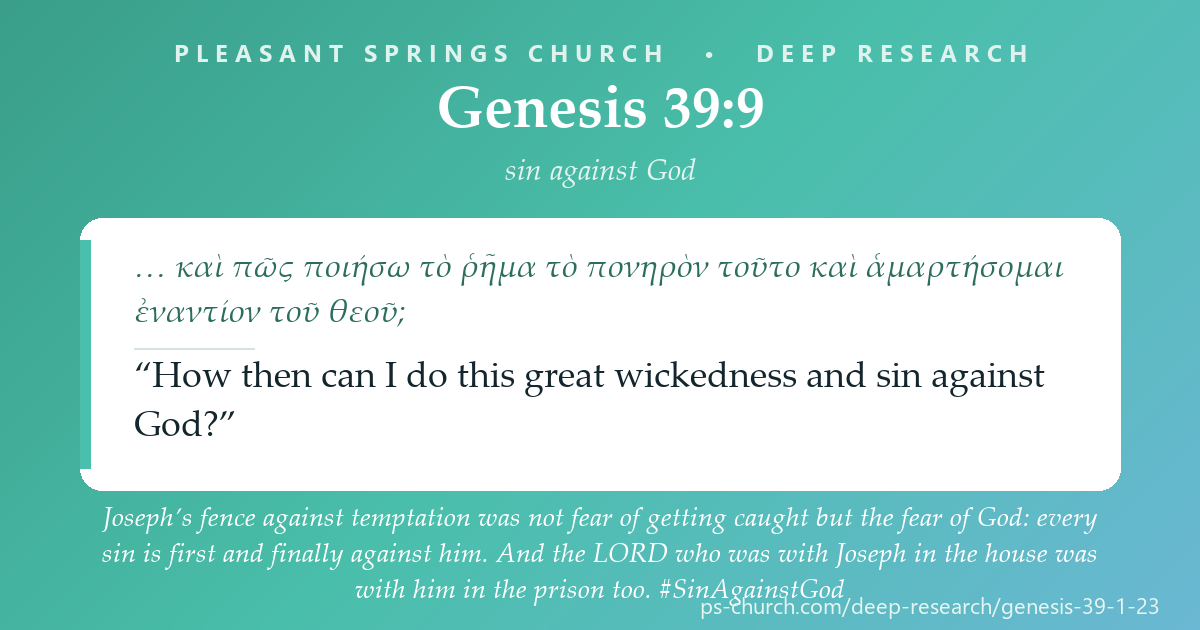
The test. Joseph is “handsome in form and appearance” (39:6), and Potiphar’s wife fixes her eyes on him. The Hebrew stresses the relentlessness: she speaks to him “day after day” (39:10). This is no single ambush but a wearing, sustained pressure — the hardest kind. Joseph’s refusal rests on two grounds, and the order matters. First, the sacredness of trust: his master has “kept back nothing from me except you, because you are his wife” (39:8–9) — to betray that trust would be treachery. But he does not stop at horizontal ethics. He climbs at once to the vertical and final ground: “How then can I do this great wickedness and sin against God?” (39:9). Every sin wrongs a neighbor; every sin is, first and finally, against God (cf. Ps 51:4). Joseph names it, and the naming is his shield.
The cost. When words fail her she uses force: she “caught him by his garment” (39:12) — and Joseph does the only faithful thing, which is to run. He leaves the garment and flees; a robe betrayed him once before (37:31–33), and now a second garment becomes false evidence in a scorned woman’s hand. Her accusation is a masterpiece of resentment, aimed first at her husband (“this Hebrew… you have brought among us,” 39:14, 17). Joseph, doing right, is punished for it: cast into “the place where the king’s prisoners were confined” (39:20). And there — precisely there — the refrain returns: “But the Lord was with Joseph and showed him steadfast love” (hesed, 39:21). Faithfulness is not rewarded with rescue but with presence; the God who was with him in the house is with him in the cell, and the same favor that ran Potiphar’s estate now runs the prison.
Audience
Israel — and every reader who has done right and suffered for it — is the audience. To a nation that would itself be enslaved in Egypt, Genesis 39 preaches that the covenant God does not abandon his people to Pharaoh’s house or Pharaoh’s prison: he goes down with them. The chapter answers the ache of the wrongly-accused and the faithfully-poor with a refrain rather than a rescue — not “God got Joseph out” (not yet), but “the Lord was with Joseph.” That is the deeper mercy: not the absence of the dungeon but the presence of God within it.
Integrity and the fear of God. For the church, Genesis 39 is Scripture’s great school of purity under fire. It teaches that temptation is often not a single dramatic hour but a daily erosion (39:10); that the strongest fence around chastity is theological, not merely prudential — sin understood as first of all “against God” (39:9; Ps 51:4); and that when argument is exhausted the godly response to seduction is not to negotiate but to flee (39:12; 1 Cor 6:18; 2 Tim 2:22). It teaches, too, the hardest lesson of providence: that doing right may cost you the prison, and that God’s reward for integrity is sometimes not deliverance but his own nearness in the next hard place (1 Pet 2:19–23; 3:14–17). And the church has long seen in this suffering-servant — betrayed, stripped of his robe, falsely condemned, numbered with prisoners, yet with God and vindicated in time — a foreshadowing (held as devotional analogy, not the literal sense) of a greater Innocent who “committed no sin” and “continued entrusting himself to him who judges justly.”
Orient on Egyptian slavery and household administration, hesed, and the fear of God.
Search by topic: Joseph, Potiphar, slavery in Egypt, household steward, hesed / steadfast love, fear of God, adultery, prison.
Which articles are relevant?
- Anchor Bible Dictionary — “Joseph (son of Jacob),” “Potiphar,” “Slavery (Old Testament),” “Egypt,” “Adultery,” “Prison.”
- Dictionary of the OT: Pentateuch — “Joseph,” “Egypt, Egyptians,” “Slavery,” “Ethics,” “Blessing.”
- NIDOTTE / TDOT — chesed (steadfast love, 39:21), tsalach (succeed/prosper, 39:2–3, 23), barakh (bless, 39:5), chata’ (sin, 39:9), ’elohim (God, 39:9).
Bibliography surfaced:
- Gordon Wenham (WBC), Victor Hamilton (NICOT), Kenneth Mathews (NAC), Bruce Waltke, Nahum Sarna (JPS) on Genesis.
- Studies of the Joseph narrative and its Egyptian setting; the “Tale of Two Brothers” (Egyptian) as a cultural analogue; treatments of hesed and of biblical sexual ethics.
- Beale & Carson, Commentary on the NT Use of the OT; and studies of 1 Peter’s theology of suffering for righteousness.
The trusted slave, the spurned mistress, and sin against God in a pagan house.
Read the household setting, the seduction, and the false accusation against ancient Egyptian custom and the Bible’s theology of God’s presence.
Which parallels shed light on religion and worldview?
The trusted foreign slave. Egyptian records confirm the picture: capable household slaves, some of them Semitic (“Asiatics”), could rise to administer an entire estate as steward, holding everything “in their hand” while the master “knew nothing except the food he ate” (39:6). Genesis presents Joseph’s rise not as luck or mere talent but as blessing: “the Lord was with him” and made all he did prosper, and Potiphar — a pagan — can see it (39:3). Blessing overflows the covenant line: for Joseph’s sake the Lord blesses even an Egyptian’s house and field (39:5) — the Abrahamic promise (“in you all families of the earth shall be blessed,” 12:3) quietly at work in a slave’s diligence.
The spurned mistress — and a famous parallel. Interpreters have long noted the Egyptian “Tale of Two Brothers,” in which a wife tries to seduce her husband’s younger brother, is refused, and then accuses him falsely. The parallel is a cultural analogue, not a source: it shows the scenario was a known human tragedy, and it throws Joseph’s distinctive into relief. What sets Genesis 39 apart is the reason for the refusal. The Egyptian tale turns on honor and family loyalty; Joseph adds a vertical dimension the pagan story lacks — “sin against God” (39:9). The seduction itself is drawn with sober restraint: no lingering, no titillation, only her bare, repeated command “Lie with me” (39:7, 12) and the wearing pressure of “day after day” (39:10). Scripture records the sin without ever sanctioning or savoring it.
Sin as against God. The theological heart of the chapter is Joseph’s logic. He owes Potiphar loyalty; he owes the woman nothing but refusal; but the wrong itself he measures against God. This is the Bible’s deepest account of sin: adultery injures a spouse and betrays a master, yet its final offense is vertical — “against you, you only, have I sinned” (Ps 51:4, David after a sin Joseph refused). Notice the divine name shifts here: the covenant refrain uses YHWH (the Lord), but Joseph, reasoning about morality before the God even a pagan household must answer to, says Elohim — “God” as the moral Ruler of all. The fear of that God, present in a house where no one is watching, is what keeps him (cf. 42:18; Prov 1:7). Purity, Genesis says, is finally a matter of coram Deo — living before the face of God.
- “The Tale of Two Brothers” (Egyptian, Papyrus D’Orbiney) — the spurned-wife / false-accusation scenario as cultural analogue (a witness to the type, not a source of the text).
- Psalm 51:4; 2 Samuel 12:13 — sin as first and finally “against God”: David names what Joseph refused.
- Genesis 12:3; 39:5 — blessing overflowing the covenant line onto an Egyptian’s house “for Joseph’s sake” (see the call of Abram).
The most remarkable thing about Genesis 39 is what it does not promise. Read the five refrains in a row — ‘the Lord was with Joseph’ (39:2), ‘the Lord was with him’ (39:3), ‘the Lord blessed’ (39:5), ‘the Lord was with Joseph’ (39:21), ‘the Lord was with him’ (39:23) — and notice that two of them fall in the prison. The narrator could have written a chapter in which God’s presence guarantees a smooth ascent: obey, and prosper. Instead he writes a chapter in which the man who does everything right ends in a dungeon, and God is just as much with him there. That is the education. The presence of God is not a reward for good behavior that buys immunity from suffering; it is the deeper gift that outlasts the loss of everything else. Joseph loses his home, then his freedom, then — for the crime of integrity — even the modest dignity of the steward’s post; and at the bottom of the fall the same sentence is waiting for him that met him at the top. The chapter refuses the prosperity gospel and the despair of the abandoned in a single stroke. It says to the slave, the prisoner, the falsely-accused, and the one who obeyed God and paid for it: your circumstances are not the measure of God’s nearness. He was with Joseph in the house; he was with Joseph in the cell; and the second is the harder, dearer miracle.
The vocabulary of the chapter: the refrain, the prospering hand, sin against God, and the flight.
Watch the fivefold “the Lord was with Joseph,” the prospering hand, the “great wickedness” named and fled, and the hesed that meets him in prison.
“The Lord was with Joseph” — the fivefold refrain that frames the chapter (twice in the house, once in the blessing, twice in the prison). The first return of the covenant name (YHWH) to the Joseph story: God’s presence tied to no circumstance.
“Successful / prospering” — tsalach: to succeed, to be made to thrive. Not Joseph’s cleverness but the Lord “making it succeed in his hand” — and Potiphar, a pagan, can see the source (39:3).
“And sin against God” — the chapter’s moral summit. Sin injures master and neighbor, but its final offense is vertical (cf. Ps 51:4). Here the ordinary name Elohim, God as moral Ruler of all — the fear of him keeps Joseph where no one is watching.
“This great wickedness” — Joseph names the seduction for what it is before he refuses it. Naming sin plainly, without euphemism, is half of resisting it; he calls it evil and great, then flees it.
“And he fled” — when she seizes his garment, Joseph leaves it and runs. Not negotiation but flight: the godly reflex before overpowering temptation (1 Cor 6:18; 2 Tim 2:22). A second robe (cf. 37:31) becomes false evidence — the cost of doing right.
“Steadfast love” — the covenant loyalty God “extended” to Joseph in the prison. The LXX renders it ἔλεος (mercy). Faithfulness rewarded not with escape but with the Lord’s presence and favor in the next hard place.
How the rest of Scripture fills out the scene:
- Genesis 39:2, 21; Isaiah 43:2; Matthew 28:20 — “I am with you”: the presence of God in fire, flood, slavery, and prison — the promise that outlasts circumstance.
- Psalm 51:4; 2 Samuel 12:13; Luke 15:18 — “against God” / “against heaven”: sin measured first and finally toward its Maker, as Joseph measured it.
- 1 Corinthians 6:18; 2 Timothy 2:22; Proverbs 5–7 — flee sexual immorality: Joseph’s running garment becomes the church’s counsel.
- 1 Peter 2:19–23; 3:14–17 — suffering for doing good, entrusting oneself to the righteous Judge: Joseph’s prison read through the cross (see the sale of Joseph).
From Potiphar's house to Pharaoh's palace, and from Joseph's cell to a greater Innocent.
Trace the presence of God, the integrity under temptation, and the wrongful suffering toward their fulfillment.
Which cross-references matter?
- Genesis 37:31–33; 39:12–18 — twice a garment is used to lie about Joseph: the brothers’ bloodied robe and the mistress’s seized cloak. Deception recorded, never sanctioned; the innocent stripped and slandered.
- Genesis 40–41 — the prison is not the end: the same “the Lord was with him” that runs the dungeon will lift him to Pharaoh’s right hand — God’s timing, not Joseph’s escape (see Joseph before Pharaoh).
- Genesis 50:20; Romans 8:28 — “you meant evil… but God meant it for good”: the false accusation and the prison folded into a saving providence.
- Psalm 105:17–22 — Israel’s own hymn on Joseph: “his feet were hurt with fetters… until what he had said came to pass” — the tested word and the vindicated servant.
- 1 Peter 2:21–24; Isaiah 53:9; Matthew 27:12–14 — the greater Innocent: no sin, no deceit, falsely accused, silent, numbered with transgressors, vindicated by God (held as devotional analogy on real patterns).
It would be a comfortable story if Joseph’s virtue were immediately rewarded — if the God who was with him had shut the mistress’s mouth and promoted the faithful steward on the spot. But that is not the story Genesis tells. Joseph does exactly the right thing, for exactly the right reason, and it lands him in prison. This is the chapter’s hard honesty and its enduring pastoral power: obedience is not a lever that forces God’s hand into rescue. Sometimes the wages of integrity, in the short account, are loss. Joseph pays for his purity with his freedom, just as he had earlier paid for his father’s love with his liberty. And yet the narrator will not let us read the prison as abandonment. The very verse that tells us Joseph is confined tells us, in the same breath, that the Lord was with him and extended to him hesed — covenant love — there. The reward for doing right was not the absence of the cell but the presence of God inside it, and the slow, sure vindication that God’s timing would bring. The church has always found here more than an example of chastity, though it is that. It has found a pattern the gospel completes: a beloved and innocent servant, betrayed by his own, stripped of his robe, falsely condemned, numbered among prisoners, entrusting himself to the God who judges justly — and raised, in the end, to save the very ones who wronged him. Read this way (as resonance, not as the verse’s plain sense), Joseph’s cell already carries the shadow of an empty tomb.
The scholarship on Genesis 39:1-23.
The commentators on the Joseph narrative; the studies of its Egyptian setting, the “Two Brothers” analogue, and biblical sexual ethics.
Commentaries & studies:
- Gordon J. Wenham (WBC), Victor P. Hamilton (NICOT), Kenneth A. Mathews (NAC), Bruce K. Waltke, Nahum M. Sarna (JPS) on Genesis.
- Studies of the Joseph novella and its Egyptian background (Redford, Kitchen); the “Tale of Two Brothers” as cultural analogue; Robert Alter on the narrative art of Genesis 39.
- Treatments of hesed (Sakenfeld) and of Old Testament and New Testament sexual ethics; studies of 1 Peter on suffering for righteousness.
Interpretation notes worth keeping:
- The fivefold refrain (39:2, 3, 5, 21, 23). A deliberate inclusio: the same clause opens and closes the chapter, with two occurrences falling in the prison. The structure preaches the theme — presence unbound by circumstance — before any sermon does.
- Elohim, not YHWH, at 39:9. The covenant refrain uses the Lord (YHWH); Joseph’s moral reasoning uses Elohim (God), the Ruler to whom even a pagan house is accountable. The shift is theologically apt, not careless — do not read the small-caps Lord into 39:9.
- “Day after day” (39:10). The temptation is a wearing campaign, not a single hour. The text’s realism about sustained pressure is part of its pastoral value; Joseph’s further avoidance (“or even to be with her”) is prudence, not prudishness.
- The garment (39:12–18). A second cloak (cf. 37:31–33) becomes false evidence. Handle Potiphar’s wife as Scripture does — her sin named soberly, without caricature or relish; the passage warns, it does not titillate.
- The devotional analogy. Joseph as a type of the suffering, vindicated Christ (innocent, betrayed, stripped, condemned, numbered with prisoners, raised to save) is venerable and rich — hold it as resonance built on real textual patterns (1 Pet 2:21–24; Gen 50:20), not as the chapter’s literal sense, the house discipline for typology throughout this library.
From a slave's integrity to the presence of God in the next hard place.
Name what you learned, why it matters, and one concrete response.
What should we carry away — and do?
- God is with you where you are. The refrain falls five times — twice in the prison. His presence is not a reward for success that buys you out of suffering; it is the deeper gift that goes down with you into the hard place.
- Sin is first against God. Joseph’s fence was theological, not merely prudential: “how… sin against God?” Whatever wrongs a neighbor wrongs God more. Living before his face — where no one else is watching — is what keeps us.
- When you can’t argue, flee. Joseph left the garment and ran. Some temptations are not to be reasoned with but removed from. And when doing right costs you the prison, trust the God whose vindication keeps better time than ours.
Step in response: name the temptation you are most tempted to negotiate with, and decide, before God, to flee it rather than manage it — remove the access, not just the intention (1 Cor 6:18). Reframe one struggle this week in Joseph’s words: not merely “this would hurt someone” but “how can I sin against God?” And if you are suffering for having done right, take the chapter’s harder comfort: the Lord was with Joseph in the cell — ask him not first for escape but for his nearness, and entrust your vindication to the God who judges justly (1 Pet 2:23).
Genesis 39:9 · to share
LXX + ESVEvery Deep Research page traces its passage across the whole sweep — the Old Testament, the Second-Temple world between the testaments (historical witnesses, not Scripture), and the New Testament. Follow the thread:
Pleasant Springs Church — Deep Research
Research method after Michael S. Heiser’s Bible Research Method (examine dictionaries → ancient literature → important words → textual connections → academic publications → share), with the Pleasant Springs “Author & Audience” foundation. Scripture set in the Hebrew, the Greek editions named on each page and the ESV (Old Testament), and the Greek New Testament and the ESV (New Testament), per the practice of Pleasant Springs Church. Genesis 39:1–23 research grounded in Wenham, Hamilton, Mathews, Waltke, and Sarna, with Alter on the narrative art and the Egyptian setting (the “Tale of Two Brothers” as cultural analogue, not source); the chapter read through its fivefold refrain (39:2, 3, 5, 21, 23), an inclusio that places God’s presence unbroken in both Potiphar’s house and the king’s prison (the covenant name YHWH throughout, LXX κύριος); Joseph’s refusal grounded in the fear of God and sin measured as “against God” (39:9, Elohim; cf. Ps 51:4), with flight as the godly response to temptation (39:12; 1 Cor 6:18); hesed in the prison (39:21, LXX ἔλεος) as faithfulness rewarded with presence rather than escape; and the Joseph-as-suffering-and-vindicated-servant reading held as devotional analogy on real textual patterns (1 Pet 2:21–24; Gen 50:20), not the literal sense — per the house discipline for typology, with grave pastoral care for the chapter’s sexual content, sober and never titillating.
Scripture quotations marked ESV are from the ESV® Bible (The Holy Bible, English Standard Version®), © 2001 by Crossway, a publishing ministry of Good News Publishers. ESV Text Edition: 2016. Used by permission. All rights reserved. The ESV text may not be quoted in any publication made available to the public by a Creative Commons license, and the ESV may not be translated in whole or in part into any other language. www.esv.org
|
Did this study bless you today? 💚 Give to Support PS Church100% of gifts go to the General Fund — thank you. |