Two whole years pass before a forgotten promise is kept. Pharaoh dreams twice — seven fat cows and seven gaunt, seven full ears and seven blighted — and no wise man of Egypt can read them; only then does the cupbearer remember Joseph. Rushed from the pit, shaved, and re-robed, Joseph sets the key with a single confession: “It is not in me; God will give Pharaoh a favorable answer.” The doubled dream is fixed by God — seven years of plenty, seven of famine — and Pharaoh, finding “a man in whom is the Spirit of God,” lifts the slave to the throne’s right hand. Two sons name the grace: God has made him forget his hardship, and fruitful in the land of his affliction. This study works Genesis 41:1–57. See the method →
Genesis 41:16, 32, 38, 51, 52, 57
Hebrew · LXX · ESVThe Shape of the Passage
Parallel panelsThe dungeon and the palace stand one verse apart. Genesis has been teaching, chapter after chapter, that God is at work where he cannot be seen — and now, at the appointed time, the hidden hand lifts its man into the light.
Author
Moses writes the hinge of the Joseph story with deliberate patience. The chapter opens on a wound: “After two whole years” (41:1) — two years the cupbearer, restored to Pharaoh’s hand, “did not remember Joseph, but forgot him” (40:23). The delay is not incidental; it is the narrator’s theology of timing. Joseph is not delivered when he asks (40:14) but when God’s purpose ripens — and it ripens through a pagan king’s troubled sleep. Twice Pharaoh dreams; twice he wakes; and all the wise men of the most learned court on earth stand mute (41:8). Only then does memory stir: “I remember my offenses today” (41:9). The whole apparatus of Egypt’s wisdom fails so that the whole glory may fall to the God of a forgotten Hebrew slave.
The confession that sets the key. Rushed from the pit — the word is bor, the same “pit” his brothers threw him into (37:24) — shaved after the Egyptian manner and given clean clothes, Joseph stands before the throne of the world and speaks first not of his gift but of its Giver: “It is not in me; God will give Pharaoh a favorable answer” (41:16). Every later honor rests on this sentence. He reads the twin dreams as one message — seven fat years, seven of famine “so severe” the plenty will be forgotten — and explains the doubling: “the thing is fixed by God, and God will shortly bring it about” (41:32). Then, unbidden, he adds counsel: let Pharaoh find “a discerning and wise man” to store a fifth of the plenty against the lean years (41:33–36). Interpretation joined to wisdom joined to humility — the court has never seen its like.
The great reversal. Pharaoh’s verdict is the chapter’s summit: “Can we find a man like this, in whom is the Spirit of God?” (41:38). In an afternoon the slave becomes viceroy: the signet ring off Pharaoh’s own hand, garments of fine linen, a gold chain, the second chariot with heralds crying before him, a throne-name — Zaphenath-paneah — and Asenath, daughter of the priest of On, for a wife (41:42–45). Joseph is thirty (41:46) — the age David and another Son would begin their public work. He gathers grain “like the sand of the sea… until he ceased to measure it” (41:49). And before the famine two sons arrive, each a name that turns the years of the pit into praise: Manasseh (God has made me forget the hardship), Ephraim (God has made me fruitful in the land of my affliction). The man has not forgotten the pain — he has watched God overrule it.
Audience
Israel, a people who knew both the pit and Egypt, heard their own future in this chapter. The nation that would be enslaved and then delivered is taught here that its God stations his servants in foreign courts and bends imperial power toward the saving of life (cf. 45:5–7; 50:20). The famine spreads “over all the land” (41:56) and “all the earth came to Egypt… to Joseph” (41:57) — and among “all the earth” are ten brothers in Canaan who once said, “we will see what will become of his dreams” (37:20). The wheel has come round: the sheaves are about to bow. Israel learned that God’s promises are not broken by delay, betrayal, or exile; they travel through them, and arrive on time.
Wisdom, stewardship, and the exalted sufferer. For the church, Genesis 41 is a school of several graces at once. It teaches the Spirit of God as gift, wisdom and discernment poured out and then humbly confessed before a watching pagan world (Jas 1:5; 1 Cor 2:12–16). It teaches stewardship that saves: foresight, restraint in plenty, provision against famine — administration as a ministry of life to the nations. It teaches the appointed time: “Humble yourselves… under the mighty hand of God so that at the proper time he may exalt you” (1 Pet 5:6; Jas 4:10) — Joseph waited thirteen years for a two-year sentence to end. And the church’s teachers have long heard, held carefully as devotional analogy and not the literal sense, a further music: a beloved, betrayed sufferer descends into a pit, waits in a prison as if forgotten, and is raised at the right hour to a throne, given a new name, and set to feed a dying world with bread — while taking a bride from among the nations (41:45; cf. Acts 7:9–10; Phil 2:8–9). The shape rhymes with the gospel because the same Author wrote both.
Orient on dreams and divination, Egyptian court and investiture, famine, and the names.
Search by topic: dreams and dream interpretation, Egypt (New Kingdom court, viceroy, investiture), magicians / wise men, Joseph, On / Heliopolis, Asenath, famine, Manasseh, Ephraim.
Which articles are relevant?
- Anchor Bible Dictionary — “Joseph,” “Dreams,” “Egypt (history and religion),” “On/Heliopolis,” “Asenath,” “Ephraim,” “Manasseh.”
- Dictionary of the OT: Pentateuch — “Joseph,” “Dreams and Visions,” “Egypt, Egyptians,” “Wisdom,” “Providence.”
- NIDOTTE / TDOT — chalom (dream), ruach (spirit/wind), chakham / navon (wise/discerning), nakhon (fixed, established), ’oni (affliction), parah (be fruitful — behind Ephraim).
Bibliography surfaced:
- Gordon Wenham (WBC), Victor Hamilton (NICOT), Kenneth Mathews (NAC), Bruce Waltke, Nahum Sarna (JPS) on Genesis.
- Studies of the Joseph narrative as wisdom literature (von Rad) and of Egyptian background (Kenneth Kitchen, James Hoffmeier) to the investiture, titles, and On/Heliopolis.
- Comparative work on the Joseph–Daniel court tales (interpreter of an empire’s dreams, exalted; Gen 41; Dan 2).
Dreams that ruled kingdoms, the shaving and the signet, and providence at the appointed time.
Read the twin dreams, the court failure, and the investiture against Egyptian custom and the Bible’s theology of providence and wisdom.
Which parallels shed light on religion and worldview?
Dreams as the voice of the gods. In the ancient Near East a king’s dream was affairs of state; Egypt kept trained ᴇartūmmīm (magician-scholars, the same word used of the Egyptian court in Exodus) and dream-manuals for exactly such nights. Genesis grants the convention and then overturns it: the professionals fail utterly (41:8, 24), and the reading comes from a prisoner who insists interpretations are not a human craft at all — “Do not interpretations belong to God?” (40:8), “It is not in me” (41:16). The doubled dream is a stock feature of the genre; Joseph reads its doubling not as art but as revelation, the divine underline: “the thing is fixed by God, and God will shortly bring it about” (41:32). What Egypt sought in omen-lore, Israel’s God simply gives.
The shaving and the signet. The narrative is soaked in accurate Egyptian color. Joseph is shaved before approaching Pharaoh (41:14) — Egyptians, unlike Semites, went clean-shaven, and one did not come to court unkempt. His investiture is textbook New-Kingdom protocol: the signet ring (delegated royal authority), garments of fine linen (shesh, byssus — priestly and noble dress), a gold chain of honor placed at the neck (a documented Egyptian reward), the second chariot with heralds crying before him (41:42–43). He receives an Egyptian throne-name, Zaphenath-paneah, and marries into the priesthood of On (Heliopolis, the great sun-cult center) — Asenath, daughter of Potiphera (41:45). Scripture neither hides nor commends the pagan setting; it shows the God of Abraham sovereign inside it, exalting his servant by an emperor’s own hand.
Providence at the appointed time. The theological spine of the chapter is timing. Joseph languishes two extra years for no fault; the cupbearer’s forgetting (40:23) is the very hinge on which deliverance turns, for had he remembered sooner, Joseph would have been freed as a favor, not raised as a ruler. God’s delays are not God’s neglect. The same hand that governs a butler’s memory governs a king’s dreams and a seven-year weather cycle — and works through Joseph’s own real wisdom and Pharaoh’s own free decision, not around them. This is providence in its fullness: God ordains the end (a people preserved) and ordains the means (a wise steward freely counseling, a king freely choosing), so that when Joseph later says “God sent me before you to preserve life” (45:5), he takes nothing from the human actors and gives everything to God.
- Genesis 40:8; 41:8, 16, 24, 25, 28, 32 — the failed magicians and the refrain “God has revealed / God will do”: revelation over divination.
- Daniel 2:27–30, 46–48 — the same court-tale shape: an exile reads the empire’s dream (“there is a God in heaven who reveals mysteries”) and is exalted; the closest canonical parallel to Genesis 41.
- Genesis 45:5–8; 50:20; Psalm 105:16–22 — the narrative’s own theology of providence: intended for evil, meant by God for good; the word of the Lord tested him until it came to pass.
The cruelest verse in the Joseph story may be the quiet one that closes the previous chapter: ‘Yet the chief cupbearer did not remember Joseph, but forgot him’ — and then the pitiless clock of 41:1: ‘After two whole years.’ Two years is a long time to sit in a dungeon on the strength of a promise a free man made and broke. But the narrator, who knows the end, is not cruel; he is careful. Had the cupbearer remembered in the first week, Joseph would have been released as a personal favor and vanished into the anonymous crowd of freed foreigners. Because he forgot, Joseph was still in the pit on the one morning in Egyptian history when the pit was the only door to the throne — the morning Pharaoh woke twice and no wise man could help him. The delay that looked like abandonment was the very hinge of the exaltation. This is the discipline Genesis keeps pressing on the reader: God’s timing is not God’s indifference, and the seasons that feel most wasted are often the ones in which he is setting the stage. Joseph did not know, in year one of the forgetting, that he was being kept for a coronation. Neither do we, in our own long seasons, know what the delay is for. But the God who governed a butler’s memory and a king’s sleep is governing ours — and at the proper time, not a day sooner and not a day late, he lifts his servants out of the pit.
The vocabulary of the reversal: the emptied ‘not in me,’ the fixed word, the Spirit, and the two named graces.
Watch Joseph’s self-emptying “not in me,” the doubled dream “fixed” and “hastened,” the pagan confession of the Spirit, and the sons’ names that turn affliction into forgetting and fruit.
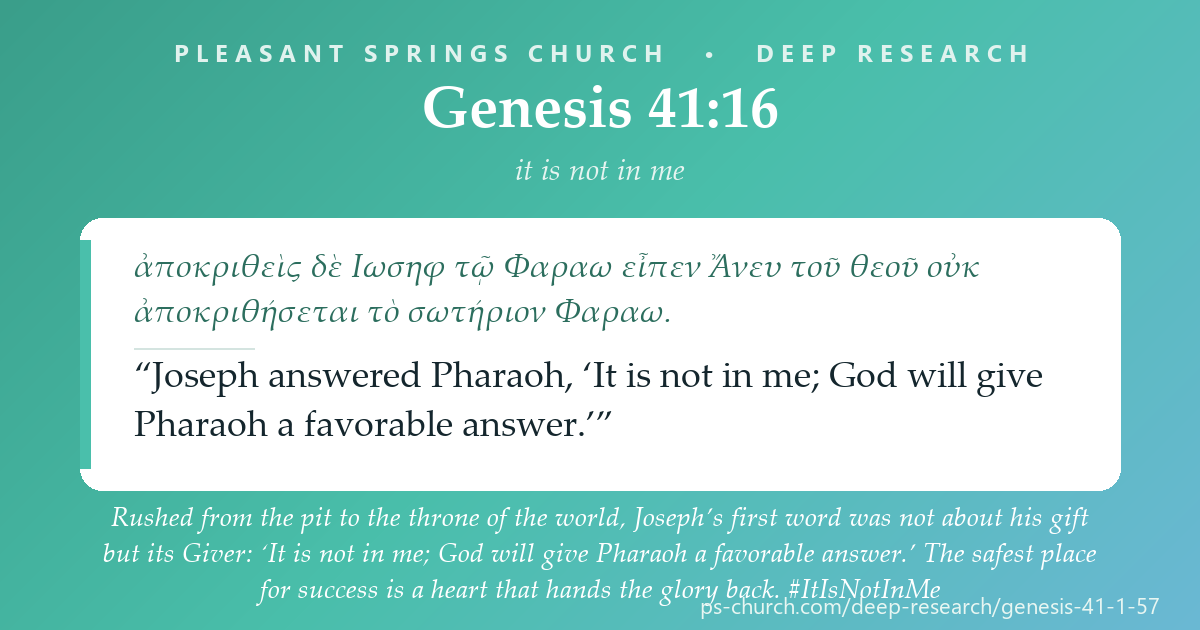
“It is not in me” — literally “apart from me.” Joseph’s first word to the throne of the world deflects all glory to God. The LXX makes the theology explicit: Ἄνευ τοῦ θεοῦ — “without God” no peace can be spoken to Pharaoh (cf. Jn 15:5).
“Fixed… will shortly bring it about” — the doubled dream means the matter is established by God and God hastens to do it. Certainty, not chance. LXX ἀληθές (“true”) and ταχυνεῖ (“he will hasten”).
“The Spirit of God” — a pagan king’s confession of what his court could not counterfeit. The same Spirit who hovered over the waters (1:2) rests as wisdom on a man (cf. Ex 31:3; Isa 11:2; Dan 5:14).
“Discerning and wise” — Joseph’s counsel (“let Pharaoh select”) becomes Pharaoh’s verdict on Joseph himself: “none so discerning and wise as you.” The gift is proven in prudent action, not display (Jas 3:13).
Manasseh — from nashani, “God has made me forget” my hardship and my father’s house. Not amnesia but healing: grace draws the sting from a remembered pit (cf. Isa 43:18–19).
Ephraim — from hiprani (root parah), “God has made me fruitful in the land of my affliction.” Fruit grows in the very soil of the suffering. LXX ηὔξησέν, “he made me increase” (cf. Jn 12:24).
How the rest of Scripture fills out the scene:
- Exodus 31:3; Isaiah 11:2; Daniel 5:11–14 — the Spirit of God as wisdom, skill, and discernment resting on a person: what Pharaoh names in 41:38.
- James 1:5; 4:10; 1 Peter 5:6 — wisdom given to those who ask, and exaltation at “the proper time” to the humbled: Joseph’s pattern turned to precept.
- Genesis 37:5–11 ↔ 41:57 — the boy’s dreams of bowing sheaves and stars, and “all the earth” now coming to Joseph for bread: the dreams beginning to come true (see the dreams and the pit).
- Psalm 105:16–22; Acts 7:9–10 — the canon’s own summaries: God sent famine and a man ahead of it; gave him favor and wisdom before Pharaoh and made him ruler of Egypt.
From a Hebrew in Pharaoh's court to the Servant raised to feed the nations.
Trace the exalted interpreter, the wisdom that saves life, and the humbled-then-lifted sufferer toward their fuller canonical shape.
Which cross-references matter?
- Genesis 40:1–23; 45:4–8; 50:20 — the immediate arc: prison dreams read, then the confession that seals it all — “you meant evil against me, but God meant it for good, to bring it about that many people should be kept alive.”
- Daniel 2:1–49; 5:11–14 — Joseph’s truest canonical twin: the exiled Hebrew who alone reads the empire’s dream, gives God the glory (“there is a God in heaven who reveals mysteries”), and is exalted over the province.
- Psalm 105:16–22 — “he had sent a man ahead of them, Joseph… the word of the Lord tested him… the king… made him lord of his house”: Israel’s hymn of Joseph’s providence.
- 1 Peter 5:6; James 4:10; Matthew 23:12 — “Humble yourselves… and at the proper time he will exalt you”: the theology of the reversal made a rule of discipleship.
- Acts 7:9–10; Philippians 2:8–9 — the betrayed and lowered one whom God raised, gave a name, and set to save: the pattern the church reads (as devotional analogy) toward its Lord.
Genesis 41 is one of the great reversals of Scripture, told with such restraint that its grandeur is easy to miss. In a single chapter a foreign slave — sold by his own family, falsely accused, forgotten in a dungeon — is set at the right hand of the most powerful man on earth, given his ring, his linen, his chariot, and the running of his kingdom. And the man himself keeps insisting, at the door of every honor, that the honor is not his: ‘It is not in me.’ That confession is why the exaltation is safe in his hands. A Joseph who took credit at the throne would have been unbearable; a Joseph who gives God the glory becomes the savior of the nations, feeding ‘all the earth.’ The old teachers of the church could not help but hear, in this shape, a rhyme with a later Beloved Son — betrayed by his own, brought low as if forgotten, then raised at the appointed hour, given a name above every name, and set to feed a dying world with bread, taking to himself a bride from among the nations. It is vital to say plainly what kind of reading this is: it is devotional analogy, a resonance the gospel makes irresistible, not the literal sense of the text and not a hidden code. Joseph is not a secret Christ; he is a real, flawed, wonderfully faithful man whose story God shaped so that, read in the light of the whole canon, it prepares the heart for the One it dimly foreshadows. Held that way — with the seam between figure and fulfillment kept honest — the analogy does what all good typology does: it makes you love the God who writes such patterns, and trust him in your own long wait between the pit and the throne.
The scholarship on Genesis 41:1-57.
The commentators on the exaltation; the studies of Egyptian background, the Joseph narrative as wisdom, and the Joseph–Daniel court tale.
Commentaries & studies:
- Gordon J. Wenham (WBC), Victor P. Hamilton (NICOT), Kenneth A. Mathews (NAC), Bruce K. Waltke, Nahum M. Sarna (JPS) on Genesis.
- Gerhard von Rad on the Joseph narrative as wisdom literature; Kenneth A. Kitchen and James K. Hoffmeier on the Egyptian setting (investiture, titles, On/Heliopolis, the shaving).
- Studies of the court-tale form shared by Joseph and Daniel, and of the theology of providence (“God meant it for good,” 50:20) across the Joseph cycle.
Interpretation notes worth keeping:
- “It is not in me” (41:16). The interpretive key. Joseph does not deny the gift; he relocates its source. The LXX’s “without God” (Ἄνευ τοῦ θεοῦ) sharpens the point — apart from God, no peace can be spoken to a king.
- The doubled dream (41:32). Repetition as divine confirmation, not redundancy — the same principle by which a matter is “established” on two witnesses (Deut 19:15). What God shows twice, he has fixed and will hasten.
- “The Spirit of God” on Pharaoh’s lips (41:38). A pagan king voices the true diagnosis. Read within the OT’s language of the Spirit as wisdom and skill (Ex 31:3; Isa 11:2); resist over-reading it as regeneration — it is the endowment of discerning wisdom that saves a generation.
- Zaphenath-paneah and Asenath (41:45). A genuine Egyptian name and a marriage into the priesthood of On. Scripture reports the assimilation into court life soberly, without either alarm or endorsement; Joseph’s God-naming of his sons (41:51–52) shows where his heart still lives.
- The names (41:51–52). Manasseh (“forget”) and Ephraim (“fruitful”) are theology in miniature: not the erasure of pain but its healing, and fruit borne precisely “in the land of affliction.” Grace does not delete the pit; it redeems it.
- The devotional analogy. Joseph-as-figure-of-Christ readings are ancient and homiletically rich; keep them as resonance built on real narrative shape (humiliation–exaltation, a savior of the nations), never as the chapter’s literal sense — the house discipline for typology throughout this library.
From the pit to the palace at the appointed time — and grace that bears fruit in the land of affliction.
Name what you learned, why it matters, and one concrete response.
What should we carry away — and do?
- Give the glory back. At the door of the greatest honor of his life, Joseph said, “It is not in me.” Every gift you carry is on loan; the safest place for success is a heart that hands the credit to God.
- Trust the delay. Two extra years in the pit were not neglect but preparation — the hinge of the whole exaltation. God’s timing is not God’s indifference; he lifts his servants at the proper time (1 Pet 5:6).
- Let affliction bear fruit. Joseph named his sons for God’s grace over his pain: forgetting and fruitfulness. You do not have to pretend the pit never happened — you get to watch God make it fruitful.
Step in response: take the gift or role you have been given — at work, at home, in the church — and consciously return the glory: name God as its source before you use it, the way Joseph did before Pharaoh. Then practice Joseph’s stewardship: in your season of plenty (of time, money, energy, health) store something against the lean years and the needs of others, so that when famine comes to someone near you, there is bread. And if you are in a long, unexplained delay, write your own two names over it — where has God helped you forget an old hurt, and where is he making you fruitful in the very land of your affliction? Name them, and wait for the appointed time.
Genesis 41:16 · to share
LXX + ESVEvery Deep Research page traces its passage across the whole sweep — the Old Testament, the Second-Temple world between the testaments (historical witnesses, not Scripture), and the New Testament. Follow the thread:
Pleasant Springs Church — Deep Research
Research method after Michael S. Heiser’s Bible Research Method (examine dictionaries → ancient literature → important words → textual connections → academic publications → share), with the Pleasant Springs “Author & Audience” foundation. Scripture set in the Hebrew, the Greek editions named on each page and the ESV (Old Testament), and the Greek New Testament and the ESV (New Testament), per the practice of Pleasant Springs Church. Genesis 41:1–57 research grounded in Wenham, Hamilton, Mathews, Waltke, and Sarna, with von Rad on the Joseph narrative as wisdom and Kitchen and Hoffmeier on the Egyptian setting; the chapter read as the hinge of the Joseph cycle — the two-year delay (41:1; cf. 40:23) as providence at the appointed time; Joseph’s self-emptying “it is not in me” (41:16; LXX Ἄνευ τοῦ θεοῦ) as the interpretive key; the doubled dream “fixed” and “hastened” by God (41:32); “the Spirit of God” confessed by a pagan king (41:38) as the wisdom that saves a generation; the great reversal (pit to viceroy, 41:41–45) and its Egyptian color read soberly; the sons Manasseh and Ephraim (41:51–52; LXX ηὔξησέν) as grace turning affliction into forgetting and fruit; and the Joseph–Daniel court-tale and Joseph-as-figure-of-Christ readings held as devotional analogy on real narrative shape (Dan 2; Ps 105:16–22; Acts 7:9–10; Phil 2:8–9), not the literal sense — per the house discipline for typology. No Tetragrammaton appears in the chapter; before Pharaoh Joseph names only Elohim.
Scripture quotations marked ESV are from the ESV® Bible (The Holy Bible, English Standard Version®), © 2001 by Crossway, a publishing ministry of Good News Publishers. ESV Text Edition: 2016. Used by permission. All rights reserved. The ESV text may not be quoted in any publication made available to the public by a Creative Commons license, and the ESV may not be translated in whole or in part into any other language. www.esv.org
|
Did this study bless you today? 💚 Give to Support PS Church100% of gifts go to the General Fund — thank you. |