Famine drives ten of Jacob’s sons down to Egypt for grain — and to the very brother they once sold. They bow before the governor with their faces to the ground, and the dreams of Genesis 37 begin to come true. Joseph knows them; they do not know him. He speaks harshly, tests them, binds Simeon — not for revenge, but to see whether anything has changed. And something has: guilt buried twenty years surfaces unbidden — “in truth we are guilty concerning our brother” — while Joseph turns aside and weeps. The returned silver turns dread toward heaven: “What is this that God has done to us?” The hidden God is at work in the very distress, driving hard hearts home. This study works Genesis 42:1–38. See the method →
Genesis 42:6, 8, 21, 28, 36
Hebrew · LXX · ESVThe Shape of the Passage
ConcentricThe dreams that once earned Joseph a pit now bring his brothers to their knees — and Genesis lets us watch conscience wake before it lets anyone be reconciled. Providence and repentance move together, slowly, in the dark.
Author
Moses resumes the Joseph narrative at its hinge. Twenty years earlier ten brothers had thrown a dreamer into a pit and sold him for silver (37:24–28); now the same famine Joseph had foretold and prepared for (41:53–57) drives those same ten down to Egypt — and to the very man they had tried to erase. The narrator sets the scene with deliberate irony: “Joseph was governor over the land… and Joseph’s brothers came and bowed themselves before him with their faces to the ground” (42:6). We are meant to hear the sheaves and the stars (37:7–9). The dreams God gave are not magic to be admired but a promise being kept, and Moses shows the keeping as slow, hidden, and hard.
The testing. Joseph “recognized his brothers, but they did not recognize him” (42:8) — and what follows is not a trap sprung by a wounded man but a test set by a discerning one. He speaks harshly (42:7), accuses them of spying (42:9), and demands they prove their word by bringing the youngest, Benjamin — the one full brother, the new favorite, the one most like himself. He binds Simeon before their eyes (42:24). The purpose is not payback; it is diagnosis. Joseph must learn whether the men who sold one brother out of envy would now abandon another to save themselves — whether twenty years have made them different. The whole apparatus of chapters 42–44 is one long, costly question: has anything changed?
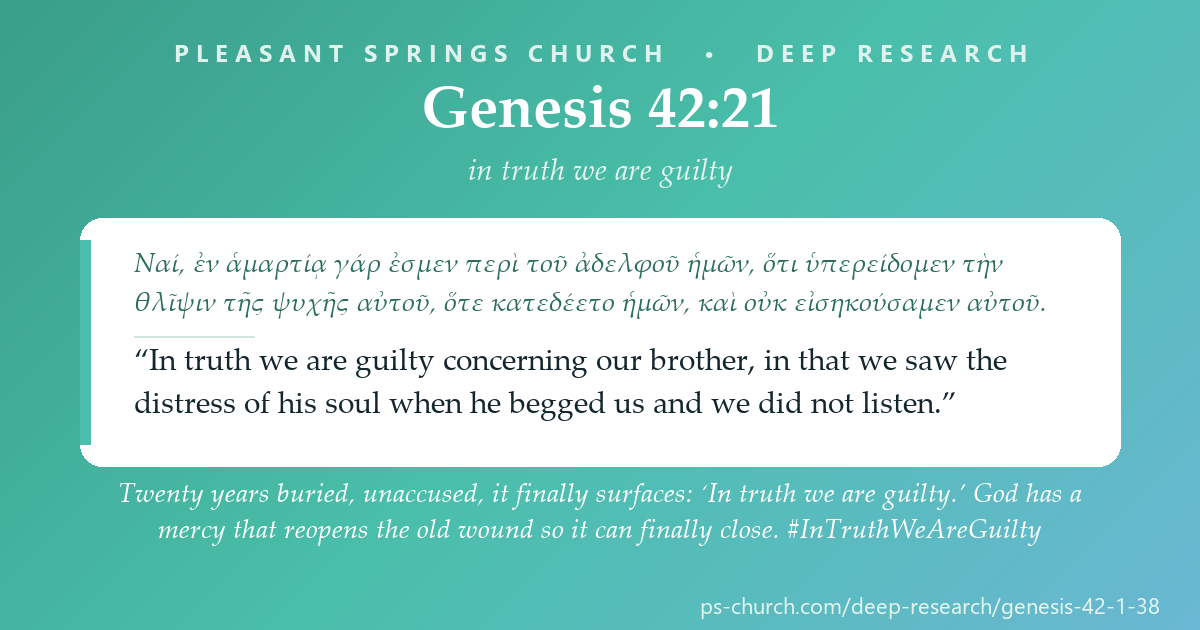
Conscience wakes. And in 42:21 the answer begins to surface. Under pressure they say to one another, not knowing the governor understands their language, “In truth we are guilty concerning our brother, in that we saw the distress of his soul when he begged us and we did not listen” — a detail the pit narrative never told us, carried all these years in a guilty memory. Reuben adds, “Did I not tell you not to sin against the boy?” (42:22). No one has accused them of anything but spying; the accusation rises from within. Joseph turns away and weeps (42:24). When the returned silver is found, dread turns Godward: “What is this that God has done to us?” (42:28). The narrator will not let us mistake a guilty conscience for repentance yet — that ripens in chapter 44 — but the first stirring is unmistakable, and it is the work of the hidden God behind the harsh governor.
Audience
Israel — the nation that would itself go down to Egypt, and come up again — read its own future in this descent. The famine, the going-down for bread, the sons of Jacob before an Egyptian lord: the family story is already the national story in miniature. And Israel heard something more searching still: that God’s providence does not bypass human guilt but works through it and toward its healing. The brothers are not merely being used; they are being brought back — their consciences awakened, their old sin named aloud, the wound reopened so that it can finally close. A God who governs history through a foreign prison and a foreign throne is also patient enough to spend twenty years turning ten hard hearts.
Conscience, providence, and the good under the harsh. For the church this chapter is a school in two truths held together. First, the awakening of conscience: guilt long buried does not die; it waits, and under God’s pressure it speaks — “In truth we are guilty” is the first honest word toward a mercy the brothers cannot yet imagine. Second, the hidden God behind a hard providence: what feels to the brothers like disaster (“all this has come against me,” Jacob laments, 42:36) is in fact rescue in progress. The same events read one way from inside the fear and another way from inside the plan. This is the Bible’s doctrine of providence lived at ground level: God’s sovereign good purpose running over and through real human evil, cancelling neither the evil nor the good — the truth Joseph will finally speak in the open (45:5–8; 50:20; cf. Rom 8:28). Genesis 42 is that truth still in shadow: the wheel is turning, the tears are real, and the God who is nowhere named as an actor is at work in every verse.
Orient on famine and grain trade, conscience and guilt, testing, and the Joseph narrative.
Search by topic: Joseph, famine, Egypt and grain, Simeon, Reuben, conscience / guilt, repentance, providence, testing.
Which articles are relevant?
- Anchor Bible Dictionary — “Joseph (son of Jacob),” “Famine,” “Egypt,” “Simeon,” “Reuben.”
- Dictionary of the OT: Pentateuch — “Joseph,” “Providence,” “Repentance,” “Retribution / Recompense,” “Narrative Art of Genesis.”
- NIDOTTE / TDOT — ’ashem (be guilty), tsarah (distress), nakar (recognize), shakal (be bereaved), ra’ab (famine), shabar (buy/sell grain).
Bibliography surfaced:
- Gordon Wenham (WBC), Victor Hamilton (NICOT), Kenneth Mathews (NAC), Bruce Waltke, Nahum Sarna (JPS) on Genesis.
- Studies of the Joseph narrative as a unified novella (Coats, From Canaan to Egypt; von Rad on the Joseph story and wisdom); treatments of guilt, conscience, and recompense in Genesis.
- Robert Alter, The Art of Biblical Narrative and The Five Books of Moses, on the recognition scenes.
Famine and empire, the bowing dreams, and the hidden hand behind a harsh throne.
Read the descent to Egypt, the recognition scene, and the returned silver against Egyptian famine administration and the Bible’s theology of concealed providence.
Which parallels shed light on religion and worldview?
Egypt, the granary of the world. That “all the earth came to Egypt to Joseph to buy grain” (41:57) is not hyperbole in an ancient setting: the Nile’s flood-fed agriculture, centrally stored and royally administered, made Egypt the reservoir of the eastern Mediterranean when regional rains failed. Semitic households coming down to Egypt in famine is a well-attested pattern (the Beni Hasan tomb painting of Asiatics entering Egypt is the classic illustration), and grain sold by state officials to foreign buyers fits the machinery Joseph now runs (41:48–49, 55–56). Genesis works entirely within this world — and bends it toward covenant, so that the empire’s storehouses become the means of preserving the family of promise (45:7).
The dreams come true — and the dreamer weeps. When the ten bow “with their faces to the ground” (42:6), Moses springs the trap the story has kept loaded since chapter 37: “Joseph remembered the dreams that he had dreamed of them” (42:9). The scene is the Bible’s great study in dramatic irony — the reader and Joseph know what the brothers cannot — but it is irony without cruelty. Joseph’s harshness is a mask over grief: three times in these chapters he must turn away to weep (42:24; 43:30; 45:2). The recognition scene, a staple of ancient storytelling, is here filled with a wholly biblical content: not a hero’s triumph over enemies but a brother’s search for whether his brothers can be saved.
The God who is nowhere named and everywhere at work. Chapter 42 never once makes God the subject of a verb. He does not appear, speak, or act on stage — and yet the brothers, feeling the silver in their sacks, name him at once: “What is this that God has done to us?” (42:28). Their fear reads the hidden hand more truly than they know. This is the Joseph narrative’s signature theology: providence concealed within ordinary causes — a famine, a policy, a journey, a coincidence of returned money — so that only faith (and a guilty conscience) perceives the Governor above the governor. It is the same doctrine Genesis 24 taught with a smile and Ruth will tell again (Ruth 2:3); here it is told in a minor key, God at work in the very distress, driving hard hearts home.
- Genesis 37:5–11 ↔ 42:6, 9 — the sheaves and stars: the bowing dreams beginning to be fulfilled (see Joseph’s dreams and the pit).
- Genesis 41:53–57 — the famine and Egypt’s storehouses: the throne that now feeds the brothers (see Pharaoh’s dreams and Joseph’s rise).
- Ruth 2:3; Proverbs 16:9; 21:1 — providence hidden in ordinary events and a king’s heart in the Lord’s hand: the theology of the concealed Governor.
The Joseph narrative is the Bible’s most sustained meditation on providence, and Genesis 42 is where it is hardest to see — which is exactly the point. Nothing overtly divine happens in this chapter. There is no vision, no oracle, no angel; God is never the subject of a sentence. There is only a famine, a bureaucratic errand for grain, a stern official, a night’s lodging, and money mysteriously back in a sack. To the brothers it feels like a run of ominous bad luck, and to Jacob like sheer catastrophe: ‘all this has come against me.’ And yet the reader, who has been told about the dreams and has watched God prosper Joseph in Potiphar’s house and Pharaoh’s prison, cannot read a single verse without seeing the hand the characters cannot. That is the education Genesis intends. The God who governs is not confined to the burning bush and the parted sea; he governs no less really through famines and food-prices, through a brother’s tears behind a mask and a conscience that will not stay buried. Genesis 42 refuses to let providence mean only the pleasant surprise; here providence includes the hard road, the bound brother, the reopened wound — because the God at work means not merely to rescue bodies from famine but to bring guilty men home. The brothers’ terrified question, ‘What is this that God has done to us?’, is truer than their fear: God is indeed doing something to them, and it is mercy wearing the face of distress.
The vocabulary of the descent: bowing, recognition, guilt, distress, and the hidden God.
Watch the fulfilled “bowed down,” the reversed “recognize,” the first “we are guilty,” the remembered “distress of his soul,” the naming of “God,” and Jacob’s “bereaved.”
“And they bowed down” — the very posture of the dreams (37:7–9). The brothers who scorned the dreamer now fulfill the dream unawares. Providence keeps its promises through the free acts of those who once fought them (cf. 50:20).
“He recognized… they did not recognize” — the root nakar, the same verb by which the brothers once made Jacob “recognize” Joseph’s bloodied coat (37:32–33). The deceivers are now the un-knowing; the wheel has come round.
“We are guilty” — the first confession, dragged up by fear after twenty years. The root ’ashem is guilt that incurs liability. No one accused them of this; conscience did. The LXX reads “we are in sin” (ἐν ἁμαρτίᾳ).
“The distress of his soul” — a detail the pit story withheld (37:23–24): they had watched Joseph plead and shut their ears. Buried memory surfaces with its ache intact. Their own present tsarah (“distress”) mirrors the one they caused.
“What is this that God has done to us?” — the chapter’s one naming of the hidden actor. Dread reads the concealed hand more truly than it knows: God is at work — not to destroy, but to bring them home.
“You have bereaved me” — Jacob’s cry from inside the fear, seeing only loss where rescue is unfolding. “All this has come against me” — the exact opposite of the truth (Rom 8:28). Grief that cannot yet see God at work.
How the rest of Scripture fills out the scene:
- Genesis 37:5–11, 23–28, 31–33 — the dreams, the pit, the pleading, the bloodied coat: everything the brothers’ confession now recalls (see Joseph’s dreams and the pit).
- Genesis 39:2–3, 21–23 — “God was with him” in slavery and prison: the same hidden providence that now governs the throne (see Joseph and Potiphar’s house).
- Genesis 44:16, 33–34; 45:5–8; 50:20 — where the awakening of 42:21 ripens into repentance and Joseph names the good God meant through their evil.
- Romans 8:28; Proverbs 16:9; 21:1 — God working all things for good; steps and kings’ hearts in his hand: the doctrine of Genesis 42 across the canon (see nothing can separate us).
From a guilty conscience in Egypt to the good God works through evil.
Trace the awakening conscience, the hidden providence, and Joseph-as-sufferer-exalted toward their fulfillment — held as devotional analogy, not the literal sense.
Which cross-references matter?
- Genesis 37 ↔ 42 — the dreams fulfilled and the crime remembered: the story doubling back on itself so that the sin can be named and, in time, healed.
- Genesis 44:16–34 — Judah’s offer to be enslaved in Benjamin’s place: the repentance the guilty conscience of 42:21 is being led toward — the man who sold a brother now ready to lose himself to save one.
- Genesis 45:5–8; 50:19–20 — “You meant evil against me, but God meant it for good”: the open statement of the providence still hidden in chapter 42 — God’s good purpose over and through real human evil, neither cancelling the other.
- Acts 7:9–13 — Stephen’s retelling: “the patriarchs, jealous of Joseph, sold him into Egypt; but God was with him…” and made himself known on the second visit — the pattern read as prologue to a greater rejected-and-exalted deliverer.
- 2 Corinthians 7:9–11; Romans 8:28 — godly grief that produces repentance; God working all things for good: the New Testament grammar of what begins to stir in 42:21, 28.
The most human thing in Genesis 42 is that Joseph cannot get through the scene without weeping, and the most disciplined thing is that he does not let it show. He speaks roughly, plays the stranger, accuses them of espionage, and jails one of them — and then he turns away and weeps, and turns back and resumes the mask. It is tempting to read this as a wounded man toying with the men who wrecked his youth, but the narrative will not support the reading. Everything Joseph does is aimed not at their punishment but at their exposure — to themselves. He is not extracting revenge; he is extracting the truth. Will these ten do to Benjamin what they did to him? Have twenty years and a father’s grief changed anything at all? He cannot forgive them into health cheaply, pretending the pit never happened; love that means to heal must first bring the wound into the light. So he applies pressure, and the pressure does what no accusation could: it lifts ‘in truth we are guilty concerning our brother’ out of a place they had kept sealed for two decades. The old teachers of the church could not help but see, softly and without forcing it, the shape of a greater rejected brother — sold for silver, given up for dead, raised to a throne, and using his power not to destroy the brothers who betrayed him but to bring them to repentance and to bread. Held as devotional resonance and not as the chapter’s plain sense, it is a shape the gospel makes hard to unsee: the offended one exalted, and bending all his authority toward the salvation of the very people who wronged him.
The scholarship on Genesis 42:1-38.
The commentators on the Joseph novella; the studies of its narrative artistry, its theology of providence, and the theme of guilt and recompense.
Commentaries & studies:
- Gordon J. Wenham (WBC), Victor P. Hamilton (NICOT), Kenneth A. Mathews (NAC), Bruce K. Waltke, Nahum M. Sarna (JPS) on Genesis.
- George W. Coats, From Canaan to Egypt: Structural and Theological Context for the Joseph Story; Gerhard von Rad on the Joseph narrative and wisdom.
- Robert Alter, The Art of Biblical Narrative, on recognition and the withheld detail (the “distress of his soul,” 42:21).
Interpretation notes worth keeping:
- The withheld detail (42:21). The pit narrative (37:23–24) never mentioned Joseph pleading; only now, from the brothers’ own mouths, do we learn they “saw the distress of his soul when he begged us.” Moses lets guilt supply what the crime scene omitted — a masterstroke of moral storytelling.
- Simeon bound (42:24). Why Simeon and not Reuben, the eldest? Reuben had at least tried to save Joseph (37:21–22); Simeon, next in line and elsewhere marked by violence (34:25), is the plausible ringleader. The choice looks deliberate, not arbitrary.
- “What is this that God has done to us?” (42:28). The brothers rightly sense a divine hand but misread its intent as threat. Conscience perceives providence before faith interprets it — the beginning, not the end, of turning.
- Guilty conscience is not yet repentance. Chapter 42 gives the first honest word (“we are guilty”); the settled change of heart waits for Judah’s self-substitution (44:33–34). Genesis distinguishes remorse under pressure from the repentance that offers itself for another.
- The devotional analogy. Joseph-as-rejected-and-exalted-deliverer (sold for silver, given up for dead, raised to save his betrayers) is a venerable and rich resonance; hold it as analogy built on real narrative patterns (Acts 7:9–13), not as a hidden literal Christ in the text — the house discipline for typology throughout this library.
From a buried guilt to the God at work in the very distress.
Name what you learned, why it matters, and one concrete response.
What should we carry away — and do?
- Buried guilt does not die. Twenty years on, unaccused, the brothers say it aloud: “In truth we are guilty.” Sin we will not confront waits — and God, in mercy, applies the pressure that finally brings it into the light.
- Providence wears the face of distress. “All this has come against me,” Jacob laments — while rescue is unfolding. The hidden God works over and through real evil, meaning good where we can see only loss (45:5–8; 50:20; Rom 8:28).
- Testing can be love, not vengeance. Joseph’s harshness masks his tears; he probes not to punish but to bring his brothers to the truth about themselves — the severe mercy that means to heal.
Step in response: name the buried thing — the old wrong you have kept sealed and unaccused. Say it plainly to God, and if you can, to the one you wronged: “in truth I am guilty.” Then look again at the distress you are inside now and ask, not “why is this against me?” but “what is God doing in this?” The same event reads one way from inside the fear and another from inside the plan. Trust the hidden Governor above the governor: he is at work in the very distress, and he means to bring you home.
Genesis 42:21 · to share
LXX + ESVEvery Deep Research page traces its passage across the whole sweep — the Old Testament, the Second-Temple world between the testaments (historical witnesses, not Scripture), and the New Testament. Follow the thread:
Pleasant Springs Church — Deep Research
Research method after Michael S. Heiser’s Bible Research Method (examine dictionaries → ancient literature → important words → textual connections → academic publications → share), with the Pleasant Springs “Author & Audience” foundation. Scripture set in the Hebrew, the Greek editions named on each page and the ESV (Old Testament), and the Greek New Testament and the ESV (New Testament), per the practice of Pleasant Springs Church. Genesis 42:1–38 research grounded in Wenham, Hamilton, Mathews, Waltke, and Sarna, with Coats and von Rad on the Joseph novella and Alter on its narrative art; the chapter read as the Bible’s doctrine of concealed providence in a minor key — the bowing dreams of 37:5–9 fulfilled (42:6, 9), conscience awakened after twenty years (“in truth we are guilty,” 42:21, the “distress of his soul” a detail withheld from the pit narrative), and the hidden God named only by frightened lips (“what is this that God has done to us?” 42:28, Elohim — no Tetragrammaton in the chapter). Joseph’s testing read as discernment and severe mercy, not vengeance (the tears behind the mask, 42:24); the providence of 45:5–8 and 50:20 — God’s good purpose over and through real human evil, cancelling neither — still in shadow here (cf. Rom 8:28); and Joseph-as-rejected-and-exalted-deliverer held as devotional analogy on real narrative patterns (Acts 7:9–13), not the literal sense — per the house discipline for typology.
Scripture quotations marked ESV are from the ESV® Bible (The Holy Bible, English Standard Version®), © 2001 by Crossway, a publishing ministry of Good News Publishers. ESV Text Edition: 2016. Used by permission. All rights reserved. The ESV text may not be quoted in any publication made available to the public by a Creative Commons license, and the ESV may not be translated in whole or in part into any other language. www.esv.org
|
Did this study bless you today? 💚 Give to Support PS Church100% of gifts go to the General Fund — thank you. |