The story of Joseph opens in bright favor and closes in the dark. A robe of distinction, two dreams of sheaves and stars bowing down, and brothers whose hatred hardens into envy and then into a plot: they strip the robe, throw Joseph into a dry pit, and sell him to Egypt for twenty pieces of silver, while a bloodied robe carries the lie home to an inconsolable father. Through it all, one name is missing — the narrator never says the Lord. Yet the dreams are true, and will be fulfilled, but only through the pit and the long years: providence hidden inside evil, the seed of “you meant it for evil, but God meant it for good.” This study works Genesis 37:1–36. See the method →
Genesis 37:3, 11, 19–20, 28, 35
Hebrew · LXX · ESVThe Shape of the Passage
ConcentricAt the exact point the covenant family is torn apart by envy, the narrator falls silent about God — no vision, no voice, not even the divine name — and lets the silence itself carry the doctrine of providence.
Author
Moses heads the chapter with the Bible’s recurring formula — “these are the generations (toledot) of Jacob” (37:2) — and then, remarkably, tells almost nothing of Jacob and everything of Joseph. The Joseph narrative (chs 37–50) is the longest sustained story in Genesis, and its opening chapter sets every engine running at once: a seventeen-year-old, son of Jacob’s beloved Rachel and of his old age, favored with a ketonet passim — a long robe of distinction and authority — who brings a bad report and dreams dreams his family cannot bear (37:2–11). The narrator names the fault plainly on both sides: a father’s open favoritism (37:3–4) and brothers whose hatred deepens by stages — they “could not speak peaceably to him,” then hated him “still more,” and at last envied him (37:4, 5, 8, 11).
The withheld Name. The single most striking feature of Genesis 37 is theological by omission. In the chapters before, God appears, speaks, wrestles, renames; here — through betrayal, near-murder, sale, and a father’s despair — the narrator will not say YHWH even once. God does not speak, appear, or act on the surface of the page. And yet the two dreams stand over the whole story like a promise that cannot be unsaid: the sheaves will bow; the sun, moon, and eleven stars will bow. The reader is being taught to trust a God who is most at work exactly where he seems most absent — the lesson the chapter will finally state outright in Joseph’s own mouth: “you meant evil against me, but God meant it for good” (50:20).
The plot, and its two would-be rescuers. Sent to check on the brothers, Joseph finds them at Dothan; they seize him, strip the robe — the badge of favor is the first thing torn away — and throw him into a dry cistern (37:23–24). Two brothers try, in tangled ways, to save him: Reuben schemes to pull him out later (37:21–22, 29–30); Judah proposes selling him rather than killing him — “what profit is it… he is our brother, our own flesh” (37:26–27), a half-mercy still soaked in betrayal. Traders carry Joseph to Egypt for twenty pieces of silver, the brothers dip the robe in goat’s blood, and Jacob — who once deceived his own father with a goat and a garment (27:9, 16) — is now deceived by his sons with the same two things. He refuses comfort: “I shall go down to Sheol to my son, mourning” (37:35).
Audience
Israel — a nation descended from these very brothers — heard its own origin story told without flattery. The twelve tribes trace to men capable of throwing a brother into a pit and selling him for the price of a slave; the chosen family is chosen by grace, not merit. Israel first heard this narrative on the near side of Egypt’s deliverance, and so read it already knowing the end: the envy that sold Joseph away was the very road by which God would preserve the family alive through famine (45:5–7; 50:20). The pit and the sale were not the defeat of the promise but its hidden highway.
Envy, and providence inside evil. For the church, Genesis 37 is a sober anatomy of envy — the sin that could not bear another’s favor, that curdled from resentment to violence, the same root that first shed a brother’s blood (4:5–8; cf. Jas 3:16). And it is Scripture’s clearest early lesson that God’s sovereignty runs through human evil without excusing one ounce of it: the brothers are fully guilty, and God is fully at work, and both are true on the same page. The dreams are the promise; the pit is the path. Held with care as devotional analogy — never confused with the chapter’s literal sense — the church has long seen in this beloved son the shape of another: loved by the father, rejected by his own, stripped of his garment, cast down, sold for silver, mourned as dead, and raised at last to a throne where he would save the very ones who betrayed him (cf. Acts 7:9–10; Jn 1:11). Sin recorded is never sin sanctioned; but grace, the chapter promises, is already writing straight with these crooked lines.
Orient on the toledot structure, dreams, the robe, envy, and the Joseph cycle.
Search by topic: Joseph, dreams and dream-revelation, ketonet passim / robe, envy and jealousy, Reuben, Judah, Dothan, Ishmaelites and Midianites, Sheol.
Which articles are relevant?
- Anchor Bible Dictionary — “Joseph (son of Jacob),” “Dreams,” “Dothan,” “Ishmaelites,” “Midian, Midianites,” “Sheol.”
- Dictionary of the OT: Pentateuch — “Joseph,” “Dreams,” “Envy,” “Providence,” “Toledot / Structure of Genesis.”
- NIDOTTE / TDOT — qana’ (be jealous/envious), chalom (dream), bor (pit/cistern), she’ol (Sheol), passim (the robe’s disputed sense).
Bibliography surfaced:
- Gordon Wenham (WBC), Victor Hamilton (NICOT), Kenneth Mathews (NAC), Bruce Waltke, Nahum Sarna (JPS) on Genesis.
- Studies of the Joseph narrative as a unified literary and theological whole (von Rad; Alter; Longacre) and of the “hidden providence” theme.
- Studies of ancient dream-reports and of the disputed ketonet passim (cf. 2 Sam 13:18).
The robe of authority, the dream that binds, envy, and the slave-price of silver.
Read the robe, the dreams, the pit, and the sale against ancient family custom, dream-belief, and the Bible’s theology of hidden providence.
Which parallels shed light on religion and worldview?
The robe as a claim. The exact phrase ketonet passim occurs only here and of the royal daughter Tamar’s garment (2 Sam 13:18) — a long, ornamented robe marking status, not labor. To clothe the eleventh son in it was to signal favor bordering on succession, over the heads of ten older brothers. The gift was a wound before Joseph spoke a word; the brothers “could not speak shalom to him” (37:4). The narrator neither approves the favoritism nor excuses the hatred it fed — a clear-eyed portrait of how a household’s injustices and its sins feed one another.
Dreams that cannot be unsaid. In the ancient Near East dreams were taken as a channel of the divine, and doubled dreams (as here, sheaves then stars) were read as fixed and certain (cf. 41:32). Joseph’s two dreams need no interpreter; the brothers understand them at once and hate the meaning — “Are you indeed to reign over us?” (37:8). Even Jacob rebukes the second, yet “kept the saying in mind” (37:11) — the same watchful treasuring Luke will later record of another parent (Lk 2:19, 51). The dreams function in the narrative as the promise does in the life of faith: announced early, mocked, buried — and unstoppably true.
The pit, the traders, and twenty pieces of silver. The brothers throw Joseph into a bor — a dry cistern, hewn for water and empty of it (37:24), the same word that will name the “pit” of his Egyptian prison (40:15) and, in the Psalms, the pit of death and Sheol (Ps 30:3; 88:4–6). Passing Midianite/Ishmaelite caravaners buy him for twenty shekels of silver — in the later law, the valuation of a male between five and twenty years (Lev 27:5), the going price of a boy. The bloodied robe then does its cruel work: the badge of a father’s love becomes the instrument of a father’s deception. Jacob the deceiver, who took the blessing with a goat and a garment (27:9–16), is undone by his sons with a goat and a garment — the narrator’s quiet justice.
- Genesis 4:5–8; James 3:16 — envy as the root that first spilled a brother’s blood, “where jealousy and selfish ambition exist, there will be disorder and every vile practice.”
- Genesis 27:9–16 ↔ 37:31–33 — the goat and the garment: the deceiver deceived, measure for measure.
- Leviticus 27:5; Zechariah 11:12–13; Matthew 26:15 — the price of a slave in silver; the shepherd priced and sold (thirty in the prophet and Gospel; twenty here) — a resonance the church has long noted.
Nothing in Genesis 37 is miraculous, and nothing in it is accidental. The chapter is built as a chain of ordinary human choices — a father’s indulgence, a boy’s tactlessness, the slow chemistry of resentment, a plot, a passing caravan, a bargain struck over silver — and God is named nowhere in it. This is deliberate and profound. The narrator has removed every visible sign of the divine precisely so that we will learn to find God where the characters cannot: not in the interruption of the natural order but in its patient governance. The brothers act with real malice and real freedom; they are guilty of everything they do. And yet not one of their choices falls outside the reach of a purpose they cannot see — the same purpose the dreams have already announced and the same purpose Joseph will one day name: ‘you meant evil against me, but God meant it for good, to bring it about that many people should be kept alive’ (50:20). Here is the deepest comfort of the doctrine of providence, and its most demanding: it does not promise that the pit is not a pit, or that the betrayal is not a betrayal, or that the years of slavery will not be long and real. It promises only — but this is everything — that the God who is silent is not absent, and that the road that runs down into the pit is, in his hands, the very road that runs up to the throne. Faith is learning to read the silence as Joseph learned to read it: backward, from the far end, where the meaning at last comes clear.
The vocabulary of the fall: the robe, envy, the dreamer, the pit, the silver, Sheol.
Watch the robe of favor, the fourfold hardening into envy, the mocked “master of dreams,” the dry pit, the slave-price of silver, and the father’s vow to grieve to Sheol.
The “robe of many colors” — better, a long ornamented robe of distinction and authority; LXX χιτῶνα ποικίλον (varied, many-hued). The exact phrase recurs only of princess Tamar’s royal garment (2 Sam 13:18). A badge of favor — and the first thing the brothers strip away (37:23).
“They were jealous” — qana’, envy: the story’s engine. Hatred (37:4) hardens by stages into envy, the sin that could not bear another’s favor — the same root that first shed a brother’s blood (Gen 4; Jas 3:16). LXX ἐζήλωσαν.
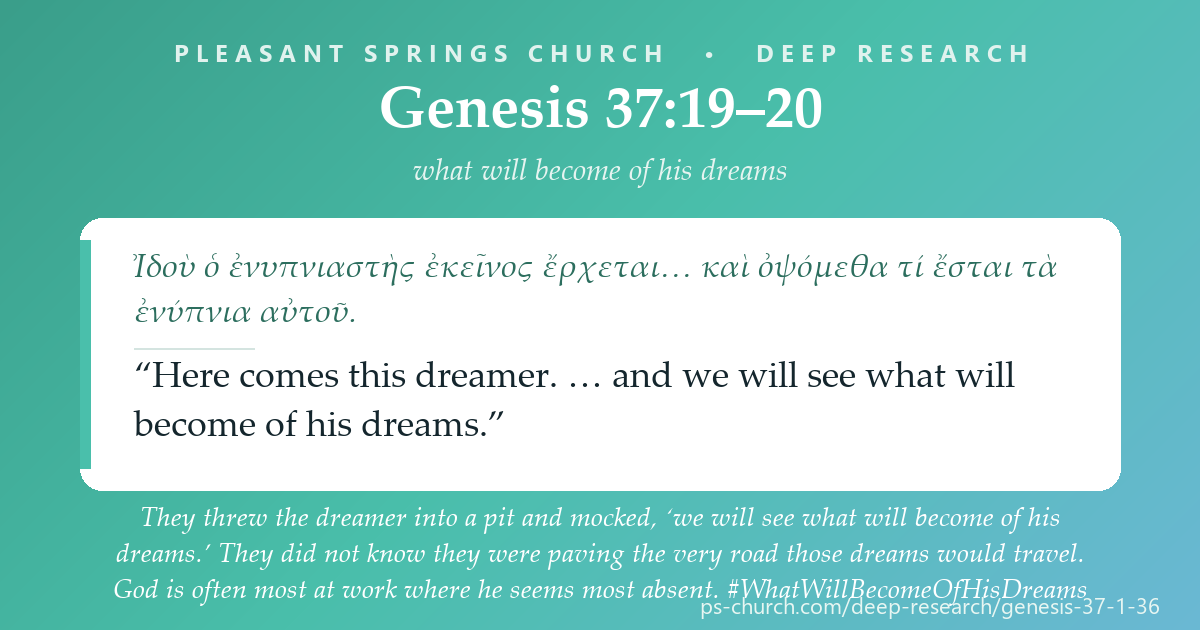
“This dreamer” — literally “the master of dreams,” a sneer; LXX ὁ ἐνυπνιαστὴς. Doubled dreams were held certain (cf. 41:32); the brothers grasp the meaning and hate it — “we will see what will become of his dreams” (37:20), unknowingly naming the very question the whole story answers.
“The pit” — a dry cistern, “there was no water in it”: emptied of what it was cut to hold. The same word names Joseph’s Egyptian “dungeon” (40:15) and, in the Psalms, the pit of death and Sheol (Ps 30:3 · LXX 29:4; 88:4–6 · LXX 87:5–7). LXX λάκκος.
“Twenty pieces of silver” — the price of a boy (the valuation of Lev 27:5). LXX renders it εἴκοσι χρυσῶν, “twenty of gold.” A brother sold as a slave for silver — a note the church has long heard against Zech 11:12–13 and Matt 26:15 (there, thirty).
“To Sheol” — the realm of the dead; LXX εἰς ᾅδου (to Hades). Jacob refuses comfort, resolving to grieve to the grave. His despair is real and honored — and, unknown to him, wrong: the son he mourns as dead is alive, and will meet him again (46:29–30).
How the rest of Scripture fills out the scene:
- Genesis 4:5–8; Proverbs 27:4; James 3:14–16 — qana’ / envy: the oldest and most corrosive sin, “who can stand before jealousy?”
- Genesis 41:32; Luke 2:19, 51 — the doubled dream held certain; the parent who “kept the saying in mind,” treasuring what is not yet understood.
- Genesis 40:15; Psalm 30:3; 88:4–6 — bor, the pit: prison, death, and Sheol; the descent from which only God draws up.
- Genesis 45:5–8; 50:20; Acts 7:9–10 — the meaning read from the far end: “you meant evil… God meant it for good” — the theology this silent chapter is written to teach.
From a pit in Dothan to the beloved Son rejected by his own.
Trace the envied favorite, the descent into the pit, and the sold-for-silver son toward their canonical horizon — the deliverance through Joseph, and (as devotional analogy) the Christ the pattern foreshadows.
Which cross-references matter?
- Genesis 39:2, 21; 45:5–8; 50:20 — the sequel that unlocks the silence: “the Lord was with Joseph” (the divine name returns in ch 39), and the envy is revealed as God’s road to Israel’s preservation.
- Genesis 42:21–22; 44:18–34 — the brothers’ conscience and Judah’s later transformation: the man who proposed the sale (37:26) will offer himself as a slave in his brother’s place — a real moral turn.
- Psalm 105:16–22; Acts 7:9–10; Hebrews 11:22 — Scripture’s own reading of Joseph: sold as a slave, kept by God, raised to save, and remembered by faith.
- Zechariah 11:12–13; Matthew 26:14–15; John 1:11 — the shepherd priced in silver; the Beloved “came to his own, and his own people did not receive him.”
The teachers of the church have read the Joseph story alongside the gospel for as long as there has been a church, and it is worth saying plainly what kind of reading this is. It is not a claim that Genesis 37 is secretly about Jesus, or that Moses meant Joseph as a coded prophecy; the chapter’s literal sense is the history of Jacob’s sons, and that history stands on its own. It is rather that the same God who governs the far end of the Joseph story governs the whole of redemption, and so the shape of the one keeps rhyming with the shape of the other. Held that way — as analogy and resonance, not as the text’s literal meaning — the correspondences are hard to miss and rich to ponder. A father’s beloved son, sent to his brothers on the father’s errand; the brothers who ‘could not speak peaceably to him’ and would not have him reign over them; the robe stripped away; the descent into the pit; the betrayal by one of the brothers for pieces of silver; the son mourned as dead by a grieving father — and then, on the far side of the descent, exaltation to a throne, and from that throne the salvation of the very ones who sold him, met not with vengeance but with tears and bread. ‘He came to his own, and his own people did not receive him’ (Jn 1:11); ‘you meant evil against me, but God meant it for good’ (50:20) is a sentence the cross would one day say in blood. The analogy neither replaces the history nor the gospel; it lets each throw light on the other, and teaches the church to trust, in its own pits, the God who is silent but never absent.
The scholarship on Genesis 37:1-36.
The commentators on the opening of the Joseph narrative; the studies of its literary unity, of ancient dreams, and of the providence theme.
Commentaries & studies:
- Gordon J. Wenham (WBC), Victor P. Hamilton (NICOT), Kenneth A. Mathews (NAC), Bruce K. Waltke, Nahum M. Sarna (JPS) on Genesis.
- Gerhard von Rad, Genesis and the essay on the Joseph narrative; Robert Alter on the literary art; Robert Longacre on its discourse structure.
- Studies of ancient Near Eastern dream-reports and of the disputed sense of passim (the robe).
Interpretation notes worth keeping:
- Midianites and Ishmaelites (37:25–28, 36). The chapter names both groups of traders; rather than a clumsy seam, this reflects overlapping nomadic labels (cf. Judg 8:24, where Midianites are called Ishmaelites) — the caravan trade of the desert marchlands.
- Reuben and Judah. Two flawed rescuers: Reuben wants to restore Joseph secretly to his father (37:22, 29–30); Judah proposes profit over murder (37:26–27). Neither is heroic — and the narrative will later redeem Judah at length (ch 44). Sin recorded, not sanctioned.
- The withheld divine name. That YHWH never appears in ch 37 is a deliberate literary-theological signal, not an accident of source: the name returns to the Joseph narrative proper when “the Lord was with Joseph” in Egypt (39:2) — the Judah interlude of ch 38 (where YHWH does appear, 38:7, 10) set to one side. Providence framed by silence.
- The devotional analogy. Beloved-son / rejected / sold-for-silver readings toward Christ are venerable and homiletically rich; hold them as resonance built on the real shape of the text and its canonical fulfillment (Acts 7:9–10; Jn 1:11), not as the chapter’s literal sense — the house discipline for typology throughout this library.
From an envied dreamer in a pit to the God who is silent but not absent.
Name what you learned, why it matters, and one concrete response.
What should we carry away — and do?
- Envy is an engine. It could not bear another’s favor; it hardened from resentment to violence. Watch it in yourself where it starts — in the inability to rejoice at someone else’s good.
- The pit is not the end of the promise. The dreams were true even as Joseph went down into the cistern. God’s purposes often run through the descent, not around it — and are read clearest from the far end.
- God is silent, not absent. The chapter never names him, and he governs every verse. When you cannot see or hear him, that is not proof he has left the story.
Step in response: bring to mind the “pit” you are in or someone you love is in — the loss, the betrayal, the long delay that makes God feel absent. Refuse both lies: that the pit is not real, and that God has left. Write over it the sentence Joseph learned to say only from the far end — “you meant evil… but God meant it for good” (50:20) — and hold it in hope, the way Jacob was wrong to despair (37:35) because the son he mourned was alive. Then examine your own heart for envy at one specific person’s good, and turn it, deliberately, into thanksgiving and blessing for them this week.
Genesis 37:19–20 · to share
LXX + ESVEvery Deep Research page traces its passage across the whole sweep — the Old Testament, the Second-Temple world between the testaments (historical witnesses, not Scripture), and the New Testament. Follow the thread:
Pleasant Springs Church — Deep Research
Research method after Michael S. Heiser’s Bible Research Method (examine dictionaries → ancient literature → important words → textual connections → academic publications → share), with the Pleasant Springs “Author & Audience” foundation. Scripture set in the Hebrew, the Greek editions named on each page and the ESV (Old Testament), and the Greek New Testament and the ESV (New Testament), per the practice of Pleasant Springs Church. Genesis 37:1–36 research grounded in Wenham, Hamilton, Mathews, Waltke, and Sarna, with von Rad, Alter, and Longacre on the literary unity of the Joseph narrative; the chapter read as Scripture’s clearest early lesson in hidden providence — the divine name deliberately withheld through betrayal, sale, and grief, to return only when “the Lord was with Joseph” in Egypt (39:2); envy (qana’, 37:11; cf. Gen 4; Jas 3:16) traced as the engine of the fall; the ketonet passim (37:3; cf. 2 Sam 13:18), the doubled dreams (37:5–11; cf. 41:32), the dry bor (37:24), and the twenty pieces of silver (37:28; Lev 27:5; cf. Zech 11:12–13; Mt 26:15) read in their own right; sin recorded and never sanctioned, Reuben and Judah as flawed rescuers with Judah’s later turn in view (ch 44); and the beloved-son / sold-for-silver reading toward Christ held as devotional analogy on the real shape of the text and its canonical fulfillment (Acts 7:9–10; Jn 1:11; 50:20), not the literal sense — per the house discipline for typology.
Scripture quotations marked ESV are from the ESV® Bible (The Holy Bible, English Standard Version®), © 2001 by Crossway, a publishing ministry of Good News Publishers. ESV Text Edition: 2016. Used by permission. All rights reserved. The ESV text may not be quoted in any publication made available to the public by a Creative Commons license, and the ESV may not be translated in whole or in part into any other language. www.esv.org
|
Did this study bless you today? 💚 Give to Support PS Church100% of gifts go to the General Fund — thank you. |