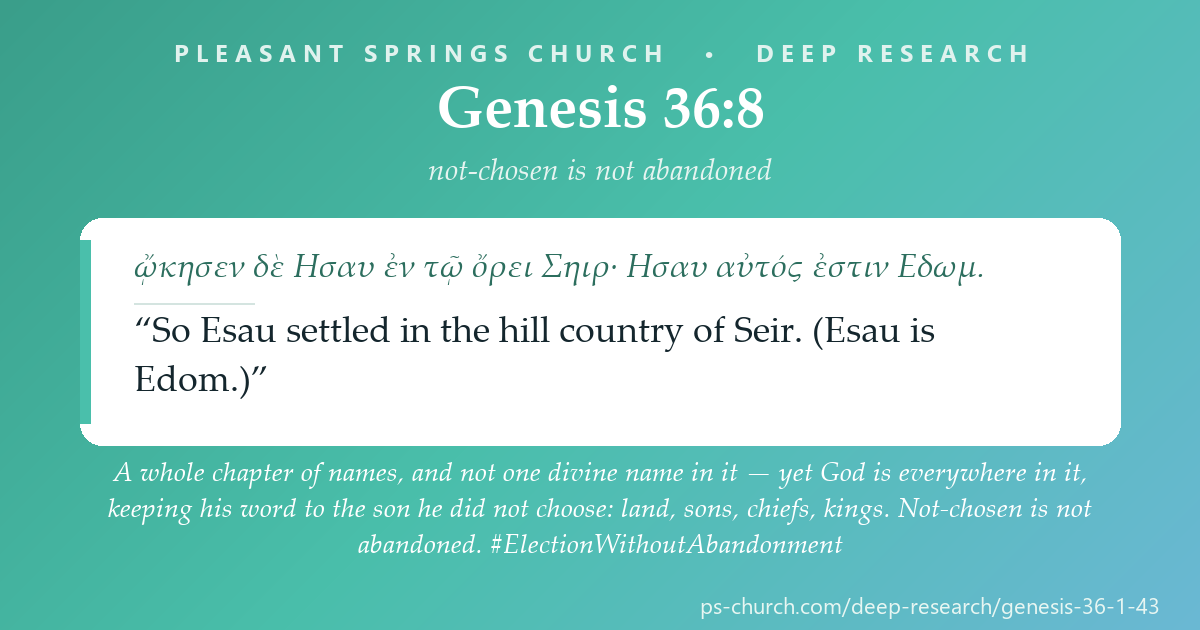
A whole chapter of names — and no divine name in any verse. Before Genesis narrows to Jacob’s twelve sons, it settles accounts with the elder brother: the generations of Esau, who is Edom. He parts from Jacob in peace, not the old quarrel — “their possessions were too great for them to dwell together” — and settles in Seir, where his line becomes chiefs, a land, and kings “before any king reigned over the Israelites.” The theology is quiet and immense: God keeps every earthly promise he made to the son he did not choose (27:39–40). Election without abandonment; divine rule over the nations; and, honestly, the headwater of a long feud the gospel finally answers (Amos 9:12; Acts 15:17). This study works Genesis 36:1–43. See the method →
Genesis 36:1, 7, 8, 31, 43
Hebrew · LXX · ESVThe Shape of the Passage
Parallel panelsScripture spends a full chapter on the family it did not choose — because the God of the covenant is also the God of the nations, and the son who is not chosen is not the son who is abandoned.
Author
Moses reaches the tenth of Genesis’ eleven toledot (“generations”) headings, and gives it to Esau, who is Edom. The placement is deliberate: before the narrative narrows to Jacob’s twelve sons (37:2, the eleventh toledot), it settles accounts with the elder brother, tidily and honorably, and lets him go — just as it had rounded off Ishmael’s line (25:12–18) before following Isaac. Genesis does not sneer at the branches it prunes. It records them with care, names their chiefs and kings, marks their land, and blesses the reader’s memory of them. The chapter is, in its way, an act of covenant honesty.
A peaceful parting. The theological hinge is 36:6–8: Esau takes his household, and “he went into a land away from his brother Jacob… for their possessions were too great for them to dwell together” (36:6–7). The words are a deliberate echo of Abraham and Lot (13:6, 11) — the same crowded prosperity, the same amicable separation, the same movement of the non-chosen line outward so the promised line can hold the land. The brothers who wrestled in the womb (25:22) and parted in fear (27–33) part here in peace. Reconciliation (ch. 33) has done its quiet work; Esau goes to Seir a settled, blessed man.
Nation, chiefs, and kings. The bulk of the chapter is a register: Esau’s Canaanite and Ishmaelite wives (36:2–3), his sons and grandsons, the alluphim — the “chiefs” or clan-heads — of Esau (36:15–19), the older Horite clans of Seir whom Esau’s people displaced and absorbed (36:20–30; cf. Deut 2:12, 22), and at last a striking notice: “These are the kings who reigned in the land of Edom before any king reigned over the Israelites” (36:31). Edom has statehood while Israel is still a wandering household. The narrator records it without envy: God’s timetable for the nations is his own, and the promise to Isaac about Esau — “you shall serve your brother” yet “you shall break his yoke” (27:40) — is already unfolding on schedule.
Audience
Israel heard this genealogy as neighbors reading about neighbors. Edom lay just to the southeast, kin by blood and rival by history: Edom refused Israel passage in the wilderness (Num 20:14–21); the two fought under David, Solomon, and the later kings; a prophet devoted a whole book to Edom’s pride and fall (Obadiah); an exile’s psalm remembered Edom’s cruelty on the day Jerusalem fell (Ps 137:7). Genesis 36 is the honest headwater of that long, sad river — and it insists, before any of the grievance, that Edom is family, really blessed by God, really given a land Israel was forbidden to seize (Deut 2:4–5). The record forbids the reader to hate what God has blessed.
‘Esau I have hated.’ Centuries later Malachi would set the two brothers side by side: “I have loved Jacob but Esau I have hated” (Mal 1:2–3; quoted at Rom 9:13). The words startle — until Genesis 36 is read first. This is covenant-election language: the Hebrew idiom of “love” and “hate” means chosen and not-chosen, preferred and passed-over, exactly as Jesus uses “hate” for “love less” in Luke 14:26. It is national and covenantal, not a verdict of divine malice or a license for ethnic contempt — and this very chapter is the proof, for here God pours out on the “hated” brother real wives, real sons, real chiefs, a real land, real kings. Election without abandonment: the doctrine stands or falls on Genesis 36, and here it stands. Paul’s point in Romans 9 is precisely this — God’s freedom to appoint vocations among peoples, not his cruelty toward persons.
The far horizon. The brother-feud does not have the last word. Amos foresaw a day when the fallen booth of David would be raised “that they may possess the remnant of Edom and all the nations who are called by my name” (Amos 9:12) — and when the first church council asked whether Gentiles could belong to Messiah, James read that very verse as the answer, “that the remnant of mankind may seek the Lord, and all the Gentiles who are called by my name” (Acts 15:17). Edom — from whom, by strange providence, the Idumean Herods later came — is folded at last not into conquest but into the gathered nations of the gospel. The genealogy that begins “Esau is Edom” ends, in the long arc of Scripture, at a table where Jacob’s God gathers Esau’s children home.
Orient on Edom, Seir, the Horites, the alluphim, and the toledot structure.
Search by topic: Esau, Edom, Seir, Horites, chiefs / dukes (alluphim), Edomite kings, toledot / generations, Idumea.
Which articles are relevant?
- Anchor Bible Dictionary — “Esau,” “Edom,” “Seir,” “Horites,” “Idumea,” “Genealogy.”
- Dictionary of the OT: Pentateuch — “Esau,” “Edom,” “Genealogies,” “Election,” “Nations.”
- NIDOTTE / TDOT — ’Edom (red / Edom), toledot (generations), ’alluph (chief / clan-head), rekhush (possessions), sane’ (hate / love-less — the election idiom).
Bibliography surfaced:
- Gordon Wenham (WBC), Victor Hamilton (NICOT), Kenneth Mathews (NAC), Bruce Waltke, Nahum Sarna (JPS) on Genesis.
- Studies of Edom’s history and archaeology; of the Genesis toledot framework; and of the king-list of 36:31–39.
- Beale & Carson, Commentary on the NT Use of the OT (Romans 9; Acts 15 / Amos 9).
A kinsman nation, a displaced people, and kings before Israel had any.
Read the genealogy against ancient tribal organization, the peaceful-separation motif, and the Bible’s theology of the nations under God.
Which parallels shed light on religion and worldview?
From clan to chiefs to kingdom. Genesis 36 quietly narrates a whole political evolution. First a family (sons and grandsons), then alluphim — the “chiefs” or heads of clans, a tribal-confederation stage — then, remarkably, kings (36:31–39). The eight kings listed do not pass power father-to-son; most come from a different city, which looks less like a dynasty than an elective or successive chieftain-kingship, the normal shape of early Transjordanian polities. The ancient reader would recognize a real nation taking real form. Scripture’s interest is theological: this is the earthly greatness Isaac had spoken over Esau (27:39–40), coming true — and coming true early, “before any king reigned over the Israelites” (36:31), while Israel was still tents and promises.
The Horites and the ethics of the land. The chapter also records the older inhabitants of Seir, the Horites (36:20–30), whom Esau’s descendants dispossessed and absorbed. Deuteronomy later reflects on this openly: “The Horites also lived in Seir formerly, but the people of Esau dispossessed them… as Israel did to the land of their possession, which the Lord gave to them” (Deut 2:12, 22). The same God who would settle Israel in Canaan had earlier settled Esau in Seir — and had forbidden Israel to take an acre of it (Deut 2:4–5). Edom’s land is a grant, not an accident; the God of Genesis 36 is sovereign over the migrations and displacements of peoples Israel never governed (cf. Acts 17:26; Amos 9:7).
Two brothers, two blessings, one grief. Genesis frames Esau and Jacob as a study in divergent destinies that need not be a study in hatred. The peaceful parting of 36:6–8 echoes Abraham and Lot (13:6–11): prosperity too large for shared ground, and the non-covenant line moving outward. Yet the ancient audience knew the sequel — Edom’s refusal in the wilderness (Num 20), the wars, Obadiah, Psalm 137 — and Genesis 36 lets them feel the sorrow of it precisely by refusing to demonize Esau here: he is blessed, settled, fruitful, a father of chiefs and kings. The feud, when it comes, is a family tragedy, not the story of a villain. That honesty is the chapter’s moral discipline — and the ground on which Malachi’s “Esau I have hated” must never be read as caprice.
- Genesis 13:6–11; 25:12–18 — the peaceful separation of prosperous kin, and the honorable rounding-off of the non-chosen line (Lot; Ishmael): Genesis’ pattern before Genesis 36.
- Deuteronomy 2:4–5, 12, 22; Amos 9:7; Acts 17:26 — God’s grant of Seir to Edom and his rule over the settlements and migrations of all nations.
- Numbers 20:14–21; Obadiah; Psalm 137:7 — the long Edom–Israel grief whose honest headwater this chapter is.
It is easy to skim Genesis 36 as a stretch of unpronounceable names and miss that it is one of the most theologically generous chapters in the book. Consider what the narrator is willing to do here. He has just spent thirty-five chapters establishing that the covenant runs through Jacob and not Esau — and now, before he turns to follow Jacob’s sons, he stops and lavishes an entire chapter on Esau’s wives, sons, grandsons, chiefs, clans, and kings, noting with evident satisfaction that Edom had kings while Israel had none. This is not the behavior of a partisan. It is the behavior of a theologian who believes that the God of the covenant is also the God of the whole earth, that election to a special vocation is not rejection from all blessing, and that the promises spoken over the passed-over son (‘by your sword you shall live,’ 27:40) are as binding on God’s honor as the promises spoken over the chosen one. Read this way, Genesis 36 becomes the indispensable footnote to Malachi 1 and Romans 9. When Scripture later says ‘Esau I have hated,’ it does not mean God withheld his kindness — the kindness is right here, chief by chief and king by king. It means only that God did not route the messianic promise through Edom. The doctrine of election, rightly held, must always keep Genesis 36 open beside it: God chooses freely, God appoints vocations among the peoples as he wills, and God abandons no one he has made. The chapter that seems to be about nobody in particular turns out to be about the width of God’s mercy — wide enough to number the children of the brother who was not chosen, and to give them a land, and to remember their names.
The vocabulary of a nation: generations, chiefs, kings, and the election idiom.
Watch the toledot heading, the thrice-struck “Esau is Edom,” the borrowed words of the peaceful parting, the alluphim, the kings “before” Israel’s, and the loaded verb “hated.”
“Generations” — the recurring structural heading of Genesis (2:4; 5:1; 6:9; …). Its use for Esau signals that his line, too, gets a proper accounting; Genesis honors the branches it does not follow (cf. Ishmael, 25:12).
“Esau is Edom” — the chapter’s thrice-struck refrain, fixing the identity beyond doubt. ’Edom (“red”) recalls the red stew (25:30) and the red hills of Seir: name, appetite, and land bound in one word.
“Their possessions were too great” — verbatim theology of 13:6 (Abraham and Lot). Prosperity forces a peaceful parting; the non-covenant line moves outward so the promised line can hold the land. Separation without a quarrel.
“Chiefs” (of Edom) — ’alluph, a clan-head or tribal chieftain (from ’eleph, “thousand / clan”). The LXX renders it ἡγεμόνες. A real polity is taking shape: family → chiefs → kings.
“Kings… before” — Edom had kings “before any king reigned over the Israelites.” The note marks God’s sovereign timetable for the nations: Edom’s statehood precedes Israel’s, exactly as Isaac’s blessing implied (27:39–40).
“Hated” — not in this chapter, but the word Malachi later uses of Esau. In covenant idiom it means loved-less / not-chosen (so “hate” = “love less,” Lk 14:26; Gen 29:31). Genesis 36’s real blessings forbid reading it as malice.
How the rest of Scripture fills out the scene:
- Genesis 13:6; 25:12–18; 27:39–40 — the peaceful parting of prosperous kin; the accounting of the non-chosen line; Isaac’s earthly blessing on Esau, fulfilled here (see the stolen blessing).
- Deuteronomy 2:4–5, 12, 22 — God’s deliberate grant of Seir to Esau, and Israel forbidden to seize it: Edom’s land is a gift, not an oversight.
- Malachi 1:2–5; Romans 9:10–13; Luke 14:26 — “Esau I have hated” as covenant-election idiom (loved-less / not-chosen), national and vocational, never malice.
- Amos 9:11–12; Acts 15:16–17 — “the remnant of Edom… all the nations who are called by my name”: the feud’s gospel resolution.
From a genealogy in Seir to Romans 9 and the ingathering of the nations.
Trace the non-chosen brother, the kept promise, and the long feud toward their New Testament resolution.
Which cross-references matter?
- Genesis 25:19–34; 27:1–40; 32–33 — the whole Esau story behind this register: the birthright, the blessing, the fear, and the reconciliation that lets ch. 36 part in peace.
- Numbers 20:14–21; Obadiah; Psalm 137:7; Ezekiel 35 — the Edom–Israel conflict this chapter honestly seeds, from wilderness refusal to exilic grief and prophetic reckoning.
- Malachi 1:2–5; Romans 9:10–13 — the election of Jacob over Esau read as God’s freedom to appoint vocations among peoples; “hated” as not-chosen, guarded by the real blessings of Genesis 36.
- Amos 9:11–12; Acts 15:16–17 — the fallen booth of David raised so “the remnant of Edom” and “all the Gentiles” are gathered: Esau’s children folded into the church, not conquest.
- Genesis 25:12–18 — Ishmael’s parallel register: the pattern of God blessing and numbering the non-covenant son (see the generations of Ishmael).
The hardest words in the Esau story are not in Genesis at all; they are in Malachi and Romans: ‘Jacob I loved, but Esau I hated.’ Torn from their context, they have done immense damage — conscripted to justify contempt for whole peoples, or to picture a God who consigns individuals to ruin before they are born out of sheer arbitrary dislike. Genesis 36 is the God-given antidote to both misreadings, and it is telling that the misreadings flourish precisely where this chapter is skipped. For here, in the very book that establishes Jacob’s election, the narrator lavishes a full chapter of honor on the ‘hated’ brother: he is prosperous, reconciled, settled in a land God himself granted him and fenced off from Israel’s conquest; his sons become chiefs, his chiefs become a nation, his nation has kings while Israel still has none. This is not the treatment of a man God despises. ‘Love’ and ‘hate,’ in the covenant vocabulary of the Ancient Near East, are the language of chosen and not-chosen, and the Hebrew ear heard them so — the same idiom by which Leah is ‘hated’ yet cherished and fruitful (29:31), and by which Jesus tells disciples to ‘hate’ father and mother, meaning to love them less than himself (Lk 14:26). What God withheld from Esau was one thing only: the messianic vocation, the line through which the Seed would come. Everything else — land, sons, greatness, a future, a name recorded in Scripture — God gave him in full. Paul’s argument in Romans 9 depends on exactly this distinction: God’s freedom to assign roles in redemptive history is not God’s cruelty toward souls. Read Genesis 36 slowly, name by name, and the caricature dies. The God who numbers Esau’s chiefs is not the God of the caricature; he is the God who will one day gather the remnant of Edom, and all the nations, to himself.
The scholarship on Genesis 36:1-43.
The commentators on the Edom genealogy; the studies of the toledot structure, the king-list, and the election idiom.
Commentaries & studies:
- Gordon J. Wenham (WBC), Victor P. Hamilton (NICOT), Kenneth A. Mathews (NAC), Bruce K. Waltke, Nahum M. Sarna (JPS) on Genesis.
- Studies of Edom’s history and archaeology (Bartlett, Edom and the Edomites); of the Genesis toledot framework; and of the Edomite king-list (36:31–39) and its relation to Israelite kingship.
- G. K. Beale & D. A. Carson, eds., Commentary on the NT Use of the OT (Romans 9; Acts 15 / Amos 9); studies of the “love / hate” election idiom.
Interpretation notes worth keeping:
- The toledot placement. Esau’s “generations” (36:1, 9) come just before Jacob’s (37:2), mirroring Ishmael before Isaac (25:12, 19): Genesis always closes the account of the non-chosen line honorably before narrowing to the chosen. Structure preaching grace.
- Two wife-lists. Esau’s wives are named differently in 26:34; 28:9 and here (36:2–3) — likely additional names, clan designations, or textual variation. The variation is old and honest; it need not be smoothed away to trust the record.
- The king-list (36:31–39). “Before any king reigned over the Israelites” is a genuine chronological note, not necessarily a late insertion; it marks God’s sovereign timing over the nations. The non-dynastic, city-by-city succession fits early Transjordanian kingship.
- Horites (36:20–30). The earlier people of Seir, dispossessed and absorbed by Esau’s line (Deut 2:12, 22). A reminder that the land-grant to Edom, like the land-grant to Israel, came under God’s hand — and by displacement Israel was told to respect (Deut 2:4–5).
- ‘Esau I have hated’ (Mal 1:3; Rom 9:13). Read with Genesis 36, not against it: covenant-election idiom (not-chosen, loved-less), national and vocational. God’s real blessings on Edom in this chapter are the guardrail against every reading of “hate” as caprice or contempt — the house discipline on this text throughout the library.
From a chapter of names to the mercy wide enough to number the non-chosen.
Name what you learned, why it matters, and one concrete response.
What should we carry away — and do?
- God keeps his word to the outsider too. Every earthly blessing Isaac spoke over Esau (27:39–40) comes true on the page: land, sons, chiefs, kings. Not being chosen for the covenant is not being abandoned by God.
- Election is vocation, not malice. “Esau I have hated” means not-chosen for the messianic line — and this very chapter, crowded with God’s kindness to Edom, is the proof. Never read election as contempt for a person or a people.
- God rules the rise of nations. Edom had kings before Israel did (36:31); the migrations and settlements of peoples are on his timetable, not chance. The God of the covenant is the God of the whole earth.
Step in response: read a chapter of names slowly — on purpose — and let it teach you the width of God’s mercy. Then find the person or people your circle quietly treats as “the not-chosen”: the rival family, the other church, the far-off nation Scripture would name as kin. Refuse to hate what God has blessed. Bless a departure in peace, as Genesis 36 blesses Esau’s; honor a branch you are not called to follow; and pray for the day when “the remnant of Edom and all the nations who are called by my name” (Amos 9:12; Acts 15:17) come home to one table.
Genesis 36:8 · to share
LXX + ESVEvery Deep Research page traces its passage across the whole sweep — the Old Testament, the Second-Temple world between the testaments (historical witnesses, not Scripture), and the New Testament. Follow the thread:
Pleasant Springs Church — Deep Research
Research method after Michael S. Heiser’s Bible Research Method (examine dictionaries → ancient literature → important words → textual connections → academic publications → share), with the Pleasant Springs “Author & Audience” foundation. Scripture set in the Hebrew, the Greek editions named on each page and the ESV (Old Testament), and the Greek New Testament and the ESV (New Testament), per the practice of Pleasant Springs Church. Genesis 36:1–43 research grounded in Wenham, Hamilton, Mathews, Waltke, and Sarna, with Bartlett on Edom; the tenth toledot of Genesis read as covenant honesty toward the non-chosen brother — the peaceful parting of 36:6–8 echoing Abraham and Lot (13:6–11), the alluphim (36:15–19; LXX ἡγεμόνες), the Horites dispossessed under God’s hand (36:20–30; Deut 2:12, 22), and the kings “before any king reigned over the Israelites” (36:31) as God’s sovereign timetable for the nations; the fulfillment of Isaac’s earthly blessing on Esau (27:39–40) as election without abandonment; and Malachi’s “Esau I have hated” (1:2–5; Rom 9:13) held strictly as covenant-election idiom — loved-less / not-chosen, national and vocational (cf. Lk 14:26; Gen 29:31), never malice — guarded by this chapter’s real blessings and resolved in the ingathering of “the remnant of Edom… all the nations who are called by my name” (Amos 9:11–12; Acts 15:16–17). No Tetragrammaton occurs in the chapter.
Scripture quotations marked ESV are from the ESV® Bible (The Holy Bible, English Standard Version®), © 2001 by Crossway, a publishing ministry of Good News Publishers. ESV Text Edition: 2016. Used by permission. All rights reserved. The ESV text may not be quoted in any publication made available to the public by a Creative Commons license, and the ESV may not be translated in whole or in part into any other language. www.esv.org
|
Did this study bless you today? 💚 Give to Support PS Church100% of gifts go to the General Fund — thank you. |