The chapter that buries the first man of faith does it with astonishing quiet. Abraham gives all he has to Isaac and sends the sons of his concubines eastward with gifts — the promise narrowing to one line — then dies at 175, “an old man and full of years, and was gathered to his people.” And there the estranged half-brothers, Isaac and Ishmael, divided since the wilderness, stand together at Machpelah and bury their father beside Sarah. God blesses Isaac; and Ishmael’s twelve princes rise exactly as promised — the un-chosen son never the un-loved son. Death in faith, brothers reconciled in grief, a torch passed on. This study works Genesis 25:1–18. See the method →
Genesis 25:6, 8, 9, 11, 16, 17
Hebrew · LXX · ESVThe Shape of the Passage
Parallel panelsGenesis buries its first patriarch not with a lament but with a genealogy and a reconciliation — because the covenant does not die with the man who first believed it; it passes on.
Author
Moses closes the Abraham cycle with the care of an estate lawyer and the eye of a theologian. The obituary is preceded by a settlement: Abraham takes another wife, Keturah (25:1; called a concubine in 25:6 and 1 Chron 1:32), and fathers six more sons who become the Arabian and eastern peoples — Midian above all, later Israel’s neighbor, tempter, and foe (Num 22; 25; 31; Judg 6). But the fruitfulness is carefully governed. Abraham gives “all he had to Isaac” (25:5), and to the sons of the concubines he gives gifts and sends them eastward, to the east country (25:6) — provided for, honored, but moved off the line of promise. The same direction that took Lot toward Sodom (13:11) and will take Esau to Edom (36:6–8): away from the land of covenant. This is not cruelty; it is the narrowing that the promise requires — one seed, one land, one line, so that through it all the families of the earth may finally be blessed (12:3).
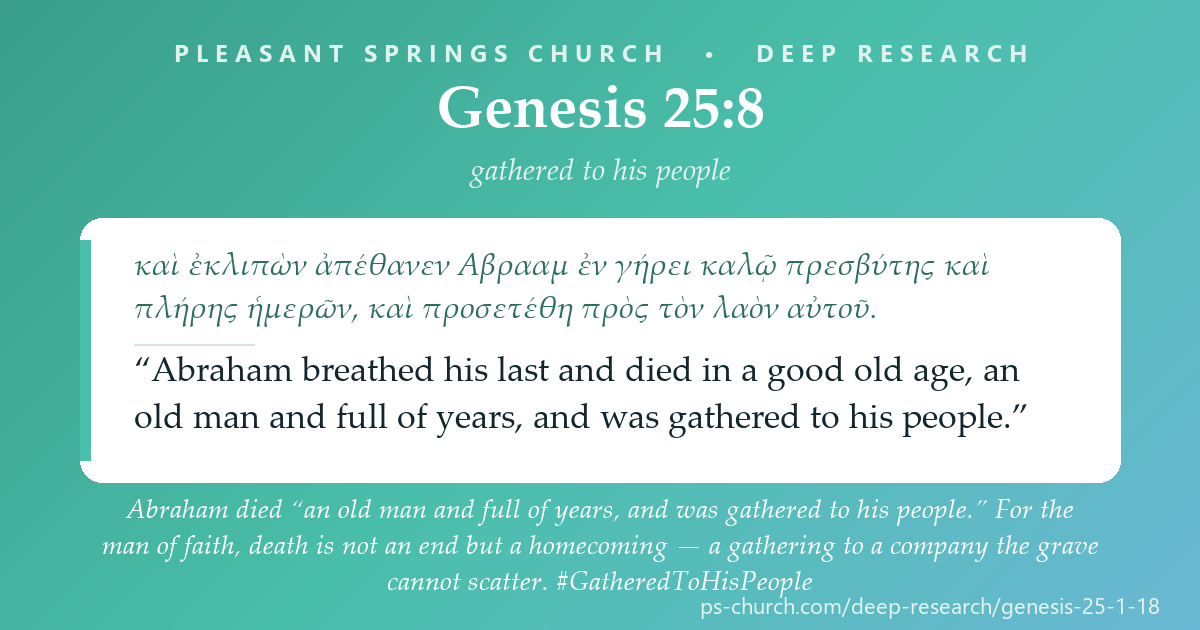
‘Gathered to his people.’ Abraham dies at 175, and the narrator reaches for a phrase heavy with more than burial: he “breathed his last and died in a good old age, an old man and full of years, and was gathered to his people” (25:8). The gathering is distinct from the burying — it is named before Isaac and Ishmael ever reach the cave — and the same idiom is spoken over a man before or apart from his burial — over Jacob while he is still dying in Egypt, years before he is carried home to Machpelah (49:33; 50:13), and over men who die far from their fathers, like Aaron on a mountain (Num 20:24). It is Genesis’ quiet hint that the death of a man of faith is a homecoming to a company that death has not dissolved. Abraham departs as he was promised he would: “you shall go to your fathers in peace; you shall be buried in a good old age” (15:15). The word full (save’a) means satisfied — a life not cut short but filled to the brim and set down willingly.
The brothers at the grave. Then comes one of Scripture’s most reticent, most moving verses: “Isaac and Ishmael his sons buried him” (25:9). The two have not stood together since the boy and his mother were sent into the wilderness (21:14). Isaac the child of promise and Ishmael the child of the flesh — rivals by their mothers, divided by an oath — meet again at their father’s cave, and grief does what rivalry could not: it puts them shoulder to shoulder at Machpelah, laying Abraham beside Sarah (25:9–10). The narrator does not moralize; he simply lets the estranged sons bury their father together. And immediately: “After the death of Abraham God blessed Isaac” (25:11) — the covenant blessing named as passing, unbroken, to the son of promise, who settles at Beer-lahai-roi, the well where the God-who-sees once found Hagar (16:13–14).
Audience
Israel read this passage as the transfer of a deed. Everything now rests on Isaac: the land, the seed, the blessing. The eastern brothers are honored kin, not enemies by birth — and Israel is told plainly whose God is faithful even to those outside the chosen line. For the toledot of Ishmael that follows is no throwaway list. God had sworn to Abraham, “As for Ishmael… I will make him fruitful… he shall father twelve princes, and I will make him into a great nation” (17:20). Here, verse by verse, it comes true: twelve sons named, “twelve princes according to their tribes” (25:16). The God of Abraham keeps even his secondary promises to the letter. Ishmael, never chosen for the covenant line, is never denigrated as a person: he is blessed, multiplied, and — like his father — “gathered to his people” (25:17). Election runs through Isaac; it does not run against Ishmael.
Death in hope, and the un-chosen son. For the church, Genesis 25 teaches two things Christians are slow to hold together. First, how to die: “full of years” and “gathered,” not clinging and not despairing — the death of one who “died in faith, not having received the things promised, but having seen them and greeted them from afar” (Heb 11:13), sure of a homeland and a company beyond the grave. When Jesus reasons from the God who calls himself “the God of Abraham” long after Abraham’s burial — “he is not God of the dead, but of the living” (Mt 22:32) — he is reading Abraham’s obituary as the seed of the resurrection. Second, how to regard those outside our own line of blessing: God’s tender faithfulness to Ishmael forbids the chosen from ever despising the unchosen. The gospel that comes through Isaac is announced as a blessing for the nations — for the sons sent east, and their sons after them. The brothers who buried Abraham together preach a quiet sermon: what our rivalries divide, grace and grief can gather again.
Orient on Keturah and the eastern tribes, 'gathered to his people,' Machpelah, and the toledot of Ishmael.
Search by topic: Keturah, Midian / Midianites, concubine, gathered to his people / death and afterlife, Machpelah, Beer-lahai-roi, Ishmael, twelve princes, toledot.
Which articles are relevant?
- Anchor Bible Dictionary — “Keturah,” “Midian,” “Ishmael,” “Machpelah,” “Concubine,” “Death and Afterlife (OT).”
- Dictionary of the OT: Pentateuch — “Abraham,” “Ishmael,” “Genealogy,” “Death,” “Blessing.”
- NIDOTTE / TDOT — ’asaph (gather), ’am (people/kin), gawa’ (breathe one’s last), save’a (satisfied/full), nasi’ (prince/chief), toledot (generations).
Bibliography surfaced:
- Gordon Wenham (WBC), Victor Hamilton (NICOT), Kenneth Mathews (NAC), Bruce Waltke, Nahum Sarna (JPS) on Genesis.
- Studies of the toledot structure of Genesis and of the Ishmaelite / Midianite / Arabian genealogies.
- Studies of “gathered to his people” and Israelite conceptions of death, the grave, and the afterlife.
Inheritance and the concubines' sons, the eastern tribes, and death as a gathering.
Read the settlement, the burial, and the genealogy against ancient inheritance custom, the desert peoples, and the Bible’s hope in death.
Which parallels shed light on religion and worldview?
Inheritance and the single heir. In the patriarchal world an aging father settled his estate before death, and the sons of secondary wives could be provided for and dismissed so that the principal heir’s portion stood undivided (cf. the anxiety of 21:10, “the son of this slave woman shall not be heir”). Abraham does exactly this: gifts and a firm sending-away for the sons of the concubines, “all he had” for Isaac (25:5–6). What looks like family law is covenant theology — the promise cannot be diluted across many houses; it narrows to one so that it may one day widen to all. The eastward sending places the other sons in the bene-qedem, the “people of the east,” the caravan and desert tribes; the Midianite traders who will later carry Joseph to Egypt (37:28, 36) descend from this very settlement.
Gathered to his people. The phrase is not a synonym for burial. It is spoken before the burial (25:8, then 25:9), and it is used of men not laid in ancestral tombs at all. It reflects an old and hopeful Israelite intuition: the dead are not annihilated but gathered — joined to the fathers, kept in a company that Sheol holds but cannot finally scatter. Genesis will not systematize this; it states it and moves on. But the seed is planted here that later revelation will bring to flower: the patriarchs live to God (Mt 22:32), Abraham welcomes the dead to his side (Lk 16:22), and the whole hope of resurrection is, in Jesus’ own argument, latent in the way God keeps naming himself the God of buried men.
The un-chosen son, blessed. The ancient world expected genealogies to flatter the chosen line and erase the rest. Genesis does the opposite: it pauses to record Ishmael’s twelve sons with dignity, names them, ranks them as princes over tribes, and reports his death in the same honored language used of Abraham (25:12–17). This is deliberate. The narrative that most sharply distinguishes the line of promise is also the narrative most careful to bless the one outside it. Paul will later read the Isaac/Ishmael division as a lesson in grace and freedom (Gal 4:21–31), and the covenant purpose of election as real and gracious (Rom 9) — but never as contempt for the persons God has made and multiplied. Election is God’s sovereign choice of an instrument for blessing the world; it is not a verdict of scorn on those not chosen for that role.
- Genesis 17:20 ↔ 25:12–16 — the promise of twelve princes made, and kept to the letter: God faithful to the un-chosen son.
- Genesis 21:14; 37:28, 36; Judges 6–8 — Ishmael sent away, the Midianite caravan, and Israel’s later conflict: the eastern kin across the canon.
- Genesis 49:33; Numbers 20:24; Deuteronomy 32:50 — “gathered to his people” named before or apart from burial (Jacob in Egypt, later carried to Machpelah; Aaron and Moses dying on their mountains): death as a gathering, not mere burial.
Genesis lavishes eleven chapters on Abraham and then dispatches his death in a single verse — and the restraint is the point. The man who first heard ‘go’ and first believed, who was reckoned righteous by faith, who was asked for his son and did not withhold him, dies without fanfare, ‘an old man and full of years,’ and is quietly gathered. There is no deathbed oracle, no last theophany, no monument — only a settled estate, a peaceful end, and two sons at a cave. This is how Genesis teaches that the covenant is bigger than any of its bearers. Abraham was never the point; the promise was, and the God who made it. So the narrative does not linger over the grave; it moves at once to the transfer — ‘after the death of Abraham God blessed Isaac his son’ — because the blessing does not lie down in Machpelah with the man who carried it. It passes on, alive, to the next set of hands. And it moves, remarkably, to bless the son who was not chosen, whose twelve princes rise exactly as God had sworn. The chapter thus holds together the two truths the covenant always holds: a fierce particularity — all to Isaac — and a wide tenderness — and gifts, and a great nation, and an honored death, for Ishmael too. To die like Abraham is to die full, satisfied, and gathered, with the promise you served handed safely to those who come after, and even your estranged brother beside you at the grave.
The vocabulary of a good death and a kept promise: gathered, full, gifts, eastward, princes.
Watch the twin idiom “gathered to his people,” the “full” of a satisfied life, the “gifts” that are not the inheritance, the fateful “east,” and the twelve “princes” of a kept oath.
“And he was gathered to his people” — named before burial (Jacob, 49:33, gathered while dying in Egypt years before Machpelah) and used of men who die far from their fathers (Aaron, Num 20:24): death as a joining, not an ending. LXX renders it προσετέθη πρὸς τὸν λαὸν αὐτοῦ (25:8) and πρὸς τὸ γένος (25:17).
“And full / satisfied” — the same root as “full of years.” Not a life cut short but one filled to the brim and set down willingly (cf. 15:15; Ps 91:16 · LXX 90:16, “with long life I will satisfy him”).
“Gifts” — what the sons of the concubines receive as they are sent east: honored and provided for, but set apart from the undivided inheritance (“all”) given to Isaac (25:5). Provision without the promise.
“Eastward · the east country” — the direction away from covenant land (cf. Lot, 13:11; Esau, 36:6). To go east in Genesis is to move off the line of blessing — yet not beyond God’s care.
“Princes / chieftains” — twelve of them, fulfilling 17:20 to the number. Ishmael’s tribal twelve stands beside Israel’s coming twelve: God keeps even his secondary oaths exactly (LXX ἄρχοντες).
“Beer-lahai-roi” — “the well of the Living One who sees me,” where the God-who-sees found Hagar (16:13–14). Isaac settles at Hagar’s well: the place of the outcast’s rescue becomes the home of the heir.
How the rest of Scripture fills out the scene:
- Genesis 35:29; 49:33; Numbers 20:24; 27:13; Deuteronomy 32:50 — the recurring “gathered to his people” (with its kin “go to your fathers,” 15:15): a settled Israelite way of naming a hopeful death.
- Genesis 17:20 ↔ 25:12–16; 21:13, 18 — the promise of a great nation and twelve princes for Ishmael, and its exact fulfillment: God faithful to the un-chosen (see the call of Abram).
- Genesis 16:13–14; 24:62; 25:11 — Beer-lahai-roi, Hagar’s well of the God-who-sees, becoming Isaac’s dwelling: the mercy shown the outcast marks the home of the heir.
- Matthew 22:31–32; Luke 16:22; Hebrews 11:13–16 — the God of buried Abraham is God of the living; the dead in faith gathered and welcomed home: the seed of resurrection in an obituary.
From a cave at Machpelah to the resurrection of the God of the living.
Trace the good death, the reconciled brothers, and the faithfulness to the un-chosen son toward their New Testament horizon.
Which cross-references matter?
- Genesis 15:15; 23:1–20; 49:29–33 — the promised peaceful death, the purchase of Machpelah, and the patriarchs gathered there: Abraham’s burial keeps every earlier word.
- Genesis 21:8–21 → 25:9 — the brothers divided in the wilderness, reunited at the grave: what rivalry split, grief gathers (cf. 33:4; 50:15–21, the family reconciliations of Genesis).
- Romans 9:6–13; Galatians 4:21–31 — Isaac and Ishmael as Paul’s lesson in election and promise: God’s sovereign, gracious choice of an instrument, never contempt for the person not chosen.
- Matthew 22:31–32; Luke 16:22–25 — “he is not God of the dead, but of the living”; the dead gathered to Abraham’s side: Jesus reads “gathered to his people” as resurrection ground.
- Hebrews 11:8–16; 1 Peter 1:3–9 — those who “died in faith” seeking a better country, gathered to the God who prepared a city for them (see the city prepared).
Nothing in the Abraham story prepares us to be moved by a burial notice, and yet 25:9 is quietly among the most affecting verses in Genesis. ‘Isaac and Ishmael his sons buried him.’ The last time these two shared a scene, one was a nursing rival and the other a mocking adolescent, and the household split in tears as Hagar carried her boy into the desert with a skin of water and a broken heart (21:14). Years of silence follow — no reunion, no reconciliation, no word that the brothers ever spoke again — until their father dies, and they appear together at the mouth of a cave to lay him beside Sarah. The narrator will not tell us what they said, whether they wept on each other’s necks as Esau and Jacob later will, whether old wounds closed or merely ached. He tells us only that they came, and stood, and buried him together. It is enough. Genesis has been teaching all along that the God who chooses one son does not abandon the other — that Ishmael, too, was heard, blessed, made a nation, and named at his own honored death — and here that theology becomes a picture: the chosen and the unchosen, side by side in grief, doing together the last work a son can do for a father. The line of promise runs through Isaac alone; but the love of the God of Abraham is wider than the line, and at the grave even estranged brothers find they are still brothers. The church that inherits Isaac’s blessing inherits also his brother-keeping: to be chosen for blessing is to be chosen to bless, never to despise.
The scholarship on Genesis 25:1-18.
The commentators on the close of the Abraham cycle; the studies of the toledot, the Ishmaelite genealogies, and Israelite death and afterlife.
Commentaries & studies:
- Gordon J. Wenham (WBC), Victor P. Hamilton (NICOT), Kenneth A. Mathews (NAC), Bruce K. Waltke, Nahum M. Sarna (JPS) on Genesis.
- Studies of the toledot framework of Genesis and of the Arabian / Ishmaelite / Midianite genealogies and their historical geography.
- Studies of “gathered to his people” and Old Testament conceptions of Sheol, the grave, and the hope of the dead.
Interpretation notes worth keeping:
- Keturah ‘wife’ and concubine (25:1, 6). The apparent tension (wife in 25:1, concubine in 25:6 and 1 Chron 1:32) reflects a secondary marriage: honored union, but her sons stand outside the primary inheritance. The chronology is not necessarily sequential to Sarah’s death; Genesis often groups by theme, not strict time.
- ‘Gathered to his people’ is not burial (25:8). Distinguished from the burial that follows and used of men interred far from kin. Read it as Israel’s hopeful reticence about death — a joining to the fathers — not a fully worked-out doctrine of the afterlife, which later revelation supplies.
- The twelve princes (25:16). A precise fulfillment of 17:20, and a deliberate counterpoint to Israel’s twelve tribes: God’s faithfulness to Ishmael is not a rival covenant but proof that he keeps every word he speaks.
- Election, not denigration (Rom 9; Gal 4). The narrowing to Isaac is God’s sovereign, gracious purpose of election, held with real human responsibility and never with scorn for Ishmael, whom God hears, blesses, and honors. The house reading: election chooses an instrument of blessing for the world, not a target of contempt.
- Beer-lahai-roi (25:11). Isaac settling at Hagar’s well (16:14) is a quiet grace-note: the place of the outcast slave’s rescue by the God-who-sees becomes the dwelling of the heir of promise.
From a good old age and a shared grave to the God of the living.
Name what you learned, why it matters, and one concrete response.
What should we carry away — and do?
- Die full, not clinging. Abraham goes “an old man and full of years, and was gathered to his people” — satisfied, at peace, sure of a homeland and a company beyond the grave. Faith teaches us how to live, and also how to let go.
- Grief can gather what rivalry split. Isaac and Ishmael, estranged for a lifetime, buried their father together. Do not wait for a graveside to be reconciled — but know that no division is beyond the reach of grace.
- Never despise the un-chosen. God kept his word to Ishmael to the letter — twelve princes, a great nation, an honored death. To be chosen for blessing is to be sent to bless, not to look down.
Step in response: if there is an estranged brother or sister — in your family, your church, your past — do not leave the reconciling to a funeral. Make the call, write the note, take the first step this week; Isaac and Ishmael show you it is never too late to stand together, and better far to do it before the grave. And when you think of your own death, learn Abraham’s posture: serve the promise, hand it on, and go when God calls — full, satisfied, and gathered — trusting the God who is not God of the dead but of the living.
Genesis 25:8 · to share
LXX + ESVEvery Deep Research page traces its passage across the whole sweep — the Old Testament, the Second-Temple world between the testaments (historical witnesses, not Scripture), and the New Testament. Follow the thread:
Pleasant Springs Church — Deep Research
Research method after Michael S. Heiser’s Bible Research Method (examine dictionaries → ancient literature → important words → textual connections → academic publications → share), with the Pleasant Springs “Author & Audience” foundation. Scripture set in the Hebrew, the Greek editions named on each page and the ESV (Old Testament), and the Greek New Testament and the ESV (New Testament), per the practice of Pleasant Springs Church. Genesis 25:1–18 research grounded in Wenham, Hamilton, Mathews, Waltke, and Sarna, with the toledot framework of Genesis and studies of the Ishmaelite genealogies and of Israelite death and afterlife; the passage read as the close of the Abraham cycle — “all” to Isaac and gifts eastward to the concubines’ sons (25:5–6) as the covenant’s narrowing; “gathered to his people” (25:8, 17; distinct from burial, cf. 49:33; Num 20:24) as Israel’s hopeful reticence about death, and the seed Jesus reads for resurrection (Mt 22:32; Heb 11:13–16); Isaac and Ishmael together at Machpelah (25:9) as rivalry gathered by grief; and the twelve princes (25:16) as the exact keeping of 17:20 — election through Isaac (Rom 9; Gal 4) as God’s gracious, sovereign purpose held with real human responsibility and never as contempt for the un-chosen son, whom God hears, blesses, and honors.
Scripture quotations marked ESV are from the ESV® Bible (The Holy Bible, English Standard Version®), © 2001 by Crossway, a publishing ministry of Good News Publishers. ESV Text Edition: 2016. Used by permission. All rights reserved. The ESV text may not be quoted in any publication made available to the public by a Creative Commons license, and the ESV may not be translated in whole or in part into any other language. www.esv.org
|
Did this study bless you today? 💚 Give to Support PS Church100% of gifts go to the General Fund — thank you. |