Two brothers, one womb, one oracle. Rebekah is barren until Isaac prays and the Lord grants the covenant line as a gift; the twins struggle within her, and God announces his purpose before either has done good or ill — “the older shall serve the younger” (25:23), the word Paul reads as the charter of election (Rom 9). Then the chapter’s small, sordid hinge: Esau, famished, trades his birthright for a bowl of red stew and shrugs — “thus Esau despised his birthright” (25:34; Heb 12:16). Sovereign grace and human responsibility stand here together, neither cancelling the other. This study works Genesis 25:19–34. See the method →
Genesis 25:21, 23, 26, 32, 34
Hebrew · LXX · ESVThe Shape of the Passage
Parallel panelsGenesis opens the story of Israel and Edom — two brothers, one womb, one oracle — and refuses to let either sovereign grace or human accountability be swallowed by the other.
Author
Moses heads the section with the fifth of Genesis’s toledot formulas — “These are the generations of Isaac” (25:19) — and then, characteristically, tells us far more about the sons than the father. The pattern of the patriarchs repeats: the matriarch is barren (25:21; cf. Sarah, 11:30; Rachel, 29:31), and the line of promise advances only by prayer answered, never by the ordinary course of nature. Isaac “prayed to the Lord for his wife… and the Lord granted his prayer” (25:21) — twenty years of it, the narrator quietly notes (25:20, 26). Grace, not biology, keeps the covenant alive.
The oracle. The children “struggled together within her” (25:22) — a wrestling that will run the length of both their lives — and Rebekah, alarmed, “went to inquire of the Lord.” The answer is poetry, and it is decisive: “Two nations are in your womb… the one shall be stronger than the other, the older shall serve the younger” (25:23). Before either boy has drawn breath or done good or ill, God discloses his purpose — and it inverts the world’s order, setting the elder in service to the younger. Moses records it not as caprice but as election: the covenant will run through the son God chooses, not the son custom would crown. Note carefully what the oracle actually says — it speaks of nations and service (Edom under Israel), not a bare decree consigning one infant to perdition.
Two boys, two appetites. Esau is born first — red (admoni) and hairy, a foreshadowing of Edom (25:25, 30); Jacob follows with his hand gripping his brother’s heel (‘aqeb), and is named accordingly — “heel-grabber,” supplanter (25:26). They grow into opposites: Esau the hunter of the open field, Jacob the settled tent-dweller; and their parents divide over them (25:28). The chapter’s climax is deliberately small and sordid. Esau comes in famished, sees Jacob’s red stew, and blurts, “I am about to die; of what use is a birthright to me?” (25:32) — melodrama in the service of appetite. He swears the bekorah away for a single bowl, “ate and drank and rose and went his way,” and the narrator seals it with a verb of contempt: “thus Esau despised his birthright” (wayyivez, 25:34). Jacob’s grasping is no innocence — the deceptions of chapter 27 lie ahead — but the profanity here is Esau’s: he traded the eternal for the immediate and called it survival.
Audience
Israel read its own origin in this womb. The nation descended from Jacob heard, in the oracle of 25:23, that its existence rested on nothing it had earned — God had chosen the line before the twins were born — and it read in Esau/Edom the neighbor and rival who would “serve” (2 Sam 8:14) and later break free (2 Kgs 8:20–22), the perennial brother-enemy of Obadiah and Malachi. “Is not Esau Jacob’s brother? Yet I have loved Jacob but Esau I have hated” (Mal 1:2–3) is this chapter’s echo down the canon: sheer covenant grace on one side, and on the other a people who, like their father, held the holy cheap.
Election and responsibility, held together. For the church, Genesis 25 is the seedbed of Romans 9. Paul quotes the oracle exactly — “the older will serve the younger” (Rom 9:12) — to establish that God’s saving purpose runs by election, “not because of works but because of him who calls” (Rom 9:11): real, gracious, and prior to all human merit. Yet the same Scripture that grounds election never lets Esau off the hook. Hebrews holds him up as a warning — “unholy… who sold his birthright for a single meal” (Heb 12:16) — and the verb of 25:34 is Esau’s own act: he despised it. The house reads these together without collapsing either: God’s sovereign choice is entirely free and entirely gracious, and Esau’s contempt is entirely his own and entirely culpable. The oracle settles which nation carries the promise; it does not license us to read a lone infant as damned from the womb, nor to imagine Esau a puppet who could not help despising what he despised. God foreknows and ordains the end through, never against, the free and accountable hearts of men — and those he saves, he keeps to the end (Jn 10:28–29; Rom 8:38–39). The warning to the church is therefore not despair but vigilance: do not, for one bowl of what perishes, hold the eternal cheap.
Orient on the toledot, birthright, primogeniture, Edom, and the oracle.
Search by topic: toledot / generations, Jacob, Esau, Edom, birthright / primogeniture, barrenness, oracle, election.
Which articles are relevant?
- Anchor Bible Dictionary — “Jacob,” “Esau,” “Edom,” “Birthright,” “Firstborn,” “Election.”
- Dictionary of the OT: Pentateuch — “Jacob,” “Esau,” “Genealogy (Toledot),” “Blessing,” “Election.”
- NIDOTTE / TDOT — bekorah (birthright), ‘atar (pray/entreat), bazah (despise), ‘aqeb (heel) / Ya‘aqob, ’edom / ’admoni (red/Edom).
Bibliography surfaced:
- Gordon Wenham (WBC), Victor Hamilton (NICOT), Kenneth Mathews (NAC), Bruce Waltke, Nahum Sarna (JPS) on Genesis.
- Studies of primogeniture and the transfer of the birthright in the ancient Near East; the reversal-of-the-firstborn motif across Genesis.
- Beale & Carson, Commentary on the NT Use of the OT (Romans 9); studies of election in Paul.
Birthright and primogeniture, the barren matriarch, and Edom the brother-nation.
Read the birthright sale, the oracle, and the naming against ancient inheritance custom and Genesis’s own pattern of the chosen younger son.
Which parallels shed light on religion and worldview?
The birthright (bekorah). In the ancient world the firstborn son held a privileged place: a double portion of the inheritance (Deut 21:17) and, in the patriarchal household, the headship of the family and the transmission of its blessing and covenant. To sell it was to trade rank, inheritance, and future for present relief. Nuzi and other second-millennium texts show birthrights being bartered among brothers, so the transaction of 25:31–33 was legally intelligible in its world — which is exactly why the narrator’s judgment falls not on the legality but on the heart: Esau got a fair price and still committed sacrilege, because what he sold was holy. The double portion was material; what rode on it in this family was the covenant of Abraham.
The reversal of the firstborn. Genesis returns again and again to a scandalous pattern: the promise passes not to the elder by right but to the younger by grace — Isaac over Ishmael, Jacob over Esau, Ephraim over Manasseh, and later Judah and Joseph over their elder brothers. The oracle of 25:23 announces the pattern as God’s doing (“the older shall serve the younger”), not the ambition of the younger. It is a standing rebuke to every human system that reads worth off of birth-order, wealth, or power: the God of Abraham chooses freely, and characteristically chooses the one the world would overlook (1 Cor 1:26–29). This is election as grace, not as merit — and it is never presented as arbitrary spite toward the passed-over, whom Scripture continues to name, bless in measure, and hold responsible.
Edom, the brother-nation. The chapter is etiology as well as narrative: Esau is “red” (admoni) and sells his birthright for “that red stuff” (ha-adom), so “his name was called Edom” (25:30). Israel’s hearers knew Edom as the neighbor to the south — kin, and yet perennial adversary: the nation that denied Israel passage (Num 20:14–21), that Obadiah indicts for standing by at Jerusalem’s fall, that Malachi names in the same breath as the oracle of the womb (Mal 1:2–4). The brothers’ struggle “within her” (25:22) is thus the first act of a national drama. Yet even here the door is not slammed: Deuteronomy commands, “You shall not abhor an Edomite, for he is your brother” (Deut 23:7), and Amos foresees the remnant of Edom brought under the Lord’s name (Amos 9:12; Acts 15:17).
- Deuteronomy 21:15–17; 23:7 — the double portion of the firstborn; and the command not to abhor Edom, “your brother.”
- Numbers 20:14–21; Obadiah; Malachi 1:2–4; Amos 9:11–12 — Edom as brother and adversary across the canon (see the doom of Edom).
- Genesis 17:15–21; 29:31–30:24; 48:8–20 — the recurring reversal of the firstborn: the promise by grace, not by birth-order.
Genesis 25 sets before us the deepest and most disorienting mystery of the covenant: that God chooses. Before the twins were born, before either had done a single thing to deserve favor or forfeit it, the oracle fell — the older shall serve the younger — and the whole subsequent history of Israel and Edom hangs on a word spoken into a womb. Paul will build the citadel of Romans 9 on precisely this text, and rightly: the salvation of sinners rests not on the will of the flesh but on the mercy of God who calls. Yet the same chapter that grounds election refuses to let it become an alibi. It does not say that God despised Esau; it says that Esau despised his birthright — the verb is his, the appetite is his, the contempt is his, the shrug of ‘what use is it to me?’ is his. Scripture holds the two together with a steadiness that our systems seldom manage: God’s sovereign choice is real, gracious, and free, running underneath the whole story like bedrock; and the human heart that trades the holy for a hot meal is real, free, and guilty, standing exposed in the daylight of the same verse. The chapter neither dissolves the mystery into fatalism — as though Esau were a marionette who could not have loved what he was born to lose — nor into mere meritocracy, as though Jacob had earned by grasping what only grace could give. It teaches the church to say both, and to say them without flinching: he chose us before the foundation of the world, and we are answerable for every despising of what he has given. The warning of Hebrews stands on this ground exactly — see to it that no one is like Esau — and it is not a warning that election makes idle, but the very shape election takes in a soul that means to keep faith to the end.
The vocabulary of the womb and the meal: prayer, oracle, heel, birthright, contempt.
Watch the entreated prayer, the “two nations” oracle, the served elder, the heel-grabber’s name, the traded birthright, and the blunt verb of contempt.
“And he prayed / entreated” — the root ‘atar, of urgent intercession; answered by the passive wayye‘ater, “he was entreated / granted his prayer.” The covenant seed comes by prayer, not nature (cf. 1 Sam 1:10–20; Rom 9:8–9). LXX: ἐδεῖτο / ἐπήκουσεν.
“Two nations” — the oracle’s own frame. It speaks of peoples and their destinies (Israel and Edom), not a bare decree of one infant’s damnation. The election is real and national before it is anything else (cf. Mal 1:2–4). LXX: δύο ἔθνη.
“The older shall serve the younger” — the world’s order inverted by grace. Quoted verbatim by Paul (Rom 9:12) as the paradigm of God’s purpose of election, “not because of works but because of him who calls.”
“Jacob” — from ‘aqeb, “heel”: the one who grips the heel, the supplanter. A name that is also a verdict on his grasping (27:36), until God renames the wrestler Israel (32:28; see Bethel).
“Birthright” — the firstborn’s double portion and, in this house, the headship of the covenant line. Material in form, eternal in what rode on it. Esau weighed it against one meal and found it light.
“And he despised” — the root bazah, to hold in contempt, treat as worthless. The narrator’s one-word verdict, and the charge Hebrews presses: “unholy… who sold his birthright for a single meal” (Heb 12:16). LXX: ἐφαύλισεν, “made light of.”
How the rest of Scripture fills out the scene:
- Romans 9:10–13 — Paul weds Genesis 25:23 to Malachi 1:2–3: election “not because of works but because of him who calls” — grace, real and free, held with human responsibility.
- Hebrews 12:15–17 — Esau as the warning: “unholy… who sold his birthright for a single meal,” who found “no chance to repent” though he sought the blessing with tears.
- 1 Samuel 1:10–20; Genesis 11:30; 29:31 — the barren matriarch and the prayed-for child: the line of promise by grace, not nature.
- Malachi 1:2–4; Obadiah; Amos 9:11–12 — Esau/Edom the brother-nation across the canon: judged, yet a remnant sought under the Lord’s name.
From a womb in Canaan to the citadel of Romans 9 and the warning of Hebrews 12.
Trace the oracle, the birthright, and the despising toward their New Testament use.
Which cross-references matter?
- Genesis 12:1–3; 22:15–18; 25:23 — the promise sworn to Abraham, now carried by the son God chooses: covenant grace running to a third generation (see the call of Abram and the binding of Isaac).
- Genesis 27:1–40; 32:22–32 — the blessing Jacob will grasp by deceit (recorded, never sanctioned) and the God who nonetheless keeps — and renames — the supplanter.
- Romans 9:6–13 — “not all who are descended from Israel belong to Israel”: the oracle of the womb as the charter of election by mercy, not merit.
- Hebrews 12:15–17 — the profane appetite as a peril to the church: guard the root of bitterness; do not sell the eternal for a meal.
- Malachi 1:2–5; Obadiah 15–21 — Jacob loved, Esau/Edom judged — and yet the kingdom given to the Lord (see Obadiah).
There is something almost unbearable in the ordinariness of Esau’s ruin. No idol, no altar to a foreign god, no dramatic apostasy — only a hungry man, a good smell, and a shrug. He comes in from the field spent, sees the red stew, and reasons with the merciless logic of appetite: I am about to die — the melodrama of a man who has missed one meal — so what use to me is a birthright? And in that sentence the whole tragedy is spoken, because he has asked exactly the wrong question. The birthright was of no immediate use; that was precisely its nature. It was future, unseen, promissory — the covenant of Abraham folded up small in a household custom — and it could only be valued by a man willing to live toward what he could not yet taste. Esau could taste the stew. So he ate and drank and rose and went his way, and the narrator does not even grant him the dignity of a struggle: ‘thus Esau despised his birthright.’ Hebrews names the sin exactly — not gluttony, but profanity: the inability to hold anything sacred that does not pay out now. This is why the church has always read Esau not as a monster but as a mirror. The peril he embodies is not spectacular wickedness; it is the steady, reasonable, hungry preference of the seen over the unseen, the immediate over the eternal, the bowl in the hand over the promise in the dark. Every disciple meets the red stew. The question the chapter presses is whether we will reckon the birthright worth more than one afternoon’s hunger — and whether, when we have failed, we will seek repentance while there is yet a place for it, and not, like Esau, only the lost blessing’s tears.
The scholarship on Genesis 25:19-34.
The commentators on the Jacob cycle; the studies of primogeniture, election, and the Second-Temple readings of the two brothers.
Commentaries & studies:
- Gordon J. Wenham (WBC), Victor P. Hamilton (NICOT), Kenneth A. Mathews (NAC), Bruce K. Waltke, Nahum M. Sarna (JPS) on Genesis.
- Studies of the reversal-of-the-firstborn motif and of birthright/inheritance in ancient Near Eastern law; John Piper, The Justification of God (Rom 9); Thomas Schreiner and Douglas Moo on Romans 9.
- G. K. Beale & D. A. Carson, eds., Commentary on the NT Use of the OT (Romans 9); F. F. Bruce on Hebrews 12.
Interpretation notes worth keeping:
- The oracle’s referent (25:23). The words are plural and national — “two nations… two peoples… the one shall be stronger.” The primary sense is Israel and Edom and their history (2 Sam 8:14; 2 Kgs 8:20–22), which Paul then presses into the service of a deeper truth about God’s electing mercy. Neither sense cancels the other; the second stands on the first.
- ‘The older shall serve the younger’ and Romans 9. Paul cites the oracle to prove that God’s purpose stands by election, not works (Rom 9:11–12). Read in the house frame: election is sovereign, gracious, and secure — those God calls he keeps — and it is never a licence to read a lone infant as reprobate from the womb, nor to deny that Esau’s own contempt (25:34) is freely his.
- ‘Esau I hated’ (Mal 1:3; Rom 9:13). The idiom of covenant preference (cf. Lk 14:26, “hate” father and mother) — not divine malice toward a person, but the choosing of one line over another. Edom is judged for what Edom did (Obad 10–14), not merely for being Esau’s.
- Esau’s ‘tears’ (Heb 12:17). He sought the lost blessing, not repentance itself; the text warns against a hardness that discovers too late what it despised. A caution to the church, not a denial that God receives the truly penitent.
- Jacob’s grasping. The narrative neither hides nor endorses it; the birthright he here buys legally he will later steal by fraud (ch. 27). God’s purpose advances through — never by approving — the sin, and the man must still be broken at the Jabbok before he is Israel.
From an oracle in the womb to the appetite that must not hold the holy cheap.
Name what you learned, why it matters, and one concrete response.
What should we carry away — and do?
- The line is grace, not nature. Rebekah was barren; Isaac prayed; the Lord granted. And before the twins had done good or ill, God chose. What you have in the covenant, you have by mercy — and mercy, once given, he keeps to the end.
- Election and responsibility are both true. God’s sovereign choice is real and free; Esau’s contempt is real and his own. Do not use the one to excuse the other. Bow to the mystery; walk in the accountability.
- Do not despise the birthright. The peril is not spectacular sin but a hungry shrug — the steady preference of the seen over the unseen. Every disciple meets the red stew; hold the eternal dearer than one afternoon’s hunger.
Step in response: name the “red stew” in your own week — the immediate comfort you are tempted to buy with something eternal (integrity, purity, a clear conscience, time with God, a promise made). Then, deliberately, value the birthright: choose the unseen good over the pressing appetite in one concrete decision. Thank God that your place in the covenant rests on his electing mercy and not your performance — and let that security make you vigilant, not careless: “see to it… that no one is… unholy like Esau” (Heb 12:15–16).
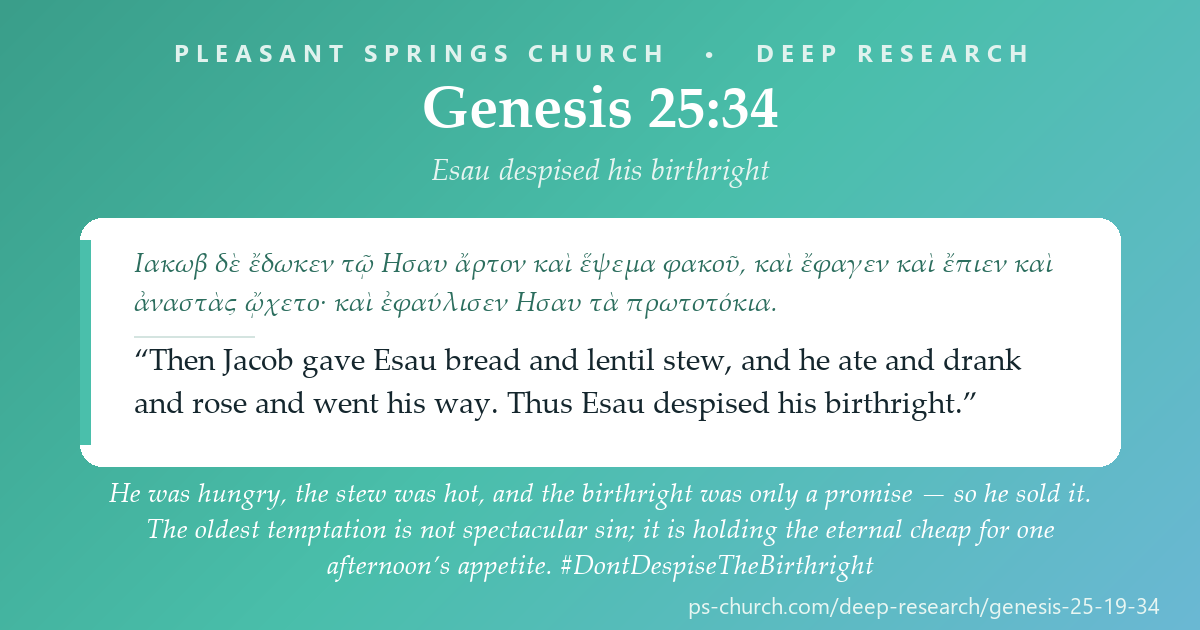
Genesis 25:34 · to share
LXX + ESVEvery Deep Research page traces its passage across the whole sweep — the Old Testament, the Second-Temple world between the testaments (historical witnesses, not Scripture), and the New Testament. Follow the thread:
Pleasant Springs Church — Deep Research
Research method after Michael S. Heiser’s Bible Research Method (examine dictionaries → ancient literature → important words → textual connections → academic publications → share), with the Pleasant Springs “Author & Audience” foundation. Scripture set in the Hebrew, the Greek editions named on each page and the ESV (Old Testament), and the Greek New Testament and the ESV (New Testament), per the practice of Pleasant Springs Church. Genesis 25:19–34 research grounded in Wenham, Hamilton, Mathews, Waltke, and Sarna, with Piper, Schreiner, and Moo on Paul’s use of the oracle; the passage read as the seedbed of Romans 9 — God’s purpose of election, real, gracious, and prior to works (Rom 9:11–13, citing 25:23 and Mal 1:2–3), held together with genuine human responsibility, since Esau himself despised (wayyivez, 25:34; LXX ἐφαύλισεν) the birthright and stands warned in Hebrews 12:16–17; the oracle read as national (Israel and Edom) before it is pressed into the deeper truth of electing mercy, with a Molinist / ROSES eternal-security frame — those God calls he keeps — and neither Esau nor Edom denigrated as persons; Jacob’s grasping recorded, never sanctioned, the supplanter awaiting the Jabbok.
Scripture quotations marked ESV are from the ESV® Bible (The Holy Bible, English Standard Version®), © 2001 by Crossway, a publishing ministry of Good News Publishers. ESV Text Edition: 2016. Used by permission. All rights reserved. The ESV text may not be quoted in any publication made available to the public by a Creative Commons license, and the ESV may not be translated in whole or in part into any other language. www.esv.org
|
Did this study bless you today? 💚 Give to Support PS Church100% of gifts go to the General Fund — thank you. |