The only chapter in Genesis given wholly to Isaac is a chapter of holy repetition. A new famine, a forbidden Egypt, the covenant reaffirmed to the second generation — “I will be with you and will bless you… because Abraham obeyed my voice” — and a son who inherits by re-digging his father’s wells and keeping their names. Between Esek (“contention”) and Sitnah (“enmity”) lies Rehoboth, “room.” Blessed a hundredfold in a famine year, Isaac hears at Beersheba by night the covenant name pass to him: “I am the God of Abraham your father. Fear not, for I am with you.” This study works Genesis 26:1–33. See the method →
Genesis 26:3, 5, 12, 22, 24
Hebrew · LXX · ESVThe Shape of the Passage
Parallel panelsGenesis gives Isaac exactly one chapter of his own — and fills it not with new revelation but with re-dug wells and a repeated promise: the covenant survives a generation by inheritance, not novelty.
Author
Moses devotes to Isaac what he gives no other patriarch: a single chapter that is entirely his, and it is deliberately made of echoes. A famine strikes “besides the former famine that was in the days of Abraham” (26:1) — the narrator is careful to say it is a new one, Isaac’s own trial. And where Abraham once went down to Egypt under famine (12:10), the Lord now forbids it: “Do not go down to Egypt” (26:2). The promise moves forward through the son on the son’s own faith, not by re-running the father’s story.
The covenant to the second generation. For the only time in Isaac’s life, the full Abrahamic covenant is spoken directly to him: presence (“I will be with you”), blessing, the land, offspring “as the stars of heaven,” and the world’s blessing in his seed (26:3–4). Remarkably, its ground is not Isaac’s merit but his father’s obedience: “because Abraham obeyed my voice and kept my charge, my commandments, my statutes, and my laws” (26:5). The words are the vocabulary of Sinai read back into Genesis — Abraham as the man who kept torah before Torah — and they teach that a child can be carried, for a season, on the covenant faithfulness of a parent (cf. 18:19).
The inherited fear. Then, jarringly, the chapter’s low point: at Gerar Isaac says of Rebekah, “She is my sister” (26:7) — the very lie his father told twice (12:13; 20:2), the third telling of the family sin, fear of death outrunning trust in the God who has just said “I will be with you.” Scripture records the failure without excusing it; grace will advance through the flawed son, but never by endorsing the flaw. Yet the blessing is undeniable: Isaac sows in a famine year and reaps a hundredfold, grows “very great,” and the Philistines envy him (26:12–14).
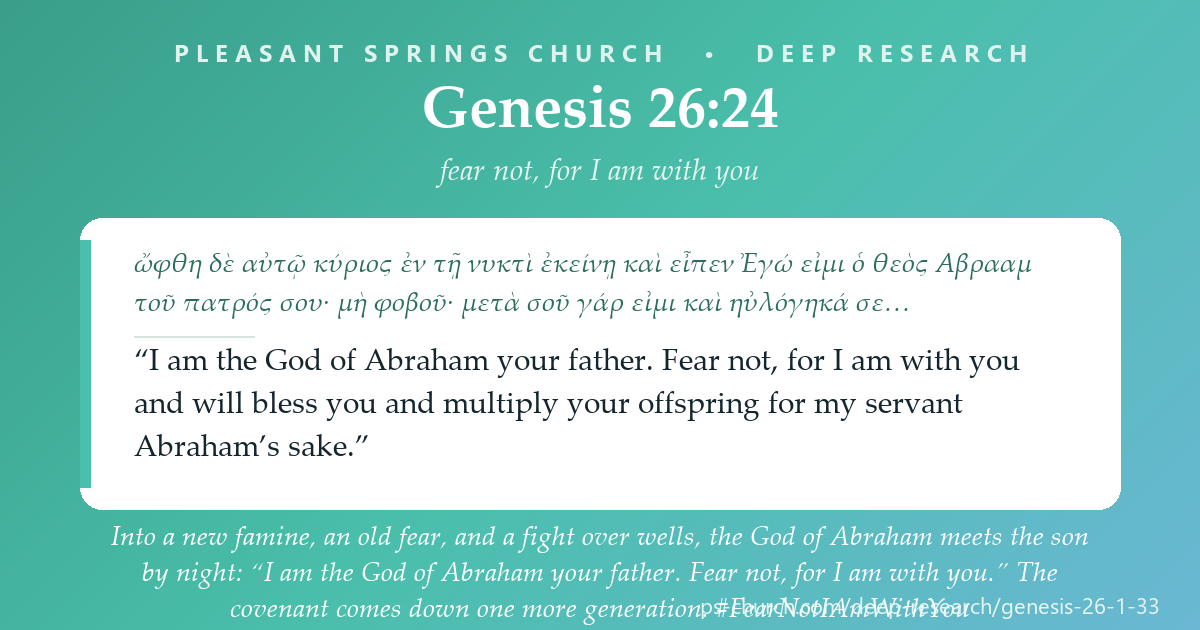
Wells, and the God of the father. The chapter’s heart is water. The Philistines had stopped up Abraham’s wells; Isaac re-digs them and restores their old names (26:18) — then, digging on, meets strife: Esek and Sitnah, contention and enmity, until Rehoboth, “room” (26:20–22). At Beersheba the Lord appears by night and hands the covenant name forward: “I am the God of Abraham your father. Fear not, for I am with you” (26:24). Isaac builds an altar, calls on the name, pitches his tent, and his servants dig — and a wary king comes for a treaty because “we see plainly that the Lord has been with you” (26:28). The chapter closes at the Well of the Oath: Shibah, Beersheba (26:33).
Audience
Israel heard in this chapter the answer to its deepest anxiety about the promise: what happens when the giant dies? Abraham is gone; can the covenant survive an ordinary son in a hostile land in a year of famine? Genesis 26 answers yes — not because Isaac is a second Abraham (he is not; he repeats his father’s worst mistake) but because the God of Abraham keeps his oath and becomes, in his own words, “the God of Abraham your father” (26:24). Israel would later name him exactly so at the burning bush: “the God of Abraham, the God of Isaac, and the God of Jacob” (Ex 3:6, 15) — the covenant name growing by one generation here.
Re-digging the fathers’ wells. The image would not be lost on a people forever tempted to abandon the old faith for the newer gods of the land. Isaac does not invent new wells; he reopens his father’s and keeps their names (26:18). The covenant generation inherits by reclaiming, not replacing — “Ask for the ancient paths… and walk in it” (Jer 6:16). And the reclaiming meets opposition (Esek, Sitnah) before it reaches room (Rehoboth): blessing and strife travel together, and the well of contention is often only two wells short of the well of room.
‘Fear not, for I am with you.’ For the church, Genesis 26:24 gives one of Scripture’s great and recurring words. The Immanuel promise — “I am with you” — runs from here to Isaiah’s exiles (“fear not, for I am with you,” Isa 41:10; 43:1–5), to Paul in a hostile city (“do not be afraid… for I am with you,” Acts 18:9–10), to the risen Christ’s last words (“I am with you always,” Mt 28:20). And the wells that Isaac fought for become, in the Gospels, the place where the Bridegroom offers water no famine can touch: “a spring of water welling up to eternal life” (Jn 4:14). The God of the fathers is with the children still — in famine, in strife, in the patient re-digging of old and holy ground.
Orient on Isaac, Gerar and the Philistines, wells and water rights, and the renewed covenant.
Search by topic: Isaac, Gerar, Abimelech, Philistines, wells / water rights, Beersheba, Rehoboth, covenant / oath, famine.
Which articles are relevant?
- Anchor Bible Dictionary — “Isaac,” “Gerar,” “Abimelech,” “Philistines,” “Beersheba,” “Wells,” “Covenant.”
- Dictionary of the OT: Pentateuch — “Isaac,” “Abrahamic Covenant,” “Blessing,” “Wife-Sister Narratives,” “Land.”
- NIDOTTE / TDOT — be’er (well), berakhah (blessing), shevu’ah / sheva’ (oath / seven), quwm (hiphil) (establish), yare’ (fear), rachav (make room).
Bibliography surfaced:
- Gordon Wenham (WBC), Victor Hamilton (NICOT), Kenneth Mathews (NAC), Bruce Waltke, Nahum Sarna (JPS) on Genesis.
- Studies of the wife-sister narratives (Gen 12; 20; 26) and of the patriarchal well-and-treaty scenes at Gerar/Beersheba.
- Beale & Carson, Commentary on the NT Use of the OT (Exodus 3:6 in the Gospels; the ‘I am with you’ formula).
Wells and water rights, treaty-oaths at the well, and a covenant passed to a son.
Read the famine, the wells, and the Beersheba treaty against ancient water law, herding economy, and covenant custom — and against the Second-Temple retellings.
Which parallels shed light on religion and worldview?
Water was survival, and a well was capital. In the semi-arid Negeb, a dug well — often to a buried spring, walled and covenanted — was among the most valuable property a herding clan could own, and the commonest cause of conflict. To “stop up” a rival’s wells (26:15) was an act of war by other means; to re-dig them and restore their names (26:18) was to reassert an inheritance. The strife of Esek and Sitnah is ordinary Negeb life — and precisely there the narrator locates the covenant blessing: Isaac neither seizes by force nor abandons the land, but withdraws, digs again, and waits for the Lord to “make room” (Rehoboth). Blessing here is not the absence of conflict but faithfulness through it.
The treaty at the well. The Beersheba scene (26:26–31) is a miniature ancient Near Eastern parity treaty: a delegation (king, adviser, army commander), a shared meal, a mutual oath sworn “early in the morning,” and a place-name commemorating the oath. Its theological engine is the pagan king’s own confession: “We see plainly that the Lord is with you” (26:28; cf. 21:22). The covenant blessing is legible even to outsiders — Abimelech reads Isaac’s prosperity as evidence of a God worth making peace with. The name Beersheba (be’er sheva’) puns on both “oath” and “seven,” the number of the sworn covenant (21:28–31), sealing the chapter at the Well of the Oath.
The Second-Temple memory. The book of Jubilees (2nd c. B.C.) retells this chapter (Jubilees 24), narrating Isaac’s wells and the Philistine strife — and, tellingly, adding a solemn curse upon the Philistines for stopping the wells, a later era’s bitterness read back into the patriarch’s story. Josephus (Antiquities 1.18) smooths the account into a tale of Isaac’s magnanimity and the envy of neighbors. And Philo allegorizes the wells as the soul’s digging for wisdom, the deepest well being knowledge of God. These are witnesses to how Israel heard the chapter — not Scripture, but a window on the questions it raised — and each fastens, in its own way, on the wells as the chapter’s enduring image.
- Genesis 21:22–34 — Abraham’s earlier well-dispute and oath with an Abimelech at Beersheba: the son’s scene deliberately mirrors the father’s.
- Jubilees 24; Josephus, Antiquities 1.18; Philo, On Dreams 1 (and On the Posterity of Cain) — Second-Temple retellings and allegory of Isaac and the wells (historical witnesses, not Scripture).
- Genesis 12:10–20; 20:1–18 — the two prior wife-sister episodes: the family fear Isaac inherits and repeats (see the call of Abram).
The most quietly radical thing about Genesis 26 is that it contains almost nothing new. Isaac faces a famine his father faced; he is tempted toward an Egypt his father fled to; he tells the lie his father told; he digs the wells his father dug and gives them back his father’s names; he makes a treaty at a well with an Abimelech, exactly as his father did, and calls the place Beersheba, as his father had. A careless reader might conclude Isaac is merely a pale copy — and in the flesh he is, repeating even the sin. But that is the point the narrator is pressing on us: the covenant does not pass to the next generation because the next generation is impressive. It passes because God keeps his oath. The chapter’s single most important sentence is not spoken by Isaac at all; it is the Lord’s — ‘I am the God of Abraham your father… for I am with you’ — and it turns a chapter of repetition into a chapter of faithfulness. This is how most believers actually inherit their faith: not by a fresh Sinai but by re-digging wells their fathers and mothers dug, clearing out the rubble the years have thrown in, and drinking again from the same old water. The names on the wells stay the same; the God who filled them is the same; and the promise, unearned and undiminished, comes down one more generation. To a church always tempted to think it must reinvent the faith to own it, Genesis 26 says: reopen the ancient wells, keep the old names, and you will find the water has not moved.
The vocabulary of inheritance: presence, the established oath, the hundredfold, and 'fear not.'
Watch the “I will be with you” bracket, the grounding “because Abraham obeyed,” the established oath, the famine-year hundredfold, the wells from contention to room, and the theophany’s “fear not.”
“I will be with you” — the Immanuel promise, bracketing the chapter (26:3, 24). The same self-naming verb of Exodus 3:14 (’ehyeh) here means presence, not metaphysics: the God who is, is with his own (Isa 41:10; Mt 28:20).
“Because Abraham obeyed” — eqev, “on the heel of / as a consequence of.” The covenant to Isaac is grounded in his father’s obedience, described in Sinai’s own words (charge, commandments, statutes, laws): Abraham kept torah before Torah.
“I will establish” — quwm (hiphil), to confirm / raise up the oath (shevu’ah) sworn to Abraham. God does not renegotiate the covenant with each generation; he establishes the standing one (cf. 17:7, 19).
“A hundredfold” — a sower’s harvest in a famine year: blessing measured against impossibility. The LXX specifies barley (κριθήν). The same hundredfold marks the good soil in Jesus’ parable (Mt 13:8, 23).
“Room / broad places” — the third well, after Esek (“contention”) and Sitnah (“enmity,” the root of satan, adversary). The LXX translates the triad — Ἀδικία, Ἐχθρία, Εὐρυχωρία (wrong, enmity, room) — charting strife to spaciousness.
“Fear not” — the theophany’s first word, healing the fear that had driven the lie of 26:7. “Fear not, for I am with you” becomes the covenant’s standing comfort across the canon (Isa 43:1–5; Acts 18:9–10).
How the rest of Scripture fills out the scene:
- Exodus 3:6, 15; 3:14; Matthew 22:32 — “the God of Abraham your father” (26:24) becoming the covenant name at the burning bush, and Jesus’ proof of resurrection: the God of the living.
- Isaiah 41:10; 43:1–5; Haggai 2:4–5; Acts 18:9–10; Matthew 28:20 — “Fear not, for I am with you”: the Immanuel promise carried from Isaac to the exiles, to Paul, to the church.
- Genesis 12:1–3; 15:5; 17:7–8; 22:16–18 — the Abrahamic covenant now “established” with Isaac: land, offspring as the stars, oath, and the world’s blessing (see the binding of Isaac).
- John 4:5–14; 7:37–39; Isaiah 12:3; Jeremiah 6:16 — the wells of the fathers, re-dug, and the living water; asking for the ancient paths: the chapter’s image at its furthest reach.
From re-dug wells and 'the God of Abraham your father' to 'I am with you always.'
Trace the renewed covenant, the wells, and the Immanuel promise toward their New Testament fulfillment.
Which cross-references matter?
- Genesis 12:10–20; 20:1–18 ↔ 26:7–11 — the wife-sister lie, told a third time: the inherited family fear, recorded and not sanctioned; grace advancing through, never endorsing, the sin.
- Genesis 21:22–34 ↔ 26:26–33 — father and son each make a well-treaty with an Abimelech at Beersheba: the covenant life running in the same channels one generation on.
- Exodus 3:6, 15; Matthew 22:31–32; Acts 3:13 — “the God of Abraham your father” joined to Isaac and Jacob: the covenant name Israel and the church confess.
- Isaiah 41:10; 43:1–5; Acts 18:9–10; Matthew 28:20; Hebrews 13:5–6 — “Fear not, for I am with you”: Isaac’s night-word become the church’s courage.
- John 4:5–14; 7:37–39; Revelation 7:17; 21:6 — the patriarchal wells opening at last onto living water and the spring of the water of life (see a bride for Isaac).
When the Lord appears to Isaac at Beersheba, he does not introduce himself as Isaac’s God. He says, ‘I am the God of Abraham your father’ — and only across the chapter, as Isaac builds his altar and calls on the name and digs his wells, does that borrowed title quietly become his own, so that a generation later the burning bush can speak of ‘the God of Abraham, the God of Isaac, and the God of Jacob’ as a single unbroken name. This is how faith is actually transmitted. It begins as someone else’s — the God of your father, your mother, your church — a testimony received before it is owned, a well dug by hands now still. And there comes a night, often in a hard season, when the God of your father meets you in the dark and says, ‘Fear not, for I am with you,’ and the inherited faith becomes a firsthand one. Isaac does not earn this; he has just repeated his father’s worst deception. He receives it, because God keeps oaths that men break. The whole New Testament rests on the durability of that name: when Jesus wants to prove that the dead will rise, he does not argue from a philosophy of the soul but from a title on a well — ‘I am the God of Abraham, and the God of Isaac, and the God of Jacob’ — God is not the God of the dead, but of the living. The God who said ‘I am with you’ to a frightened man at Beersheba has bound his own name to those he keeps, and death cannot unbind it.
The scholarship on Genesis 26:1-33.
The commentators on the Isaac chapter; the studies of the wife-sister narratives, patriarchal wells and treaties, and the Abrahamic covenant renewed.
Commentaries & studies:
- Gordon J. Wenham (WBC), Victor P. Hamilton (NICOT), Kenneth A. Mathews (NAC), Bruce K. Waltke, Nahum M. Sarna (JPS) on Genesis.
- Studies of the wife-sister type-scene (Gen 12; 20; 26) and of the patriarchal well-and-oath narratives; T. D. Alexander and others on the Abrahamic covenant across the generations.
- G. K. Beale & D. A. Carson, eds., Commentary on the NT Use of the OT (Exodus 3:6 in the Synoptic resurrection debate).
Interpretation notes worth keeping:
- A third Abimelech scene (26:1–11). “Abimelech” (“my father is king”) may be a Philistine royal title rather than the same man as chapter 20; the narrative pointedly repeats the father’s sin to show the son’s need of the same grace. The lie is reported, not commended.
- ‘Because Abraham obeyed my voice’ (26:5). The blessing to Isaac rests on Abraham’s faith-obedience, not Isaac’s merit — and the Sinai vocabulary (charge, commandments, statutes, laws) frames Abraham as the paradigm of a kept covenant, without making the promise a wage earned.
- The wells and the names (26:18). Restoring the fathers’ names to re-dug wells is an act of covenant memory, not mere property law: inheritance by reclaiming. The LXX translates the three new well-names (Ἀδικία, Ἐχθρία, Εὐρυχωρία), foregrounding the movement from wrong to enmity to room.
- ‘The God of Abraham your father’ (26:24). The covenant name expands by a generation here, anchoring Exodus 3:6, 15 and the resurrection argument of Matthew 22:32. Read the theophany as the hinge of the whole chapter, not a footnote to the wells.
- LXX divergences. 26:12 adds “of barley” (κριθήν); 26:24 renders the blessing as an accomplished perfect, “I have blessed you” (ηὐλόγηκά σε), where the Hebrew is future — the Greek reading the covenant blessing as already secured in Abraham. MT drives the ESV; the Greek is noted, not followed.
From re-dug wells and a famine-year harvest to 'Fear not, for I am with you.'
Name what you learned, why it matters, and one concrete response.
What should we carry away — and do?
- Inherit by re-digging. Isaac invents no new wells; he reopens his father’s and keeps their names. Faith is transmitted before it is owned — clear the rubble from the old wells and drink again from the same water.
- Blessing travels with strife. Esek, Sitnah, then Rehoboth: contention and enmity often stand between us and the room God means to make. Withdraw, dig again, and wait for the Lord to make room — do not seize it by force or abandon the ground.
- The God of your father meets you. To a frightened, failing son God says, “I am the God of Abraham your father. Fear not, for I am with you.” The inherited faith becomes firsthand in the dark, on the strength of a kept oath.
Step in response: name one “well” your parents or your church dug that has been stopped up in your life — a practice of prayer, a Scripture, a Lord’s Day rhythm, a habit of generosity — and re-dig it this week, keeping its old name. Where you are meeting Esek or Sitnah — a relationship or work full of contention — ask whether God is calling you to withdraw and dig again rather than fight for the well, trusting him for Rehoboth. And carry Isaac’s night-word into whatever you fear: “Fear not, for I am with you.”
Genesis 26:24 · to share
LXX + ESVEvery Deep Research page traces its passage across the whole sweep — the Old Testament, the Second-Temple world between the testaments (historical witnesses, not Scripture), and the New Testament. Follow the thread:
Pleasant Springs Church — Deep Research
Research method after Michael S. Heiser’s Bible Research Method (examine dictionaries → ancient literature → important words → textual connections → academic publications → share), with the Pleasant Springs “Author & Audience” foundation. Scripture set in the Hebrew, the Greek editions named on each page and the ESV (Old Testament), and the Greek New Testament and the ESV (New Testament), per the practice of Pleasant Springs Church. Genesis 26:1–33 research grounded in Wenham, Hamilton, Mathews, Waltke, and Sarna, with the studies of the wife-sister type-scene (Gen 12; 20; 26) and the patriarchal well-and-oath narratives; the only chapter given wholly to Isaac read as covenant by inheritance — a new famine and a forbidden Egypt (26:1–2); the Abrahamic covenant established to the second generation (26:3–5, wa-haqimoti, grounded “because Abraham obeyed my voice”); the sister-lie of 26:7 recorded and not sanctioned; the re-dug wells and their restored names (26:18), from Esek and Sitnah to Rehoboth (LXX Ἀδικία / Ἐχθρία / Εὐρυχωρία); the famine-year hundredfold (26:12, LXX “of barley”); and the Beersheba theophany (26:24) handing forward “the God of Abraham your father… fear not, for I am with you” — anchoring Exodus 3:6, 15 and Matthew 22:32, with the Immanuel promise carried to Isaiah, Paul, and the church (Isa 43:1–5; Acts 18:9–10; Mt 28:20). LXX 26:24 reads the blessing as an accomplished perfect (ηὐλόγηκά σε); MT drives the ESV.
Scripture quotations marked ESV are from the ESV® Bible (The Holy Bible, English Standard Version®), © 2001 by Crossway, a publishing ministry of Good News Publishers. ESV Text Edition: 2016. Used by permission. All rights reserved. The ESV text may not be quoted in any publication made available to the public by a Creative Commons license, and the ESV may not be translated in whole or in part into any other language. www.esv.org
|
Did this study bless you today? 💚 Give to Support PS Church100% of gifts go to the General Fund — thank you. |