The day of the Lord is near upon all the nations.” The shortest book in the Old Testament — a single chapter against proud Edom, the brother-nation that gloated over Jerusalem’s fall — widens at its close from one nation to all, and from judgment to hope. Edom’s pride is repaid measure for measure; a rescued remnant stands on Mount Zion; and the last five words say where all history is going: “the kingdom shall be the Lord’s.” Revelation echoes it as its own climax. This study works Obadiah 15–21 from Mount Esau to the reign of God. See the method →
Obadiah 15, 17, 21 (same numbering in MT, LXX & English)
Hebrew · LXX · ESVThe Shape of the Passage
LeitwortObadiah — twenty-one verses, the shortest book in the Old Testament — is an oracle against Edom, most likely after Edom joined in or gloated over the fall of Jerusalem (587 BC). Its close widens from Edom to the day of the Lord over all nations and the reign of God.
Author
Obadiah (“servant of the Lord”) prophesies against Edom — the nation descended from Esau, Jacob’s twin brother (Gen 25; 36). The occasion is Edom’s betrayal: standing aloof, even helping the enemy, on the day Jerusalem fell (vv.10–14). The book’s first half announces Edom’s downfall for its pride (“you who say in your heart, ‘Who will bring me down to the ground?’”, v.3); its climax (vv.15–21) turns that particular judgment into a universal one and then into hope for Zion.
Mount Esau, Mount Zion. The final verses set two mountains against each other: “Mount Esau,” the stronghold of human pride, and “Mount Zion,” the place of a rescued, holy remnant. History runs from the one to the other — from the day of the Lord that levels the proud to the kingdom that belongs to God alone.
Audience
Judah in the raw aftermath of the exile — a people wronged by a brother-nation and tempted to despair that the arrogant win. To them Obadiah promises that God sees, that pride will be repaid in kind, and that the last word belongs not to Edom’s fortress but to the Lord’s reign on Zion.
How it fits the canon. Obadiah is never quoted in the New Testament, but it stands in a long biblical trajectory: Esau/Edom as the profane brother (Mal 1:2–5; Rom 9:13; Heb 12:16), the day of the Lord over the nations, and above all the closing hope — “the kingdom shall be the Lord’s” — which the Revelation echoes as its own climax: “the kingdom of the world has become the kingdom of our Lord and of his Christ” (Rev 11:15).
Orient on Edom, the day of the LORD, the remnant, and the kingdom of God.
Search by topic: Obadiah, Edom / Esau, day of the LORD, remnant, kingdom of God.
Which articles are relevant?
- Anchor Bible Dictionary — “Obadiah,” “Edom,” “Esau,” “Day of the Lord.”
- Dictionary of the OT: Prophets — “Obadiah, Book of,” “Edom, Edomites,” “Day of the Lord,” “Kingdom of God.”
- NIDOTTE / TDOT — יוֹם יְהוָה (yôm YHWH, day of the Lord), פְּלֵיטָה (pəlêṭâ, remnant), מוֹשִׁיעִים (môšîʿîm, saviors), מְלוּכָה (məlûḵâ, kingship).
Bibliography surfaced:
- Paul R. Raabe (Anchor Yale, Obadiah), Hans Walter Wolff (Continental), Daniel I. Block (ZECOT), Billy K. Smith & Frank Page (NAC), Douglas Stuart (WBC) on Obadiah.
- Ehud Ben Zvi, A Historical-Critical Study of the Book of Obadiah; studies of the v.21 “saviors/kingdom” crux.
- Beale & Carson, NT Use of the OT (Revelation; the Esau/Edom trajectory).
The brother-enemy, the two mountains, and the kingdom of God.
Read Edom as history and as type, weigh the “saviors” crux, then follow the closing hope to the reign of God.
Which parallels shed light on religion and worldview?
The brother who became the enemy. Edom is Esau (Gen 36:1). The rivalry that began in Rebekah’s womb (Gen 25:23) hardened into national enmity, and it reached its low point when Edom cheered the destruction of Jerusalem. So in the prophets “Edom” comes to stand for something larger than one small nation: the proud, self-secure power that gloats over God’s people and imagines itself untouchable (Isa 34; 63:1–6). Obadiah’s judgment is on that — historical Edom, and every “Mount Esau” since.
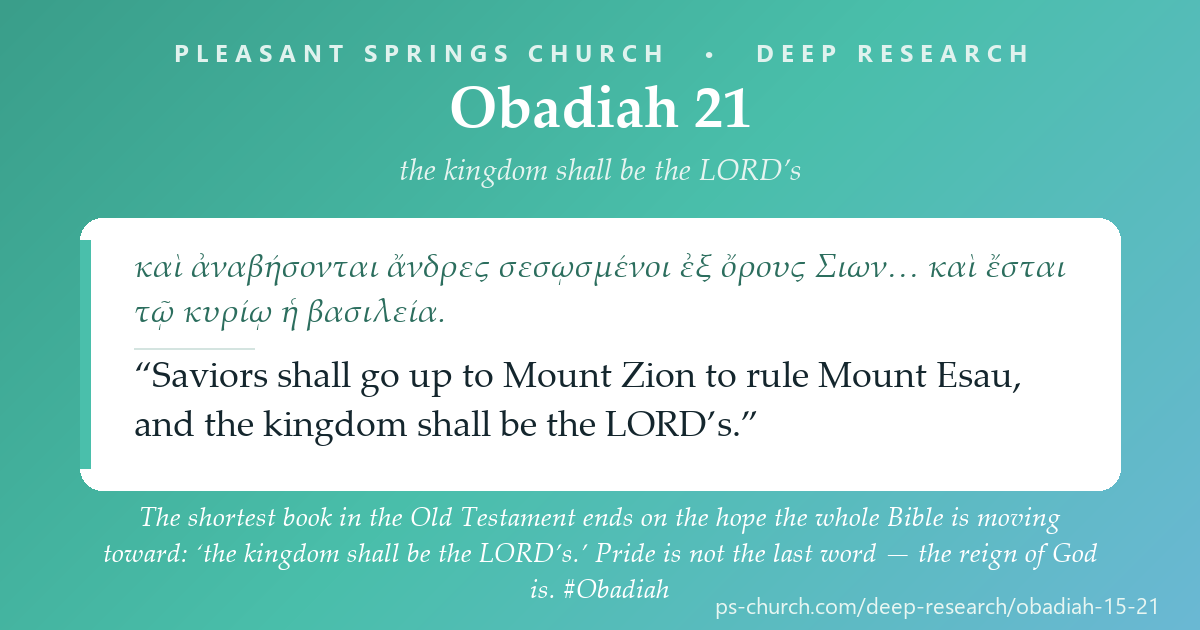
Two readings of ‘saviors.’ Verse 21 holds a small text-critical difference. The Hebrew reads “saviors (môšîʿîm) shall go up to Mount Zion” — human deliverers, like the “saviors” God raised up in the days of the judges (Judg 3:9, 15). The Greek read the same consonants as a passive, “men who have been saved” (ἄνδρες σεσῳσμένοι) — the rescued remnant rather than rescuers. Both are ancient; this study shows the difference. And either way the sentence lands in the same place: whoever goes up to Zion, and however they are described, “the kingdom shall be the Lord’s.” Human deliverers never reign in their own right; they serve a King.
- Genesis 25:23; 27:41; Malachi 1:2–5 — the twin rivalry, Esau’s grudge, and the later oracle “Esau I have hated”: the Edom trajectory Obadiah concentrates.
- Isaiah 34; 63:1–6; Jeremiah 49:7–22 — Edom as the archetype of the judged nations; Jeremiah’s parallel Edom-oracle (which shares much of Obadiah 1–9).
- Judges 3:9, 15; Nehemiah 9:27 — God raising up “saviors” (môšîʿîm) for his people: the human deliverers behind v.21’s Hebrew.
- Amos 9:11–12 — “the remnant of Edom… and all the nations who are called by my name”: the other side of the Edom oracle, gathering rather than only judging (see Amos 9).
Obadiah ends on the note that ends the Bible. Its last clause — “the kingdom shall be the Lord’s” (Hebrew wəhāyəṯâ la-YHWH ham-məlûḵâ) — is the whole hope of Scripture in five words: that history is going somewhere, and where it is going is the unrivaled reign of God. The New Testament never quotes Obadiah, but Revelation says the same thing at its turning point: the seventh trumpet sounds and loud voices in heaven cry, “The kingdom of the world has become the kingdom of our Lord and of his Christ, and he shall reign forever and ever” (Rev 11:15). What Obadiah saw as the toppling of Mount Esau and the rescue of Mount Zion, the Revelation sees consummated in Christ — the true Deliverer to whom every human “savior” only ever pointed. A word of care the text requires: Edom’s judgment is God’s to give, not ours; the Esau/Edom typology (Rom 9:13; Heb 12:16) is about election and the profane despising of holy things, never a license to despise persons. The comfort of Obadiah is not that our enemies will suffer but that God will reign — and that his reign is the safety of all who take refuge on his holy mountain.
The vocabulary of the day, the remnant, and the reign of God.
Watch the “saviors” who never reign in their own right — the kingdom is the Lord’s.
“The day of the Lord” — God’s decisive day of judgment and vindication, here widened from Edom to “all the nations.” Edom’s fate becomes the pattern for the world’s.
“As you have done, it shall be done to you” — measure-for-measure justice; “your deeds shall return on your own head.” The principle behind “whatever one sows” (Gal 6:7).
“An escaped remnant” — survivors on Mount Zion. The Greek reads instead ἡ σωτηρία (“salvation”) — from a surviving people to deliverance itself.
“Saviors, deliverers” — human agents (from yāšaʿ, “save”; the root of the name Yeshua/Jesus). The Greek read a passive, “men who have been saved.” Either way, subordinate to the Lord’s kingship.
“Kingship, royal dominion” — “the kingdom shall be the Lord’s.” The book ends not on Edom’s ruin but on God’s universal reign (cf. Rev 11:15).
How the canon carries these themes:
- Revelation 11:15; 12:10 — “the kingdom of the world has become the kingdom of our Lord”: Obadiah’s closing hope consummated (thematic echo, not a citation).
- Romans 9:13 (quoting Malachi 1:2–3) — “Jacob I loved, but Esau I hated”: the election contrast Obadiah dramatizes (Paul quotes Malachi, not Obadiah).
- Hebrews 12:16–17 — “unholy like Esau, who sold his birthright”: the New Testament’s reading of Esau as the type of the profane.
- Galatians 6:7; Matthew 7:2 — “whatever one sows, that will he also reap”: the measure-for-measure of Obadiah 15.
From the fall of proud Edom to the reign that has no end.
Trace the day of the Lord and the kingdom of God from Edom’s judgment into the Revelation.
Which cross-references matter?
- Genesis 25:23; 27:41; Numbers 24:18 — Esau and Jacob; “Edom shall be dispossessed” in Balaam’s oracle: the long backstory.
- Isaiah 34; 63:1–6; Ezekiel 35; Malachi 1:2–5 — Edom as the archetype of the proud nations under judgment.
- Amos 9:11–12; Acts 15:16–17 — “the remnant of Edom… and all the nations”: the gathering counterpart (see Amos 9).
- Joel 2:32; 3:16–17 — deliverance on Mount Zion in the day of the Lord (see Joel 2).
- Revelation 11:15; 19:6; 21:1–4 — the kingdom become the Lord’s; the reign of God consummated.
Obadiah is small but not slight. Its architecture moves deliberately from the particular to the cosmic: a specific grievance (Edom’s treachery, vv.10–14), then the day of the Lord “upon all the nations” (v.15), then the reversal on Mount Zion (v.17), then the final, quiet claim that the kingship is God’s (v.21). The measure-for-measure logic (“as you have done, it shall be done to you”) is not petty revenge but moral order: a universe in which pride is not the last word. Scholars debate the v.21 crux — active “saviors” or passive “the saved” — and it is worth showing, but the theology is untouched by it: whoever ascends Zion does so under a reign not their own. Obadiah refuses both despair (the arrogant do not finally win) and triumphalism (the victory is God’s, not Judah’s). It hands the reader, in its very last breath, the hope the whole Bible is moving toward: the kingdom shall be the Lord’s.
The scholarship on Obadiah 15-21.
The commentators on Obadiah; the studies of the v.21 crux and the Edom tradition.
Commentaries & studies:
- Paul R. Raabe (Anchor Yale, Obadiah), Hans Walter Wolff (Continental, Obadiah and Jonah), Daniel I. Block (ZECOT), Billy K. Smith & Frank Page (NAC), Douglas Stuart (WBC).
- Ehud Ben Zvi (BZAW 242); Anthony Gelston (BHQ, The Twelve Minor Prophets) on the text of Obadiah; studies of the v.21 saviors/kingdom crux.
- G. K. Beale & D. A. Carson, eds., Commentary on the NT Use of the OT (Revelation).
Interpretation notes worth keeping:
- No versification offset. Obadiah has one chapter; MT, LXX, and English number the verses identically (unlike its batch-neighbor Nahum, where English 1:15 = MT 2:1).
- The v.21 crux. MT “saviors” (active human deliverers) vs LXX “men who have been saved” (passive); v.17 MT “remnant” vs LXX “salvation.” Show the divergences; the closing kingship is unaffected.
- Not quoted in the NT. Every New Testament link (Rev 11:15; Rom 9:13; Heb 12:16) is a thematic echo or a quotation of a different book — present them as resonance, and name the actual source.
- Edom, held rightly. Historical nation and prophetic cipher for proud powers; the judgment is God’s, and the Esau typology is about election, not a warrant against persons.
From the toppling of pride to the reign of God.
Name what you learned, why it matters, and one concrete response.
What should we carry away — and do?
- Pride is not the last word. Edom said, “Who will bring me down to the ground?” God answered. Whatever proud power seems untouchable today, the day of the Lord outlasts it.
- The kingdom is the Lord’s. History is not drifting; it is heading toward the unrivaled reign of God. Your allegiance belongs to the King whose kingdom cannot fall.
- Vengeance is God’s, not ours. Obadiah does not hand the wronged a sword; it hands them a hope. Leave judgment to the Judge, and take refuge on his holy mountain.
Step in response: where you have been wronged and are tempted to plot your own repayment, hand it to the God who says “as you have done, it shall be done to you” — and let his coming kingdom, not your grievance, set the tone of your week. Pray “your kingdom come,” and live as a citizen of the reign that will not fall.
Obadiah 21 · to share
ESVEvery Deep Research page traces its passage across the whole sweep — the Old Testament, the Second-Temple world between the testaments (historical witnesses, not Scripture), and the New Testament. Follow the thread:
Pleasant Springs Church — Deep Research
Research method after Michael S. Heiser’s Bible Research Method (examine dictionaries → ancient literature → important words → textual connections → academic publications → share), with the Pleasant Springs “Author & Audience” foundation. Scripture set in the Hebrew, the Greek editions named on each page and the ESV (Old Testament), and the Greek New Testament and the ESV (New Testament), per the practice of Pleasant Springs Church. Obadiah 15–21 research grounded in Raabe, Wolff, Block, and Smith & Page, with Ben Zvi and Gelston on the text of v.21 and Beale & Carson on the kingdom-of-God trajectory; the Jeremiah 49 parallel and the Esau/Edom tradition as canonical and interpretive context.
Scripture quotations marked ESV are from the ESV® Bible (The Holy Bible, English Standard Version®), © 2001 by Crossway, a publishing ministry of Good News Publishers. ESV Text Edition: 2016. Used by permission. All rights reserved. The ESV text may not be quoted in any publication made available to the public by a Creative Commons license, and the ESV may not be translated in whole or in part into any other language. www.esv.org
|
Did this study bless you today? 💚 Give to Support PS Church100% of gifts go to the General Fund — thank you. |