Seven chapters of Jubilees carry Abraham from Isaac’s weaning to his own deathbed: Hagar sent away, the binding of Isaac at the prompting of Mastema, Sarah’s death counted as the tenth trial, three last testaments, and a vision of human lives shrinking and then growing again. The book dates every one of these events, and the dates are where its witnesses part company. R. H. Charles, translating the Ethiopic in 1902, marked seven numerals in these chapters as corrupt and, in his commentary, proposed a correction for every one — chosen, his notes say, to make the dates agree, above all with the birth date the book gives Abraham (11:15) and the 175 years he lived. VanderKam’s critical Geʻez text has all seven as Charles translated them. Hebrew copies from Qumran — found after Charles wrote — preserve three of those places: twice they read what the Geʻez reads, once they read a number neither has, and at none of the three do they read Charles’s correction. The number neither has, a forty-third jubilee for the year Abraham died, is the one Dillmann had conjectured and Charles had rejected because it put Abraham’s death in AM 2060, not the 2051 his arithmetic required. So the page prints the arithmetic for every reading and settles none. The same Hebrew has ‘two’ where the Geʻez has the ‘five’ of Abraham’s 175. Measured in Geʻez against Geʻez Genesis, the binding of Isaac never shares more than five consecutive words with Genesis 22, and Abraham’s death shares more with Jacob’s in Genesis 50 than with his own in Genesis 25. This is not Scripture for us; it is a Second-Temple witness, read closely and tested by the canon. See the method →
Jubilees series: ← 11:1–16:31 · 17:1–23:32 · 24:1–29:20 → · start at the Prologue
The Book of Jubilees is a Second-Temple Jewish retelling of Genesis 1 through Exodus 24, set out as a revelation to Moses on Sinai and dictated by ‘the angel of the presence’. The first page of this series gives the date scholars commonly propose, c. 160–150 BC; that dating is reported, not tested here. It is canonical in the Ethiopian Orthodox Church, Hebrew copies of it were found at Qumran — six manuscripts that overlap these chapters are measured here — and it is not Scripture for us. We read it as a witness to how some Jews before Christ retold Abraham, and we read it critically, testing everything by the canon. Where it has what Genesis does not (Mastema, the tenth trial, a seven-day feast, a vision of shortened lives) the page says so and does not treat any of it as Scripture’s own.
⚠️ What this page can and cannot measure — read this first.
HELD: Charles’s English, all 1,307 verses; VanderKam’s Geʻez, all 1,307 verses, as measurement substrate; Dillmann’s Geʻez Genesis (1,526 verses, 19,476 words); the Masoretic Hebrew Bible; the CATSS Greek Genesis; the Samaritan Genesis (one manuscript, Chester Beatty 751); and Hebrew fragments of Jubilees from Qumran that overlap these chapters — 6 manuscripts, fetched for this study from the Scripta Qumranica Electronica edition.
NOT HELD: any Greek, Latin or Syriac Jubilees; Charles’s 1895 or Dillmann’s 1859 Ethiopic editions; VanderKam’s apparatus; the official editions of the Qumran fragments (DJD); 4Q225, the ‘Pseudo-Jubilees’ text with its own binding of Isaac. VanderKam’s English translation is on the digitiser’s raw pages beside the Geʻez; it is in copyright and is not quoted here. The Anno Mundi figures it prints in brackets at the nine dated verses of these chapters (1989, 2003, 2010, 2024, 2027, 2046, 2052, 2057, 2109) are the nine this page computes.
CONSEQUENCE: no Greek New Testament measurement is possible against a Geʻez and English text, so every New Testament connection on this page is named, not measured. Word runs are measured only within one language: Geʻez Jubilees against Geʻez Genesis, Qumran Hebrew against Masoretic Hebrew. No English run is measured anywhere on this page.
Jubilees 17:1–23:32 — thirteen verses, in Charles’s English
English: R. H. Charles (1902; SPCK reprint 1917), verbatim, his signs kept · Hebrew: Qumran, where it survives · Geʻez: measured, quoted only in phrasesDated, and not daggered: seventh week, first year, first month, twelfth day of the forty-first jubilee = AM 2003, the figure in Charles’s own margin. The Geʻez has the same four numerals.
Genesis 22:1 says simply that God tested Abraham. Here the proposal comes from Mastema — named 4 times in these seven chapters and 12 times in the whole Geʻez book (counted on the stem of the name; once, at 11:5, the digitised text spells it with a different first letter).
Count what the text names. The Geʻez marks 7 objects of trial with the preposition bə- (land, famine, wealth of kings, wife, circumcision, Ishmael, Hagar) and uses the verb ‘try’ 4 times in this one verse. This verse shares no two consecutive Geʻez words with any verse of Genesis.
Charles’s English reads like Genesis 22:3–4. The two Geʻez texts share no two consecutive words — not with Genesis 22:3, not with any verse of Genesis. Jubilees opens ወአሌለየ ፡ በነገህ ፡ ወጸዐነ ፡ አድግቶ; Dillmann’s Genesis opens ወተንሥአ ፡ አብርሃም ፡ በጽባሕ ፡ ወረሐነ ፡ አድጎ. And the last clause, he saw the place afar off, has no Genesis verse to stand against: Dillmann’s Genesis has no verse 22:4.
The narrator steps into the scene: I stood before him. This is the angel of the presence who dictates the whole book to Moses (1:27; 2:1); he says I again at 18:10–11, us at 18:14 and we tried him at 19:3.
A seven-day festival, dated by arithmetic only. The challenge falls on the twelfth of the first month (17:15) and Abraham sees the place on the third day (18:3): the 14th or 15th, depending on where the count starts — the days Leviticus 23:5–6 gives to Passover and to the seven-day Feast of Unleavened Bread. The chapter never names Passover. The Geʻez word for it, in 4 spellings, occurs 11 times in 10 verses of the whole book, every one of them in chapter 49. And the nearest this verse comes to any other verse of Jubilees is two consecutive words, a depth 8 other verses reach; the two words seven days are shared with 3 of them (28:9, 44:3, 49:22). The date is arithmetic; the name is not in the text.
The only trial the text numbers is this one — ወዝመከራ ፡ ዓሥር, literally ‘and this tenth trial’. Chapters 17–19 name at most nine (the seven of 17:17, the binding, and Sarah’s burial). Its noun trial and its verb was tried are the last two of the 9 words from the root ‘try’ in chapters 17–23 that are said of Abraham — and the noun’s only appearance in them.
ויצווהו לאמור אני זק[נתי] [ולוא] [ידעתי] [יום] [מותי] [כי] [אני] [שבע]21:1And in the sixth year of the †seventh† week of this jubilee Abraham called Isaac his son, and commanded him, saying: "I am become old, and. know not the day of my death, and am full of my days.
Charles daggered seventh and read sixth (AM 2050 for 2057). The Geʻez has ዘሳብዕ ፡ ሱባዔ, ‘seventh’. The Hebrew of 4Q219 (above) has השבי°ע°י° — three letters read with certainty, three marked uncertain — and its certain letters already rule out ‘sixth’, which in Hebrew would be הששי: its third letter is not the one 4Q219 has. [sic] The full stop in ‘and. know’ is in the transcription this page quotes; the 1902 and 1917 printings both read ‘and know’.
HEBREW ABOVE: 4Q219, col. 1 l. 11; col. 1 l. 12 (Scripta Qumranica Electronica, CC BY-SA 4.0)
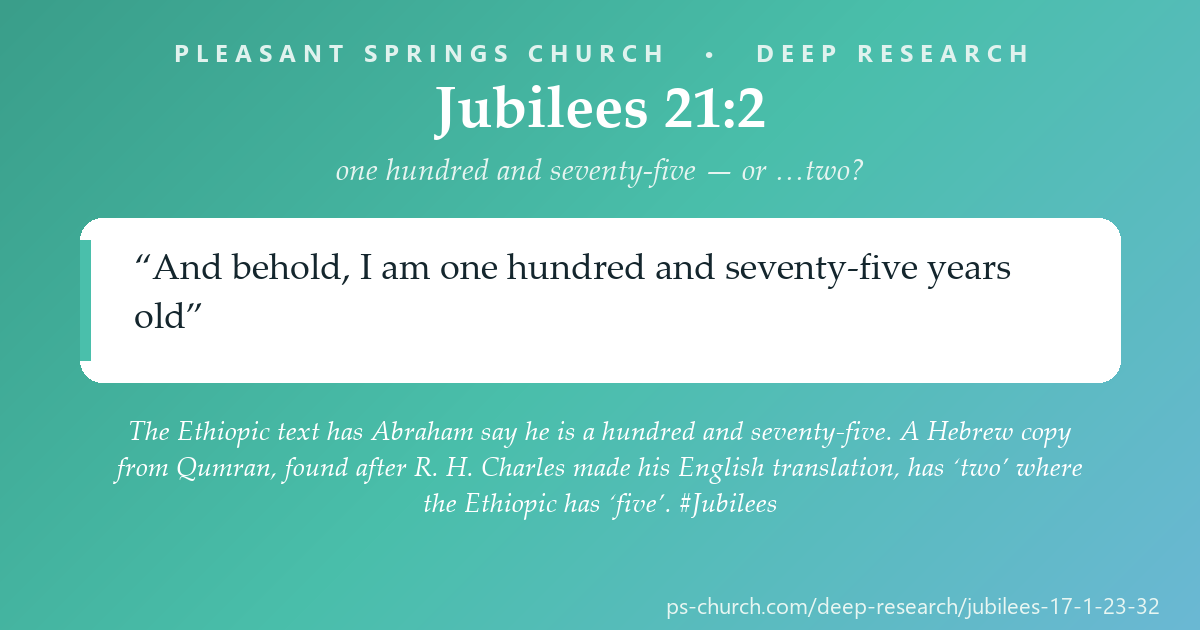
No dagger here, and the witnesses still differ. The Geʻez reads ምእት ፡ ወሰብዓ ፡ ወኀምስቱ, 175. The Hebrew line above reads בן שתים°, ‘a son of two’; the hundreds and tens after it are restored by the editors, not preserved. (The first word of that line, ימי, ends 21:1’s ‘full of my days’.) Five in one witness, two in the other.
HEBREW ABOVE: 4Q219, col. 1 l. 13 (Scripta Qumranica Electronica, CC BY-SA 4.0)
[השנית] [בו] [היאה] ה°שנה אשר מת בה אברהם בא[ו] [יצחק] [וישמעאל]22:1And it came to pass in the †first† week in the †forty-fourth† jubilee, in the †second† year, that is, the year in which Abraham died, that Isaac and Ishmael came from the Well of the Oath to celebrate the feast of weeks--that is, the feast of the first-fruits of the harvest--to Abraham, their father, and Abraham rejoiced because his two sons had come.
Three numerals daggered by Charles. In his 1902 commentary he proposed sixth for the week, forty-second for the jubilee and seventh for the year — AM 2051, the year Abraham turns 175 by the book’s own birth date for him; the 1917 reprint’s notes keep only the first two. The Geʻez: first week of the አርብዓ ፡ ወአርባዕ (‘forty and four’) jubilee, second year = AM 2109. The Hebrew above: בשבוע הרישון, ‘in the first week’, and לשלושה וא°ר°, ‘of the three-and-fo[rty]’ — a forty-third jubilee. Neither the Geʻez nor Charles reads it; it is the number Dillmann had conjectured here, which Charles’s 1902 commentary records and rejects because it would put Abraham’s death in AM 2060. The year is restored by the editors and is not preserved.
HEBREW ABOVE: 4Q219, col. 2 l. 35; col. 2 l. 36 (Scripta Qumranica Electronica, CC BY-SA 4.0)
[שנים] [ויתם] [את] [ימי] [חייו] זקן ושבע ימים ….23:8And he lived three jubilees and four weeks of years, one hundred and seventy-five years, and completed the days of his life, being old and full of days.
Three jubilees and four weeks = 147 + 28 = 175, and Genesis 25:7 gives 175 in the Masoretic, Greek and Samaritan texts alike. The Hebrew of 2Q19 (above; the first clause of its first line, mostly restored, is the end of 23:7, ‘the days of weeping for Abraham were ended’) keeps ‘three jubilees he lived’ — and זקן ושבע ימים, old and full of days, with the word days that the Masoretic Genesis 25:8 does not have.
HEBREW ABOVE: 2Q19, frg. 1 l. 4; frg. 1 l. 5 (Scripta Qumranica Electronica, CC BY-SA 4.0)
The turn of the vision. No messiah is named: the Geʻez words for ‘anointed’ searched here occur 0 times in the whole book. The section heading Charles’s reprint gives these verses (‘The Messianic Kingdom’) is the editors’, not the text’s.
The frame closes: the only verse in chapters 17–23 that names Moses, and the third mention here of the heavenly tablets (18:19, 19:9, 23:32).
⚠️ The two earlier pages in this series describe their English as ‘R. H. Charles, 1913 (public domain), lightly modernized’. This page does not modernise anything. The file it quotes is the 1917 reprint of the 1902 translation, which differs from the 1902 printing in a few archaisms (hath for has, doeth for does).
Versification — stated, as on every page here, and here it is a third state. There is no Masoretic Jubilees, no Greek Jubilees, no King James Jubilees and no Vulgate Jubilees on this disk — the Greek, King James and Vulgate loaders raise an error when asked for it, and the Masoretic corpus has no such book — and therefore no ESV offset to state. The verse numbers are Charles’s and VanderKam’s, and they agree: chapters 17–23 run 18·19·31·13·26·30·32 verses in Charles’s English and in the Geʻez alike, 169 in all.
The Qumran Hebrew has no verse numbers at all — only columns, fragments and lines. Each Hebrew line on this page is matched to its verse by content, and the page says which line it is.
The Genesis the Geʻez is measured against has its own numbering. Dillmann’s Ethiopic Genesis follows the Septuagint’s verse numbers. In the stretch Jubilees 17–23 parallels it lacks two numbers the Masoretic and CATSS Greek texts both have: 22:4 and 23:20.
The Shape of the Passage
A dated sequence, with one measured frame (17:15–19:8) — not a chiasmThe frame around the binding is measured, not asserted. Words from the Geʻez root m-k-r, ‘try’, occur 10 times in chapters 17–23. The 9 said of Abraham (8 verb forms and the noun trial) all stand between 17:16 and 19:8 — and none of them inside chapter 18; the other, at 21:13, is the altar wood, ‘such as have been tested as to their appearance’. The word group ‘faithful’ occurs 10 times, 9 of them between 17:15 and 19:9 (one of those, 18:16, inside the binding); the one outside, at 21:4, is said of God. The story of the test is framed by the vocabulary of testing, and that vocabulary stays out of the story itself.
The echo in chapter 23 is measured too: the Geʻez phrase ‘ten hundred years’ (literally; Charles prints ‘a thousand years’ and ‘one thousand years’) stands at 23:15 (what the forefathers had) and 23:27 (what the restored will approach). In the whole Geʻez book it stands in only 3 verses — these two and 4:30, where Adam ‘lacked seventy years of one thousand years’. (‘Ten hundred’ of anything — years, generations, fighting men — is in 7 verses.)
Where this sits in the book’s own frame. The whole book is the angel of the presence dictating to Moses on Sinai (1:27; 2:1), out of the heavenly tablets, on a scheme of fifty jubilees that ends at the crossing into Canaan — by the book’s own sum at 50:4, 49 jubilees + one week + two years + forty years = 2,450 years. These chapters run through jubilees 41 to 44 of the fifty, as the text stands. The angel says I at 18:9–11, the tablets are cited at 18:19, 19:9 and 23:32, and Moses is addressed at 23:32.
This is NOT offered as a chiasm. The decline and the restoration in chapter 23 echo one phrase; the testaments of chapters 20–22 are a series, not a mirror.
⚠️ Where this page sits. Jubilees is filed under Pseudepigrapha & Second Temple. It is canonical in the Ethiopian Orthodox Church and absent from the Hebrew Bible and from the Protestant, Roman Catholic and Greek Orthodox canons. Nothing taught at Pleasant Springs rests on it.
Author
Anonymous, and speaking through an angel. The book never gives its author’s name; it gives its narrator’s. In these chapters the angel of the presence says I in the middle of the binding (18:9–11), us at 18:14, we tried him at 19:3, and at 23:32 turns to Moses: write down these words.
A priestly mind. Chapter 21 is Abraham teaching Isaac the law of the peace offering, the fat, the salt, the woods allowed on the altar and the washing of hands and feet — laws Leviticus gives at Sinai, set here in the mouth of a patriarch. The first page of this series describes the writer as a priestly, Torah-zealous Jew of the second century BC; nothing on this page tests that.
A counter of dates. Nine verses in these chapters open on a date in jubilees, weeks of years and years. Those dates are where the book’s witnesses now disagree, and that is the finding this page is built on.
Audience
Readers told to stay apart. Abraham’s testaments in chapters 20–22 press three things: take no wife from the daughters of Canaan (20:4, a verse that also orders burning for a woman who commits fornication; 22:20), keep away from blood (21:6, 17–20), and Separate thyself from the nations, And eat not with them (22:16). Whoever the first readers were, they are told who they are by being told who Abraham was. Who those readers were is not measured here.
Readers told their own age is short-lived. Chapter 23 lays the shrinking of human life against the days of the forefathers — nineteen jubilees once, seventy or eighty years now — and promises a generation in which the children will begin to study the laws. Charles read 23:16–25 as the author’s own times (his notes cite 1 Maccabees); that is Charles’s reading, reported, not tested here.
Orient on the book, on Mastema, on the binding of Isaac in Jewish tradition, and on the calendar of jubilees.
Search by topic: Jubilees, Book of; Mastema; Akedah; testament literature; heavenly tablets; calendars in early Judaism; Dead Sea Scrolls, 4QJubilees.
Which articles are relevant?
- Anchor Bible Dictionary — “Jubilees, Book of” (VanderKam) and “Calendars (Ancient Israelite and Early Jewish),” the articles the earlier pages of this series cite.
- Eerdmans Dictionary of Early Judaism — “Jubilees”; and search it for the binding of Isaac, Mastema and the testament form.
- Dictionary of Deities and Demons in the Bible — search for Mastema and for Satan.
- Dictionary of New Testament Background (IVP) — “Jubilees,” “Rewritten Bible.”
- On the text — any article that says which Ethiopic edition it reads, and whether it has used the Qumran fragments. An article that gives Jubilees’ dates for Abraham without saying whose numerals it follows is not usable for these chapters — see Stage 3.
Bibliography surfaced:
- James C. VanderKam, Jubilees: A Commentary (Hermeneia, two volumes). Not consulted for this page.
- James C. VanderKam, The Book of Jubilees: A Critical Text (CSCO 510, 1989) — the Geʻez measured here, without its apparatus.
- R. H. Charles, The Book of Jubilees, or the Little Genesis (1902; reprinted with an introduction by G. H. Box, SPCK 1917) — the English quoted here.
- J. T. A. G. M. van Ruiten, Abraham in the Book of Jubilees (Brill) — on how these chapters handle Genesis. Not consulted.
- James L. Kugel, A Walk Through Jubilees; Michael Segal, The Book of Jubilees.
Hebrew copies from Qumran, a heavenly accuser, ten trials and a priestly testament.
Three bodies of material meet in these chapters, and the page keeps them apart: the Hebrew copies of Jubilees itself, the canonical texts it sits beside, and later Jewish tradition named only through Charles’s notes.
The Hebrew copies of these chapters — what is actually held:
- 4Q219 — Abraham’s testament to Isaac, 21:1 to 22:1, in two columns. The richest Hebrew witness for this page: it preserves letters of the date of 21:1, of Abraham’s age in 21:2, and of the date of 22:1, ‘the year in which Abraham died’.
- 4Q220 — the sacrificial law, 21:5–10. The same verses as part of 4Q219: two Hebrew copies of one passage of Jubilees on this disk.
- 4Q221 — 21:22–24, 22:22, and 23:10–13 (the shortening of lives). The same edition carries later chapters, not used here.
- 2Q19 — 23:7–8: the forty days of weeping and the ‘three jubilees’ of Abraham’s life.
- 3Q5, fragment 1 — 23:12–13: in the Hebrew, no peace … blow upon blow (Charles’s English: ‘there is no peace’ … ‘wound on wound’).
- 4Q176a, fragments 19–20 — 23:21–23: in the Hebrew, great wrath on the deeds of the generation (Charles’s English: ‘a great punishment will befall the deeds of this generation’).
- Identified here by content against Charles’s English. 219 preserved whole words in all — words with no letter restored by the editors. None of them is from chapters 17–20. The whole set of 19 Scripta Qumranica editions of Jubilees and related manuscripts is on this disk (4Q216–224, 1Q17–18, 2Q19–20, 3Q5, 4Q176, 4Q176a, 4Q176b, 11Q12, 4Q482–483); no line in any of them names Mastema, Hagar or Moriah, and none uses nsh, Genesis 22:1’s verb ‘test’. (The other Hebrew verb for testing, bḥn, does occur: 4Q176 frg. 15 l. 3 keeps kbḥwn, ‘as one tests’, in a quotation of Zechariah 13:9, and the editors restore nbḥny, ‘tested’, for the altar wood of 21:13 in 4Q219 col. 2 l. 8.) So no Hebrew of the binding of Isaac was found in any Jubilees manuscript held here — a search by name and verb, not a line-by-line identification of every scrap.
Which parallels shed light on the world of the text?
- Job 1–2 — a scene in heaven, and an accuser who proposes a test of a man God has praised. Jubilees 17:15–18 has both; Genesis 22:1 has neither. A canonical shape the book shares; the page does not say which way any influence ran. See Job 1–3.
- The Testament of Levi 9 — Isaac teaching Levi the law of sacrifice. Charles’s note on 21:1 calls it ‘a remarkable parallel’ and suggests a common source. Charles’s judgement; the Testament is not held here.
- The ten trials of Abraham — a rabbinic tradition (the Mishnah’s tractate Avot, chapter 5, speaks of them; Charles’s note on 17:17 cites the different lists in Pirqe de Rabbi Eliezer). Neither is held here. What is measured is Jubilees’ own count — see Stage 3.
- Isaac’s age at the binding — Charles’s note gives 23 by the book’s chronology and 37 by the rabbinic Seder Olam. The 37 is reported from Charles; the Jubilees figure is re-derived in Stage 3, and it is not one number but two.
- 4Q225 (‘Pseudo-Jubilees’) — a separate Qumran text that, as this shelf’s Genesis 22 study describes it, tells the binding with Mastema present. Not Jubilees, and not held here.
Jubilees reckons time in a 364-day year and in jubilees of 49 years, and it argues for that calendar elsewhere (6:32–38). In these chapters it shows up as dates and as feasts: the seven-day festival of 18:18–19, and the ‘feast of weeks’ Abraham keeps in the year of his death (22:1). That calendar is the book’s own program. This page reports it and does not adopt it.
Five Geʻez words that carry the chapters — and the nine dates that carry the argument.
Every word count below is over VanderKam’s Geʻez, chapters 17–23 (169 verses, 3,308 words) or the whole book (1,307 verses), and the page says which each time. No count is taken from the English.
10 words from this root in chapters 17–23; the 9 said of Abraham all stand between 17:16 and 19:8 — 8 verb forms and 1 noun: Mastema’s wherein Thou dost try him (17:16), four in the list of 17:17, one in 17:18, we tried him at 19:3, and at 19:8 the noun trial and the verb was tried. None in chapter 18. The tenth is the altar wood of 21:13, such as have been tested as to their appearance. Dillmann’s Geʻez Genesis has the verb in the first verse of its binding story (22:1). In Jubilees the root, where it is said of Abraham, stands in the frame and not in the story; in Dillmann’s Genesis it stands in the story’s first verse.
10 occurrences of the word group in chapters 17–23 (counted on its two stems), 9 of them between 17:15 and 19:9. Voices in heaven say it of Abraham at 17:15; Mastema makes it his question at 17:16 (if he is faithful); the angel says it at 17:17–18; God says it at 18:16; and 19:8–9 closes the frame: found faithful, patient in spirit. The one outside is 21:4, where it is said of God.
4 times in these chapters (17:16, 18:9, 18:12, 19:28), 12 in the whole Geʻez book. At 17:16 he is a ‘prince’ who speaks before God; at 18:12 he is ‘put to shame’; at 19:28 Abraham prays that the spirits of Mastêmâ will not rule over Jacob. No form of the name occurs in the Masoretic, CATSS Greek or Dillmann Geʻez Genesis held here.
3 times in these chapters: the seven-day festival is ‘ordained and written on the heavenly tables’ (18:19); Abraham is ‘recorded on the heavenly tables as the friend of God’ (19:9); and the vision of chapter 23 is ‘written’ there for a testimony (23:32). The book’s claim to authority, surfacing three times in seven chapters.
The only number the text puts on any trial. 17:17 lists 7 objects of trial, each marked with the preposition bə-; chapter 18 is the binding; 19:3–8 is Sarah’s burial, and 19:8 calls it the tenth. That is nine, not ten. Charles’s note fills the gap from 14:21 (Sarah’s barrenness) and counts Ishmael and Hagar as two. The text gives the count and leaves the list to the reader.
The dates, three witnesses side by side:
Jubilees dates events ‘in the Nth jubilee, in the Mth week, in the Kth year’. Anno Mundi = 49(N−1) + 7(M−1) + K. Every date below is computed that way from the numerals as they stand, with the jubilee carried from the last one the text names (the forty-first at 13:16, the forty-second at 19:1).
| Verse | Event | Charles’s English (verbatim) | Geʻez (VanderKam) | AM as the text stands | Charles’s margin and reading | Qumran Hebrew |
|---|---|---|---|---|---|---|
| 17:1 | Isaac weaned | ‘first year of the †fifth† week’ | ወበአሐዱ ፡ ዓመት ፡ ዘሱባዔ ፡ ኃምስ | 1989 | margin 1982; reads fourth | — |
| 17:15 | voices in heaven; Mastema | ‘in the seventh week, in the first year thereof, in the first month in this jubilee, on the twelfth of this month’ | በሱባዔ ፡ ሳብዕ | 2003 | margin 2003 | — |
| 19:1 | Abraham to Hebron | ‘in the first year of the first week in the forty-second jubilee’ | አርብዓ ፡ ወክልኤቱ | 2010 | margin 2010 | — |
| 19:2 | Sarah dies | ‘in the first year of the †third† week of this jubilee’ | ዘሱባዔ ፡ ሣልስ | 2024 | reads second (2017); no margin date | — |
| 19:10 | Isaac marries | ‘in the fourth year thereof’ | ወበዓመት ፡ ራብዕ ፡ ሎቱ | 2027 | margin 2020 | — |
| 19:13 | Jacob and Esau born | ‘in the sixth week, in the second year thereof’ | ወበሱባዔ ፡ ሳድስ ፡ በካልእ ፡ ዓመቱ | 2046 | margin 2046 | — |
| 20:1 | testament to all his sons | ‘in the forty-second jubilee, in the first year of the †seventh† week’ | ዘሱባዔ ፡ ሳብዕ | 2052 | margin ‘2052 (?2045)’; note: ‘Probably corrupt for "sixth" (Charles).’ | — |
| 21:1 | testament to Isaac | ‘in the sixth year of the †seventh† week of this jubilee’ | ወበሳድስ ፡ ዓመት ፡ ዘሳብዕ ፡ ሱባዔ | 2057 | margin ‘2057 (?2050)’; reads sixth | השבי°ע°י° seventh |
| 22:1 | the year Abraham died | ‘in the †first† week in the †forty-fourth† jubilee, in the †second† year’ | በሱባዔ ፡ ቀዳሚ … አርብዓ ፡ ወአርባዕ … በካልእ ፡ ዓመት | 2109 | reads sixth week, forty-second jubilee, seventh year = AM 2051 (the year only in his 1902 commentary; the 1917 notes give the week and jubilee); no margin | הרישון first; לשלושה וא°ר° 43rd; year restored |
Read across the rows. Charles daggered 7 numerals in 5 verses and, in his 1902 commentary, proposed a reading for all 7; the 1917 reprint’s footnotes print 6 of them, leaving out the seventh year at 22:1. VanderKam’s Geʻez has all 7 as Charles translated them — the daggers are Charles’s judgement, not a gap in the manuscripts. The Qumran Hebrew preserves letters at 3 of the 7 places: it agrees with the Geʻez at 2, reads a third number at 1, and reads Charles’s correction at 0. That third number, a forty-third jubilee at 22:1, is the one Dillmann had conjectured: Charles’s 1902 commentary records the conjecture and sets it aside because it would put Abraham’s death in AM 2060 (the same commentary calls the jubilee of 24:1, after Abraham’s death, ‘the forty-third’). Charles could not have known: the Qumran caves were found from 1947, after he had made this translation.
Charles’s corrections were built to make the dates agree, and his notes say so. His 1902 notes give the reasons: at 21:1 and 22:1, that Abraham, born in AM 1876 (11:15) and living 175 years, must die in AM 2051; at 20:1, that the text as it stands dates the testament to all his sons a year after that death; at 19:2, that Isaac must marry at forty (Genesis 25:20) after Sarah’s death; at 17:1, by analogy with the numeral he corrects at 16:15. His corrections in 17:1, 19:2, 20:1 and 21:1 all do the same thing: each moves a date back by exactly one week of years, seven years. Of his 7 margin dates in these chapters, five equal the date as the text stands (2003, 2010, 2046, and the first figures of ‘2052 (?2045)’ and ‘2057 (?2050)’); two give his corrected date alone (1982, 2020). The margins — and the Anno Mundi figures VanderKam’s English prints in brackets, which equal all nine dates as the text stands — are used here as cross-checks, never as the measurement.
What the dates do to Abraham and Isaac — arithmetic only:
Abraham’s last years do not add up in the Geʻez. At 21:1–2 (AM 2057) he says he is 175. At 22:1 (AM 2109) he dies, and 23:8 says he lived 175 years. The same age, 52 years apart. In the Hebrew of 4Q219 the death falls in a forty-third jubilee, not a forty-fourth. With its first week (preserved) and a second year (restored by the editors, as the Geʻez has it), that is AM 2060, 3 years after 21:1 — and the Hebrew age at 21:2 is ‘…two’. The editors restore 172; only the ‘two’ is on the leather. With that restoration the Hebrew’s two statements agree (172 + 3 = 175). Without it, all that can be said is that the Hebrew’s unit is two and the Geʻez’s is five.
Measured against the book’s own birth date for Abraham — the yardstick Charles himself used. 11:14–15 put his birth in AM 1876, with no dagger, so he turns 175 in AM 2051. As the text stands — and the Hebrew keeps the week of 21:1 — he is 181 at 21:1, where he says 175; at the Geʻez date of his death he would be 233, at the Hebrew’s 184. Charles’s readings put 21:1 in AM 2050 (he would be 174) and the death in AM 2051 (175). That fit is by design, not a finding: it is the sum his 1902 notes on 21:1 and 22:1 set out to satisfy. What the Hebrew is a check the corrections were not built for — and at the three places it can be read, it does not have them.
Jacob’s age when Abraham dies. Jacob is born in AM 2046 (19:13; no dagger; the Geʻez agrees). Genesis implies he was 15: Abraham was 100 at Isaac’s birth, Isaac 60 at the twins’, and Abraham died at 175 — the same three numbers in the Masoretic, Greek and Samaritan texts. By the Geʻez date he is 63. By the Hebrew jubilee, with the Geʻez year, he is 14. Charles’s readings, which leave 19:13 as it stands, put the death in AM 2051, when Jacob is 5.
Isaac’s age at the binding. The binding is dated AM 2003 (17:15, no dagger). Isaac’s birth (16:13) is given a month, not a year: ‘in the third month’, after a conception in the sixth month (16:12) of the year 15:1 names, ‘the fifth year of the †fourth† week’ — so in the following year, the one 16:15 names (‘the sixth year of the †fourth† week’). Charles daggered those numerals too and read them as third. So Isaac is born in AM 1987 as the text stands, AM 1980 by Charles’s readings (his margin at 16:13). Isaac is 16 (as the text stands) / 23 (Charles’s reading) at the binding. His age at weaning is 2 (as the text stands) / 2 (Charles’s reading); at his marriage 40 (as the text stands) / 40 (Charles’s reading), where Genesis 25:20 has 40; at the twins’ birth 59 (as the text stands) / 66 (Charles’s reading), where Genesis 25:26 has 60.
Every age the dates imply, in every reading, against Genesis:
| Age | As the text stands (Geʻez = Charles’s numerals) | Charles’s readings | Qumran Hebrew | Genesis (Masoretic = Greek = Samaritan) |
|---|---|---|---|---|
| Abraham at Isaac’s birth | 111 | 104 | — | 100 (21:5) |
| Isaac at the binding | 16 | 23 | — | no age given |
| Isaac at Sarah’s death | 37 | 37 | — | 37 (127 − 90: 23:1, 17:17) |
| Isaac at his marriage | 40 | 40 | — | 40 (25:20) |
| Isaac at the twins’ birth | 59 | 66 | — | 60 (25:26) |
| Abraham at 21:1–2, by the birth date of 11:15 (he says 175) | 181 | 174 | 181** (he says ‘…two’) | — |
| Abraham at his death, by the birth date of 11:15 | 233 | 175 | 184* | 175 (25:7) |
| Jacob at Abraham’s death | 63 | 5 | 14* | 15 (25:7 − 21:5 − 25:26) |
* with the Geʻez year at 22:1, which 4Q219 does not preserve. ** 4Q219 preserves the week of 21:1 (‘seventh’); its year is restored by the editors. Abraham’s birth: AM 1876 (11:14–15, no dagger). Isaac’s birth: AM 1987 as the text stands, AM 1980 by Charles’s readings (his margin at 16:13). The Hebrew death year is AM 2060. Charles’s death year is AM 2051, with the seventh year his 1902 commentary proposes at 22:1.
No column agrees with Genesis at every row. All of them give Isaac 37 at Sarah’s death and 40 at his marriage, as Genesis implies. As the text stands, Isaac is a year short of Genesis at the twins’ birth and Abraham eleven years past it at Isaac’s; Charles’s readings are four years past Genesis at Isaac’s birth and six at the twins’, reach the 175 of Abraham’s death exactly — the figure his notes start from — and leave Jacob 5 where Genesis implies 15; the Hebrew, at the rows it reaches, puts Abraham 9 years past 175 at his death and Jacob one year short of Genesis’s 15. Arithmetic only: this page does not say that any column follows a text of Genesis. Charles’s own 1902 note on 19:2 does say he chose ‘second’ there so that Isaac marries at forty, as Genesis 25:20 has him.
The Genesis ages these dates are weighed against — and why they cannot pick a tradition:
| Genesis | Age | Masoretic | Greek (CATSS) | Samaritan |
|---|---|---|---|---|
| 17:17 | Sarah when Isaac is promised | 90 | 90 | 90 |
| 21:5 | Abraham at Isaac’s birth | 100 | 100 | 100 |
| 23:1 | Sarah’s life | 127 | 127 | 127 |
| 25:7 | Abraham’s life | 175 | 175 | 175 |
| 25:20 | Isaac at his marriage | 40 | 40 | 40 |
| 25:26 | Isaac at the twins’ birth | 60 | 60 | 60 |
In this stretch of Genesis the Masoretic, Greek and Samaritan texts give the same age every time. So for chapters 17–23 the arithmetic cannot say that Jubilees ‘follows’ any one of them. The ages Jubilees states outright — Sarah 127 (19:7, ‘two jubilees and four weeks and one year’) and Abraham 175 (21:2, 22:7, 23:8) — are the Genesis figures in all three. Dillmann’s Geʻez Genesis 25:7 brackets the ‘seventy’ in Abraham’s 175 — in the digitiser’s words, a square bracket marks ‘an omission corrected according to later Ethiopic manuscripts’ (Dillmann’s own apparatus was not consulted); Jubilees’ Geʻez has it in all three places.
Lives shortened (23:9–15), against Genesis 5 and 9:29:
The text’s ladder: the forefathers’ days were nineteen jubilees (931 years); after the Flood they fell below it; Abraham did not complete four (196); later generations will not complete two (98); a man who lives a jubilee and a half (73½) will be called long-lived; ‘three score years and ten, and, if he is strong, four score years’ (23:15, the numbers of Psalm 90:10, which Charles’s note cites). At the turn, the days grow again, ‘Till their days draw nigh to one thousand years’ (23:27).
| Genesis | Life | Masoretic | Greek (CATSS) | Samaritan | Masoretic, as full jubilees + years |
|---|---|---|---|---|---|
| 5:5 | Adam | 930 | 930 | 930 | 18 + 48 |
| 5:8 | Seth | 912 | 912 | 912 | 18 + 30 |
| 5:11 | Enosh | 905 | 905 | 905 | 18 + 23 |
| 5:14 | Kenan | 910 | 910 | 910 | 18 + 28 |
| 5:17 | Mahalalel | 895 | 895 | 895 | 18 + 13 |
| 5:20 | Jared | 962 | 962 | 847 | 19 + 31 |
| 5:23 | Enoch | 365 | 365 | 365 | 7 + 22 |
| 5:27 | Methuselah | 969 | 969 | 720 | 19 + 38 |
| 5:31 | Lamech | 777 | 753 | 653 | 15 + 42 |
| 9:29 | Noah | 950 | 950 | 950 | 19 + 19 |
Measured against Genesis: nineteen jubilees is 931 years. 5 of the ten lives died within their nineteenth jubilee (883–931 years: Adam, Seth, Enosh, Kenan, Mahalalel) in every one of the three texts — Adam’s 930 is one year short of nineteen full jubilees. Lives longer than nineteen jubilees: 3 in the Masoretic text, 3 in the Greek, 1 in the Samaritan. The longest life is 969, 969 and 950 years respectively. None reaches the ‘thousand years’ of 23:15 and 23:27. Arithmetic, not dependence: the page does not say which Genesis the author read.
Geʻez against Geʻez, Hebrew against Hebrew — and the New Testament, named only.
The screen, declared. Each of the 169 verses of Geʻez Jubilees 17–23 against all 1,526 verses of Dillmann’s Geʻez Genesis. Words are split on the word divider and whitespace; the full stop, the semicolon and the editors’ sigla — Dillmann’s brackets, parentheses and asterisks, and the eight bracket pairs and one query sign in VanderKam’s text — are removed (the sign, not the word it marks), and nothing else is changed. A run is a sequence of whole word forms, in order, identical letter for letter — so a conjunction or preposition written onto the front of a word makes it a different word, and a numeral Dillmann writes in figures never matches one Jubilees writes in letters. Zero means ‘no two consecutive words shared’; single shared words are not counted. The tie band is the number of Genesis verses that reach the same depth.
The fold, declared and shown both ways. Geʻez manuscripts interchange four sets of letters — h/ḥ/ḫ, s/ś, ʾ/ʿ, ṣ/ḍ, in every vowel order. Every headline number is given without that fold and with it.
⚠️ Two editors, two manuscript bases. The Jubilees text is VanderKam’s (1989); the Genesis is Dillmann’s (1853). Agreement is a lower bound, and a disagreement may be editorial.
The distribution — with and without the fold:
Without the fold: of 169 verses, 120 reach two, 37 reach three, 6 reach four, 3 reach five, and nothing reaches six. 49 share no two consecutive words with any verse of Genesis.
With the fold: 121 reach two, 37 three, 7 four, 3 five; 48 share none. The fold changes exactly two verses: 19:22 (0 → 2) and 21:1 (3 → 4).
With Dillmann’s bracketed words left out instead of kept: 119 reach two, 36 three, 5 four, 3 five; 50 share none. That changes exactly two verses: 17:2 (2 → 0; its only pair with Genesis, at 22:7, is the two words Dillmann brackets there) and 21:2, whose run of four with Genesis 25:7 runs through a word Dillmann brackets (see the counter-examples below).
Against the whole book: across all 1,307 verses of Jubilees the deepest run with Genesis anywhere is 8, at 24:1 against Genesis 25:11 (band 1), on the next page of this series; 31 verses reach five. So a ceiling of five in these chapters is ordinary for the book, and the page does not call it a surprise.
All 169 verses — deepest Geʻez Genesis partner, tie band, and the band from the Genesis side
| Jubilees | Run | Band (Genesis verses at that depth) | Partners, with each partner’s own deepest run in all of Jubilees and its band |
|---|---|---|---|
| 17:1 | 2 | 1 | Gen 21:8 (2, band 3) |
| 17:2 | 2 | 1 | Gen 22:7 (3, band 1) |
| 17:3 | 3 | 1 | Gen 7:3 (3, band 1) |
| 17:4 | 3 | 1 | Gen 21:10 (3, band 1) |
| 17:5 | 2 | 2 | Gen 20:2 (2, band 2); Gen 21:25 (2, band 3) |
| 17:6 | 3 | 5 | Gen 17:15 (5, band 1); Gen 17:19 (3, band 4); Gen 18:13 (3, band 3); Gen 18:26 (3, band 3) … and 1 more |
| 17:7 | 2 | 1 | Gen 21:13 (2, band 2) |
| 17:8 | 2 | 1 | Gen 19:27 (2, band 25) |
| 17:9 | 0 | — | shares no two consecutive words with any verse of Genesis |
| 17:10 | 5 | 1 | Gen 21:16 (5, band 1) |
| 17:11 | 3 | 2 | Gen 16:11 (3, band 1); Gen 21:17 (3, band 1) |
| 17:12 | 3 | 1 | Gen 21:19 (3, band 1) |
| 17:13 | 2 | 7 | Gen 21:8 (2, band 3); Gen 21:20 (3, band 2); Gen 24:37 (2, band 4); Gen 27:46 (2, band 8) … and 3 more |
| 17:14 | 3 | 1 | Gen 4:25 (6, band 1) |
| 17:15 | 3 | 2 | Gen 8:4 (3, band 4); Gen 8:14 (4, band 1) |
| 17:16 | 2 | 5 | Gen 21:4 (2, band 9); Gen 22:6 (3, band 1); Gen 22:9 (2, band 9); Gen 25:5 (2, band 6) … and 1 more |
| 17:17 | 0 | — | shares no two consecutive words with any verse of Genesis |
| 17:18 | 2 | 1 | Gen 34:19 (2, band 6) |
| 18:1 | 5 | 2 | Gen 22:1 (5, band 1); Gen 22:11 (5, band 1) |
| 18:2 | 2 | 3 | Gen 1:9 (2, band 9); Gen 37:20 (2, band 2); Gen 37:22 (2, band 11) |
| 18:3 | 0 | — | shares no two consecutive words with any verse of Genesis |
| 18:4 | 3 | 1 | Gen 22:5 (3, band 1) |
| 18:5 | 3 | 1 | Gen 22:6 (3, band 1) |
| 18:6 | 3 | 3 | Gen 22:1 (5, band 1); Gen 22:7 (3, band 1); Gen 22:11 (5, band 1) |
| 18:7 | 2 | 16 | Gen 1:3 (2, band 5); Gen 1:6 (2, band 6); Gen 1:9 (2, band 9); Gen 1:11 (2, band 39) … and 12 more |
| 18:8 | 2 | 6 | Gen 8:9 (2, band 32); Gen 21:4 (2, band 9); Gen 22:6 (3, band 1); Gen 22:9 (2, band 9) … and 2 more |
| 18:9 | 3 | 1 | Gen 30:27 (3, band 1) |
| 18:10 | 3 | 2 | Gen 22:1 (5, band 1); Gen 22:11 (5, band 1) |
| 18:11 | 3 | 1 | Gen 22:12 (3, band 2) |
| 18:12 | 3 | 1 | Gen 22:13 (3, band 1) |
| 18:13 | 3 | 1 | Gen 22:14 (3, band 3) |
| 18:14 | 2 | 13 | Gen 3:9 (2, band 1); Gen 17:15 (5, band 1); Gen 17:19 (3, band 4); Gen 18:1 (2, band 15) … and 9 more |
| 18:15 | 3 | 2 | Gen 22:16 (3, band 1); Gen 22:17 (3, band 1) |
| 18:16 | 3 | 1 | Gen 18:18 (3, band 4) |
| 18:17 | 5 | 1 | Gen 22:19 (5, band 1) |
| 18:18 | 0 | — | shares no two consecutive words with any verse of Genesis |
| 18:19 | 0 | — | shares no two consecutive words with any verse of Genesis |
| 19:1 | 0 | — | shares no two consecutive words with any verse of Genesis |
| 19:2 | 2 | 1 | Gen 50:4 (3, band 1) |
| 19:3 | 2 | 4 | Gen 18:16 (2, band 3); Gen 22:10 (2, band 6); Gen 22:13 (3, band 1); Gen 23:2 (3, band 1) |
| 19:4 | 0 | — | shares no two consecutive words with any verse of Genesis |
| 19:5 | 3 | 2 | Gen 23:2 (3, band 1); Gen 35:27 (5, band 1) |
| 19:6 | 2 | 3 | Gen 19:1 (2, band 2); Gen 19:3 (2, band 8); Gen 50:13 (3, band 4) |
| 19:7 | 2 | 14 | Gen 5:5 (2, band 5); Gen 5:8 (2, band 4); Gen 5:11 (2, band 4); Gen 5:14 (2, band 4) … and 10 more |
| 19:8 | 0 | — | shares no two consecutive words with any verse of Genesis |
| 19:9 | 2 | 5 | Gen 1:17 (3, band 1); Gen 2:8 (2, band 16); Gen 11:8 (4, band 1); Gen 27:45 (2, band 2) … and 1 more |
| 19:10 | 2 | 8 | Gen 21:4 (2, band 9); Gen 22:6 (3, band 1); Gen 22:9 (2, band 9); Gen 24:47 (2, band 5) … and 4 more |
| 19:11 | 2 | 1 | Gen 17:23 (3, band 1) |
| 19:12 | 2 | 3 | Gen 4:17 (3, band 4); Gen 4:25 (6, band 1); Gen 24:36 (2, band 19) |
| 19:13 | 2 | 21 | Gen 24:17 (2, band 3); Gen 24:22 (2, band 3); Gen 24:30 (2, band 4); Gen 24:32 (2, band 5) … and 17 more |
| 19:14 | 0 | — | shares no two consecutive words with any verse of Genesis |
| 19:15 | 2 | 3 | Gen 35:27 (5, band 1); Gen 48:15 (2, band 23); Gen 48:16 (2, band 40) |
| 19:16 | 2 | 8 | Gen 19:9 (2, band 2); Gen 25:28 (2, band 1); Gen 27:36 (2, band 9); Gen 29:30 (3, band 2) … and 4 more |
| 19:17 | 2 | 25 | Gen 1:11 (2, band 39); Gen 1:14 (3, band 1); Gen 1:15 (3, band 1); Gen 1:17 (3, band 1) … and 21 more |
| 19:18 | 3 | 1 | Gen 7:23 (3, band 3) |
| 19:19 | 0 | — | shares no two consecutive words with any verse of Genesis |
| 19:20 | 2 | 25 | Gen 1:11 (2, band 39); Gen 1:14 (3, band 1); Gen 1:15 (3, band 1); Gen 1:17 (3, band 1) … and 21 more |
| 19:21 | 2 | 1 | Gen 27:36 (2, band 9) |
| 19:22 | 0 | — | shares no two consecutive words with any verse of Genesis |
| 19:23 | 2 | 3 | Gen 3:14 (3, band 1); Gen 3:17 (5, band 1); Gen 30:27 (3, band 1) |
| 19:24 | 2 | 1 | Gen 48:16 (2, band 40) |
| 19:25 | 0 | — | shares no two consecutive words with any verse of Genesis |
| 19:26 | 2 | 1 | Gen 27:11 (5, band 1) |
| 19:27 | 2 | 27 | Gen 1:11 (2, band 39); Gen 1:14 (3, band 1); Gen 1:15 (3, band 1); Gen 1:17 (3, band 1) … and 23 more |
| 19:28 | 0 | — | shares no two consecutive words with any verse of Genesis |
| 19:29 | 2 | 6 | Gen 3:14 (3, band 1); Gen 3:17 (5, band 1); Gen 22:11 (5, band 1); Gen 25:22 (2, band 10) … and 2 more |
| 19:30 | 2 | 1 | Gen 22:6 (3, band 1) |
| 19:31 | 2 | 2 | Gen 19:9 (2, band 2); Gen 29:30 (3, band 2) |
| 20:1 | 2 | 2 | Gen 17:20 (2, band 3); Gen 25:4 (2, band 3) |
| 20:2 | 3 | 1 | Gen 3:24 (3, band 1) |
| 20:3 | 0 | — | shares no two consecutive words with any verse of Genesis |
| 20:4 | 3 | 2 | Gen 24:3 (3, band 3); Gen 36:2 (3, band 2) |
| 20:5 | 0 | — | shares no two consecutive words with any verse of Genesis |
| 20:6 | 0 | — | shares no two consecutive words with any verse of Genesis |
| 20:7 | 0 | — | shares no two consecutive words with any verse of Genesis |
| 20:8 | 2 | 3 | Gen 23:10 (2, band 12); Gen 32:20 (2, band 10); Gen 50:14 (3, band 1) |
| 20:9 | 2 | 6 | Gen 4:14 (2, band 22); Gen 6:12 (3, band 1); Gen 7:3 (3, band 1); Gen 8:21 (2, band 10) … and 2 more |
| 20:10 | 3 | 1 | Gen 18:18 (3, band 4) |
| 20:11 | 2 | 6 | Gen 21:4 (2, band 9); Gen 22:6 (3, band 1); Gen 22:9 (2, band 9); Gen 25:5 (2, band 6) … and 2 more |
| 20:12 | 3 | 3 | Gen 9:19 (3, band 6); Gen 19:31 (3, band 6); Gen 34:30 (3, band 7) |
| 20:13 | 0 | — | shares no two consecutive words with any verse of Genesis |
| 21:1 | 3 | 1 | Gen 27:2 (3, band 2) |
| 21:2 | 4 | 1 | Gen 25:7 (4, band 1) |
| 21:3 | 0 | — | shares no two consecutive words with any verse of Genesis |
| 21:4 | 2 | 2 | Gen 25:6 (3, band 1); Gen 43:28 (2, band 7) |
| 21:5 | 0 | — | shares no two consecutive words with any verse of Genesis |
| 21:6 | 2 | 2 | Gen 11:4 (2, band 40); Gen 15:5 (5, band 1) |
| 21:7 | 2 | 6 | Gen 10:9 (2, band 24); Gen 18:22 (2, band 23); Gen 19:13 (2, band 23); Gen 19:27 (2, band 25) … and 2 more |
| 21:8 | 0 | — | shares no two consecutive words with any verse of Genesis |
| 21:9 | 2 | 9 | Gen 10:9 (2, band 24); Gen 18:22 (2, band 23); Gen 19:13 (2, band 23); Gen 19:27 (2, band 25) … and 5 more |
| 21:10 | 2 | 9 | Gen 7:11 (2, band 8); Gen 23:10 (2, band 12); Gen 26:32 (2, band 8); Gen 30:35 (2, band 6) … and 5 more |
| 21:11 | 2 | 24 | Gen 2:11 (3, band 5); Gen 8:9 (2, band 32); Gen 9:15 (3, band 1); Gen 9:19 (3, band 6) … and 20 more |
| 21:12 | 0 | — | shares no two consecutive words with any verse of Genesis |
| 21:13 | 0 | — | shares no two consecutive words with any verse of Genesis |
| 21:14 | 0 | — | shares no two consecutive words with any verse of Genesis |
| 21:15 | 2 | 1 | Gen 27:25 (4, band 1) |
| 21:16 | 0 | — | shares no two consecutive words with any verse of Genesis |
| 21:17 | 0 | — | shares no two consecutive words with any verse of Genesis |
| 21:18 | 2 | 1 | Gen 9:5 (2, band 13) |
| 21:19 | 2 | 4 | Gen 1:29 (3, band 2); Gen 6:2 (2, band 4); Gen 9:5 (2, band 13); Gen 9:6 (2, band 5) |
| 21:20 | 0 | — | shares no two consecutive words with any verse of Genesis |
| 21:21 | 2 | 6 | Gen 2:5 (2, band 44); Gen 2:7 (2, band 10); Gen 7:21 (3, band 1); Gen 9:5 (2, band 13) … and 2 more |
| 21:22 | 2 | 12 | Gen 2:6 (2, band 6); Gen 2:9 (2, band 8); Gen 2:19 (2, band 13); Gen 4:10 (2, band 14) … and 8 more |
| 21:23 | 0 | — | shares no two consecutive words with any verse of Genesis |
| 21:24 | 2 | 1 | Gen 6:5 (3, band 1) |
| 21:25 | 2 | 2 | Gen 9:12 (2, band 15); Gen 24:48 (3, band 2) |
| 21:26 | 0 | — | shares no two consecutive words with any verse of Genesis |
| 22:1 | 2 | 5 | Gen 18:31 (2, band 4); Gen 20:11 (2, band 4); Gen 25:8 (2, band 5); Gen 25:11 (8, band 1) … and 1 more |
| 22:2 | 2 | 5 | Gen 31:18 (4, band 1); Gen 36:7 (2, band 2); Gen 37:2 (2, band 9); Gen 37:22 (2, band 11) … and 1 more |
| 22:3 | 2 | 1 | Gen 7:10 (2, band 16) |
| 22:4 | 2 | 12 | Gen 4:3 (2, band 2); Gen 8:10 (2, band 55); Gen 13:6 (2, band 9); Gen 19:28 (2, band 16) … and 8 more |
| 22:5 | 0 | — | shares no two consecutive words with any verse of Genesis |
| 22:6 | 4 | 1 | Gen 14:19 (4, band 2) |
| 22:7 | 2 | 7 | Gen 9:9 (2, band 38); Gen 24:47 (2, band 5); Gen 25:7 (4, band 1); Gen 27:6 (2, band 5) … and 3 more |
| 22:8 | 3 | 3 | Gen 19:37 (3, band 13); Gen 32:33 (3, band 14); Gen 47:26 (4, band 1) |
| 22:9 | 2 | 7 | Gen 12:3 (2, band 8); Gen 17:7 (6, band 1); Gen 18:18 (3, band 4); Gen 22:18 (2, band 15) … and 3 more |
| 22:10 | 2 | 3 | Gen 6:5 (3, band 1); Gen 27:26 (3, band 2); Gen 31:43 (2, band 6) |
| 22:11 | 3 | 1 | Gen 27:29 (5, band 1) |
| 22:12 | 2 | 18 | Gen 2:11 (3, band 5); Gen 8:9 (2, band 32); Gen 9:15 (3, band 1); Gen 9:19 (3, band 6) … and 14 more |
| 22:13 | 0 | — | shares no two consecutive words with any verse of Genesis |
| 22:14 | 0 | — | shares no two consecutive words with any verse of Genesis |
| 22:15 | 2 | 5 | Gen 25:20 (2, band 3); Gen 26:3 (4, band 1); Gen 28:4 (4, band 1); Gen 28:9 (2, band 2) … and 1 more |
| 22:16 | 2 | 2 | Gen 26:24 (3, band 1); Gen 28:4 (4, band 1) |
| 22:17 | 0 | — | shares no two consecutive words with any verse of Genesis |
| 22:18 | 2 | 1 | Gen 33:14 (2, band 3) |
| 22:19 | 0 | — | shares no two consecutive words with any verse of Genesis |
| 22:20 | 3 | 1 | Gen 24:3 (3, band 3) |
| 22:21 | 2 | 2 | Gen 3:5 (7, band 1); Gen 46:6 (2, band 12) |
| 22:22 | 2 | 11 | Gen 4:14 (2, band 22); Gen 6:12 (3, band 1); Gen 7:3 (3, band 1); Gen 8:10 (2, band 55) … and 7 more |
| 22:23 | 2 | 2 | Gen 25:19 (2, band 1); Gen 28:9 (2, band 2) |
| 22:24 | 2 | 26 | Gen 2:11 (3, band 5); Gen 4:14 (2, band 22); Gen 6:3 (2, band 27); Gen 6:12 (3, band 1) … and 22 more |
| 22:25 | 0 | — | shares no two consecutive words with any verse of Genesis |
| 22:26 | 2 | 5 | Gen 22:6 (3, band 1); Gen 33:18 (2, band 12); Gen 35:4 (2, band 23); Gen 35:6 (3, band 4) … and 1 more |
| 22:27 | 2 | 2 | Gen 24:7 (2, band 27); Gen 26:4 (4, band 1) |
| 22:28 | 2 | 2 | Gen 3:14 (3, band 1); Gen 3:17 (5, band 1) |
| 22:29 | 0 | — | shares no two consecutive words with any verse of Genesis |
| 22:30 | 0 | — | shares no two consecutive words with any verse of Genesis |
| 23:1 | 2 | 1 | Gen 49:33 (2, band 1) |
| 23:2 | 2 | 5 | Gen 20:7 (2, band 4); Gen 25:8 (2, band 5); Gen 25:11 (8, band 1); Gen 26:18 (5, band 1) … and 1 more |
| 23:3 | 3 | 1 | Gen 28:16 (3, band 2) |
| 23:4 | 2 | 12 | Gen 22:6 (3, band 1); Gen 22:8 (2, band 2); Gen 22:19 (5, band 1); Gen 23:10 (2, band 12) … and 8 more |
| 23:5 | 4 | 1 | Gen 50:1 (4, band 1) |
| 23:6 | 2 | 8 | Gen 22:7 (3, band 1); Gen 26:18 (5, band 1); Gen 27:5 (2, band 3); Gen 31:18 (4, band 1) … and 4 more |
| 23:7 | 3 | 2 | Gen 20:8 (3, band 2); Gen 50:13 (3, band 4) |
| 23:8 | 0 | — | shares no two consecutive words with any verse of Genesis |
| 23:9 | 2 | 1 | Gen 9:20 (2, band 2) |
| 23:10 | 2 | 7 | Gen 3:14 (3, band 1); Gen 3:17 (5, band 1); Gen 18:31 (2, band 4); Gen 25:18 (2, band 24) … and 3 more |
| 23:11 | 0 | — | shares no two consecutive words with any verse of Genesis |
| 23:12 | 2 | 1 | Gen 6:4 (3, band 1) |
| 23:13 | 0 | — | shares no two consecutive words with any verse of Genesis |
| 23:14 | 2 | 1 | Gen 50:15 (2, band 3) |
| 23:15 | 0 | — | shares no two consecutive words with any verse of Genesis |
| 23:16 | 2 | 1 | Gen 3:24 (3, band 1) |
| 23:17 | 0 | — | shares no two consecutive words with any verse of Genesis |
| 23:18 | 2 | 2 | Gen 8:19 (3, band 4); Gen 45:20 (2, band 7) |
| 23:19 | 0 | — | shares no two consecutive words with any verse of Genesis |
| 23:20 | 2 | 31 | Gen 1:11 (2, band 39); Gen 1:14 (3, band 1); Gen 1:15 (3, band 1); Gen 1:17 (3, band 1) … and 27 more |
| 23:21 | 2 | 3 | Gen 22:10 (2, band 6); Gen 28:6 (2, band 28); Gen 38:20 (2, band 4) |
| 23:22 | 2 | 4 | Gen 19:24 (2, band 3); Gen 23:6 (2, band 9); Gen 24:50 (2, band 3); Gen 41:32 (2, band 3) |
| 23:23 | 2 | 27 | Gen 1:11 (2, band 39); Gen 1:14 (3, band 1); Gen 1:15 (3, band 1); Gen 1:17 (3, band 1) … and 23 more |
| 23:24 | 0 | — | shares no two consecutive words with any verse of Genesis |
| 23:25 | 0 | — | shares no two consecutive words with any verse of Genesis |
| 23:26 | 3 | 1 | Gen 24:48 (3, band 2) |
| 23:27 | 0 | — | shares no two consecutive words with any verse of Genesis |
| 23:28 | 0 | — | shares no two consecutive words with any verse of Genesis |
| 23:29 | 0 | — | shares no two consecutive words with any verse of Genesis |
| 23:30 | 0 | — | shares no two consecutive words with any verse of Genesis |
| 23:31 | 3 | 2 | Gen 26:28 (3, band 1); Gen 39:3 (4, band 2) |
| 23:32 | 2 | 2 | Gen 9:12 (2, band 15); Gen 38:10 (2, band 34) |
The three runs of five — and why only two of them are rare:
- 17:10 → Genesis 21:16 — five words, band 1 from both sides. Hagar’s words: እስመ ፡ ትቤ ፡ ኢይርአይ ፡ ሞቶ ፡ ለሕፃንየ, for she said, Let me not see the death of my child (the page’s own English gloss of Dillmann’s Genesis 21:16; the same five words stand in Jubilees 17:10, where Charles has ‘Let me not see the death of my child’). No other verse of Jubilees reaches five with Genesis 21:16.
- 18:17 → Genesis 22:19 — five words, band 1 from both sides. Abraham returns to his young men, and they rise and go together.
- 18:1 → Genesis 22:1 and 22:11 — five words, band 2. ‘Abraham, Abraham’ … ‘Behold, (here) am I’. The band is 2 because Genesis says it twice, at the start of the story and when the angel calls. This is the page’s counter-example: one of the two deepest runs in the binding is a formula Genesis itself repeats. From the Genesis side each of the two is reached at five by 18:1 alone.
The binding, verse by verse:
14 of the 19 verses of chapter 18 share at least two consecutive words with Genesis 22 (screened against Genesis 22 alone; run, then the Genesis verses that reach it):
18:1 → 5: 22:1, 22:11 · 18:4 → 3: 22:5 · 18:5 → 3: 22:6 · 18:6 → 3: 22:1, 22:7, 22:11 · 18:8 → 2: 22:6, 22:9 · 18:9 → 2: 22:12 · 18:10 → 3: 22:1, 22:11 · 18:11 → 3: 22:12 · 18:12 → 3: 22:13 · 18:13 → 3: 22:14 · 18:14 → 2: 22:1, 22:11, 22:15 · 18:15 → 3: 22:16, 22:17 · 18:16 → 2: 22:18 · 18:17 → 5: 22:19
From 18:11 to 18:17 the partners advance a verse at a time — 22:12, 22:13, 22:14, then 18:14’s second call from heaven, which meets both calls in Genesis, then 22:16–17, 22:18, 22:19. Five verses share nothing with Genesis 22: 18:2, 18:3, 18:7, 18:18, 18:19.
18:18–19, the seven-day festival, has nothing in Genesis to share — and against the rest of Jubilees its deepest runs are formulas: 18:19 reaches 4 words, written on the heavenly tables, with 5 verses tied; 18:18 reaches 2, with 8 verses tied, and with only three of them are the two words seven days. 18:7, God will provide for himself a sheep, shares no two consecutive words with Genesis 22:8, where the same sentence stands: three single words recur there — God, for himself and my son — and between them the verb will provide and the word for sheep each differ from Genesis’s by one vowel sign. 18:3 is the journey — Charles’s English sounds like Genesis 22:3, and Jubilees 18:3 shares no two consecutive Geʻez words with Genesis 22:3 or with any other verse of Genesis: rose early in the morning and saddled are different words in each. 18:2 is lost by one vowel: Jubilees writes ዘታፈቅር ፡ ይስሐቅሃ, Genesis writes ዘታፈቀር ፡ ይስሐቅሃ — in Charles’s English ‘whom thou lovest, (even) Isaac’ — and the first word differs in a single vowel sign. Whether that is VanderKam’s manuscripts or Dillmann’s, this page cannot say; it is exactly why agreement here is a lower bound.
And one clause has no Genesis to meet. The end of 18:3 — ወርእየ ፡ መካነ ፡ እምርሑቅ, and he saw the place afar off — is Genesis 22:4 in the Hebrew and the Greek. Dillmann’s Geʻez Genesis has no 22:4.
What these chapters pass over, and what they compose:
Genesis 21:8–25:10 — 146 verses in Dillmann’s numbering — 84 of them share no two consecutive words with any verse of Jubilees 17–23, and only 21 share three or more. 11 of those 21 are in Genesis 22.
Genesis 24, the servant’s journey for Rebecca, runs to 67 verses. 47 of them share no two consecutive words with these chapters; 2 share three, and both of those meet Abraham’s warnings against Canaanite wives (20:4; 22:20) and the vision of 23:26 — not the single verse, 19:10, in which Jubilees marries Isaac to Rebecca. Genesis 25:1–10, Keturah’s sons and Abraham’s death: 1 of 10 verses reaches three, and it is 25:7, Abraham’s age, meeting Abraham’s own words at 21:2. Nothing in the death and burial itself (25:8–10) reaches three.
On the Jubilees side, 49 of 169 verses share no two consecutive words with Genesis. By chapter: ch. 17: 2, ch. 18: 3, ch. 19: 8, ch. 20: 5, ch. 21: 11, ch. 22: 8, ch. 23: 12. The heaviest are chapter 21 (the sacrificial law) and chapter 23 (the vision) — and also 17:17, the list of trials, and 19:8, the tenth.
The 84 Genesis verses (21:8–25:10) that share no two consecutive words with Jubilees 17–23
21:9, 21:11, 21:21–21:24, 21:26–21:30, 21:34, 22:2, 22:20–22:24, 23:3–23:5, 23:7–23:9, 23:12–23:19, 24:2, 24:4–24:6, 24:8–24:10, 24:12, 24:14–24:16, 24:18–24:21, 24:23–24:29, 24:31, 24:33–24:35, 24:38–24:42, 24:44–24:46, 24:49, 24:51, 24:54–24:60, 24:63–24:64, 24:66–25:3, 25:9–25:10.
By chapter: Gen 21: 12, Gen 22: 6, Gen 23: 14, Gen 24: 47, Gen 25: 5. Among them: Sarah seeing Ishmael (21:9), most of the treaty with Abimelech (21:22–34), God’s command itself (22:2, lost by one vowel), Nahor’s children (22:20–24), most of the purchase of Machpelah (23:3–19), most of Genesis 24, and Abraham’s burial (25:9–10). A zero here means no shared pair of whole word forms in these two editions, not that the episode is absent from Jubilees.
Abraham’s death, in Jacob’s words:
Against Genesis 25:7–10 — Abraham’s own death — no verse of Jubilees 23:1–8 shares more than 2 consecutive words (the two Geʻez words for ‘Abraham died’, 23:2). Its deepest runs are elsewhere:
- 23:1 → Genesis 49:33 — 2. ወሰፍሐ ፡ እገሪሁ, stretched out his feet (Charles’s English of 23:1), band 1 from both sides — Jacob’s death in Genesis 49:33, Abraham’s in Jubilees 23:1. Charles’s note points here too.
- 23:3 → Genesis 28:16 — 3. Jacob awoke from his sleep (band 1; from the Genesis side band 2, because Jubilees 31:1 also reaches three with Genesis 28:16, with different words) — at Bethel in Genesis, beside the dead Abraham in Jubilees.
- 23:5 → Genesis 50:1 — 4. ውስተ ፡ ገጸ ፡ አቡሁ ፡ ወበከየ — on the face of his father, and wept: Joseph over Jacob in Genesis 50:1, Isaac over Abraham in Jubilees 23:5. Band 1 from both sides; Charles’s note cites Genesis 50:1 here.
- 23:7 → Genesis 50:13 — 3. Band 2 (Genesis 20:8 also reaches three, with different words); from the Genesis side band 4, the other three sharing only into the land of Canaan. The three shared words mean and they buried him in the cave — Jacob’s burial in Genesis 50:13; Charles’s English of 23:7 has buried him in the double cave.
On this measurement, the death of Abraham in Jubilees shares more consecutive Geʻez words with the death and burial of Jacob in Genesis than with the death of Abraham in Genesis. That is what the two Geʻez texts share; it is not a claim about where the author found his words.
⚠️ Four more counter-examples the page prints against itself:
- 21:2 → Genesis 25:7 — four words, band 1 from both sides, and a number that depends on a bracket. ምእት ፡ ወ[ሰብዓ ፡] ወኀምስቱ ፡ ዓመት, literally a hundred and seventy and five years: Abraham’s age in Abraham’s own mouth in Jubilees, and in the narrator’s in Genesis. Dillmann prints the ‘seventy’ in brackets — to mark, in the digitiser’s words, ‘an omission corrected according to later Ethiopic manuscripts’ (Dillmann’s own apparatus was not consulted). This page removes bracket signs and keeps the word, so the run is 4; leave the bracketed word out and it is 2. It is the only deep row in these chapters whose number changes when the bracketed words are left out (the other verse that changes, 17:2, falls from 2 to 0). Charles’s note on 21:2 cites Genesis 25:7.
- 22:6 → Genesis 14:19 — four words, band 1; from the Genesis side, band 2. ‘the Most High God, Who hath created heaven and earth’ (Charles) is Melchizedek’s blessing in Genesis — and in Jubilees it is said again by Rebecca at 25:11. A blessing formula, not a link between scenes.
- 21:1 → Genesis 27:2 — three without the fold (band 1; from the Genesis side band 2, because Jubilees 26:1 gives Isaac the same three words), four with it. Jubilees ረሳእኩ ፡ ወኢያአምር ፡ ዕለተ ፡ ሞትየ, Genesis ረሣዕኩ ፡ ወኢያአምር ፡ ዕለተ ፡ ሞትየ — in Charles’s English, know not the day of my death, after ‘I am become old’. The two spellings of the first word differ only in letters the fold joins. In Genesis these are Isaac’s words; Charles’s note says so. This is the one deep row where the declared fold changes the published number.
- 22:11 → Genesis 27:29 — three. Charles’s note calls the line ‘Verbally from Gen. xxvii. 29’. In the Geʻez it is three words — and Genesis 27:29’s own deepest partner in Jubilees is 26:23, at 5, where Jubilees tells Isaac’s blessing itself. ‘Verbal’ in Charles’s English is not the same as verbatim in the Geʻez.
Hebrew against Hebrew: the Qumran fragments and the Masoretic text
The screen: every stretch of two or more preserved whole words in the 6 manuscripts — a stretch ends at damage, at any restored letter and at a space the scribe left blank; letters the edition marks uncertain are read as it reads them — 53 stretches holding 191 words, drawn from the 219 preserved whole words in all (a lone word between breaks forms no stretch) — against all 23,204 verses of the Masoretic Hebrew Bible, consonants only, final letter forms folded, nothing else changed. The Qumran spelling is fuller than the Masoretic (kwl for kl, lwʾ for lʾ), so every such word breaks a run: the counts are a lower bound.
Distribution: 15 reach two, 6 reach three, 3 reach four, 1 reaches five, nothing reaches six; 38 share no two consecutive words with any Masoretic verse. From the Masoretic side, the eight Masoretic verses paired below by the screen (Leviticus 1:8 and 1:12, Exodus 29:22, 2 Kings 3:27, Genesis 35:29, 1 Chronicles 23:1, Job 42:17) and by the pair count (Genesis 25:8) are each reached at their deepest by one Qumran stretch only — band 1.
- The deepest is a formula. 4Q220 (frg. 1, l. 6), Jubilees 21:8: על האש אשר על המזבח, on the fire which is upon the altar (Charles) — five words, band 2: Leviticus 1:8 and 1:12, the law of the burnt offering, while Jubilees is giving the law of the peace offering.
- 4Q219 (col. 1, l. 35), the same verse, 21:8: החלב אשר עליהן ואת, the fat which is upon them, and — four, band 1, Exodus 29:22 (the ordination ram). Leviticus 3:4, 10 and 15, the peace-offering law itself, reach only two: they spell ‘upon them’ without the yod (עלהן) and go on differently; Leviticus 4:9 and 7:4 reach three. Spelling, not subject, sets this band.
- 4Q176a, Jubilees 23:22: ויהי קצף גדול על, and there was (or: will be) great wrath upon (Charles’s English of the Ethiopic: ‘a great punishment will befall’) — four, band 1, 2 Kings 3:27. A Moabite siege in Kings; the coming judgement in Jubilees.
- 2Q19, Jubilees 23:8: זקן ושבע ימים, old and full of days — three, band 3: Genesis 35:29 (Isaac), 1 Chronicles 23:1 (David), Job 42:17. Against the Masoretic Genesis 25:8 — Abraham’s own death — it is two, because that verse reads old and full with no days. The Samaritan Genesis 25:8 has זקן ושבע ימים, three words; the Greek has πλήρης ἡμερῶν. So on this one word the Hebrew of Jubilees reads with the Samaritan and the Greek of Genesis, and not with the Masoretic. The page reports the agreement; it does not say who read whom. Charles saw the same divergence from the Ethiopic alone: his note on 21:1 (‘am full of my days’) reads ‘Cf. Gen. xxv. 8, where LXX, Sam., Vulg. read "full of days," but MT omits "days."’ The Hebrew of 2Q19 now shows the word in a Hebrew copy of Jubilees itself.
The New Testament — named, not measured:
- James 2:21–23 — Abraham offering Isaac, and called a friend of God (so the ESV; the Greek has no article); Jubilees 19:9 has him ‘recorded on the heavenly tables as the friend of God’. The title is older than both: 2 Chronicles 20:7 and Isaiah 41:8. No run can be measured between a Geʻez verse and a Greek one.
- Hebrews 11:17–19 — Abraham, when he was tested, offered Isaac. Hebrews says only that he was tested; Genesis 22:1 says God tested him; Jubilees gives the proposal to Mastema.
- Galatians 4:21–31 — Hagar and Sarah, the son of the slave and the son of the free woman; Jubilees 17:4–7 tells the casting out. See Galatians.
- Matthew 24:10 — many will betray one another and hate one another; Charles’s note on 23:19 sets Jubilees’ strife of young against old beside it, with 4 Ezra 6:24.
- Acts 10:28 and Galatians 2:11–14 — Peter told to call no one common or unclean, and rebuked for withdrawing from the table with Gentiles. Jubilees 22:16 tells Jacob, Separate thyself from the nations, And eat not with them. This is where Pleasant Springs reads the canon against the testament: the church’s table is open to every nation in Christ. That is the church’s reading, stated as such.
They settle that, in Geʻez, Jubilees 17–23 never shares more than five consecutive words with Dillmann’s Genesis, that two of its three runs of five are unique from both sides, and that its account of Abraham’s death shares more with Jacob’s death than with Abraham’s. They settle that the Hebrew from Qumran disagrees with the Geʻez on two of Abraham’s numbers and with Charles’s corrections on all three it can see, and that at 22:1 it reads ‘three-and-fo[rty]’ — the forty-third jubilee Dillmann had conjectured. Charles’s corrections fit the book’s own birth date for Abraham — but his 1902 notes say that is how he chose them, so the fit is not evidence for them.
They do not settle which number the author wrote. A Hebrew copy can be older than every Ethiopic one and still be wrong; a scribe can miscopy a numeral in any language; an author’s own dates need not agree with one another. And they do not measure allusion — Mastema’s place in the story, Abraham as the friend of God, the seven-day feast: none of these is a run of words, and none is weighed here as one.
What this page could not check, what it found wrong on the shelf, and where it is weakest.
This is the section that makes the shelf trustworthy, and it is long because a great deal here could not be checked.
⚠️ What this page could NOT check:
- The Geʻez apparatus. The digitised text is VanderKam’s critical text without its apparatus. Every Geʻez numeral on this page is VanderKam’s reading; whether any Ethiopic manuscript reads sixth at 21:1 or forty-third at 22:1 cannot be checked here.
- The official editions of the Qumran fragments. The Hebrew is the Scripta Qumranica Electronica edition (Kratz, Kottsieper and Steudel, on the basis of the Qumran-Wörterbuch text and Abegg’s preliminary text), CC BY-SA 4.0. The restorations and the uncertain-letter marks are that edition’s; the DJD edition was not consulted, and no photograph was examined.
- Isaac’s birth date. It stands in chapters 15–16, under numerals Charles daggered, and this page takes it as an input in both readings rather than measuring it.
- Abraham’s birth date. 11:15 gives AM 1876. The page measures each reading against it but does not ask whether 11:15 itself is sound; the Geʻez and Charles agree there (no dagger), and no Hebrew of 11:14–15 is identified among the fragments on this disk.
- The Greek, Latin and Syriac witnesses to Jubilees. Charles’s note on 21:3 supplies words ‘from the Latin’. No Latin Jubilees is held here, and no Greek citation of it.
- Charles’s 1902 commentary is read through OCR. Its notes on 17:1, 19:2, 20:1, 21:1, 22:1 and 24:1 are cited from the Internet Archive’s text layer of the Cornell copy, whose columns are interleaved; the page paraphrases them rather than quote OCR, and the self-check re-finds each one in that file. Dillmann’s conjecture of a forty-third jubilee at 22:1 is known here only through Charles’s report of it; Dillmann’s own work on Jubilees is not held.
- VanderKam’s commentary, van Ruiten, Kugel and Segal. Named in Stage 1; not consulted. Anything this page says about how scholars read these chapters is reported from Charles’s notes or labelled as general.
- Allusion. The run engine finds verbatim contact. It cannot see Job 1–2 behind 17:15–18, or Psalm 90:10 behind 23:15, except where the words coincide.
⚠️ What this page found wrong on the shelf — reported, not quietly fixed:
- The Genesis 22 study links ‘Jubilees 17:15–18:19’ to the chapter-2 page, and says Jubilees ‘dates it to Passover’ and gives ‘Isaac’s willing offering’. Measured: chapters 17–18 never name Passover (the Geʻez word for it, in 4 spellings, occurs 11 times in the book, all in chapter 49) and never say Isaac consented; any Passover dating is arithmetic on 17:15 and 18:3 (see the codex). Reported for correction; this page does not edit another study.
- The Deuteronomy 7 study groups ‘Jubilees 20:4; 22:20; 30:7–17’ as hardening Deuteronomy 7:3 ‘into a blanket ban on marriage with any Gentile’. In Charles’s English, 20:4 and 22:20 forbid wives from the daughters of Canaan and no one else; the ban on the seed of the Gentiles is 30:7 and 30:11. Reported, not edited.
- Besides the Genesis 22 study, six more (Genesis 23, 24 and 25; Leviticus 2 and 3; Matthew 4) cite Jubilees 17–23 with a link to the chapter-2 page, and the Deuteronomy 7 study links its citation of 20:4 and 22:20 there too. Once this page is live those links can point here; reported, not edited.
- The provenance note for the Geʻez Genesis lists six absent verse numbers. Measured against the Masoretic text there are seven: the six listed and 23:20, which is missing at the end of a chapter and so is not a gap in the numbering.
- The two earlier Jubilees pages call their English ‘R. H. Charles, 1913 (public domain), lightly modernized’. The text on disk is the 1917 reprint of the 1902 translation; this page quotes it unmodernised.
⚠️ Where this page is weakest:
- Two Geʻez texts from two editors. A run of three between VanderKam’s Jubilees and Dillmann’s Genesis may be a run of six in two manuscripts this page has not compared. Every Geʻez figure here is a lower bound.
- The 21:1 reading rests on three letters. The edition reads seventh; three of its six letters are marked uncertain. The page’s claim is the narrow one: the three certain letters cannot spell sixth.
- The forty-third jubilee rests on a word and two uncertain letters. Three is certain; the forty is two letters read as uncertain and four restored.
- The Hebrew-side arithmetic borrows the Geʻez’s year numbers. The years of 21:1 and 22:1 are restored in 4Q219, not preserved. Every Hebrew-based date on this page says so.
- The English is quotation, not a measured column. No English run is computed anywhere.
- The structure diagram claims only what it counts — the dates that open seven of its units, the distribution of one root, one repeated phrase — and is expressly not a chiasm. Its other breaks follow the story, and are a reader’s judgement.
Editions & studies:
- R. H. Charles, The Book of Jubilees, or the Little Genesis (London: A. & C. Black, 1902; SPCK reprint with an introduction by G. H. Box, 1917) — the English here.
- J. C. VanderKam, The Book of Jubilees: A Critical Text (CSCO 510; Louvain: Peeters, 1989) — the Geʻez measured here, digitised by Ran HaCohen.
- A. Dillmann, Octateuchus Aethiopicus (Leipzig, 1853) — the Geʻez Genesis, digitised by Ran HaCohen, Beta maṣāḥəft, CC BY-SA 4.0.
- Scripta Qumranica Electronica — 4Q219, 4Q220, 4Q221, 2Q19, 3Q5, 4Q176a, CC BY-SA 4.0.
- The Samaritan Pentateuch — Text-Fabric dataset of MS Chester Beatty 751 (Højgaard, Naaijer and Schorch), CC BY-NC 4.0.
- J. C. VanderKam, Jubilees (Hermeneia) — not consulted.
A test, a tenth trial, a deathbed, and a number this page cannot settle.
Name what you learned, why it matters, and one concrete response.
What should we carry away — and do?
- A correction can make a text agree with itself and still not be what the old copies read. Charles daggered seven numbers and, in 1902, corrected all seven, choosing his corrections so that Abraham’s last years fit the birth date the book itself gives. Hebrew copies he never saw keep three of those places — and at none of them do they read his correction. At one of them they read the forty-third jubilee that Dillmann had conjectured and Charles had set aside because it did not make the sums come out. Hold your own emendations of hard texts loosely: a reading that makes the sums come out is not yet a reading anyone has found in a manuscript.
- The same English can hide different originals. Charles’s English of Jubilees 18 reads almost like Genesis 22; the two Geʻez texts share at most five words in a row, and the journey verse shares none. When two texts sound alike in translation, ask what they say in their own language.
- Scripture puts the test plainly. Genesis 22:1 says God tested Abraham; Hebrews 11:17 says he was tested; James 2:21–23 calls the result faith completed by works and Abraham a friend of God. Jubilees has an accuser and a count of ten that Genesis does not. Read those as a witness to how the story was retold, and the canon as the story itself.
- One concrete response. Read Genesis 22:1–19 aloud this week, then Hebrews 11:17–19, and name one thing you are being asked to trust God with rather than hold on to.
Jubilees 21:2 · to share
English (Charles) · Hebrew (4Q219)Every Deep Research page traces its passage across the whole sweep — the Old Testament, the Second-Temple world between the testaments (historical witnesses, not Scripture), and the New Testament. Follow the thread:
Jubilees series: ← 11:1–16:31 · 17:1–23:32 · 24:1–29:20 → · start at the Prologue
Pleasant Springs Church — Deep Research
Research method after Michael S. Heiser’s Bible Research Method (examine dictionaries → ancient literature → important words → textual connections → academic publications → share), with the Pleasant Springs “Author & Audience” foundation. Scripture set in the Hebrew, the Greek editions named on each page and the ESV (Old Testament), and the Greek New Testament and the ESV (New Testament), per the practice of Pleasant Springs Church. ⚠️ Status: Jubilees is not part of the canon read at Pleasant Springs; it is canonical in the Ethiopian Orthodox Church and is filed here under Pseudepigrapha & Second Temple. Nothing taught here rests on it. English: R. H. Charles, The Book of Jubilees (1902; SPCK reprint 1917), public domain, transcription from sacred-texts.com (J. B. Hare), quoted verbatim from the file and never modernised. Geʻez Jubilees: VanderKam’s critical text (1989), digitised by Ran HaCohen — used as measurement substrate; its licence chain is disputed, so only short phrases carrying a measured finding are shown. Geʻez Genesis: Dillmann, Octateuchus Aethiopicus (1853), digitised by Ran HaCohen; Beta maṣāḥəft, CC BY-SA 4.0. Qumran Hebrew: Scripta Qumranica Electronica (R. G. Kratz, I. Kottsieper, A. Steudel, on the Qumran-Wörterbuch text and M. Abegg’s preliminary text), CC BY-SA 4.0. Samaritan Genesis: Text-Fabric dataset of the Samaritan Pentateuch (Højgaard, Naaijer, Schorch), CC BY-NC 4.0. Masoretic Hebrew: Miqra according to the Masorah. Greek Genesis: CATSS. No ESV, KJV or Vulgate Jubilees exists to quote. Runs are measured only within one language; every New Testament connection is named, not measured. Direction of influence is nowhere asserted.
Scripture quotations marked ESV are from the ESV® Bible (The Holy Bible, English Standard Version®), © 2001 by Crossway, a publishing ministry of Good News Publishers. ESV Text Edition: 2016. Used by permission. All rights reserved. The ESV text may not be quoted in any publication made available to the public by a Creative Commons license, and the ESV may not be translated in whole or in part into any other language. www.esv.org
|
Did this study bless you today? 💚 Give to Support PS Church100% of gifts go to the General Fund — thank you. |