A man in the land of Uz — not an Israelite, with no covenant, no law, no temple and no priest — is twice called blameless by God himself. Then a question is asked in a heavenly court, and the whole book exists to answer it: haḥinnām — “is it for nothing that Job fears God?” Nobody disputes that Job is good. What is disputed is whether goodness like that can exist unpaid, or whether it is simply the return on a hedge God built around the property. And no answer given in that courtroom could settle it. The only way to find out is to take the hedge away. What follows is four disasters in one afternoon, four messengers ending with the same nine Hebrew words, and a man who tears his robe and worships. Then boils, and a wife, and three friends who sit on the ground for seven days and say nothing at all. And then Job opens his mouth and curses the day he was born — and God does not answer for another thirty-five chapters. Two differences between the Hebrew and the Greek run under this whole study: God’s admission that he was incited against Job “for nothing,” which the Greek row does not carry — and Job’s wife, who gets nine words in Hebrew and ninety-three in Greek. See the method →
Job 1:1–3:26 (selections)
Hebrew · Greek (Rahlfs) · ESVThen a question is asked in a heavenly court, and the whole book exists to answer it: haḥinnām yārēʾ ʾiyyōḇ ʾəlōhîm — “is it for nothing that Job fears God?” (1:9). It is not a question about Job’s conduct, which nobody disputes. It is a question about whether disinterested faith exists at all — whether anyone loves God for God rather than for the hedge around the property. And it cannot be answered by argument. It can only be answered by taking the hedge away.
What follows is four disasters in one afternoon, each reported by a survivor who says the same nine words; then boils; then a wife; then three friends who sit on the ground for a week and say nothing. And then Job opens his mouth and curses the day he was born.
The verse frame is stable; the divergences are inside the verses. Counted in both columns: Job 1 = 22 verses, Job 2 = 13, Job 3 = 26 in the Masoretic Text and in Rahlfs. No offset, no gaps, nothing missing.
⚠️ But Rahlfs carries five further verse-units in chapter 2 — 2:9a–e — and they are all one speech: the wife’s. In Hebrew she gets nine words, six of them speech. In Greek she gets ninety-three. The speech alone goes from six words to eighty-four — fourteenfold. Both are printed above, entire, so the difference can be seen rather than described. And the Greek is not more of the same: it is a different woman. The Hebrew gives her a provocation. The Greek gives her a bereavement — your memorial has vanished from the earth; sons and daughters, the pangs of my womb, whom I laboured for in vain… and I, a wanderer and a servant, going from house to house, waiting for the sun to set, that I may rest from the griefs that hold me now. She lost the same ten children.
Three cautions on that speech, because it is easy to overstate. (1) The lettering is Rahlfs’s editorial subdivision of one continuous speech; the Greek manuscripts have no verse numbers. It is one long verse against one short one, not six verses against one. (2) Only 2:9a–d — seventy-two words — have no Hebrew counterpart. 2:9e is not a plus: ἀλλὰ εἰπόν τι ῥῆμα εἰς κύριον καὶ τελεύτα renders the Hebrew’s closing bārēḵ ʾəlōhîm wāmŭṯ — καὶ τελεύτα answers wāmŭṯ exactly. (3) Whether the expansion translates a longer Hebrew text, is the translator’s own, or draws on the same stream as the Testament of Job is genuinely unsettled, and this page does not choose. What it is not is Origen’s supplement — asterisked material fills places where the Greek was shorter, and this runs the other way.
⚠️ And at 2:3 the two columns part company at exactly the point commentators find hardest. The Hebrew has God say wattəsîtēnî ḇō ləḇalləʿō ḥinnām — “you incited me against him to swallow him up for nothing”: a first-person object on the verb, God the one acted upon, and God the unexpressed subject of “swallow up.” Rahlfs has no verb of inciting and no ‘me’ at all, and moves the object from Job’s person to his property: “but you said to destroy his goods to no purpose.” That is the strongest evidence available that the difficulty in this verse is not modern squeamishness — an ancient translator felt it first. But do not generalise it into “the Greek softens”: at 2:6 the Greek is blunter than the Hebrew, reading παραδίδωμί σοι αὐτόν, “I hand him over to you.”
The Shape of the Passage
Parallel panelsTwo cautions about this diagram, because both are commonly overstated. The scene division is a widely held reading of the shape, not a feature marked in the text, and some analyses make 2:11–13 a sixth panel. And the phrase wayəhî hayyōm (“now there was a day”) is not a heaven-marker, though it is often described as one: it occurs three times here — 1:6, 1:13 and 2:1 — and opens ordinary episodes at 1 Samuel 1:4, 2 Kings 4:8 and elsewhere. Note too that panel A″ does not begin at the head of 2:7 but mid-verse, at 2:7b, where the accuser strikes.
Chapter 3 is the hinge, and it is a change of genre as much as of mood. Everything before it is prose; everything from here to chapter 42 is poetry.
This opens the Wisdom & Poetry shelf. Behind it stands the whole Historical Books sequence, which ended with a book that never names God. Job names him constantly and gets no answer for thirty-seven chapters.
Author
He tells you the answer in chapter 1 and then withholds it for forty chapters. This is the only book in the Bible that hands the reader the solution on page one and then makes them watch six people argue without it. The dramatic irony is the whole design. Every time a friend says suffering means sin, we know something he does not — and we also know that Job’s own theory is no better.
He writes two registers and lets the seam show. Chapters 1–2 are spare narrative prose with folktale cadences — round numbers, repeated formulas, four messengers with one identical sentence. Chapter 3 is dense poetry with a vocabulary that barely overlaps. Whether the prose frame is an older story the poet took up is argued and not settled, and the page does not decide it; but the change at 3:1 is audible in any language.
And he is scrupulous about who says what. The narrator certifies Job twice — and narrows the certificate the second time. 1:22 says Job did not sin and did not charge God with wrong; 2:10 says only that he did not sin with his lips. After 2:10 the formula never appears again in the book. Whether the narrowing is significant is one of the oldest arguments about this book.
Audience
People who had been taught that righteousness is rewarded. That teaching is not a straw man — it is the plain sense of Deuteronomy 28 and much of Proverbs, and the friends quote it accurately. Job is not written against bad theology but against true theology applied as a rule, which is a far harder target and much closer to home.
People who would notice that Job is not one of them. He is a gentile in Uz. He has no covenant to appeal to, no law to have broken, no temple to bring a sacrifice to and no prophet to consult. Stripping away every Israelite category is what lets the question be asked in the open: not "why does God treat Israel like this" but "what is God like at all."
And people who needed permission to say chapter 3 out loud. The book puts the most unrestrained lament in Scripture in the mouth of the one man God has twice certified as blameless. Whatever chapter 3 is, it is not presented as the speech of a wicked man — and the friends, who treat it as exactly that, are the ones God rebukes at the end (42:7).
Orient on the satan, the divine council, the lament form, and the shape of the book.
Search by topic: Job, book of; satan / the accuser; divine council; sons of God; Uz; retribution theology; lament; theodicy; righteous sufferer; Leviathan; Sheol; mourning rites.
Which articles are relevant?
- Anchor Bible Dictionary — “Job, Book of,” “Satan,” “Council, Heavenly,” “Sons of God,” “Uz,” “Leviathan,” “Retribution,” “Lament.”
- Dictionary of the OT: Wisdom, Poetry & Writings (IVP) — the single most useful volume for this shelf: “Job 1–2,” “Satan,” “Suffering,” “Theodicy,” “Lament,” “Retribution,” “Ancient Near Eastern Background.”
- NIDOTTE / TDOT — שָׂטָן (śāṭān), תָּם (tām) and תֻּמָּה (tummāh), חִנָּם (ḥinnām), בָּרַךְ (bāraḵ), סוּת (sûṯ, incite).
- On the Greek — the NETS introduction to Iob, which is unusually important here: it sets out that the Old Greek was roughly one-sixth shorter than the Hebrew and that our printed text is the filled-out one. See the caution below.
Bibliography surfaced:
- David J. A. Clines, Job 1–20 (WBC) — the fullest philological treatment in English.
- Carol A. Newsom, The Book of Job: A Contest of Moral Imaginations — the best account of why the book sets genres against each other rather than resolving them.
- C. L. Seow, Job 1–21 (Illuminations) — exhaustive on text and reception history.
- John E. Hartley, The Book of Job (NICOT); Norman Habel, The Book of Job (OTL).
Righteous sufferers elsewhere, a heavenly court, and a translated text that is not what it looks like.
First the Mesopotamian comparisons — where the differences matter more than the parallels. Then a caution about the Greek text of this particular book that affects everything on this page.
Which parallels shed light on these chapters?
Mesopotamia had been writing about righteous sufferers for centuries. Ludlul bēl nēmeqi (“I will praise the lord of wisdom”) has a sufferer abandoned by his god, struck with disease, and eventually restored by Marduk. The Babylonian Theodicy is an acrostic dialogue between a sufferer and a friend who defends divine justice — formally very close to Job. The older Sumerian “Man and his God” is shorter and ends in confession.
The differences are the instructive part. In the Mesopotamian texts the sufferer generally concludes that he must have offended unknowingly — the gods’ standards are inscrutable, so guilt is assumed and the remedy is ritual. Job refuses that move for thirty-nine chapters, and the book’s narrator has already told us he is right to. And in none of them does the deity certify the sufferer’s innocence beforehand, which is precisely what makes the biblical book unbearable.
The heavenly court is a standing biblical picture, not a peculiarity here. 1 Kings 22:19–23 shows YHWH enthroned with the host of heaven and a spirit volunteering to entice Ahab; Psalm 82 has God judging in the divine assembly; Zechariah 3:1–2 has haśśāṭān standing to accuse the high priest and being rebuked. Reading Job 1–2 as unique — or as demonology — misses that it is a courtroom scene in a familiar genre.
The setting is deliberately archaic and deliberately foreign. Wealth in livestock; a patriarch offering his own sacrifices with no priest; a lifespan of 140 further years (42:16); the qəśîṭāh as a unit of value (42:11), a word otherwise found only in Genesis 33:19 and Joshua 24:32. The book reads as though set in the patriarchal age, whatever date it was written — and the date is disputed across most of a millennium, with no consensus this page will pretend to.
- Ludlul bēl nēmeqi and the Babylonian Theodicy (Akkadian — witnesses, not Scripture) — in Lambert, Babylonian Wisdom Literature, or COS I. Read the primary texts before any summary of “the Babylonian Job”; the label oversells the resemblance.
- 1 Kings 22:19–23; Psalm 82; Zechariah 3:1–2 — not external witnesses but the biblical divine-council scenes that make Job 1:6 legible.
- The Testament of Job (Second-Temple Greek, pseudepigrapha — a witness, not Scripture) — a very different Job: patient, victorious, with an expanded role for his wife, who is named Sitis and given a grief and a death of her own. Its portrait runs parallel to the expanded speech in the Greek at 2:9. Whether they share a tradition or one depends on the other is unsettled.
- 11QtgJob (Qumran — material evidence) — an Aramaic Targum of Job, and one of the very few Targums attested that early. It preserves parts of chapters 17–42; chapters 1–3 are not among the surviving portions, so it cannot be cited for this passage.
- Ezekiel 14:14, 20 — Noah, Daniel and Job named together as proverbially righteous, which implies Job was a known figure independent of this book.
The Old Greek translation of Job was about one-sixth shorter than the Hebrew. Roughly four hundred lines are simply not in it. Origen filled the gaps from Theodotion and marked the supplements with asterisks — and it is that filled-out text which passed into the great codices and into Rahlfs’s edition.
So the printed Greek is not one translation but a composite, and a page that prints “LXX” beside the Hebrew for Job is showing something quite different from what it shows for, say, Ecclesiastes. This page therefore says “Rahlfs,” not “the Old Greek,” everywhere, and the CATSS file carries no asterisks to tell the layers apart.
What this means concretely for chapters 1–3. Counted directly: MT and Rahlfs agree at 22, 13 and 26 verses. There is no shortfall at all here — which is exactly what the composite text predicts, and which is why nobody should cite these three chapters as evidence about the length of the Old Greek. The one large difference in this passage runs the other way: the wife’s speech, where the Greek has seventy-two words the Hebrew does not, and which is therefore not Origenic supplement.
And one more caution about our Hebrew. The Hebrew here comes from Sefaria’s Miqra according to the Masorah, cross-checked against its Ta’amei Hamikra edition. No critical apparatus was consulted, so this page says “the Masoretic text as printed in these editions” and never claims to report BHS, BHQ or the Leningrad Codex directly.
An office with an article, a word that means “for nothing,” and a fence seen from both sides.
Read 1:9 and 2:3 together and notice that ḥinnām is the only word both the accuser and God use. Then read 1:10 beside 3:23.
“The accuser” or “the adversary.” The noun occurs fourteen times in Job, every one of them between 1:6 and 2:7 — and every one carries the definite article. Counted: zero occurrences in chapter 3, and zero in the remaining thirty-nine chapters. He appears, does his work, and is never mentioned again. Hebrew proper names do not normally take the article, so this is a designation — an office — not yet a personal name; that much is near-consensus, though what the office is (accuser? attacker? inspector?) is argued. Compare Zechariah 3:1–2, also with the article, and 1 Chronicles 21:1 without it — where whether it is a name is genuinely contested. Rahlfs has ὁ διάβολος thirteen times (all but 1:8) and never transliterates ‘satan’ at all. Do not press the Greek article: it articulates Job’s own name too.
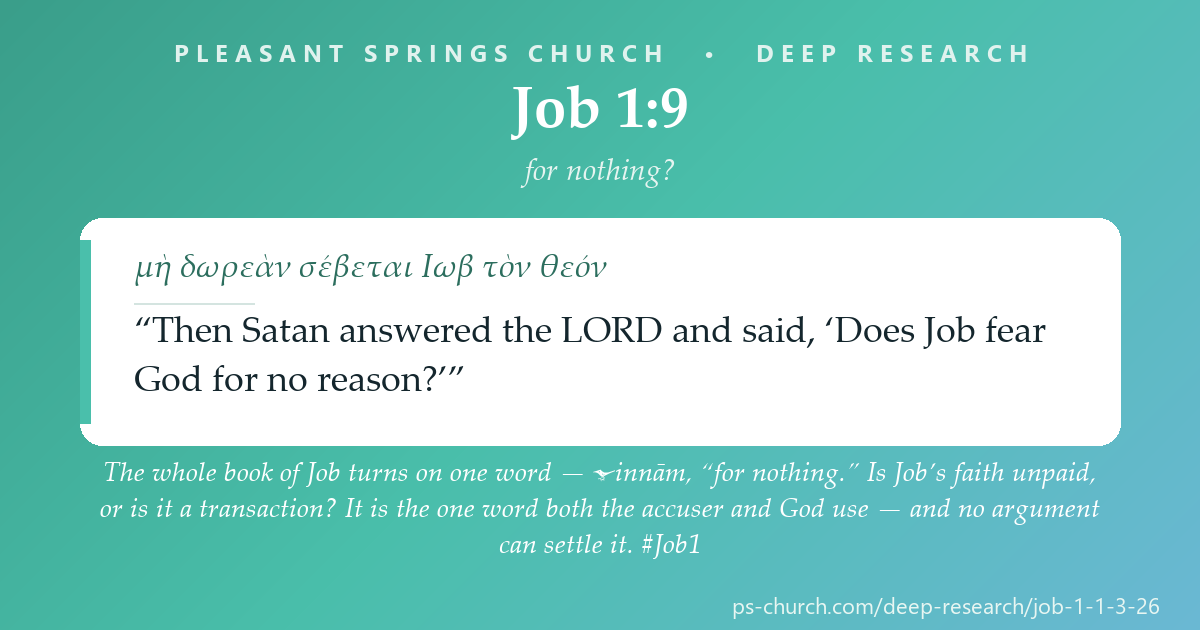
“For nothing, without cause, gratis.” The pivot of the entire book, and it is spoken twice — once by the accuser and once by God. At 1:9 it is the charge: is it for nothing that Job fears God? — i.e. is his piety unpaid, or is it a transaction? At 2:3 God turns the same word back: you incited me against him to swallow him up ḥinnām. The Hebrew idiom covers both “without payment” and “without justification” (cf. Proverbs 3:30; Psalm 35:19), and which sense is uppermost at 2:3 is disputed. The Greek does not read it as “undeservedly”: it has δωρεάν at 1:9 but διὰ κενῆς at 2:3 — nearer pointlessly than unjustly.
“Blameless and upright.” Three times, and never again in the remaining forty chapters. The narrator says it once; God says it twice, both times to the accuser — and 1:8 and 2:3 are consonantally identical, with 1:1 differing by a single letter. Tām does not mean sinless. The root means complete, whole, and the book itself tells against the stronger sense: the narrator has to certify separately that Job did not sin (1:22, 2:10), which would be pointless if tām already said it; and at 2:3 integrity is something Job keeps a grip on (maḥăzîq) — held, not possessed. Note also that ἀναμάρτητος, “sinless,” occurs zero times in Greek Job.
“Your integrity.” The cognate noun occurs twice, both in chapter 2, both governed by the same participle — and the second speaker is quoting the first word for word. God: ʿōḏennû maḥăzîq bəṯummāṯō, “he still holds fast his integrity” (2:3). His wife: ʿōḏəḵ maḥăzîq bəṯummāṯeḵ, “are you still holding fast your integrity?” (2:9). She says of him exactly what God said of him — and draws the opposite conclusion. The Greek does not render the word at all at 2:9.
“To bless” — used four times in these chapters as a euphemism for its opposite. Nobody in the text will write “curse God,” so the scribes write “bless” and the reader supplies the sense: Job fears his sons have blessed God in their hearts (1:5); the accuser predicts Job will bless God to his face (1:11, 2:5); his wife tells him to bless God and die (2:9). The same verb is used straight at 1:10 (“you have blessed the work of his hands”) and at 1:21 (“blessed be the name”) — so the word does double duty in a single chapter. The Greek does not preserve the device: at 2:9 it says plainly εἰπόν τι ῥῆμα εἰς κύριον, “say some word against the Lord.”
“And you incited me.” Hiphil of sûṯ with a first-person object suffix: God is the one acted upon, and God is the unstated subject of the following infinitive “to swallow him up.” This is the hardest word in the passage and the page does not soften it. The verb is a general incitement verb, not a satan-marker — it is used of the adversary at 1 Chronicles 21:1 but also of a wife at 1 Kings 21:25 and of counsellors at 2 Chronicles 18:2. And Rahlfs has no incitement verb here at all, and no “me”: see the codex note above.
“And God has hedged him in.” Job uses the accuser’s own image and turns it inside out. At 1:10 the accuser complains śaḵtā ḇaʿăḏō — “you have hedged about him” — of a fence that protects. At 3:23 Job says God has hedged him in, of a fence that traps. The shared element is the prepositional phrase baʿăḏō; the verbs are from different roots that sound alike, and whether they are two roots or byforms of one is disputed. The picture, either way, is the same fence seen from the other side.
Counted here, not assumed:
- Verse counts. Job 1 = 22, Job 2 = 13, Job 3 = 26 in the Masoretic text as printed in these editions and in Rahlfs. No offset in this passage.
- Fourteen occurrences of haśśāṭān, all articular, all between 1:6 and 2:7. Zero in chapter 3; zero in chapters 4–42. The Greek has ὁ διάβολος thirteen times — the missing one is 1:8, where the Greek drops the noun and keeps only the pronoun.
- Four identical escape-lines. And I alone have escaped to tell you occurs at 1:15, 1:16, 1:17 and 1:19 — identical in Hebrew letter for letter and accent for accent. The Greek does not preserve the fixity, using three different wordings across the four places — so a reader of the Greek alone cannot hear the hammering repetition the Hebrew builds.
- The two verdicts differ, and in both directions. 1:22 — “in all this Job did not sin and did not charge God with wrong”; 2:10 — “in all this Job did not sin with his lips.” The second drops a clause and adds a word. The formula never occurs again after 2:10.
- Two things chapter 3 does not contain. The word šəʾōl does not occur in Job 3 — the text says only šām, “there” (3:17, 3:19); “Sheol” is the commentator’s label. And the verb bāraḵ does not occur in chapter 3 at all: the only similar-looking word is birḵāyim, “knees,” at 3:12. Job curses his day, and does so with three different roots — qālal (3:1), nāqaḇ and ʾārar (both 3:8) — none of them the euphemism of the wager.
A courtroom in heaven, a lament that Scripture permits, and one New Testament verse.
Read 1 Kings 22:19–23 and Zechariah 3:1–2 before Job 1:6. Then read Jeremiah 20:14–18 beside Job 3 — the same curse, from a prophet.
Which cross-references matter?
- 1 Kings 22:19–23; Psalm 82; Zechariah 3:1–2 → Job 1:6; 2:1 — the divine council. Zechariah is the closest: haśśāṭān standing at the right hand to accuse, and rebuked. Same office, same article.
- Jeremiah 20:14–18 beside Job 3 — “Cursed be the day on which I was born… Why did I come out from the womb to see toil and sorrow?” A prophet says almost exactly what Job says, and the canon preserves both without apology. Compare also Psalm 88, which ends in darkness with no resolution.
- Job 1:21 and Ecclesiastes 5:15; 1 Timothy 6:7 — naked from the womb, naked in return. Job’s line is quoted at funerals more than any other sentence in the book; note that the Greek adds a clause the Hebrew has no counterpart for — ὡς τῷ κυρίῳ ἔδοξεν οὕτως καὶ ἐγένετο, “as it seemed good to the Lord, so it came to pass.”
- Ezekiel 14:14, 20 — Noah, Daniel and Job as a proverbial trio of the righteous, and even they “would deliver but their own lives.” Evidence that Job was a known figure outside this book.
- James 5:11 — the only mention of Job in the New Testament. Verified: the name occurs exactly once in the Greek New Testament. And the word is ὑπομονή, endurance — not μακροθυμία, patience, which James has just used three times in the previous four verses. The traditional phrase “the patience of Job” renders the wrong word, and the right one — staying under a weight — fits a man who argues for thirty-nine chapters far better than placidity does.
- Job 1:6 and Genesis 6:2; Job 38:7 — bənê hāʾəlōhîm. Job 1:6 and 2:1 are the only two places in the Hebrew Bible where the phrase carries the article. Rahlfs renders it “the angels of God” in both — an interpretation, and the page reports it as one rather than adopting it.
- Job 2:13 and the practice of sitting shiva — seven days and nights on the ground without a word. The friends’ first act is the only thing they do that Job never criticises.
The wager, the prologue's origin, and four questions that are not settled.
Clines, Newsom and Seow. Then the hard things — stated as difficulties, because that is what they are.
Commentaries & studies:
- David J. A. Clines, Job 1–20 (WBC) — the philological standard; exhaustive bibliographies and unusually frank about what cannot be decided.
- Carol A. Newsom, The Book of Job: A Contest of Moral Imaginations — argues the book deliberately sets incompatible genres against one another rather than resolving them. The best account of why the prose/poetry seam is a feature.
- C. L. Seow, Job 1–21 (Illuminations) — especially strong on reception history, including how the wife has been read across two millennia.
- On the Greek: Homer Heater, A Septuagint Translation Technique in the Book of Job; and the long-running Gard/Gerleman vs. Orlinsky argument over whether the Greek Job systematically “theologises” or is simply free.
Four things this page reports as unsettled:
- Whether the prose frame is older than the poem. The style, vocabulary and divine-name usage all shift at 3:1. Many hold the poet took up an existing folk tale; others defend a unified composition. The seam is observable; the explanation is not. Date proposals span most of a millennium.
- The wager — and why the usual defences do not quite work. Two moves are commonly made: that God permits rather than causes, and that ḥinnām means only “Job did not deserve it.” Both have real support — 1:12 and 2:6 do distribute agency, and ḥinnām is used that way elsewhere. But 2:3 puts a first-person object on “incited,” and no distribution of agency in 1:12 reaches backwards over that. The page states the difficulty and leaves it standing — noting that the ancient Greek translator, who removed the clause, evidently found it difficult too.
- Whether 2:10’s “with his lips” is a hint. An old argument. b. Bava Batra 16a (a rabbinic witness, not Scripture) has Rava infer that Job did not sin with his lips but sinned in his heart — and Abaye disputing it on the same page. Many modern commentators instead tie the phrase to the second test, where the pressure was to speak. Both readings are reported; neither is adopted.
- What 3:25 means. “For the thing that I feared has come upon me.” Whether Job is saying he was anxious all along, or stating a general truth, is genuinely open. It should certainly not be used to suggest Job’s fear ‘opened a door’ to his suffering — the text gives the cause in chapter 1, and it is not that.
A question nobody can answer with words, and a week of silence.
Name what you learned, why it matters, and one concrete response.
What should we carry away — and do?
- The question is whether love of God can be disinterested — and it cannot be settled by argument. Does Job fear God for nothing? No answer given in a heavenly courtroom would prove anything. The only demonstration available is a man who has lost everything and does not let go, which is why the book is a story rather than a treatise.
- Chapter 3 is in the Bible, and it is spoken by the man God calls blameless. The most unrestrained lament in Scripture is not put in the mouth of a rebel. Whatever else it is, it is not presented as sin — and the friends who treat it as sin are the ones rebuked at the end.
- “The patience of Job” is a mistranslation, and it has done damage. James says endurance — staying under the weight — not placidity. Job complains for thirty-nine chapters and is commended anyway. Anyone who has been told to suffer quietly on the authority of that phrase has been told something the Greek does not say.
- One concrete response. The friends’ best act is their first: seven days on the ground, saying nothing, because they saw the grief was very great. Everything after that made it worse. Go and sit with someone, and do not explain anything.
Job 1:9 · to share
Hebrew + Greek (Rahlfs) + ESVEvery Deep Research page traces its passage across the whole sweep — the Old Testament, the Second-Temple world between the testaments (historical witnesses, not Scripture), and the New Testament. Follow the thread:
Pleasant Springs Church — Deep Research
Research method after Michael S. Heiser’s Bible Research Method (examine dictionaries → ancient literature → important words → textual connections → academic publications → share), with the Pleasant Springs “Author & Audience” foundation. Scripture set in the Hebrew, the Greek editions named on each page and the ESV (Old Testament), and the Greek New Testament and the ESV (New Testament), per the practice of Pleasant Springs Church. Job 1–3 research grounded in Clines (WBC), Newsom, Seow (Illuminations), Hartley (NICOT) and Habel (OTL). This opens the Wisdom & Poetry shelf. Text: Hebrew from the Masoretic text as printed in the editions consulted — Sefaria’s Miqra according to the Masorah, cross-checked against its Ta’amei Hamikra edition; no critical apparatus was consulted, so this page does not claim to report BHS, BHQ or the Leningrad Codex. Greek from Rahlfs’s Septuaginta (CATSS digitization), printed without editorial punctuation and with proper names unaccented; English ESV. ⚠️ A caution specific to this book: the Old Greek of Job was roughly one-sixth shorter than the Hebrew, and Origen filled the gaps from Theodotion. The printed Greek is therefore composite, and the CATSS file carries no asterisks to separate the layers — so this page says “Rahlfs” throughout and never “the Old Greek.” Counted directly, Job 1, 2 and 3 show 22, 13 and 26 verses in both columns, with no shortfall at all; the page states explicitly that these chapters are therefore not evidence about the length of the Old Greek. ⚠️ The one large divergence here runs the other way and is printed in full: the speech of Job’s wife at 2:9, nine Hebrew words against ninety-three Greek (the speech alone, six words against eighty-four). Three limits are stated on that finding: the a–e lettering is Rahlfs’s editorial subdivision of one continuous speech, not six verses; only 2:9a–d (72 words) lack a Hebrew counterpart, since 2:9e renders the Hebrew’s closing clause; and the origin of the expansion is named as unsettled — longer Vorlage, translator’s expansion, or shared tradition with the Testament of Job — with the explicit note that it is not Origenic supplement, which fills the opposite kind of gap. ⚠️ At 2:3 the divergence is theological and is reported without softening: the Hebrew has God say you incited me (first-person object) to swallow Job up ḥinnām; Rahlfs has no incitement verb, no “me,” and shifts the object to Job’s goods. The page presents this as evidence that the difficulty is ancient rather than modern, while explicitly declining to generalise it — at 2:6 the Greek is blunter than the Hebrew. Counts stated on the page were derived from the primary files, not from secondary literature: fourteen articular occurrences of haśśāṭān, all between 1:6 and 2:7 and none thereafter; thirteen of ὁ διάβολος (absent at 1:8), with no transliteration of ‘satan’ anywhere in Greek Job; four letter-identical escape-formulas at 1:15–19 whose fixity the Greek does not preserve; and the absence of both šəʾōl and bāraḵ from chapter 3. That haśśāṭān is articular is reported as showing an office rather than a personal name — with the note that what the office is remains argued, and that the Greek article cannot be pressed since it articulates Job’s own name too. Four questions are named as unsettled and left open: the origin of the prose frame and the book’s date; the wager at 2:3, where the page sets out the two standard harmonisations, credits what is right in each, and states why neither reaches the first-person object; whether 2:10’s “with his lips” is a hint, with b. Bava Batra 16a cited as a rabbinic witness preserving both sides; and the sense of 3:25, with an explicit warning against using it to suggest Job’s fear invited his suffering. James 5:11 is corrected on the Greek — ὑπομονή, endurance, not μακροθυμία — and Job is noted as occurring exactly once in the New Testament. Testament of Job, 11QtgJob and Ben Sira are read as witnesses and never levelled with Scripture, and it is stated that 11QtgJob does not preserve chapters 1–3 and so cannot be cited here. Mesopotamian parallels are given with their differences foregrounded rather than their resemblances. Typology is handled per the house position: what the text says, what the New Testament itself draws, and what we see from this side of the cross — with the seeing left to the reader.
Scripture quotations marked ESV are from the ESV® Bible (The Holy Bible, English Standard Version®), © 2001 by Crossway, a publishing ministry of Good News Publishers. ESV Text Edition: 2016. Used by permission. All rights reserved. The ESV text may not be quoted in any publication made available to the public by a Creative Commons license, and the ESV may not be translated in whole or in part into any other language. www.esv.org
|
Did this study bless you today? 💚 Give to Support PS Church100% of gifts go to the General Fund — thank you. |