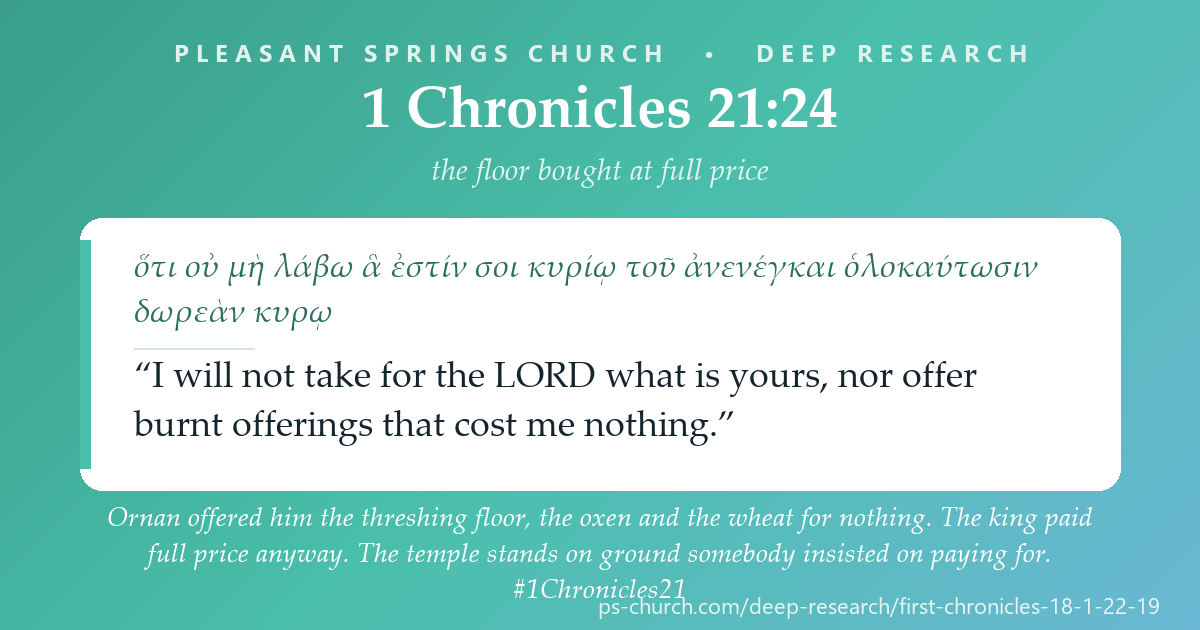
Five chapters that run from victory to plague to a receipt. David subdues everyone and dedicates the spoil; a war starts because an Ammonite king shaves David’s ambassadors and cuts their robes off at the hip; Rabbah falls; giants die. And then, with no transition, a census — and seventy thousand men die of a plague their king caused by counting them. It stops at a threshing floor on the edge of the city, where a farmer looks up from his wheat and sees an angel with a drawn sword. Ornan offers the floor, the oxen, the sledges and the grain, for nothing. The king refuses: “I will not take for the Lord what is yours, nor offer burnt offerings that cost me nothing.” He pays six hundred shekels of gold, builds an altar, fire falls — and then the sentence the book has been walking toward: “Here shall be the house of the Lord God” (22:1). Chapter 17 refused David a temple and gave no reason; 22:8 finally gives one — “you have shed much blood” — and the evidence is the four chapters you have just read. This unit also carries the sharpest differences from Samuel anywhere: who incited the census, what the floor cost, who Elhanan killed, and the story Chronicles leaves out while keeping the line that sets it up. All four are printed side by side and none is reconciled. See the method →
1 Chronicles 18:1–22:19 (selections)
Hebrew · Greek (Rahlfs, Paraleipomenon A) · ESVIt stops at a threshing floor on the edge of the city, where a farmer is threshing wheat and looks up to see an angel with a drawn sword. Ornan offers David the floor, the oxen, the threshing sledges and the wheat, for nothing. The king refuses to take it. “I will not take for the Lord what is yours, nor offer burnt offerings that cost me nothing.” He pays six hundred shekels of gold, builds an altar, and fire falls from heaven. And then the sentence the book has been walking toward since chapter 13: “Here shall be the house of the Lord God” (22:1).
Chapter 17 refused David a temple and gave no reason. Chapter 22 gives it — and the reason is the four chapters you have just read. “You have shed much blood and have waged great wars.” The Chronicler laid out the evidence before he delivered the verdict.
This unit carries the sharpest differences from Samuel anywhere in the book. All four are printed; none is reconciled. In the Septuagint this book is 1 Paraleipomena, “things omitted” — Παραλειπομένων Αʹ (Paraleipomenōn A). Chapters 18–22 are numbered alike in Hebrew, Greek and English, and the verse counts match exactly — 17, 19, 8, 30, 19 — with nothing absent from Rahlfs. Counted, not assumed.
⚠️ (1) Who incited the census. 1 Chronicles 21:1: “Then Satan stood against Israel and incited David.” 2 Samuel 24:1: “Again the anger of the Lord was kindled against Israel, and he incited David against them.” The two verses name different agents for the same act. Note also that the Hebrew here is שָׂטָן without the definite article — unlike Job 1–2 and Zechariah 3, where it is haśśāṭān, “the accuser,” a title. Whether that makes it a proper name here is exactly what is argued about, and Stage 3 says so rather than deciding it. The Greek has διάβολος, also without the article.
⚠️ (2) What the floor cost. 1 Chronicles 21:25: six hundred shekels of gold for “the site” (hammāqōm). 2 Samuel 24:24: fifty shekels of silver for the threshing floor and the oxen. Different metal, different quantity, different object. Both are in the Bible.
⚠️ (3) Who Elhanan killed. 1 Chronicles 20:5: Elhanan struck down “Lahmi the brother of Goliath the Gittite.” 2 Samuel 21:19: Elhanan struck down “Goliath the Gittite.” This page reports both and does not tell you which is prior.
⚠️ (4) The story that is not here. 20:1 keeps the whole opening of 2 Samuel 11:1, including the clause “while David remained in Jerusalem” — and then jumps straight to the fall of Rabbah at 2 Samuel 12:26–31. Bathsheba, Uriah, Nathan and the child are simply not in this book. He kept the sentence that sets the story up and left the story out, which is a much stranger act than quietly skipping the chapter.
The Shape of the Passage
SequenceBehind these chapters stands the promise of chapter 17, which refused David a temple without saying why. In front of them stands a building, and a mountain that Genesis 22 named long before.
Author
He omits in public and it is not concealment. The Bathsheba affair is missing from this book, and that is usually reported as the Chronicler cleaning David up. But look at what he actually does at 20:1. He copies the opening of 2 Samuel 11 including the clause that exists only to set the story up — “while David remained in Jerusalem” — and then cuts to the end of the siege. A writer covering something up removes the trailhead. He left the trailhead in, for readers who had the other scroll, and went on with his own subject.
And he does not spare David where it serves that subject. Chapter 21 is not flattering. David orders a census over the explicit objection of Joab, of all people; seventy thousand die; the king says “I have sinned… but these sheep, what have they done?” The Chronicler keeps every word of it, and he keeps it because this is his temple-founding story. The site is not acquired in a moment of glory. It is acquired on the worst day of the reign.
He is also building toward a handover. Chapter 22 is the first of four chapters (22–29) that have no parallel in Samuel or Kings at all: David gathering material, organising staff, and charging his son. The Chronicler is not interested in David as a warrior-king so much as in David as the man who got everything ready for something he was not allowed to do.
Audience
People who worshipped on that exact patch of ground. Everything in this unit converges on one place, and the readers knew where it was — they could walk to it. 22:1 is the Chronicler handing his congregation the deed: this is why the house is here and not somewhere else. Not because a king chose a fine site, but because a plague stopped there and he paid for it.
People who had been counted, and knew what it cost. A census in the ancient world meant taxation and conscription. Subject peoples under Persian administration were registered, assessed and levied. A story about a king who numbered his people and brought disaster on them would not have read as abstract to the first audience.
And people who had to fund a temple out of very little. Chapter 22’s inventory — a hundred thousand talents of gold, bronze and iron beyond weighing — is not a builder’s estimate for a community that had trouble finishing a wall. It is a memory of a scale they did not have, and the point that survives it is the sentence in 21:24: you do not give God what costs you nothing. That principle scales down to a poor province better than the numbers do.
Orient on David’s wars, on the census and its dangers, on threshing floors and altar sites, and on the satan.
Search by topic: David (wars of); Zobah; Hadadezer; Ammon; Rabbah; Rephaim / giants; census in the ancient Near East; ransom money (Exodus 30); plague; the destroying angel; satan; Ornan / Araunah; threshing floor; Mount Moriah; temple site; Solomon.
Which articles are relevant?
- Anchor Bible Dictionary — “David,” “Zobah,” “Ammon,” “Rabbah,” “Rephaim,” “Census,” “Satan,” “Angel of the Lord,” “Araunah,” “Moriah,” “Temple, Jerusalem.”
- Dictionary of the OT: Historical Books (IVP) — “David,” “Warfare,” “Census,” “Temple,” “Angels, Messengers,” “Satan.”
- NIDOTTE / TDOT — שָׂטָן (śāṭān), מָנָה (mānāh, count), גֹּרֶן (gōren, threshing floor), מָקוֹם (māqōm, place/site), חִנָּם (ḥinnām, for nothing), דָּם (dām, blood), מְנוּחָה (mənûḥāh, rest).
- On the Greek — the NETS introduction to 1 Supplements, and its note on διάβολος at 21:1.
Bibliography surfaced:
- Gary N. Knoppers, 1 Chronicles 10–29 (Anchor Yale); Sara Japhet, I & II Chronicles (OTL); Ralph W. Klein, 1 Chronicles (Hermeneia); H. G. M. Williamson, 1 and 2 Chronicles (NCBC).
- On the satan: Peggy L. Day, An Adversary in Heaven, and the relevant entries in ABD and DDD (Dictionary of Deities and Demons in the Bible). Read 1 Chronicles 21:1 beside Job 1–2 and Zechariah 3 with the Hebrew article in front of you. (Critical scholarship; the philology is useful and the conclusions are weighed.)
Why counting people was dangerous, what an envoy’s beard meant, and what the retellings did with the census.
First the world: military registration and its price, the diplomatic outrage that starts chapter 19, and threshing floors as sacred ground. Then watch Josephus, who retells the census and cannot decide whose fault it was either.
Which parallels shed light on these chapters?
A census was a military and fiscal act, and Israel’s law attached a price to it. Mari, Alalakh and later Assyrian and Persian administration all register men for conscription and taxation — counting is how a state converts people into resources. And Exodus 30:12 makes the danger explicit: “When you take the census of the people of Israel… each shall give a ransom for his life to the Lord… that there be no plague among them when you number them.” The word “plague” is in the law, attached to the act of counting. Neither Chronicles nor Samuel cites that text, and this page does not claim they do — but a reader who knows the Torah is not surprised by what happens.
What Hanun did to the envoys was a declaration of war, not a prank. Shaving a man and cutting his garment off at the buttocks attacked honour at both ends — the beard was a mark of adult standing across the Near East, and exposure was the standard humiliation of prisoners in Assyrian reliefs. Diplomatic envoys were legally inviolable; the Amarna correspondence is full of complaints about detained or mistreated messengers. 19:5 is exact about the consequence: the men were “greatly ashamed,” and David told them to stay at Jericho until their beards grew. The king’s first response to a national insult is to protect the dignity of the men it landed on.
And a threshing floor was already half a sacred space. Flat, raised, swept, public — it was where grain was separated and where a community’s year was decided, and floors turn up as places of judgment and decision throughout the Bible. That the temple stands on one is not incidental; the Chronicler tells you the address twice (21:15, 28) before naming what will be built there.
- Josephus, Antiquities 7.13.1–4 (§§318–334) (Second-Temple — a witness, not Scripture) — he retells the census at length, keeps Joab’s objection, keeps the plague and the angel and the purchase. On the agency he follows neither of our texts cleanly: he speaks of God being angry and of David’s fault, without introducing an accuser. Worth reading as a first-century writer with both traditions available, declining to resolve them.
- Exodus 30:11–16 — not an external witness but the law in the background: a census requires a ransom, “that there be no plague among them when you number them.” Cited because it is the nearest thing to an explanation, and because neither narrative invokes it.
- Amarna letters; Assyrian palace reliefs (ancient Near Eastern documents and royal propaganda — witnesses, not Scripture) — for the inviolability of envoys and for the shaving and stripping of captives. Cited for the practice.
- b. Berakhot 62b (rabbinic-era — a witness, not Scripture) — the discussion of the census and the angel, including the reading of 21:15 (“he relented”) against the site of the temple. Homiletic, and cited as such.
The two verses. 2 Samuel 24:1: the anger of the Lord was kindled against Israel, and he incited David. 1 Chronicles 21:1: Satan stood against Israel and incited David. Same event, different agent named.
What the Hebrew actually shows. Everywhere else the word appears of a heavenly figure — Job 1–2, Zechariah 3 — it carries the definite article: haśśāṭān, “the accuser,” a role or office, like “the prosecutor.” Here there is no article. That is a real, checkable difference, and it is why some read this as the first use of the term as a name, while others render it “an adversary” and take it of a human enemy. The Greek translator read a figure, not a man: διάβολος.
What this page will not do. It will not pretend the two verses say the same thing, and it will not pretend the difference is trivial. It also will not use the pair as a tidy formula — “God permits, Satan performs” — and then present that as what the text says. That reconciliation is a theological proposal, and a respectable one, but it is not written in either verse. Job is the book that holds both agencies together explicitly, and Job takes forty chapters and still does not give a mechanism.
What is not in doubt. Both accounts agree that David is responsible. He says so himself, twice, in the strongest terms available: “I have sinned greatly… I have acted very foolishly” (21:8), and “Was it not I who gave command to number the people? It is I who have sinned and done great evil. But these sheep, what have they done?” (21:17). Whatever stood behind the impulse, neither book lets the king off, and neither lets him blame it.
One noun without its article, one word for “free of charge,” and the difference between bloodshed and sin.
Look at śāṭān in 21:1 and then at Job 1:6 and Zechariah 3:1 with the article in view. Then follow ḥinnām through the purchase, and notice that 22:8 disqualifies David without ever calling his wars wrong.
“Adversary, accuser.” The ordinary meaning is a human opponent — the word is used of David himself by the Philistine commanders (1 Sam 29:4) and of Solomon’s enemies (1 Kgs 11:14, 23, 25). Of a heavenly figure it appears in Job 1–2 and Zechariah 3, and in both of those it carries the definite article: haśśāṭān, “the accuser” — a function, not a personal name. Here alone it stands without the article, which is the whole basis of the argument that this is the term becoming a name. The Greek read a figure: διάβολος, “slanderer,” the word the Septuagint uses for haśśāṭān in Job. This page reports the grammar and declines to settle the question.
“For nothing, gratis, without cost.” The pivot of the purchase: “nor offer burnt offerings ḥinnām.” It is the same word Satan uses of Job — “Does Job fear God for nothing?” (Job 1:9) — and the two uses sit interestingly together: the accuser asks whether worship is ever free of self-interest, and here a king refuses to let his worship be free of cost. Whether the Chronicler intends the echo is not stated, and this page does not claim it does. The Greek is δωρεάν.
“The place, the site.” Small word, doing heavy work. David asks for “the place of the threshing floor” and pays for the place — and it is a standard term for a sanctuary site, the word behind “the place that the Lord your God will choose” throughout Deuteronomy 12. Note the difference from Samuel: 2 Samuel 24:24 has David buy the threshing floor and the oxen; Chronicles has him buy the site. One is a transaction; the other is a title deed.
“Blood” — and in the plural, dāmîm, characteristically bloodshed, bloodguilt. It is the reason given for the refusal: “you have shed much blood… you shall not build a house to my name.” Read carefully, this is not called a sin. The wars of chapters 18–20 are reported as victories the Lord gave (18:6, 13). The disqualification is not moral condemnation but something more like unfitness for a particular task — and the contrast drawn in the next breath is not “a righteous man” but “a man of rest” (22:9).
“Rest.” Solomon is to be ʾîš mənûḥāh, “a man of rest,” and his name is glossed from šālōm in the same verse. It is the word for the settled state the land is promised after the wars — Deuteronomy 12:10, Joshua 21:44 — and the same word Naomi uses for what she wants for her daughters-in-law (Ruth 1:9). The temple is not built by the man who won the peace but by the man who inherits it.
“To number” and “to count.” The verbs of the offence. Joab uses the second when he protests, and his objection is worth quoting because it is theological rather than practical: “May the Lord add to his people a hundred times as many as they are! Are they not, my lord the king, all my lord’s servants? Why then should my lord require this? Why should it be a cause of guilt for Israel?” (21:3). The general is the one who sees it, and the Chronicler adds that Joab did not complete the count — Levi and Benjamin were not numbered, “for the king’s command was abhorrent to Joab” (21:6).
Two things here reported rather than tidied:
- The numbers do not match between the accounts. 1 Chronicles 21:5 gives 1,100,000 in Israel and 470,000 in Judah; 2 Samuel 24:9 gives 800,000 and 500,000. Chronicles also notes that the count was never finished — Levi and Benjamin were left out (21:6) — which accounts for some but not all of the difference. The plague figure, seventy thousand, is the same in both. This page prints the figures and does not reconcile them, and notes that the standing question about אֶלֶף (ʾelep, “thousand” or a military unit) applies here as elsewhere and is unsettled.
- The angel and the sword are fuller in Chronicles. 21:16 has David lift his eyes and see “the angel of the Lord standing between earth and heaven, and in his hand a drawn sword stretched out over Jerusalem”; 21:26 has fire come down from heaven on the altar; 21:27 has the sword put back in its sheath. None of those three details is in 2 Samuel 24. Whether Chronicles is expanding or Samuel abbreviating is not something this page claims to know.
The law about counting, the mountain named in Genesis, and the four places this unit and Samuel part company.
Read Exodus 30:12 before 1 Chronicles 21 and the plague stops being arbitrary. Then follow the threshing floor forward to 2 Chronicles 3:1 and backward to Genesis 22, and set the four Chronicles/Samuel differences out in columns.
Which cross-references matter?
- Exodus 30:11–16 — “when you take the census… that there be no plague among them when you number them.” The law names the danger and prescribes a ransom. Neither narrative quotes it, and this page does not claim they do; but it is the text a first reader would have had in mind, and it is why Joab’s objection is about guilt rather than about administration.
- 2 Samuel 24 beside 1 Chronicles 21 — the two accounts, and the differences are not cosmetic. Agent: the anger of the Lord (2 Sam 24:1) against Satan (1 Chr 21:1). Price: fifty shekels of silver for the floor and the oxen (2 Sam 24:24) against six hundred shekels of gold for the site (1 Chr 21:25). Numbers: 800,000/500,000 against 1,100,000/470,000. Additions in Chronicles: the angel between earth and heaven, the fire from heaven, the sheathed sword, and Joab’s refusal to count Levi and Benjamin. All printed; none reconciled.
- 2 Samuel 11–12 and the seam at 1 Chronicles 20:1–2 — the omission, and how it is done. 20:1 reproduces 2 Samuel 11:1 almost entirely, keeping “while David remained in Jerusalem,” and 20:2 resumes at 2 Samuel 12:26–31. What falls in the gap is Bathsheba, Uriah, Nathan’s parable and the death of the child. He kept the setup line and left out the story.
- 2 Samuel 21:19 beside 1 Chronicles 20:5 — Elhanan killed “Goliath the Gittite” in Samuel; “Lahmi the brother of Goliath the Gittite” here. The relationship between the two readings, and between both and 1 Samuel 17, is argued in every commentary. This page prints both and states that it does not know which is prior.
- Genesis 22:2 and 2 Chronicles 3:1 — Abraham is sent to “the land of Moriah… on one of the mountains of which I shall tell you.” And 2 Chronicles 3:1 says Solomon began to build “on Mount Moriah, where the Lord had appeared to David his father, at the place that David had appointed, on the threshing floor of Ornan.” Chronicles is the book that makes the identification — and it makes it there, not here. On this page the connection is reported as Chronicles’ own, later claim, not read back into chapter 21.
- 1 Chronicles 22:8 beside 17:4 — chapter 17 says only “you shall not build me a house,” with no reason attached. 22:8 supplies one: much blood, great wars. Five chapters of narrative stand between the refusal and its explanation, and those five chapters are the wars.
- 1 Chronicles 21:24 and Malachi 1:6–14 — “I will not offer burnt offerings that cost me nothing” against a priesthood offering blind and lame animals because they were the ones nobody wanted. Same principle, opposite behaviour, and Malachi’s congregation is much closer in time to the Chronicler’s than David’s is.
Where the scholarship agrees, where it does not, and the four questions left open here.
Knoppers, Japhet, Klein and Williamson on the unit; Day and the DDD on the satan. Then four live questions — and on three the honest answer is that the text does not say.
Commentaries & studies:
- Gary N. Knoppers, 1 Chronicles 10–29 (Anchor Yale) — the fullest treatment of chapter 21 and of its relationship to 2 Samuel 24, including the Qumran evidence.
- Sara Japhet, I & II Chronicles (OTL) — on the Chronicler’s theology of the temple site and on the function of the omissions.
- Ralph W. Klein, 1 Chronicles (Hermeneia) — the technical work on the price, the numbers and the pluses in chapter 21.
- H. G. M. Williamson, 1 and 2 Chronicles (NCBC) — on chapters 22–29 as a unit without parallel, and on the handover to Solomon.
- Peggy L. Day, An Adversary in Heaven: satan in the Hebrew Bible — the standard study of the term. (A critical scholar; the philological work on the article is the useful part and is what is used here.)
Interpretation notes worth keeping:
- Whether 21:1 names a person — not settled by the grammar alone. The absence of the article is a fact; what follows from it is an argument. Some read the first appearance of “Satan” as a proper name; others render “an adversary” and take it of a human opponent; the Greek translator read a figure. This page reports the grammar and the range, and does not resolve it.
- Whether the two accounts can be harmonised. The common proposal — that God permitted what Satan performed, as in Job — is theologically serious and is not stated in either text. Presenting it as the plain sense of the passage would be adding to the word of God; dismissing it would be pretending Job does not exist. It is named here as a proposal.
- The Qumran Samuel scrolls matter to this discussion. 4QSam has repeatedly shown that Chronicles sometimes reflects a Hebrew text of Samuel different from the Masoretic one, which weakens the old assumption that every difference is the Chronicler editing. Whether that applies to any particular difference in this unit is a separate question, argued case by case.
- Why David is disqualified. The text says blood and wars (22:8; cf. 28:3) and does not call those wars sinful — it has just called several of them victories God gave. Proposals range from ritual unfitness to a theology of the temple as a place of rest. Scripture gives the fact and not the mechanism, and this page stops where it stops.
What worship costs, who gets blamed, and building for someone else to finish.
Name what you learned, why it matters, and one concrete response.
What should we carry away — and do?
- “I will not offer burnt offerings that cost me nothing.” Ornan offered the floor, the oxen, the sledges and the wheat, free, to his king, on a day when refusing would have been reasonable. David paid full price anyway. The temple stands on ground somebody insisted on paying for. Ask what you currently give God that costs you nothing, and whether you would notice if it stopped.
- The king took the blame in front of everyone. “It is I who have sinned and done great evil. But these sheep, what have they done?” He does not mention Satan. He does not mention the anger of the Lord. Whatever stood behind the impulse, the man who gave the order says so.
- He prepared a building he was told he would never see. Chapter 22 is a man cutting stone, stockpiling iron and hiring masons for a project explicitly assigned to somebody else, and instructing his son to do the part he wanted. Most faithful work is like this.
- One concrete response. Do one thing this week for something you will not be there to finish — a fund you will not draw on, a person you will not see mature, a task somebody else will get the credit for. Then read 22:5: “I will therefore make preparation for it.”
1 Chronicles 21:24 · to share
Hebrew + Greek (Rahlfs, Paraleipomenon A) + ESVEvery Deep Research page traces its passage across the whole sweep — the Old Testament, the Second-Temple world between the testaments (historical witnesses, not Scripture), and the New Testament. Follow the thread:
Pleasant Springs Church — Deep Research
Research method after Michael S. Heiser’s Bible Research Method (examine dictionaries → ancient literature → important words → textual connections → academic publications → share), with the Pleasant Springs “Author & Audience” foundation. Scripture set in the Hebrew, the Greek editions named on each page and the ESV (Old Testament), and the Greek New Testament and the ESV (New Testament), per the practice of Pleasant Springs Church. 1 Chronicles 18–22 research grounded in Knoppers (Anchor Yale), Japhet (OTL), Klein (Hermeneia) and Williamson (NCBC), with Day and the DDD on שָׂטָן. Book name: in the Septuagint this book is Paraleipomenon A, Παραλειπομένων Αʹ; the Hebrew title is דִּבְרֵי הַיָּמִים. Text & numbering: Hebrew from the Masoretic Text; Greek from Rahlfs’s Septuaginta (CATSS digitization of the Rahlfs text), printed without editorial punctuation and with proper names unaccented; English ESV. Chapters 18–22 are numbered alike in Hebrew, Greek and English and the verse counts match exactly (17, 19, 8, 30, 19) with nothing absent from Rahlfs — counted against both columns, not assumed. ⚠️ Four differences from Samuel are printed and none reconciled. (1) Agency at 21:1: “Satan stood against Israel” against 2 Samuel 24:1, “the anger of the Lord… incited David.” The Hebrew שָׂטָן here is anarthrous, unlike Job 1–2 and Zechariah 3, and this grammatical fact is reported while the conclusion drawn from it is left open; the common harmonisation (God permits, Satan performs) is named as a theological proposal and explicitly not presented as the sense of either verse. Both accounts agree David is responsible, and the page says so. (2) Price at 21:25: six hundred shekels of gold for the site, against fifty shekels of silver for the floor and oxen at 2 Samuel 24:24. (3) Elhanan at 20:5: “Lahmi the brother of Goliath” against “Goliath” at 2 Samuel 21:19; the page prints both and states it does not know which is prior. (4) The omission at 20:1–2: Chronicles reproduces the opening of 2 Samuel 11:1 including “while David remained in Jerusalem” and resumes at 2 Samuel 12:26 — keeping the line that sets up the Bathsheba narrative while omitting the narrative. That is reported as what it is, and not described as concealment. Census numbers differ (1,100,000/470,000 here against 800,000/500,000 at 2 Samuel 24:9) and are not reconciled; Chronicles' note that the count was never completed (21:6) is reported, and the unsettled question of אֶלֶף is named as unsettled. Chronicles’ pluses in chapter 21 — the angel between earth and heaven (21:16), fire from heaven (21:26), the sheathed sword (21:27), Joab’s refusal to number Levi and Benjamin — are listed as absent from 2 Samuel 24 without claiming to know the direction of the difference. Exodus 30:11–16 is cited as background and explicitly not as a quotation: neither narrative invokes it. The Moriah identification is Chronicles’ own and is made at 2 Chronicles 3:1, not here, and is not read back into chapter 21. 22:8 is reported precisely: the text disqualifies David for bloodshed without calling his wars sinful, having just described several as victories God gave, and the page does not supply a mechanism Scripture withholds. Second-Temple and rabbinic witnesses (Josephus, Ant. 7; b. Berakhot 62b) are read as witnesses and never levelled with Scripture. The relevance of the Qumran Samuel scrolls to Chronicles/Samuel differences is noted as a general caution, not applied to any particular reading here. Typology is handled per the house position: what the text says, what the New Testament itself draws, and what we see from this side of the cross — with the seeing left to the reader.
Scripture quotations marked ESV are from the ESV® Bible (The Holy Bible, English Standard Version®), © 2001 by Crossway, a publishing ministry of Good News Publishers. ESV Text Edition: 2016. Used by permission. All rights reserved. The ESV text may not be quoted in any publication made available to the public by a Creative Commons license, and the ESV may not be translated in whole or in part into any other language. www.esv.org
|
Did this study bless you today? 💚 Give to Support PS Church100% of gifts go to the General Fund — thank you. |