The oxen stumbled, a man reached out to steady the ark, and he died on the spot. David was angry, and then he was afraid, and the ark went into a stranger’s house for three months. Chronicles reports all of that as flatly as Samuel does — and then does something Samuel never does: it explains. When the journey is attempted again, David says out loud what went wrong. “Because we did not seek him according to the rule” (15:13). The rule was not obscure: the ark was to be carried by Levites, on poles, on their shoulders. It had been put on a new cart — which is how the Philistines had sent it back. A reverent method, borrowed from people who did not know any better. And the verb in David’s confession is the verb that was Saul’s epitaph three chapters earlier: seek. Notice too where the writer puts the gap. In 2 Samuel, David’s palace and his Philistine victories come before the ark is moved at all; Chronicles drops that whole chapter between the failure and the success, so that God is establishing the king in the very chapter where the king is too frightened to go near him. It ends in a reversal that governs the rest of the Bible: David says he will build God a house, and God says no — and then says he will build David one. This study works 1 Chronicles 13:1–17:27 in Hebrew, Septuagint and ESV, including the verse Rahlfs does not have (16:24) and the clause of 2 Samuel 7:14 that 1 Chronicles 17:13 leaves out. See the method →
1 Chronicles 13:1–17:27 (selections)
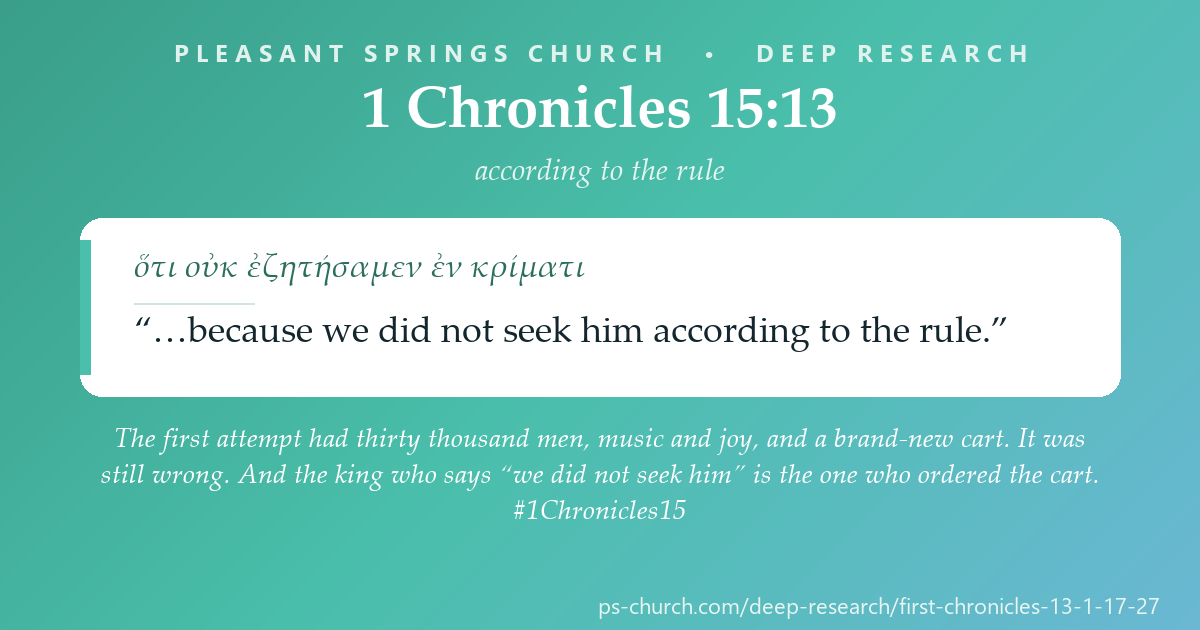
Hebrew · Greek (Rahlfs, Paraleipomenon A) · ESVThen Chronicles does something Samuel does not: it explains. When David tries again, he says out loud what went wrong — “because we did not seek him according to the rule” (15:13). The rule is not obscure: the ark was to be carried by Levites, on poles, on their shoulders (Exodus 25:14; Numbers 4:15; 7:9). It had been put on a new cart, which is how the Philistines had sent it back (1 Samuel 6:7) — a reverent method, borrowed from people who did not know any better. And the verb in that sentence is the Chronicler’s own: dāraš, seek — the verb that was Saul’s epitaph three chapters earlier.
And notice where the writer puts the gap. In 2 Samuel, David’s palace, his sons and his two Philistine victories come before the ark is moved at all (2 Sam 5:11–25). Chronicles takes that same material and drops it between the failed attempt and the successful one, as chapter 14. The effect is deliberate: while the ark sits in another man’s house and the king is too frightened to touch it, God is quietly establishing him anyway.
It ends with a reversal that governs the rest of the Bible. David, finally settled, says he will build God a house. God says no — and then says he will build David one.
Three things about the columns above. In the Septuagint this book is 1 Paraleipomena, “things omitted” — Παραλειπομένων Αʹ (Paraleipomenōn A). Numbering: chapters 13–17 agree across Hebrew, Greek and English, and the verse counts match (14, 17, 29, 43, 27 in the Masoretic Text) with a single exception. ⚠️ 16:24 is not in Rahlfs. In the middle of the psalm David appoints, the line “Declare his glory among the nations, his marvellous works among all the peoples” — which is also Psalm 96:3 — is simply absent from the Greek. This was counted against both columns, not taken from a commentary: 1 Chronicles 16 has 43 verses in the Masoretic Text and 42 in Rahlfs.
⚠️ The Hebrew of 15:13 is genuinely difficult. The opening words לְמַבָּרִאשׁוֹנָה are a form with no secure parallel, and the versions and modern translations diverge over how to construe them — “because you did not carry it the first time,” “because it was not you at the first,” and others. The Greek took its own route (ὅτι οὐκ ἐν τῷ πρότερον ὑμᾶς εἶναι). The second half of the verse, which is the part that matters, is not in doubt. This page prints the difficulty rather than choosing a smooth rendering and saying nothing.
⚠️ 17:13 is shorter than 2 Samuel 7:14, and the missing words matter. Samuel has: “I will be to him a father, and he shall be to me a son. When he commits iniquity, I will discipline him with the rod of men, with the stripes of the sons of men.” Chronicles does not have that sentence at all, and puts in its place an unconditional promise: “I will not take my steadfast love from him, as I took it from him who was before you.” The two are printed side by side in Stage 4 and neither is treated as the real one.
The Shape of the Passage
ConcentricBehind these chapters stand the ark’s twenty years at Kiriath-jearim (1 Samuel 5–7) and the Torah’s instructions for carrying it. In front of them stand a threshing floor bought at full price, a temple built by somebody else, and a promise the New Testament will not stop quoting.
Author
He rearranges, and he tells you why. Two editorial acts define this unit. First, he splits the ark narrative and inserts chapter 14 into the gap — material 2 Samuel places earlier. Second, he adds an explanation Samuel never gives: 15:13, David naming the fault in his own mouth. Neither is concealment. He keeps Uzza’s death, keeps David’s anger, keeps the three-month delay. What he adds is a reason, and the reason is liturgical: the ark was carried the wrong way by the wrong people.
He is a Levite’s historian. Chapter 15 is where a modern reader’s attention usually fails — the lists of Levites, the doorkeepers, the harps according to Alamoth and the lyres according to Sheminith. But this is the Chronicler doing exactly what he did in the genealogy, where Levi got the centre chapter. For a community whose one surviving institution was a temple and its staff, the question “who is authorised to carry holy things, and how?” was not antiquarian. It was the job description of the people reading.
And he leaves a loose end standing. At the end of chapter 16 there are two sanctuaries running at once: the ark in a tent at Jerusalem with Asaph before it, and the tabernacle with the bronze altar still at Gibeon with Zadok before it. He does not tidy this. It is the situation the temple will eventually resolve, and it is one of the reasons chapter 17 exists.
Audience
People who ran a sanctuary and needed to know that method matters. The lesson of chapters 13 and 15 read back to back is uncomfortable and precise: sincerity is not sufficient. David’s first attempt is enthusiastic, national, musical and joyful, and it kills a man. The second is the same journey done the way God said. For readers whose whole vocation was handling holy things on other people’s behalf, that is the most practical passage in the book.
People with no king and a promise about a throne. Chapter 17 lands differently in Yehud than it does in Jerusalem under Solomon. There is no son of David on any throne when the Chronicler writes. He copies the promise anyway, and he copies it in a form that has had the discipline clause removed and an unconditional ḥeseḏ put in its place. That is a pastoral decision with a theological edge, and Stage 4 prints both versions rather than pretending there is only one.
And people who sang. The psalm in chapter 16 is stitched from pieces of Psalms 105, 96 and 106 — which means the Chronicler expected his readers to recognise it, the way a congregation recognises a hymn from its first line. He is not composing; he is quoting the hymnbook, and putting it in David’s mouth on the day the ark came home.
Orient on the ark and its transport law, on threshing floors, on the Levitical singers, and on the dynastic oracle.
Search by topic: ark of the covenant; Kiriath-jearim; Uzzah; threshing floor; Obed-edom; Levites (transport of holy things); Asaph, Heman, Ethan; temple singers; Alamoth and Sheminith; Gibeon; tabernacle; Davidic covenant; Nathan; nagid; hesed.
Which articles are relevant?
- Anchor Bible Dictionary — “Ark of the Covenant,” “Kiriath-jearim,” “Uzzah,” “Obed-edom,” “Threshing Floor,” “Music and Musical Instruments,” “Asaph,” “Gibeon,” “Davidic Covenant,” “Nathan.”
- Dictionary of the OT: Historical Books (IVP) — “Ark of the Covenant,” “Levites, Priests,” “Music,” “Worship,” “David,” “Covenant.”
- NIDOTTE / TDOT — דָּרַשׁ (dāraš, seek), מִשְׁפָּט (mišpāṭ, rule, ordinance), פָּרַץ (pāraṣ, break out), בַּיִת (bayiṯ, house), חֶסֶד (ḥeseḏ), נָשָׂא (nāśāʾ, carry).
- On the Greek — the NETS introduction to 1 Supplements, and its notes on the psalm of chapter 16 and its relation to the Greek Psalter.
Bibliography surfaced:
- Gary N. Knoppers, 1 Chronicles 10–29 (Anchor Yale); Sara Japhet, I & II Chronicles (OTL); Ralph W. Klein, 1 Chronicles (Hermeneia); H. G. M. Williamson, 1 and 2 Chronicles (NCBC).
- On the dynastic oracle, read 2 Samuel 7 and 1 Chronicles 17 in parallel columns first, then a commentary on each — and note which one your commentary treats as the baseline.
How holy objects were moved, what a cart meant, and what the ancient retellings did with Uzza.
First the world: divine images in procession, the significance of carrying poles, and the temple-building ideology of ancient kings. Then watch Josephus, who cannot let Uzza’s death stand unexplained — and explains it differently from Chronicles.
Which parallels shed light on these chapters?
Carrying a god was a defined, guarded procedure everywhere in the ancient world. Mesopotamian and Egyptian processional images were borne on poles by consecrated personnel, and the rules for who could touch them were strict. Israel’s ark is not a divine image — that is the whole point of it — but the transport law follows the same logic: rings on the sides, poles through the rings, and the poles are never to be removed (Exodus 25:14–15); the Kohathites carry it on their shoulders and do not touch the holy things (Numbers 4:15; 7:9). The cart is the anomaly. The last people to move the ark on a new cart were the Philistines (1 Samuel 6:7–8), who had no reason to know better, and it worked for them. David copies a method that had visibly succeeded, and it is the wrong method.
Threshing floors are where this book keeps stopping. A threshing floor is flat, open, raised and public — and in the Bible it is repeatedly a place of decision: Ruth’s (Ruth 3), the one at Nacon or Chidon where Uzza dies (13:9), and the one David will buy from Ornan at the end of this book, which becomes the temple site. The Chronicler is not making a symbol out of it; he simply keeps telling you where things happened, and they keep happening there.
And every ancient king wanted to build his god a house. Temple-building is the standard royal achievement across the Near East — it demonstrates piety, legitimacy and surplus all at once, and royal inscriptions from Mesopotamia to Egypt say so at length. That is what makes chapter 17 strange. David proposes the most conventional act of ancient kingship available to him, and is refused — and the refusal is turned into a promise running in the opposite direction. The king will not build the house; the house will be built for the king.
- Josephus, Antiquities 7.4.2 (§§81–85) (Second-Temple — a witness, not Scripture) — he retells the death of Uzza and cannot leave it bare. Josephus supplies a motive the Bible does not give: that Uzza was not a priest and yet touched the ark, and so the death is made intelligible as a breach of office. Notice that this is close to what Chronicles says at 15:13 but not the same — Chronicles blames the method and the whole company, David included, not one man’s presumption. The instinct to isolate the fault in the person who died is very old, and very tempting.
- Josephus, Antiquities 7.4.4 (§§90–95) — on the oracle: he keeps the refusal and the promise, and characteristically explains the refusal by David’s wars and bloodshed — which is the reason Chronicles itself will give later (22:8; 28:3), though not here. Chapter 17 gives no reason at all.
- b. Sotah 35a (rabbinic-era — a witness, not Scripture) — the discussion of Uzza, including the observation that the ark “carried its bearers” and therefore needed no steadying. A homiletic reading, cited as such.
- Ancient Near Eastern temple-building inscriptions (royal propaganda — witnesses, not Scripture) — for the convention chapter 17 breaks. Cited for the practice, not to prove anything about the text.
What the text says. The oxen stumbled. Uzza put out his hand to the ark. God struck him and he died there. David was angry, and afraid, and stopped. Three months later the ark was moved again, correctly, and David said the fault had been that “we did not seek him according to the rule” — first person plural, the king included.
What the text does not say. It does not say what Uzza was thinking. It does not call him presumptuous, or irreverent, or faithless. It does not tell us whether he was a Levite — his father Abinadab had housed the ark for twenty years, so he had grown up beside it, which is either an argument that he should have known or an explanation of why he stopped noticing. Scripture does not adjudicate that, and neither will this page.
What people do with the gap. Josephus makes it about Uzza’s status. A great deal of preaching makes it about Uzza’s heart. Both are ways of arriving at a tidier God, and both require inventing an interior life for a man about whom the Bible records one gesture. Chronicles’s own answer points somewhere much less comfortable — at the cart, at the procedure, at the whole cheerful national procession that had not asked how this was supposed to be done. The fault named in 15:13 is corporate and the first person to own it is the king.
And the anger stays in the text. 13:11 says David was angry because the Lord had broken out against Uzza, and the place is named for the breach. The narrator does not correct him, and does not say he was wrong to be angry — any more than the narrator of Ruth 1 corrects Naomi. A study that hurries past the anger to get to the lesson has skipped the part where a man is allowed to be furious with God for three months and then go back and do it right.
The verb that convicts a king, the word for “the proper way,” and one root that both kills and conquers.
Follow dāraš from Saul’s epitaph into David’s confession. Then watch pāraṣ name two places a chapter apart — one where God broke out against Israel and one where he broke out for them — and count bayiṯ through chapter 17.
“Seek, inquire of, consult” — the Chronicler’s master verb, and it brackets this whole unit. At 13:3 David says of the ark, “we did not seek it in the days of Saul”; at 15:13 he says the disaster happened “because we did not seek him according to the rule.” Three chapters earlier it was Saul’s epitaph: he sought a medium and did not seek the Lord. The same verb condemns a king and then convicts his successor — and David is the one who says it about himself. The Greek uses ζητέω throughout and the thread holds.
“According to the rule / the prescribed manner.” Mišpāṭ is usually “justice” or “judgment,” but it also means the proper procedure for a thing — the way it is laid down. That is its force here: not that they lacked sincerity, but that there was a stated way and they used another. The Greek is worth seeing: Rahlfs has ἐν κρίματι, “in judgment,” which reaches for the legal sense and leaves the procedural one behind — so a Greek reader gets a slightly different sentence from a Hebrew one.
“To break out, burst through.” One of the sharpest pieces of wordplay in Chronicles, and it is easy to miss because it lands in two opposite directions. God breaks out against Uzza and the place is called Perez-uzza (13:11). One chapter later David defeats the Philistines and says “God has broken through my enemies by my hand like a bursting flood,” and names that place Baal-perazim (14:11). And at 15:13 the verb returns for the first incident. The same divine force that killed a man wins a battle, and the Chronicler puts the two namings a chapter apart so that you feel it. The Greek uses διακόπτω for both and keeps the link.
“House” — and chapter 17 is built entirely on its three senses: a palace (David lives in a house of cedar), a temple (he proposes to build God a house), and a dynasty (God will build him a house). The reversal happens in the space between two meanings of one word. It is Leitwort technique of the plainest kind: count the occurrences and you have the argument. The Greek keeps it, using οἶκος throughout, so the pun survives translation — which is not always the case in this book.
“Steadfast love, covenant loyalty.” It carries the weight of the promise: “my ḥeseḏ I will not take from him, as I took it from him who was before you.” And it has already been sung twice in the previous chapter — “for his ḥeseḏ endures for ever” (16:34, 41), the refrain that will be sung at the temple’s dedication and again at its rebuilding after the exile (Ezra 3:11). The word the community still sang was the word in the promise. The Greek is ἔλεος throughout.
“To carry, bear, lift.” The verb of the corrected procedure: “the Levites carried the ark of God on their shoulders with the poles, as Moses had commanded according to the word of the Lord” (15:15). It is repeated through the chapter until the point is unmissable. The contrast is not carrying versus not carrying; it is carrying on shoulders versus carrying on wheels — the difference between a burden a person bears and a load a vehicle takes.
Two things here reported rather than tidied:
- The opening of 15:13 is a genuine crux. לְמַבָּרִאשׁוֹנָה is a form with no secure parallel in Biblical Hebrew, and the ancient and modern versions construe it differently — “because you did not carry it the first time,” “because it was not you at the first,” “because at the first you were not [the ones],” and the Greek (ὅτι οὐκ ἐν τῷ πρότερον ὑμᾶς εἶναι) goes its own way. The sense of the clause is clear from context — the Levites were not the carriers the first time — but the grammar is not, and this page prints a rendering while saying it is a rendering.
- The psalm of 16:8–36 is a composite, and it is not hidden. Verses 8–22 correspond to Psalm 105:1–15; verses 23–33 to Psalm 96:1–13; verses 34–36 to Psalm 106:1 and 47–48, ending with the doxology that closes Book IV of the Psalter. The wording is not identical to the Psalms as we have them, and which direction the borrowing runs is disputed. What is not disputed is that the Chronicler expected the material to be recognised. Note also that this is where the one Greek minus falls: 16:24 is absent from Rahlfs — a line that is Psalm 96:3.
The law that was broken, the chapter that was moved, the clause that was dropped, and where the promise goes.
Read Exodus 25 and Numbers 4 and then 1 Chronicles 13 — the fault is legible without a commentary. Then set 2 Samuel 7:14 beside 1 Chronicles 17:13 and notice what is missing, and follow the shared half of the verse into Hebrews 1.
Which cross-references matter?
- Exodus 25:12–15; Numbers 4:15; 7:9 — the transport law, and the reason 15:13 is not arbitrary. Rings, poles, shoulders; the Kohathites carry the holy things and do not touch them; and “to the sons of Kohath he gave none [of the carts], because they were charged with the service of the holy things, which they carried on their shoulders.” The carts are named in the Torah and explicitly withheld from the ark.
- 1 Samuel 5–7 — where the new cart comes from. The Philistines built one to send the ark home (6:7–8), and it reached Beth-shemesh, where men also died for looking into the ark. Then it sat at Kiriath-jearim for twenty years. David is reusing a method with a precedent and no authorisation.
- 2 Samuel 6 beside 1 Chronicles 13 and 15–16 — the same events. Samuel tells the ark story in one continuous chapter; Chronicles splits it and inserts chapter 14 (= 2 Samuel 5:11–25) into the gap. Chronicles also adds the Levitical organisation of chapter 15 and the psalm of chapter 16 entirely. And Samuel keeps Michal’s contempt as the chapter’s closing scene; Chronicles keeps the sentence about Michal despising David (15:29) but drops the exchange that follows.
- 2 Samuel 7 beside 1 Chronicles 17 — and this is the difference that matters most in the unit. 2 Samuel 7:14 reads: “I will be to him a father, and he shall be to me a son. When he commits iniquity, I will discipline him with the rod of men, with the stripes of the sons of men.” 1 Chronicles 17:13 does not contain that sentence, and reads instead: “I will not take my steadfast love from him, as I took it from him who was before you.” Samuel’s promise is unbreakable but disciplined; Chronicles’ is unbreakable and unqualified. Both are Scripture, both are printed here, and no attempt is made to decide which is the real one.
- Hebrews 1:5 — “I will be to him a father, and he shall be to me a son” — quoted of Christ, and quoted from exactly the half of the verse that both versions share. The clause 2 Samuel has and Chronicles lacks is not part of the citation. That is worth stating precisely and not overstating: what the New Testament draws is the father-son formula, and this page marks the connection and does not build an argument on the omission.
- 1 Chronicles 16:34, 41 → 2 Chronicles 5:13; 7:3 → Ezra 3:11 — “for he is good, for his ḥeseḏ endures for ever.” The refrain is sung when the ark comes to the tent, when the temple is dedicated, and again when its foundation is relaid after the exile. The Chronicler’s readers were the people singing it the third time.
- 1 Chronicles 13:9 and 21:15–28 — two threshing floors. A man dies at one; the other is bought at full price and becomes the site of the temple. The Chronicler does not connect them for you.
Where the scholarship agrees, where it does not, and what stays open.
Knoppers, Japhet, Klein and Williamson on the unit. Then three live questions — and on two the honest answer is that the text does not say.
Commentaries & studies:
- Gary N. Knoppers, 1 Chronicles 10–29 (Anchor Yale) — strongest on the rearrangement of the ark narrative and on what the insertion of chapter 14 achieves.
- Sara Japhet, I & II Chronicles (OTL) — on the Chronicler’s treatment of the dynastic promise and on the removal of the conditional element at 17:13.
- Ralph W. Klein, 1 Chronicles (Hermeneia) — the technical work on 15:13 and on the psalm of chapter 16 and its relation to the Psalter.
- H. G. M. Williamson, 1 and 2 Chronicles (NCBC) — on the Levitical material of chapter 15 and its bearing on the date of the book.
Interpretation notes worth keeping:
- Why 17:13 lacks the discipline clause — disputed. Proposals: the Chronicler is writing after the discipline has already fallen and has no need to predict it; he is deliberately presenting the promise as unconditional to a community with no king; he is following a different text of Samuel. The Qumran Samuel scrolls have complicated the assumption that Chronicles simply abbreviated a text identical to our 2 Samuel, and this page states the difference as a fact and the explanations as proposals.
- The direction of borrowing in chapter 16 — unsettled. Whether the Chronicler quoted the Psalms, or the Psalms and Chronicles both drew on a common liturgical stock, is argued both ways. The wording differs from the Psalter at several points, which is evidence but not proof either direction.
- Whether Uzza was a Levite — not stated. His father Abinadab kept the ark; that is all the text says about the household’s standing. Josephus assumes he was not a priest; Chronicles does not raise the question and locates the fault elsewhere. This page reports the silence rather than filling it.
- The two sanctuaries at the end of chapter 16. Ark in a tent at Jerusalem, tabernacle and bronze altar at Gibeon, with staff at both. Whether this reflects a genuine memory of a divided cult or the Chronicler’s harmonisation of conflicting traditions is argued; what is certain is that he reports it without embarrassment, which is itself worth noticing.
Sincerity and method, anger that is allowed to stand, and a refusal that turns into a promise.
Name what you learned, why it matters, and one concrete response.
What should we carry away — and do?
- Enthusiasm is not the same as obedience. The first attempt has thirty thousand men, music, joy and a brand-new cart, and it is wrong. The second has the same king, the same ark, the same destination, and poles on Levites’ shoulders. The difference is not the amount of feeling; it is whether anyone asked how this was supposed to be done.
- The fault was owned in the first person plural. David does not say “Uzza was presumptuous.” He says “we did not seek him according to the rule” — and he is the king who ordered the cart. Notice how much easier it would have been to locate the failure in the man who died.
- You are allowed three months. David is angry with God, and afraid of God, and the narrator lets both stand without correction, and then David goes back and does it right. The Bible does not require you to have finished processing something before you obey it.
- One concrete response. Find one thing you do for God that you have never actually checked against what he asked for — a practice, a habit, a way of running something — and check it this week. Not because sincerity is worthless, but because David’s was not enough either.
1 Chronicles 15:13 · to share
Hebrew + Greek (Rahlfs, Paraleipomenon A) + ESVEvery Deep Research page traces its passage across the whole sweep — the Old Testament, the Second-Temple world between the testaments (historical witnesses, not Scripture), and the New Testament. Follow the thread:
Pleasant Springs Church — Deep Research
Research method after Michael S. Heiser’s Bible Research Method (examine dictionaries → ancient literature → important words → textual connections → academic publications → share), with the Pleasant Springs “Author & Audience” foundation. Scripture set in the Hebrew, the Greek editions named on each page and the ESV (Old Testament), and the Greek New Testament and the ESV (New Testament), per the practice of Pleasant Springs Church. 1 Chronicles 13–17 research grounded in Knoppers (Anchor Yale), Japhet (OTL), Klein (Hermeneia) and Williamson (NCBC). Book name: in the Septuagint this book is Paraleipomenon A, Παραλειπομένων Αʹ; the Hebrew title is דִּבְרֵי הַיָּמִים. Text & numbering: Hebrew from the Masoretic Text; Greek from Rahlfs’s Septuaginta (CATSS digitization of the Rahlfs text), printed without editorial punctuation and with proper names unaccented; English ESV. Chapters 13–17 are numbered alike in Hebrew, Greek and English, and the verse counts were checked against both columns rather than assumed: 14, 17, 29, 43 and 27 in the Masoretic Text, matched exactly in Rahlfs except at 16:24, which is absent from the Greek — a line that is also Psalm 96:3, missing from the middle of the psalm David appoints. ⚠️ 15:13 is a genuine crux: the opening לְמַבָּרִאשׁוֹנָה has no secure parallel, the ancient and modern versions construe it differently, and the page prints a rendering while saying it is one; the second half of the verse, on which the study turns, is not in doubt. The Greek ἐν κρίματι takes mišpāṭ in its legal rather than its procedural sense, and this is stated. ⚠️ Chronicles and Samuel are not harmonised: Chronicles splits the ark narrative of 2 Samuel 6 and inserts 2 Samuel 5:11–25 between the two attempts as chapter 14 — a rearrangement demonstrated by comparison, not asserted; it adds the Levitical organisation of chapter 15 and the psalm of chapter 16 entirely; it keeps Michal’s contempt (15:29) but drops the exchange that follows in 2 Samuel 6:20–23. ⚠️ The most significant difference in the unit is at 17:13: 2 Samuel 7:14 contains a discipline clause — “when he commits iniquity, I will discipline him with the rod of men” — which 1 Chronicles 17:13 does not contain, substituting an unqualified promise of ḥeseḏ. Both are printed side by side, neither is treated as the authentic one, and the explanations offered for the difference (a later standpoint; a pastoral choice; a different Hebrew Vorlage, on which the Qumran Samuel scrolls are relevant) are named as proposals. Hebrews 1:5 quotes only the half both versions share, and the page says so rather than building an argument on the omission. Uzza is reported exactly as the narrator reports him: the text does not state his tribe, his motive or his character, and this page declines to supply any of the three, noting that Josephus locates the fault in the man while Chronicles locates it in the method and in a first-person plural that includes the king. David’s anger (13:11) is left standing uncorrected, as Naomi’s is in Ruth 1. The psalm of 16:8–36 is identified as a composite of Psalms 105:1–15, 96:1–13 and 106:1, 47–48, with the direction of borrowing named as disputed rather than settled. The two sanctuaries at the end of chapter 16 are reported without harmonisation. Second-Temple and rabbinic witnesses (Josephus, Ant. 7; b. Sotah 35a) are read as witnesses and never levelled with Scripture. Typology is handled per the house position: what the text says, what the New Testament itself draws (Hebrews 1:5; Luke 1:32–33; Acts 2:30), and what we see from this side of the cross — with the seeing left to the reader.
Scripture quotations marked ESV are from the ESV® Bible (The Holy Bible, English Standard Version®), © 2001 by Crossway, a publishing ministry of Good News Publishers. ESV Text Edition: 2016. Used by permission. All rights reserved. The ESV text may not be quoted in any publication made available to the public by a Creative Commons license, and the ESV may not be translated in whole or in part into any other language. www.esv.org
|
Did this study bless you today? 💚 Give to Support PS Church100% of gifts go to the General Fund — thank you. |