Nine chapters of names is where most Bible reading plans go to die. It is also, read properly, one of the boldest openings any biblical writer attempts. The Chronicler is addressing a small, poor province under Persian rule — people with a rebuilt altar, a modest temple, no king, and a very long memory of what happened the last time. And he begins with a single word: Adam. Three names, no verb, and the whole primeval history is behind you (1:1). Then he works forward, and the order is the argument: Judah first, though Judah is the fourth son, with the text stopping in 5:1–2 to explain why; Levi at the centre, given a chapter of his own; Benjamin last, and then again. Judah, Levi, Benjamin — king, priest, and the tribe that stayed — are precisely the people sitting in front of him. Twice the list breaks. In chapter 4 a man named for his mother’s pain prays one sentence and is answered, and is never mentioned again. And at 9:1 the whole apparatus turns on one word, maʿal, breach of faith — the word that will kill Saul one verse later and burn Jerusalem at the end of the second book. This study works 1 Chronicles 1:1–9:44 in Hebrew, Septuagint and ESV, with the Greek’s own omissions counted rather than assumed — 1:11–16 and 1:18–23 are simply not there — and with the places where Chronicles and Samuel disagree printed side by side rather than reconciled. See the method →
1 Chronicles 1:1–9:44 (selections)
Hebrew · Greek (Rahlfs, Paraleipomenon A) · ESVWhat follows is not a filing cabinet. It is an argument made out of names, and the order is the argument. Judah comes first though he is Jacob’s fourth son, and the text stops to explain why (5:1–2). Levi sits at the centre, given more room than any tribe but Judah. Benjamin comes last, and then again. Judah, Levi, Benjamin — those are the people who actually came home. The genealogy is a map of the room the writer is standing in.
And twice the list breaks. In the middle of chapter 4, with no introduction and no follow-up, a man nobody has heard of prays one sentence and God gives him what he asks — and then the names resume as though nothing happened. Then at 9:1 the whole apparatus turns on a single word: maʿal, breach of faith. Nine chapters establishing that these people belong, and the last clause says why they nearly did not.
The book, the name, and the Greek — counted, not assumed. In the Septuagint this book is 1 Paraleipomena, “things omitted” — Παραλειπομένων Αʹ (Paraleipomenōn A). In Greek this book is Paraleipomenon A, Παραλειπομένων Αʹ — “of the things left out.” It is a librarian’s name and a bad one: it files Chronicles as the leftovers of Samuel–Kings, the offcuts bin. Jerome disliked it and said so, proposing instead chronicon totius divinae historiae, “a chronicle of the whole divine history” — which is where our English name comes from, and which is much closer to what the book is doing. The Hebrew name is better still: דִּבְרֵי הַיָּמִים (diḇrê hayyāmîm), “the events of the days.”
⚠️ The Greek of these chapters is shorter than the Hebrew, and this page counted it. Set the Masoretic Text beside Rahlfs and 1 Chronicles has 943 verses to the Greek’s 930. The gap is not scattered. Twelve of the thirteen are in chapter 1: 1:11–16 and 1:18–23 are simply not in the Greek — and those are precisely the stretches lifted from the Table of Nations, the descendants of Mizraim and Canaan, and the sons of Joktan (compare Genesis 10). A Greek scribe with Genesis already on the shelf appears to have seen no reason to copy it twice. The thirteenth is 16:24, “Declare his glory among the nations,” missing from the middle of the psalm David appoints — a line that is also Psalm 96:3. These counts are our own and can be checked against the columns above.
Chronicles and Samuel–Kings are not harmonised on this page. Where they differ they are printed side by side and left standing — and they differ inside these nine chapters already. 2:13–15 makes David the seventh son of Jesse; 1 Samuel 16 passes seven before David and gives Jesse eight. Both readings are printed in Stage 4 and no reconciliation is manufactured.
The Shape of the Passage
ConcentricBehind these chapters stands the whole story already told — Genesis, Samuel, Kings — and the fire at the end of it (2 Kings 25). In front of them stand a rebuilt altar, a smaller temple, and a community trying to work out whether it is still the same people.
Author
Anonymous, and working after the exile. The book never names him. The tradition at b. Bava Batra 15a says “Ezra wrote his own book and the genealogy of Chronicles up to himself” — a tradition worth knowing and not a colophon, and most scholars now read the Chronicler as a separate hand. What the book itself shows is a date: the genealogy of David in chapter 3 runs past Zerubbabel for several generations, and 9:2–34 describes a community already resettled. That puts him in the Persian period, plausibly the fourth century. He is not a survivor writing in shock. He is writing for the grandchildren of survivors.
He is a historian who tells you his sources, and a theologian who chooses them. He cites records constantly — here alone, “the Book of the Kings of Israel” (9:1), enrolment by genealogy (5:17), written registers (4:41). He is clearly working from documents. But he is not neutral about which documents, and the shape of chapters 1–9 shows it: whole tribes are compressed into a verse while Levi gets a chapter. A genealogy is a claim, not an archive.
And he writes by omission. This is the thing to hold on to for the whole book. He knows Samuel and Kings — he uses them almost verbatim in places — and he leaves out enormous stretches: David’s years as a fugitive, Bathsheba, Amnon and Tamar, Absalom, the entire northern kingdom as a story in its own right. That is not dishonesty and it is not ignorance. He is writing for people who have the other books; the Greek name Paraleipomenon gets him exactly backwards. He is not supplying leftovers. He is retelling one line of the story — the line that runs through the temple and the house of David — for readers who need to know that it did not end.
Audience
A small province with a large memory. Yehud under Persia was perhaps twenty-five miles across. The second temple was standing but modest; men who had seen the first one wept at the foundation of this one (Ezra 3:12). There was no king, and there would not be one. The people reading this had every reason to think of themselves as a remnant of a remnant — a footnote to a story that had already happened.
So he starts at Adam. Not at Cyrus, not at Abraham. The first word of the book is the first man, and the effect is to put this small congregation on the same page as the whole human race. You are not the epilogue. You are the current paragraph. Nine chapters of names are how a writer says that to a people who have been told they are finished.
And they were people for whom a name was a legal document. After the exile, descent decided things: whether a man could serve as a priest, whether a family had a claim on a field, whether one belonged to the assembly at all. Ezra 2:62 and Nehemiah 7:64 record men excluded from the priesthood because “these sought their registration among those enrolled in the genealogies, but they were not found there.” That is what is at stake in a list. When the Chronicler writes nine chapters of names, his readers are not skimming — they are looking for their own.
Orient on Chronicles as a book, on genealogy as an ancient form, and on the Persian province these readers lived in.
Search by topic: Chronicles, Books of; Chronicler’s History; genealogy; tribal lists; Yehud; Persian period Judah; Levites; priesthood; gatekeepers; Judah (tribe); Benjamin; Jabez; maʿal / unfaithfulness; the Writings (Ketuvim); canon order.
Which articles are relevant?
- Anchor Bible Dictionary — “Chronicles, Books of,” “Chronicler’s History,” “Genealogy,” “Judah (tribe),” “Benjamin,” “Levites,” “Priests and Levites,” “Jabez,” “Yehud.”
- Dictionary of the OT: Historical Books (IVP) — “Chronicles, Books of,” “Genealogies,” “Levites, Priests,” “Israel,” “Historiography, Old Testament.” The article on genealogies is the one to read first: it is what turns nine chapters of names from an obstacle into evidence.
- NIDOTTE / TDOT — יָחַשׂ (yāḥaś, enrol by genealogy), מַעַל (maʿal, breach of faith), תּוֹלְדוֹת (tōləḏōṯ, generations), עֶצֶב (ʿeṣeḇ, pain), גְּבוּל (gəḇûl, border).
- On the Greek — the NETS introduction to 1 Supplements (Paraleipomenon A). Short, and it is where the description of the Greek in the codex note comes from — including the character of the translation and the status of the minuses in chapter 1.
Bibliography surfaced:
- Sara Japhet, I & II Chronicles (OTL) and The Ideology of the Book of Chronicles; Gary N. Knoppers, 1 Chronicles 1–9 (Anchor Yale) — the standard treatment of exactly this unit; Ralph W. Klein, 1 Chronicles (Hermeneia); H. G. M. Williamson, 1 and 2 Chronicles (NCBC).
- Robert R. Wilson, Genealogy and History in the Biblical World — the study that established the linear/segmented distinction used in Stage 2, drawing on comparative material. (A critical scholar; we take the analysis of form, and weigh the rest.)
What a genealogy was for in the ancient world — and what the ancient retellings did with these nine chapters.
First the form: linear and segmented genealogies, and why real ones are fluid rather than sloppy. Then watch what the later witnesses do with chapters 1–9 — because the most revealing thing in the reception of this passage is what Josephus does, which is nothing at all.
Which parallels shed light on this passage?
A genealogy in the ancient Near East was a working document, not a hobby. Assyrian and Babylonian king lists, Sumerian dynastic lists, Ugaritic and later Arab tribal genealogies all do the same jobs: they establish a claim to office, they locate a household inside a tribe, and they say who is owed what. They are recited, and they are used in court. Robert Wilson’s comparative work made the standard distinction: a linear genealogy runs one line deep (A begot B begot C) and exists to legitimate the man at the end; a segmented genealogy branches (A had three sons, and the first had four) and exists to map relationships between whole groups. 1 Chronicles 1–9 uses both, and switches deliberately. Chapter 1 is linear until it reaches Israel; chapters 2–8 are heavily segmented; the line of David in chapter 3 goes linear again precisely where a claim is being made.
Real genealogies are fluid, and that is a fact about the genre rather than a fault in the text. Anthropologists working with living tribal genealogies found the same thing repeatedly: lists shorten, names drop, and lines are restated as circumstances change — not because anyone is lying, but because the list is doing a present-tense job. This is worth knowing before you meet the places where Chronicles and Samuel do not match, or where a name appears in two tribes. It is not licence to wave difficulties away. It is a caution against demanding of an ancient list a kind of precision it was never built to carry — and equally against pretending the differences are not there. Stage 4 prints one of them in full.
And a name could be a livelihood. The Persian-period documents from the Judean and Babylonian diaspora — the Ál-Yahudu tablets, the Murašû archive from Nippur, the Elephantine papyri — are full of Judeans identified by patronymic, buying, leasing, witnessing and suing. That is the ordinary world behind chapter 9: householders, gatekeepers, singers, and men who could prove who their father was. (These are witnesses, not Scripture, and they are cited here for the texture of the period, not to prove anything about the text.)
- Josephus, Antiquities (Second-Temple — a witness, not Scripture) — and here the witness is an absence, which is why it is worth reporting. Josephus is retelling this whole history for a Greek-reading audience, and when he reaches the material of 1 Chronicles 1–9 he does not retell it. He has already given the primeval genealogies from Genesis in Book 1, and he picks the narrative up at Saul’s death and David’s accession. A Roman-era historian writing for outsiders found nine chapters of Israelite family names unusable. The Chronicler wrote them anyway — which tells you he was not writing for outsiders.
- b. Bava Batra 14b–15a (rabbinic-era — a witness, not Scripture) — two things at one folio. The order of the Writings places Chronicles last, so that in this arrangement the Hebrew Bible ends where 2 Chronicles ends: with a Persian king telling the people of God to go up. And the attribution: “Ezra wrote his own book and the genealogy of Chronicles up to himself.” Both are traditions about the book, reported as such.
- b. Temurah 16a (rabbinic-era — a witness, not Scripture) — the classic homiletic treatment of Jabez, identifying him with Othniel and reading the prayer as a request for Torah. It is a sermon on the verse, not a report of it, and this page keeps the two apart.
- Targum of Chronicles (rabbinic-era Aramaic — a witness, not Scripture) — a translation that cannot leave a bare list bare. It supplies identifications the Hebrew does not make, folding the names into known figures and known stories. Worth reading precisely to watch a translator finding the silence of a genealogy intolerable.
- Ál-Yahudu tablets; the Murašû archive; the Elephantine papyri (Persian-period documents — witnesses, not Scripture) — Judeans in the sixth to fifth centuries doing ordinary legal and commercial business under their own names and their fathers’ names. Cited for the world, not for the text.
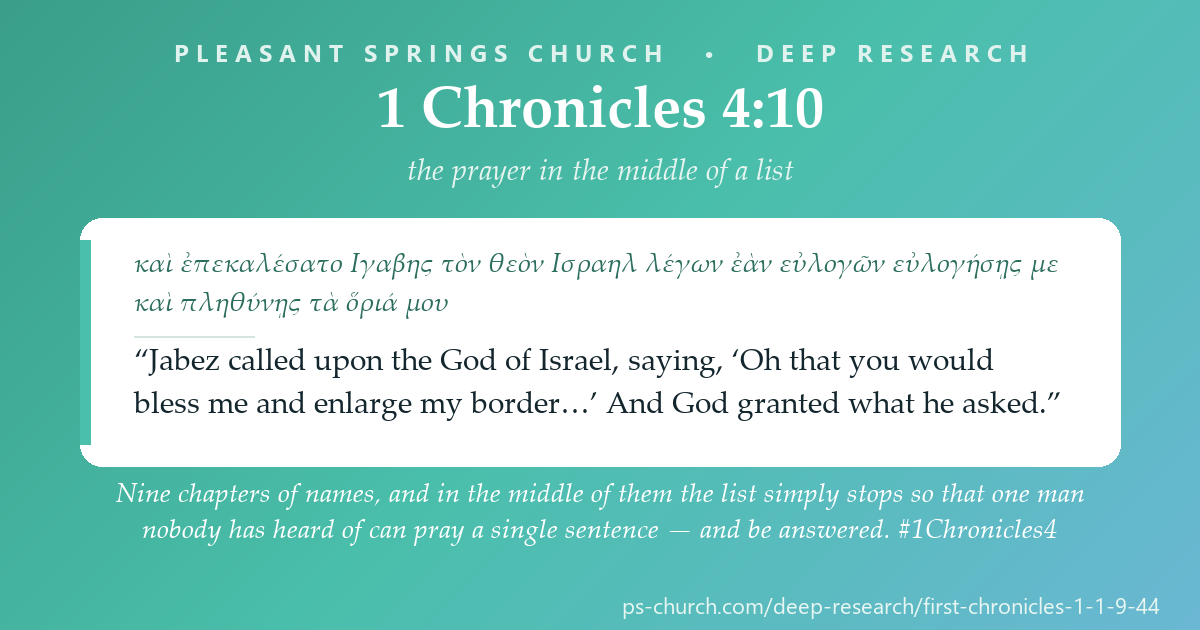
In the middle of the Judah genealogy, with no preparation, the names stop: “Jabez was more honourable than his brothers” (4:9). We are told his mother named him יַעְבֵּץ (Yaʿbēṣ) “because I bore him in pain” — עֹצֶב (ʿōṣeḇ), the same three consonants rearranged. He prays one sentence. God grants it. The list resumes and he is never mentioned again.
Two things are worth saying about this, and they pull in opposite directions.
First, the placement is the point. A genealogy is the most impersonal writing in Scripture — it is the form that reduces a life to a position in a sequence. And right in the middle of it, one man speaks, and God hears him. The Chronicler could have put this anywhere. He put it here, where it interrupts, so that a reader working through a list of strangers is stopped by a voice.
Second, this verse has been badly used. A popular treatment made the prayer of Jabez into a formula — say these words and receive enlarged borders — and that is a misuse of a narrative report. The text does not offer the sentence as a technique; it reports what one man asked and what God did. Note too what the request actually is: “that you would keep me from harm so that it might not bring me pain” — a man named for his mother’s pain asking not to cause any. Read as a prayer against becoming what you were named, it is a far better verse than the one printed on the mugs.
And the Greek cannot follow any of it. Rahlfs transliterates the name — Ιγαβης — so the pun on pain is inaudible, and the translator, left with a wordplay he could not carry, produced ἔτεκον ὡς γαβης, “I bore as gabes,” which explains nothing. This page prints the loss rather than arguing from a Hebrew pun while showing a Greek column that does not have it.
One registry verb, one verdict, and a name nobody can translate.
Follow maʿal from 9:1 into 10:13 and on to the last chapter of 2 Chronicles — it is the single word that holds this book together. Then watch hityaḥes, a bureaucrat’s verb doing theology, and the pun on pain that no version can carry.
“Breach of faith, treachery, unfaithfulness” — and it is the hinge of the whole book. It is not a general word for sin: in the Torah it is the term for sacrilege, for violating what is holy (Lev 5:15; Num 5:6–7), and for Achan taking what was devoted (Joshua 7:1). The Chronicler uses it as a verdict. Nine chapters of names end: “Judah was taken into exile in Babylon because of their maʿal” (9:1). One verse into the narrative, Saul dies “for his maʿal which he committed against the Lord” (10:13). And the book will close the same way, on the generation that went into exile (2 Chr 36:14). One word stitches the genealogy to the story and the beginning to the end. Note the Greek honestly: Rahlfs has ἐν ταῖς ἀνομίαις αὐτῶν at 9:1 and ἐν ταῖς ἀνομίαις αὐτοῦ at 10:13 — so the Greek keeps the link, which is worth saying, but it renders it “lawlessness” and the specifically cultic charge of sacrilege is gone.
“To be enrolled by genealogy” — a verb that exists almost only in Chronicles, Ezra and Nehemiah, which tells you when it mattered. It is a registry word: not “to be descended from” but “to be entered in the record.” 5:1 uses it for the birthright that was not reckoned to Reuben; 9:1 sums up the whole preceding nine chapters with it. The Greek at 9:1 reaches for a rare noun, ὁ συλλοχισμός — a “mustering” or reckoning-together — and the register-office flavour survives.
“Pain” and the name Jabez — the same three consonants, עצב, with two of them swapped. His mother names him for her labour, and he asks God that he might not be ʿoṣbî, the same root again, in his own life. It is the same word as the woman’s ʿiṣṣāḇōn in Genesis 3:16 and the man’s ʿiṣṣāḇōn in 3:17 — the pain of bringing forth and the pain of working ground. Untranslatable, and the versions prove it: the Greek transliterates and gives up; every English version has to add a footnote.
“Border, territory.” Jabez asks God to enlarge it. In a book obsessed with who holds which land — and written for people who had just got a fraction of it back — that is not a vague request for prosperity but a concrete one about ground. The Greek is exact: τὰ ὅριά μου, “my boundaries.”
“Birthright.” The Chronicler stops the list to do something he almost never does — explain himself. Reuben was firstborn, “but because he defiled his father’s couch, his birthright was given to the sons of Joseph… yet Judah became strong among his brothers and a chief came from him, though the birthright belonged to Joseph.” That is the writer telling you, out loud, why Judah is standing at the front of a list he does not head by right. The Greek reads it differently: where the Hebrew has the birthright given to the sons of Joseph, Rahlfs has τῷ υἱῷ αὐτοῦ Ιωσηφ, “to his son Joseph,” and renders bəḵōrāh as εὐλογία, “blessing.”
“The events of the days” — the book’s Hebrew name, and much the best of the three. It is the phrase used throughout Kings for the royal annals ( “the Book of the Chronicles of the Kings of Judah”). Set it beside the Greek Παραλειπόμενα, “things left out,” and Jerome’s Latin chronicon, and you have three ancient judgments about what kind of book this is — annals, appendix, or chronicle of the whole. Only one of them is the book’s own.
Two things in these chapters reported rather than tidied:
- Dan and Zebulun have no genealogy here. Of the twelve tribes, chapter 7 covers Issachar, Benjamin, Naphtali, Manasseh, Ephraim and Asher — and Dan and Zebulun are missing. Explanations have been offered (textual damage at 7:12; deliberate omission; a list that never had them), and none of them is secure. What can be said is that a writer who gives Levi a whole chapter and Judah two and a half is plainly not trying to be even-handed, so an argument from silence here is weak in both directions.
- The same names appear in more than one tribe, and the boundaries are not always tidy. Simeon is absorbed into Judah and told as such (4:24–43); Benjamin is given both in chapter 8 and again in chapter 9; some family names recur across lists. This is normal for the genre — see Stage 2 on the fluidity of real genealogies — and it is also, honestly, sometimes just hard. Where a difficulty is genuinely unresolved this page says so rather than choosing a harmonisation and printing it as though it were the text.
The books this list is made of, the difference it will not hide, and the two genealogies at the front of the New Testament.
Trace four threads: the sources quarried in chapter 1; the seventh-son problem in chapter 2; maʿal running forward into chapter 10 and on to the end of 2 Chronicles; and what Matthew and Luke are doing when they open with a list of names.
Which cross-references matter?
- Genesis 5, 10, 11, 25, 35, 36 — chapter 1 is quarried almost entirely from these, in order: the line from Adam (Gen 5), the Table of Nations (Gen 10), Shem to Abram (Gen 11), Ishmael and Keturah (Gen 25), Israel’s sons (Gen 35), and Esau and Edom at length (Gen 36). The Chronicler is reading Genesis and expects you to have read it too. And the Greek scribe evidently agreed — the two stretches missing from the Greek of chapter 1 are precisely the ones already available in Greek Genesis.
- Ruth 4:18–22 — the ten-name line from Perez to David, which 1 Chronicles 2:5–15 gives again in expanded form. Ruth ends on that genealogy; Chronicles begins with it. Two books, one line, and in both cases the list is the point rather than an appendix to it.
- 1 Samuel 16:6–13 beside 1 Chronicles 2:13–15 — printed here because they differ. Chronicles: “Ozem the sixth, David the seventh” — seven sons, David last. Samuel: Jesse makes seven of his sons pass before Samuel and then sends for the youngest, which gives eight. Proposals exist — a son who died without issue, a son omitted because he left no line, a difference in the sources. None is stated in Scripture, and this page does not choose one. Both readings are in the Bible; both are printed here.
- 1 Chronicles 9:1 → 10:13 → 2 Chronicles 36:14 — the maʿal thread. Judah goes into exile for it; Saul dies for it; the last generation before the fire commits it. Follow that one word and you have the Chronicler’s argument in three verses.
- 1 Chronicles 3:17–24 — the line of David carried through the exile to Jehoiachin, Shealtiel, Zerubbabel and beyond. Set it beside the last four verses of 2 Kings, where Jehoiachin is eating at a Babylonian king’s table. Kings ends with the line alive but captive; Chronicles keeps writing names after it.
- Matthew 1:1–17 and Luke 3:23–38 — both Gospels open the story of Jesus with a genealogy, and they do the two things 1 Chronicles does. Matthew runs from Abraham forward through David and through the deportation to Babylon, using the exile as a structural hinge exactly as Chronicles does. Luke runs backwards past Abraham to “Adam, the son of God” — and no book in the Old Testament had begun at Adam except this one. Whether Luke is deliberately echoing 1 Chronicles 1:1 is not stated in Scripture and this page does not assert it; what can be said is that both writers thought a list of names was the right way to begin.
- Luke 11:51 — “from the blood of Abel to the blood of Zechariah, who perished between the altar and the sanctuary.” The Zechariah who died there is the one in 2 Chronicles 24:20–22. In the Hebrew arrangement attested at b. Bava Batra 14b, where Chronicles stands last, that phrase runs from the first murder in the canon to the last — Genesis to Chronicles, first book to last. It is a striking fit. It is also worth noting honestly that the order of the Writings was not fixed everywhere and at all times, so this is offered as an illumination rather than a proof.
Where the scholarship agrees, where it does not, and the three questions this page leaves open.
Japhet, Knoppers, Klein and Williamson on the unit; Wilson on the form. Then three live questions — and on two of them the honest answer is that the text does not say.
Commentaries & studies:
- Gary N. Knoppers, 1 Chronicles 1–9 (Anchor Yale) — a whole volume on these nine chapters, and the first place to go. Strong on the genealogies as a literary and political construction and on the Greek evidence.
- Sara Japhet, I & II Chronicles (OTL) and The Ideology of the Book of Chronicles — the most influential argument that the Chronicler is a theologian with a coherent position, not an editor with scissors, and that Chronicles is independent of Ezra–Nehemiah.
- Ralph W. Klein, 1 Chronicles (Hermeneia) — the fullest technical treatment of the text-critical problems, including the relationship of the Hebrew to the Greek in chapter 1.
- H. G. M. Williamson, 1 and 2 Chronicles (NCBC) and Israel in the Books of Chronicles — particularly on the Chronicler’s attitude to the northern tribes, which matters for why chapter 7 exists at all.
- Robert R. Wilson, Genealogy and History in the Biblical World — the comparative study behind Stage 2. (A critical scholar; the analysis of genealogical form is useful and is taken as such.)
Interpretation notes worth keeping:
- Who wrote it, and when — not settled. The old view that one “Chronicler” wrote Chronicles–Ezra–Nehemiah as a single work has been substantially abandoned since Japhet and Williamson; most now treat Chronicles as independent. A Persian-period date is agreed; the century is not. This page says “Persian period, plausibly fourth century” and does not pretend to more.
- Whether chapters 1–9 are original to the book — disputed. Some have argued the genealogies are a later addition to a narrative that began at chapter 10. The concentric shape printed above, and the maʿal link from 9:1 into 10:13, are among the better arguments that they belong — but this is an argument, and it is presented as one.
- The relationship of the Greek to the Hebrew here. The minuses at 1:11–16 and 1:18–23 are usually explained as a scribe declining to duplicate Genesis, and that is the most natural reading. It is an explanation, not a datum. What is a datum is that they are absent, and this page counted them rather than repeating the claim from a commentary.
- Jabez. There is no scholarly consensus identifying him, and the rabbinic identification with Othniel (b. Temurah 16a) is homiletic. The honest position is that we know his name, his mother’s reason for it, one sentence he prayed, and that God answered — and nothing else whatever.
What nine chapters of names are for, and what to do with the fact that yours is not in them.
Name what you learned, why it matters, and one concrete response.
What should we carry away — and do?
- The names are not the obstacle; they are the argument. A community that had been told it was a footnote is handed nine chapters establishing that it is the current paragraph of a story that starts at Adam. If you have ever skipped these chapters — and almost everyone has — the thing to notice is what it cost the writer to put them first. He knew he was going to lose readers. He did it anyway.
- God hears people who are not the point of the story. Jabez has one sentence and no sequel. He is not a king, a priest or a prophet; he is a man in a list, named for his mother’s pain, and the narrator stops everything to record that he asked and God gave. Most people live in the lists. This is the verse for that.
- Read the difference honestly. 1 Chronicles 2:15 and 1 Samuel 16 do not agree about how many sons Jesse had. Notice how much better it feels to be told that plainly than to be handed a smooth explanation — and carry that habit into every hard place in Scripture. A faith that needs the difficulties hidden is not being protected; it is being weakened.
- One concrete response. Write down the three or four generations you actually know — names, not stories — and the one thing you would want recorded about each. Then read 1 Chronicles 4:9–10 again. The Chronicler gave Jabez nine Hebrew words. It was enough.
1 Chronicles 4:10 · to share
Hebrew + Greek (Rahlfs, Paraleipomenon A) + ESVEvery Deep Research page traces its passage across the whole sweep — the Old Testament, the Second-Temple world between the testaments (historical witnesses, not Scripture), and the New Testament. Follow the thread:
Pleasant Springs Church — Deep Research
Research method after Michael S. Heiser’s Bible Research Method (examine dictionaries → ancient literature → important words → textual connections → academic publications → share), with the Pleasant Springs “Author & Audience” foundation. Scripture set in the Hebrew, the Greek editions named on each page and the ESV (Old Testament), and the Greek New Testament and the ESV (New Testament), per the practice of Pleasant Springs Church. 1 Chronicles 1–9 research grounded in Knoppers (Anchor Yale, a full volume on this unit), Japhet (OTL), Klein (Hermeneia) and Williamson (NCBC), with Wilson on genealogical form. Book name: in the Septuagint this book is Paraleipomenon A, Παραλειπομένων Αʹ, “of the things left out” — a librarian’s name that misjudges the book; Jerome proposed chronicon totius divinae historiae instead, whence our “Chronicles,” and the Hebrew title is דִּבְרֵי הַיָּמִים, “the events of the days.” Text & numbering: Hebrew from the Masoretic Text; Greek from Rahlfs’s Septuaginta (CATSS digitization of the Rahlfs text), printed without editorial punctuation and with proper names unaccented; English ESV. ⚠️ The Greek is shorter here, and it was counted rather than assumed: 1 Chronicles has 943 verses in the Masoretic Text and 930 in Rahlfs. Twelve of the thirteen absent verses fall in chapter 1 — 1:11–16 and 1:18–23, precisely the material duplicated from the Table of Nations in Genesis 10 — and the thirteenth is 16:24, a line of Psalm 96 missing from the middle of the psalm David appoints. The usual explanation, that a translator declined to copy Genesis twice, is reported as an explanation and not as a datum. ⚠️ Chronicles and Samuel–Kings are not harmonised: 1 Chronicles 2:13–15 makes David the seventh son of Jesse while 1 Samuel 16 yields eight; both are printed and no reconciliation is invented. Divergences between the columns are named where they bear on an argument — 4:9–10 (the Greek transliterates Ιγαβης and the ʿeṣeḇ wordplay is lost, and the second half of the prayer is rendered quite differently), 5:1–2 (bəḵōrāh as εὐλογία, and “the sons of Joseph” as “his son Joseph”), 9:1 (maʿal as ἀνομία, so the link to 10:13 is kept but the cultic charge of sacrilege is lost). Where this page argues from a Hebrew word, what the Greek column actually does with it is stated in the same breath. Dan and Zebulun are absent from chapter 7 and the page says the explanations are not secure rather than choosing one. Jabez is reported exactly as the narrator reports him; the popular use of 4:10 as a formula is named and declined, and the rabbinic identification with Othniel (b. Temurah 16a) is cited as homily, not as report. Second-Temple and rabbinic witnesses (Josephus; b. Bava Batra 14b–15a; b. Temurah 16a; the Targum of Chronicles) are read as witnesses and never levelled with Scripture. The canonical observation about Luke 11:51 depends on the order of the Writings attested at b. Bava Batra 14b, and the page states that this order was not universal rather than resting an argument on it. Typology is handled per the house position: what the text says, what the New Testament itself draws, and what we see from this side of the cross — and the reader is left to do the seeing.
Scripture quotations marked ESV are from the ESV® Bible (The Holy Bible, English Standard Version®), © 2001 by Crossway, a publishing ministry of Good News Publishers. ESV Text Edition: 2016. Used by permission. All rights reserved. The ESV text may not be quoted in any publication made available to the public by a Creative Commons license, and the ESV may not be translated in whole or in part into any other language. www.esv.org
|
Did this study bless you today? 💚 Give to Support PS Church100% of gifts go to the General Fund — thank you. |