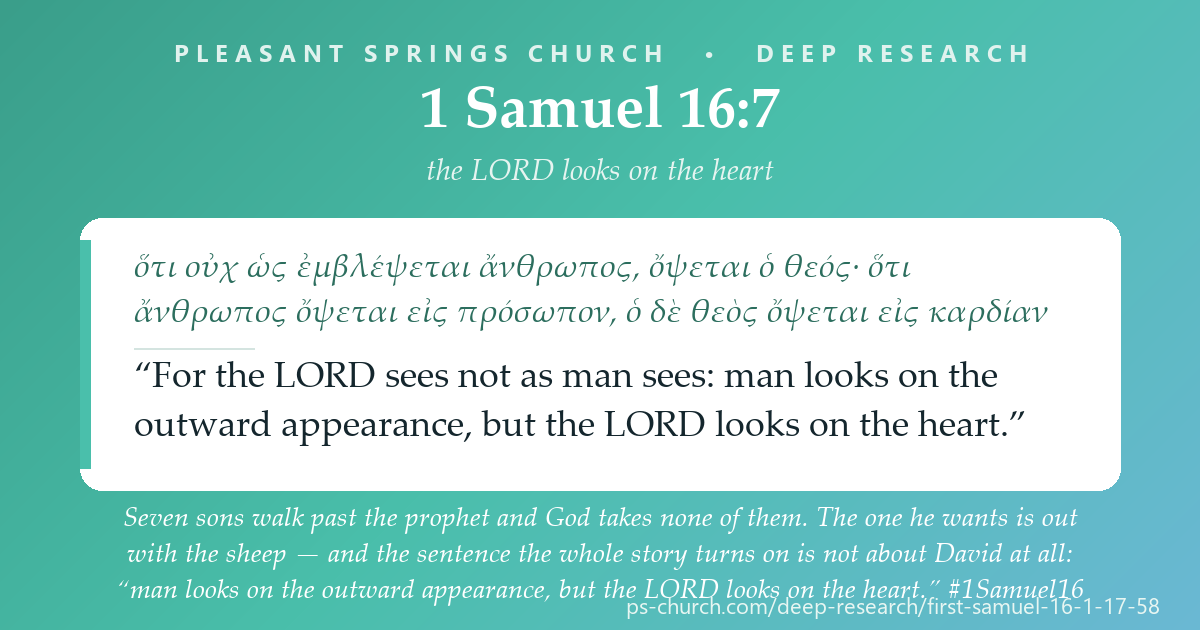
Seven sons walk past a prophet and God takes none of them. That is the scene these two chapters are built on, and the sentence that turns them is spoken before the first son has finished crossing the room: “Do not look on his appearance or on the height of his stature… For the Lord sees not as man sees: man looks on the outward appearance, but the Lord looks on the heart” (16:7). The one God wants is not in the room. He is out with the sheep, and they have to send for him. Samuel anoints him among his brothers, the Spirit of the Lord rushes on him — and departs from Saul, who is left with a harmful spirit and a boy with a lyre. Then the valley: a champion out of Gath, forty days of morning-and-evening taunting, an army that will not move, an older brother’s contempt, a king’s armour that does not fit, five smooth stones out of a streambed, and a sentence shouted across open ground before anything had been proved — “You come to me with a sword and with a spear and with a javelin, but I come to you in the name of the Lord of hosts… the Lord saves not with sword and spear. For the battle is the Lord’s” (17:45–47). This passage also carries the single largest difference between the Hebrew and the Greek anywhere in this library, and this page prints it in the table rather than hiding it: the Old Greek of 1 Kingdoms lacks thirty-nine of the eighty-eight verses of 1 Samuel 17–18, and Goliath is six cubits tall in the Hebrew and four in the Greek. Both are shown; neither is settled. This study works 1 Samuel 16:1–17:58 in Hebrew, in Greek and in the ESV. See the method →
1 Samuel 16:1–17:58 (selections)
Hebrew (MT) · Greek (Rahlfs, 1 Kingdoms) · ESV(1) The Greek does not call this book 1 Samuel. In the Septuagint, Samuel and Kings are one series of four books called Kingdoms (Βασιλειῶν), and this is 1 Kingdoms (Βασιλειῶν Αʹ). A reader looking for “1 Samuel” in a Greek Bible will not find it under that name. (2) The edition. The Greek above is Rahlfs’s Septuaginta (1935), in the standard digitization; punctuation is editorial and proper names are left unaccented as Rahlfs leaves them. Underlining marks a place where the Greek and the Hebrew are not saying the same thing. On why this library prints what it prints and shows you both, see the texts we print. (3) 1 Kingdoms is Old Greek throughout. The later kaige revision — the first-century pull of the Greek back toward a proto-Masoretic Hebrew — touches 2 Kingdoms 11:2 onward and the end of Kings, but not this book (Thackeray; and see Barthélemy, Les devanciers d’Aquila). So what you are reading here is old, and it was translated from a Hebrew text that was not the one the Masoretes later transmitted.
The big one: the Old Greek of 1 Samuel 17–18 is far shorter than the Hebrew. Not a phrase here and there — whole paragraphs. Thirty-nine of the eighty-eight verses of these two chapters are simply not in it — about forty-four percent (Tov). Enumerated, so that this is a list and not a gesture, the Old Greek lacks: 17:12–31, 17:41, 17:48b, 17:50, 17:55–58; 18:1–6a, 18:10–11, 18:12b, 18:17–19, 18:21b, 18:29b–30. Which means the Greek story has no Jesse sending David to the camp with parched grain, ten loaves and ten cheeses; no forty days of morning-and-evening challenge; no Eliab losing his temper; and no “whose son is this youth?” at the end. In the Greek, David is already Saul’s armour-bearer (16:21), and he steps forward from where he is. Manuscripts. The shorter text is that of Codex Vaticanus and the manuscripts with it. Codex Alexandrinus and others do carry a Greek translation of the missing verses — but that translation has long been recognised as Hexaplaric, i.e. supplied later out of the Hebrew in the course of Origen’s work, not part of the original Greek (Wellhausen; Driver; B. Johnson, Die hexaplarische Rezension; Tov). The oldest datable witness to the short form is Hippolytus’s sermon on David and Goliath (second century A.D.), which does not have 17:55–58; the oldest datable witness to the long form is 1QSam (1Q7) from Qumran, which preserves 1 Samuel 18:17–18 — verses the Greek does not have (Barthélemy, DJD I). Both forms are ancient.
And Goliath’s height. The Hebrew reads six cubits and a span; the Greek, 4QSama and Josephus read four. That is roughly nine feet nine against six feet nine — and the ESV itself prints the difference in a footnote at 17:4: “Hebrew; Septuagint, Dead Sea Scroll and Josephus four.” This page prints the ESV’s Hebrew in the English column and the Greek’s four in the Greek column, because that is what each text says. It does not tell you which is right. Numbering. There is no chapter- or verse-offset in this passage: where the Greek has a verse it carries the same number as the Hebrew and the English, and chapter 16 runs 1–23 in all three. What the Greek has instead of an offset is holes — the numbers jump. That was counted, not assumed.
The Shape of the Passage
LeitwortThese two chapters follow immediately on the rejection of Saul over Amalek (1 Samuel 14–15); behind them stand the request for a king (chs 8–10), the law of the king in Deuteronomy 17, and Judges’ refrain that there was no king in Israel (Judges 19–21). Bethlehem is where Ruth 4 left us, with a genealogy that ends on David’s name.
Author
A narrator who tells you what God said, and then shows you every human being in the story getting it wrong. Chapter 16 gives the reader information nobody inside the story has: the Lord says outright, in 16:7, what he is doing and why. Then the narrative spends two chapters watching people fail to apply it. Samuel looks at the tall brother and is corrected. Jesse does not think to call the eighth son in from the field. Eliab tells his brother what is in his heart and is exactly wrong about it. Saul looks at David and sees a boy who needs armour. Goliath looks at David and laughs. The reader has been told the rule and is then made to watch six people break it — and that is a way of teaching that a bare command could not accomplish.
And this is the author who is willing to leave a seam showing. Nobody who has read 16:21–22 and then 17:55–58 has failed to notice that Saul, who loved David and wrote to his father by name, asks whose son he is. It is the single most discussed problem in the book. What this page will not do is pretend the problem is not there, and what it also will not do is treat it as a defect: Robert Alter’s term for the biblical narrators’ habit of setting two accounts side by side without smoothing them is composite artistry, and Judges and Genesis have already taught the reader of this library that seams in these books are usually design rather than clumsiness. Whether that is the right explanation here is one of three live options, and Stage 5 lays out all three without picking.
He also refuses to make David impressive in the ordinary way. Look at what the text actually praises. Not his size — it never gives one. Not his skill — the sling is mentioned in a single clause. What it gives you is a boy who says the same thing four times in different words: the Lord delivered me from the lion, the Lord will deliver me from this Philistine, the Lord saves not with sword and spear, the battle is the Lord’s. The narrator lets him say it and does not comment. He does not have to.
Audience
People who already knew how the story ends, and were being told how it started. Everything in chapter 16 is quiet and small: a prophet frightened of the king, a heifer, a horn of oil, a village so minor that the elders come out trembling because a visit from Samuel can only mean trouble. The anointing happens indoors, among brothers, and nobody outside the room finds out for years. An audience that knew David as king is being shown that the kingdom began in a room in Bethlehem with a boy who had been left in the field — and that this was not an accident of the story but the announced method.
They also knew what a Philistine was. These were not generic villains. The Philistines were part of the movement of peoples the Egyptians recorded as the Sea Peoples — the Peleset of Ramses III’s inscriptions — who settled the coastal plain in the twelfth century B.C. and held the five cities of Gaza, Ashkelon, Ashdod, Ekron and Gath, Goliath’s town. The Greek translator never calls them Philistines. He calls them ἀλλόφυλοι, “people of another stock,” more than a hundred times in this book. It is the ancient world’s way of saying not ours.
A note on how this page handles the hard part. The manuscript difference in these chapters is not a footnote and it is not tucked away at the bottom. It is printed in the table itself, verse by verse, with the gaps shown as gaps. That is deliberate. Our pastor’s standing instruction to this library is that we say why we print what we print and show the reader the other text rather than hiding it — because the differences are how different parts of the world came to different Bibles, and that is worth seeing (the texts we print). Nothing in the Christian faith rests on which of these two forms of 1 Samuel 17 is the older. Both of them say a boy went out with a sling and God gave the victory.
Orient on an anointing nobody sees, a spirit that comes and a spirit that goes, and a duel in a valley.
Search by topic: David; Jesse; Bethlehem / Ephrathah; Samuel; anointing and messiah (mashiach); Spirit of the Lord in Judges–Samuel; evil / harmful spirit; kinnor (lyre) and music therapy in the ancient world; Philistines; Sea Peoples; Gath and Tell es-Safi; Elah, Socoh, Azekah, Ephes-dammim; champion / single combat; sling and slingers; scale armour; cubit and span; herpah (reproach); Samuel, Books of, text of; 4QSamuel-a.
Which articles are relevant?
- Anchor Bible Dictionary — “David,” “Jesse,” “Bethlehem,” “Goliath,” “Philistines,” “Gath,” “Elah, Valley of,” “Sea Peoples,” “Anointing,” “Messiah,” “Weights and Measures,” “Samuel, Books of.”
- Dictionary of the OT: Historical Books (IVP) — “David,” “Samuel, Books of,” “Philistines,” “Warfare,” “Music,” “Spirit of God,” “Text and Textual Criticism.” The last of these will name 1 Samuel as the standard example, and that is not a criticism of the book.
- NIDOTTE / TDOT — רָאָה (rāʾāh, see), נָבַט (nāḇaṭ, look upon), לֵבָב (lēḇāḇ, heart), מָשַׁח (māšaḥ, anoint), צָלַח (ṣālaḥ, rush upon), רוּחַ (rūaḥ, spirit), חָרַף (ḥārapḥ, defy, reproach), יָשַׁע (yāšaʿ, save).
- For the Greek and the text — any reference article on the Septuagint of Samuel should tell you three things: that the book is called 1 Kingdoms; that the Greek here is Old Greek and not kaige-revised; and that chapters 17–18 are much shorter in it than in the Hebrew. If an article does not mention the third, it is not a reliable guide to this passage.
Bibliography surfaced:
- P. Kyle McCarter Jr., I Samuel (Anchor Bible, 1980) — the standard text-critical commentary on this book, and the fullest English defence of the shorter Greek.
- Robert Alter, The David Story (1999); David Tsumura, The First Book of Samuel (NICOT); Ralph W. Klein, 1 Samuel (WBC); Robert D. Bergen, 1, 2 Samuel (NAC); Bill T. Arnold, 1 & 2 Samuel (NIVAC); Walter Brueggemann, First and Second Samuel (Interpretation); V. Philips Long on the historical questions.
- D. Barthélemy, D. W. Gooding, J. Lust and E. Tov, The Story of David and Goliath: Textual and Literary Criticism — Papers of a Joint Research Venture (OBO 73; Fribourg / Göttingen, 1986). Four Septuagint scholars, two of them arguing each way, in one book. If you read only one thing about this problem, read this.
- Emanuel Tov, “The Composition of 1 Samuel 16–18 in the Light of the Septuagint,” reprinted in The Greek and Hebrew Bible — where the verse-by-verse list of minuses, pluses and variants is set out in full.
An Egyptian who fought a champion in single combat, a pharaoh who named the Peleset, a potsherd from Gath — and what the ancient retellings did with the story.
Read 17:8–10 against the one first-hand ancient account of a champion duel we possess; read “Philistine of Gath” against Ramses III’s list of the Peoples of the Sea and against the excavations at Tell es-Safi; then watch what Josephus, Ben Sira and the rabbis did with these chapters — and note carefully which form of the story each of them had.
Which parallels shed light on the world of the passage?
Single combat between champions was a real institution, and we have an eyewitness account of one. In the Story of Sinuhe, an Egyptian official living in exile in Syria-Palestine in the twentieth century B.C. is challenged in his own camp. Read it beside 1 Samuel 17 and the resemblance is not thematic, it is structural: “A mighty man of Retenu came, that he might challenge me in my (own) camp. He was a hero without his peer, and he had repelled all of it… Then (he took) his shield, his battle-axe, and his armful of javelins. Now after I had let his weapons issue forth, I made his arrows pass by me uselessly… He charged me, and I shot him, my arrow sticking in his neck. He cried out and fell on his nose. I felled him with his (own) battle-axe and raised my cry of victory over his back” (ANET 19, Wilson’s translation). A champion; a challenge; a hero without peer; a shield-and-javelins inventory; a missile weapon that beats a close-quarters one; the giant falling on his face; the hero finishing him with the champion’s own weapon. 1 Samuel 17 is telling a kind of story its first hearers recognised at once — and the deviation is the point. Sinuhe wins by his own bow and takes the man’s cattle. David says out loud, before he throws, that the Lord saves without sword or spear and that the battle is not his.
The Philistines are on the Egyptian record. In the eighth year of Ramses III (early twelfth century B.C.), the Medinet Habu inscriptions describe a coalition on the move: “the Peleset, Tjeker, Shekelesh, Denye(n), and Weshesh, lands united” (ANET 261). Peleset is the Philistines. They are foreigners in Canaan too — newcomers of the same generation as the Israelite settlement, holding the coastal plain and the good iron while Israel held the hills. Gath, Goliath’s city, is almost certainly Tell es-Safi, which sits at the mouth of the Elah valley — that is, the valley of this chapter is the road from Gath up into Judah. In 2005 the excavators there found a potsherd in a securely dated Iron Age context inscribed in Proto-Canaanite letters with two names, ʾlwt and wlt. It is not “Goliath’s inscription,” and the excavator has said so plainly — but the two names are non-Semitic and etymologically of the same family as the name גׇּלְיָת, at the right place and roughly the right period (Maeir, Wimmer, Zukerman and Demsky, BASOR 351 [2008]). What it shows is that a name like Goliath belonged in Gath. That is all it shows, and it is worth having.
What the ancient retellings did — and which text each of them had. This is where the manuscript question stops being abstract. Josephus (first century A.D.) gives Goliath’s height as four cubits and a span, with the Greek and against the Hebrew. He also has David reply to the dog insult — “No, not for a dog, but for a creature worse than a dog” — which is a Greek plus and is not in the Hebrew at all. And yet he also has Jesse sending David to the camp with provisions, and Eliab rebuking him — material that is only in the Hebrew. He is a mixed witness, and an honest page has to say so. He does not have “whose son is this youth?”
- The Story of Sinuhe, Egypt, c. 20th century B.C. (ANET 18–22, the duel at 19) (an Egyptian tale — a witness, not Scripture) — the fullest ancient first-person account of a champion challenge, and the closest formal parallel to 1 Samuel 17 that survives.
- Ramses III, the war against the Peoples of the Sea, Medinet Habu, year 8, early 12th century B.C. (ANET 261) (an Egyptian royal record — a witness, not Scripture) — “the Peleset, Tjeker, Shekelesh, Denye(n), and Weshesh.” The Philistines arrive in the record.
- The Tell es-Safi / Gath ostracon, published 2008 (an archaeological find — a witness, not Scripture) — ʾlwt and wlt in Proto-Canaanite, from Iron Age Gath: names of the same non-Semitic family as “Goliath.” Not his, and not claimed to be.
- Josephus, Antiquities, books 6.8–6.9 (Whiston’s chapter division; the David and Goliath narrative) (Second-Temple — a witness, not Scripture) — Goliath “of four cubits and a span in tallness” (Ant. 6.171); David’s “worse than a dog” retort, which only the Greek has; Eliab’s rebuke, which only the Hebrew has; and no “whose son is this youth?” at the end. A mixed witness, and therefore an important one.
- Sirach 47:3–5 (Second-Temple; non-canonical in this church’s reckoning — a witness, not Scripture) — the earliest surviving reading of this chapter: “He played with lions as though they were young goats… In his youth did he not kill a giant, and take away the people’s disgrace, when he whirled the stone in the sling and struck down the boasting Goliath? For he called on the Lord, the Most High, and he gave strength to his right arm.” Note what Ben Sira keeps: the lion and the bear, the disgrace taken away (17:26), and above all who gave the strength.
- Hippolytus, Sermon on David and Goliath (2nd–3rd century A.D.; ed. Garitte, CSCO 263–264) (early Christian — a witness, not Scripture) — the oldest datable witness to the short form of the story: he does not have 17:55–58.
- 1QSam (1Q7), Qumran (a Hebrew manuscript — a witness to the text) — preserves 1 Samuel 18:17–18, verses the Old Greek does not have. The oldest datable witness to the long form. Published by Barthélemy in DJD I.
- 4QSama (4Q51), c. 50–25 B.C. (a Hebrew manuscript — a witness to the text) — the oldest Hebrew witness to 1 Samuel 17:4, and it reads ארבע אמות וזרת, four cubits and a span. Transcriptions in DJD 17; that, and not a summary, is where a reader should check them.
It is worth being concrete about what the two forms of this chapter actually feel like, because “the Greek is shorter” is an abstraction until you read both.
The Hebrew story has a rhythm of delay. Forty days of a man walking out morning and evening while an army watches. A father at home who has no idea what is happening and sends his youngest with bread and cheese and a request for news. A brother who is humiliated by the arrival. A boy who has to ask three separate times what the reward is before anybody takes him to the king. It is a story about a nation that waited too long, and about how deliverance arrived from the direction nobody was watching — the back road from Bethlehem, carrying lunch.
The Greek story is tighter and faster. Goliath issues the challenge; Israel is terrified; David — who is already at court, already the king’s armour-bearer, already established in chapter 16 — steps forward and says let no one’s heart fail. There is no gap between the taunt and the answer. And at the end there is no scene of a king failing to recognise the boy he loved.
Both stories say the same thing about God. Both have 16:7. Both have “the Lord saves not with sword and spear.” Both have the battle belonging to the Lord. Whichever came first — and Stage 5 sets out the arguments — the confession did not change.
Seeing, looking, height — and the word that says the crime was blasphemy, not invasion.
Follow raʾah through both chapters and you have the argument; then check the two words that occur exactly twice each — nabat and gabah — and notice where the second occurrence falls.
“See.” The key word of both chapters, sixteen times, and the argument of the whole passage is packed into 16:7, where it appears three times in one verse: “not what man sees… man sees to the eyes… the Lord sees to the heart.” The ordinary Hebrew idiom “I have seen” can mean “I have picked out” — which is why 16:1 reads in the ESV as “I have provided for myself a king.” Both senses are live at once, and the chapter uses both. The Greek follows faithfully with ὁράω / βλέπω, and at 16:7 it says ὁ θεός where the Hebrew says the divine name.
“Look upon, gaze at.” It occurs exactly twice in these two chapters, and the two occurrences face each other. At 16:7 Samuel is told “do not look (אַל־תַּבֵּט) on his appearance.” At 17:42 “the Philistine looked (וַיַּבֵּט) and saw David… and disdained him, for he was but a youth, ruddy and handsome in appearance.” Goliath does exactly the thing the prophet was forbidden to do, in the same words, and it is the last mistake he makes. This is the one detail on this page most worth carrying home.
“Height, tallness.” Also exactly twice. In 16:7 God rejects Eliab’s “height of stature”; in 17:4 the Philistine’s “height” is the first thing we are told about him. The reader has already been told what God thinks of that measurement before the chapter that is built on it begins. (And the measurement itself is the passage’s most famous variant — six cubits in the Hebrew, four in the Greek, 4QSama and Josephus.) A third man in the book was measured this way: Saul, who was “taller than any of the people from his shoulders upward” (9:2, 10:23).
Literally “the man of the two-between” — the man who stands in the space between two armies. It is not the ordinary word for a warrior; it occurs nowhere else in the Old Testament in this sense, and English has to render it “champion.” The Greek did not attempt it and simply wrote ἀνὴρ δυνατός, “a mighty man.” The idea is institutional: two armies stand still while one man from each side settles it. That is what Sinuhe describes, and it is what David refuses to treat as a private contest.
“Defy, taunt, reproach.” The second thread of chapter 17: the verb five times and the noun once, and every occurrence is about words rather than weapons. Goliath says “I defy the ranks of Israel” (17:10); the men say he has come up “to defy Israel” (17:25); David asks who takes away “the reproach” and who this man is that he should “defy the armies of the living God” (17:26); and the speech ends by naming the offence exactly — “the God of the armies of Israel, whom you have defied” (17:45). The crime in this chapter is blasphemy, not invasion, and that is why the answer to it is a sentence about who saves. The Greek renders it ὀνειδίζω throughout — the same verb the New Testament uses of the reproaches cast at Christ.
“Spirit, wind, breath.” One word does the pivot of chapter 16 in a single verse: the Spirit of the Lord rushes on David (16:13) and departs from Saul (16:14), and what fills the vacancy is called רוּחַ־רָעָה מֵאֵת יְהוָה, “a harmful spirit from the Lord.” The page reports the preposition as it stands. Notice what the text does not say: it does not explain it, and it does not use the vocabulary of possession. What it does say is that a boy with a lyre could make it lift. The Greek is if anything more physical — ἔπνιγεν, it was choking him.
“Rush upon.” Not a gentle verb, and not a private one. It is the word used when the Spirit came on Othniel, on Jephthah, on Samson and on Saul (Judges 14:6; 1 Samuel 10:6, 11:6) — every time, for public deliverance rather than personal comfort. The Greek chose ἐφήλατο, “leapt upon.” David is anointed and then the Spirit comes, in that order, and the next thing that happens to him is that he goes back to the sheep.
“Save, deliver.” The verb at the summit of the whole passage: “the Lord saves not with sword and spear” — יְהוֹשִׁיעַ, the same three consonants that stand behind the names Joshua and Jesus. The Greek is σῴζει κύριος. And the sentence that follows it in the Hebrew is four words long: כִּי לַיהוָה הַמִּלְחָמָה, “for to the Lord the battle.” There is no verb in it at all.
Where this vocabulary surfaces later:
- 1 Samuel 9:2; 10:23 — Saul, “a handsome young man… from his shoulders upward he was taller than any of the people.” The book has already given the reader a king chosen partly for his height, and 16:7 is the correction (see 1 Samuel 8–10).
- 1 Samuel 13:14; 15:28 — “a man after his own heart”; “a neighbor of yours, who is better than you.” Chapter 16 is the answer to two sentences already spoken over Saul (see 1 Samuel 11–13 and 1 Samuel 14–15).
- Psalm 78:70–72 — “He chose David his servant and took him from the sheepfolds… With upright heart he shepherded them.” Israel’s own summary of this chapter, and it keeps both the sheep and the heart.
- 1 Kings 8:39 — “for you, you only, know the hearts of all the children of mankind.” Solomon prays 16:7 back to God at the dedication of the temple. So do Jeremiah 17:10 and Proverbs 16:2.
- Acts 13:22 — “I have found in David the son of Jesse a man after my heart, who will do all my will.” Paul, preaching in a synagogue in Pisidian Antioch, quotes the outcome of this chapter and joins it to 1 Samuel 13:14. (Cited in text; there is no page for Acts 13 in this library yet.)
- 2 Corinthians 10:4 — “the weapons of our warfare are not of the flesh.” The New Testament’s own way of carrying 17:47 forward, and the reason no Christian may read this chapter as a warrant for force (see Ephesians 2 for the same logic applied to salvation itself).
The genealogy that ends at Bethlehem, the law of the king, the other man who killed Goliath, and the covenant this anointing is heading toward.
Trace four: the line that runs from Ruth 4 to Jesse’s door; the two kings of 1 Samuel measured against Deuteronomy 17; the Elhanan problem at 2 Samuel 21:19; and the promise of 2 Samuel 7, toward which this anointing is the first step.
Which cross-references matter?
- Ruth 4:17–22 — “they named him Obed. He was the father of Jesse, the father of David.” The book of Ruth exists in order to end on the name that chapter 16 walks up to, and it ends in the same village. Samuel goes to Bethlehem because of a story about a Moabite widow and a barley harvest (see Ruth 4).
- Deuteronomy 17:14–20 — the law of the king: he must not multiply horses or wives or silver, and he must write out a copy of the law and read it all his days, “that his heart may not be lifted up above his brothers.” The heart is in the law of the king before it is in 16:7. Israel asked for a king “like all the nations” and got a tall one; the Lord picks by the standard Deuteronomy already named (see Deuteronomy 17).
- Genesis 49:8–12 — “The scepter shall not depart from Judah.” The boy in the field is of Judah, and the blessing of Jacob has been waiting for this since Genesis (see Genesis 49).
- Judges 3:31; 15:15; 16:28–30 — an oxgoad, a jawbone, and a blind man’s arms. The pattern of God winning with the wrong equipment is not new here; it is the running habit of the book just behind this one (see Judges 3 and Judges 13–16). So is deliverance from Philistines specifically.
- Judges 7:2–7 — “The people with you are too many… lest Israel boast over me, saying, ‘My own hand has saved me.’” Gideon’s three hundred and David’s five stones make the same argument (see Judges 6–8).
- 2 Samuel 7:8–16 — “I took you from the pasture, from following the sheep, that you should be prince over my people Israel… your throne shall be established forever.” God’s own summary of 1 Samuel 16, spoken back to David years later, and the covenant this anointing is walking toward (see 2 Samuel 7).
- 2 Samuel 21:19 and 1 Chronicles 20:5 — a genuine and well-known difficulty, reported here rather than avoided. 2 Samuel 21:19 says “Elhanan the son of Jaare-oregim, the Bethlehemite, struck down Goliath the Gittite, the shaft of whose spear was like a weaver’s beam.” 1 Chronicles 20:5 says Elhanan “struck down Lahmi the brother of Goliath the Gittite.” The ESV footnotes 2 Samuel 21:19 itself: “Contrast 1 Chronicles 20:5, which may preserve the original reading.” The readings on offer are that Chronicles preserves the older text and 2 Samuel has suffered in copying; that “Goliath” was a title or a second name; or that two Philistine warriors are involved. We report the difficulty and do not settle it.
- Psalm 78:70–72; Psalm 151 (LXX) — the first is Scripture and remembers David taken from the sheepfolds; the second is a short psalm found only in the Greek Bible and at Qumran, in which David speaks in the first person about being the smallest of his brothers and going out against the Philistine. It is non-canonical in this church’s reckoning, and it is a witness to how early readers loved this story.
Sermons have been built on the five stones. Some say David took five because Goliath had four brothers. Some say he took five because his faith was small. Some say he took five because he expected to need only one and took four for the Lord to use.
The text says none of this. It says: “Then he took his staff in his hand and chose five smooth stones from the brook and put them in his shepherd’s pouch. His sling was in his hand, and he approached the Philistine.” That is the whole verse. It gives no reason for the number and draws no lesson from it. The brothers of Goliath are a separate list in 2 Samuel 21:15–22, and Scripture never connects the two.
Here is what the verse does say, and it is better than the guesses. Every object in it belongs to the job David already had: a shepherd’s staff, a shepherd’s pouch, a sling for driving off animals, and stones out of the streambed at the bottom of the valley. He went to the fight with what was in his hands that morning — after refusing the king’s armour, which was the only equipment in the story that had ever been near a battle.
Where Scripture gives no reason, we say so and stop. That is a discipline, not a poverty; and a reader who learns to notice when the preacher has supplied a reason the text withheld has learned something that will protect them for the rest of their life.
The shorter Greek, the height of Goliath, the seam at 17:55 — three real debates, laid out and not settled.
Barthélemy and Gooding on one side, Lust and Tov on the other, in the same 1986 volume; McCarter (Anchor Bible) for the fullest English case; and then the question every reader actually asks about the height. Our part is to state the evidence and the positions accurately and to leave the reader free.
Commentaries & studies:
- P. Kyle McCarter Jr., I Samuel (Anchor Bible, 1980) — the standard text-critical commentary on the book, working closely from the Greek and the Qumran evidence.
- Robert Alter, The David Story (1999) — a fresh translation with commentary, and the best English guide to the artistry of these chapters. (Cited for the literary observation only; the theological frame here is the church’s, not his.)
- David Toshio Tsumura, The First Book of Samuel (NICOT, 2007) — consistently the most conservative recent voice on the Hebrew text, and useful precisely because he pushes back where others do not.
- Ralph W. Klein, 1 Samuel (WBC); Robert D. Bergen, 1, 2 Samuel (NAC); Bill T. Arnold, 1 & 2 Samuel (NIVAC); Walter Brueggemann, First and Second Samuel (Interpretation); V. Philips Long, The Reign and Rejection of King Saul.
- D. Barthélemy, D. W. Gooding, J. Lust and E. Tov, The Story of David and Goliath: Textual and Literary Criticism (OBO 73; Fribourg / Göttingen, 1986) — the joint volume in which the two explanations argue with each other in print.
- Emanuel Tov, “The Composition of 1 Samuel 16–18 in the Light of the Septuagint” (repr. in The Greek and Hebrew Bible), with full lists of the minuses, the pluses and the variants; A. van der Kooij, “The Story of David and Goliath — The Early History of Its Text,” ETL 68 (1992), arguing the other way.
- Eugene Ulrich, The Qumran Text of Samuel and Josephus (1978), and F. M. Cross et al., Qumran Cave 4.XII: 1–2 Samuel (DJD 17, 2005) — what the scrolls actually preserve, in transcription.
- J. Daniel Hays, “Reconsidering the Height of Goliath,” JETS 48 (2005), and “The Height of Goliath: A Response,” JETS 50 (2007) — the argument for the shorter reading, with the counter-arguments printed alongside it. Azzan Yadin, “Goliath’s Armor and Israelite Collective Memory,” VT 54 (2004), on the description of the equipment.
- Aren M. Maeir, S. Wimmer, A. Zukerman and A. Demsky, “A Late Iron Age I / Early Iron Age IIA Old Canaanite Inscription from Tell es-Sāfî/Gath,” BASOR 351 (2008) — the ostracon, described soberly by the people who dug it up.
The three debates, stated fairly:
- 1. Why is the Greek so much shorter? Two explanations, both held by serious scholars, and this page picks neither.
The Greek is an abridgement. On this view the Hebrew is the original story and the Greek translator (or an editor before him) cut it down — because the long form has awkward joins, and a tidier story results. Barthélemy and Gooding argue this in the 1986 volume, and van der Kooij has argued it since: the Masoretic story is a coherent and satisfying narrative once you read it on its own terms, and the shorter Greek looks like the work of someone smoothing away difficulties.
The Greek reflects a shorter Hebrew. On this view the translator did not cut anything; he had in front of him a Hebrew manuscript that was already short, and the longer Hebrew grew later by the joining of a second telling. Lust and Tov argue this in the same volume, and it is McCarter’s position in the Anchor Bible. Their strongest argument is translation technique: the Greek of 1 Kingdoms is measurably literal — it is one of the most literal units in the whole Septuagint — and a translator who renders his source word for word everywhere else is not likely to have cut forty-four percent of two chapters. They also point to the Greek’s pluses: a man who was abbreviating does not add lines.
What can be said without taking sides: both forms are ancient — the short form is attested by Hippolytus in the second century, the long form by 1QSam at Qumran. Neither is a modern invention, and neither is a corruption invented to embarrass the other. - 2. Goliath’s height. Report both; print both; decide neither. Six cubits and a span is read by the Masoretic Hebrew, the Vulgate and the Syriac — roughly nine feet nine. Four cubits and a span is read by the Old Greek, by 4QSama (the oldest Hebrew manuscript of this verse, first century B.C.), by Josephus, and by the Lucianic Greek — roughly six feet nine. The arguments for four: it is the older attested reading by a thousand years, it has Hebrew and Greek witnesses agreeing against the Masoretic Text, and six feet nine in a world of men averaging five foot three is already a giant — enough to explain the armour, the shield-bearer and the terror. The arguments for six: the Masoretic Text is the received Hebrew and has its own weight; the description of the equipment fits an enormous man; and a scribe might as easily have reduced a startling number as inflated a plain one. The ESV prints six and footnotes four. This page prints both and does not adjudicate. Nothing in the passage’s meaning moves either way: the point of the chapter is not the size of the man but that the Lord saves without sword or spear.
- 3. The seam at 17:55–58. At 16:21–22 Saul knows David, loves him, and writes to Jesse by name; at 17:55–58 he asks Abner whose son the boy is. Three readings are on offer. (a) The two chapters preserve two accounts of how David came to court, set side by side by an editor who did not merge them — the composite artistry reading. (b) Saul is not asking the boy’s name but his family’s standing, because he has just promised his daughter and a tax exemption to the man’s household (17:25) and now needs to know which household that is — a reading with real support in the wording, since the question is always “whose son,” never “who.” (c) The Hebrew narrative here is not strictly chronological, and 16:14–23 summarises a service that began after the duel. And the fourth fact: the Greek does not have the problem at all, because it does not have these verses — which one side reads as the sign of an original short text and the other as the sign of a later tidying. All four observations are true at once. We report them and stop.
- What this page deliberately does not do. It does not decide the direction of the difference in chapters 17–18. It does not decide Goliath’s height. It does not decide the Elhanan question at 2 Samuel 21:19. It does not explain the harmful spirit of 16:14 by a theory. And it does not turn Goliath into a metaphor — see the note below.
There is a familiar sermon on this chapter. It goes: you have giants in your life — debt, addiction, fear, that diagnosis — and you must find your five smooth stones and face them. It is warm, it is memorable, and it is not what the passage says.
Notice what that sermon does. It makes you David. It makes your problem the Philistine. And it quietly moves the sentence at the centre of the chapter from God to you: the battle is the Lord’s becomes be brave and the battle is yours. The text is then no longer about God at all. It is about self-confidence with a biblical illustration attached, and when the giant does not fall — and often it does not — the hearer is left to conclude that the failure was in the size of their faith. That is a cruelty, and it is built into the sermon.
Preach what it says. An army that could fight would not. A king who was head and shoulders above everyone else would not. The one person in Israel who went out was the one who had been told nothing except what God had already done for him with a lion and a bear — and what he said as he went was not I can do this but the Lord saves not with sword and spear; the battle is the Lord’s. The chapter is an argument about who saves, and it is aimed at people who are afraid and have run out of resources. That is a far better word for a frightened person than a challenge to be braver.
A devotional analogy, labelled as such: Christians have long read the champion standing between two armies, whose single victory becomes the victory of everyone behind him, as a picture of Christ — and the pattern of one representative for the many is one the New Testament itself uses of him (Romans 5:12–19). Read that way, the point is the same one 17:47 makes: the people did not fight and the people were saved. We flag it as a devotional analogy rather than presenting it as the passage’s own claim, because 1 Samuel 17 does not say it and no New Testament writer cites this chapter that way. What the New Testament does say about David out of these chapters is Acts 13:22: “a man after my heart” — which sends you straight back to 16:7 (see Romans 5).
A sentence about the heart, a sentence about the battle — and a table with the gaps left in.
Name what you learned, why it matters, and one concrete response.
What should we carry away — and do?
- 16:7 is the sentence, and it cuts both ways. It is a comfort when you are the one nobody called in from the field. It is a warning when you are the one doing the looking. Samuel — a prophet, at the height of his powers, on an errand from God — got it wrong on the first man he saw.
- Nobody in the story applies it. Samuel looks at height. Jesse forgets a son. Eliab announces what is in his brother’s heart and is wrong. Saul reaches for armour. Goliath looks and laughs. The reader has been told the rule in advance and then made to watch five people break it — which is a more effective way of teaching it than being told twice.
- The battle line is the confession. “You come to me with a sword and with a spear and with a javelin, but I come to you in the name of the Lord of hosts… the Lord saves not with sword and spear. For the battle is the Lord’s.” Said out loud, in front of everybody, before anything had been proved.
- The difference between the Hebrew and the Greek here is a gift, not a threat. Two ancient forms of one chapter, both old, both saying the same thing about God. The table above shows you the gaps rather than papering over them, and the ESV’s own footnotes point at three of them. A faith that can only survive on smoothed edges is being trained to flinch.
- Saul is a tragedy, not a joke. He is the tallest man in Israel and he cannot go out. He loves the boy in chapter 16 and will try to kill him in chapter 18. His armour does not fit anybody else. Read him with pity; the book does.
- And it is not about your giants. There is no encouragement in this chapter to be braver. There is an announcement about who saves — which is a great deal better, because it does not depend on you being David.
Step in response: two things this week. First, read 1 Samuel 16 and 17 straight through in one sitting — about ten minutes — and mark every occurrence of the word see or look or appearance; there are sixteen of the main one, and seeing them stacked up changes the chapter. Second, ask 16:7 of yourself in one specific relationship: name a person you have quietly written off on the basis of something you can see — how they present, how they speak, what they wear, where they come from — and this week do one concrete thing that treats them as someone whose heart you have not read.
1 Samuel 16:7 · to share
Hebrew · LXX (Rahlfs, 1 Kingdoms) · ESVEvery Deep Research page traces its passage across the whole sweep — the Old Testament, the Second-Temple world between the testaments (historical witnesses, not Scripture), and the New Testament. Follow the thread:
Pleasant Springs Church — Deep Research
Research method after Michael S. Heiser’s Bible Research Method (examine dictionaries → ancient literature → important words → textual connections → academic publications → share), with the Pleasant Springs “Author & Audience” foundation. Scripture set in the Hebrew, the Greek editions named on each page and the ESV (Old Testament), and the Greek New Testament and the ESV (New Testament), per the practice of Pleasant Springs Church. 1 Samuel 16–17 research grounded in McCarter (Anchor Bible), Alter (The David Story), Tsumura (NICOT), Klein (WBC), Bergen (NAC), Arnold (NIVAC), Brueggemann (Interpretation) and Long, with Alter on Leitwort and on composite artistry. ⚠️ The Greek, and the largest Hebrew/Greek divergence in this library. The Greek column prints Rahlfs’s Septuaginta (1935), where this book is 1 Kingdoms (Βασιλειῶν Αʹ); punctuation is editorial and proper names are left unaccented as Rahlfs leaves them. 1 Kingdoms is Old Greek throughout — the kaige revision touches 2 Kingdoms 11:2 onward and the end of Kings, not this book (Thackeray; Barthélemy, Les devanciers d’Aquila). The Old Greek of 1 Samuel 17–18 lacks 39 of the 88 verses of the Masoretic Text — about 44 percent: 17:12–31, 41, 48b, 50, 55–58; 18:1–6a, 10–11, 12b, 17–19, 21b, 29b–30 (list per Tov). Those verses are shown in the table above as gaps rather than omitted from the page. Codex Alexandrinus and others do carry a Greek translation of them, long recognised as Hexaplaric (Wellhausen; Driver; B. Johnson; Tov). Both forms are ancient: the short form is attested by Hippolytus (2nd c., ed. Garitte, CSCO 263–264), the long form by 1QSam (1Q7) at Qumran, which preserves 18:17–18 (Barthélemy, DJD I). Whether the Greek reflects a shorter Hebrew Vorlage (Lust, Tov, McCarter) or abridges a fuller Hebrew (Barthélemy, Gooding, van der Kooij) is genuinely and actively debated — see the joint volume The Story of David and Goliath (OBO 73, Fribourg/Göttingen, 1986) — and this page reports the debate and does not adjudicate it. Goliath’s height: MT, Vulgate and Syriac read six cubits and a span; the Old Greek, 4QSama (DJD 17) and Josephus (Ant. 6.171) read four — roughly nine feet nine against six feet nine. The ESV prints six and footnotes four (“Hebrew; Septuagint, Dead Sea Scroll and Josephus four”); both are printed here and neither is settled. The ESV also follows the Greek at 17:52 (“Septuagint; Hebrew Gai”) and at 17:12. The apparent contradiction between 16:21–22 and 17:55–58 is reported, with the readings on offer laid out and none chosen. Numbering: there is no chapter- or verse-offset in this passage — where the Greek has a verse it carries the same number as the Hebrew and the English, and chapter 16 runs 1–23 in all three; what the Greek has instead of an offset is holes. ANE background from the Story of Sinuhe (ANET 19) for the champion duel and the Medinet Habu record of Ramses III (ANET 261) for the Peleset; the Tell es-Safi/Gath ostracon is cited from Maeir et al., BASOR 351 (2008) and is expressly not claimed to name Goliath. Second-Temple witnesses (Josephus, Ant. 6.8–6.9 in Whiston’s chapter division, with the height at Ant. 6.171; Sirach 47:3–5, non-canonical; Psalm 151 LXX, non-canonical) are read as witnesses, not Scripture. Word counts (raʾah 16×; nabat 2×; gabah 2×; haraph 5× plus the noun once) were counted from the Masoretic text printed above and can be checked against it. The Elhanan difficulty at 2 Samuel 21:19 / 1 Chronicles 20:5 is reported and not resolved. Saul is treated as a tragedy and not a villain; and this page declines the “face your giants” reading as a moralising of the text, with any Christ-ward reading labelled as a devotional analogy.
Scripture quotations marked ESV are from the ESV® Bible (The Holy Bible, English Standard Version®), © 2001 by Crossway, a publishing ministry of Good News Publishers. ESV Text Edition: 2016. Used by permission. All rights reserved. The ESV text may not be quoted in any publication made available to the public by a Creative Commons license, and the ESV may not be translated in whole or in part into any other language. www.esv.org
|
Did this study bless you today? 💚 Give to Support PS Church100% of gifts go to the General Fund — thank you. |