Midian came up at harvest “like locusts in number” with camels beyond counting, and Israel went to live in dens and caves and strongholds (6:2, 5). That is where the angel finds Gideon: down in a rock-cut wine-vat, beating out wheat by hand where the raiders will not see it — and greeted with words that do not fit him at all. “The Lord is with you, O mighty man of valor” (6:12). His answer is the honest question of the whole book: “Please, my lord, if the Lord is with us, why then has all this happened to us? And where are all his wonderful deeds that our fathers recounted to us?” (6:13). What follows is a commission, fire out of a rock, an altar torn down at night “because he was too afraid” (6:27), the name Jerubbaal, and then the fleece — asked twice, granted twice, and neither commended nor condemned by the text, which is exactly what this study will report. Then thirty-two thousand men become three hundred, for one stated reason: “lest Israel boast over me, saying, ‘My own hand has saved me’” (7:2). Trumpets, jars, torches, and “A sword for the Lord and for Gideon!” And then the hinge the whole account is built on: Israel says rule over us, and Gideon answers, “I will not rule over you, and my son will not rule over you; the Lord will rule over you” (8:23) — and in the very next verse asks for the golden earrings, makes an ephod, sets it up in his own town, “and all Israel whored after it there, and it became a snare to Gideon and to his family” (8:27). He refuses the crown and does the king’s act anyway, and the narrator simply reports it. This study works Judges 6:1–8:35 in Hebrew, in both Greek texts, and in the ESV. See the method →
Judges 6:1–8:35 (selections)
Hebrew · Greek (Rahlfs A, with B noted) · ESVThe Shape of the Passage
LeitwortBehind these chapters stand the unfinished conquest and the cycle stated in the abstract (Judges 1–2), and the three judges before Gideon (Othniel, Ehud, Shamgar) and Deborah, Barak and Jael (chs 4–5). In front of them stands the son of the concubine at Shechem: Abimelech. Further back stand the golden earrings of Exodus 32, the law of the king in Deuteronomy 17, and the ephod of Exodus 28.
Author
A narrator whose method is to report and refuse to grade. Judges does not name its author, and the book’s power does not depend on knowing him. What it has is a storyteller with iron self-control. He tells you Gideon tore down the altar by night “because he was too afraid of his family and the men of the town” (6:27) — and then says nothing. He tells you Gideon asked for a confirming sign twice after an audible commission and a consumed offering (6:36–40) — and says nothing. He tells you the pursuit of Zebah and Zalmunna turns out to have a private motive (“They were my brothers, the sons of my mother,” 8:19) — and says nothing. And he puts 8:23 and 8:24 back to back without a syllable of comment. That silence is technique, not carelessness. Robert Alter’s name for it is reticence and the gap: the narrator withholds motive and verdict and makes the reader do the work.
He is also writing against a formula he has already given you. Judges 2:11–19 lays out the cycle in the abstract — did evil / sold into a hand / cried out / a deliverer raised up / the land had rest — and then every account varies it, and the variations are the message. Gideon’s account keeps every beat (6:1, 6:6, 6:14, 8:28) and adds two the formula never mentioned: a prophet who answers the cry with an indictment instead of a rescue (6:7–10), and a deliverer whose own house becomes the next idolatry (8:27, 8:33). The cycle has not broken yet. It has started to sag.
A note on how this page handles the text. Judges has two Greek texts, not one (see the codex note). The Greek column prints Rahlfs’s A text and names B wherever it materially differs. Every Greek line here was checked in the text it is labelled with. Nothing on this page depends on preferring one Greek witness over the other, and where they disagree the difference is shown rather than smoothed.
Audience
People hiding food. The first thing the chapter establishes is not theology but economics: Midian comes up at harvest “like locusts in number” with camels beyond counting (6:5; 7:12), and Israel is living in dens and caves and strongholds (6:2). A man is beating out wheat in a wine-vat. Whoever first heard this knew what that felt like — and knew that the covenant had promised otherwise. The question at 6:13 is theirs before it is Gideon’s.
And people arguing about kings. Judges 8:22–23 and Judges 9 are, between them, the Old Testament’s first sustained argument about monarchy, and the book’s closing refrain (“in those days there was no king in Israel”) will come back to it. Gideon says the right thing: the Lord rules. Then he takes the gold, makes a cult object, keeps a harem large enough to produce seventy sons, and names one of them Abimelech — which means “my father is king.” The narrator lets those facts sit next to the speech. He does not tell you what to conclude. He does not have to.
They also needed to hear that God bends. This is not a page about a man who failed a test. God answers the fleece. God gives the sign at the rock, and the reassurance at the outposts before the battle (7:9–15), and each time it is offered rather than demanded. The account is unsparing about Gideon and unsparing in the other direction too: the Lord keeps meeting a frightened man where he actually is.
Orient on Midian, the ephod, Baal and Asherah, the judge’s office, and the sign.
Search by topic: Gideon; Jerubbaal; Midian and the Midianites; Ishmaelites; Amalek and the people of the East; Ophrah; Abiezer; Baal; Asherah; ephod; teraphim and cult objects; theophany and the angel of the Lord; sign (ʾōt); judge (šōpēṭ) and the office of judge; kingship in Israel; Shechem; concubine (pîlegeš).
Which articles are relevant?
- Anchor Bible Dictionary — “Gideon,” “Jerubbaal,” “Midian, Midianites,” “Ephod,” “Baal (Deity),” “Asherah,” “Judges, Book of,” “Ophrah,” “Succoth,” “Penuel.”
- Dictionary of the OT: Historical Books (IVP) — “Judges, Book of,” “Gideon,” “Judge, Judging,” “Canaanite Gods and Religion,” “Ephod,” “Kingship,” “Warfare.”
- NIDOTTE / TDOT — יָד (yād, hand), יָשַׁע (yāšaʿ, save), מָשַׁל (māšal, rule), אֵפוֹד (ʾēpōd), נֶזֶם (nezem, ring/earring), מוֹקֵשׁ (mōqēš, snare), זָנָה (zānāh, whore), גִּזָּה (gizzāh, fleece).
Bibliography surfaced:
- Barry G. Webb, The Book of Judges (NICOT); Daniel I. Block, Judges, Ruth (NAC); Trent C. Butler, Judges (WBC); Robert G. Boling, Judges (Anchor Bible); K. Lawson Younger Jr., Judges/Ruth (NIV Application Commentary); Susan Niditch, Judges: A Commentary (OTL); J. Clinton McCann, Judges (Interpretation); Tammi J. Schneider, Judges (Berit Olam).
- On the two Greek texts: Natalio Fernández Marcos, Judges (Biblia Hebraica Quinta) and his essays on the Hebrew and Greek texts of Judges — the standard entry point for the A/B problem.
- On the Qumran evidence: Julio Trebolle Barrera in DJD XIV (the editio princeps of 4QJudgᵃ and 4QJudgᵇ), and Robert Rezetko, “The Qumran Scrolls of the Book of Judges” (JHS) for the debate.
- Beale & Carson, Commentary on the New Testament Use of the Old Testament — for Hebrews 11:32, which names Gideon first among the judges.
The god who is supposed to fight, camels in the desert, a Qumran scroll without four verses — and two ancient retellings that could not leave the ending alone.
Read the chapter against Ugaritic Baal, against Assyrian records of camel-borne desert raiders, against the Qumran text of Judges 6 — and then against how Second-Temple readers handled the fact that nothing happens to Gideon.
Which parallels shed light on religion and worldview?
Joash’s taunt lands where it does because of who Baal was. “Will you contend for Baal? Or will you save him?… If he is a god, let him contend for himself” (6:31). In the Ugaritic poems — the primary evidence for Canaanite religion, from tablets excavated at Ras Shamra — Baal is precisely the god who fights for his own throne. He is handed two clubs, Yagrush (“Chaser”) and Ayamur (“Driver”), and told: “Chase Yamm from his throne, Nahar from his seat of dominion… Thou’lt take thine eternal kingdom” (ANET 130); later “Baal seizes the sons of Asherah… Baal mounts his throne of kingship” (ANET 140). And Asherah — the object beside the altar at 6:25–30 — is in the same texts a goddess: “Homage to Lady Asherah of [the Sea], Obeisance to the Progenitress of the Gods” (ANET 130). So Joash’s sentence is not a village joke. It is an argument aimed at the storm-god’s own résumé: the deity whose whole mythology is combat cannot get up off the ground to defend one altar. The name that sticks — Jerubbaal, “let Baal contend” — is a standing dare.
The camels are a real historical question and should be reported as one. Midian raids with camels beyond counting (6:5; 7:12), and Gideon strips the crescent ornaments from their necks (8:21, 26). Camel-borne desert confederations are abundantly documented later: Ashurbanipal’s Arabian campaigns list camels as tribute, plunder and transport over and over — “I took as booty from them countless prisoners, donkeys, camels and small cattle” (ANET 299), and in the same annals the defeated slit their camels open to drink (ANET 299). What is disputed is how early. Lidar Sapir-Hen and Erez Ben-Yosef (“The Introduction of Domestic Camels to the Southern Levant,” Tel Aviv 40, 2013) argued from the Aravah copper sites that domestic camels appear in the southern Levant only in the last third of the tenth century BC; others — Martin Heide, and the Associates for Biblical Research — marshal earlier textual and faunal evidence and dispute both the dating and the inference from a single region. We do not adjudicate this. Absence of evidence in one valley is a weaker claim than it sounds, and a stronger claim than dismissal allows; and Christian faith has never rested on the stratigraphy of the Aravah.
A Qumran scroll of this very chapter is missing four of its verses. 4QJudgᵃ (4Q49; copied c. 50–25 BC) preserves parts of Judges 6 — verses 2–6 and 11–13 — and does not have 6:7–10, the paragraph in which a prophet answers Israel’s cry with an indictment. Trebolle Barrera, who published it, argued that the scroll witnesses an earlier and shorter literary form of the book. Emanuel Tov called the scroll “manifestly non-aligned.” Fernández Marcos replied that the verses could as easily have been lost by accident or dropped deliberately, that the fragment is far too small to characterize, and that the passage was already present when Judges was translated into Greek. And the debate has a Greek footnote you can see in the codex above: Codex Vaticanus (B) has no equivalent of the first clause of 6:7, which Fernández Marcos judges an independent scribal accident (similar openings, similar endings) rather than support for the scroll. Two things are worth taking from this. First, this is what real textual evidence looks like — small, fragmentary, and argued over by careful people in both directions. Second, it changes nothing that any Christian believes; it is a question about the history of a paragraph, not about the truth of the book.
- The Ugaritic Baal cycle, Ras Shamra, 14th–13th c. BC (ANET 129–142) (Canaanite myth — a witness, not Scripture) — Baal battling Yamm for the throne with the clubs Yagrush and Ayamur (130); “Baal seizes the sons of Asherah… Baal mounts his throne of kingship” (140); “Lady Asherah of the Sea… Progenitress of the Gods” (130). The background to Judges 6:25–32.
- Ashurbanipal’s Arabian campaigns, 7th c. BC (ANET 297–301) (Assyrian royal annals — a witness, not Scripture) — camels as the tribute, transport and plunder of desert confederations; the standard documentation for camel-borne raiding in the ancient Near East, several centuries after the events of Judges.
- 4QJudgᵃ (4Q49), c. 50–25 BC (Dead Sea Scrolls — a witness, not Scripture) — Judges 6:2–6, 11–13, with no 6:7–10. Published by Trebolle Barrera in DJD XIV; read as an earlier short form by him, as inconclusive by Fernández Marcos. Verify before repeating either verdict as settled; neither is.
- Pseudo-Philo, Liber Antiquitatum Biblicarum 35–36, 1st c. AD (Second-Temple — a witness, not Scripture) — see the note below; this is the single most useful ancient witness on this page.
- Josephus, Antiquities 5.213–232 (Whiston 5.6.1–7) (Second-Temple — a witness, not Scripture) — Gideon “brought his sheaves of corn privately, and thrashed them at the wine-press; for he was too fearful of their enemies” (5.213). He reverses the lapping test: those who knelt were the men of courage, those who drank “tumultuously” did so out of fear — and God told Gideon to take those three hundred (5.216–217). There is no fleece, no Jerubbaal, no Succoth, no ephod. And at the end: “Gideon would have laid down the government, but was over-persuaded to take it, which he enjoyed forty years” (5.232). Josephus turns the refusal into an acceptance.
- Sirach 46:11–12 (Second-Temple — a witness, not Scripture) — Ben Sira blesses “the judges, each by his name, ὅσων οὐκ ἐξεπόρνευσεν ἡ καρδία”: as many as whose heart did not go whoring. That is the exact verb the Greek uses at Judges 8:27 (ἐξεπόρνευσεν πᾶς Ισραηλ). And Ben Sira, who names Joshua, Caleb and Samuel, names no judge at all.
- Hebrews 11:32 — and yet the New Testament does name him, first in its list: “Gideon, Barak, Samson, Jephthah.” Held together with everything above, not instead of it.
The clearest proof that the narrator’s restraint is deliberate is what happened the moment anyone retold the story.
Pseudo-Philo (Liber Antiquitatum Biblicarum, a first-century Jewish retelling of Genesis–Samuel) does two remarkable things. On the fleece he supplies a defence Gideon never offers: “Behold, Moses, the first of all the prophets, besought the Lord for a sign, and it was given him. But who am I, except the Lord that hath chosen me give me a sign?” (LAB 35:6) — and then, after one sign, he hurries past the rest with “he asked for yet other signs, and they were given him. Are not these written in the book of the Judges?” (35:7). On the ephod he does the opposite of hurrying: he says outright that Gideon “made idols and worshipped them” (36:3), and then he writes God a speech to explain the silence — that God will not rebuke Gideon in his lifetime, because when Gideon pulled down Baal’s altar everyone said “let Baal avenge himself,” so any punishment now would be credited to Baal; therefore “shall Gedeon die in a good old age… But after that Gedeon is dead I will punish him once” (36:4). That is a first-century reader staring at exactly the gap this page is about — why does nothing happen to Gideon? — and filling it in.
Josephus takes the other route: he deletes. No fleece, no Jerubbaal, no ephod, no blood feud — and 8:23 is quietly inverted into a resignation Gideon was talked out of (Ant. 5.232). Ben Sira takes a third: he blesses the judges as a class and names not one of them.
Three ancient readers, three different ways of not leaving it alone. The book of Judges leaves it alone. That is the datum. Whatever else these witnesses are worth — and they are witnesses, never Scripture — they show that the silence in the biblical text is a choice, and that it was already uncomfortable two thousand years ago.
Whose hand saves, what “rule” means, and the two nouns that end the account: an ephod and a snare.
Track yad (“hand”) from 6:1 to 8:22 and watch 7:2 name the danger out loud; then watch mashal (“rule”) three times in one verse; then nezem, which has been in this Bible before.
“Hand” and “palm” — the Leitwort of the whole account, and the argument of it. Israel is given into the hand of Midian (6:1); Gideon is sent to save Israel from the palm of Midian (6:14); he asks God to save Israel by my hand (6:36–37); God cuts the army to three hundred for one stated reason, “lest Israel boast over me, saying, ‘My own hand has saved me’” (7:2). The Greek follows it exactly with χείρ: Ἡ χείρ μου ἔσωσέν με. When the men of Israel finally speak at 8:22, they say the one sentence the whole campaign was designed to make impossible.
“Save, deliver.” This is the verb the book pairs with the noun judge when it defines the office: “the Lord raised up judges, who saved them” (2:16). It is also the verb Joash aims at Baal — “Will you contend for Baal? Or will you save him?” (6:31) — and the root behind the names Joshua and Jesus. Greek renders it σῴζω throughout. The question this account asks is never whether Israel will be saved, but whose hand will get the credit.
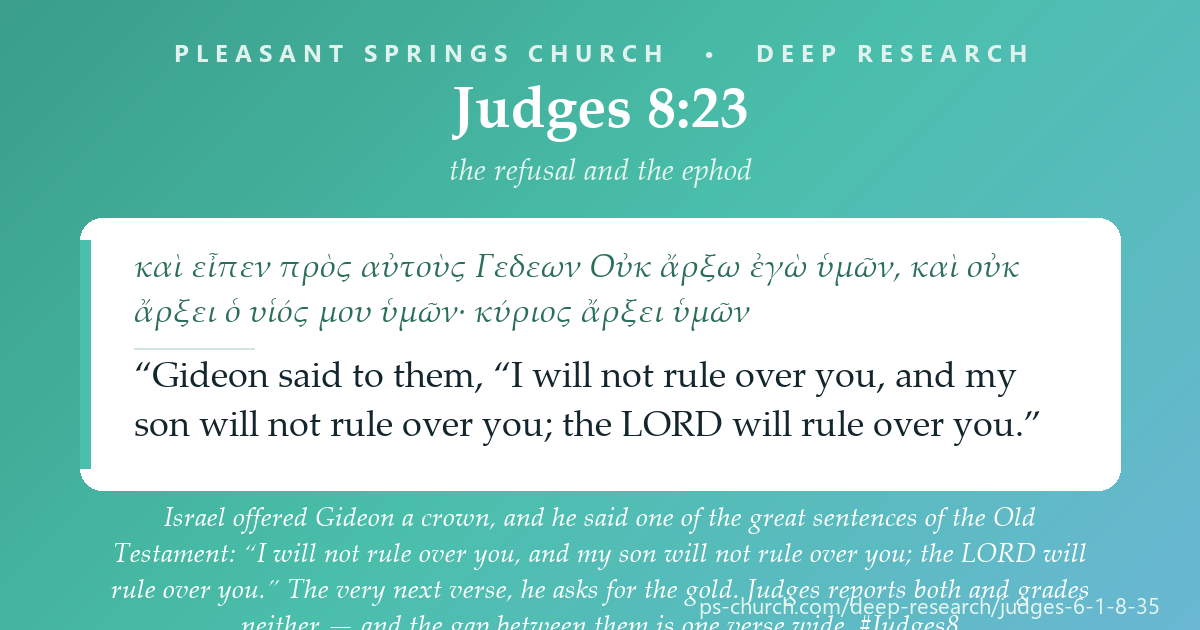
“Rule.” Note that Israel does not use the word king (מֶלֶךְ) — they ask Gideon to rule, “you and your son and your grandson also,” which is a dynasty in everything but name. Gideon’s answer hammers the same verb three times and ends on the subject that matters: יְהוָה יִמְשֹׁל בָּכֶם, “the Lord will rule over you.” Greek A: Οὐκ ἄρξω ἐγὼ ὑμῶν, καὶ οὐκ ἄρξει ὁ υἱός μου ὑμῶν· κύριος ἄρξει ὑμῶν. Then he names a son Abimelech, “my father is king” (8:31).
“Ring, earring, nose-ring.” This is the word of Exodus 32:2–3 — “take off the rings of gold that are in the ears of your wives…” — from which Aaron made the calf; and of Genesis 35:4, where Jacob’s household surrenders “the rings that were in their ears” along with the foreign gods, and he buries them under the terebinth at Shechem. A reader who has the Torah in his ear hears the whole trajectory the moment Gideon says “give me the earrings.” Greek: ἐνώτιον, “ear-piece.”
The ephod — in the Torah the high priest’s vestment, made of gold, blue, purple and scarlet, carrying the breastpiece and the Urim and Thummim (Exodus 28:6–30). Elsewhere in Judges it stands with carved images and household gods in a private shrine (17:5; 18:14–20). Which of those Gideon made, the text does not say; it says only that it was made from war-gold, set up in his own town rather than at the sanctuary, and that Israel whored after it. Both Greek texts refuse to translate it at all — A transliterates εφουδ, B εφωθ — which is itself a small confession that the translators were not sure what to call it either.
“Snare” — a bait-stick or trap for birds and animals. It is the Torah’s standing word for what the nations and their gods become to Israel (Exod 23:33; Deut 7:16) and what Judges 2:3 has already warned of. Greek A renders it σκάνδαλον — the trap-trigger, the word the New Testament turns into “stumbling block” — and B σκῶλον. The verse says the snare caught the man who made it: “a snare to Gideon and to his family.” Chapter 9 is what that cost.
“To whore, be unfaithful” — the book’s own verb for idolatry, used of Israel at 2:17 and then twice here: they whored after the ephod while Gideon lived (8:27) and after the Baals as soon as he died (8:33). The Greek is ἐκπορνεύω — and it is the very word Sirach 46:11 uses to bless the judges “whose heart did not go whoring.” The vocabulary is marital because the covenant is.
“Winepress” and “threshing floor.” You thresh on a gōren — an open, exposed, windy platform, because the whole point is the wind. Gideon is threshing in a gaṯ, a sunken rock-cut vat, which is hopeless for winnowing and excellent for not being seen. The narrator never calls him a coward; he just tells you where the man is standing. And then, twenty-six verses later, Gideon lays the fleece out on the threshing floor (6:37) — the open place he would not use. The two words are five chapters apart in most sermons and twenty-six verses apart in the text.
Where this vocabulary surfaces later:
- 1 Samuel 8 and 12 — Israel asks for a king “like all the nations,” and Samuel hears it as a rejection of the Lord’s own rule — the argument Gideon makes at 8:23, now with the nation on the other side of it. Samuel’s farewell speech names Jerubbaal in his list of deliverers (1 Sam 12:11).
- 1 Samuel 12:11; 2 Samuel 11:21 — the Bible itself keeps calling him Jerubbaal (and at 2 Sam 11:21, Jerubbesheth, with the element “shame” substituted for Baal — a scribal reverence, the same convention behind Ish-bosheth and Mephibosheth).
- Psalm 83:9–11 · MT 83:10–12 · LXX 82:10–12 — “Do to them as you did to Midian, as to Sisera and Jabin at the river Kishon… Make their nobles like Oreb and Zeeb, all their princes like Zebah and Zalmunna.” Three numbers, and they all differ: the Septuagint counts this psalm as 82 (it has run one behind the Hebrew since Ps 9/10), and because the superscription is verse 1 in both Hebrew and Greek, the verses run one ahead of the English as well. Checked in an actual Greek Psalter, not computed.
- Isaiah 9:4 (MT/LXX 9:3); 10:26 — “as on the day of Midian” becomes shorthand in the prophets for a deliverance God did with nothing: the yoke broken, the staff of the oppressor snapped (Greek ὡς τῇ ἡμέρᾳ τῇ ἐπὶ Μαδιαμ). It stands two verses before “For to us a child is born… and the government shall be upon his shoulder” (9:6 · MT/LXX 9:5) — a government, at last, that can be handed to someone. Isaiah 9 carries a one-verse offset here: English 9:1–7 = Hebrew and Greek 8:23–9:6.
- Hebrews 11:32 — “Gideon, Barak, Samson, Jephthah… who through faith conquered kingdoms.” The New Testament names him among the faithful. It does not say he is a model of conduct, and this page will not make him one in either direction.
The cycle formula, the gold in everyone’s ears, and the crown that gets refused and then taken.
Trace four: the account against the formula of 2:11–19; the earrings of Exodus 32; the ephod of Exodus 28; and the argument about kingship that runs from Deuteronomy 17 through Judges 8 and 9 to 1 Samuel 8.
Which cross-references matter?
- Judges 2:11–19 — the cycle stated in the abstract, the interpretive key to the whole book (see Judges 1–2). Gideon’s account keeps all five beats: did evil (6:1), gave them into the hand of Midian (6:1), cried out (6:6), a deliverer raised up (6:14), the land had rest forty years (8:28). What it adds is what matters — a prophet who answers the cry with an indictment (6:7–10), and a deliverer whose own gold becomes the next snare (8:27). The formula still holds; the account has begun to bend it.
- Exodus 32:2–4 — “Take off the rings of gold that are in the ears of your wives…” and Aaron made a calf (see Exodus 32). Judges 8:24–27 is the same noun, the same collection, the same result: a cult object made from donated jewellery, and a nation gone after it. The narrator does not draw the line. The vocabulary does.
- Genesis 35:2–4 — Jacob’s household hands over the foreign gods and the rings in their ears, and he buries them under the terebinth at Shechem (see Genesis 35). Gideon collects at Ophrah what Jacob buried at Shechem. And Shechem is where Gideon’s concubine lives (8:31).
- Exodus 28:6–30 — the ephod as the Torah defines it: gold and coloured yarn, the shoulder-pieces, the breastpiece of judgment, the Urim and Thummim (see Exodus 28). Gideon’s ephod is made of the right metal in the wrong place by the wrong man for an unnamed purpose. That is usually how it goes.
- Deuteronomy 17:14–20 — the law of the king: he must not acquire many horses, or many wives, or excessive silver and gold, and he must write out a copy of the law (see Deuteronomy 17). Read it beside Judges 8:24–31, where Gideon takes the gold and has “many wives” and seventy sons. He refused the title. He is failing the job description.
- Judges 9:1–57 — and the bill comes due. The son named “my father is king” kills the seventy on one stone and is made king at Shechem (see Judges 9). 8:30–31 is not a genealogical footnote; it is the fuse.
- Judges 8:1–3 and 12:1–6 — the same Ephraimite complaint, twice. Gideon defuses it with a proverb about grape-gleanings and “their anger against him subsided”; when Jephthah faces it, forty-two thousand die over the pronunciation of a word (see Judges 10–12). The book is showing you the slope.
- 1 Samuel 8:4–22; 12:11–12 — “they have rejected me from being king over them.” Gideon’s sentence is the theological position the whole Deuteronomistic argument turns on, and Israel will eventually take the other side of it.
- Isaiah 9:4 (MT/LXX 9:3); Isaiah 10:26; Psalm 83:9–11 · MT 83:10–12 · LXX 82:10–12 — “the day of Midian” as the canon’s permanent shorthand for a rescue nobody could take credit for. Both references carry a numbering offset; both are given in full above.
This is the most-preached verse in the passage and the one most often made to say something it does not say, so it is worth being exact.
What the text says. Gideon has already had an angelic visit, an audible commission (6:14, 16), a request for a sign granted with fire out of a rock (6:17–21), an altar built and named (6:24), a direct night-time command obeyed (6:25–27), and the Spirit of the Lord coming on him (6:34). After all of that, he says: “If you will save Israel by my hand, as you have said…” (6:36) and lays out the fleece. God does it. Then he asks again, and prefaces it with “let not your anger burn against me” — which tells you Gideon himself thought he might be pushing it — and God does that too (6:39–40).
What the text does not say. It does not commend the fleece. It does not condemn it. It does not call it faith and it does not call it unbelief. It records a request and a granting, twice, and moves on. That is the whole of the biblical data, and it should be reported as the whole of it.
What follows for us. Using this as a method for making decisions — “putting out a fleece” — goes past what is written, in three specific ways. (1) Gideon is not seeking guidance; he already has the guidance, in words, and is asking for reassurance about it. (2) He is not a believer using a technique; he is a man in a book that also records a burning bush, a talking donkey and fire from heaven. (3) The New Testament, which is where Christians live, never once recommends it, and offers something different: Scripture, the Spirit, prayer, wisdom, and the church (Rom 12:2; Col 3:16–17; Phil 2:12–13; James 1:5).
And what it shows about God. Something worth more than a technique. God accommodated him. Twice. Without rebuke, without a lecture, without withdrawing the commission from a man who plainly needed more than he had been given. That is not a warrant for a method. It is a fact about the character of the one being asked — and it is a great deal kinder than most of the sermons preached from it.
The commentaries, the two Greek texts, and the two verses this page will not reconcile.
Webb, Block, Butler, Boling, Younger, Niditch, McCann and Schneider on Judges; Fernández Marcos on the A and B texts; Trebolle and Rezetko on 4QJudgᵃ; and, at length, 8:23 read beside 8:24–27.
Commentaries & studies:
- Barry G. Webb, The Book of Judges (NICOT) — and his earlier The Book of the Judges: An Integrated Reading (JSOTSup 46), the study that did most to make the book readable as a designed whole.
- Daniel I. Block, Judges, Ruth (NAC), with his article “Will the Real Gideon Please Stand Up? Narrative Style and Intention in Judges 6–9” (JETS 40, 1997) — the single most useful thing in print on the question this page is asking.
- Trent C. Butler, Judges (WBC); Robert G. Boling, Judges (Anchor Bible); K. Lawson Younger Jr., Judges/Ruth (NIVAC); Susan Niditch, Judges (OTL); J. Clinton McCann, Judges (Interpretation); Tammi J. Schneider, Judges (Berit Olam).
- Wolfgang Bluedorn, Yahweh versus Baalism: A Theological Reading of the Gideon-Abimelech Narrative — on 6:25–32 and chapter 9 as one sustained argument about which god actually saves.
- Natalio Fernández Marcos, Judges (Biblia Hebraica Quinta), and his essays on the Hebrew and Greek texts of Judges — the A/B problem, the character of Codex Vaticanus, and the Antiochene text.
- Julio Trebolle Barrera, DJD XIV (4QJudgᵃ, 4QJudgᵇ); Robert Rezetko, “The Qumran Scrolls of the Book of Judges: Literary Formation, Textual Criticism, and Historical Linguistics” (Journal of Hebrew Scriptures) — a full and fair statement of both sides of the 6:7–10 debate.
- Robert Alter, The Art of Biblical Narrative — for reticence, the gap, and repetition-with-variation, the tools this page uses on the narrator’s silences.
- Lidar Sapir-Hen and Erez Ben-Yosef, “The Introduction of Domestic Camels to the Southern Levant: Evidence from the Aravah Valley” (Tel Aviv 40, 2013), read alongside the responses of Martin Heide and of the Associates for Biblical Research — a live disagreement, not a settled result.
Interpretation notes worth keeping:
- The three categories must stay separate. This book approves some things, reports without approving others, and condemns a few outright. It approves what God does (6:14, 16, 7:2, 7:7). It reports, without a word of praise or blame, that Gideon acted by night out of fear (6:27), that he asked for two more signs (6:36–40), that he flailed the elders of Succoth with thorns and killed the men of Penuel (8:16–17), that he had a personal score to settle (8:19), and that he made the ephod (8:27). And it condemns the idolatry — but note whose: “all Israel whored after it there” (8:27), “the people of Israel… whored after the Baals” (8:33). Even the condemnation falls on the nation, and Gideon is described only as the man it became a snare to. Blurring those three categories in either direction is how this book gets misread.
- The hinge is 8:23 next to 8:24. “I will not rule over you, and my son will not rule over you; the Lord will rule over you” is one of the great sentences of the Old Testament, and it is entirely true. And the very next verse is “Let me make a request of you: every one of you give me the earrings from his spoil.” He declines the office and then performs the office — levying from the plunder, funding a sanctuary, establishing it in his own capital, accumulating wives and an heir named my father is king. The narrator sets the two verses side by side and says nothing. The reader is meant to feel the drop. Naming the drop is reading; supplying the verdict the narrator withheld is not.
- The ephod is genuinely underdetermined, and honesty requires saying so. The text does not say what it was for. It does not say Gideon worshipped it. It does not say he intended it as an idol. Ancient readers filled the gap immediately — Pseudo-Philo says flatly that he “made idols and worshipped them” — and modern commentators propose a priestly vestment, a divinatory device, an image, or a war-trophy shrine. The verse gives us three facts and stops: he made it from the gold, he set it up in his town, and all Israel whored after it there. That is enough for the point the narrator is making and not enough for the sermon most of us have heard.
- The pursuit turns personal, and the text does not flag it. Judges 8:4–21 is the hardest stretch to summarize honestly. Gideon asks two Israelite towns for bread and is refused with a sneer; he promises to “flail your flesh with the thorns of the wilderness and with briers” (8:7), comes back, and does it — then breaks down the tower of Penuel and kills the men of the city (8:16–17). (A small text-critical note that belongs here rather than in a footnote: at 8:16 the Hebrew reads וַיֹּדַע, “and he made known / taught,” which is why the ESV has “taught the men of Succoth a lesson.” Both Greek texts read a verb of tearing instead — A κατέξανεν, “he tore them,” B ἠλόησεν, “he threshed them.” The Greek is blunter than the English.) Then, at the end, the reason for the whole pursuit surfaces: “They were my brothers, the sons of my mother” (8:19). A national deliverance has been carrying a blood feud inside it. The narrator reports it and offers no assessment, and this page will not supply one. But it will not pretend the verses are not there, and it will not present them as a model.
- And do not read the silence as approval. Two errors, and both are errors. The first is the Sunday-school flattening that turns Gideon into a hero of decisive faith and his methods into a template. The second is the opposite one: treating the narrator’s reserve as the page’s licence to prosecute him, chapter by chapter, on charges the text never files. The book is doing something more disciplined than either. It is showing you what deliverance looked like in Israel once “there arose another generation… who did not know the Lord” (2:10) — and letting the picture make the argument.
- Hebrews 11:32 is not in tension with any of this. The list there is a list of people God used through faith, not a list of exemplary characters; it names Samson and Jephthah in the same breath. Gideon really did believe God enough to take three hundred men into the dark, and the Spirit of the Lord really did come upon him (6:34). Both halves are in the Bible. A page that keeps only one of them has edited the Bible.
- On the historical questions. The chronology of the judges (the “480 years” of 1 Kgs 6:1 against the sum of the judges’ years, and whether the judgeships overlap), the Iron I settlement debate, and the date of camel domestication are all genuinely contested, and this page names positions rather than adjudicating them. None of them is load-bearing for Christian faith, and no honest reader should be asked to stake it there.
It is worth sitting with 6:12, because it is one of the strangest greetings in Scripture. Gibbōr ḥayil is a military and social term — a man of standing, a warrior, someone with substance behind him. It is said to a man crouched in a wine-vat beating out wheat by hand so the raiders will not see the chaff blow.
Two ways to read it, and they are not exclusive. It may be irony — the angel naming the gap between what Israel was promised and what Israel has become, in a single phrase, which is exactly what Gideon himself does one verse later (“where are all his wonderful deeds?”). Or it may be the plainest kind of grace: God addressing a man by what he will be, because God is about to make him that. The narrator, as usual, does not choose for us.
What is not ambiguous is what happens next. Gideon does not say “yes, Lord.” He argues — twice (6:13, 6:15) — and the argument is not rebuked. He asks for a sign; it is given. He asks again; it is given. He is afraid to go down to the camp; God offers him a way to hear his enemies talking, so that his hands “shall be strengthened” (7:11). Every single one of those accommodations is God’s idea or God’s untroubled reply.
Which is why the ending is so heavy. This is not a man God dealt with harshly. This is a man God carried, at every step, farther than he could have gone; who then said the truest sentence in the chapter — the Lord will rule over you — and in the next breath asked for the gold. If there is a warning in the Gideon account, it is not aimed at people who are frightened. It is aimed at people who have been helped.
From a winepress full of wheat to an ephod in the wrong town.
Name what you learned, why it matters, and one concrete response.
What should we carry away — and do?
- 6:13 is allowed. “If the Lord is with us, why then has all this happened to us?” is not rebuked, not corrected, and not answered with a lecture. It is answered with a commission. The Bible contains people who say hard things to God and are still sent.
- The fleece is reported, not recommended. Scripture neither commends nor condemns it — and building a decision-making method on it goes past what is written. What the passage does show is a God who accommodated a frightened man twice without a word of reproach. Take that and leave the technique.
- 7:2 is the sentence the whole campaign exists to prevent. “Lest Israel boast over me, saying, ‘My own hand has saved me.’” God reduced an army by 99% to protect a truth. And then at 8:22 Israel says it anyway, out loud, in the form of a compliment.
- 8:23 is true, and it is not enough by itself. Gideon said the right thing about God’s kingship and then did the king’s work anyway. It is possible to hold a correct doctrine of who rules and to spend the rest of the week ruling. The gap between 8:23 and 8:24 is one verse wide.
- The narrator’s silence is doing something. He does not tell you what to think about the night raid, the fleece, the thorns, the feud, or the ephod. He shows you, and stops. Learn to read that, because most of Judges is written that way, and the reader who supplies verdicts everywhere will end up hearing his own voice instead of the book’s.
- And the danger came after the victory. Nothing in Gideon’s life went wrong while he was afraid in a winepress. It went wrong on the day everyone told him he had saved them.
Step in response: two things this week. First, say the 6:13 question out loud to God rather than about him — the actual question, in your own words, without softening it. That verse exists so that you can. Second, find the place where you have quietly started ruling something you once said belonged to God — a ministry, a household, a room, a reputation — and hand it back in some concrete way that costs you: tell someone, share the decision, give the credit away in public. Gideon’s sentence took ten seconds. The ephod took the rest of his life.
Judges 8:23 · to share
Greek (Rahlfs A) + ESVEvery Deep Research page traces its passage across the whole sweep — the Old Testament, the Second-Temple world between the testaments (historical witnesses, not Scripture), and the New Testament. Follow the thread:
Pleasant Springs Church — Deep Research
Research method after Michael S. Heiser’s Bible Research Method (examine dictionaries → ancient literature → important words → textual connections → academic publications → share), with the Pleasant Springs “Author & Audience” foundation. Scripture set in the Hebrew, the Greek editions named on each page and the ESV (Old Testament), and the Greek New Testament and the ESV (New Testament), per the practice of Pleasant Springs Church. Judges 6–8 research grounded in Webb (NICOT), Block (NAC, with his 1997 JETS article on Judges 6–9), Butler (WBC), Boling (Anchor), Younger (NIVAC), Niditch (OTL), McCann (Interpretation) and Schneider (Berit Olam), with Fernández Marcos on the Greek texts, Trebolle Barrera (DJD XIV) and Rezetko (JHS) on the Qumran evidence, and Alter on narrative reticence. ANE background from the Ugaritic Baal cycle (ANET 129–142, esp. 130 and 140) for Baal, Yamm and Asherah behind Judges 6:25–32, and Ashurbanipal’s Arabian campaigns (ANET 297–301) for camel-borne desert raiders; the date of camel domestication (Sapir-Hen and Ben-Yosef, Tel Aviv 40, 2013, and the responses to it) is reported as an open question and not adjudicated. Second-Temple witnesses (Pseudo-Philo, LAB 35–36; Josephus, Ant. 5.213–232 = Whiston 5.6.1–7; Sirach 46:11–12) are read as witnesses, never as Scripture. Text. Judges survives in two substantially different Greek forms — A (Codex Alexandrinus) and B (Codex Vaticanus) — which Rahlfs prints in parallel on the same page; there is no single “the LXX” for this book. The Greek column on this page is Rahlfs’s A text throughout, verified line by line and cross-checked in a second independent digitization of the same text; where B materially differs in a verse printed above, B is printed beside it and labelled (6:12, 6:27, 6:32, 8:23, 8:27), and the remaining significant divergences are named in the codex note (6:7, which B effectively lacks; 6:34; 8:22). Numbering: Judges has no chapter- or verse-offset — Hebrew, Greek A, Greek B and English agree throughout all twenty-one chapters; where this page cites a psalm the Septuagint numbers differently (Ps 83 = LXX Ps 82) both numbers are given. The fleece (6:36–40) is reported as the text reports it — neither commended nor condemned — and is explicitly not offered as a model for decision-making; the juxtaposition of 8:23 with 8:24–27, and the personal motive that surfaces at 8:19, are stated plainly and left as the narrator left them.
Scripture quotations marked ESV are from the ESV® Bible (The Holy Bible, English Standard Version®), © 2001 by Crossway, a publishing ministry of Good News Publishers. ESV Text Edition: 2016. Used by permission. All rights reserved. The ESV text may not be quoted in any publication made available to the public by a Creative Commons license, and the ESV may not be translated in whole or in part into any other language. www.esv.org
|
Did this study bless you today? 💚 Give to Support PS Church100% of gifts go to the General Fund — thank you. |