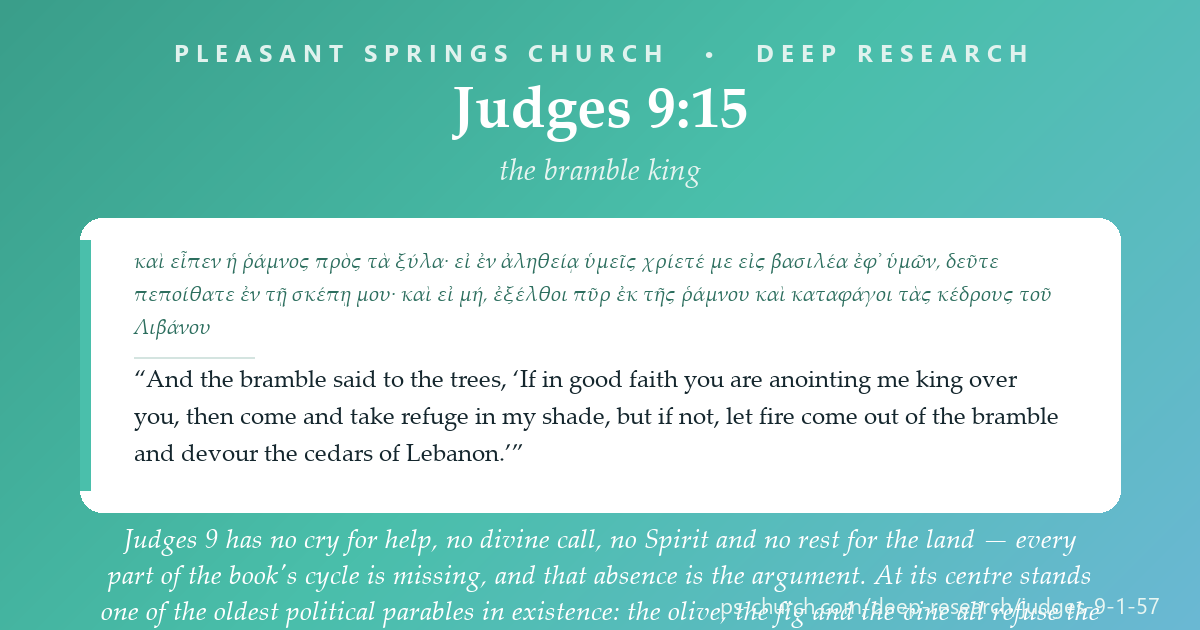
Gideon had been offered a crown and refused it: “I will not rule over you, and my son will not rule over you; the Lord will rule over you” (8:23). His son learned a different lesson. Abimelech goes to his mother’s family at Shechem and asks the question of a man who has already decided the answer — “Which is better for you, that all seventy of the sons of Jerubbaal rule over you, or that one rule over you?” (9:2) — takes seventy pieces of silver out of the house of Baal-berith, hires men the text calls “worthless and reckless,” and kills his seventy brothers on one stone. Only Jotham, the youngest, escapes. And then Jotham climbs Mount Gerizim — the mountain of blessing — and shouts down a curse in the form of a story: the trees went out to anoint a king; the olive would not leave its oil, the fig its sweetness, the vine its wine, because each of them had real work to do; and so they asked the bramble, which has no fruit to lose and no shade to give, and it said, “come and take refuge in my shade… but if not, let fire come out of the bramble and devour the cedars of Lebanon” (9:8–15). It is one of the oldest political parables in existence, and the only candidate willing to rule is the one that can only burn. What follows is three years and a collapse: an evil spirit, a revolt, a city razed and sown with salt, a stronghold set alight, and an end at Thebez under a millstone dropped by a woman whose aim the narrator has already reported before he lets Abimelech ask to have the story told differently. Measure the whole chapter against the cycle of 2:11–19 and every single element is gone — no cry, no call, no Spirit, no deliverance, no rest, and not one occurrence of the covenant name in fifty-seven verses. And then, at 9:56–57, the narrator of Judges does the thing he almost never does: he tells you what he thinks. This study works Judges 9:1–57. See the method →
Judges 9:1–57 (selections)
Hebrew · LXX (Judges A) · ESVThe Shape of the Passage
ConcentricThis chapter is the second half of one story. It begins in Judges 6–8, with Gideon’s refusal of the crown and the ephod he made anyway, and it ends by handing the book on to Jephthah. The pattern it is measured against was laid down at 2:11–19. The mountain Jotham stands on was assigned its role in Deuteronomy 27 and used for it in Joshua 8:30–35.
Author
A narrator who almost never comments — and who comments here. That is the single most important thing about this chapter, and it is why it belongs early in any serious reading of Judges. The book will shortly report a vow that costs a daughter her life, a Levite who dismembers a woman and sends the pieces out as mail, and a tribe that solves a shortage of wives by abduction, and it will do all of it without a word of evaluation. Readers regularly conclude that the narrator has no view. Judges 9 is the proof that he does. At 9:56–57 he steps forward, says “Thus God returned the evil of Abimelech,” ties it to a curse spoken nearly forty verses earlier, and steps back again. The silence everywhere else is therefore a choice, not an oversight. He can say it. He is declining to.
And he tells this one by subtraction. Robert Alter’s name for the biblical narrator’s habit of withholding is reticence — the gap you are meant to notice. Here the gaps are structural. The formula of 2:11–19 is so fixed by chapter 9 that a reader hears the missing beats the way you hear a dropped line in a hymn: no distress, no cry, no call, no Spirit, no deliverance, no rest. The narrator reports God doing something exactly three times in fifty-seven verses (9:23; 9:56; 9:57) — the only other place God is the subject of a verb is a wish inside Jotham’s own speech (9:7) — and all three of those acts are acts of giving evil back. The Lord is not named once. A chapter about a man who made himself king is told as a chapter in which God barely speaks — and that, too, is the technique.
A note on the Greek. Judges is the Old Testament book with two Greek texts, printed in parallel by Rahlfs and translated twice by NETS. This page prints the A text and names the B readings where they matter (see the codex note and Stage 5). Nothing on the page depends on preferring one over the other.
Audience
People who had just heard Gideon say no. Whoever first heard this heard it directly after 8:22–23, where Israel offers Gideon a dynasty and he answers, “I will not rule over you, and my son will not rule over you; the Lord will rule over you.” The verb there is מָשַׁל (māšal). It is the first verb out of Abimelech’s mouth in 9:2. He has taken his father’s word and inverted his father’s sentence, and the audience is meant to hear it. Gideon refused the crown and then made the ephod; his son skips the refusal.
People who knew what Shechem was. This is not a neutral address. Shechem is where Abram built his first altar in the land (Gen 12:6–7), where Jacob bought ground and set up an altar (Gen 33:18–20), where the sword of Simeon and Levi was drawn (Gen 34), where Joseph’s bones were buried, and where Joshua gathered all Israel to renew the covenant and set up a stone “under the oak that was in the sanctuary of the Lord” (Josh 24:26). Judges 9:6 crowns Abimelech “by the oak of the pillar at Shechem.” Many readers take that to be the same tree. The text does not say so, and this page will not claim it does — but the audience did not need to be told what ground they were standing on.
And people who had to decide what a king was for. Jotham’s fable is not a general theory of politics and it is not aimed at monarchy as such; it is aimed at these men and this king (9:16–20 applies it by name). But it does put a question into the book that the book will keep asking to its last verse (21:25): what happens to a people whose only volunteer is the one with nothing to lose?
Orient on Abimelech, Shechem and its covenant god, the fable as a genre, and the geography of a three-year collapse.
Search by topic: Abimelech (son of Jerubbaal), Jerubbaal / Gideon, Shechem, Baal-berith and El-berith, Beth-millo, Migdal-shechem (Tower of Shechem), Gerizim and Ebal, Jotham, Gaal son of Ebed, Zebul, Thebez, Zalmon, concubine (pilegesh), kingship in early Israel, fable and parable (mashal), atad (bramble/buckthorn), armor-bearer, millstone, salt (sowing with).
Which articles are relevant?
- Anchor Bible Dictionary — “Abimelech,” “Shechem,” “Baal-Berith,” “El-Berith,” “Millo,” “Gerizim, Mount,” “Thebez,” “Fable,” “Judges, Book of,” “Kingship (Israelite).”
- Dictionary of the OT: Historical Books (IVP) — “Judges, Book of,” “Abimelech,” “Kingship,” “Canaanite Gods and Religion,” “Fables, Parables and Riddles,” “Violence,” “Archaeology of the Period.”
- NIDOTTE / TDOT — מָשַׁל (māšal, rule), מָלַךְ (mālaḵ, be king), שָׂרַר (śārar, be prince — the verb of 9:22), אָטָד (ʾāṭāḏ, bramble), רָעָה (rāʿāh, evil), קְלָלָה (qəlālāh, curse), בָּגַד (bāġaḏ, deal treacherously).
Bibliography surfaced:
- Barry G. Webb, The Book of Judges (NICOT); Daniel I. Block, Judges, Ruth (NAC); Trent C. Butler, Judges (WBC); Robert G. Boling, Judges (Anchor Bible); K. Lawson Younger Jr., Judges and Ruth (NIVAC); Susan Niditch, Judges (OTL); J. Clinton McCann, Judges (Interpretation); Tammi J. Schneider, Judges (Berit Olam).
- On the Greek: the introduction to NETS Judges, which sets out why Rahlfs printed an A text and a B text and translates both.
- On Shechem: the excavation literature for Tell Balāṭah (Sellin; G. Ernest Wright; Edward F. Campbell; Lawrence E. Stager), read as a live discussion rather than a settled result.
- Robert Alter, The Art of Biblical Narrative — for reticence, the gap, and the way a Hebrew narrator characterizes by what he declines to say.
A city named on an Egyptian soldier’s tombstone, a warlord in the Amarna post, a temple with seventeen-foot walls, and a very old habit of letting plants argue.
Take four soundings: Shechem in the written records of the second millennium; Shechem in the ground; the fable as an ancient Near Eastern genre; and the way the first readers of this chapter — Josephus and Pseudo-Philo — retold it.
Which parallels shed light on the setting?
Shechem is one of the few towns in this book named in a foreign record centuries before it. The stela of an Egyptian officer of Sen-Usert III (Sesostris III, 19th century BC) — ANET prints it as “The Inscription of Khu-Sebek, Called Djaa”; it is better known as the Stela of Sebek-khu — records a northern campaign: “His majesty reached a foreign country of which the name was Sekmem… Then Sekmem fell, together with the wretched Retenu” (ANET 230, in ANET’s Egyptian Historical Texts; ANET’s own footnote on Sekmem reads simply, “Probably Shechem”). Whatever else is uncertain, the place Abimelech seizes was already old enough, and important enough, to be worth a pharaoh’s attention.
And in the fourteenth century it had a strongman of its own. In the Amarna letters — the diplomatic correspondence of Egypt’s Canaanite vassals (ANET 483–490) — the ruler of the Shechem highlands is Lab’ayu, and his neighbours complain about him constantly. In EA 289 Abdi-Heba of Jerusalem asks the pharaoh, in effect, whether he is expected to behave the way Lab’ayu did when he handed the land of Shechem over to the ʿApiru — the sentence is paraphrased here rather than quoted, since the wording depends on which edition you read (Moran, The Amarna Letters, is the standard English text). The letters are a genuine window onto the world of Judges 9: a hill-country town, a leader with a private following of landless fighters, cities that turn on one another, and an overlord too far away to help. ⚠ What they are not is a proof-text. The equation of the ʿApiru with the Hebrews is a contested proposal, not an established result — the term looks social rather than ethnic, and it turns up from Anatolia to Egypt. Read the letters for the world; do not read them for the genealogy.
The temple in the ground at Shechem. Shechem is identified with Tell Balāṭah, at the eastern edge of modern Nablus. Ernst Sellin dug there in 1913–14 and again from 1926, and an American expedition under G. Ernest Wright worked the site from 1956. What they found on the acropolis is the largest Canaanite temple yet excavated in the land — a migdal or “fortress-temple” (“Temple 1”) with foundation walls something like seventeen feet thick. Campbell, Stager and many others connect it with the building Judges 9 calls the Tower of Shechem and the stronghold of the house of El-berith (9:46). The connection is widely made and is genuinely attractive; it is not unanimous, and stratigraphy is argued about in print. We do not adjudicate it here. What the excavation does establish beyond argument is that the chapter’s furniture — a temple treasury that could hand over seventy pieces of silver, a stronghold a thousand people could crowd into — is the furniture of a real Late Bronze town.
Arguments between rival goods are an old genre. Jotham’s fable is not a one-off invention. Mesopotamian scribes had a whole tradition of disputation literature, and ANET prints one of the Sumerian examples right beside the Cain-and-Abel material: Dumuzi and Enkimdu: the Dispute between the Shepherd-God and the Farmer-God (ANET 41–42). ANET’s own headnote describes the form exactly — a group of compositions whose “contents consist in large part of disputes between two gods, two demigods, or two kings, each of whom attempts to convince the other of his superiority by extolling his own virtues and achievements and belittling those of his opponent” — and it notes that in the surviving Sumerian texts the quarrel ends in a settlement rather than a killing, because the farmer-god simply refuses to fight. The Akkadian branch of the same tradition includes the well-known contest of the tamarisk and the date palm (edited by W. G. Lambert, Babylonian Wisdom Literature, in his chapter on fables and contest literature; the ANET page for that one lies past our local copy and is therefore not cited here). Knowing the genre is worth something practical: it tells you Jotham’s hearers would have recognized the form at once and been ready for the sting. It also tells you the fable is art, and that its details are chosen. The olive, the fig and the vine are precisely the three crops the hill country actually lived on. The bramble is precisely the plant that is good for nothing but burning. ⚠ And the difference is as instructive as the likeness: the ANE disputations are contests between two useful things, each boasting; Jotham’s trees are not competing at all — three of them decline, and the one that accepts has nothing whatever to boast of.
- The Inscription of Khu-Sebek, Called Djaa (the Stela of Sebek-khu), reign of Sen-Usert III, 19th c. BC (ANET 230) (an Egyptian military inscription — a witness, not Scripture) — “a foreign country of which the name was Sekmem… Then Sekmem fell, together with the wretched Retenu”; ANET’s footnote on the name: “Probably Shechem.”
- The Amarna letters, 14th c. BC (ANET 483–490) (Canaanite vassal correspondence — a witness, not Scripture) — Lab’ayu of Shechem and his ʿApiru; EA 289 (Abdi-Heba of Jerusalem) is the letter that names Shechem. Moran, The Amarna Letters, is the standard English edition. ⚠ The ʿApiru/Hebrew equation is debated and is not used here as an identification. (These pages lie past our local copy of ANET; the reference follows the standard index rather than a page we have checked.)
- Dumuzi and Enkimdu: the Dispute between the Shepherd-God and the Farmer-God (ANET 41–42) (Sumerian — a witness, not Scripture) — the disputation genre behind Jotham’s trees, with ANET’s own headnote defining the form. For the Akkadian branch (the tamarisk and the date palm) see W. G. Lambert, Babylonian Wisdom Literature, on fables and contest literature.
- Josephus, Antiquities 5.233–253 (= Whiston 5.7.1–5; the Abimelech account runs from §233, Παῖδες δὲ ἦσαν αὐτῷ γνήσιοι μὲν ἑβδομήκοντα, to §253, with Jair beginning at §254) (Second-Temple — a witness, not Scripture) — he names the concubine Drumah (Δρούμας), sets Jotham’s speech at “a publick festival at Shechem,” and compresses and reorders the fable: fig, then vine, then olive, and then “the brier” with a gloss for readers who might miss the joke — “it is a sort of wood good for firing.” He has Jotham live privately in the mountains three years; he says Abimelech “sowen its ruins with salt”; he puts about fifteen hundred at the rock. And — this is the datum — where the Bible reports, Josephus editorializes: Abimelech “underwent this death, as a punishment for the wickedness he had perpetrated against his brethren,” and “the calamity that happened to those Shechemites was according to the prediction of Jotham” (Whiston’s English).
- Pseudo-Philo, Liber Antiquitatum Biblicarum 37 (first century — a witness, not Scripture) — a remarkable accident: the Latin text has lost a leaf at exactly this point. M. R. James’s translation prints nothing but “[A leaf gone.]” after the single sentence on the killing of the brothers, and the text resumes in the middle of the fable; it breaks off again after Abimelech’s death with “[A gap of uncertain length in the text.]” What survives has fig, vine, apple and bramble, and gives each tree a specific sentence on Abimelech — “neither shall Abimelech obtain continuance in his rulership”; “so shall the blood of Abimelech be required at your hand”; “Abimelech shall die by stones.” The bramble’s speech reaches back to Adam (“the earth was condemned to bring forth thorns and thistles”) and to Moses (“it was by a thorn bush that it enlightened him”). LAB gives Abimelech one year and six months rather than three years, and keeps the woman and “the half of a millstone.” James himself thought the adaptation “singularly inept as it stands” and wondered whether the lost opening would have made it plausible — a translator’s honesty worth imitating.
It is worth being exact about these three, because Judges is read badly in both directions.
What it condemns, out loud: Abimelech. This is the one chapter in the book where the narrator says it — twice, in 9:56 and 9:57, using the word evil (רָעָה) of both the king and the city that made him. There is nothing to reconstruct here and nothing to soften.
What it reports without approving: nearly everything else. The seventy on one stone. The hired men. The ambushes. The razing of Shechem and the salt. The thousand in the stronghold. Gaal’s boast and Zebul’s trap. Abimelech’s last order to his armour-bearer. The narrator gives these to you flat, without comment, and a page that supplies the outrage on his behalf has taken the sentence out of his mouth. He knows how to say it. He said it in 9:56.
What it approves: nobody, and that is the strangest fact about the chapter. There is no hero in Judges 9. Jotham speaks truly and then runs and lives “because of Abimelech his brother” (9:21) — he is right, and he is powerless, and the text does not pretend otherwise. The woman at Thebez is not praised; she is simply the last thing that happens. The Sunday-school habit of turning every figure in Judges into a hero and every episode into a model breaks completely here, and it is a mercy that it does, because it is the same habit that turns Samson into a role model twenty pages later. Judges is not a gallery of examples. It is an argument, and this chapter is one of its sharpest paragraphs.
The verb Gideon refused, the verb the book withholds, a bramble with no shade, and a name that is never spoken.
Watch mashal travel from Gideon’s refusal into his son’s sales pitch; watch the book decline to say shaphat; count fire, head and evil; and notice which divine name is missing for fifty-seven verses.
“Rule, have dominion.” Abimelech’s pitch uses his father’s verb. Israel had said to Gideon, “Rule over us” (מְשָׁל־בָּנוּ, 8:22), and Gideon answered, “I will not rule over you, and my son will not rule over you; the Lord will rule over you” (8:23) — three times, one verb. In 9:2 the son puts the same verb back on the table: “that all seventy… rule over you, or that one rule over you.” The Greek A text hears the change of register and switches words, ἄρχειν for the seventy and κυριεύειν for the one man — to govern against to be lord over.
“Be a prince, lord it.” The book’s own summary formula is “and he judged Israel N years” (שָׁפַט) — it is used of Tola in the very next paragraph (10:2). Of Abimelech the text will not use it. It says וַיָּשַׂר אֲבִימֶלֶךְ עַל־יִשְׂרָאֵל שָׁלֹשׁ שָׁנִים, “Abimelech lorded it over Israel three years” (ESV “ruled over”). The verb śārar occurs exactly once in the book of Judges — here (the related noun śar, “commander,” turns up at 4:7 and again in this chapter at 9:30, of Zebul). One verb, and the whole verdict of the book on his office is inside it.
The bramble or buckthorn — a low, thorny scrub, no fruit, no timber, and famously good for a quick hot fire. The Greek A text renders it ῥάμνος. The joke inside the invitation is that a bramble has no shade: “come and take refuge in my shade” is an offer of nothing, made by the only candidate with nothing to give up. And then the same plant that cannot shelter you can certainly burn you — “let fire come out of the bramble and devour the cedars of Lebanon,” the tallest trees in the ancient imagination, threatened by a thorn bush.
“To sway, wave, totter.” It is the refrain of the three trees that say no, identical all three times: “and go to sway over the trees?” (ESV “hold sway” catches the pun in English). The root elsewhere means to stagger or be shaken. Every fruit tree in the fable describes ruling as wobbling about above other people — and each one has a reason not to: oil, sweetness, wine. They will not stop doing their work in order to be important.
“Fire.” Five occurrences, and they run the chapter. It is threatened by the bramble (9:15), aimed twice by Jotham (9:20), used by Abimelech on the stronghold at Shechem (9:49), and is what he has come to the tower at Thebez to do when he dies (9:52). The bramble said fire would come out of it; the last thing the man does is carry fire to somebody else’s door.
“Head, top.” Nine occurrences, in the chapter’s two registers. Elevation: Jotham stands on the top of Gerizim (9:7) and the ambushes sit on the mountain tops (9:25), and Gaal watches men coming down from those same tops (9:36). Military: four more are the ordinary Hebrew idiom for a company or column of troops — Abimelech attacks “in four companies” (9:34), then in three (9:43; cf. 9:37, 44), which is why English versions do not print the word “head” there at all. And then it comes down: the millstone lands on Abimelech’s head (9:53), and God returns the evil of Shechem “on their heads” (9:57). The word that runs the chapter as height and as command ends as accountability. (Count it yourself; that is the point of printing the list.)
“Evil.” It occurs three times in the chapter and nowhere else in it. First it is the evil spirit God sends (9:23); then it is the evil of Abimelech (9:56) and all the evil of the men of Shechem (9:57). Note what is missing: this is the only word-family the book’s cycle formula depends on (“Israel did evil in the sight of the Lord”), and here it never once appears in that phrase. The evil in Judges 9 is not diagnosed; it is simply handed back.
“Turn, return” — in the causative, make something come back. The last two verses use it twice: וַיָּשֶׁב אֱלֹהִים (“God returned”) and הֵשִׁיב אֱלֹהִים (“God made… return”). The A text renders the pair with two different compounds, ἀπέστρεψεν and ἐπέστρεψεν. It is the vocabulary of a boomerang, and it is the narrator’s only editorial in the chapter.
“God.” Six occurrences — and the Tetragrammaton, the personal covenant name, does not occur in Judges 9 at all. That is checkable in any Hebrew Bible and it is worth checking. Two of the six are inside the fable, on the lips of trees; one is Jotham’s wish that God would listen; and the last three are the only actions the narrator reports God taking. Compare 6:34, where רוּחַ יְהוָה, “the Spirit of the Lord,” clothed Gideon. In this chapter the only רוּחַ is רוּחַ רָעָה.
Where this vocabulary surfaces again:
- Judges 8:22–23 — the refusal that this chapter answers: “I will not rule over you… the Lord will rule over you” (see Judges 6–8). Read 9:2 immediately after it; the two verses are built out of the same verb.
- Judges 10:1–2 — the very next paragraph restores both missing verbs at once: “there arose to save Israel Tola… and he judged Israel twenty-three years” (see Judges 10–12). The contrast is deliberate and it is one verse away.
- Deuteronomy 17:14–20 — the law of the king, which anticipates Israel asking for one and sets conditions that Abimelech violates in every particular (see Deuteronomy 17). Israel’s problem was never that it had a king; it was what kind.
- Deuteronomy 27–28 — blessing on Gerizim, curse on Ebal, and a long liturgy of curses that come upon a people and overtake them. Judges 9:57 says the curse of Jotham “came upon them” using the ordinary verb of that liturgy (see Deuteronomy 27 and 28).
- 2 Samuel 11:21 — the only place outside Judges 9 where this Abimelech is mentioned (the Abimelechs of Genesis 20–21 and 26 are Philistine kings of Gerar, a different man and a different name-bearer), and it is a soldier’s proverb. Joab coaches a messenger on how David will react to a bad assault: “Who killed Abimelech the son of Jerubbesheth? Did not a woman cast an upper millstone on him from the wall, so that he died at Thebez?” Three centuries later the story was still the standard example of a commander who got too close to a wall.
- Hebrews 11:32 — the New Testament’s roll call names Gideon, Barak, Samson and Jephthah out of this book. Abimelech is not in it. Neither is he called a judge in Judges. Both silences are worth noticing together.
The blessing mountain, the covenant oak, the crown that was refused — and a King who walked away from one.
Trace four threads: Gerizim and what it was for; Shechem across the whole canon; the question of kingship from Deuteronomy 17 forward; and the evil spirit of 9:23, handled without a slogan.
Which cross-references matter?
- Deuteronomy 27:11–13 — “These shall stand on Mount Gerizim to bless the people… and these shall stand on Mount Ebal for the curse.” Gerizim is the blessing mountain, and Israel had actually done this, on that spot, in Joshua 8:30–35 — the altar of uncut stones, the law written out, every word read aloud to everyone (see Deuteronomy 27 and Joshua 7–8). Jotham climbs the blessing mountain to pronounce a curse. The text does not comment; it simply gives you the coordinates and lets you do the arithmetic.
- Joshua 24 — the covenant renewed at Shechem, ending with a great stone set up “under the oak that was in the sanctuary of the Lord” as a witness (24:26), and Joseph’s bones buried there (24:32) (see Joshua 23–24). Judges 9:6 crowns Abimelech “by the oak of the pillar at Shechem.” Many readers hear the same tree; the text does not say so, and neither will we.
- Genesis 12:6–7; 33:18–20; 34 — Shechem is where Abram built his first altar in the land, where Jacob bought a field and called an altar “God, the God of Israel,” and where Dinah’s brothers turned the city’s covenant into a massacre (see Genesis 12, 33, 34). Shechem has a long memory of covenants made and covenants weaponized, and Judges 9 adds a chapter to it — where the temple money that buys the murderers comes from the house of Baal-berith, “lord of the covenant.”
- Judges 2:11–19 — the cycle in the abstract, which is the measuring stick this whole page uses (see Judges 1–2). Compare a clean run of it in Othniel, a bent one in Deborah and Barak, and its final collapse in 17–18 and 19–21.
- 1 Samuel 8 — Israel asks for a king “like all the nations,” and Samuel answers with a list of what a king will take. Judges 9 is the book’s worked example, three centuries early, of what happens when the only man who wants the job is the one you should not give it to. (No Deep Research page yet; cited here in text.)
- John 6:15 — “Perceiving then that they were about to come and take him by force to make him king, Jesus withdrew again to the mountain by himself.” Set beside Judges 9 this is not typology and this page does not offer it as such; it is the canon’s own contrast. The one man in Scripture with an actual right to the crown is the one who will not be levered onto it by a crowd — and who receives it, later, from his Father rather than from Shechem.
This verse is going to stop some readers, and it should not be hurried past with a slogan.
First, what the verse says. The Hebrew is וַיִּשְׁלַח אֱלֹהִים רוּחַ רָעָה — “and God sent an evil spirit” — between Abimelech and the leaders of Shechem. The Greek A text has ἐξαπέστειλεν ὁ θεὸς πνεῦμα πονηρόν. There is no textual escape hatch; the versions agree. The same idiom appears later of Saul (1 Samuel 16:14).
Second, what the verse does not say. It does not say God made anyone sin. The second half of the very same verse puts the verb of betrayal in human hands: “and the leaders of Shechem dealt treacherously with Abimelech” — וַיִּבְגְּדוּ, they broke faith, they did it. Nor does the chapter offer any mechanism. It does not tell you what the spirit is, how it works, or what it did. Judges 9 is a chapter of enormous reticence, and this is one of its silences.
Third, what the canon holds alongside it. “God cannot be tempted with evil, and he himself tempts no one” (James 1:13). Both sentences stand in the same Bible. Christians have proposed several ways of holding them — that God withdraws a restraint and lets a murderous alliance become what it already was; that he permits and governs what he does not author; that Hebrew idiom will attribute to God what he allows. Each of these has been held by serious people, and each is a way of refusing the two things Scripture never says: that God is the author of sin, and that the Shechemites were not responsible.
What the page will not do is turn the difficulty into a bumper sticker — not “God is sovereign over evil, end of discussion,” and not “this is just how ancient people talked.” Both of those are ways of not reading the verse. Here is what the chapter itself gives you: a conspiracy founded on a mass murder came apart, and the narrator tells you at the end that this was God returning what these men had done (9:56–57). He calls it justice. He does not explain it. Neither will we.
The commentaries, the two Greek texts, the fable’s politics, and the parts we will not settle.
Webb, Block, Butler, Boling, Younger, Niditch, McCann and Schneider on Judges; the NETS introduction on the A and B texts; Boogaart and Ogden on this chapter in particular; and an honest list of the open questions.
Commentaries & studies:
- Barry G. Webb, The Book of Judges (NICOT, 2012) and his earlier The Book of the Judges: An Integrated Reading — the most sustained argument that the book is one designed composition and that its variations on the cycle are its message.
- Daniel I. Block, Judges, Ruth (NAC); Trent C. Butler, Judges (WBC); Robert G. Boling, Judges (Anchor Bible); K. Lawson Younger Jr., Judges and Ruth (NIVAC).
- Susan Niditch, Judges (OTL); J. Clinton McCann, Judges (Interpretation); Tammi J. Schneider, Judges (Berit Olam) — the literary and social readings, which are especially attentive to who in this chapter is named and who is not.
- T. A. Boogaart, “Stone for Stone: Retribution in the Story of Abimelech and Shechem,” JSOT 32 (1985) 45–56 — the standard treatment of the chapter’s measure-for-measure design.
- Graham S. Ogden, “Jotham’s Fable: Its Structure and Function in Judges 9,” The Bible Translator 46 (1995) 301–308 — on the fable’s form and how it works where it stands.
- Vince Endris, “Yahweh versus Baal: A Narrative-Critical Reading of the Gideon/Abimelech Narrative,” JSOT 33 (2008) 173–195 — on chapters 6–9 as a single argument about which god is actually running Israel.
- Christopher T. Begg, “Abimelech, King of Shechem according to Josephus,” Ephemerides Theologicae Lovanienses 72 (1996) 146–164 — a verse-by-verse comparison of Ant. 5.233–253 with the biblical text, and the place to go if the Josephus notes at Stage 2 interest you.
- Nadav Na’aman, “A Hidden Anti-Samaritan Polemic in the Story of Abimelech and Shechem (Judges 9),” Biblische Zeitschrift 55 (2011) 1–20 — a much later dating and setting for the chapter than most conservative readers will accept; listed because it is a serious argument in print about why Shechem, and because naming the positions is better than pretending they are not there.
- A New English Translation of the Septuagint (NETS), Judges — the introduction is the clearest short account of why there are two Greek Judges, and the volume prints A and B in parallel columns so a reader without Rahlfs can see the divergence.
- The excavation reports and syntheses for Tell Balāṭah (Sellin; G. E. Wright, Shechem: The Biography of a Biblical City; Edward F. Campbell; Lawrence E. Stager on the fortress-temple) — read as an ongoing discussion.
Interpretation notes worth keeping:
- The cycle, and the argument from absence. The formula at 2:11–19 has six moving parts. Judges 9 has none of them. There is no “the people of Israel did evil in the sight of the Lord,” no oppressor, no cry, no raising up, no salvation, no rest. This is not an impression: זָעַק/צָעַק, יָשַׁע, שָׁפַט and שָׁקַט are simply absent from the chapter, as is the Tetragrammaton. Abimelech is the one figure in the book’s central section of whom none of it is ever said — not raised up, not given the Spirit, never said to save anyone, never called a judge. Even Shamgar, who gets a single verse and an oxgoad, is said to have saved Israel (3:31).
- The two Greek texts, stated once more because it matters. Rahlfs printed Judges twice — an A text (Codex Alexandrinus plus the Origenic and Lucianic groups) and a B text (Codex Vaticanus) — because the traditions differ enough to amount to separate editions. Later work has refined the picture (the A witnesses are now usually subdivided AI/AII/AIII, and many hold that the Old Greek is best preserved within the Lucianic AII group), but the practical point for a reader is unchanged: quoting “the Septuagint” of Judges without saying which one is meaningless. This page prints A and names B where the sense diverges.
- Is Jotham’s fable anti-monarchic? Positions differ and none should be flattened. Some read it as a broad polemic against kingship as such — the useful refuse to rule, the useless volunteer. Others (Webb, Block among them) read it as aimed narrowly at this king, since 9:16–20 applies it by name and the book’s ending appears to lament the absence of a king rather than the idea of one. A third reading takes the fable as older material given a sharpened setting. We do not adjudicate. What can be said from the text is that 9:16–20 is an application to Abimelech and Shechem specifically, and that the book’s closing refrain pulls the other way.
- The salt (9:45). Israel’s Bible mentions sowing a city with salt exactly once, here. Explanations offered include a ritual act of desacralization, a curse on the ground’s fertility, and a symbolic gesture whose original force is lost. The text gives no reason and we will not invent one. Deuteronomy 29:23 does describe a ruined land as “the whole land burned out with brimstone and salt, nothing sown and nothing growing, where no plant can sprout” — and the ESV’s own cross-reference at that verse points here, to Judges 9:45. That tells us the image was available; it does not tell us what Abimelech thought he was doing.
- The women of the chapter. Two women appear, and both are unnamed. One is Abimelech’s mother, identified only as Gideon’s concubine at Shechem (8:31) — the fact that gives Abimelech a claim on the city and, in 9:18, gives Jotham the phrase “the son of his female servant.” The other is the woman at Thebez. It is worth noticing that the narrator tells you exactly what she did (9:53) before he lets Abimelech ask to have the record altered (9:54) — the last order of his life is an order about how the story will be told, and the story does not obey. The chapter neither praises her nor blames her; it reports her, and then it reports him trying to erase her, and it leaves the two sentences side by side. Compare the pattern the book has already set at 4:9 and 5:24–27, where a battle is decided by a woman and the text says so plainly.
- The one place the narrator speaks. 9:56–57 is not a small thing. Everything readers find hard about Judges — the vow in chapter 11, the Levite in chapter 19, the abductions in chapter 21, all narrated without a word of evaluation — has to be read in the light of the fact that this narrator can evaluate and does, once, here. His restraint elsewhere is deliberate rhetoric, not moral confusion, and reading it as approval is a mistake about the author, not just about the text.
- Chronology. The chapter gives Abimelech three years and no synchronism with anything outside itself. The larger arguments — the 480 years of 1 Kings 6:1 against the sum of the judges’ years, whether the judgeships overlap, the dating of Iron I settlement — are real, live and unsettled, and nothing on this page depends on any of them. Christian confidence has never rested on a chronology, and no reader should be asked to stake it there.
Read 9:22 and 10:1–2 back to back and you can watch a narrator withhold a title.
Of Abimelech: וַיָּשַׂר אֲבִימֶלֶךְ עַל־יִשְׂרָאֵל שָׁלֹשׁ שָׁנִים — he lorded it over Israel three years.
Of the next man in the book, one chapter later: “there arose to save Israel Tola… and he judged Israel twenty-three years.” Both of the book’s load-bearing verbs — save and judge — come straight back the moment Abimelech is off the page.
And there is a third thing the chapter withholds. In this book, the deliverers get a sentence like “the Spirit of the Lord was upon him” (3:10), or “clothed Gideon” (6:34), or “rushed upon him” (14:6). Abimelech gets a spirit too. It is רוּחַ רָעָה.
None of this is stated as a criticism. It is done by vocabulary, and that is how this book usually works. If you learn to read Judges by watching which words the narrator uses and which he refuses, you will be a better reader of everything that comes after — including the chapters where what he refuses to say is far harder to bear.
From a man who wanted the crown to a fable about who should never have it.
Name what you learned, why it matters, and one concrete response.
What should we carry away — and do?
- Read the chapter for what is missing. No cry, no call, no Spirit, no deliverance, no rest, and not one occurrence of the covenant name. The book has trained you to expect six things and gives you none of them. In Scripture, absence is sometimes the loudest sentence on the page.
- The olive, the fig and the vine all say the same thing. “Shall I leave my oil… my sweetness… my wine, and go hold sway over the trees?” Three refusals, one reason: they already have work that feeds people. The fable’s quietest claim is that fruitfulness and the appetite for position tend to pull in opposite directions.
- The only volunteer was the bramble. It had nothing to lose because it had nothing to give, and its offer of shelter was an offer of nothing — a bramble has no shade. Then it threatened to burn the cedars. Watch for the pattern rather than the plant: the candidate with the least to sacrifice, the most extravagant promise, and a threat sitting inside the invitation.
- Jotham stood on the mountain of blessing and said a curse. Gerizim was where Israel had stood to hear the blessings read (Deut 27; Josh 8:33–35). That is where this had come to. Geography is doing theology, and the narrator lets you find it yourself.
- The narrator speaks once, and it settles how you read the rest. “Thus God returned the evil of Abimelech” (9:56). Because he says it here, we know that when he says nothing later — and he will say nothing about some appalling things — the silence is a technique, not an endorsement. That single verse is the key to the last half of the book.
- Do not go looking for a hero in this chapter. There isn’t one. Jotham is right and powerless; the woman at Thebez is neither praised nor blamed; everyone else is worse. Judges is not a gallery of role models, and the habit of making it one is exactly what turns Samson into a devotional poster later on.
Step in response: two things this week. First, read Judges 2:11–19 out loud, then read Judges 9 straight through with a pen, and mark every place where the pattern should have appeared and does not. It takes twenty minutes and it will change how you read the rest of the book. Second, take Jotham’s fable somewhere it will land: think of one piece of genuinely fruitful work you are doing — something quiet that actually feeds people — and decline one opportunity this week to leave it in order to be more visible. The olive, the fig and the vine each gave the same answer, and the book agrees with them.
Judges 9:15 · to share
LXX (Judges A) + ESVEvery Deep Research page traces its passage across the whole sweep — the Old Testament, the Second-Temple world between the testaments (historical witnesses, not Scripture), and the New Testament. Follow the thread:
Pleasant Springs Church — Deep Research
Research method after Michael S. Heiser’s Bible Research Method (examine dictionaries → ancient literature → important words → textual connections → academic publications → share), with the Pleasant Springs “Author & Audience” foundation. Scripture set in the Hebrew, the Greek editions named on each page and the ESV (Old Testament), and the Greek New Testament and the ESV (New Testament), per the practice of Pleasant Springs Church. Judges 9 research grounded in Webb (NICOT), Block (NAC), Butler (WBC), Boling (Anchor), Younger (NIVAC), Niditch (OTL), McCann (Interpretation) and Schneider (Berit Olam), with Boogaart, “Stone for Stone” (JSOT 32, 1985, 45–56), Ogden, “Jotham’s Fable” (The Bible Translator 46, 1995, 301–308), Endris (JSOT 33, 2008, 173–195) and Begg (ETL 72, 1996, 146–164) on this chapter in particular, and Alter on the narrator’s reticence. ANE background from “The Inscription of Khu-Sebek, Called Djaa” — the Stela of Sebek-khu (ANET 230, checked against our copy), whose “Sekmem” ANET itself footnotes “probably Shechem”; the Sumerian disputation Dumuzi and Enkimdu (ANET 41–42, checked) for the genre of Jotham’s parable, with the Akkadian tamarisk-and-palm contest cited from Lambert’s Babylonian Wisdom Literature rather than from an ANET page we cannot check; and the Amarna letters for Lab’ayu of Shechem (ANET 483–490, past our local copy and so cited from the standard index, not from a checked page), with the ʿApiru/Hebrew equation reported as contested and not used as an identification. The fortress-temple at Tell Balāṭah is reported as a widely made but not unanimous identification with the “house of El-berith” of 9:46, and is not adjudicated. Second-Temple witnesses (Josephus, Ant. 5.233–253 = Whiston 5.7.1–5; Pseudo-Philo, LAB 37) are read as witnesses, not Scripture. Numbering & text: ⚠ Judges survives in two substantially different Greek forms, which Rahlfs printed in parallel on the same page as A (Codex Alexandrinus with the Origenic and Lucianic groups) and B (Codex Vaticanus); there is no single “LXX” of this book. The Greek column on this page prints the A text throughout — every line verified word by word against the A text before printing — with punctuation and elision following the printed editions, and the B readings named where the sense diverges (9:2, 9:4, 9:7, 9:15, 9:46, 9:48, 9:53, 9:54, and the spelling of Shechem). Chapter and verse numbers carry no offset in Judges 9 — Hebrew, both Greek texts and English all run 1–57 alike. Hebrew from the Masoretic Text, with the qere printed at 9:8 and 9:12. The evil spirit of 9:23 is reported as the text has it, with the human agency of 9:23b and the witness of James 1:13 held alongside it and no mechanism supplied; the killings of 9:5, 9:45 and 9:49 are reported plainly and briefly and are not dwelt on; and the governing discipline of this book’s pages is kept — what the text approves, what it reports without approving, and what it condemns are held apart, and where the narrator is silent the page says he is silent.
Scripture quotations marked ESV are from the ESV® Bible (The Holy Bible, English Standard Version®), © 2001 by Crossway, a publishing ministry of Good News Publishers. ESV Text Edition: 2016. Used by permission. All rights reserved. The ESV text may not be quoted in any publication made available to the public by a Creative Commons license, and the ESV may not be translated in whole or in part into any other language. www.esv.org
|
Did this study bless you today? 💚 Give to Support PS Church100% of gifts go to the General Fund — thank you. |