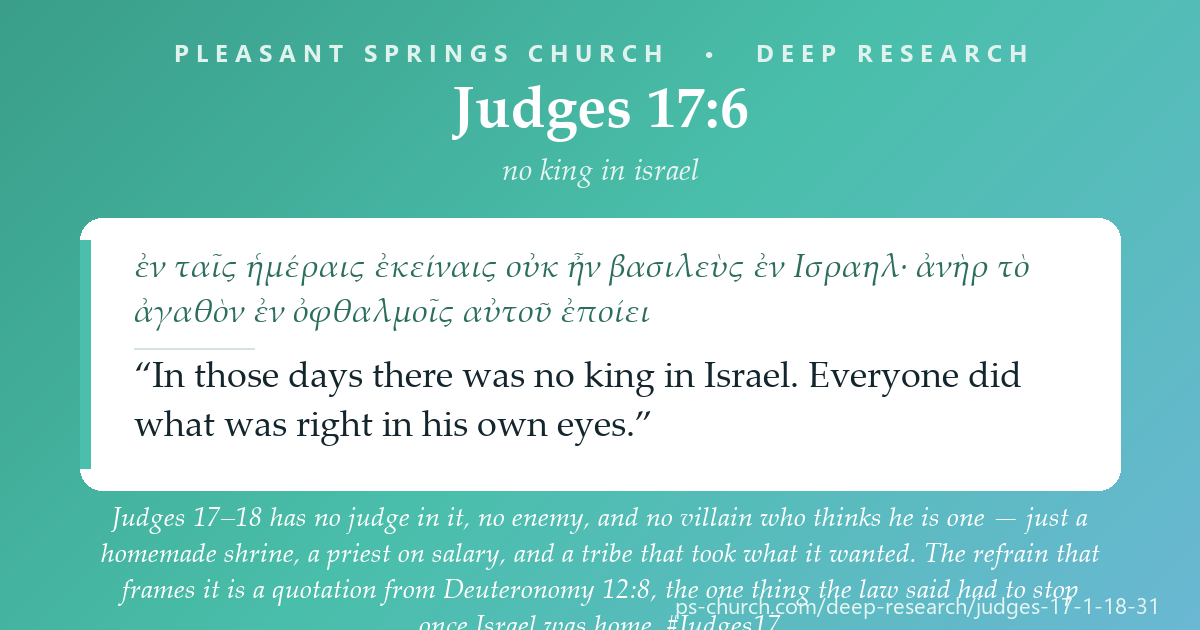
The book changes shape here. There is no judge in these two chapters — no oppressor, no crying out, no deliverer raised up, no rest for the land. Just Israel, left to itself, and it is worse. A man from the hill country of Ephraim confesses to his mother that he is the one who took her eleven hundred pieces of silver — the silver over which she had “uttered a curse” — and she answers, without a pause, “Blessed be my son by the Lord” (17:2). Then she dedicates the silver to the Lord and has it made into “a carved image and a metal image” (17:3–4). Nobody in the story appears to notice the contradiction. Micah builds a shrine, makes an ephod and household gods, ordains his own son, and then hires a passing Levite for ten pieces of silver a year, a suit of clothes and his living — and says the sentence this study turns on: “Now I know that the Lord will prosper me, because I have a Levite as priest” (17:13). In chapter 18 the tribe of Dan, which never took the land it was given, goes looking for an easier one; the hired priest supplies an oracle, six hundred armed men take the idol and the priest, “and the priest’s heart was glad” (18:20), and Laish — “a people quiet and unsuspecting” — is put to the sword and burned. The narrator does not comment on any of it. Twice, framing the whole thing, comes the refrain that will govern the rest of the book: “In those days there was no king in Israel. Everyone did what was right in his own eyes” (17:6) — a quotation from Deuteronomy 12:8, the very thing the law said had to stop once Israel was in the land. This study works Judges 17:1–18:31, in Hebrew, in both Greek texts of Judges, and in the ESV — including the raised letter in the Hebrew of 18:30 that turns Moses into Manasseh. See the method →
Judges 17:1–18:31 (selections)
Hebrew · LXX (A text) · ESVThe Shape of the Passage
Parallel panelsThese two chapters open the book’s last section. Behind them stand the cycle stated in the abstract (2:11–19) and every judge who varied it — Othniel and Ehud, Deborah and Barak, Gideon, Abimelech, Jephthah and Samson, who came from the very Danite camp between Zorah and Eshtaol that sends out the spies here (13:25; 18:2). In front of them stands chapters 19–21, and the same refrain, one last time.
Author
A narrator who has stopped using his own machinery. For sixteen chapters the book has run on a formula it announced in advance: Israel did what was evil in the sight of the Lord, he sold them, they cried out, he raised up a deliverer, and the land had rest (2:11–19). Every judge bent it a little further. Here it is simply gone. Nobody does evil in the sight of the Lord; nobody cries out; nobody is raised up; the land does not rest. The one formula that survives is the one the author put in its place, and he built it out of the old one: “everyone did what was right in his own eyes” (17:6). Same verb, same idiom of sight — and the eyes have changed owner. That is the whole argument of the last five chapters compressed into a clause.
And he refuses to editorialize. He tells you that a mother dedicated silver to the Lord and had an idol cast from it, and adds nothing. He tells you a bought priest said “Go in peace; the journey on which you go is under the eye of the Lord” — and does not say whether the Lord said anything of the kind. He tells you the priest’s heart was glad, and stops. This is Robert Alter’s reticence: the gap is the technique, and the reader is meant to stand in it. We know the silence is deliberate because the narrator can speak when he wants to — he does it once, at 9:56–57, over Abimelech (see that page). Here he chooses not to. This study will not fill in the verdict he withheld.
A note on the text. Judges is the clearest case in the Old Testament of a book preserved in two substantially different Greek editions. This page prints the A text and names B wherever it changes the sense — including at 18:30, where the two Greek texts disagree about whose grandson the priest was. Nothing here depends on choosing between them.
Audience
People who could walk to the sanctuary this story explains. Chapter 18 ends with a place you could visit: a city called Dan, at the far north, with a shrine in it and a priestly line running out of it “until the day of the captivity of the land” (18:30). Anyone who first heard this knew what Dan later became — one of the two calves (1 Kings 12:29–30). The chapter is not gossip about a hill-country farmer. It is an account of where a national sanctuary came from: stolen silver, a home-made image, and a priest who went to the highest bidder.
And people who knew what the tribe of Dan was supposed to have. Dan was allotted land (Joshua 19:40–48). It did not hold it — “the Amorites pressed the people of Dan back into the hill country” (Judg 1:34). So 18:1 says the tribe “was seeking for itself an inheritance,” and a reader who has just come through Joshua hears the word inheritance as a word about a gift that was already given. What follows is a tribe solving a covenant problem by moving somewhere easier and killing people who were not expecting them.
The last line points at Shiloh. “As long as the house of God was at Shiloh” (18:31). Shiloh is where the tent of meeting actually stood (Joshua 18:1) — a day’s walk from Micah’s hill country. The whole story happens while the real thing is up the road. That is the author’s closing comment, and it is made entirely out of geography.
Orient on the ephod, the teraphim, ordination, the Levites’ support, Dan, Laish and Shiloh.
Search by topic: pesel and massekah (carved and cast image), ephod, teraphim / household gods, ordination (“filling the hand”), Levites — cities, dues and support, priesthood (non-Aaronic), oracles and inquiring of God, Dan (tribe and city), Laish / Leshem, Shiloh, Micah (of Ephraim), Beth-rehob, Zorah and Eshtaol.
Which articles are relevant?
- Anchor Bible Dictionary — “Judges, Book of,” “Dan (Place),” “Dan (Person/Tribe),” “Micah (Person),” “Teraphim,” “Ephod,” “Levites and Priests,” “Shiloh,” “Beth-rehob.”
- Dictionary of the OT: Historical Books (IVP) — “Judges, Book of,” “Idols, Idolatry, Teraphim, Household Gods,” “Priests and Levites,” “Sanctuary,” “Tribes of Israel and Land Allotments.”
- NIDOTTE / TDOT — פֶּסֶל (pesel, carved image), מַסֵּכָה (massēḵāh, cast image), אֵפוֹד (ʾēpōḏ), תְּרָפִים (tərāpîm), עָשָׂה (ʿāśāh, make/do), לָקַח (lāqaḥ, take), שָׁקַט (šāqaṭ, be quiet, have rest), נַחֲלָה (naḥălāh, inheritance).
Bibliography surfaced:
- Barry G. Webb, The Book of Judges (NICOT); Daniel I. Block, Judges, Ruth (NAC); Trent C. Butler, Judges (WBC); Robert G. Boling, Judges (Anchor Bible); K. Lawson Younger Jr., Judges and Ruth (NIVAC); Susan Niditch, Judges (OTL); J. Clinton McCann, Judges (Interpretation); Tammi J. Schneider, Judges (Berit Olam).
- Natalio Fernández Marcos, Judges (Biblia Hebraica Quinta 7) — the standard current point of entry for the double Greek text and for the Masoretic notes, including the litterae suspensae.
- Robert Alter, The Art of Biblical Narrative — for reticence, the gap, and repetition-with-variation, which is exactly how 17:10 and 18:19 are built.
- Studies of household and family religion in ancient Israel, and of the relation between local shrines and the central sanctuary in Deuteronomy.
Gods that live in a house, a city named in Egyptian lists — and two ancient retellings that could not leave this story alone.
Read the chapter against household gods in the ancient Near East, then against what the wider world knew of Laish, then against how Second-Temple and rabbinic readers handled a priest descended from Moses.
Which parallels shed light on religion and worldview?
Gods that belong to a household were ordinary; a household that owned its god was not. The teraphim of 17:5 are the household gods Rachel hid under a camel saddle (Genesis 31:19, 34). A Nuzi adoption tablet gives the nearest documented parallel to what such objects could mean legally: “if Nashwi does not have a son of his own, then Wullu shall take the gods of Nashwi” (ANET 220). The editorial note printed with it draws the conclusion that “possession of the household gods marked a person as the legitimate heir, which explains Laban’s anxiety in Gen. 31:26 f.” (ANET credits the tablet’s publication to C. J. Gadd, RA xxiii [1926], no. 51.) That inference — ANET’s, not the tablet’s — has been contested in print: Moshe Greenberg, “Another Look at Rachel’s Theft of the Teraphim,” JBL 81 (1962), argued that the Nuzi evidence points to family leadership rather than to inheritance shares. Report the tablet; flag the inference. What the tablet does establish is the world Judges 17 assumes: portable divine images kept in a house, doing something for the family that owns them.
Laish was a real place with a paper trail older than Israel. The name turns up among the Canaanite towns identified in the Egyptian topographical lists compiled from Thutmose III onward (ANET 242–243). ANET itself supplies the caution — “identifications are often difficult or impossible, and some of the later lists are suspect as having a strong fictional coloring” — so this is a datum, not a proof. The site is Tel Dan (Tell el-Qadi), excavated from 1966 by Avraham Biran; a bilingual Greek and Aramaic inscription found there in 1976, dedicated “to the god who is in Dan,” fixed the identification, and the same excavation produced the large cultic precinct at the north of the mound and, in 1993, the Aramaic stele mentioning the “house of David.” None of that dates the events of Judges 18, and this page does not claim it does. The chronology of the judges — the 480 years of 1 Kings 6:1 against the sum of the judgeships, and whether the judgeships overlap — is genuinely disputed, and we name the positions rather than adjudicate them.
Two ancient retellings, and both of them flinch. Josephus keeps the Danite migration and throws the rest away: five men go north, find the land good, and the tribe “built there the city Dan” (Ant. 5.175–178; Whiston 5.3.1). No Micah. No idol. No hired Levite. No massacre — the city is simply built. Pseudo-Philo does the opposite and expands it enormously: Liber Antiquitatum Biblicarum 44 opens with the refrain (“in those days there was no prince in Israel: but every man did that which was pleasing in his sight”), names Micah’s mother Dedila, and has her tell her son to melt the gold, make idols, “and thou shalt become a priest to them” — then sets out a price list: seven didrachms for a sheep, one didrachm of silver for incense. An ancient reader looked at Judges 17 and saw a business, and wrote the tariff in. It is a witness to how the story landed, not Scripture, and Pseudo-Philo’s Micah is punished at length in a way Judges never mentions.
- Nuzi adoption tablet, Middle Babylonian period (ANET 220) (a Mesopotamian legal document — a witness, not Scripture) — “if Nashwi does not have a son of his own, then Wullu shall take the gods of Nashwi.” Published by C. J. Gadd (RA xxiii [1926], no. 51). ANET’s own footnote draws the inheritance inference; that inference is contested (Greenberg, JBL 81 [1962]), while the household-gods practice itself is not.
- Egyptian topographical lists of Asiatic countries (ANET 242–243) (Egyptian royal inscriptions — a witness, not Scripture) — Laish stands among the identified names, with ANET’s own warning that the identifications are frequently uncertain.
- Josephus, Antiquities 5.175–178 (Whiston 5.3.1) (Second-Temple — a witness, not Scripture) — the Danite migration retold with the idol, the Levite and the killing removed; the tribe simply “built there the city Dan.” (Whiston’s chapter-and-section numbering differs from Niese’s continuous sections.)
- Pseudo-Philo, Liber Antiquitatum Biblicarum 44 (first century — a witness, not Scripture) — Micah’s mother is named Dedila; she directs the idols, the priesthood and a published fee schedule (“for sheep 7 didrachms, and for incense… one didrachm of silver of full weight”); a long divine speech runs the Ten Commandments through the episode one by one.
- b. Bava Batra 109b–110a (rabbinic-era — a witness, not Scripture) — the sustained ancient discussion of 18:30, of who Jonathan was, and of the excuse he gave the Danites; treated at Stage 4.
- Sirach 46:11–12 (Second-Temple — a witness, not Scripture) — the judges praised in general terms (“may their bones revive from where they lie”), with nothing said of these two chapters at all.
The Hebrew adjective in 18:7 and 18:27 is שֹׁקֵט (šōqēṭ), from the root šqt, “be quiet, be at rest.” It is not a rare word in Judges. It is the word of the cycle’s happy ending: “and the land had rest forty years” (וַתִּשְׁקֹט הָאָרֶץ) at 3:11 and 3:30, at 5:31, at 8:28. Four times a judge delivers Israel and the land gets šeqeṭ.
Here there is no judge and no rest for Israel — and the only people in the chapter who have it are Canaanites in a valley in the far north. Then six hundred Israelites take it from them. The narrator does not say a word about this; he simply uses the word twice, once in the scouting report and once in the killing, and lets a reader who has been paying attention hear it. That is the whole method of the book in one adjective. Whether the echo is deliberate cannot be proved from the text, and this page does not claim more than that the vocabulary is the same and the effect is unmistakable.
The verb that makes both the idol and the refrain, the ordination formula in the wrong hands, and two words nobody can translate.
Watch ʿasah run from “to make a carved image” (17:3) to “the carved image that he made” (18:31); watch “in his own eyes” replace “in the eyes of the Lord”; and watch shaqat, the cycle’s word for rest, attach itself to a city about to be burned.
“Make, do” — the commonest verb in the language, and the key word of these two chapters. The silver is given “to make a carved image”; the smith made it; Micah made an ephod; “everyone did what was right in his own eyes”; “consider what you will do”; “my gods that I made”; “what Micah had made”; “the carved image that he made.” The refrain and the idol are the same verb, and that is not a coincidence a preacher has to supply — it is on the page.
“What was right in his own eyes.” The whole book has been saying הָרַע בְּעֵינֵי יְהוָה, “the evil in the eyes of the Lord” (2:11 and at the head of every cycle). Now the noun flips to the right and the eyes change owner. And the phrase is quoted from the law: Deuteronomy 12:8, אִישׁ כָּל־הַיָּשָׁר בְּעֵינָיו, “everyone doing whatever is right in his own eyes” — which Moses names as precisely the thing that must stop once Israel is in the land and there is one place the Lord chooses. Judges 17:6 is the announcement that it did not stop. (The echo is at the Hebrew level: neither Greek text of Judges reproduces the Greek of Deut 12:8, τὸ ἀρεστὸν ἐνώπιον αὐτοῦ.)
“A carved image and a metal image” (LXX A γλυπτὸν καὶ χωνευτόν). Pesel is the exact word of the second commandment — “you shall not make for yourself a carved image” (Exodus 20:4) — and massekah is the word for the golden calf (Exod 32:4). The mother uses the language of consecration over them: הַקְדֵּשׁ הִקְדַּשְׁתִּי, “I have surely dedicated” (a Hebrew infinitive absolute, doubling the verb for emphasis; A renders it in kind, ἁγιασμῷ ἡγίασα). Holy language, forbidden object, one sentence.
“Household gods” — the Greek does not translate it but transliterates, A θεραφιν, B θαραφιν (17:5), which is a translator’s way of saying he knows what the object is and has no Greek word for it. The same objects Rachel steals (Gen 31:19), and the same objects Israel will one day be stripped of: “without ephod or household gods” (Hosea 3:4). Note the pairing there — ephod and teraphim, exactly Micah’s inventory.
“He filled the hand of” — ESV “ordained,” and the ESV footnotes the literal Hebrew. This is the technical formula for consecrating a priest in Exodus 29:9 and Leviticus 8, and it is used here twice: Micah “fills the hand” of his son, then of the Levite. A private citizen performs an ordination in his own house, with the correct vocabulary and no authority whatever, and the narrator reports it without comment. Both Greek texts keep the idiom literally (A ἐνέπλησεν τὴν χεῖρα, B ἐπλήρωσεν τὴν χεῖρα).
“Hire.” The Levite’s own summary of his position, in his own mouth: “this is how Micah dealt with me: he has hired me, and I have become his priest” (וַיִּשְׂכְּרֵנִי; Greek ἐμισθώσατό με, the verb behind mercenary). Alter’s rule is that a character’s first recorded words are characterizing. In the previous chapter the Levite says nothing at all; the first thing he ever tells anyone about himself is his contract.
“Quiet, undisturbed.” ESV “quiet and unsuspecting.” The verb is the one the cycle uses for its reward: “and the land had rest” (וַתִּשְׁקֹט הָאָרֶץ). In these chapters no Israelite has it and a Canaanite city does — until 18:27. Greek A calls them ἡσυχάζοντα καὶ πεποιθότα, “at rest and trusting.”
Two words nobody can translate with confidence. The ESV prints “lacking nothing that is in the earth and possessing wealth” and then footnotes it: “the meaning of the Hebrew word is uncertain.” The Greek witnesses did not know either — A has “μὴ δυναμένους λαλῆσαι ῥῆμα,” not able to speak a word; B produces “κληρονόμος ἐκπιέζων θησαυροῦ,” an heir squeezing out treasure, which is not obviously sense in Greek either. Where the Hebrew is genuinely obscure this page says so instead of choosing a translation and calling it the meaning.
Where this vocabulary surfaces later:
- 1 Kings 12:28–30 — Jeroboam “made two calves of gold… and he set one in Bethel, and the other he put in Dan. Then this thing became a sin.” The city founded in Judges 18, with a stolen image and a bought priesthood, is one of the two places the northern kingdom will put its calves. The chapter is telling you where that came from.
- Hosea 3:4 — “without king or prince, without sacrifice or pillar, without ephod or household gods.” Micah’s exact inventory, listed by a prophet as the thing Israel will lose.
- Psalm 78:60 — “He forsook his dwelling at Shiloh, the tent where he dwelt among mankind.” Judges 18:31 dates the Danite shrine by Shiloh; the Psalm tells you how the Shiloh story ended.
- 1 Samuel 2:12–17, 27–36 — the priesthood at Shiloh itself going bad, and a man of God sent to say so. Judges 17–18 is not an isolated scandal; it is the beginning of a question the next book will answer with a king and with a faithful priest.
- Matthew 6:24 — “You cannot serve God and money.” The Levite of Judges 17–18 is the Bible’s most compact illustration of a man who thought he could do both, and who accepted a promotion mid-burglary.
The law this refrain is quoting, the inheritance Dan already had — and a raised letter in the Hebrew that hides a name.
Trace four: Deuteronomy 12 behind the refrain; Joshua 19 and Judges 1 behind the Danite migration; the second commandment behind the “dedicated” silver; and the genealogy of 18:30, which every ancient witness handles differently.
Which cross-references matter?
- Deuteronomy 12:8 — “You shall not do according to all that we are doing here today, everyone doing whatever is right in his own eyes.” The refrain of Judges 17:6 is that sentence, in the same Hebrew words, reported as fact. Deuteronomy 12 is the chapter about the place the Lord your God will choose (12:5) and about not sacrificing wherever you like; a private shrine in Ephraim and a stolen one in Dan are the exact opposite (see Deuteronomy 12).
- Joshua 19:40–48 and Judges 1:34 — Dan was allotted territory, and then “the Amorites pressed the people of Dan back into the hill country.” Joshua 19:47 already reports the northern move: they “fought against Leshem… calling Leshem, Dan.” The two accounts differ — Joshua calls the city Leshem and reports the capture in one verse with no idol and no Levite; Judges calls it Laish and gives it two chapters. This page reports both and does not harmonise them (see Joshua 13–19).
- Exodus 20:4 and Exodus 32:4 — pesel and massekah, the two words of Judges 17:3–4, are the words of the second commandment and of the golden calf (see Exodus 20, Exodus 32). The mother is not ignorant of the vocabulary of holiness; she uses it correctly and applies it to the one thing it may not cover.
- Judges 8:24–27 — Gideon “made an ephod of it… and all Israel whored after it there, and it became a snare to Gideon and to his family.” The ephod of 17:5 is the second one in this book, and the first one had already been named a snare (see Judges 6–8).
- Numbers 27:21 and Deuteronomy 18:9–14 — Israel did have a sanctioned way to inquire: before Eleazar the priest, by the judgment of the Urim. Judges 18:5 uses the right verb in the wrong house (see Numbers 27, Deuteronomy 18).
- Deuteronomy 18:1–8 — the Levites “shall have no portion or inheritance with Israel… the Lord is their inheritance,” and provision is made for a Levite who comes from any of the towns to serve at the chosen place. The young man of 17:7 is a Levite with no inheritance, walking, looking for a place — which is the law’s own scenario, resolved the wrong way.
- 1 Chronicles 23:15–16 and 26:24 — “The sons of Moses: Gershom and Eliezer… The sons of Gershom: Shebuel the chief”; and “Shebuel the son of Gershom, son of Moses, was chief officer in charge of the treasuries.” This is the genealogy that makes Judges 18:30 explosive, and it is the text the rabbis argue from.
This is a genuine textual curiosity and it is worth getting exactly right, because it is usually reported second-hand.
The Hebrew. The Masoretic Text of 18:30 reads בֶּן־מְנַשֶּׁה, “son of Manasseh.” But the nun — the נ that is the only letter distinguishing מנשה (Manasseh) from משה (Moses) — is written raised above the line in the manuscripts and is printed that way in BHS and BHQ. It is one of only four such litterae suspensae in the Hebrew Bible; the others are an ayin in the word forest — “the boar from the forest ravages it” — at Psalm 80:13 · MT 80:14 · LXX 79:14, and two more at Job 38:13, 15, where MT, LXX and English agree on the numbering. A suspended letter is a scribal flag: the tradition is telling you, in the margin of the word itself, that something is going on here.
The versions split, and they split cleanly. The A text of the Greek reads υἱοῦ Μωυσῆ — son of Moses. The B text reads υἱὸς Μανασση — son of Manasseh. The Vulgate reads filii Moysi, of Moses. The ESV prints “son of Moses” with a footnote, “Or Manasseh.” So the two Greek editions of Judges land on opposite sides of the same word — which is, incidentally, as clear a demonstration as this book gives of why Rahlfs prints them both.
What the ancient readers said it was. The Talmud discusses the verse at length and states the traditional explanation without embarrassment: he was in fact the son of Moses, but because he did what Manasseh king of Judah did, the verse attributed his descent to Manasseh (b. Bava Batra 109b). The same passage adds Rabbi Yoḥanan’s comment in the name of Rabbi Shimon ben Yoḥai, “from here it is learned that corruption is linked to one who is corrupt.” A page later the Gemara has the Danites confront Jonathan with his own descent, and gives him a self-serving proverb in reply — a person should hire himself out to avodah zarah rather than take charity — and then corrects him: the phrase meant work that is beneath you, not idol-service. “Skin a carcass in the market and take payment, but do not say: I am a great man and this matter is beneath me” (b. Bava Batra 110a).
What to make of it. The plain reading of the evidence is that the priest of the shrine at Dan was Moses’ own grandson, and that at some point in transmission a letter was inserted — and left deliberately raised, so that it could still be seen — to keep the name of Moses out of that sentence. That is not a scandal about the text; it is a window into people who revered it. They did not delete anything. They lifted one letter half a line and left the evidence lying in the open for three thousand years. Note also the sheer speed of the decline the verse implies: three generations from Sinai to a stolen idol in the north.
The commentaries, the two Greek texts, and the line this page will name without lecturing.
Webb, Block, Butler, Boling, Younger, Niditch, McCann and Schneider on Judges; Fernández Marcos on the double Greek text; Alter on the repeated phrase — and a plain word about 17:13.
Commentaries & studies:
- Barry G. Webb, The Book of Judges (NICOT) — the fullest recent treatment of the book’s design, and of why 17–21 is an epilogue rather than an appendix.
- Daniel I. Block, Judges, Ruth (NAC) — sustained attention to the Canaanization of Israel, and to this passage as its demonstration.
- Trent C. Butler, Judges (WBC); Robert G. Boling, Judges (Anchor Bible); K. Lawson Younger Jr., Judges and Ruth (NIVAC).
- Susan Niditch, Judges (OTL); J. Clinton McCann, Judges (Interpretation); Tammi J. Schneider, Judges (Berit Olam) — three quite different literary readings of the epilogue.
- Natalio Fernández Marcos, Judges (BHQ 7) — on the A and B texts, the Masoretic apparatus, and the suspended nun.
- Emanuel Tov, Textual Criticism of the Hebrew Bible — for the litterae suspensae and other scribal marks as a class, rather than as a curiosity.
- Moshe Greenberg, “Another Look at Rachel’s Theft of the Teraphim,” JBL 81 (1962) — the standard challenge to the Nuzi inheritance reading of the household gods.
Interpretation notes worth keeping:
- The cycle is gone, and its absence is the argument. Measure this account against 2:11–19 and every element is missing: no “did what was evil in the sight of the Lord,” no oppressor, no crying out, no deliverer, no rest. The book has been showing you Israel failing under pressure. Now it shows you Israel with no pressure at all, and it is worse. That is the point of putting these chapters last rather than in chronological order — and 18:30’s genealogy (a grandson of Moses) suggests the events are early, whatever their position in the scroll.
- 17:13 is the verse to name, and to name plainly. “Now I know that the Lord will prosper me, because I have a Levite as priest.” This is a transaction: the correct professional is on staff, therefore the blessing is secured. It treats God as a mechanism with an input. It is also the only theological sentence anyone in these two chapters says out loud, and the man saying it is sincere. It should be said once, soberly, that this is not an ancient error we have outgrown — the belief that having the right person, the right programme or the right giving in place obliges God to produce a result is alive and expensive. The text does not preach at Micah, and this page will not preach at anyone either. It simply notes what the sentence is.
- The oracle at 18:6 is the sharpest silence in the passage. “Go in peace. The journey on which you go is under the eye of the Lord.” A bought priest, standing in a house full of images, gives a word in the divine name; the narrator neither endorses it nor exposes it. He does not say God spoke. He does not say God did not. What he does is let you watch what the word is used for over the next twenty verses, and leave you to draw the line. Where Scripture is silent, we say it is silent and stop.
- Report Laish plainly and briefly, and notice the irony the narrator builds and does not explain. A city described twice as “quiet and unsuspecting” is struck with the sword and burned (18:27). The book’s opening chapters catalogued fortified cities Israel could not take (1:19, 27–35). Here Israelites take an unwalled, undefended one with no allies, and the text mentions there was “no deliverer” (מַצִּיל) — the vocabulary of rescue that God has been supplying to Israel all book long, absent for somebody else. The narrator supplies no verdict; the arrangement is the verdict.
- Keep three categories distinct. What the text approves: nothing in these chapters. What it reports without approving: nearly all of it — the shrine, the ordination, the hire, the oracle, the theft, the killing. What it condemns: it condemns none of it in so many words, and the condemnation is the whole shape of the book, which will end “everyone did what was right in his own eyes.” Blurring those three is the most common way to misread Judges.
- What this passage is not. It is not a warrant for anything. Nobody may use 18:27 to justify violence against any people, and nobody may read Micah’s mother as a lesson about somebody else’s religion. The book’s indictment is of Israel, told by an Israelite, for Israelites.
- The two Greek texts are a feature of this book, not a threat to it. Rahlfs prints A and B in parallel because they are two editions, not two copies. Nothing on this page turns on choosing between them — and at 18:30, where they disagree outright, both readings are given.
- Chronology and archaeology stay open. The date of the Danite migration, the relation of Judges 18 to Joshua 19:47, the 480 years of 1 Kings 6:1, and the stratigraphy of Tel Dan are all disputed among careful people. We name the positions and do not adjudicate, and no Christian confidence is staked on the outcome.
Four Hebrew words, וַיִּיטַב לֵב הַכֹּהֵן, and they arrive in the middle of a burglary. Six hundred armed men are standing at the gate; the household images are already out of the house; the priest has just asked, “What are you doing?” and has been told to put his hand over his mouth. Then he is offered a bigger congregation. And the narrator, who has told us almost nothing about this man’s interior life, chooses this moment to tell us how he felt.
Notice the verb. It is yāṭaḇ, “to be good” — the same root Micah used in the sentence that is the centre of this page. The ESV renders 17:13 “the Lord will prosper me,” but the Hebrew verb is יֵיטִיב (yēṭîḇ) — “will do me good” — and here at 18:20 the same root comes back on the priest: his heart was made good. Micah expected good because he had a priest. The priest gets his good by walking out on Micah. The one word that both men reach for is the word for benefit, and it is the only theology either of them displays.
Scripture never tells us what became of him beyond the name in 18:30 and the priestly line that ran from him “until the day of the captivity of the land.” It offers no repentance and no judgment scene — the later tradition supplied both, which is a sign of how badly readers have always wanted them. Where the text stops, we stop. What can be said is that a man who could be bought was bought twice in two chapters, and that a settled heart is not the same thing as a clean one.
From a shrine in a farmhouse to a national sanctuary built on stolen goods.
Name what you learned, why it matters, and one concrete response.
What should we carry away — and do?
- The frightening chapter is the one with no villain in it. There is no Midian here, no Philistines, no Sisera. Nobody in these two chapters thinks he is doing wrong. A mother blesses her son; a man builds a chapel; a Levite takes a job; a tribe looks for somewhere to live. Judges is arguing that this is worse than oppression, and it puts it last for that reason.
- “Everyone did what was right in his own eyes” is a quotation. It is Deuteronomy 12:8, the thing the law said had to stop once Israel was in the land. The book is not describing anarchy in general; it is naming a specific, legislated-against failure and reporting that it happened anyway.
- 17:13 is a sentence to be honest about. Having the right person on staff does not oblige God to prosper anybody. The line between gratitude for good ministry and a transaction with God is thinner than we like, and Micah could not see it from where he was standing. Neither, mostly, can we.
- Watch what a person’s first recorded words are. The Levite’s are “he has hired me” (18:4). His heart is glad when the offer improves (18:20). The text says nothing about his character; it just lets him speak twice.
- Notice who had rest. The word the book uses for the peace a judge brings — šōqēṭ, quiet — belongs in these chapters to Laish, and Israel takes it away. Report that plainly; do not decorate it.
- The last verse is a compass. “As long as the house of God was at Shiloh.” The real sanctuary was up the road the whole time. The problem was never a shortage of access.
Step in response: two things this week. First, ask where your own religion is transactional — what do you privately believe you have secured by giving, serving, attending, or by having the right teacher? Write the sentence out the way Micah said it (“Now I know that God will… because I…”), and then read Deuteronomy 12 with it in your hand. Second, read Judges 17–18 straight through, out loud, in one sitting, and stop yourself every time you want to add the narrator’s verdict. Learning to sit in that silence is most of what this book is teaching.
Judges 17:6 · to share
LXX (A text) + ESVEvery Deep Research page traces its passage across the whole sweep — the Old Testament, the Second-Temple world between the testaments (historical witnesses, not Scripture), and the New Testament. Follow the thread:
Pleasant Springs Church — Deep Research
Research method after Michael S. Heiser’s Bible Research Method (examine dictionaries → ancient literature → important words → textual connections → academic publications → share), with the Pleasant Springs “Author & Audience” foundation. Scripture set in the Hebrew, the Greek editions named on each page and the ESV (Old Testament), and the Greek New Testament and the ESV (New Testament), per the practice of Pleasant Springs Church. Judges 17–18 research grounded in Webb (NICOT), Block (NAC), Butler (WBC), Boling (Anchor), Younger (NIVAC), Niditch (OTL), McCann (Interpretation) and Schneider (Berit Olam), with Fernández Marcos (BHQ 7) on the double Greek text and the Masoretic apparatus, Tov on the litterae suspensae, and Alter (The Art of Biblical Narrative) on reticence and repetition-with-variation. ANE background from a Nuzi adoption tablet (ANET 220) — published by C. J. Gadd, with ANET’s own inheritance inference on the household-gods clause flagged as contested (Greenberg, JBL 81 [1962]) — and from the Egyptian topographical lists in which Laish is identified (ANET 242–243, with ANET’s own caution about those identifications); Tel Dan reported from the Biran excavations, including the bilingual Greek–Aramaic inscription that fixed the site’s identity, without dating the events of Judges 18. Second-Temple and rabbinic witnesses from Josephus Ant. 5.175–178 (Whiston 5.3.1; Whiston’s section numbering differs from Niese/Loeb), Pseudo-Philo LAB 44 and b. Bava Batra 109b–110a — all read as witnesses, never leveled with Scripture. Text & numbering: Judges survives in two substantially different Greek forms, A (Alexandrinus) and B (Vaticanus), which Rahlfs prints in parallel on the same page; the Greek printed on this page is the A text throughout, with B named wherever it changes the sense (17:1, 17:2, 17:6, 17:13, 18:7, 18:17, 18:30 especially). Chapter and verse numbers carry no offset here — Hebrew, both Greek texts and English all read 17:1–18:31 alike. At 18:30 the Masoretic Text reads Manasseh with a raised (suspended) nun, one of four litterae suspensae in the Hebrew Bible; the Greek A text reads Moses, the Greek B text reads Manasseh, the Vulgate reads Moysi, and the ESV prints “Moses” with the footnote “Or Manasseh” — all four verified against the texts themselves. The ketiv/qere at 17:2 and the acknowledged obscurity of יוֹרֵשׁ עֶצֶר at 18:7 are reported rather than smoothed. No Qumran fragment preserves any part of Judges 17–18. The chronology of the judges and the archaeology of Tel Dan are reported as open questions and not adjudicated. Throughout, what the text approves, what it reports without approving, and what it condemns are kept as three distinct categories; the destruction of Laish is reported plainly and briefly and is never a warrant for violence by anyone; and where the narrator is silent this page says so and stops.
Scripture quotations marked ESV are from the ESV® Bible (The Holy Bible, English Standard Version®), © 2001 by Crossway, a publishing ministry of Good News Publishers. ESV Text Edition: 2016. Used by permission. All rights reserved. The ESV text may not be quoted in any publication made available to the public by a Creative Commons license, and the ESV may not be translated in whole or in part into any other language. www.esv.org
|
Did this study bless you today? 💚 Give to Support PS Church100% of gifts go to the General Fund — thank you. |