Laban’s sons grumble and his face turns cold, and the Lord speaks a word of pure grace: “Return to the land of your fathers… and I will be with you.” What follows is a study in a God who protects and restrains. Jacob flees by stealth; Rachel steals her father’s household gods — a sober blemish of idolatry in the covenant family; Laban gives chase — and is muzzled by a dream: “say nothing to Jacob, good or bad.” The two wary men raise a heap of stones at Galeed and Mizpah, and Laban’s famous line — “the Lord watch between you and me” — turns out to be not a fond blessing but a boundary treaty between men who do not trust each other. This study works Genesis 31:1–55. See the method →
Genesis 31:3, 19, 24, 42, 49
Hebrew · LXX · ESVThe Shape of the Passage
ConcentricGenesis lets the covenant advance through two men who deceive and distrust each other — and shows God protecting his own not by their virtue but by his own faithful hand: a word of grace to go, a dream to muzzle the pursuer, a watch set at the border.
Author
Moses tells the end of the twenty-year Laban apprenticeship (31:38, 41) as an escape narrative that is really a providence narrative. The trigger is social: Laban’s sons resent Jacob’s new wealth (31:1), and Laban’s panim — his face — is “not toward him as before” (31:2). Into that chill comes the decisive voice: “Return to the land of your fathers… and I will be with you” (31:3). Everything after is the outworking of that promise through very ordinary, very tangled human material. Jacob makes his case to Rachel and Leah (31:4–16), rehearsing the changed wages, the dream of the flock, and “the God of Bethel” who saw it all; the sisters, estranged from a father who “has sold us and devoured our money” (31:15), consent. The flight is by stealth — “Jacob outwitted Laban the Aramean” (31:20, literally stole the heart) — and the deceiver’s household is not clean: Rachel steals the teraphim (31:19), the household gods, an idolatry the narrator records without softening and without excusing.
God muzzles Laban. The theological center of the chapter is 31:24: Laban overtakes Jacob after a seven-day chase, the power in his hand to do harm (31:29), and God meets him first — “in a dream by night” — with a single restraining command: “Be careful not to say anything to Jacob, either good or bad.” The idiom “from good to bad” means the whole range of speech — Laban is not to press any claim, kindly or cruel, that would keep Jacob in his grip. The pursuer arrives with the power and the pretext to ruin Jacob, and finds himself gagged by heaven the night before. What follows is theater: an aggrieved father lecturing (“the daughters are my daughters… but what can I do this day?” 31:43), a fruitless search for the gods (Rachel, seated on the saddle-bag, pleads “the way of women,” 31:35 — the idols never found), and Jacob’s long, indignant twenty-years speech, which finally names the true actor: “the God of my father… the Fear of Isaac… saw my affliction… and rebuked you last night” (31:42).
The heap at the border. The chapter ends not in reconciliation but in armistice. The two men raise a heap of stones and a pillar; Laban names it in Aramaic (Yegar-sahadutha) and Jacob in Hebrew (Galeed) — both mean “heap of witness” (31:47). The pile is also called Mizpah, “watchpost,” and Laban’s words over it are routinely misquoted as a tender benediction. In context they are the opposite: “The Lord watch between you and me, when we are out of one another’s sight” (31:49) — invoking God as a sentinel between two men who need watching precisely because they do not trust each other. The stipulations that follow are a non-aggression pact: do not mistreat my daughters, do not take other wives, do not pass this heap to do harm (31:50–52). A shared meal seals it; Laban kisses his grandchildren, blesses them, and goes home (31:55). The covenant advances — but through, never because of, the sin on either side.
Audience
Israel heard its own story in Jacob’s. A people who would one day flee a hard master (Laban the Aramean prefigures every later oppressor; cf. the wandering-Aramean confession of Deut 26:5) learned that their God goes with the weak and the outwitted, that he sees affliction and the labor of hands (31:42; cf. Ex 3:7), and that he can silence a pursuer with a word in the night. They also heard a warning against themselves: the teraphim hidden in the baggage of the covenant family is the same idolatry that would dog Israel from the wilderness to the exile (cf. Judg 17–18; 1 Sam 19:13; Zech 10:2). The chapter refuses to pretend the patriarchs’ house was pure; it shows a God faithful to an unfaithful family — grace, not merit, keeping the promise alive.
Providence, restraint, and the abused “Mizpah.” For the church, Genesis 31 is a lesson in the God who restrains evil as surely as he commands good. The pursuer with the power in his hand to do harm is stopped by a dream (cf. Ps 105:14–15, “he rebuked kings on their account” — the same verb, yakach, as 31:42); no weapon formed against the covenant prospers, not because Jacob deserves protection but because God has said “I will be with you.” The chapter also teaches sober reading: the “Mizpah benediction” stitched onto jewelry and framed for departing friends is, in its own setting, a wary treaty between two distrustful men — God set as watchman over a boundary, not warmth exchanged across a table. To quote it as sentiment is to miss its lesson. Rightly read, it still preaches: where human trust fails, God remains the watcher between us; and the teraphim in the saddle-bag is a mirror — a call to put away the idols we carry even into the household of faith (cf. Gen 35:2–4, where Jacob finally buries the foreign gods at Shechem).
Orient on teraphim, covenant/treaty forms, the dream-warning, and the ‘Fear of Isaac.’
Search by topic: teraphim / household gods, Laban, Mizpah / Gilead, covenant and treaty, dreams as revelation, the Fear of Isaac, Aram / Paddan-aram.
Which articles are relevant?
- Anchor Bible Dictionary — “Teraphim,” “Laban,” “Mizpah,” “Gilead,” “Covenant,” “Aram / Aramean.”
- Dictionary of the OT: Pentateuch — “Teraphim / Household Gods,” “Jacob,” “Covenant,” “Dreams,” “Idolatry.”
- NIDOTTE / TDOT — teraphim (household gods), pachad (dread / “Fear” of Isaac), tsafah (keep watch, → Mizpah), yakach (rebuke), gal / galed (heap of witness), berith (covenant).
Bibliography surfaced:
- Gordon Wenham (WBC), Victor Hamilton (NICOT), Kenneth Mathews (NAC), Bruce Waltke, Nahum Sarna (JPS) on Genesis.
- Studies of the teraphim and household gods in the ancient Near East; treaties, boundary-markers, and the “witness heap” form.
- Essays on the Nuzi parallels (household gods, adoption, inheritance) and their proper limits for reading Genesis 31.
Household gods, the muzzling dream, and the boundary-treaty at the heap.
Read the teraphim theft, Laban’s dream, and the Galeed / Mizpah pact against ancient household religion, treaty custom, and the Bible’s theology of restraint.
Which parallels shed light on religion and worldview?
Teraphim: the idols in the baggage. The teraphim were household gods — figurines of the family’s protective deities, associated with the domestic cult and, in some settings, with divination (Ezek 21:21; Zech 10:2) and with claims on the family estate. Interpreters have long reached for the Nuzi tablets, where possession of the household gods could bear on inheritance rights — a possible motive for Rachel’s theft — though the parallel should be held loosely, not pressed into a full explanation. What the narrative itself will not do is approve the act. Rachel’s theft is recorded, not sanctioned; the LXX bluntly calls the objects εἴδωλα — “idols” — and the whole episode drips with irony: a “god” that can be stolen, hidden under a saddle, and sat upon is no god at all (cf. Isa 46:1–2, gods that must be carried). Idolatry has crept inside the covenant household, and it will have to be buried before Jacob can go up to Bethel (35:2–4).
The dream that muzzles the pursuer. In the ancient world a night-dream was a recognized channel of divine speech, and here God uses it as a leash. Laban has the manpower (“his kinsmen,” 31:23) and the grievance to force Jacob’s return; God meets him first: “Be careful not to say anything to Jacob, either good or bad” (31:24). The merism “from good to bad” covers the entire span of speech — every enticement and every threat — so that Laban arrives already disarmed, reduced to lecturing about what he could have done (“It is in my power to do you harm,” 31:29) while confessing that God has forbidden it. This is the Bible’s doctrine of common restraint in narrative: the Lord not only leads his people but reins in their adversaries (Gen 20:6, Abimelech; Ps 105:14–15; cf. Job 1–2). The covenant is safe not because Jacob is strong or honest — he is neither — but because the pursuer’s mouth is stopped by heaven.
The heap, the watch, and the wary treaty. The closing scene follows the shape of an ancient boundary-treaty: a monument (heap and pillar), witnesses (the stones themselves; “God is witness,” 31:50), a shared meal ratifying the pact (31:46, 54), stipulations (protect the daughters, take no other wives, do not cross this line for harm, 31:50–52), and a deity invoked to enforce it. Laban names it in his Aramaic, Jacob in Hebrew — two languages, one distrust. The famous Mizpah word (“watchpost,” from tsafah, to keep watch) calls God to police the border between them “when we are out of one another’s sight” (31:49): a sentinel invoked precisely because neither man will be there to guard against the other. It is a peace of separation, not of fellowship — the best two deceivers can manage — and Scripture reports it as such, without gilding it.
- Genesis 20:6; Psalm 105:14–15; Job 1–2 — God restraining the powerful for his people’s sake: the theology behind Laban’s muzzling dream.
- Judges 17–18; 1 Samuel 19:13; Ezekiel 21:21; Zechariah 10:2 — the teraphim across the canon: household idolatry and its divinatory abuse, always under judgment.
- Genesis 21:22–34; 26:26–31 — earlier boundary-treaties with a meal and a witness (Abraham, then Isaac, with Abimelech at Beersheba): the covenant-family among wary neighbors.
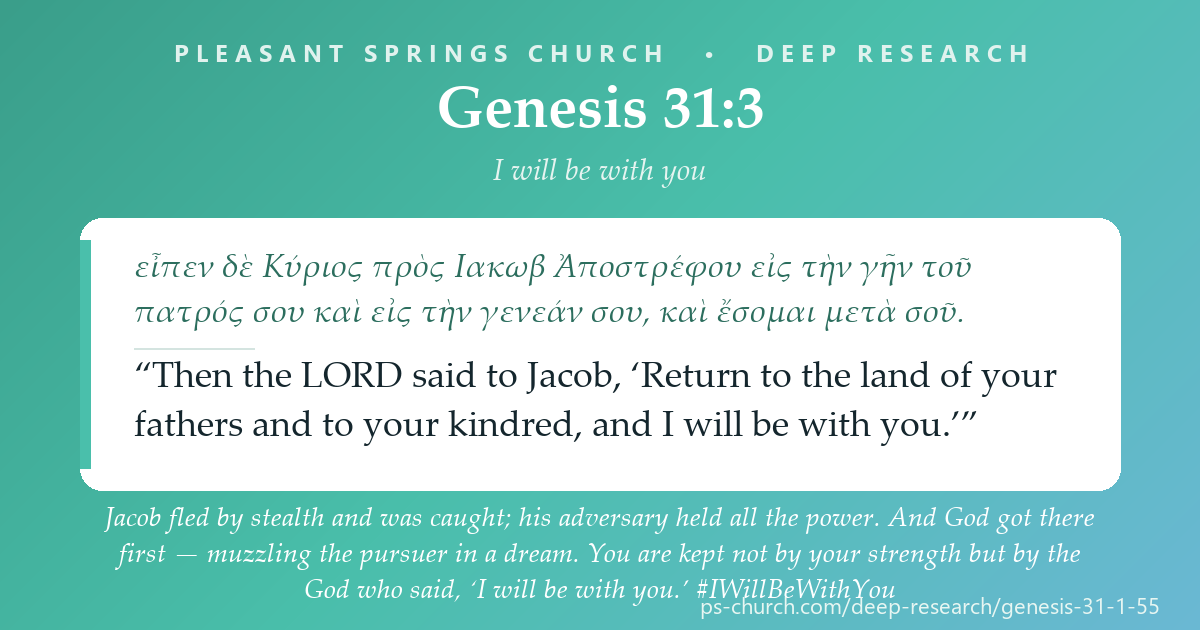
Genesis 31 is often read as a squabble between two rogues — a grasping uncle and a slippery nephew — and so it is; but that is not what the chapter is about. It is about the Lord who said ‘I will be with you’ and then proves it, not by making Jacob admirable but by making Jacob safe. Notice how little of the deliverance runs through Jacob’s competence. He flees by stealth and is caught; his household harbors stolen idols he does not even know about; his grand speech is three parts self-pity to one part faith. The decisive act in the whole chapter is done offstage, in the dark, in another man’s dream: God gets to Laban first and ties his tongue. That is the doctrine of providence at its most bracing — the same God who guides the obedient also gags the dangerous, and both are grace. Israel needed to know it, because Israel would spend its history outmatched by Labans and Pharaohs and empires; and the church needs to know it, because we are not kept by our strength or our spotlessness but by a Keeper who neither slumbers nor sleeps. And there is a warning folded into the comfort: the teraphim in the saddle-bag. The covenant family carries idols even as God carries the family. The chapter will not let us romanticize the patriarchs, and it will not let us romanticize ourselves. Grace guards a people who still have gods to bury — and it summons them, at last, to bury them (35:2–4).
The vocabulary of the escape: presence, idols, the muzzled mouth, the watched border.
Watch the presence-promise (31:3), the teraphim (31:19), the gag “good or bad” (31:24), the “Fear of Isaac” (31:42), and the heap named Galeed / Mizpah with its sentinel “watch” (31:49).
“Return… and I will be with you” — grace initiates the flight. The same presence-promise given at Bethel (28:15) now sends Jacob home; the whole rescue hangs on this word, not on Jacob’s cunning.
“Household gods” — family idols of the domestic cult (LXX εἴδωλα, “idols”). A sober blemish inside the covenant house: a god small enough to steal, hide, and sit on (cf. Isa 46:1–2). Buried at last in 35:2–4.
“Either good or bad” — a merism for the whole range of speech. God gags Laban’s every enticement and threat; the pursuer arrives already disarmed. Divine restraint, not Jacob’s skill, wins the day.
“The Fear of Isaac” — a rare divine title: the God whom Isaac reveres (dread/awe). Jacob swears by him, naming the true protector who “saw my affliction… and rebuked you last night” (yakach; cf. Ps 105:14–15).
“Heap of witness” — Jacob’s Hebrew name for the cairn; Laban’s Aramaic Yegar-sahadutha means the same. Two languages, one distrust: stones stacked as a mute witness between men who will not watch each other in person.
“Watchpost… the Lord watch” — from tsafah, to keep sentinel-watch. Not a fond blessing but a boundary invocation: God set to police the line “when we are out of one another’s sight.” A wary peace of separation.
How the rest of Scripture fills out the scene:
- Genesis 28:15; 31:3; 46:4 — “I will be with you”: the presence-promise that frames Jacob’s whole journey out and home (see Jacob’s ladder at Bethel).
- Genesis 35:2–4; Joshua 24:2, 14–15 — the foreign gods (teraphim) finally buried; Israel called to put away the gods its fathers served beyond the River.
- Genesis 20:6; Psalm 105:14–15; Proverbs 21:1 — God restraining and turning the powerful: the theology of Laban’s muzzling dream.
- Deuteronomy 26:5; Hosea 12:12 — “a wandering Aramean was my father”: Israel remembering Jacob’s servitude to Laban as the shape of its own story.
From a stolen idol and a watched border to the God who keeps his own.
Trace the presence-promise, the restrained adversary, and the buried idols toward their canonical resolution.
Which cross-references matter?
- Genesis 28:10–22 ↔ 31:3, 13 — Bethel bookends the exile: the vow made on the way out (“if God will be with me”) answered on the way home (“I am the God of Bethel… return”).
- Genesis 32–33 — escaping Laban only to face Esau: Jacob is boxed between two men he has wronged, and God meets him at the Jabbok before the reunion — the next study (see Jacob wrestles at the Jabbok).
- Genesis 35:1–4 — the teraphim of chapter 31 buried under the oak at Shechem: the idols in the covenant house finally put away.
- Exodus 3:7; 1 Samuel 24:12–15 — the God who “sees affliction” and “judges between” the wronged and the powerful: Jacob’s appeal becomes Israel’s and David’s.
- Romans 8:31–39; 2 Timothy 4:18 — “If God is for us, who can be against us?” The muzzled pursuer of Genesis 31 is a first sketch of the kept people no adversary can finally seize.
Few verses in Genesis have been more affectionately abused than 31:49. Engraved on rings and lockets, spoken over parting friends, ‘The Lord watch between me and thee, when we are absent one from another’ has become a benediction of tender fellowship — two hearts entrusting each other to God across the miles. It is worth saying plainly that this is almost the reverse of what Laban meant. The words are spoken by a man who has just chased his son-in-law across the country, ransacked his tents for stolen gods, and been prevented from violence only by a nightmare. The ‘watch’ he invokes is a sentinel’s watch over a suspect; the clause that follows — ‘when we are out of one another’s sight’ — is not the ache of friendship but the calculation of distrust: since I cannot keep my eye on you, let God do it. The stipulations make it unmistakable: do not mistreat my daughters, take no rival wives, do not cross this heap to harm me. This is a demilitarized border with God posted as the guard. And yet — here is the mercy that even a wary treaty cannot exclude — the verse is not therefore empty of comfort. For it remains true, in the mouth of scoundrels and saints alike, that when human trust has run out and we can no longer watch over one another, God still watches. Laban meant a threat; the Spirit preserved a truth larger than Laban. The rings and lockets are reading the wrong genre — but they are not entirely wrong about the God.
The scholarship on Genesis 31:1-55.
The commentators on the Laban cycle; the studies of teraphim, treaty-form, and the Nuzi parallels with their proper limits.
Commentaries & studies:
- Gordon J. Wenham (WBC), Victor P. Hamilton (NICOT), Kenneth A. Mathews (NAC), Bruce K. Waltke, Nahum M. Sarna (JPS) on Genesis.
- Studies of the teraphim / household gods and of ancient boundary-treaties and witness-monuments; assessments of the Nuzi tablets and their limited bearing on Genesis 31.
- Robert Alter, The Art of Biblical Narrative, on the Jacob–Laban duel of deceivers and the chapter’s irony.
Interpretation notes worth keeping:
- Rachel’s theft (31:19, 34–35). Recorded, not endorsed. Whether motivated by inheritance claims, lingering devotion, or spite against her father, the act is idolatry in the covenant house — and the narrator’s irony (a god sat upon) is its own verdict.
- The Nuzi parallels. Once pressed to “explain” the teraphim as title-deeds to the estate; now handled with caution. Illuminating background, not a master key — the text gives no motive, and the theology does not depend on one.
- “The Fear of Isaac” (31:42, 53). A genuine divine title (the God whom Isaac holds in awe), not “the one Isaac is afraid of.” Jacob swears by this God while Laban hedges by “the gods of Nahor” (31:53) — the theological gulf between the two men laid bare.
- The “Mizpah benediction” (31:49). A boundary-treaty invocation, not a sentimental farewell. Reading it as warm fellowship inverts its plain sense; reading it as “God watches where we cannot” keeps its real, sober comfort.
- Divine restraint (31:24, 29). The chapter’s hinge. Laban’s own admission — “it is in my power… but the God of your father spoke to me” — is the clearest window in Genesis onto God reining in an adversary.
From a muzzled pursuer and a watched border to the God who keeps his own.
Name what you learned, why it matters, and one concrete response.
What should we carry away — and do?
- Grace goes first, and grace guards. “Return… and I will be with you” sends Jacob; a dream in the night muzzles Laban. You are kept not by your strength or your spotless record but by a Keeper who reaches your adversary before you do.
- Bury the teraphim. Idols travel in the baggage of the faithful. The god small enough to steal and sit on is exposed as no god at all — and it must be put away (35:2–4), not carried into worship.
- Read ‘Mizpah’ soberly. It is a wary watch between distrustful men, not a warm blessing. Yet its truth survives its genre: when human trust runs out, God still watches. Do not sentimentalize it — and do not miss the mercy in it.
Step in response: take an honest inventory of the “teraphim” in your baggage — the small securities you keep alongside your faith in God — and name one to bury this week. Then rest in the harder comfort of the chapter: you cannot always guard the borders of your own life or watch over those you love at a distance, but God does not slumber. Where you have been outmatched by a Laban, entrust the outcome to the God who muzzles pursuers in the night — “the God of my father… saw my affliction” (31:42) — and go home under the word that never fails: I will be with you.
Genesis 31:3 · to share
LXX + ESVEvery Deep Research page traces its passage across the whole sweep — the Old Testament, the Second-Temple world between the testaments (historical witnesses, not Scripture), and the New Testament. Follow the thread:
Pleasant Springs Church — Deep Research
Research method after Michael S. Heiser’s Bible Research Method (examine dictionaries → ancient literature → important words → textual connections → academic publications → share), with the Pleasant Springs “Author & Audience” foundation. Scripture set in the Hebrew, the Greek editions named on each page and the ESV (Old Testament), and the Greek New Testament and the ESV (New Testament), per the practice of Pleasant Springs Church. Genesis 31:1–55 research grounded in Wenham, Hamilton, Mathews, Waltke, and Sarna, with Alter on the Jacob–Laban duel of deceivers; the chapter read as a portrait of the God who protects and restrains — the presence-promise “I will be with you” (31:3; cf. 28:15) sending Jacob home, and the muzzling dream (31:24, 29; cf. Gen 20:6; Ps 105:14–15) stopping the pursuer; the teraphim (31:19, 34–35; LXX εἴδωλα) recorded as idolatry inside the covenant house, to be buried at Shechem (35:2–4); the “Fear of Isaac” (31:42) as a genuine divine title; and the Galeed / Mizpah pact (31:44–54) read as a wary non-aggression treaty — God set as watchman over a border between distrustful men, not the sentimental benediction it is often made — while its larger truth (God watches where we cannot) is honored. LXX divergences at 31:24 (πονηρά for “good or bad”) and 31:49 (ὁ θεό&sfgr; for the Tetragrammaton) noted at the passage rather than altering the ESV.
Scripture quotations marked ESV are from the ESV® Bible (The Holy Bible, English Standard Version®), © 2001 by Crossway, a publishing ministry of Good News Publishers. ESV Text Edition: 2016. Used by permission. All rights reserved. The ESV text may not be quoted in any publication made available to the public by a Creative Commons license, and the ESV may not be translated in whole or in part into any other language. www.esv.org
|
Did this study bless you today? 💚 Give to Support PS Church100% of gifts go to the General Fund — thank you. |