Jacob wants to go home, but Laban has learned he is a walking blessing — “the Lord has blessed me because of you.” A wage is struck (the speckled and spotted animals), a cheat rigs it, and Jacob answers with peeled poplar rods at the watering troughs. The flocks bear speckled young; Jacob “increased greatly.” It looks like folk-magic vindicated — until one chapter later God says in a dream, “I have seen all that Laban is doing to you… God has taken away the livestock of your father and given them to me.” Not the rods, but providence; not merit, but grace; the covenant kept in a far country. This study works Genesis 30:25–43. See the method →
Genesis 30:25, 27, 30, 37, 43
Hebrew · LXX · ESVThe Shape of the Passage
Parallel panelsThe chapter lets us watch a schemer scheme and an exploiter exploit — and then, one chapter on, tells us plainly that neither the rods nor the cunning did the work: God did. Providence is the point the surface almost hides.
Author
Moses sets the scene at the turning of Jacob’s exile. Joseph is born (30:25), the fourteen years of bride-service are done, and Jacob wants to go home to the land of promise. But Laban has learned that Jacob is a walking blessing. His confession is remarkable on a pagan’s lips: “I have learned by divination that the Lord has blessed me because of you” (30:27) — the very shape of the Abrahamic promise (“in you all the families of the earth shall be blessed,” 12:3) now spilling, unbidden, onto the man exploiting its heir. Jacob presses the point: “you had little before I came… the Lord has blessed you at my foot” (30:30) — blessing following his every step.
The bargain and the rods. Jacob asks for the off-color animals — the speckled, spotted, and black, the recessive minority in Near-Eastern flocks — as his wage (30:31–33). It is a modest, self-auditing arrangement: any ordinary-colored beast found with Jacob would convict him of theft. Laban agrees, then immediately cheats, pulling out the striped and spotted stock and putting a three-day march between them and Jacob (30:35–36). So Jacob answers cunning with cunning: he peels white streaks into fresh poplar, almond, and plane rods and sets them where the flocks breed, on a folk theory that what the mothers see at conception marks their young (30:37–39). The narrator reports the device in full — and reports, too, that the flocks bore speckled young and Jacob “increased greatly” (30:43). Left there, it would read like sympathetic magic vindicated.
But the text refuses to leave it there. One chapter later Jacob tells his wives the dream God gave him: “I have seen all that Laban is doing to you… the angel of God said… ‘all the goats that mate with the flock are striped, spotted, and mottled’… Thus God has taken away the livestock of your father and given them to me” (31:9–12). The rods are quietly overruled: the breeding was God’s doing, seen in a dream, aimed at justice for the exploited. Moses lets Jacob’s superstition stand in the story precisely so that the God who works around it can be seen the more clearly — the covenant-bearer prospered not by his cleverness but despite it.
Audience
Israel heard its own life in this scene: the covenant people flourishing in a far country, under an employer who changed the terms “ten times” (31:7), kept honest by nothing but the God who counts the flocks. The promise made in Bethel — “you shall spread abroad to the west and the east… and I will keep you wherever you go” (28:14–15) — is here coming true in the very word the chapter uses for Jacob’s increase (parats, 30:30, 43). Israel in Egypt, Israel in Babylon, Israel scattered would read this and know: God’s blessing is not held hostage by a hostile master or a foreign land.
Providence, not superstition — and grace, not merit. For the church the passage is a bracing double lesson. First, it will not let us baptize our schemes: Jacob’s rods “worked” only because God had already decided to work, and Scripture is at pains (ch 31) to strip the credit from the folk-magic and give it to the Lord. What looks like technique succeeding is really providence condescending. Second, it will not let us imagine we earned the blessing: Jacob is no hero here — he is a fugitive out-maneuvering a cheat — and yet God keeps the covenant oath through him anyway. The deception of Laban and the counter-scheming of Jacob are both recorded, not sanctioned; God’s gracious purpose advances through the sin it never endorses (cf. 50:20; Rom 8:28). The comfort is not that our tricks prosper, but that God’s faithfulness does — even in Haran, even through us.
Orient on Laban, ancient pastoral wages, divination, and animal breeding.
Search by topic: Laban, Jacob, wages and hire, sheep and goats, animal husbandry, divination / omens, Paddan-aram / Haran, prenatal influence in the ancient world.
Which articles are relevant?
- Anchor Bible Dictionary — “Laban,” “Jacob,” “Wages,” “Sheep,” “Divination,” “Paddan-aram.”
- Dictionary of the OT: Pentateuch — “Jacob,” “Laban,” “Blessing,” “Providence,” “Magic and Divination.”
- NIDOTTE / TDOT — nachash (divine, read omens), barakh (bless), parats (break out, increase), naqod / talu’ / chum (speckled / spotted / dark), maqqel (rod, staff).
Bibliography surfaced:
- Gordon Wenham (WBC), Victor Hamilton (NICOT), Kenneth Mathews (NAC), Bruce Waltke, Nahum Sarna (JPS) on Genesis.
- Studies of ancient Near-Eastern herding contracts and shepherds’ wages (Nuzi and Mesopotamian parallels).
- Treatments of the “maternal impression” folk belief in antiquity and of the Jacob-Laban cycle as a contest of trickster and cheat.
Herding contracts, the rods at the trough, and the God who sees.
Read the wage agreement, the peeled rods, and the dream of chapter 31 against ancient pastoral custom and the Bible’s theology of providence.
Which parallels shed light on religion and worldview?
The shepherd’s wage. In the ancient Near East a hired herdsman was often paid from the flock’s own increase, with normal losses and normal colors owed back to the owner. Jacob’s proposal fits and sharpens this: he will take only the anomalies — speckled, spotted, dark — a small fraction in flocks bred for solid white sheep and solid dark goats. The arrangement is deliberately self-policing (30:33): a plain animal in Jacob’s pen is stolen goods. That Laban leaps at it, then instantly rigs it by removing the off-color breeding stock and marching them three days off (30:35–36), tells us who the real trickster of the chapter is — and why 31:7 can say he “changed my wages ten times.”
The peeled rods. Jacob’s response belongs to a widespread ancient folk belief: that what a mother sees or experiences at conception stamps her offspring (“maternal impression”). He peels white stripes into green rods of poplar, almond, and plane and props them at the watering troughs where the flocks come into heat (30:37–39). To the ancient eye this is applied science; to the modern eye it is sympathetic magic; to the biblical narrator it is neither the hero nor the villain of the story. Notice what the text does not say: it never says the rods caused anything. It says the flocks bred speckled and Jacob grew rich — and then, in chapter 31, it tells us why, in a register the rods know nothing about.
The God who sees in Haran. The decisive interpretation is Jacob’s own, and he credits it to revelation: “the angel of God said to me in the dream… ‘I have seen all that Laban is doing to you’… God has taken away the livestock of your father and given them to me” (31:11–12, 9). The breeding was providence, not pigment-magic; and its motive was justice — God saw the cheating and reversed it. This is the Bible’s doctrine of providence at its most disarming: it works through ordinary flocks and even through a man’s misguided rods, so seamlessly that a bystander would call it animal husbandry, while the covenant oath of Bethel (28:13–15) is quietly being kept a thousand miles from the land.
- Genesis 31:4–13 — Jacob’s dream: the striped-and-spotted breeding shown to be God’s act, and God’s answer to Laban’s injustice.
- Genesis 28:13–15; 31:7, 42 — the Bethel promise (“I will keep you wherever you go”) and the ten-times-changed wage: the covenant kept against an exploiter.
- Genesis 50:20; Proverbs 16:9; 19:21; Romans 8:28 — God bending even human scheming and hostility toward his good purpose (see the call of Abram).
Genesis 30 is one of the boldest passages in Scripture for the way it dares to report a superstition without a word of rebuke — and then, one chapter later, calmly demolishes it. Read only to 30:43, a reader could close the book convinced that Jacob’s peeled rods are a proven fertility technique, that sympathetic magic delivers, that the clever man engineers his own blessing. The narrator knows exactly what he is doing by withholding comment. He lets the surface stand so that the depth can surprise us: in 31:10–12 Jacob himself — not the pious narrator, but the schemer — testifies that in a dream he was shown the flock already breeding striped and spotted by the hand of God, and that God did it because ‘I have seen all that Laban is doing to you.’ At a stroke the rods are exposed as beside the point. What prospered Jacob was not the poplar but the providence; not the trick but the God who saw the cheating and answered it. The lesson cuts two ways and the church needs both edges. Against superstition: God is not manipulated by our devices, and when our devices seem to work it is his kindness, not their power, that we are watching. Against pride: Jacob earned none of this — he is a fugitive out-scheming a cheat — and God kept the Abrahamic oath through him regardless, which is the definition of grace. The blessing promised at Bethel materializes in the last place merit could claim it: a far country, a rigged contract, a man with rods in his hands and no righteousness to stand on. That is how the covenant God works — through, but never because of, the sin he means to redeem.
The vocabulary of the wage: omens, blessing, breaking-out, and the rods overruled.
Watch Laban’s “divination,” the blessing that follows Jacob’s foot, the covenant verb parats, the reported-not-endorsed rods, and the speckled flocks that God, not the poplar, produced.
“I have learned by divination” — nachash, to read omens (the verb behind Joseph’s “divining cup,” 44:5). Laban the pagan seeks his answers in omens, yet must name the covenant God as the source of his gain. LXX: οἰωνισάμην.
“The Lord has blessed me because of you” — the Abrahamic promise (“in you… blessed,” 12:3) spilling onto the exploiter. Blessing radiates from the covenant-bearer even to the man cheating him.
“At my foot” — ESV “wherever I turned.” The Lord’s blessing tracks Jacob’s every step; prosperity follows the promised man like a shadow (cf. 39:5, the LORD blessing Potiphar’s house for Joseph’s sake).
“Broke out / increased” — parats, the exact verb of the Bethel promise, “you shall spread abroad (u-pharatsta) to the west and the east” (28:14). The covenant word is coming true in Haran, in the chapter’s own vocabulary.
“Rod / peeled streaks” — the poplar, almond, and plane sticks Jacob whittles and sets at the troughs. The narrative reports the folk device without endorsing it; chapter 31 quietly overrules it, crediting God, not the rods (31:9–12).
“Speckled and spotted” (with chum, “dark”) — the off-color minority Jacob took as wages. In the dream, the very goats that mate are “striped, spotted, and mottled” by God’s design (31:12): the pattern of Jacob’s wealth was painted by providence.
How the rest of Scripture fills out the scene:
- Genesis 28:13–15; 30:30, 43 — parats, “spread abroad”: the Bethel oath fulfilled in the chapter’s word for Jacob’s increase (see the call of Abram).
- Genesis 31:4–13; 31:42 — the dream that reinterprets the whole scene: “God has taken away the livestock of your father… I have seen all that Laban is doing to you.” Providence, not the poplar.
- Genesis 39:2–5, 23 — the same pattern in Jacob’s son: “the Lord was with Joseph… the Lord blessed the Egyptian’s house for Joseph’s sake.” Blessing radiating from the covenant-bearer.
- Genesis 50:20; Proverbs 16:9; Romans 8:28 — God overruling a cheat’s injustice and a schemer’s devices for good: the theology under Genesis 30.
From the flocks of Haran to the God who prospers his own in a far country.
Trace the covenant blessing, the exploited-yet-kept servant, and providence-through-scheming toward their fuller biblical statement.
Which cross-references matter?
- Genesis 31:1–13, 38–42 — Jacob’s summary of twenty years: Laban’s cheating, the wages changed ten times, and “if the God of my father… had not been on my side… you would have sent me away empty-handed.” The chapter’s own commentary.
- Genesis 12:3; 28:13–15 — the promise to bless, to multiply, and to keep “wherever you go”: Genesis 30 is that oath quietly cashed in Haran.
- Genesis 39:2–5; Deuteronomy 8:17–18 — the Lord who gives the power to get wealth, lest we say “my own hand has gotten me this”: the antidote to trusting the rods.
- Genesis 50:20; Romans 8:28; 1 Corinthians 1:27–29 — God working through crooked circumstances and unlikely instruments, that no flesh might boast.
- Jeremiah 29:4–7; 1 Peter 2:11–12 — the covenant people flourishing faithfully in a land not their own: Israel’s and the church’s life in exile foreshadowed at Laban’s troughs.
It is worth sitting with how little Jacob deserves what happens to him in Genesis 30. He is not praying, as the servant prayed in chapter 24; he is not worshiping, as Abraham worshiped on the mountain. He is negotiating a shrewd contract and then rigging it with whittled sticks, matching a cheat trick for trick. There is no altar in this chapter, no theophany, no obedience worth the name — and at the end of it the man is richer than his defrauder and on his way to becoming a nation. If we did not have chapter 31, we might read this as a fable of cunning rewarded. But chapter 31 forces the theological reading: God was the actor all along, moving the flocks, seeing the injustice, keeping an oath sworn at Bethel to a runaway with a stone for a pillow. That is the scandal and the comfort of the passage together. The scandal: God’s blessing is not the wage of our righteousness — if it were, Jacob would have gone home empty. The comfort: God’s blessing is not forfeited by our failure — because it never rested on our merit in the first place, but on his promise. The church that learns to read Genesis 30 rightly will stop trusting its own rods — its techniques, its leverage, its clever contracts — and start trusting the God who prospered a schemer in a far country for no reason but that he had said he would. He keeps his word to the west and to the east, wherever we go, and brings us home.
The scholarship on Genesis 30:25-43.
The commentators on the Jacob-Laban cycle; studies of ancient herding contracts, of the “maternal impression” belief, and of providence in the patriarchal narratives.
Commentaries & studies:
- Gordon J. Wenham (WBC), Victor P. Hamilton (NICOT), Kenneth A. Mathews (NAC), Bruce K. Waltke, Nahum M. Sarna (JPS) on Genesis.
- Robert Alter, The Art of Biblical Narrative and his Genesis commentary on the trickster-cycle; studies of Nuzi and Mesopotamian shepherding contracts.
- Essays on divination and folk belief in the patriarchal narratives, and on parats / the Bethel promise-formula.
Interpretation notes worth keeping:
- The rods (30:37–39). The narrative reports Jacob’s folk practice; it does not commend it, and it does not attribute the increase to it. Genesis 31:9–12 relocates the cause entirely to God. Read the two chapters together, and the “magic” dissolves into providence.
- Who is the trickster? Popular retellings cast Jacob as the sly winner. The text is more even-handed: Laban divines, exploits, and changes the wage “ten times” (31:7); Jacob counter-schemes. Both are sinners; God alone is righteous — and gracious.
- ‘Because of you’ (30:27, 30). Laban’s own words confess the Abrahamic blessing operating through Jacob onto an outsider (12:3). Even a manipulative pagan can see the Lord’s hand; seeing it did not make him righteous.
- Providence, not prosperity-technique. The passage is often abused as a charter for spiritual “methods” that guarantee increase. Its actual theology is the reverse: the technique is the red herring, the sovereign kindness of God is the point (Deut 8:17–18).
- Deception recorded, not sanctioned. As throughout the Jacob cycle, the narrator lets the sin stand unwhitewashed and shows God advancing his purpose through it without endorsing it — the house discipline for reading these chapters (cf. 27; 34).
From peeled rods to the providence that keeps its promise in a far country.
Name what you learned, why it matters, and one concrete response.
What should we carry away — and do?
- Trust the Provider, not the rods. When our methods seem to “work,” it is God’s kindness we are watching, not our technique’s power. Genesis 31 strips the credit from the poplar and gives it to the Lord.
- God sees the exploited. “I have seen all that Laban is doing to you” (31:12). To everyone under an unjust employer, a rigged deal, a wage changed ten times: the God who counts the flocks is not blind, and not slow.
- Grace, not merit. Jacob earned none of this. If blessing were wages, he’d have gone home empty. It rests on God’s promise, not our performance — which is why our failures cannot forfeit it either.
Step in response: name the “rod” you are secretly trusting — the leverage, the angle, the technique you believe is really securing your future — and lay it down. Then, in the place where you feel exploited or stuck, pray Genesis 31:12 back to God: you have seen all of this. Do your honest work as Jacob still pastured the flock (30:31), but rest your hope on the Keeper of the Bethel promise, who blesses his own “wherever you go” and brings them home. Give thanks this week for one increase you cannot honestly credit to yourself — and call it what it is: providence.
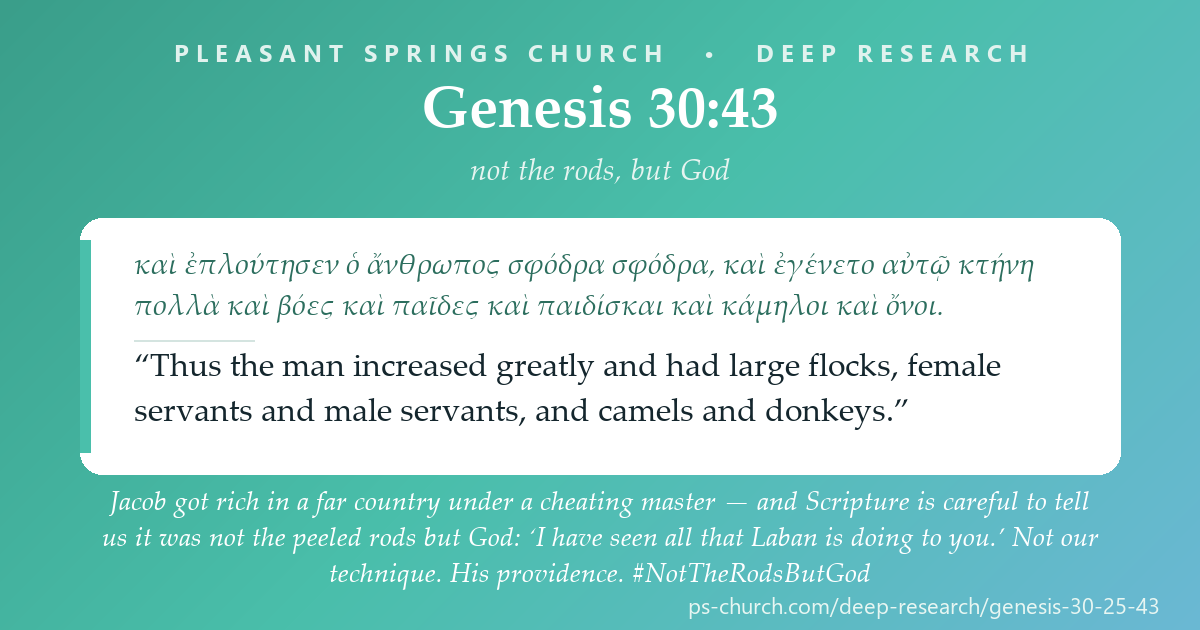
Genesis 30:43 · to share
LXX + ESVEvery Deep Research page traces its passage across the whole sweep — the Old Testament, the Second-Temple world between the testaments (historical witnesses, not Scripture), and the New Testament. Follow the thread:
Pleasant Springs Church — Deep Research
Research method after Michael S. Heiser’s Bible Research Method (examine dictionaries → ancient literature → important words → textual connections → academic publications → share), with the Pleasant Springs “Author & Audience” foundation. Scripture set in the Hebrew, the Greek editions named on each page and the ESV (Old Testament), and the Greek New Testament and the ESV (New Testament), per the practice of Pleasant Springs Church. Genesis 30:25–43 research grounded in Wenham, Hamilton, Mathews, Waltke, and Sarna, with Alter on the Jacob-Laban trickster cycle and studies of ancient Near-Eastern herding contracts; the passage read for its own theology, supplied by Genesis 31:9–12 — the peeled poplar rods (30:37–39) reported but not endorsed, the increase credited in Jacob’s dream to God, who “has seen all that Laban is doing” and “taken away the livestock of your father and given them to me”; the covenant verb parats (“spread abroad,” 28:14; 30:30, 43) marking the Bethel oath fulfilled in a far country; Laban’s divination and his confession that the Lord blessed him “because of you” (30:27) heard as the Abrahamic blessing (12:3) reaching even the exploiter; and both Laban’s exploitation and Jacob’s counter-scheming taken as recorded, not sanctioned — providence, not superstition or merit, prospering the covenant-bearer by grace (cf. 50:20; Deut 8:17–18; Rom 8:28).
Scripture quotations marked ESV are from the ESV® Bible (The Holy Bible, English Standard Version®), © 2001 by Crossway, a publishing ministry of Good News Publishers. ESV Text Edition: 2016. Used by permission. All rights reserved. The ESV text may not be quoted in any publication made available to the public by a Creative Commons license, and the ESV may not be translated in whole or in part into any other language. www.esv.org
|
Did this study bless you today? 💚 Give to Support PS Church100% of gifts go to the General Fund — thank you. |