The angels of God meet Jacob on the road home, and he names the place Mahanaim — “two camps,” God’s host beside his own. Then the report lands: Esau is coming with four hundred men. “Greatly afraid and distressed,” Jacob does the prudent thing — and then, for the first time on record, he prays at length: he names the covenant God, confesses “I am not worthy of the least of all the deeds of steadfast love,” pleads “deliver me,” and grips God’s own word: “but you said, I will surely do you good.” Fear driving the schemer to his knees and onto the promise. This study works Genesis 32:1–21. See the method →
Genesis 32:1–2, 9–12
Hebrew · LXX · ESVThe Shape of the Passage
InclusioGenesis records its longest prayer at the moment its most self-reliant man runs out of schemes — because fear that drives us to God, and back onto his promises, is the beginning of a changed life.
Author
Moses places this scene at the hinge of the Jacob story. Twenty years earlier Jacob fled Canaan alone, a fugitive from the brother he had cheated of blessing and birthright; now, at God’s command (31:3), he is coming home — and the one obstacle he cannot outwit is waiting on the road. The chapter opens on the unseen: “the angels of God met him” (32:1), and Jacob names the place Mahanaim, “two camps” — God’s host and his own, encamped together. It is a quiet assurance the narrative sets down before it raises the terror, so that the reader knows what Jacob cannot yet feel: he is not walking to Esau alone.
The fear and the two camps. The messengers return with the report that turns the blood cold: Esau approaches with four hundred men (32:6) — a war-band, not a welcome. Jacob is “greatly afraid and distressed” (32:7), and his first instinct is the old one: manage the crisis. He divides everything into two companies so that “if Esau comes to the one camp and attacks it, the camp that is left will escape” (32:8). Scripture does not scold the planning; it is sober prudence. But planning alone has always been Jacob’s religion, and here, for the first time, it is not enough.
The prayer (32:9–12). What follows is the fullest recorded prayer in Genesis, and it is a model of how a believer prays under threat. Jacob grounds himself in who God is: “O God of my father Abraham and God of my father Isaac, O Lord who said to me, Return…” (32:9) — he prays back to God the very command that put him on this dangerous road, refusing to let God be less than his word. He confesses: “I am not worthy of the least of all the deeds of steadfast love and all the faithfulness that you have shown to your servant” (32:10) — literally, “I am too small” (qatonti): the grasper who wrestled others for blessing now measures himself against grace and is undone. He pleads the concrete need: “deliver me… from the hand of Esau” (32:11). And he closes on the promise: “But you said, I will surely do you good, and make your offspring as the sand of the sea” (32:12). Fear has done its proper work — it has driven the schemer to his knees and pinned him to the covenant.
Audience
Israel heard its own story in Jacob’s. The nation that bore his new name (Israel, 32:28) was forever meeting its own Esaus — hostile powers on every border, guilt in its own past, a future it could not secure by cunning. Genesis 32 taught them the posture of survival: remember that the angel-camp goes with you (cf. 2 Kgs 6:16–17; Ps 34:7); take honest, prudent steps; but ground your safety not in the plan but in the God who commanded the journey and swore the promise. The prayer that pleads God’s own word back to him is the very shape of Israel’s later intercession (Ex 32:13; Num 14:17–19; Neh 9) — Abraham had reasoned with God so (Gen 18:23–25), and Moses would.
Fear, prayer, and the humbling of the schemer. For the church, this passage is a school of prayer under pressure. Jacob shows that faith and prudence are not rivals: he prays and he plans, commits the outcome to God and sends the gift ahead. He shows that the honest cry of the frightened is welcome — God is not embarrassed by “deliver me.” And he shows, most tenderly, that grace works by making the proud small: the man who spent his life seizing blessing finally says “I am not worthy,” and it is the truest thing he has ever prayed (cf. Lk 15:19; 18:13; 1 Pet 5:6). The whole night’s wrestling still lies ahead (32:22–32) — but the surrender begins here, in a prayer, with the promises of God gripped like a rope in the dark.
Orient on Mahanaim, the angel-camp, hesed, prayer, and the appeasing gift.
Search by topic: Mahanaim, Jabbok, Jacob and Esau, angels / camp of God, hesed, prayer in the Pentateuch, minchah (gift/tribute), kaphar (to cover / appease).
Which articles are relevant?
- Anchor Bible Dictionary — “Mahanaim,” “Jabbok,” “Jacob,” “Esau,” “Angel,” “Prayer (OT).”
- Dictionary of the OT: Pentateuch — “Jacob,” “Prayer,” “Fear,” “Blessing,” “Angels.”
- NIDOTTE / TDOT — chesed (steadfast love), ’emet (faithfulness), qaton (be small/unworthy), natsal (deliver), machaneh (camp), kaphar (cover/appease), minchah (gift).
Bibliography surfaced:
- Gordon Wenham (WBC), Victor Hamilton (NICOT), Kenneth Mathews (NAC), Bruce Waltke, Nahum Sarna (JPS) on Genesis.
- Studies of prayer in the Old Testament (Miller, They Cried to the Lord) and of the Jacob cycle’s literary design.
- Word studies on hesed (Sakenfeld) and on kaphar / atonement vocabulary in its non-cultic sense.
The angel-camp, the war-band of four hundred, and gift-diplomacy in the ancient East.
Read the encampment at Mahanaim, the threat of an armed retinue, and the staged gift against ancient custom and the Bible’s theology of prayer and providence.
Which parallels shed light on religion and worldview?
The unseen camp. Jacob names the place Mahanaim — a dual form, “two camps” — because the meeting with “the angels of God” (32:1) discloses a second host beside his own. The narrator sets this before the crisis deliberately: the same theology that will later let Elisha’s servant see the mountain “full of horses and chariots of fire” (2 Kgs 6:17), that lets the psalmist sing “the angel of the Lord encamps around those who fear him” (Ps 34:7). Jacob does not yet feel the protection — his fear is real and about to spike — but the reader is told the truth in advance: the road to Esau runs through God’s encampment.
Four hundred men. To an ancient reader the number was ominous: “four hundred men” is the size of David’s fighting band in the wilderness (1 Sam 22:2; 25:13) — a raiding force, not an escort. Esau’s advance reads as a blood-feud coming to collect. Jacob’s response — dividing into two companies for survival — is the sober calculation of a man who expects the worst; the text neither mocks it nor rests in it. Ancient wisdom prized exactly this pairing: take every prudent precaution, and commit the issue to God (cf. Prov 21:31, “the horse is made ready… but victory belongs to the Lord”).
Gift as diplomacy; covering the face. The elaborate present — hundreds of goats, sheep, camels, cattle, and donkeys sent forward in successive droves (32:13–20) — is minchah, the tribute-gift of ancient diplomacy, designed to soften a superior’s anger before a face-to-face meeting. Jacob’s own words expose the strategy’s theology: “I may appease him” — Hebrew akapperah panaw, literally “I will cover his face” (32:20), the same root (kaphar) that will carry Israel’s whole language of atonement. Here it is worldly and prudential — a man buying back a brother’s favor. But the vocabulary quietly points past itself: the offended face that must be covered, the gift that goes ahead to make peace — Genesis lets the diplomacy of a frightened patriarch foreshadow, in shadow only, a costlier covering yet to come (cf. Rom 3:25).
- 2 Kings 6:15–17; Psalm 34:7; 91:11 — the encampment of the angels around God’s people: what Mahanaim names and the fearful cannot yet see.
- 1 Samuel 22:2; 25:13; 30:9–10 — “four hundred men” as an armed war-band: why Esau’s approach reads as threat.
- Proverbs 21:31; Genesis 32:20 (kaphar) ↔ Leviticus 16; Romans 3:25 — prudence with trust; the “covering” of an angry face, worldly here, atoning there.
The genius of Genesis 32 is that it refuses to let us choose between trusting God and taking responsible action — Jacob does both, in the right order, and the narrator approves. He does not merely pray and then passively await rescue, nor does he merely scheme as if prayer were a formality; he divides his camps with a soldier’s realism, he prepares a gift with a diplomat’s care, and he pours out to God a prayer of such theological precision that the church has studied it for millennia. The order matters: the fear that seizes him (32:7) does not drive him first to his own cleverness, as it always had, but through his cleverness to his knees. And the prayer itself is a lesson in what to hold onto when everything is uncertain. He does not tell God how frightened he feels and leave it there; he reaches back and grips two things that cannot move — God’s revealed character (‘God of my father Abraham… who said to me, Return’) and God’s spoken promise (‘But you said, I will surely do you good’). This is the anatomy of believing prayer under threat: confess your smallness honestly, name your terror plainly, ask for the concrete deliverance you need — and then press upon God the word he has already given, not to inform him of it, but to lay hold of him by it. Jacob has finally learned that the promises of God are not decorations on a life otherwise run by wits; they are the rope you grip in the dark, and the God who tied the other end will not let go.
The vocabulary of a frightened prayer: two camps, hesed, made small, deliver, but-you-said.
Watch the angel-camp Mahanaim, the hesed Jacob cannot deserve, the “I am too small,” the bare “deliver me,” the promise-pleading “but you said,” and the “covering” of Esau’s face.
“Two camps” — the dual of machaneh (camp): God’s angel-host encamped beside Jacob’s own. The name frames the chapter’s comfort before its terror (cf. Ps 34:7 · LXX 33:8). The LXX renders it Παρεμβολαί, “Camps.”
“Steadfast love” — God’s covenant loyalty in action, which Jacob confesses he cannot deserve “the least of.” The LXX renders it here δικαιοσύνη (righteousness): hesed is love that keeps faith with its own commitments.
“I am not worthy” — literally “I have become small.” The word of a schemer finally undone by grace: the grasper measured against God’s hesed and made low (cf. Lk 18:13; 1 Pet 5:6).
“Deliver me” — from natsal, to snatch away, rescue. The plain, unashamed cry of the frightened; God welcomes the honest “deliver me” (cf. Ps 34:4; Mt 6:13).
“But you said” — the hinge of the prayer: Jacob presses God’s own promise back upon him. Not to inform God, but to lay hold of him by his word — the pattern of covenant intercession (Ex 32:13; Num 14:17–19).
“I may appease him” — literally “cover his face” (kaphar), the root of Israel’s atonement language. Here worldly gift-diplomacy; yet the vocabulary of a covered, angry face points beyond itself (Lev 16; Rom 3:25). LXX: ἐξιλάσομαι.
How the rest of Scripture fills out the scene:
- 2 Kings 6:15–17; Psalm 34:7; 91:11; Hebrews 1:14 — the angel-camp of Mahanaim: unseen protection around those who fear God.
- Genesis 18:23–25; Exodus 32:13; Numbers 14:17–19; Nehemiah 9 — the prayer that pleads God’s character and word back to him: Jacob’s “but you said” becomes Israel’s intercession.
- Luke 15:19; 18:13–14; 1 Peter 5:6 — “I am not worthy” (qatonti): grace works by making the proud small (see the call of Abram).
- Genesis 32:20 (kaphar); Leviticus 16; Romans 3:25 — the covered face: prudential appeasement here, atonement’s shadow beyond.
From a frightened prayer at the Jabbok to the throne of grace.
Trace the angel-camp, the promise-pleading prayer, and the humbled schemer toward their fuller biblical light.
Which cross-references matter?
- Genesis 27:41; 28:13–15; 31:3 — the old grudge, the Bethel promise, and the command to return: why Esau is a terror and why Jacob can still pray.
- Genesis 32:22–32; 33:1–11 — the night of wrestling and the morning of reconciliation that follow: the prayer answered beyond fear, Esau running to embrace him.
- Psalm 34:4–7; 56:3–4 — “I sought the Lord… and he delivered me”: the fearful believer’s psalmody, Jacob’s prayer set to song.
- Matthew 6:13; Luke 11:9–13; Philippians 4:6–7 — ask plainly, plead the Father’s goodness, and let the peace of God guard you: New Testament prayer under threat.
- Hebrews 4:16; 2 Corinthians 1:20 — draw near to the throne of grace; every promise of God is “Yes” in Christ — the “but you said” a believer may now pray with confidence.
It is worth pausing on how badly Jacob prays, and how well. Badly, because he is terrified: this is no serene meditation but the desperate speech of a man who has counted four hundred armed men against his wives and children and can see no way through. Well, because terror has finally taught him the one thing his cleverness never could — where to look. Notice what he does not do. He does not bargain, offering God a vow in exchange for rescue as he once did at Bethel (28:20–22); the older Jacob is past deal-making with heaven. He does not protest his innocence; he confesses instead that he deserves nothing — ‘I am not worthy of the least of all your steadfast love.’ And he does not, in the end, rest his hope on the size of his gift or the cleverness of his two camps, though he has prepared both; he rests it on a sentence God spoke: ‘But you said, I will surely do you good.’ That is the whole secret of the prayer, and of the changed man beginning to emerge from the schemer. He has stopped trying to secure the blessing by seizing it — from Esau, from Isaac, from Laban, even from God — and has begun, at last, to receive it as a gift promised by grace and grasped only by faith. The wrestling that very night will finish the lesson and leave him limping; but the surrender starts here, on his knees, with God’s promise held like a rope in the dark. Every frightened believer who has ever prayed ‘deliver me’ and then whispered ‘but you said’ is praying in the school of Jacob at Mahanaim.
The scholarship on Genesis 32:1-21.
The commentators on the Jacob cycle; the studies of Old Testament prayer, of hesed, and of the kaphar vocabulary.
Commentaries & studies:
- Gordon J. Wenham (WBC), Victor P. Hamilton (NICOT), Kenneth A. Mathews (NAC), Bruce K. Waltke, Nahum M. Sarna (JPS) on Genesis.
- Patrick D. Miller, They Cried to the Lord: The Form and Theology of Biblical Prayer; studies of hesed (Sakenfeld) and of the Jacob narrative’s literary structure.
- Word studies on kaphar / atonement vocabulary (Milgrom; Averbeck) in its cultic and non-cultic uses.
Interpretation notes worth keeping:
- Mahanaim (32:2). The dual “two camps” is read as God’s host beside Jacob’s; the same word recurs when Jacob divides his own company into “two camps” (32:7, 10) — the wordplay ties the comfort to the crisis. Later a real town (2 Sam 2:8; 17:24).
- The order of the prayer (32:9–12). Address (who God is) → confession (“I am not worthy”) → petition (“deliver me”) → appeal to the promise (“but you said”). A widely-noted model of covenant prayer; the promise-appeal is its structural climax, not an afterthought.
- Faith and works of prudence. The narrative frames Jacob’s planning (dividing the camps; the staged gift) and his praying as complementary, not competing — a caution against both fatalism and mere self-reliance.
- Kaphar at 32:20. Here plainly “appease / cover a face,” a non-cultic use that anchors the atonement word in ordinary reconciliation; read the sacrificial overtones as canonical resonance, not as the verse’s literal claim.
- Versification. English 32:1 answers to MT/Rahlfs 32:2 (the Hebrew chapter opens with Laban’s departure, English 31:55). The ESV numbering is used here; the underlying Hebrew and Greek are cited accordingly.
From a schemer’s terror to a prayer that grips the promise.
Name what you learned, why it matters, and one concrete response.
What should we carry away — and do?
- Two camps. Before your fear names the odds, God has already encamped his help beside you (Ps 34:7). You may not feel the angel-host; walk as if the truth is truer than the terror.
- Pray and plan. Jacob divided his camps and fell to his knees. Faith is not the enemy of prudence; take the responsible step, then commit the outcome to God — in that order.
- Grip the promise. When you are most afraid, do what Jacob did: confess your smallness, ask plainly for rescue, and press God’s own word back on him — “but you said.” The promises are the rope you hold in the dark.
Step in response: take the fear you are carrying this week and pray it in Jacob’s order — begin with who God is (“God of my father…”), confess honestly that you are not worthy of the least of his steadfast love, ask for the concrete deliverance you actually need, and then find one promise of Scripture and pray it straight back to God: “but you said.” Write that promise on a card and keep it where the fear finds you. And do the prudent thing too — the honest step, the hard conversation, the gift sent ahead — then leave the face you dread to the God who covers faces and turns brothers into an embrace (33:4).
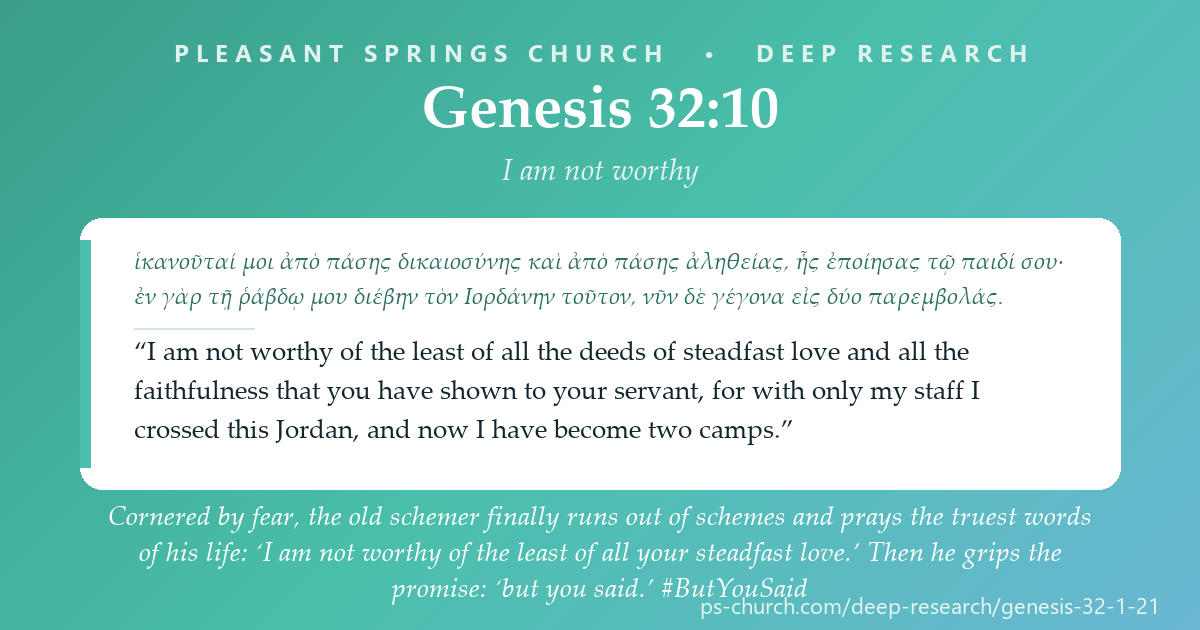
Genesis 32:10 · to share
LXX + ESVEvery Deep Research page traces its passage across the whole sweep — the Old Testament, the Second-Temple world between the testaments (historical witnesses, not Scripture), and the New Testament. Follow the thread:
Pleasant Springs Church — Deep Research
Research method after Michael S. Heiser’s Bible Research Method (examine dictionaries → ancient literature → important words → textual connections → academic publications → share), with the Pleasant Springs “Author & Audience” foundation. Scripture set in the Hebrew, the Greek editions named on each page and the ESV (Old Testament), and the Greek New Testament and the ESV (New Testament), per the practice of Pleasant Springs Church. Genesis 32:1–21 research grounded in Wenham, Hamilton, Mathews, Waltke, and Sarna, with Miller on Old Testament prayer; the chapter read as Genesis’s fullest prayer and a school of intercession under threat — the angel-camp of Mahanaim (32:2; LXX Παρεμβολαί) set as comfort before terror (cf. Ps 34:7); Jacob’s fear (32:7) driving him past his cunning to a prayer that names God’s character, confesses “I am not worthy” (qatonti, 32:10, of hesed he cannot deserve; LXX δικαιοσύνη), pleads “deliver me” (natsal, 32:11), and climaxes by pressing God’s promise back on him (“but you said,” 32:12; cf. Ex 32:13; Neh 9); faith and prudence held together (the two camps and the staged gift, 32:7–20); and the “covering” of Esau’s face (kaphar, 32:20; LXX ἐξιλάσομαι) read as prudential appeasement with atonement’s vocabulary in shadow (Lev 16; Rom 3:25) — deception and self-reliance recorded, not endorsed, as grace begins to make the schemer small.
Scripture quotations marked ESV are from the ESV® Bible (The Holy Bible, English Standard Version®), © 2001 by Crossway, a publishing ministry of Good News Publishers. ESV Text Edition: 2016. Used by permission. All rights reserved. The ESV text may not be quoted in any publication made available to the public by a Creative Commons license, and the ESV may not be translated in whole or in part into any other language. www.esv.org
|
Did this study bless you today? 💚 Give to Support PS Church100% of gifts go to the General Fund — thank you. |