Two judges rise and die in five verses, with no enemy and no rescue between them. Then Israel serves seven pantheons at once — the Baals, the Ashtaroth, and the gods of Syria, Sidon, Moab, Ammon and Philistia (10:6). They cry out. And for the only time in the book, God refuses: “I will save you no more. Go and cry out to the gods whom you have chosen; let them save you in the time of your distress” (10:13–14). They put the foreign gods away, say “do to us whatever seems good to you,” and serve the Lord — and the narrator writes the sentence the whole book leans on: “and he became impatient over the misery of Israel” (10:16). Then Jephthah: a mighty warrior and the son of a prostitute, driven out by his brothers so that he would inherit nothing, gathering worthless fellows in the land of Tob, and recalled the moment Gilead needs a fighter — “Did you not hate me and drive me out of my father’s house?” (11:7). He fights the first round with words, sending the king of the Ammonites sixteen verses of covenant history. Then he makes a vow. This study reports the vow and its outcome plainly, sets out both historic readings of what happened, refuses to decide between them, and says without hedging what the law says about human sacrifice. His daughter is unnamed in Scripture, she is the one who speaks, and the women of Israel would not let her be forgotten (11:40). Then Ephraim comes over the river about an invitation, and forty-two thousand Israelites die at the fords of the Jordan over the way they said one word. This study works Judges 10:1–12:15. See the method →
Judges 10:1–12:15 (selections)
Hebrew · LXX (Rahlfs, A text) · ESVThe Shape of the Passage
ConcentricThese chapters follow Abimelech’s collapse (ch 9) and precede Samson (chs 13–16). Behind them stand Gideon (chs 6–8) and the formula the whole book runs on (2:11–19). Jephthah’s message to Ammon reaches back further still — to Sihon and the Arnon (Numbers 21) and to Moses’ own retelling of that march (Deuteronomy 2–3).
Author
A narrator who reports and refuses to comment. This is the single hardest thing to get right in Judges, and it is hardest here. The book will tell you that Jephthah made a vow, that his daughter came out of the doors, and that at the end of two months he “did with her according to his vow” — and it will not say one word about whether that was right. It does not condemn him. It does not excuse him. Robert Alter’s term for this technique is reticence: the narrator withholds motive and judgment and makes the reader do the work, and the silence is craft, not carelessness. The temptation runs in two opposite directions — to make Jephthah a hero of faith whose methods we may copy, or to supply the thundering denunciation the text withholds and pass it off as the narrator’s. This page will do neither. It reports what the text approves, what it reports without approving, and what it condemns, and keeps those three categories apart.
And he is writing about speech. Jephthah is the most articulate judge in the book. He is given the longest speech any judge gets — the message to the king of the Ammonites (11:12–28) is sixteen verses of covenant history, geography and legal argument, and it is genuinely good. He talks his way from exile back into command (11:9–10). He negotiates with God (11:30–31). And every catastrophe in his story is verbal: he loses his daughter to a sentence, and Ephraim loses forty-two thousand men to a syllable. The narrator marks it with a rare idiom used twice in two verses: פָּצָה פֶּה, “to open the mouth wide” — “I have opened my mouth to the Lord” (11:35), “you have opened your mouth to the Lord” (11:36). It is a book about a nation that has stopped listening, and here is a man undone by talking.
A note on how this page handles the Greek. Judges is the one book of the Old Testament whose Greek survives in two substantially different forms, A and B, which Rahlfs prints in parallel on the same page. Every Greek line in the codex above is from the A text; wherever B says something materially different it is named and quoted. The differences here are not trivia — at 11:39 the two texts disagree about how much to say, and at 12:6 both of them translate the password and so destroy the test. Chapter and verse numbers, by contrast, run together with no offset at all in these three chapters, and the page says so rather than leaving a reader to wonder.
Audience
People east of the Jordan, and people who did not trust them. This is a Gilead story. Gilead is Transjordan — territory settled before anyone crossed into Canaan (Joshua 13), always slightly outside, always slightly suspect. The insult that gets forty-two thousand men killed is exactly that: “You are fugitives of Ephraim, you Gileadites, in the midst of Ephraim and Manasseh” (12:4) — you are not really a tribe, you are leftovers. And this is the second time Ephraim has picked this fight. They said almost the same thing to Gideon (8:1–3), and Gideon defused it with a compliment. Jephthah, who is better with words than Gideon, does not. That contrast is the narrator’s, and it is worth noticing.
People who knew the Torah story — and a leader who knew most of it. Jephthah’s message to Ammon assumes hearers who can follow a rehearsal of Numbers 20–21: Kadesh, Edom, Moab, the Arnon, Sihon, Heshbon, Jahaz. He argues, correctly, that Israel never took Moabite or Ammonite land; it took Amorite land, from a king who attacked first. But he addresses Ammon while arguing about Moab, and he names Chemosh, who is Moab’s god (Ammon’s is Milcom). Three readings are current: that Ammon had absorbed Moabite territory and Moabite claims, so the argument is apt; that the speech incorporates an older dispute with Moab; or that this is deliberate characterization — a self-taught man who knows the story almost well enough. We do not adjudicate. What we will say is that the theological grammar of 11:24 — your god gives you land, our God gives us land — is exactly the grammar of the neighbours (Stage 2), and that whether the narrator is endorsing Jephthah or simply letting us hear him is the sort of thing this book leaves open on purpose.
And people who counted years. Jephthah tells Ammon that Israel has held the Arnon towns for 300 years (11:26). That figure, the 480 years of 1 Kings 6:1, and the summed years of the individual judges do not obviously fit together, which is why some read the judgeships as partly overlapping and regional rather than consecutive and national. Careful people hold each position and the question is genuinely open. Nothing in Christian faith rests on the answer, and this page will not pretend otherwise in either direction.
Orient on the judge, the vow, the ban on child sacrifice, Gilead and Ammon — and the two Greek texts.
Search by topic: Jephthah; judge (shophet) and the cycle of Judges; minor judges; vow (neder) and the law of vows; burnt offering (olah); child sacrifice / Molech; Ammon and Ammonites; Chemosh and Milcom; Gilead; Mizpah; Tob; Ephraim (tribe of); shibboleth and dialect; Septuagint — the A and B texts of Judges.
Which articles are relevant?
- Anchor Bible Dictionary — “Jephthah,” “Judges, Book of,” “Judge,” “Vow,” “Sacrifice and Sacrificial Offerings,” “Human Sacrifice,” “Molech,” “Ammon, Ammonites,” “Chemosh,” “Gilead,” “Mizpah,” “Tob,” “Shibboleth.”
- Dictionary of the OT: Historical Books (IVP) — “Judges, Book of,” “Jephthah,” “Vows,” “Women,” “Violence,” “Ammon, Ammonites,” “Tribes of Israel,” “Land.”
- NIDOTTE / TDOT — זָעַק / צָעַק (zāʿaq / ṣāʿaq, cry out), נֶדֶר (neḏer, vow), עֹלָה (ʿōlāh, burnt offering), קָצַר (qāṣar, be short — with נֶפֶשׁ), גִּבּוֹר חַיִל (gibbōr ḥayil), רֵיק (rēq, empty, worthless), שִׁבֹּלֶת (šibbōleṯ).
- For the Greek — look up “Judges” in any Septuagint introduction and it will tell you what almost no English Bible does: that Judges has two Greek texts, and that Rahlfs prints them both.
Bibliography surfaced:
- Barry G. Webb, The Book of Judges (NICOT); Daniel I. Block, Judges, Ruth (NAC); Trent C. Butler, Judges (WBC); Robert G. Boling, Judges (Anchor Bible); K. Lawson Younger Jr., Judges and Ruth (NIVAC); Susan Niditch, Judges (OTL); J. Clinton McCann, Judges (Interpretation); Tammi J. Schneider, Judges (Berit Olam).
- David Marcus, Jephthah and His Vow (Texas Tech Press, 1986) — the standard monograph, which surveys the entire history of interpretation and declines to settle it.
- Natalio Fernández Marcos, editor of Biblia Hebraica Quinta vol. 7, Judges — the entry point for the textual history, including the Greek A/B problem.
- Robert Alter, The Art of Biblical Narrative — for reticence, the gap, and why a narrator’s silence is a technique rather than a verdict.
A Moabite king who argues exactly like Jephthah, a refugee prince who came back with a private army — and the earliest readers on the vow.
Read 11:24 against the Mesha stele, which uses the same theology of land about the same towns; read 11:1–3 against the ancient Near East’s displaced-son-turned-warlord story; and then read the vow against the people who read it first — Josephus, Pseudo-Philo, the rabbis.
Which parallels shed light on religion and worldview?
Jephthah’s argument and a Moabite king’s inscription are in the same idiom. At 11:24 Jephthah says: “Will you not possess what Chemosh your god gives you to possess? And all that the Lord our God has dispossessed before us, we will possess.” Some three centuries later King Mesha of Moab had that same grammar carved in basalt: “Chemosh was angry at his land… And Chemosh said to me, ‘Go, take Nebo from Israel!’… Chemosh drove him out before me” (Moabite Stone, ANET 320–321, Albright’s translation). Mesha boasts about the very towns Jephthah is arguing over — Aroer, the Arnon, Jahaz, Medeba, Dibon — and about the same god. This is not a claim that Israel’s faith was one more of these; it is a claim about the vocabulary of the argument. Jephthah is talking to a neighbouring king in the diplomatic language a neighbouring king would understand. Whether the narrator endorses that or is simply reporting how the man talked, the text does not say.
The outcast who comes back at the head of a private army was a recognizable career. The statue of Idrimi of Alalakh (fifteenth century BC) tells it in the first person: after trouble in his father’s house at Aleppo, Idrimi fled, spent years as a refugee in Canaan among the ḥapiru, gathered men, and came back to take a throne (ANET 557 — that page lies past our local scan; the page number comes from ANET’s own table of contents, and the statue is published and easily checked). Jephthah at 11:1–11, and later David at Adullam, are recognizably the same social shape: the disinherited man, the band of “worthless fellows” in marginal country, the community that wants nothing to do with him until it needs a fighter. ⚠ One caution. It is often said that the Amarna letters’ ʿapiru simply are the Hebrews. That equation is contested and has never been established — ʿapiru looks like a social category (displaced, stateless, available for hire) rather than an ethnic one. It is a proposal, not a result, and this page uses it only for the social picture.
And human sacrifice was a real practice in the world around Israel — which is exactly why the law bans it by name. The Old Testament itself reports a neighbouring king doing it in extremity (2 Kings 3:27, the king of Moab offering his eldest son on the wall). Classical writers describe child sacrifice at Carthage (Diodorus Siculus 20.14), and the Punic tophet precincts of the western Mediterranean have long been read that way — though the archaeological interpretation of those cemeteries is itself actively disputed, and we do not settle it here. What matters for this page is not how common the practice was but what Israel’s own law says about it, which is Stage 4, and which is not ambiguous at all.
- The Moabite Stone (Mesha Inscription), c. 830 BC (ANET 320–321) (a Moabite royal inscription — a witness, not Scripture) — “Chemosh said to me, ‘Go, take Nebo from Israel!’”; “Chemosh drove him out before me.” The same god, the same valleys, and the same theology of land that Jephthah puts in his letter at 11:24.
- The statue inscription of Idrimi, king of Alalakh (ANET 557 — page past our local scan; number from ANET’s table of contents) (an Akkadian royal inscription — a witness, not Scripture) — the exiled son, the years among the ḥapiru, the return in force.
- Josephus, Antiquities 5.7.10 (Whiston’s chapter-and-section numbering, which differs from the Loeb/Niese sections) (Second-Temple — a witness, not Scripture) — Josephus has no doubt what happened and no doubt what he thinks of it: Jephthah “sacrificed his daughter as a burnt-offering, offering such an oblation as was neither conformable to the law nor acceptable to God, not weighing with himself what opinion the hearers would have of such a practice.” Note both halves — he reports the act, and he condemns it, which is precisely what the biblical narrator declines to do.
- Pseudo-Philo, Liber Antiquitatum Biblicarum 39–40 (first century AD — a witness, not Scripture) — the fullest early retelling. God is angry at the vow before it is ever fulfilled: “Behold, Jephthah hath vowed that he will offer unto me that which meeteth with him first. Now therefore if a dog meet with Jephthah first, shall a dog be offered unto me?” (39:11). The daughter is named Seila, given a long lament, and told by God himself that “she is more wise than her father, and a maiden of understanding more than all the wise” (40:4). She is sacrificed (40:8); the maidens of Israel bury her; the four-day annual lament is instituted, and her tomb is called by her name. ⚠ This is an early Jewish retelling, not Scripture — the name Seila, the lament and the mountain are Pseudo-Philo’s, not the Bible’s. It is cited here because it shows unmistakably how a first-century Jewish reader took 11:39, and because it is the earliest place anyone thought to give her a name.
- Sirach 46:11–12 (Second-Temple — a witness, not Scripture) — “The judges also, with their respective names, those whose hearts did not fall into idolatry and who did not turn away from the Lord—may their memory be blessed!” The praise is real, and it is carefully qualified, and Ben Sira does not name a single one of them.
- b. Ta‘anit 4a (rabbinic-era — a witness, not Scripture) — “Three people entreated God in an unreasonable manner… Eliezer, servant of Abraham; Saul, son of Kish; and Jephthah the Gileadite.” Two of the three got a merciful answer anyway. Jephthah did not: “God responded to him unreasonably, and his daughter happened to come to him.”
- Genesis Rabbah 60:3 (rabbinic-era — a witness, not Scripture) — the same list, and then a devastating aside. The vow could have been undone; Phinehas the priest could have released him. “Pinḥas said: ‘It is he who requires my services; shall I go to him?’ And Yiftaḥ said: ‘I am the head of the chieftains of Israel, shall I go to Pinḥas?’ Between the two of them, that young woman was lost.” Two men stood on their dignity and she died of it. Rashi reports the same tradition at 11:39 and adds that both men were punished for it.
There is a real observation to make about the Greek here, and then a hard stop. At 11:34 the A text calls the daughter μονογενὴς αὐτῷ ἀγαπητή — “his only-begotten, beloved” — where B has simply μονογενής. And the vow at 11:31 reads ἀνοίσω αὐτὸν ὁλοκαύτωμα, “I will offer him up as a whole burnt offering,” using the same verb (ἀναφέρω) the Greek translator used at Genesis 22:2: Λαβὲ τὸν υἱόν σου τὸν ἀγαπητόν… καὶ ἀνένεγκον αὐτὸν, “take your son, the beloved one… and offer him up.” Pseudo-Philo noticed the resemblance too, and had Seila argue from it: “Rememberest thou not that which was in the days of our fathers, when the father set his son for a burnt offering?” (LAB 40:2).
So the resemblance is not invented. But notice what it does not license. At Moriah God stopped it; the entire point of Genesis 22 is the voice that says “do not lay your hand on the boy.” Here no voice comes. The New Testament nowhere reads Jephthah’s daughter as a figure of anything; Hebrews 11:32 names her father among the faithful and says nothing about her at all. This site’s rule is that typology is legitimate only where the New Testament has itself made the connection, and here it has not. What the Greek shows is a translator’s ear and a first-century reader’s instinct — genuinely worth knowing. It is not a doctrine, and building one on it would do to her exactly what the story already did: use her for something.
The cry that turns into a war-cry, the shortness of God’s soul, a mouth opened too wide, and one consonant.
Follow zaaq/tsaaq through all six occurrences and watch it change sides; sit with qatsar nephesh at 10:16; weigh olah at 11:31 before you read Stage 5; and notice how little the word shibboleth itself matters.
“Cry out” — the Leitwort of the passage, and two spellings of what is effectively one verb. It is the covenant’s emergency word, the cry of the oppressed that God has bound himself to hear, and it drives the whole cycle of Judges. Here it is used six times in three chapters and it degrades every time: Israel cries to the Lord (10:10); God reminds them that crying used to work (10:12); God tells them to take their crying to the gods they chose (10:14); the Ammonites are called out to war (10:17, the same root in the passive); Ephraim is called out to war against fellow Israelites (12:1); and Jephthah throws it back at Ephraim — “I cried out to you and you did not save me” (12:2). Same verb, six times, travelling from prayer to civil war.
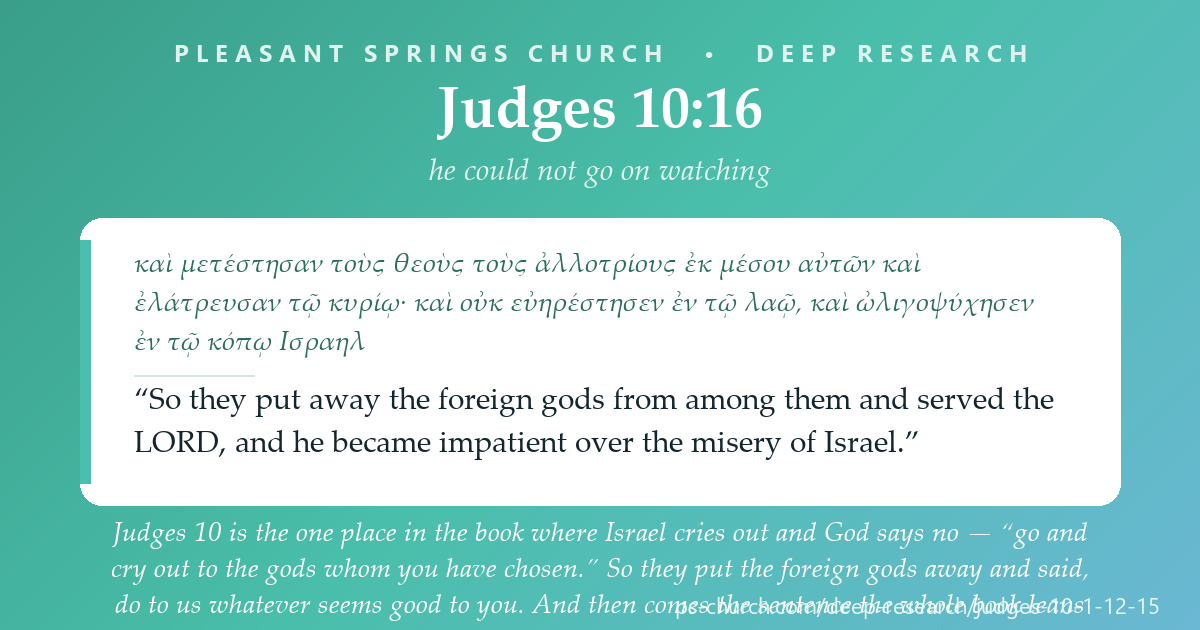
Literally “and his soul became short” — the Hebrew idiom for running out of patience or endurance. It is used of people who cannot take any more: Israel in the wilderness (Num 21:4), and Samson under Delilah’s pressing, whose soul “was vexed to death” (16:16). Here the subject is God, and the translations divide. The ESV keeps the idiom’s ordinary force — “he became impatient over the misery of Israel” — while others hear compassion in it: he could bear Israel’s misery no longer. Both are defensible; the ambiguity is in the Hebrew, not in the translators. Either way the sentence records something happening inside God, and it is the last thing the narrator says before the machinery of rescue creaks back into motion. Both Greek texts heard the idiom the same way — A ὠλιγοψύχησεν, “he became short-souled”; B ὠλιγώθη ἡ ψυχὴ αὐτοῦ, “his soul was made small.”
“Mighty man of valour” — a title of standing as much as of strength; it can mean a warrior, a man of substance, or the head of a fighting household. It is the phrase the angel throws at Gideon in the winepress (6:12). The sentence structure of 11:1 is the whole tragedy in miniature: Jephthah the Gileadite was a mighty man of valour — and he was the son of a prostitute. Two clauses, joined and left without comment. A has δυνατὸς ἐν ἰσχύι, “powerful in strength”; B has ἐπηρμένος δυνάμει, “lifted up in power.”
“Empty ones” — the ESV’s “worthless fellows.” The same word describes the men Abimelech hired with temple silver two chapters earlier (9:4), which is a link the narrator surely intends: two men, two chapters apart, gathering the same kind of following. Judges is dry about it and says no more. B translates the word literally, ἄνδρες κενοί, “empty men”; A softens it to ἄνδρες λιτοί, “plain, unadorned men.”
“And I will offer it up (as) a burnt offering.” The verb and the noun are the standard technical pair for the whole-burnt sacrifice — the offering entirely consumed, with nothing kept back (Lev 1). This clause is the crux of the whole debate (Stage 5). Read straight, it says “and it shall be the Lord’s and I will offer it up as a burnt offering”; the medieval alternative reads that second waw as “or.” One datum to hold before deciding: both Greek texts render it as a single unqualified offering with no alternative in sight — ἀνοίσω αὐτὸν ὁλοκαύτωμα in A and in B alike.
“To open the mouth wide” — a rare and forceful idiom, not the ordinary verb for speaking. Jephthah uses it of himself (“I have opened my mouth to the Lord, and I cannot take back my vow”) and his daughter repeats it straight back to him (“you have opened your mouth to the Lord”). Elsewhere it describes a mouth gaping to devour (Ps 22:13) and the ground opening to swallow (Num 16:30). In this story the man’s own mouth is the pit.
The word for what the daughters of Israel did every year. It is vanishingly rare — this verse and Judges 5:11 are effectively its only occurrences, and at 5:11 it means to recount or rehearse the Lord’s deeds. So “lament” (ESV) and “commemorate” are both live renderings; both Greek texts chose the first (θρηνεῖν, “to sing a dirge”). Either way the fact is the same, and it is the text’s own last word about her: the women of Israel built a four-day annual observance around a girl whose name the book never gives, so that she would not be lost.
An entirely ordinary word. It means an ear of grain (Gen 41:5) and, in other contexts, a flowing stream (Ps 69:2) — grimly apt at a river crossing. Nothing whatever is at stake in its meaning; everything is at stake in its first consonant. The Ephraimites said sibbōlet, and the men of Gilead killed them for it. ⚠ Notice what the Greek does: A demands a Σύνθημα (“password”) and B a Στάχυς (“ear of grain”). Neither transliterates. A Greek reader is told what the word meant and can no longer hear why anyone died for it.
Where this vocabulary surfaces later:
- The cry God has bound himself to hear — zāʿaq and ṣāʿaq are the covenant’s emergency vocabulary. Israel cried out in Egypt and God heard (Exod 2:23–25); of the widow and the orphan God says “I will surely hear their cry” (Exod 22:23). Judges 10:14 is the one place where the answer is go and cry somewhere else — and even that turns out not to be the last word, two verses later.
- Numbers 30:2 (MT/LXX 30:3) — “If a man vows a vow to the Lord… he shall not break his word. He shall do according to all that proceeds out of his mouth” (see Numbers 30). The Greek reads πάντα, ὅσα ἐὰν ἐξέλθῃ ἐκ τοῦ στόματος αὐτοῦ, ποιήσει — and Jephthah’s daughter gives that formula back to him word for word: “do to me according to what has gone out of your mouth” (11:36). She knows the law. ⚠ Note the numbering here: this chapter runs one verse ahead in Hebrew and Greek, so English 30:2 = MT/LXX 30:3.
- Leviticus 5:4–6 — the law that exists precisely for a man in Jephthah’s position: “if anyone utters with his lips a rash oath to do evil or to do good… when he realizes his guilt… and confesses the sin he has committed, he shall bring to the Lord as his compensation… a female from the flock” (see Leviticus 4–5). A rash oath is a sin to be confessed and atoned for, not a contract to be honoured at any price.
- Leviticus 27:1–8 — and the law that exists for a person vowed to the Lord: a valuation table in shekels, written down precisely so that a human being dedicated by vow can be redeemed. Israel’s law had a way out, and it was in the book.
- Ecclesiastes 5:4–5 — “It is better that you should not vow than that you should vow and not pay.” The other side of the ledger, and the reason this is genuinely hard rather than obvious.
- Hebrews 11:32 — “For time would fail me to tell of Gideon, Barak, Samson, Jephthah, of David and Samuel and the prophets.” Jephthah is named among the faithful in a list that is about God’s faithfulness through deeply mixed people. It is not a character reference for anything in chapter 11.
The march Jephthah rehearses, the law that forbids what happens next, and the tribe that has done this before.
Trace four threads: the Torah history behind 11:12–28; the law’s absolute ban on child sacrifice; the law’s written provision for rash vows; and Ephraim’s standing grievance, which has appeared once already and will tear the nation apart later.
Which cross-references matter?
- Numbers 20–21 — the events Jephthah rehearses: Kadesh and Edom’s refusal, the detour round Moab, the Arnon as Moab’s border, the request to Sihon, Jahaz, and Israel’s possession of Amorite land “from the Arnon to the Jabbok” (see Numbers 21). His summary is accurate, and it is one of the clearest signs in Judges that a man on the far edge of Israel still had the story.
- Deuteronomy 2:1–37 — Moses’ own retelling of that march, including the explicit instruction not to harass Moab or the Ammonites, because their land was never Israel’s to take (see Deuteronomy 1–3). Jephthah’s legal argument is built on it.
- Leviticus 18:21; 20:2–5 — “You shall not give any of your children to offer them to Molech, and so profane the name of your God: I am the Lord”; and then a capital statute against it, with God saying “I myself will set my face against that man” (see Leviticus 18). This is not a technicality. It is a line Israel is forbidden to cross.
- Deuteronomy 12:31 and 18:10 — “for they even burn their sons and their daughters in the fire to their gods”; “There shall not be found among you anyone who burns his son or his daughter as an offering” (see Deuteronomy 12 and Deuteronomy 18; the same book treats seduction into false worship as a capital matter, Deuteronomy 13). Deuteronomy names child sacrifice as a reason the nations are under judgment in the first place.
- Jeremiah 7:31 — and the verse that settles God’s attitude beyond argument. They burned their sons and daughters in the fire, “which I did not command, nor did it come into my mind.” God does not merely forbid it; he says the thought never occurred to him. Anyone who reads Judges 11 as evidence that God accepts such offerings has read past this verse.
- Genesis 22:1–19 — the near-sacrifice that God stopped, and the only place in Scripture where a father is told to offer his only child (see Genesis 22). The differences are the whole point: there, a command from God and an angel who stops the knife; here, a bargain volunteered by a man, and no voice at all.
- Judges 8:1–3 — Ephraim’s first grievance, brought to Gideon in nearly the same words (“What is this you have done to us, not to call us…?”) and defused with a compliment (see Judges 6–8). Judges 12 is the rerun with no diplomacy in it, and it should be read as the second half of a pattern.
- Judges 19–21 — where inter-tribal violence goes when nobody stops it, and the book’s own closing verdict on it (see Judges 19–21). The fords of the Jordan at 12:6 are the first time in the book that Israelites kill Israelites in numbers. They will not be the last.
Put four texts side by side and the picture is clear, and it is not the picture usually preached.
First: vows are serious. “He shall not break his word. He shall do according to all that proceeds out of his mouth” (Num 30:2, MT/LXX 30:3). Ecclesiastes agrees: pay what you vow. Nobody should pretend that seriousness away, and Jephthah’s daughter, who quotes exactly that language back to him, plainly took it seriously.
Second: some vows are void because their content is forbidden. A vow does not turn a prohibited act into a permitted one. Human sacrifice is banned outright and by name — Lev 18:21; 20:2–5; Deut 12:31; 18:10 — and Jer 7:31 says it never entered God’s mind. Nothing a man says in a field before a battle can make that lawful. A rash vow does not obligate anyone to sin.
Third: the law provides the exit, in writing. Leviticus 5:4–6 treats a rash oath as a sin requiring confession and a guilt offering — the remedy is repentance, not performance. Leviticus 27:1–8 sets a shekel valuation precisely so that a person vowed to the Lord can be redeemed. The way out was on the books, and Israel’s oldest commentators knew it: Genesis Rabbah 60:3 says flatly that Phinehas could have released him, and that the reason he did not was that neither man would walk to the other.
Fourth: Judges reports none of this. The narrator does not cite Leviticus. He does not have anyone tell Jephthah he is wrong. He tells you what was vowed and what was done, and then he moves to a river crossing. That silence is the book’s argument, not its approval — this is a nation in which everyone has become his own authority, and a man can make a vow like this with nobody near him who will say no.
The two readings of 11:39, laid out fairly and left unadjudicated — and what is not in question either way.
Webb, Block, Butler, Boling, Younger, Niditch, McCann and Schneider on Judges; Marcus on the vow; Fernández Marcos on the Greek; Trible on how this chapter has been read and skipped. Then the two readings, with the evidence on each side.
Commentaries & studies:
- Barry G. Webb, The Book of Judges (NICOT), and his earlier The Book of the Judges: An Integrated Reading — the fullest case that 10:6–16 is the theological hinge of the whole book.
- Daniel I. Block, Judges, Ruth (NAC); Trent C. Butler, Judges (WBC); Robert G. Boling, Judges (Anchor Bible); K. Lawson Younger Jr., Judges and Ruth (NIVAC).
- Susan Niditch, Judges (OTL); J. Clinton McCann, Judges (Interpretation); Tammi J. Schneider, Judges (Berit Olam) — three very different readings, all attentive to the women in the book.
- David Marcus, Jephthah and His Vow (Texas Tech Press, 1986) — the monograph on the question. Marcus surveys the whole history of interpretation and concludes that the Hebrew is genuinely ambiguous and that both outcomes remain possible.
- Phyllis Trible, Texts of Terror (1984) — the study that forced a generation of readers to stop skipping this chapter. Read it critically, and read it.
- Natalio Fernández Marcos, Biblia Hebraica Quinta vol. 7, Judges — on the textual history of the book, including the A/B problem in Greek.
The vow: the two readings, and where this page stands:
- What the text says, plainly and briefly. Jephthah vowed that whatever came out of the doors of his house to meet him would be the Lord’s and that he would offer it up for a burnt offering (11:30–31). His daughter came out. He tore his clothes. She asked for two months. At the end of them she returned, “and he did with her according to his vow that he had made” (11:39). That is the whole of what the narrator reports. He offers no comment of any kind.
- Reading (a): she was offered as a burnt offering. The evidence: the plain sense of the Hebrew, since heʿəlāh ʿōlāh is the fixed technical phrase for a whole burnt sacrifice and means nothing else anywhere in the Old Testament; the fact that both Greek texts render 11:31 as a single unqualified offering (ἀνοίσω αὐτὸν ὁλοκαύτωμα) with no hint of an alternative; the violence of Jephthah’s reaction at 11:35, which is hard to account for if the outcome were his daughter’s celibacy; and the fact that this was the dominant reading in both Jewish and Christian tradition for most of its history — Pseudo-Philo (first century), Josephus (first century, who calls it unlawful and unacceptable to God), b. Ta‘anit 4a, Genesis Rabbah 60:3 and Rashi all take it this way.
- Reading (b): she was dedicated to perpetual virginity. The evidence: 11:39 does not say he offered her as a burnt offering — it says “he did with her according to his vow,” and then immediately adds “she had never known a man,” which is an odd remark to make about someone who has just been killed; the threefold weight on her virginity in 11:37–39 (she asks to weep for her virginity, she weeps for her virginity, she had never known a man) rather than on her life; the fact that she mourns her virginity and not her death; and a grammatical argument for reading the second waw of 11:31 as disjunctive — “it shall be the Lord’s, or I will offer it up for a burnt offering” — on the analogy of Exod 21:15. This reading is medieval in origin: its classic statement is Radak (David Kimhi, d. 1235) at Judges 11:31, who credits it to his father and argues it exactly as above (“it does not say ‘he offered her as a burnt offering’… this shows us that she was separated”). Gersonides followed him, and so did many later Christian interpreters.
- What weighs against each. Against (a): the narrator’s wording at 11:39 is notably indirect where he could have been explicit, and the annual observance at 11:40 is described with a rare verb that can mean recount as readily as lament. Against (b): the disjunctive waw is grammatically possible but is not the natural reading of this clause; neither Greek witness knows anything of it; Israel has no known institution of lifelong female celibacy for the record to be describing; and the reading appears nowhere at all for well over a thousand years after the book was written.
- This page does not adjudicate. Careful, believing readers have landed on both sides, and the honest position is that the Hebrew of 11:39 does not close the question. We set out the evidence and let the reader weigh it. What we will not do is pick the reading that hurts less and present it as settled.
- And here is what does not depend on the outcome. The text does not commend Jephthah. It reports. There is no verse in Judges praising the vow, no verse saying God accepted it, no verse saying it was required. Whichever way a reader lands on 11:39, the narrative offers exactly zero warrant for the vow itself — and the law that Jephthah’s own daughter could quote (11:36, echoing Num 30:2) also told him what to do about a rash oath (Lev 5:4–6) and how a person vowed to God could be redeemed (Lev 27:1–8).
- Human sacrifice is abhorrent to God and forbidden outright. Lev 18:21; 20:2–5; Deut 12:31; 18:10; and above all Jer 7:31 — “which I did not command, nor did it come into my mind.” Nothing in this chapter licenses it and nothing in this chapter is a model for anyone. A vow made rashly creates no obligation to sin. If you have ever been told that a promise to God binds you to something God forbids, this chapter is not the evidence for it; the law is the evidence against it.
- The Spirit came on him — and the vow came after. 11:29 says the Spirit of the Lord was upon Jephthah; 11:30 says he made the vow anyway. Judges holds those two facts together without explaining them, and so does Hebrews 11:32, which names him among the faithful. That combination is uncomfortable and it is meant to be. God genuinely used him. The book is not thereby recommending him. Keeping those two sentences apart is most of what it takes to read Judges honestly.
- On the 42,000. The number is reported here exactly as the text gives it (12:6), and the horror is left standing: Israelites killing Israelites at a river crossing by dialect test, with no Canaanite anywhere in the story. It is sometimes noted that Hebrew ʾelep can mean a military unit as well as a thousand; that debate is real and belongs to the wider question of large numbers in the Old Testament. We are not using it here to make this smaller. The point of 12:6 is not the arithmetic. The point is that there was a test at all.
Sit with 10:16, because it is the strangest sentence in the book and the one everything else leans on.
Read the exchange again. Israel has served seven pantheons — the Baals, the Ashtaroth, and the gods of Syria, Sidon, Moab, Ammon and Philistia. That is not backsliding; that is a systematic tour of the neighbourhood. Then they cry out. And God, for the only time in Judges, says no: “Go and cry out to the gods whom you have chosen; let them save you in the time of your distress” (10:14). It is not sarcasm and it is not cruelty. It is the most exact possible answer: you wanted them — ask them.
Then Israel does something the formula never asks for. They do not argue and they do not bargain. They say “do to us whatever seems good to you” — which is a surrender, not a negotiation — and then they put the foreign gods away and serve the Lord. And the narrator writes: וַתִּקְצַר נַפְשׁוֹ בַּעֲמַל יִשְׂרָאֵל. His soul became short at the misery of Israel.
The idiom is ordinary Hebrew for running out of patience — it is used of the people in the wilderness at Num 21:4 and of Samson at 16:16. Here it is used of God, and it can be heard two ways: he had had enough of them, or he had had enough of watching them. The Hebrew genuinely allows both and the translations divide. But notice what happens next in the story rather than in the lexicon. He saves them. Whatever ran short in God, the result was rescue for people who had earned none of it.
That is the theological spine of Judges, and it is why the book is not finally about judges at all. The cycle does not run on Israel’s repentance — the repentance here is thin, late and prompted by disaster. It runs on the fact that God could not watch. “Then the Lord raised up judges, who saved them” (2:16). Not because they deserved it. Because of 10:16.
From a refused prayer to a rash promise to a password at a river.
Name what you learned, why it matters, and one concrete response.
What should we carry away — and do?
- The centre of the book is a sentence about God, not about a judge. Judges is usually taught as a gallery of colourful deliverers. Its actual engine is 10:16: God, having every right to walk away, could not. Everything else in the book — including the parts that are hard to read — happens downstream of that.
- Watch what happens to the word ‘cry.’ It starts as prayer (10:10) and ends as the muster-call for civil war (12:1). When a people stops crying to God, it does not stop crying; it starts crying against each other. That is not a moral this page is inventing — it is one Hebrew root, used six times, moving in one direction.
- Jephthah is neither the villain of a morality tale nor a role model. The Spirit came on him. Hebrews names him among the faithful. He also made a vow no one should ever make and kept it when he should have repented of it. Scripture holds both, and it holds them by saying less rather than more. Learn to read that way and most of Judges opens up.
- Do not make a promise God has not asked for. Jephthah’s vow was volunteered. God had already given him the Spirit and would have given him the victory. The habit of trying to buy from God what he has already decided to give is alive and well, and it costs people things they cannot get back. And if you have made a promise that would require you to do wrong to keep it, the law’s own answer is confession, not performance (Lev 5:4–6).
- She is unnamed, and she is the one who speaks. The book never tells us what she was called. It does tell us that when her father could only talk about himself — “you have brought me very low” — she answered with the law, and asked for two months and her friends. And it tells us that the women of Israel refused to let her disappear: four days, every year, for a girl with no name. Whatever else you carry out of chapter 11, carry that.
- The test at the fords is the sound of a nation ending. Nobody at that river was a Canaanite. The only question was how you said one word. Any community that starts sorting its own people by accent, vocabulary or tribe has already lost the thing it thinks it is defending.
Step in response: two things this week. First, look at the promises you have actually made — to God, to people — and find the one you made in a panic. Take it to someone who is allowed to tell you the truth about it, and ask them whether keeping it would be faithfulness or pride. Second, find the person in your church who gets sorted out by an accent, an income, a background, a family name — the one who would have been tested at the ford — and go sit with them. There is no shibboleth in the kingdom of God.
Judges 10:16 · to share
LXX (Rahlfs, A text) + ESVEvery Deep Research page traces its passage across the whole sweep — the Old Testament, the Second-Temple world between the testaments (historical witnesses, not Scripture), and the New Testament. Follow the thread:
Pleasant Springs Church — Deep Research
Research method after Michael S. Heiser’s Bible Research Method (examine dictionaries → ancient literature → important words → textual connections → academic publications → share), with the Pleasant Springs “Author & Audience” foundation. Scripture set in the Hebrew, the Greek editions named on each page and the ESV (Old Testament), and the Greek New Testament and the ESV (New Testament), per the practice of Pleasant Springs Church. Judges 10–12 research grounded in Webb (NICOT), Block (NAC), Butler (WBC), Boling (Anchor), Younger (NIVAC), Niditch (OTL), McCann (Interpretation) and Schneider (Berit Olam), with David Marcus, Jephthah and His Vow (1986) on the two readings of 11:39 and Fernández Marcos (BHQ vol. 7, Judges) on the textual history. ANE background from the Moabite Stone / Mesha inscription (ANET 320–321, Albright’s translation), whose Chemosh-language and whose towns (Aroer, the Arnon, Jahaz, Medeba, Dibon) run parallel to Judges 11:18–26, and from the statue inscription of Idrimi of Alalakh (ANET 557 — that page lies past our local scan; the number is taken from ANET’s own table of contents) for the exiled-son-turned-warlord pattern; the ʿapiru/Hebrew equation is treated as a contested proposal, never as an established result. Second-Temple and rabbinic witnesses (Josephus, Ant. 5.7.10 in Whiston’s numbering, which differs from the Loeb/Niese sections; Pseudo-Philo, LAB 39:10–11 and 40:1–9; Sirach 46:11–12; b. Ta‘anit 4a; Genesis Rabbah 60:3; Rashi and Radak at Judges 11) are read as witnesses, not Scripture — and the name Seila is Pseudo-Philo’s, not the Bible’s: in Scripture she is unnamed. Text & numbering: Judges survives in two substantially different Greek forms, A (associated with Codex Alexandrinus) and B (associated with Codex Vaticanus), which Rahlfs prints in parallel on the same page; the Greek column on this page is Rahlfs’s A text throughout, with B quoted wherever it differs materially (10:6, 10:16, 11:1, 11:3, 11:39, 12:1, 12:6, 12:7). Chapter and verse numbers in Judges 10–12 carry no offset at all — MT, LXX and English agree throughout, and this is stated rather than assumed; the one numbering divergence cited anywhere on this page is Numbers 30:2 English = MT/LXX 30:3, flagged where it occurs. None of the published Qumran Judges fragments reaches these chapters, so no Dead Sea evidence is claimed. Jephthah’s vow is reported plainly and deliberately not adjudicated: the burnt-offering reading and the perpetual-virginity reading are each set out with their evidence, and the page states without qualification that human sacrifice is forbidden in the law (Lev 18:21; 20:2–5; Deut 12:31; 18:10; Jer 7:31) and that a rash vow creates no obligation to sin (Lev 5:4–6; Lev 27:1–8). Typology is used only where the New Testament itself makes the connection; it does not do so here, and none is manufactured. Chronology (the 300 years of 11:26 against 1 Kings 6:1 and the summed judgeships) is named as an open question and left open.
Scripture quotations marked ESV are from the ESV® Bible (The Holy Bible, English Standard Version®), © 2001 by Crossway, a publishing ministry of Good News Publishers. ESV Text Edition: 2016. Used by permission. All rights reserved. The ESV text may not be quoted in any publication made available to the public by a Creative Commons license, and the ESV may not be translated in whole or in part into any other language. www.esv.org
|
Did this study bless you today? 💚 Give to Support PS Church100% of gifts go to the General Fund — thank you. |