Seven chapters of place-names — the longest stretch of geography in the Bible — and they open with an old man being told what is not finished: “You are old and advanced in years, and there remains yet very much land to possess” (13:1). They close, seven chapters later, with “so they finished dividing the land” (19:51). Between those two sentences the narrator files borders, towns and totals — and keeps stopping to let people speak. Caleb at eighty-five asks for the hill country with the giants on it. Achsah gets down from her donkey and asks her father for water, and gets the upper springs and the lower. Mahlah, Noah, Hoglah, Milcah and Tirzah stand before the priest and receive the inheritance they had argued for a generation before. Four times the register admits failure — “could not drive out” — and seven tribes who have not moved are asked, “How long will you put off going in?” and sent to write the land down in a book before the lot is cast for them at Shiloh. Last of all, after everyone else has a home, Joshua asks for one. See the method →
Joshua 13:1–19:51 (selections)
Hebrew · LXX · ESVThe Shape of the Passage
InclusioThese chapters sit between two very different kinds of writing. Behind them stand the campaign narratives and the thirty-one-king list (chs 11–12); ahead of them lie the cities of refuge, the Levites’ forty-eight towns and the altar of witness (chs 20–22), and then Joshua’s farewell and the covenant at Shechem (chs 23–24). The legislation being carried out here was given on the plains of Moab: the land to be divided by lot (Numbers 26:52–56), the borders of Canaan and the men appointed to apportion them (Numbers 34), the east-bank settlement of Reuben, Gad and half-Manasseh (Numbers 32), and the case of Zelophehad’s daughters, opened in Numbers 27 and closed in Numbers 36. Joshua 13–19 is the receipt.
Author
The narrator writes like a registrar — and then keeps letting people talk. Most of these seven chapters is administrative prose of a kind the ancient world knew well: a boundary walked in words (“then the boundary goes up… turns… goes down… and its limit is at the sea”), followed by town rosters with subtotals. It is dry on purpose. A boundary you can dispute is a boundary that has been written down.
But the file will not stay closed. Four times the prose stops for a voice: an old soldier asking for a mountain (14:6–12); a bride asking for water (15:18–19); five sisters standing in front of the priest and the general (17:4); a tribe complaining that its lot is too small and getting a very short answer (17:14–18). This is the craft of Hebrew narrative doing what Robert Alter taught a generation of readers to watch for — the narrator reports action sparely and speech at length, so the sentences that are spoken aloud carry the weight. In a chapter of coordinates, a spoken sentence is a spotlight.
And the registrar is honest. He writes the failures into the same file as the successes: “did not drive out” (13:13), “could not drive out” (15:63), “did not drive out” (16:10), “could not take possession” (17:12). A propagandist edits those out. This one files them — which is one reason the book has to be read as a whole and not by its summary sentences alone (see the panel below on 11:23 and 13:1).
Audience
People who are about to have an address. For forty years Israel had been a marching camp: everyone in the same place, everyone under the same cloud, no fences. These chapters are the moment that ends. From now on a man is from somewhere — from Jattir, from Socoh, from Beth-shemesh — and his children will be buried in a field with a name. That is why the lists are not filler to the first hearers. Somewhere in the middle of Joshua 15 or 19 is your town. The dull verse is the deed to your house.
And people who could not claim they had arranged it. The land is distributed by גּוֹרָל (gōrāl), the lot — cast “before the Lord… at the entrance of the tent of meeting” (19:51). Nobody lobbied. Nobody out-argued a cousin. The strong tribes did not take the best valleys because they were strong; Judah’s portion turned out too large and Simeon was given a share inside it (19:9). To a young nation with every incentive to fight over ground, the message of the procedure was as loud as the message of the map: you did not win this, and you cannot claim you negotiated it.
Hearers who already knew two of these stories. Caleb’s hearers knew what he had said forty-five years earlier at Kadesh-barnea (Numbers 13–14); the daughters of Zelophehad’s hearers knew the ruling that bore their name. Joshua 14 and 17 are the payoff of promises the audience had been carrying for a generation. That is what makes these two paragraphs, in the middle of a survey document, land like an ending.
Orient on tribal allotment, the lot, inheritance, boundary description, Shiloh, the Anakim, and the towns themselves.
Search by topic: tribal allotments, land distribution, the lot (goral), inheritance (nachalah), boundary and border descriptions, town lists, Shiloh, tent of meeting, Caleb, Kenizzites, Anakim, Hebron / Kiriath-arba, Debir / Kiriath-sepher, Achsah, Othniel, Zelophehad’s daughters, Gezer, Jebusites, chariots of iron, Timnath-serah, historical geography of Israel.
Which articles are relevant?
- Anchor Bible Dictionary — “Tribes of Israel,” “Land, Distribution of,” “Lots, Casting of,” “Inheritance,” “Boundaries,” “City Lists,” “Shiloh,” “Caleb,” “Kenaz / Kenizzites,” “Anak, Anakim,” “Hebron,” “Debir,” “Achsah,” “Gezer,” “Jebus, Jebusites,” “Timnath-serah.”
- Dictionary of the OT: Historical Books (IVP) — “Land,” “Land Distribution,” “Joshua, Book of,” “Geographical Extent of Israel,” “Tribes of Israel and Land Allotments,” “Lots,” “Non-Israelite Nations.” This volume is the single best first stop for these chapters.
- NIDOTTE / TDOT — נַחֲלָה (naḥălāh, inheritance), גּוֹרָל (gōrāl, lot), יָרַשׁ (yāraš, possess / dispossess), גְּבוּל (gəḇūl, border), חֵלֶק (ḥēleq, portion), מִגְרָשׁ (migrāš, pastureland).
- Atlases and historical geography — Anson Rainey & R. Steven Notley, The Sacred Bridge; Barry Beitzel, The New Moody Atlas of the Bible; Yohanan Aharoni, The Land of the Bible: A Historical Geography. These chapters are the reason such books exist; read them with a map open.
Bibliography surfaced:
- Richard S. Hess, Joshua (TOTC) — especially good on the town lists as genuine administrative documents.
- David M. Howard Jr., Joshua (NAC); Trent C. Butler, Joshua (WBC); Marten H. Woudstra, The Book of Joshua (NICOT); Robert G. Boling, Joshua (Anchor); L. Daniel Hawk, Joshua (Berit Olam).
- Emanuel Tov and Leonard Greenspoon on the Greek Joshua — the standard entry point for the shorter-text question and for the town lists in particular.
- Nili Wazana, All the Boundaries of the Land (2013) — how ancient border descriptions actually worked as a genre.
Town lists, surveyors, and the lot — the world in which a land-registry was a normal thing to write.
Read the lists as what they are — an ancient administrative genre — then let the Second-Temple and rabbinic readers show what they found in them, and keep the archaeology honestly unsettled.
Which parallels shed light on religion and worldview?
Town lists were a real genre, and Egypt kept the biggest ones. On the walls of the Temple of Amon at Karnak, Thut-mose III inscribed rosters of the Canaanite and Syrian towns he claimed — “Roster of the countries of Upper Retenu which his majesty shut up in the town of the wretched Megiddo” (ANET 242). The names on those lists read like a page of Joshua: Achshaph, Acre, Aphek, Ashtaroth, Beeroth, Beth-Anath, Beth-Dagon, Beth-Horon, Mahanaim, Makkedah, Megiddo, Merom, Mishal, Rehob, Shunem, Socho, Taanach. Pritchard’s own editor adds the caution any honest reader needs: the identifications “are often difficult or impossible,” and some of the later royal lists are “suspect as having a strong fictional coloring” (ANET 242). A town list in the ancient world could be a survey or a boast, and you have to ask which you are reading. Joshua’s lists sit oddly for a boast: they carry subtotals that do not always match the names, and they include the places Israel failed to take.
Somebody actually walked it. Joshua sends three men from each of seven tribes to “go up and down the land” and write it in a book (18:4–9). The Greek translator reached for a technical word for this that he uses nowhere else: χωροβατέω (18:8, 9) — literally “to pace out ground,” the verb of a land surveyor. Josephus (Antiquities 5.1.20–22 — a first-century witness, not Scripture) tells the story with the same instinct and fills in what he thinks it must have involved: Joshua asked for “one man out of every tribe… who should measure the land faithfully, and without any fallacy or deceit,” and sent “some geometricians” along with them; ten men went, they graded the land by quality rather than acreage, and “in the seventh month came to him to the city of Shiloh, where they had set up the tabernacle.” Josephus is embroidering. But he has read the text rightly on the thing that matters: this is a survey, done by named men, written down, and checkable.
The lot, and who was holding it. Casting lots to divide property was ordinary across the ancient Near East; what is not ordinary is where Israel does it — “before the Lord… at the entrance of the tent of meeting” (19:51). The rabbis pressed the question of mechanism. A baraita preserved in b. Bava Batra 122a (rabbinic-era — a witness, not Scripture) reasons from Numbers 26:55–56 that the land was divided “only by a lottery” and “only with the Urim VeTummim,” and reconciles the two with a scene: “Elazar the High Priest was dressed with the Urim VeTummim, and Joshua and all the Jewish people were standing before him,” with one container of tribe-names and another of territories. The same passage adds that portions of unequal value were evened out with money. Joshua does not describe any of this; the rabbis are supplying it. What Joshua does insist on is the venue — the lot is cast in front of God.
And the archaeology is genuinely contested. Whether the settlement of Canaan is best explained as conquest, as gradual peaceful infiltration, or as an internal social upheaval has been argued for a century, and the excavation of the very towns named in these chapters is part of the argument — the date of the sanctuary at Shiloh, the destruction layers at Hazor (Yadin, and then Ben-Tor), the Late Bronze occupation of Gezer, Debir and Jerusalem. Positions worth knowing, not adjudicating here: Albright’s conquest model, Alt and Noth’s infiltration model, Mendenhall and Gottwald’s revolt model, and the more recent settlement-pattern surveys. We name the debate and leave it open. It is worth saying plainly, in both directions: no excavation has “proved the Bible,” and no excavation has emptied it — and the church’s confidence in Scripture was never resting on the next season’s trench.
- Lists of Asiatic Countries Under the Egyptian Empire — the Karnak topographical lists of Thut-mose III and later pharaohs (ANET 242–243; the Megiddo campaign at ANET 234–238) — the closest ancient analogue to Joshua’s rosters, with the editor’s own warning about identification and “fictional coloring” printed alongside them.
- Josephus, Antiquities 5.1.19–22 (Second-Temple — a witness, not Scripture) — the tabernacle set up at Shiloh, Joshua old and facing walled cities he cannot take, the eastern tribes sent home, and the survey party of ten with “geometricians” who graded the land by quality rather than size.
- Sirach 46:1–10 (Second-Temple — a witness, not Scripture) — the Praise of the Fathers on Joshua and Caleb, and one line that is almost a commentary on Joshua 14: καὶ ἔδωκεν ὁ κύριος τῷ Χαλεβ ἰσχύν, καὶ ἕως γήρους διέμεινεν αὐτῷ, ἐπιβῆναι αὐτὸν ἐπὶ τὸ ὕψος τῆς γῆς, καὶ τὸ σπέρμα αὐτοῦ κατέσχεν κληρονομίαν — “and the Lord gave Caleb strength, and it stayed with him into old age, so that he went up onto the height of the land, and his seed obtained an inheritance” (46:9).
- b. Bava Batra 122a, with b. Bava Batra 117a (rabbinic-era — witnesses, not Scripture) — the lot and the Urim and Thummim held together; and the old dispute over whether the land was divided among those who left Egypt or those who entered Canaan.
- 4QJosha (4Q47) and 4QJoshb (4Q48), with 4Q379, the Apocryphon of Joshua — quoted in 4QTestimonia (4Q175) — (Dead Sea Scrolls — witnesses, not Scripture). The two Cave 4 Joshua manuscripts are fragmentary; 4QJosha is best known for placing the altar-building of Joshua 8:30–35 at a different point in the book, which shows that Joshua circulated in more than one arrangement in antiquity. That is the honest limit of what they establish.
- The Amarna letters from the Canaanite city-rulers, including the letters of ʿAbdi-Ḫeba of Jerusalem, are the standard background for a Late-Bronze Canaan of small walled towns each with its own king — the world Joshua 12’s king-list and these town rosters presuppose. One caution: the old equation of the ʿApiru of those letters with the biblical Hebrews is a contested proposal, never an established result, and should not be leaned on. (Cited without an ANET page: the Amarna section lies beyond our locally verifiable scan.)
It is easy to skim Joshua 15 and conclude that nothing is happening. Something is. For seven chapters God deals in specifics — not “a land flowing with milk and honey” but Shamir and Jattir and Socoh and Kiriath-sannah and Anab and Eshtemoh; not “a future and a hope” but a boundary that goes up past the ascent of Adummim and goes down to the Stone of Bohan the son of Reuben (18:17). The abstraction has become an address.
That is worth sitting with, because most of us are more comfortable with a God of themes than a God of places. Joshua’s hearers were not being offered a principle. They were being handed a field with a wall on it that somebody would have to mend. Every promise God keeps eventually gets that specific — and specific promises are the only kind you can be disappointed by, which is exactly why the book also has to record the towns that were not taken.
Inheritance, the lot, the one root that means both “possess” and “dispossess,” and a surveyor’s verb.
Watch nachalah (the key word of the whole section); goral, the lot that removes negotiation; yarash, where receiving a home and displacing a people are one root; gebul, the border that protects; the twin tənāh lī, “give me”; and two Greek words that show a translator at work.
“Inheritance, patrimony” — the Leitwort of these seven chapters, sounded in nearly every paragraph and used of the last thing given in them (19:49). It is not a windfall; it is what belongs to a family across generations, which is why it cannot simply be sold (compare Naboth’s refusal in 1 Kings 21:3). The LXX renders it with the κληρ- family — κληρονομία, and the verb κατακληρονομέω, “to give as an inheritance” — the very words the New Testament will use of what believers receive in Christ.
“Lot” — probably a stone or potsherd, shaken or drawn. Joshua “cast” it (וַיַּשְׁלֵךְ, 18:10) and the lot “came out” or “went up” for a tribe. The theology is in Proverbs 16:33: the lot is thrown, “but its every decision is from the Lord.” The LXX uses κλῆρος, and thereby collapses lot and inheritance into one word-family — which is exactly the point being made. κλῆρος is still with us in English: it is the root of clergy.
One root doing two jobs, and the whole tension of the section lives in it. In the simple stem it means to take possession, to inherit — “land… to possess” (13:1), “going in to take possession” (18:3). In the causative it means to dispossess, to drive out — “could not drive out” (15:63; 17:12). Hebrew will not let the reader separate receiving a home from what happened to the people already there; the same three consonants say both. The Greek splits what the Hebrew joins, rendering now κληρονομέω (inherit), now ἐξολεθρεύω or ἀπόλλυμι (destroy).
“Border, territory” — the workhorse noun of these chapters, and the one that makes them feel like a deed rather than a poem. The verbs attached to it are physical: the border goes up, turns, goes down, passes along, and its limit is (תֹּצְאֹתָיו) at some named point. LXX ὅριον. Deuteronomy attaches a commandment to this noun — “you shall not move your neighbor’s landmark” (Deut 19:14) — and Proverbs 22:28 and the Egyptian Instruction of Amen-em-Opet warn against exactly the same crime in almost the same words. Boundaries protect the weak; that is why God draws them.
“Give me” — the identical Hebrew imperative on the lips of an eighty-five-year-old soldier and of a young bride, four chapters apart, and the only two people in the section who use it. Caleb asks for the hardest ground; Achsah asks for water in dry ground. Neither is rebuked and both are given more than they asked (Caleb gets Hebron itself; Achsah gets the upper springs and the lower). Joshua’s own request at 19:50 uses a different Hebrew verb (שָׁאַל, “he asked”), but the Greek ties him to Caleb with one verb, αἰτέω.
“To pace out ground, to survey” — a rare technical verb, from χῶρος (ground) + βαίνω (to walk); a chorobates was a surveyor’s levelling instrument. The Hebrew simply says the men “passed through the land” (וַיַּעַבְרוּ בָאָרֶץ); the Greek translator, working in Egypt where land survey was a state profession, saw at once what the men were doing and reached for the trade word. Then: “they wrote it… by its towns, seven portions, εἰς βιβλίον — into a book.”
A window into how a translator works when he is stuck. Achsah asks for גֻּלֹּת מָיִם — “basins of water,” hence ESV “springs of water.” The Greek translator did not recognise the phrase, so he transliterated it as if it were a place: δός μοι τὴν Γολαθμαιν. Having made it a proper noun, he had to carry it through — “and Caleb gave her the upper Golathmain and the lower Golathmain.” It is a small, human moment in the history of the Bible’s transmission, and a useful reminder of why we read the columns side by side rather than one alone.
How the New Testament takes up this material:
- Colossians 1:12 — “the Father, who has qualified you to share in the inheritance of the saints in light” (εἰς τὴν μερίδα τοῦ κλήρου τῶν ἁγίων). Both of Joshua’s words are in that phrase: the portion and the lot. See Colossians 1:15–20.
- Ephesians 1:11, 14, 18 — “in him we have obtained an inheritance” (ἐκληρώθημεν, literally “we were allotted”), the Spirit as the down-payment “of our inheritance,” and “the riches of his glorious inheritance in the saints.” The vocabulary of Joshua 13–19 becomes the vocabulary of salvation. See Ephesians 2:1–10.
- Acts 1:26 — “they cast lots for them, and the lot fell on Matthias” (ἔπεσεν ὁ κλῆρος). The last casting of lots in the Bible, done the way Joshua did it: after prayer, before God, and never again after Pentecost.
- Acts 13:19 — “he gave them their land as an inheritance” (κατεκληρονόμησεν) — Paul in the synagogue at Antioch, summarising these very chapters in a single verb, the LXX’s own.
- Hebrews 4:8–9 — “For if Joshua had given them rest, God would not have spoken of another day later on. So then, there remains a Sabbath rest for the people of God.” The New Testament’s own reading of the unfinished business in Joshua 13:1: what Joshua gave was real, and it was not the last word. (See the study of Hebrews 4:14–16 for the surrounding argument.)
- 1 Peter 1:4 — “an inheritance that is imperishable, undefiled, and unfading, kept in heaven for you.” Every adjective there is an answer to a way a piece of Canaan could be lost.
Promise, inheritance, the unfinished map, and four people who asked.
Trace four threads: the land promised to Abraham and now surveyed; the legislation of Numbers actually carried out; the honest record of what was not taken, which Judges will pick up; and “inheritance” as it travels from a field in Judah to the Father’s house.
Which cross-references matter?
- Genesis 12:7; 13:14–17; 15:18–21; 17:8 — “To your offspring I will give this land”; “Lift up your eyes and look… Arise, walk through the length and the breadth of the land”; the boundaries named to Abram in the covenant that was cut. See Genesis 12, Genesis 13 and Genesis 15. Joshua 13–19 is Genesis 13:17 written out as a survey report.
- Genesis 23:1–20 — the only ground Abraham ever owned was a burial cave at Hebron, bought at full price (Genesis 23). Four hundred years later Hebron is given outright to Caleb (14:13). The first deed and the fulfilment are the same town.
- Numbers 13:1–14:45 — the report of the twelve, the Anakim, and Caleb’s “let us go up at once” (Numbers 13–14). Joshua 14:6–12 is the same man, forty-five years later, asking for the exact hill country everyone else had been afraid of — and he names the fear out loud (“you heard on that day how the Anakim were there”).
- Numbers 26:52–56; 27:1–11; 34:1–29; 36:1–13 — the law being executed here: division by lot according to size (ch 26); the daughters of Zelophehad’s petition and the ruling (ch 27); the borders and the commission of Eleazar, Joshua and one chief per tribe (chs 34–35); and the tribal safeguard added at the very end of Numbers (ch 36). Joshua 17:3–6 is the receipt for all of it, with the five names written out again: Mahlah, Noah, Hoglah, Milcah, Tirzah.
- Numbers 32:1–42; 21:21–35 — the east-bank settlement and the defeat of Sihon and Og that made it possible (ch 32; ch 21), summarised again in Joshua 13:8–33.
- Deuteronomy 1:35–36; 7:22; 19:14 — Caleb singled out by name, “because he has wholly followed the Lord” (Deut 1); the warning that the nations would be cleared “little by little” and not all at once (Deut 7) — which is Moses’ own answer to why Joshua 13–19 looks the way it does; and the landmark law (Deut 19).
- Deuteronomy 33; Genesis 49:1–28 — the tribal blessings (Deut 33; Genesis 49) name the character of each tribe; Joshua 13–19 names its ground. Read them together and the map acquires personalities.
- Joshua 11:23; 21:43–45 — “So Joshua took the whole land… And the land had rest from war” (chs 11–12); “Not one word of all the good promises… had failed” (chs 20–22). These two summaries and Joshua 13:1 have to be held together; see the panel below.
- Judges 1:1–36 — the book that follows opens by reporting the same failures at length, town by town, including the identical notices about Jerusalem and Gezer. Notably, the Greek Joshua already carries two of those notices (at 19:47a and 19:48a) that the Hebrew Joshua does not. Judges 2:1–3 then gives the theological verdict on them.
- 1 Chronicles 2:49 and Judges 1:12–15 — “The daughter of Caleb was Achsah”: she is remembered in a genealogy, and her story is told a second time almost word for word at the opening of Judges. The Bible does not forget the woman who asked for water.
- Psalm 16:5–6 · LXX Ps 15:5–6 — “The Lord is my chosen portion and my cup; you hold my lot. The lines have fallen for me in pleasant places; indeed, I have a beautiful inheritance.” Every noun is from Joshua’s land office — portion, lot, measuring-lines (σχοινία), inheritance — and it is said by a man whose actual portion is God. Levi’s clause (13:33) has become everyone’s hope. (The psalm numbers differ: MT/English 16 = LXX 15; the verse numbers agree.)
- Psalm 78:55 · LXX Ps 77:55 and Psalm 105:11 · LXX Ps 104:11 — “he apportioned them for a possession and settled the tribes of Israel in their tents”; “To you I will give the land of Canaan as your portion for an inheritance” (LXX σχοίνισμα κληρονομίας, “the measuring-line of your inheritance”). Israel sang these chapters. (MT/English Ps 78 = LXX Ps 77; MT/English Ps 105 = LXX Ps 104; verse numbers agree.)
- Ezekiel 47:13–48:35 — the prophet redraws the allotments for a restored people, gives the sojourner an inheritance among the tribes (47:22–23), and ends with a city named “The Lord Is There.” The genre of Joshua 13–19 turns up again as prophecy.
- Romans 8:17 — “heirs of God and fellow heirs with Christ.” See Romans 8:31–39. The word that Joshua used of a field in Judah is the word Paul uses of everything.
This is the honest problem of the book, and it should not be smoothed over. Joshua 11:23 says: “So Joshua took the whole land, according to all that the Lord had spoken to Moses. And Joshua gave it for an inheritance to Israel according to their tribal allotments. And the land had rest from war.” Two chapters later, God says to the same man: “You are old and advanced in years, and there remains yet very much land to possess” (13:1). And two chapters after our passage ends, the narrator says “Not one word of all the good promises that the Lord had made to the house of Israel had failed; all came to pass” (21:45) — in a book that has just recorded, four times in seven chapters, that Israel did not drive out the Geshurites and Maacathites, that Judah could not take Jerusalem, Ephraim did not take Gezer, and Manasseh could not take the valley (13:13; 15:63; 16:10; 17:12–13). Judges 1 then opens by listing the same failures at greater length. The tension is inside the text, and it is one of the most interesting things about Joshua.
Three readings are given seriously, and each accounts for part of it. (1) ‘All’ as summary, not inventory. Ancient historical writing — Israel’s and its neighbours’ — uses sweeping totals to say that a campaign was decisive, not that every square metre changed hands; 11:23 would then mean the back of organised resistance was broken, which is exactly what chapters 10–12 describe. (2) Gift complete, possession progressive. The text itself keeps both tenses side by side: “I have given…” and “you shall drive out…”; Moses had already said the clearing would happen “little by little” (Deut 7:22), and 13:1 is not God retracting a promise but assigning a job. (3) Two different subjects. The summaries (11:23; 21:43–45) speak of what God did and promised; the failure notices speak of what Israel followed through on. On that reading 21:45 is exactly true as stated — no promise failed — and 15:63 is exactly true as stated, and they are answering different questions.
And then the part that stays in tension, which we will not resolve. Even granting all three readings, 11:23 and 13:1 are two sentences about the same man and the same land that pull in opposite directions, and the book puts them two chapters apart without comment. It never tells us how to hold them. The most it does is what these chapters do — print the triumph and the shortfall in the same file, in the same tone, and let the reader feel the gap. That gap is where the book of Judges is going to happen, and it is where Hebrews 4:8 stands when it says that if Joshua had given them rest, God would not have spoken of another day. The unfinished business is not an embarrassment in the text; it is a door the New Testament walks through.
The commentaries, the Greek town lists, and how to read a chapter of coordinates.
Hess, Howard, Butler, Woudstra, Boling and Hawk on Joshua; Tov and Greenspoon on the Greek; Wazana and the historical geographers on the lists; and a fence around the warfare that is reported here.
Commentaries & studies:
- Richard S. Hess, Joshua (Tyndale OT Commentaries) — the most useful single volume on chapters 13–19, and the strongest defence of the lists as real administrative documents rather than late idealisation.
- David M. Howard Jr., Joshua (New American Commentary); Trent C. Butler, Joshua (Word Biblical Commentary); Marten H. Woudstra, The Book of Joshua (NICOT); Robert G. Boling, Joshua (Anchor Bible); L. Daniel Hawk, Joshua (Berit Olam) — Hawk especially on the literary effect of the failure notices sitting inside the summaries.
- Emanuel Tov and Leonard J. Greenspoon on the Greek Joshua — the shorter Old Greek, the relation of the town lists in the two traditions, and the lettered pluses (15:59a; 19:47a, 48a; 24:33a–b).
- Nili Wazana, All the Boundaries of the Land: The Promised Land in Biblical Thought in Light of the Ancient Near East (2013) — boundary description as a recognisable ancient genre.
- Anson F. Rainey & R. Steven Notley, The Sacred Bridge; Yohanan Aharoni, The Land of the Bible; Barry J. Beitzel, The New Moody Atlas of the Bible — for the geography itself.
- Robert Alter, The Art of Biblical Narrative — not on Joshua in particular, but the reason to notice that a survey document keeps stopping for direct speech.
Interpretation notes worth keeping:
- Do not preach the summaries without the file. A sermon on 21:45 that never mentions 15:63 is not preaching Joshua; it is preaching an excerpt. The book itself refuses that, which is a mercy: it means a Christian may say “God kept every promise” and “we did not follow through” in the same breath, because Scripture already does.
- The lists are lists, and that is fine. Resist the temptation to allegorise place-names. What these chapters are for is specificity — the claim that the God of Israel deals in real coordinates rather than in sentiment. Read a paragraph of it aloud sometime; the effect is not boredom but weight.
- Numbers in ancient lists are hard, and the Greek proves it. The Hebrew of Joshua 15 sometimes names more towns than its own subtotal counts, and the Greek disagrees with the Hebrew three times (15:44 ten/nine; 15:57 nine/ten; 15:62 seven/six) and carries a whole extra district after 15:59 including Bethlehem. Nothing doctrinal hangs on this, and pretending the difficulty is not there helps no one; the sober conclusion is that we are handling genuinely ancient administrative material that has been copied for a very long time.
- Caleb is a Kenizzite. Joshua 14:6, 14 call him “the Kenizzite,” and Kenaz appears in Genesis 36:11, 15 among Esau’s descendants; many readers therefore conclude that the man with the most famous faith in the generation was, by descent, an outsider grafted into Judah. The text does not spell this out and the point should be made without over-claiming — but it fits a book that opens with Rahab and includes the Gibeonites.
- Achsah is not a footnote. Three verses, in the middle of the driest chapter in the Bible, preserve a woman’s negotiation with her father verbatim — and the narrator of Judges thought it important enough to tell again (Judg 1:12–15). She asks for what her situation actually requires, she asks the person who can give it, and she does not apologise for asking. Commentators who reduce her to a marriage transaction are reading past the only sentences the passage bothers to quote.
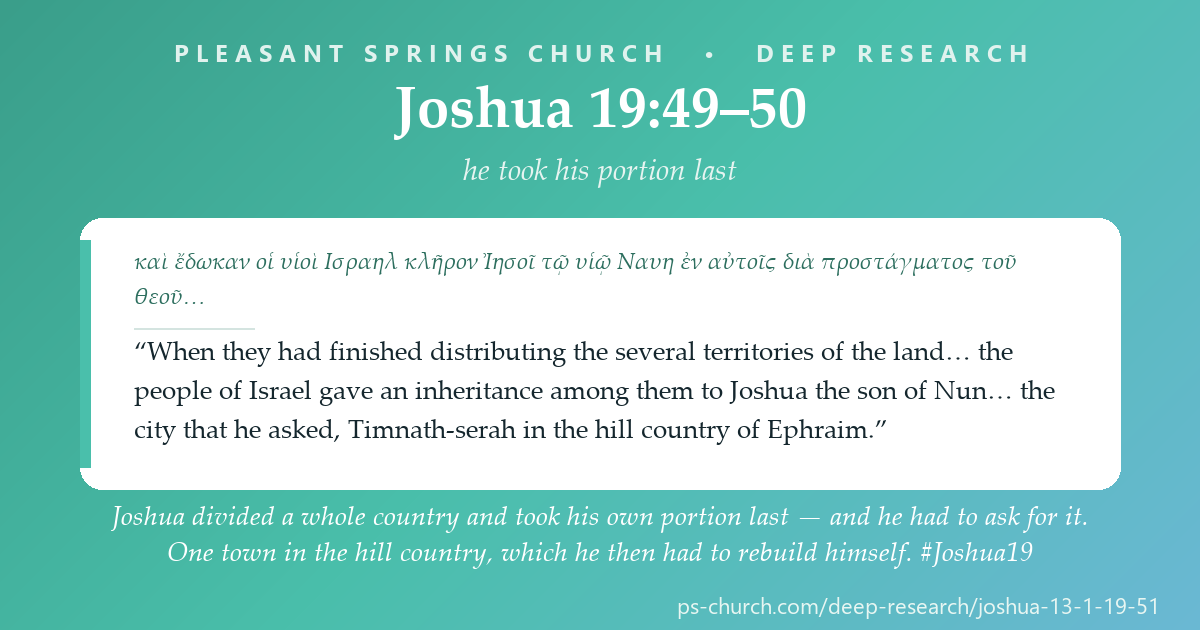
- Joshua’s own portion (19:49–50) is deliberately last. He has presided over every allotment; his name is on the deed of every tribe; and he is served after all of them, and only when he asks. The narrator says nothing about it, which is the point — the restraint is the comment. Compare Numbers 12:3 on Moses.
- Archaeology: name the positions, do not adjudicate. Conquest, infiltration and revolt models are all still argued, and the digs at Hazor, Shiloh, Gezer and Jerusalem are live. Two failure modes to avoid, and they are equal and opposite: claiming that archaeology has proved the Bible, and shrugging as though the historical question does not matter. It matters; it is also not where faith is anchored.
These are chapters of land registry, but dispossession is in them. Caleb drives the three sons of Anak out of Hebron (15:14); Manasseh and Ephraim put surviving Canaanites to forced labour (16:10; 17:13) — a real subjugation, and the text does not dress it up; Dan, squeezed out of its allotment, goes north, takes Leshem by the sword and renames it after its ancestor (19:47). We report it plainly rather than skipping the hard verses, because a summary that quietly leaves them out is not honest about the passage.
Locate it exactly. Scripture presents this as a bounded, divinely-commanded judgment at one unrepeatable point in redemptive history, on a people whose “iniquity” God had waited four centuries to be “complete” (Gen 15:16). It is not a template. Where Scripture gives no further reason — and here it gives very little — we say so and stop.
And say the rest unmistakably. Nothing in these chapters licenses violence, coercion, or ethnic hostility by anyone today. “The weapons of our warfare are not of the flesh” (2 Cor 10:4); “we do not wrestle against flesh and blood” (Eph 6:12); when James and John wanted fire from heaven, Jesus turned and rebuked them (Luke 9:54–55); “Put your sword back into its place” (Matt 26:52). It has to be said plainly that this text has been misused — to bless conquest, colonisation and the dispossession of peoples in later centuries, including within living memory. No reader of this page may use it that way. And these boundary lists in particular are a promise and a charge given to one people at one moment; they are not a modern property deed and must not be pressed into contemporary political conclusions they were never written to settle.
From a surveyor’s line to a leader who takes his portion last.
Name what you learned, why it matters, and one concrete response.
What should we carry away — and do?
- God deals in addresses. Seven chapters of place-names are seven chapters of God refusing to be vague. If you have been praying in abstractions, try praying a coordinate this week — a name, a street, a Tuesday.
- Ask for the hard ground. Caleb was eighty-five and asked for the hill country because the giants were on it, and because God had said something about it forty-five years earlier that he had never let go of. Most of us ask for the easy portion and call it wisdom. What did God say to you a long time ago that you are still owed — and are you still strong enough to go and get it?
- Ask like Achsah. She had land without water, so she got down off the donkey and said, “Give me a blessing… give me also springs of water.” Three verses. No apology, no manipulation, the right request to the right person — and she got both springs. Some of us have been given a portion and have never once asked for what would make it liveable.
- Five names, written down twice. Mahlah, Noah, Hoglah, Milcah, Tirzah asked for an inheritance in Numbers 27 and stood there and received it in Joshua 17 — and the text prints all five names again rather than saying “the daughters of Zelophehad.” God finishes what he starts, and he does it by name.
- File the failures honestly. The same register that records the victories records “could not drive out.” Churches, families and people who can only tell the winning half of their story eventually cannot be trusted with any of it. Tell both halves, in the same tone.
- The lot means nobody negotiated. No tribe can say it out-argued a cousin for the good valley. Everything you have that matters came to you the same way — “What do you have that you did not receive?” (1 Cor 4:7).
- And the leader eats last. Joshua hands out every allotment in Israel and receives his own after all of them — and has to ask for it. Any authority that does not work like that is not working like Joshua’s.
Step in response: take one promise God made you that has gone quiet — something you were sure of years ago and stopped mentioning. Write it down with a date, the way the survey party wrote the land in a book, and bring it back to God this week and ask plainly, in Caleb’s words: “So now give me this hill country.” Then look for one person in your life who has been handed a portion without any water in it — and go be the springs.
Joshua 19:49–50 · to share
LXX + ESVEvery Deep Research page traces its passage across the whole sweep — the Old Testament, the Second-Temple world between the testaments (historical witnesses, not Scripture), and the New Testament. Follow the thread:
Pleasant Springs Church — Deep Research
Research method after Michael S. Heiser’s Bible Research Method (examine dictionaries → ancient literature → important words → textual connections → academic publications → share), with the Pleasant Springs “Author & Audience” foundation. Scripture set in the Hebrew, the Greek editions named on each page and the ESV (Old Testament), and the Greek New Testament and the ESV (New Testament), per the practice of Pleasant Springs Church. Joshua 13–19 research grounded in Hess (TOTC), Howard (NAC), Butler (WBC), Woudstra (NICOT), Boling (Anchor) and Hawk (Berit Olam), with Tov and Greenspoon on the Greek Joshua, Wazana on ancient boundary description, and Rainey & Notley, Aharoni and Beitzel on the geography; the ANE town-list parallel from the Karnak rosters of Thut-mose III (ANET 242–243, with the Megiddo campaign at ANET 234–238); Second-Temple and rabbinic witnesses (Sirach 46:1–10, Josephus Ant. 5.1.19–22, b. Bava Batra 117a and 122a) and the Qumran Joshua manuscripts 4QJosha/4QJoshb, all read as witnesses, not Scripture. Textual note: the Old Greek of Joshua is roughly 4–5% shorter than the MT, and Joshua 13–19 is where the two traditions diverge most — verified here verse by verse, including three disagreeing town totals (15:44, 15:57, 15:62), the extra Bethlehem district Rahlfs prints as 15:59a, the Gezer plus at 16:10, and the lettered verses 19:47a and 19:48a; the Greek also closes 19:51 with “and they went to take possession of the land” rather than “so they finished dividing the land.” Versification: Joshua 13–19 carries no chapter or verse offset — MT, LXX and English agree throughout — apart from those lettered pluses and the reversed order of the two Danite verses in Joshua 19 (Rahlfs’ 19:47 = MT 19:48); the psalms cited follow the standard shift (MT/English Ps 16 = LXX 15; Ps 78 = LXX 77; Ps 105 = LXX 104, verse numbers agreeing). Greek follows Rahlfs. The tension between “Joshua took the whole land” (11:23; 21:43–45) and “there remains yet very much land” (13:1; 13:13; 15:63; 16:10; 17:12–13) is reported with three readings laid out and the residue left standing, not harmonised away. The dispossession narrated in these chapters is reported plainly and fenced explicitly: it licenses no violence, coercion or ethnic hostility today, and the boundary lists are not a modern property deed.
Scripture quotations marked ESV are from the ESV® Bible (The Holy Bible, English Standard Version®), © 2001 by Crossway, a publishing ministry of Good News Publishers. ESV Text Edition: 2016. Used by permission. All rights reserved. The ESV text may not be quoted in any publication made available to the public by a Creative Commons license, and the ESV may not be translated in whole or in part into any other language. www.esv.org
|
Did this study bless you today? 💚 Give to Support PS Church100% of gifts go to the General Fund — thank you. |