Very many horses and chariots. That is how the north comes: a coalition under Jabin of Hazor, “a great horde, in number like the sand that is on the seashore” (11:4), fielding the decisive technology of the age — the thing every king in Canaan wanted and almost none could replace. And the order Joshua receives is the one order no ancient commander would ever give: “You shall hamstring their horses and burn their chariots with fire” (11:6). He does exactly that (11:9). Hazor, “the head of all those kingdoms” (11:10), is taken and burned — alone among the cities that stood on their mounds, the text is careful to say (11:13) — and the chapter does not soften what a campaign under the ban was. Then the sentence readers have wrestled with ever since: “For it was the Lord’s doing to harden their hearts” (11:20), in a book that has already given us Rahab and the Gibeonites, who were not hardened. And then: “So Joshua took the whole land… And the land had rest from war” (11:23) — a sentence the same book qualifies two chapters later, and which this study opens rather than smooths. Chapter 12 then stops narrating and starts naming: thirty-one kings, one at a time, beginning with Sihon and Og. Not filler — a war memorial. This study works Joshua 11:1–12:24. See the method →
Joshua 11:1–12:24 (selections)
Hebrew · LXX · ESVThe Shape of the Passage
Parallel panelsThese two chapters close the campaign half of Joshua. Behind them: the commission (ch 1), Rahab (ch 2), the crossing (chs 3–4), Gilgal and the commander of the army (ch 5), Jericho (ch 6), Achan and the altar on Ebal (chs 7–8), the Gibeonite treaty (ch 9) and the southern campaign (ch 10). Ahead of them: the allotments (chs 13–19), refuge and the altar of witness (chs 20–22), and the covenant at Shechem (chs 23–24).
Author
The book is anonymous. It never names its writer, and it repeatedly says “to this day” (6:25; 9:27; 15:63), which means at minimum that some distance stands between the events and the telling. Jewish tradition attributed the book to Joshua himself with the closing verses added by Eleazar and Phinehas (b. Bava Batra 14b–15a); modern study reads it as part of a longer historical work. Neither the tradition nor the theory is Scripture, and the page will not pretend to settle it.
Whoever wrote it kept receipts. That is the striking thing about this passage. The writer has just told a campaign in nine verses — and then spends fourteen verses of chapter 11 and the whole of chapter 12 on lists: regions, boundary points, peoples, and finally thirty-one kings named individually. He also preserves details that do him no favours as a propagandist: only one city was burned (11:13); Gibeon made peace and was not taken (11:19); the Anakim survive in Gaza, Gath and Ashdod (11:22). A writer inventing a clean conquest does not leave those in.
And he is a theologian of the word, not of the sword. Eight times between 11:12 and 12:6 he ties what happened to what Moses was told (11:12; 11:15 × 3; 11:20; 11:23; 12:6 × 2). His verdict on Joshua is not “he conquered” but “he left nothing undone of all that the " + SC + " had commanded Moses” (11:15). The measure is obedience to a word already given.
Audience
Israelites who could check the list. Chapter 12 is written for people who knew where Taanach and Megiddo and Tirzah were, who could walk to Hebron in a day, and for whom “the king of Jericho, one” was not an abstraction. A list only functions as a memorial for a community that recognizes the names on it.
A people who would soon need both halves of the summary. Israel is told “Joshua took the whole land… and the land had rest from war” (11:23), and then, almost immediately, “there remains yet very much land to possess” (13:1). The audience lived in the gap between those two sentences, and the book does not hide the gap from them. The generation that read chapter 12 as a monument would also read Judges 1 as an indictment.
People tempted by chariots. This is not a hypothetical audience. Israel’s later kings did acquire horses in quantity (1 Kings 10:26–29), against the plain instruction of Deuteronomy 17:16; the prophets had to say “woe to those who… rely on horses” (Isaiah 31:1); and a psalm had to teach the congregation to sing “some trust in chariots and some in horses, but we trust in the name of the " + SC + " our God” (Psalm 20:7 · MT 20:8 · LXX 19:8). Joshua 11 is where that argument starts, and it starts with a decision made in a field, about captured equipment, on the day it would have been most useful.
Orient on Hazor, chariot warfare, the ban, the hardening of hearts, and the ancient king list.
Search by topic: Hazor; Merom; Jabin; chariot and horse in the ancient Near East; hamstringing; herem / devoted to destruction; hardening of the heart; Anakim; tell (city mound); king lists and city lists; Sihon and Og; Tirzah.
Which articles are relevant?
- Anchor Bible Dictionary — “Hazor,” “Merom, Waters of,” “Jabin,” “Chariots,” “Horse,” “Ban,” “Anak, Anakim,” “Joshua, Book of,” “Tirzah.”
- Dictionary of the OT: Historical Books — “Joshua, Book of,” “Conquest and Settlement,” “City Lists,” “Warfare,” “Herem,” “Canaan, Canaanites,” “Archaeology of the Land.”
- NIDOTTE / TDOT — עָקַר (ʿāqar, hamstring), רֶכֶב (reḵeḇ, chariotry), סוּס (sūs, horse), חָרַם (ḥāram, devote to destruction), חָזַק (ḥāzaq, be/make strong, harden), שָׁקַט (šāqaṭ, be quiet, have rest), תֵּל (tēl, mound).
- Anchor Bible Dictionary / IEJ & NEAEHL — the site entries for Tel Hazor, which is where the excavation history and the interpretive dispute are laid out most fully.
Bibliography surfaced:
- Richard S. Hess, Joshua (TOTC); David M. Howard Jr., Joshua (NAC); Trent C. Butler, Joshua (WBC); Robert G. Boling, Joshua (AB); Marten H. Woudstra, The Book of Joshua (NICOT); L. Daniel Hawk, Joshua (Berit Olam).
- K. Lawson Younger Jr., Ancient Conquest Accounts (JSOTSup 98) — the standard study of the conventional, formulaic register of ANE conquest reports, Joshua 9–12 included.
- Emanuel Tov and Leonard J. Greenspoon on the Greek Joshua — the shorter Old Greek text and its relation to the MT.
- Amnon Ben-Tor et al., the Hazor excavation volumes (the Selz Foundation expedition, in memory of Yigael Yadin).
What a Late Bronze king did with captured chariots — and what Joshua was told to do with them.
Read 11:6 and 11:9 against the way ANE kings actually inventoried captured horses and chariots; then read the conquest summaries against a neighbouring king narrating his own ḥerem; then set the archaeology of Tel Hazor out fairly, naming the positions and adjudicating none of them.
Which parallels shed light on religion and worldview?
The chariot was the prize, and everyone knew it. The clearest single illustration is Egyptian and it is close at hand: Thut-mose III’s annals of the battle of Megiddo end with a booty list, and after the prisoners the list turns at once to the animals and the vehicles — “2,041 horses, 191 foals, 6 stallions” and, after the two gold-worked chariots of the enemy and the prince, “892 chariots of his wretched army — total: 924” (ANET 237). The same page counts the captured maryanu, the chariot aristocracy of Late Bronze Canaan. A victorious king counted chariots and took them home; they were the most valuable movable asset on a battlefield and the basis of the next campaign. Joshua 11:6 tells Israel to cripple the animals and burn the vehicles on the spot. Whatever else that is, it is not the behaviour of a state building an army.
Hazor was not just another town. The site of Tel Hazor is by a wide margin the largest Bronze Age mound in the region, upper city and lower city together, and Hazor appears in the archives of Mari on the middle Euphrates as a significant player in international trade and diplomacy centuries before Joshua, and again in the Amarna correspondence of the fourteenth century, where its ruler is among the very few in Canaan styled a king. (The Amarna letters are collected in ANET — the relevant pages fall outside our local scan, so they are cited here without page numbers. And the frequently repeated equation of the ʿApiru of those letters with the biblical Hebrews is a long-debated proposal, not an established result; we do not build on it.) When 11:10 says Hazor “formerly was the head of all those kingdoms,” the extra-biblical record makes that a sober description rather than a boast.
A neighbouring king describing his own ḥerem. The Moabite Stone, set up by Mesha king of Moab in the ninth century, is the fairest comparison available and it should be read soberly, not as a gotcha in either direction. Mesha reports that “Chemosh said to me, ‘Go, take Nebo from Israel!’” and that he took it “slaying all… for I had devoted them to destruction for (the god) Ashtar-Chemosh” (ANET 320–321, trans. W. F. Albright) — the same verbal root as Joshua’s חֵרֶם. Two things follow, and both matter. First: the biblical writers were using a register their neighbours also used, which is a caution against reading every totalizing phrase as an inventory — a caution about register, and never an escape hatch that makes the text say nothing. Second, and more pointed: the same inscription declares “Israel hath perished for ever,” which was demonstrably not true when the stone was cut. That is what sweeping royal summary language does in this world, and it is worth holding in mind one chapter before Joshua 13:1.
The archaeology of Hazor, fairly stated. Yigael Yadin excavated the site in 1955–58 (and again in 1968) and identified a violent destruction of the Late Bronze city which he connected with the events of Joshua 11. Amnon Ben-Tor has directed the renewed excavations since 1990; he too found the monumental buildings destroyed in an intense conflagration, with Egyptian and Canaanite statuary deliberately mutilated, and has argued that an external destroyer is the best explanation. Sharon Zuckerman, his co-director, read the same evidence differently, arguing from a preceding period of decline and from the uneven pattern of burning that the city fell to an internal collapse or rebellion rather than an invading army. Others again dispute the chronology on which the whole question turns. These are the live positions; this page names them and adjudicates none of them. It is worth saying plainly why: the Christian faith does not rest on a stratum. Archaeology is a genuine and valuable witness, it is fragmentary by nature, and it is read by honest people in more than one way. “Archaeology proves the Bible” and “archaeology refutes the Bible” are both larger claims than the evidence supports.
- Annals of Thut-mose III — the Megiddo booty list (ANET 237) (Egyptian royal text — a witness, not Scripture) — horses, foals, stallions and 924 chariots itemized as plunder, with the maryanu chariot warriors counted among the captives. The exact opposite of Joshua 11:9, item for item.
- The Moabite Stone (Mesha Inscription) (ANET 320–321, trans. W. F. Albright) (ANE royal inscription — a witness, not Scripture) — a king who says his god told him to attack, who uses the verb “devote to destruction,” and who also writes “Israel hath perished for ever.” Read for register, and read soberly.
- The Mari archives and the Amarna letters (ANE archives — witnesses, not Scripture) — independent attestation of Hazor as a major power in Canaan long before and shortly before the period in view. Cited without ANET page numbers, which fall outside the scan we can verify locally.
- Josephus, Antiquities 5.1.18 (Whiston’s numbering) (Second-Temple — a witness, not Scripture) — retells the northern battle with his own inflated figures (three hundred thousand foot, ten thousand horse, twenty thousand chariots) and keeps the detail that mattered to him: Joshua “slew their horses, and burnt their chariots.” Even a first-century Roman-world historian found that worth reporting.
- Sirach 46:1–8 (Second-Temple — a witness, not Scripture) — the earliest surviving praise-poem about Joshua: “mighty in war… for he waged the wars of the Lord,” with the sun held back and the hailstones (46:4–6) and then Caleb (46:7–8). Notice what is not there: Hazor, the coalition, the horses. Second-Temple memory kept chapter 10 and let chapter 11 go.
- 4QJosha (4Q47) and 4QJoshb (4Q48) (Dead Sea Scrolls — witnesses, not Scripture) — the Joshua scrolls from Cave 4. 4QJosha preserves material from roughly Joshua 2–10 and is famous for placing the altar-and-law-reading episode (MT 8:30–35) early, next to 5:2–7; 4QJoshb is smaller still. Neither, as published, preserves chapters 11–12, and this page therefore makes no Qumran claim about our passage.
- b. Bava Batra 14b–15a (rabbinic-era — a witness, not Scripture) — the tradition that Joshua wrote his own book and that the closing verses were added after his death.
Put 11:6 beside ANET 237 and the strangeness of it comes into focus. Thut-mose III wins at Megiddo and the scribe immediately starts counting: horses, foals, stallions, 924 chariots, coats of mail, bows. That is what victory was — the enemy’s army converted into your army. Chariotry was the tank corps of the Late Bronze Age: expensive, technically demanding, decisive on flat ground, and impossible to build quickly. To capture a chariot force intact was to leap a generation ahead.
Israel is told to destroy it. Not to sell it, not to garrison it, not even to store it — to cut the hamstrings of the horses and set fire to the vehicles, in the field, the same day. And the narrator, who compresses a whole war into a sentence elsewhere, slows down enough to say it twice: God says it in 11:6, and the text repeats it almost word for word as done in 11:9.
Behind that stands a line in the law about the king Israel would one day have: “he must not acquire many horses for himself” (Deut 17:16). The logic is not that cavalry is wicked. It is that a nation which owes its existence to a rescue can very easily start trusting the machinery instead — and that the surest way to a standing army is a stable. Israel had already watched Egypt’s chariots go into the sea (Exod 14:23–28) and had sung about it: “the horse and his rider he has thrown into the sea” (Exod 15:1). Joshua 11 asks whether they meant it, on the one day it cost something.
Sinews and chariots, a head of kingdoms, a hardened heart, a land that got quiet — and the word “one.”
Watch ʿiqqēr (hamstring) run from command to execution; ləḥazzēq (harden), the same verb used of Pharaoh; šāqəṭāh (had rest), which becomes the refrain of Judges; and ʾeḥāḏ (“one”), repeated after every king in chapter 12 and absent from the Greek.
“Hamstring” — to cut the tendon above the hock so the animal can never again pull or carry. The LXX chooses a compound built on νεῦρον, “sinew”: νευροκοπήσεις… ἐνευροκόπησεν, “you shall cut the sinews… he cut the sinews.” Scripture uses the word rarely, and the other occurrences are worth knowing: Jacob condemns it as violence in Genesis 49:6 (“in their willfulness they hamstrung oxen”), and 2 Samuel 8:4 reports David doing to captured chariot horses exactly what Joshua did — “but left enough for 100 chariots.” The exception in that verse is the beginning of a long story.
“Chariotry” and “horse” (LXX ἅρματα, ἵπποι). In 11:4 they are the coalition’s headline asset, “very many”; by 11:9 they are wreckage. The pairing becomes a fixed theological shorthand in Israel’s vocabulary — the thing you trust instead (Ps 20:7 · MT 20:8 · LXX 19:8; Isa 31:1) — and the law had already legislated against stockpiling it (Deut 17:16).
“Head” — Hazor “formerly was the head of all those kingdoms.” The Greek renders it with a participle of rule, ἄρχουσα πασῶν τῶν βασιλειῶν, “ruling over all those kingdoms.” The word is doing historical work, not rhetorical: it explains why this one city is singled out, why its king heads the coalition, and why it alone is burned.
“Devote to destruction” — to place something irrevocably outside human use by handing it over to God. The LXX uses ἐξολεθρεύω here rather than the noun ἀνάθεμα it used at Jericho. This is the vocabulary of the hardest verses in the book, and it is reported here plainly rather than translated away. The same root appears in a Moabite king’s mouth on the Mesha Stele (ANET 320–321) — which tells us the word was current in the region, and tells us nothing at all about whether either use was right.
“To make strong,” hence “to harden” — and it is the same verb the Torah uses of Pharaoh: “I will harden his heart” (אֲחַזֵּק, Exod 4:21). The Greek translators of the two books went different ways: Exodus reads σκληρυνῶ, “I will make hard”; Joshua reads κατισχῦσαι, “to make strong.” The Hebrew link, however, is exact, and it is almost certainly deliberate: the northern kings are being narrated as Pharaoh was.
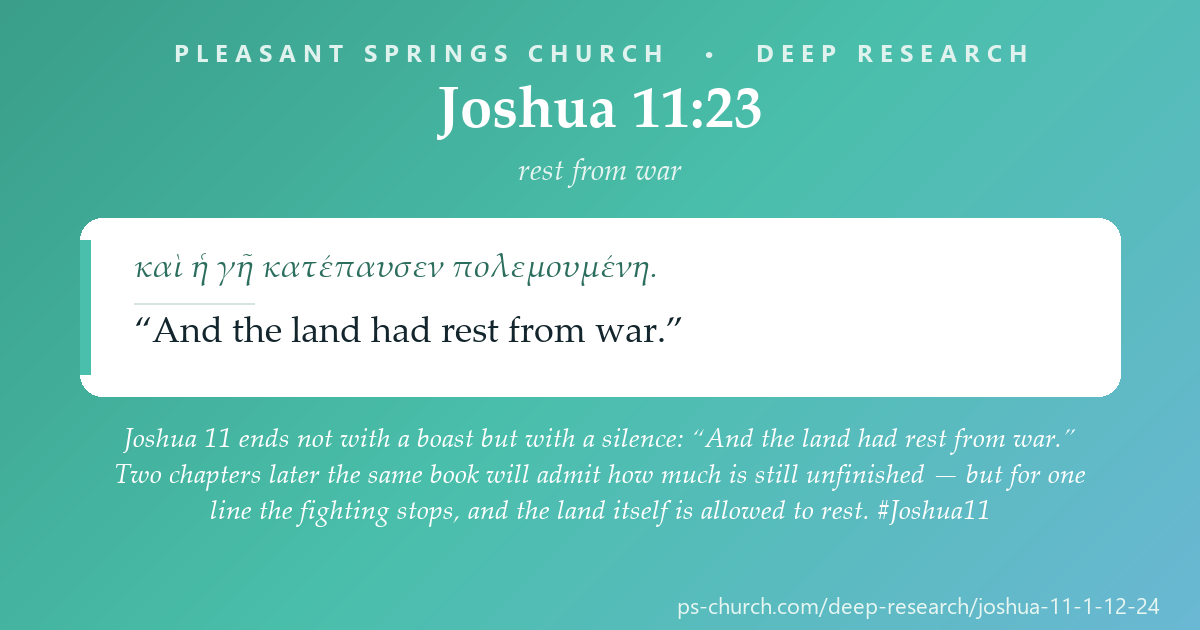
“Had rest / was quiet” — the subject is not Israel but the land: “and the land had rest from war.” The Greek is even gentler, ἡ γῆ κατέπαυσεν πολεμουμένη, “the land ceased being warred upon.” The same verb becomes the refrain of the next book — “So the land had rest forty years” (Judges 3:11; 5:31; 8:28, and eighty at 3:30) — and it is the note this page’s share verse is built on.
“One” — the small word that makes chapter 12 what it is. After every single king in the list the Hebrew says one: the king of Jericho, one; the king of Ai, one; on and on, thirty-one times, closing with “in all, thirty-one kings.” It is a counting formula, and it is also a refusal to let a war be summarized. The Greek does not have it — Rahlfs lists the kings in the accusative with no numeral after any of them, and totals εἴκοσι ἐννέα, twenty-nine.
How the rest of Scripture takes up this vocabulary:
- Psalm 20:7 (MT 20:8 · LXX 19:8) — “Some trust in chariots and some in horses, but we trust in the name of the Lord our God.” A congregation singing what Joshua 11:9 did. (Note the numbering: from Psalm 9/10 onward the Greek Psalter runs one number behind the Hebrew, and the Hebrew counts the superscription as verse 1, so the English 20:7 is MT 20:8 and LXX 19:8.)
- Isaiah 31:1 — “Woe to those who go down to Egypt for help and rely on horses, who trust in chariots because they are many… but do not look to the Holy One of Israel…” The prophets had to fight this battle again, and lost it more often than not.
- 1 Kings 10:26–29 — Solomon with 1,400 chariots and 12,000 horsemen, importing from Egypt: the exact thing Deuteronomy 17:16 forbade, generations after Joshua burned the first ones.
- Judges 1:19 — and then the sting: Judah “could not drive out the inhabitants of the plain because they had chariots of iron.” The technology Joshua refused to adopt is the technology that later stops Israel at the edge of the valleys.
- Exodus 14:23–28; 15:1 — the founding image (see Exodus 14, Exodus 15): Egypt’s chariots in the sea, and Israel singing about it. Joshua 11 is that song turned into a policy.
- 2 Samuel 7:1, 11 — “rest” language carried forward to the king: “the Lord had given him rest from all his surrounding enemies” (see 2 Samuel 7). And Hebrews 4:8–9 takes the next step: “For if Joshua had given them rest, God would not have spoken of another day later on” — the New Testament’s own reading of the limits of 11:23 (see Hebrews 4:14–16).
“The whole land” and “very much land remains” — the book’s own great tension, opened.
Trace three threads: the horses and chariots from Exodus 14 to Judges 1; the hardening of hearts from Pharaoh to Joshua 11:20, with the counter-cases inside this very book; and the two sets of summary statements about the conquest, quoted side by side and left in tension where they remain in tension.
Which cross-references matter?
- Numbers 21:21–35 — Sihon and Og, who head the memorial in 12:2–5, defeated a generation earlier under Moses (see Numbers 21; also Deuteronomy 2–3). Chapter 12 begins east of the Jordan on purpose: the memorial starts before Joshua did.
- Numbers 13:22, 28, 33; Joshua 11:21–22 — the Anakim, the reason a whole generation refused to go in (see Numbers 13–14), reported here as cut off from the hill country, with the second half of 11:21 saying what that meant — “Joshua devoted them to destruction with their cities” — and, in the same breath, as still present in Gaza, Gath and Ashdod. The book gives with one hand and qualifies with the other.
- Genesis 15:16 — “the iniquity of the Amorites is not yet complete” (see Genesis 15): the text’s own timing for the judgment described here, four centuries of forbearance before it.
- Exodus 4:21; 7:3; 9:12; 14:4 — the hardening of Pharaoh, the closest analogue to 11:20 and the same Hebrew verb at Exodus 4:21 (see also Exodus 9).
- Joshua 2:8–13; 9:3–15 — and the counter-cases, inside this same book: Rahab, who heard the same reports and asked for mercy, and the Gibeonites, who heard and sued for peace. 11:19 explicitly excepts them. Whatever 11:20 means, it does not mean that no one could do otherwise.
- Joshua 13:1–7; 15:63; 16:10; 17:12–13 — the other set of statements, only one chapter later and then repeatedly (see Joshua 13–19): “there remains yet very much land to possess”; Judah “could not drive out” the Jebusites; Manasseh “could not take possession.”
- Joshua 21:43–45 — and the strongest form of the first set (see Joshua 20–22): “Not one word of all the good promises that the Lord had made to the house of Israel had failed; all came to pass.”
- Judges 1:19, 21, 27–36; 2:1–3 — the next book opens by cataloguing, tribe by tribe, what was not driven out. There is no Deep Research page on Judges yet; it is cited here in bold, and it should be read alongside Joshua 11:23 rather than instead of it.
- Numbers 33:50–56 — the instruction that frames both (see Numbers 33): “you shall drive out the inhabitants… but if you do not,… they shall be as barbs in your eyes.” The gift and the task are stated together from the beginning.
These are the two sentences, and the honest thing is to put them next to each other before doing anything else with them. “So Joshua took the whole land, according to all that the Lord had spoken to Moses… And the land had rest from war” (11:23). “Now Joshua was old and advanced in years, and the Lord said to him, ‘You are old and advanced in years, and there remains yet very much land to possess’” (13:1). One chapter apart, in the same book, by the same writer. And it is not an isolated wobble: 21:43–45 says “not one word… had failed,” while 15:63, 16:10 and 17:12–13 say the tribes could not drive people out, and Judges 1 opens by listing the failures town by town.
Three readings are on the table, and each has real weight. (1) “All” as summary, not inventory. Ancient conquest reports characteristically speak in sweeping totals; K. Lawson Younger’s study of the genre documents this across Egyptian, Hittite and Assyrian texts, and the Mesha Stele’s “Israel hath perished for ever” is the nearest example. On this reading 11:23 claims the campaign was decisive, not that every settlement changed hands. (2) The gift is complete; the possession is progressive. This is the text’s own idiom, and it is startling once you notice it: God says “I have given” and in the same breath “you shall drive out” (Josh 1:3; 13:6; Num 33:53). The deed is signed and the moving is not finished. (3) The summaries and the lists are answering different questions. 11:23 and 21:45 are statements about God’s promise — it held, nothing failed. 13:1 and Judges 1 are statements about Israel’s follow-through — it lapsed. Both can be true of the same territory without either being softened.
And then the honest stop. What remains in tension is this: 11:23 does not read like a partial claim. It says “the whole land” and “the land had rest,” and 21:44 adds “not one of all their enemies had withstood them” — which is hard to hold, as a plain sentence, beside “they could not drive out” three chapters earlier. The three readings above relieve the pressure; none of them dissolves it, and a page that told you otherwise would be selling you something. Scripture has placed the two statements four columns apart and left them there. The right response is to let the book be as candid as it evidently intends to be — a book proud enough to carve thirty-one names in stone and honest enough to admit, on the next page, how much was still undone — and to notice that the New Testament reads it exactly that way: “For if Joshua had given them rest, God would not have spoken of another day later on” (Heb 4:8). The rest of 11:23 was real. It was not the last one.
The commentaries, the Greek text, the genre question, and the excavation dispute.
Hess, Howard, Butler, Boling, Woudstra and Hawk on Joshua; Younger on the conquest-account genre; Tov and Greenspoon on the shorter Greek Joshua; Yadin, Ben-Tor and Zuckerman on Tel Hazor — named, not adjudicated.
Commentaries & studies:
- Richard S. Hess, Joshua (TOTC); David M. Howard Jr., Joshua (NAC); Trent C. Butler, Joshua (WBC); Robert G. Boling, Joshua (AB); Marten H. Woudstra, The Book of Joshua (NICOT).
- L. Daniel Hawk, Every Promise Fulfilled: Contesting Plots in Joshua, and his Joshua (Berit Olam) — the sustained argument that the book’s competing accounts of complete and incomplete conquest are a deliberate feature of its design rather than a seam to be sanded down.
- K. Lawson Younger Jr., Ancient Conquest Accounts: A Study in Ancient Near Eastern and Biblical History Writing (JSOTSup 98) — the comparative study of the genre, and the standard reference for the claim that this register is conventional and hyperbolic.
- Emanuel Tov, Textual Criticism of the Hebrew Bible, and Leonard J. Greenspoon, Textual Studies in the Book of Joshua — the shorter Old Greek of Joshua, its relation to the MT, and the Qumran evidence.
- Amnon Ben-Tor et al., the Hazor excavation reports of the renewed (Selz Foundation) expedition; Yigael Yadin, Hazor: The Rediscovery of a Great Citadel of the Bible; Sharon Zuckerman, “Anatomy of a Destruction: Crisis Architecture, Termination Rituals and the Fall of Canaanite Hazor” (Journal of Mediterranean Archaeology, 2007).
Interpretation notes worth keeping:
- The conquest, located precisely. The text presents this as a bounded, divinely commanded judgment at a unique moment in redemptive history: on named nations, for stated wickedness, after four centuries of forbearance (Gen 15:16), at explicit command through Moses (11:12, 15, 20; cf. Deut 7, Deut 20), with Israel placed under the identical standard and, in the event, exiled under it. It is not an ethnic category: Rahab and the Gibeonites are inside the covenant community by the end of the story, and Israelites are put outside it in chapter 7.
- The difficulty is real, and no slogan should be offered for it. Verses 11:11 and 11:20 are printed here in full, and 11:12, 11:14 and 11:21 are named and reported rather than summarized around — a summary sentence that would not be true of those verses is not an acceptable summary. Where Scripture gives a reason it is given here; where it gives none, that is said and the page stops. There is no attempt to make these chapters comfortable, and no dwelling on them for effect: no numbers are quoted as rhetoric, and the register is deliberately restrained.
- It licenses no violence, coercion, or ethnic hostility by anyone today — ever, by anyone, for any cause. The church’s weapons “are not of the flesh” (2 Cor 10:4); the struggle is “not against flesh and blood” (Eph 6:12); when the disciples proposed fire from heaven Jesus rebuked them (Luke 9:54–55) and told Peter to put the sword away (Matt 26:52). It must also be said plainly that these chapters have been misused — to sanctify conquest, colonization and the dispossession of peoples, in more than one century and on more than one continent. That misuse was a lie about the text, and no reader of this page may repeat it.
- On register, carefully. ANE conquest accounts are characteristically sweeping and formulaic, and Joshua uses that register (Younger). This is a genuine observation about how such reports speak, and it should be held with a light hand: it is a caution against reading every totalizing phrase as a body count, and it is not an escape hatch that makes the text say nothing. The Mesha Stele is the fair comparison in both directions.
- 11:20, the hardening. The text says the hardening was the Lord’s doing, in the same verb used of Pharaoh, and it does not explain further. Two things must be said together. First, the book itself refuses to be read as blanket determinism: 11:19 stops mid-sentence to except Gibeon (the Greek of 11:19 lacks the exception clause; the Hebrew keeps it), and Rahab is the first character in the book to confess that the Lord “is God in the heavens above and on the earth beneath” (2:11). People in this very narrative were not hardened. Second, this page will not resolve the freedom-and-sovereignty question with a slogan in either direction. This church holds a Molinist account of providence — which is a framework for holding divine sovereignty and genuine creaturely freedom together without collapsing either — but a framework is not a licence to flatten a text. Exodus said both “the Lord hardened Pharaoh’s heart” and “Pharaoh hardened his heart,” and Joshua 11:20 gives us only the first half. Where Scripture gives no reason, we say so and stop.
- On the archaeology. Hazor is one of the few places where a biblical claim and a major excavation address the same event, which is exactly why the interpretations diverge: Yadin and Ben-Tor read the Late Bronze destruction as the work of an outside conqueror, Zuckerman as internal collapse, and the chronology itself is disputed. Name the positions, weigh them honestly, and do not let a page of Scripture be made to depend on the outcome. Faith is not waiting on a trench report.
- Chapter 12 is not an appendix. Read as a list it is tedious; read as a memorial it is the point. It names the defeated one at a time, in a world where losers were normally erased; it begins with victories Joshua had nothing to do with (12:2–6, under Moses); and its arithmetic is honest enough to be checkable — which is presumably why the Hebrew and Greek totals differ. Thirty-one names is also a sober number: this took years (11:18), and somebody kept the record.
From very many horses and chariots to a land that finally got quiet.
Name what you learned, why it matters, and one concrete response.
What should we carry away — and do?
- The day you win is the day you decide what you will trust next. Joshua had a chariot corps in his hands and was told to destroy it. Every advantage you acquire honestly is still a candidate for becoming the thing you lean on. The question is not whether the resource is good; it is what it will be in five years.
- Obedience, not achievement, is the verdict. The narrator’s summary of Joshua is not a body count or a map: “He left nothing undone of all that the Lord had commanded Moses” (11:15). Moses is named eight times between 11:12 and 12:6. The campaign is graded against a word.
- Take the hard verses at full weight, or you have not read the chapter. 11:11, 11:20 and 11:21 are in this passage, and no honest summary of it can be written as though they were not. Report them, locate them, refuse every modern application of them — and do not pretend they are easy.
- Do not harmonize what Scripture left open. “Joshua took the whole land” (11:23) and “there remains yet very much land to possess” (13:1) are one chapter apart. Learning to hold both without smoothing either is most of what it means to read the Bible as an adult.
- Keep the names. Chapter 12 exists because someone thought the cost and the outcome of those years deserved to be written down one line at a time. Churches forget faster than they think. Write down what God actually did, with names and dates, while you still remember them.
And the rest Joshua gave was real but not final — “there remains a Sabbath rest for the people of God” (Hebrews 4:9). We are not asked to secure it; we are asked to trust the one who has.
Step in response: name one “chariot” — a capability, a reserve, a reputation, a relationship you quietly rely on — and do one concrete thing this week that puts your weight on God instead of on it. Then take fifteen minutes and start your own chapter 12: a plain list, one line per entry, of the things God has done in your household or your congregation, with names. Read it out loud the next time the land is not at rest.
Joshua 11:23b · to share
LXX + ESVEvery Deep Research page traces its passage across the whole sweep — the Old Testament, the Second-Temple world between the testaments (historical witnesses, not Scripture), and the New Testament. Follow the thread:
Pleasant Springs Church — Deep Research
Research method after Michael S. Heiser’s Bible Research Method (examine dictionaries → ancient literature → important words → textual connections → academic publications → share), with the Pleasant Springs “Author & Audience” foundation. Scripture set in the Hebrew, the Greek editions named on each page and the ESV (Old Testament), and the Greek New Testament and the ESV (New Testament), per the practice of Pleasant Springs Church. Joshua 11–12 research grounded in Hess (TOTC), Howard (NAC), Butler (WBC), Boling (AB), Woudstra (NICOT) and Hawk (Berit Olam, and Every Promise Fulfilled), with K. Lawson Younger Jr., Ancient Conquest Accounts, on the genre and register of ANE conquest reports, and Tov and Greenspoon on the Greek Joshua. ANE background verified against the local scan: the Megiddo booty list of Thut-mose III (ANET 237 — 2,041 horses, 924 chariots, the maryanu counted as captives) and the Moabite Stone (ANET 320–321, trans. W. F. Albright), read soberly for register and for a neighbouring king’s own use of “devote to destruction.” The Mari and Amarna archives are cited without page numbers, which fall outside the scan we can check locally, and the ʿApiru/Hebrew equation is treated as a contested proposal, not a result. Second-Temple and rabbinic witnesses (Sirach 46:1–8; Josephus, Ant. 5.1.18 in Whiston’s numbering; b. Bava Batra 14b–15a) are read as witnesses, not Scripture; 4QJosha and 4QJoshb are noted only to say that neither, as published, preserves chapters 11–12, so no Qumran claim is made here. The Tel Hazor excavation dispute is reported with the positions named (Yadin; Ben-Tor; Zuckerman) and deliberately not adjudicated, and no article of faith is made to depend on it. Numbering: Joshua carries no chapter offset in any tradition, and every verse printed on this page bears the same number in Hebrew, Greek and English; the Psalm cited at Stage 3 does diverge and is given in all three (Ps 20:7 · MT 20:8 · LXX 19:8, checked in an actual Greek Psalter). Text: Greek from Rahlfs throughout, verified verse by verse against the printed text rather than back-translated; the Old Greek of Joshua is roughly 4–5% shorter than the MT, and the specific minuses in this passage (11:4, 11:10, 11:19) and the differing king-total at 12:24 (twenty-nine against the Hebrew’s thirty-one) are reported where they occur rather than harmonized; at 11:13b Rahlfs is followed against Vaticanus-based printings and the divergence flagged. The conquest material is reported plainly, located as a bounded and unrepeatable judgment, and fenced without qualification against any modern application; 11:20 is handled as Exodus handles Pharaoh, with the counter-cases in this same book named and the freedom-and-sovereignty question left unresolved rather than settled by slogan; and the “whole land” / “very much land remains” tension is quoted from both sides, given three fair readings, and then explicitly left in tension where it remains.
Scripture quotations marked ESV are from the ESV® Bible (The Holy Bible, English Standard Version®), © 2001 by Crossway, a publishing ministry of Good News Publishers. ESV Text Edition: 2016. Used by permission. All rights reserved. The ESV text may not be quoted in any publication made available to the public by a Creative Commons license, and the ESV may not be translated in whole or in part into any other language. www.esv.org
|
Did this study bless you today? 💚 Give to Support PS Church100% of gifts go to the General Fund — thank you. |