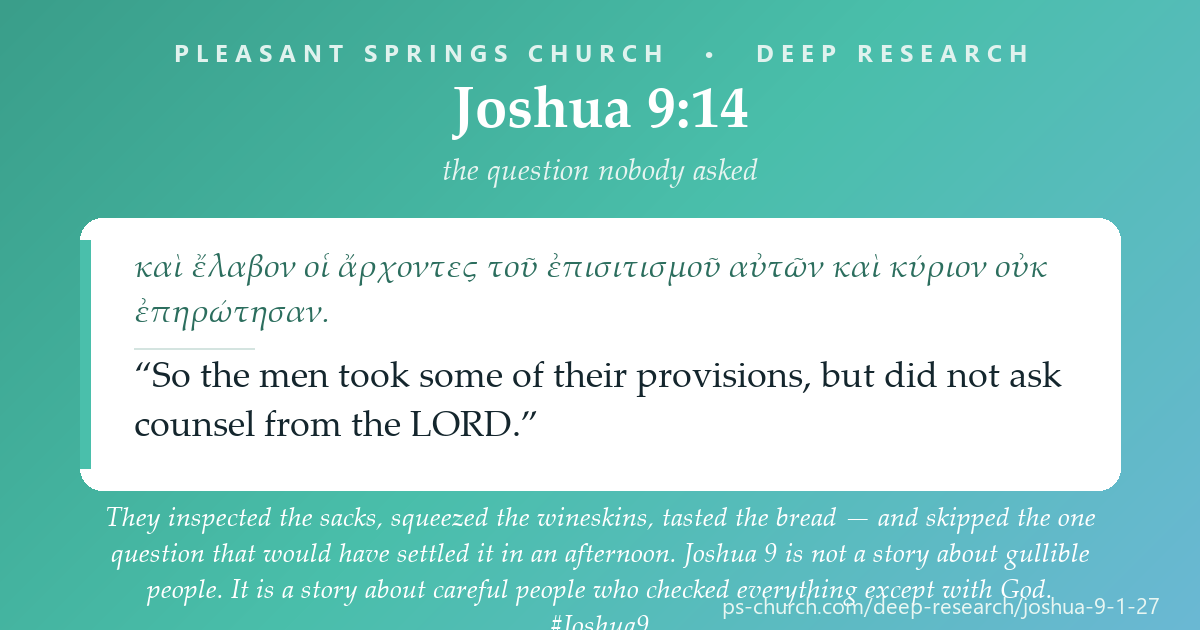
The same news reaches everyone west of the Jordan, and there are exactly two responses to it. The kings gather as one to fight (9:1–2). Gibeon “on their part acted with cunning” (9:4) — and the narrator slows down to show you the props one at a time: sacks worn out, wineskins split and tied back together, sandals patched, clothes worn thin, bread gone dry. Then the line that is too good, the flourish of a man enjoying his own performance: “It was still warm when we took it from our houses… but now, behold, it is dry and crumbly” (9:12). Israel is not naive — the first thing out of their mouths is the right question, “Perhaps you live among us” (9:7). They examine the evidence and the evidence holds. And then verse 14, which is the hinge of the whole chapter: they took some of the provisions, “but did not ask counsel from the Lord.” Three days later the geography collapses, the congregation turns on its leaders, and the leaders make the decision this chapter is really about: “We have sworn to them by the Lord, the God of Israel, and now we may not touch them” (9:19). What follows is servitude, plainly reported — cutters of wood and drawers of water — and, in the same breath, a permanent posting at the altar. This study works Joshua 9:1–27. See the method →
Joshua 9:1–27 (selections)
Hebrew · LXX · ESVThe Shape of the Passage
ConcentricChapter 9 sits at the seam of the book. Jericho and Ai are behind it (ch 6; chs 7–8) — and 9:3 says so explicitly: Gibeon acts because it heard what happened to those two towns. The Gibeonite treaty is also the fuse for what follows: five kings will attack Gibeon precisely for making peace, and Joshua will march all night to defend the people who cheated him (ch 10).
Author
An anonymous narrator, and one who plainly enjoys this story. Joshua is told in a spare, formulaic style — cities fall in a sentence, kings die in a list — and then chapter 9 slows almost to a stop so that we can look at a wineskin. Sacks: worn out. Skins: worn out, split, tied back together. Sandals: worn out and patched. Clothes: worn out. Bread: dry and crumbling. The itemizing is the joke, and the narrator is in on it. Hebrew narrative normally tells you almost nothing about objects; when it slows down to describe five of them in a row, it is showing you a stage set.
He also lets the con man overplay his hand. Biblical narrative is famously reticent — it withholds motive and lets speech do the characterizing. So watch the speech. The delegation is asked a simple question and answers with a set piece: the name of the God, the plagues in Egypt, Sihon and Og, the elders back home, the quoted instructions of the elders back home — and then the flourish, “this was still warm when we packed it” (9:12). Nobody needed to say that. It is the detail an honest traveller would never think of and a liar cannot resist.
And he refuses to make Israel look stupid. This is the mark of a careful writer. He could have had Israel swallow the story whole; instead he gives them the correct suspicion in verse 7, before a single prop has been examined. What he then records is not gullibility but a due-diligence failure of a very modern kind: they audited the evidence in front of them and skipped the one enquiry that was not in front of them.
Audience
Israelites who lived next door to Gibeonites. The chapter ends with “to this day” (9:27) — the narrator’s standing signal that he is explaining something his readers can still see. There were Gibeonites at the sanctuary doing exactly this work, and everybody knew it, and somebody had to explain why a Canaanite town was inside the covenant community instead of under the ban. This chapter is the answer, and it does not flatter the ancestors who produced the situation.
A people who had just been told twice what an oath costs. They are one generation from Sinai and from Moab, where the law had said plainly: “You shall not swear by my name falsely, and so profane the name of your God” (Lev 19:12); “If a man vows a vow to the " + SC + ", or swears an oath to bind himself by a pledge, he shall not break his word” (Num 30:2, MT/LXX 30:3). The leaders in 9:19 are not being sentimental. They are quoting the catechism.
And a people who had also been told not to do this. “You shall make no covenant with them” (Exod 23:32; Deut 7:2). So the chapter hands its first readers a genuine collision: a command broken, and an oath that must nevertheless be honoured. The text does not resolve it by pretending the covenant was fine. It resolves it by ranking two obligations — and by putting the Name above the mistake.
Orient on Gibeon, treaty and oath, the ban, cunning, and the temple servants.
Search by topic: Gibeon and el-Jib; covenant (berith) and treaty; oath and vow; herem / the ban; Hivites and Horites; cunning and craftiness; Urim and Thummim and inquiring of the Lord; Nethinim / temple servants; corvée and forced labour.
Which articles are relevant?
- Anchor Bible Dictionary — “Gibeon,” “Gibeonites,” “Covenant,” “Oath,” “Ban,” “Hivites,” “Horites,” “Nethinim,” “Urim and Thummim.”
- Dictionary of the OT: Historical Books — “Joshua, Book of,” “Gibeon, Gibeonites,” “Canaan, Canaanites,” “Herem,” “Oaths and Vows,” “Treaties.”
- NIDOTTE / TDOT — עָרְמָה (ʿormāh, cunning), בְּרִית (bərîṯ, covenant), שָׁבַע (šāḇaʿ, swear), שְׁבוּעָה (šəḇûʿāh, oath), קֶצֶף (qeṣep̄, wrath), רָחוֹק / קָרוֹב (far / near), נָשִׂיא (nāśîʾ, leader).
Bibliography surfaced:
- Richard S. Hess (TOTC), David M. Howard Jr. (NAC), Trent C. Butler (WBC), Robert G. Boling (AB), Marten H. Woudstra (NICOT) and L. Daniel Hawk (Berit Olam) on Joshua.
- James B. Pritchard, Gibeon: Where the Sun Stood Still — the excavation of el-Jib and the inscribed jar handles.
- Emanuel Tov and Leonard Greenspoon on the Greek Joshua; Eugene Ulrich on 4QJosha.
- Studies of oath and treaty in Israel and the ancient Near East, and of the gibʿonim / netinim in Chronicles and Ezra–Nehemiah.
Gods of the oath, a plague blamed on a broken treaty, and sixty jar handles that say “Gibeon.”
Read 9:15–20 against the way ancient treaties were actually sworn — divine witnesses, curses, and the assumption that the gods punish the oath-breaker — then against Gibeon on the ground at el-Jib, and finally against how Second-Temple and rabbinic readers handled an oath obtained by fraud.
Which parallels shed light on religion and worldview?
An oath put a god inside the contract. This is the single most important background fact for the chapter, and it is not a theory: it is what the treaty tablets say. The Hittite treaty between Mursilis and Duppi-Tessub ends with an enormous list of gods — storm-gods, patron-gods, “Sin, lord of the oath, Ishara, queen of the oath,” the mountains, the rivers, the springs, the sea, heaven and earth — and then the formula: “let these be witnesses to this treaty and to the oath” (ANET 205). The sanction follows at once: should the vassal “not honor these words of the treaty and the oath, may these gods of the oath destroy” him, his wife, his son, his house and his land (ANET 205). The parallel treaty with Kurtiwaza says the same, with the parties calling the gods “to be assembled… to listen and to serve as witnesses” (ANET 205–206). Read Joshua 9:19–20 in that world and the leaders’ sentence stops sounding like legalism: they swore by the Lord, the God of Israel, so the Lord is now a party, and “lest wrath be upon us” is not superstition but the plain meaning of what they did.
And the ancients believed the sanction was real, generations later. The Hittite king Muršili II left a series of Plague Prayers asking why a plague had been killing his people for twenty years, and part of his answer is that his father had broken a treaty oath sworn to the storm-god by attacking Egyptian territory: the guilt stood, and the country was paying for it. (The prayers are in ANET in the Hittite hymns and prayers section, past the reach of our local scan, so no page is cited here.) That is not a proof of anything biblical; it is a window into the mental world in which 2 Samuel 21:1–14 is intelligible — a three-year famine, and the answer “There is bloodguilt on Saul and on his house, because he put the Gibeonites to death.” Israel’s neighbours would have found that reasoning entirely familiar. What is not familiar is which side God takes: he holds Israel to a promise that Israel was tricked into making.
Gibeon on the ground. James B. Pritchard excavated el-Jib, about six miles north-west of Jerusalem, between 1956 and 1962, and pulled from the great pool and its debris more than sixty jar handles scratched with the consonants gbʿn — Gibeon. It is about as secure a site identification as biblical archaeology ever produces, and the wine-industry installations there make the wineskins of 9:4 and 9:13 feel less like stage dressing than they read. The site is also a genuine problem, and it should be reported as one: excavation turned up Late Bronze pottery in a number of tombs but very little sign of a Late Bronze settlement, which is awkward for any straightforward reading of a thirteenth-century Gibeon negotiating as a city. Explanations on offer range from limited excavation and erosion, to a different chronology, to a text using a later name for the place. We are not going to adjudicate that here, and nothing in this chapter’s theology depends on the outcome. Name the problem, keep reading.
- Treaty between Mursilis and Duppi-Tessub (ANET 203–205) and the god list of the treaty between Suppiluliumas and Kurtiwaza (ANET 205–206) (Hittite documents — witnesses, not Scripture) — the gods invoked as “witnesses to this treaty and to the oath,” and the curse on the party who does not honour it. This is the machinery Joshua 9:18–20 assumes.
- Plague Prayers of Muršili II (CTH 378; in ANET’s Hittite prayers, beyond our verified page range) (Hittite prayer — a witness, not Scripture) — a national disaster traced to a treaty oath broken by the king’s father. The closest ancient analogue to the logic of 2 Samuel 21.
- Josephus, Antiquities 5.49–57 (Second-Temple — a witness, not Scripture) — and the changes are the interesting part. Josephus drops the bread and the wineskins entirely and keeps only the worn clothes; he has the Gibeonites recruit Chephirah and Kiriath-jearim into the plan; he makes the swearing party “Eleazar the High Priest, with the senate”; he has Joshua discover the fraud later, on campaign, rather than on the third day; and the elders decide to make them public servants specifically “that they might not break the oath they had made to them.” What he does not include anywhere is Joshua 9:14 — the failure to enquire of God simply vanishes.
- b. Gittin 46a (rabbinic-era — a witness, not Scripture) — the sharpest ancient discussion of exactly our problem, and it splits. R. Yehoshua ben Levi reads 9:18 (“for the leaders of the congregation swore to them”) as proof that an oath sworn publicly cannot be dissolved at all. The Rabbis answer that the oath never took effect, since the Gibeonites said “we came from a far country” and had not — and that Israel spared them anyway because of the sanctity of God’s name: killing them would have desecrated the Name, whatever the contract law said. Both halves of that argument are worth hearing.
- James B. Pritchard, Gibeon: Where the Sun Stood Still and the el-Jib inscribed handles (archaeology — evidence, not Scripture) — the identification of the site, the wine installations, and the Late Bronze question, reported without adjudication.
Set 9:1 beside 9:3 and you have the whole moral geography of the chapter in four verses. The same report reaches everyone west of the Jordan. The kings hear it and gather as one to fight. Gibeon hears it and decides that fighting is not survivable — and does something the text calls cunning and does not call brave.
Then notice who else in this book heard the same news. Rahab, in Joshua 2, says: “we have heard how the Lord dried up the water of the Red Sea before you… and what you did to the two kings of the Amorites who were beyond the Jordan, to Sihon and Og” (2:10). The Gibeonites, seven chapters later, say: “we have heard a report of him, and all that he did in Egypt, and all that he did to the two kings of the Amorites who were beyond the Jordan, to Sihon the king of Heshbon, and to Og king of Bashan” (9:9–10). That is the same speech, item for item. Two Canaanite households, the same intelligence briefing, the same conclusion: this God is not to be fought.
But the difference should be reported too, because the text draws it. Rahab goes on to confess, “the Lord your God, he is God in the heavens above and on the earth beneath” (2:11), and she asks for the oath openly. The Gibeonites never say anything of the kind. Asked afterwards why they did it, they answer: “we feared greatly for our lives because of you” (9:24). Fear of God and fear for your skin are not the same thing, and the narrator does not pretend otherwise. What the chapter says is that in this case both were enough to survive on — and that the second kind of person ended up standing at the altar anyway.
Cunning, far and near, the mouth that was not asked, the oath, and the wood and the water.
Watch rachoq (“far”) collide with qereb (“in the midst”); note that ormah is Proverbs’ word for prudence; and read 9:14 literally — “the mouth of the Lord they did not ask” — against Numbers 27:21, where that mouth was installed for Joshua by name.
“Cunning, shrewdness” — a morally two-faced word. Its root is the serpent’s in Genesis 3:1 (ʿārûm, “more crafty than any other beast”), and it is also the stated goal of the book of Proverbs: “to give prudence to the simple” (Prov 1:4, same noun). The Greek keeps the ambiguity exactly — Joshua 9:4 has μετὰ πανουργίας, and Proverbs 1:4 has πανουργίαν as a thing wisdom hands out. So the narrator’s first verdict on the Gibeonites is not simply “wicked”; it is “clever,” with the shadow attached.
“Far” and “near” — the chapter’s key word-pair, and the lie itself. Distance is the legal question, because Deuteronomy 20:15 allows terms of peace only to “the cities that are very far from you.” The Gibeonites therefore do not claim to be innocent; they claim to be foreign. The Greek carries the pair over: ἐκ γῆς μακρόθεν in 9:6, 9 against ἐγγύθεν αὐτῶν εἰσιν in 9:16.
“In my midst” — the suspicion Israel voices in its very first sentence, and the exact phrase the narrator uses to confirm it three days later (“in his midst they were dwelling,” 9:16) and Joshua uses to accuse them (“you dwell in our midst,” 9:22). Israel was right. That is what makes 9:14 the tragedy it is: the correct hypothesis was on the table and was never tested.
Literally, “and the mouth of the Lord they did not ask.” This is not vague piety. There was a procedure, and Joshua of all people knew it: at his commissioning, “he shall stand before Eleazar the priest, who shall inquire for him by the judgment of the Urim before the Lord. At his word (his mouth) they shall go out, and at his word they shall come in” (Num 27:21). The instrument was installed for exactly this kind of question. The Greek simplifies to καὶ κύριον οὐκ ἐπηρώτησαν, “and they did not enquire of the Lord.”
“Oath” — from šāḇaʿ, “to swear,” a verb built on the number seven. It runs four times through six verses and carries the second half of the chapter the way “far” carries the first. Crucially, the leaders swore by the Lord (9:18, 19): the object of the verb is the Name. That is why 9:20 fears קֶצֶף (qeṣep̄, “wrath”) — not Gibeonite reprisal, but God’s.
“Cutters of wood and drawers of water” — the lowest labour in the settlement, and the phrase is repeated three times so that nobody can miss the sentence. It is servitude and should be called that. It is also, word for word, a category Deuteronomy had already placed inside the covenant assembly: “your little ones, your wives, and the sojourner who is in your camp, from the one who chops your wood to the one who draws your water” — standing before the Lord to enter his covenant (Deut 29:11, MT/LXX 29:10). The Greek makes the link plain, using the identical pair ξυλοκόπος and ὑδροφόρος in both places.
“Cursed” — and Joshua chooses the word deliberately: “Cursed be Canaan; a servant of servants shall he be to his brothers” (Gen 9:25). Both texts pair the curse with the word for slave, and the Greek uses the same adjective, ἐπικατάρατος, in each. That link has been put to appalling use in later centuries to justify enslaving people; it has no such meaning and never did — and this very chapter is the counter-evidence, since the “cursed” Gibeonites end up posted at God’s altar and are still there “to this day.”
Where the New Testament picks up the threads:
- Ephesians 2:13, 17 — “you who once were far off (μακράν) have been brought near (ἐγγύς)… And he came and preached peace to you who were far off and peace to those who were near.” Those are the same two Greek roots that carry Joshua 9 — there μακρόθεν (9:6, 9) and ἐγγύθεν (9:16), with μακράν itself in Joshua’s accusation at 9:22. This is not a citation of Joshua: Paul is drawing on Isaiah 57:19 — ESV “Peace, peace, to the far and to the near,” and in the Greek εἰρήνην ἐπ’ εἰρήνην τοῖς μακρὰν καὶ τοῖς ἐγγὺς οὖσιν — so we label the connection for what it is: a devotional echo we notice, not an argument the apostle makes. But it is a striking place to end up. The Gibeonites lied about being far away in order to get near; in Christ the far-off are brought near without a lie, and at cost to God rather than to them. See Ephesians 2:1–10.
- Matthew 5:33–37; James 5:12 — “Do not take an oath at all… let what you say be simply ‘Yes’ or ‘No.’” Not a repeal of Joshua 9 but its logic pressed further: if a sworn word is unbreakable, the safest life is one in which the plain word is already unbreakable and the oath is unnecessary.
- Hebrews 6:13–18 — God “swore by himself,” and it is “impossible for God to lie.” Joshua 9 shows Israel bound by an oath sworn in God’s name even when the oath was procured by fraud; Hebrews shows why that is the shape of the universe they were living in. See Hebrews 1:1–4.
- Romans 5:8 — the pattern of a covenant kept toward people who had no right to it. The Gibeonites are not saved by their honesty; there was none. See Romans 5:1–11.
The loophole, the oath laws, the famine under David, and a Canaanite town that ends up housing the tent of meeting.
Trace four threads: the statute the Gibeonites exploited; the laws about swearing that bind the leaders; the canon’s own follow-through in 2 Samuel 21; and what became of Gibeon afterwards.
Which cross-references matter?
- Deuteronomy 20:10–15 — the loophole, and it is precise. Cities “very far from you” get terms of peace first, and if they accept, “all the people who are found in it shall do forced labor for you and shall serve you” (20:11). Cities “of these peoples” do not (20:16–18). The Gibeonites have plainly heard this law and worked out where its seam is — and note that the outcome they engineer, forced labour and survival, is exactly what 20:11 prescribes for the distant city that surrenders. They did not merely lie; they lied their way into a specific clause. See Deuteronomy 19–21.
- Exodus 23:32; Deuteronomy 7:2 — “You shall make no covenant with them”: the command chapter 9 breaks. The book does not hide this. Nor does it treat the broken command as cancelling the oath.
- Numbers 27:21 — the mechanism skipped at 9:14: Joshua is to stand before Eleazar, “who shall inquire for him by the judgment of the Urim before the Lord.” The commissioning text of Joshua’s own office names the very step his men omit. See Numbers 27.
- Leviticus 19:12; Numbers 30:2 (MT/LXX 30:3); Deuteronomy 23:21–23 (MT/LXX 23:22–24); Ecclesiastes 5:4–5 (MT/LXX 5:3–4) — the law and wisdom of swearing: do not profane the Name; “he shall not break his word”; do not delay; “it is better that you should not vow than that you should vow and not pay.” See Leviticus 19 and Numbers 30.
- Psalm 15:4 (LXX Psalm 14:4) — the portrait of the person who may dwell on God’s holy hill includes “who swears to his own hurt and does not change.” That is a one-line description of Joshua 9:19. (The Greek reads it differently — ὁ ὀμνύων τῷ πλησίον αὐτοῦ καὶ οὐκ ἀθετῶν, “who swears to his neighbour and does not annul it” — and the psalm numbering runs one behind from LXX Psalm 9 onward, so the English 15 is the Greek 14.)
- 2 Samuel 21:1–14 — the follow-through, and it is the reason this chapter is not a curiosity. Centuries later: “there was a famine in the days of David for three years… And the Lord said, ‘There is bloodguilt on Saul and on his house, because he put the Gibeonites to death’” (21:1), with the narrator explaining that the Gibeonites “were not of the people of Israel but of the remnant of the Amorites. Although the people of Israel had sworn to spare them, Saul had sought to strike them down in his zeal” (21:2). God enforced, against a king of Israel, an oath his ancestors were tricked into swearing. Zeal was no defence. (See 2 Samuel 7 for the covenant with that house.)
- Joshua 11:19 — the book’s own note on this episode: “There was not a city that made peace with the people of Israel except the Hivites, the inhabitants of Gibeon.” Gibeon is the flagged exception in a book that elsewhere summarizes sweepingly — part of the larger tension between “Joshua took the whole land” (11:23) and “there remains yet very much land to possess” (13:1), which is opened properly at chapters 11–12 and 13–19.
- 1 Kings 3:4–5; 1 Chronicles 16:39 — what Gibeon became. David stationed Zadok and the priests “before the tabernacle of the Lord in the high place that was at Gibeon,” and Solomon “went to Gibeon to sacrifice there, for that was the great high place… At Gibeon the Lord appeared to Solomon in a dream by night.” The lie in Joshua 9 ends with the tent of meeting standing in the town that told it.
- Nehemiah 3:7 — and they are still there after the exile: “the men of Gibeon and of Mizpah” repairing the wall of Jerusalem — men of Gibeon still doing manual labour in Jerusalem the better part of a millennium after 9:27, though Nehemiah does not say they are the temple-servants of Joshua 9.
It is easy to preach this chapter in one of two dishonest directions. One softens the sentence into a promotion: look, they got to serve at the altar! The other reads only the servitude and stops. The text will not allow either, because it says both things in one sentence and repeats it three times.
Take the hard half first. The Gibeonites are cursed (9:23). They lose their standing as a free people. The work assigned is the drudgery of the settlement — hauling firewood, hauling water — and it is hereditary: “some of you shall never be anything but servants.” That is not a happy ending, and dressing it up dishonours the people it happened to.
Now the other half, which is equally in the text. The posting is “for the congregation and for the altar of the Lord… in the place that he should choose” (9:27). That last phrase is Deuteronomy’s formula for the sanctuary (Deut 12:5). And Deuteronomy 29:11 had already listed “the one who chops your wood… the one who draws your water” among those standing before the Lord to enter into his covenant — the same two job titles, in Hebrew and in Greek alike. So the sentence that keeps them low also keeps them permanently inside, at the one place in Israel where God had put his name. Every load of wood they carried was fuel for a sacrifice.
The honest summary is that this is a real judgment with a real mercy folded into it, and the chapter does not tidy the tension away. Neither should we.
The commentaries, the Greek Joshua, the Qumran evidence, and the questions worth keeping.
Hess, Howard, Butler, Boling, Woudstra and Hawk on the chapter; Auld, Tov, Greenspoon, Ulrich, van der Meer and De Troyer on the Greek and Qumran Joshua; Pritchard for el-Jib.
Commentaries & studies:
- Richard S. Hess, Joshua (TOTC); David M. Howard Jr., Joshua (NAC); Trent C. Butler, Joshua (WBC); Robert G. Boling, Joshua (AB); Marten H. Woudstra, The Book of Joshua (NICOT); L. Daniel Hawk, Joshua (Berit Olam).
- A. Graeme Auld, “Joshua: The Hebrew and Greek Texts,” in Studies in the Historical Books of the Old Testament (VTSup 30; Brill, 1979), 1–14; reprinted in Joshua Retold (T&T Clark, 1998), 7–24 — a foundational survey of how the Hebrew and Greek texts of Joshua stand to one another.
- Emanuel Tov, “The Growth of the Book of Joshua in the Light of the Evidence of the LXX Translation,” in Studies in Bible (ScrHier 31; Magnes, 1986), 321–39 — the argument that the translator “found an often-shorter text” rather than abbreviating one himself. Leonard Greenspoon, Textual Studies in the Book of Joshua, on the Greek witnesses.
- Eugene Ulrich, ed., 4QJosha in Qumran Cave 4.IX: Deuteronomy, Joshua, Judges, Kings (DJD 14; Clarendon, 1995), and his “4QJoshuaa and Joshua’s First Altar in the Promised Land” (IOQS Paris 1992).
- Michaël N. van der Meer, Formation and Reformulation: The Redaction of the Book of Joshua in the Light of the Oldest Textual Witnesses (Brill, 2004); Kristin De Troyer, “Reconstructing the Older Hebrew Text of the Book of Joshua,” Textus 26 (2016).
- James B. Pritchard, Gibeon: Where the Sun Stood Still (Princeton, 1962), and Hebrew Inscriptions and Stamps from Gibeon.
Interpretation notes worth keeping:
- The altar pericope is the clearest window in the book onto the two text traditions — and it sits in your chapter. Rahlfs prints the Ebal altar, the stones, and the reading of the law as Joshua 9:2a–2f, right after the kings gather; the Masoretic Text has the same material at 8:30–35, before that; and Ulrich argued that 4QJosha puts it earlier still, at the Jordan-crossing scene, appealing to Josephus, who likewise has Joshua build an altar at the camp immediately after the crossing (Ant. 5.20). Three witnesses, three positions. Ulrich read the Qumran sequence as “probably prior” to the received text; van der Meer and others have argued the reverse. The debate is live and this page does not settle it. What it does show is that the shape of Joshua was still being arranged when our earliest witnesses were copied — which is a fact about the history of the book, not a verdict on its truth.
- 9:14 is the verse, and it is not about prayerlessness in general. The failure is specific and procedural: there was an oracle, Joshua had been given access to it by name (Num 27:21), the question was a factual one an oracle could settle, and nobody asked. The chapter is not against evidence — Israel examined the evidence carefully, and the evidence was fake. It is against treating evidence as sufficient when a further check was available and free.
- Who failed? The Hebrew of 9:14 says “the men” took the provisions; the Greek says “the rulers” did. The Greek is an interpretation, and probably a fair one, since 9:15 immediately has the leaders of the congregation swearing and 9:18 has the whole congregation grumbling at them. The chapter is, among other things, a study in leadership: leaders made the mistake, leaders bore the complaint, and leaders refused to fix it by breaking their word.
- The oath is honoured; the covenant is not endorsed. Careful readers should keep these apart. The narrator never says Israel was right to make the treaty — it broke an explicit command (Deut 7:2) and skipped the prescribed enquiry. He says that having sworn by the Lord, they could not now touch them. The distinction is the whole ethic of the chapter: a wrong decision does not licence a second wrong to escape the first.
- Some scholars read the Gibeonites’ speech as covenant-vassal language, and it repays the reading. “We are your servants” (9:8, 11) is the standard self-designation of a subordinate party in ancient diplomacy, and the request “make a covenant with us” asks for exactly the arrangement Deuteronomy 20:11 describes. This does not make the deception innocent; it makes it competent.
- On the ban, plainly and once. Joshua 9:24 states what the Gibeonites believed was coming: that God had commanded Israel “to destroy all the inhabitants of the land from before you.” That is what the text says, and softening it by leaving it out would be dishonest. Scripture presents the conquest as a bounded, divinely commanded judgment at one moment in redemptive history, after centuries of forbearance (Gen 15:16, “the iniquity of the Amorites is not yet complete”), with Israel placed under the identical standard and later expelled by it. It is hard, and where Scripture gives no further reason we stop rather than invent one. It is also worth knowing that ANE conquest reports are characteristically sweeping and formulaic — the Mesha Stele (ANET 320–321) narrates the same kind of thing in a neighbouring king’s own voice — though that is an observation about register and never a way of making the text say less than it says. None of this licenses violence, coercion, or ethnic hostility by anyone today. This passage and its neighbours have in fact been misused to justify conquest and dispossession in later centuries, and no reader may use them that way: our weapons are not of the flesh (2 Cor 10:4), our struggle is not against flesh and blood (Eph 6:12), and the one who reached for a sword in his Lord’s defence was told to put it away (Matt 26:52).
- What chapter 9 adds to that discussion is a datum people often miss: the one Canaanite city that asks for peace gets it, and the narrator reports the arrangement as binding on Israel for centuries. Rahab and Gibeon are both inside the book, and both survive by believing the reports about what God had done.
From “it was still warm” to “we have sworn to them by the Lord.”
Name what you learned, why it matters, and one concrete response.
What should we carry away — and do?
- Due diligence that stops one question short is not due diligence. Israel looked, touched, tasted and asked a sharp question. Everything they checked, they checked well. The evidence had been manufactured to survive exactly that inspection. The step they skipped was the only one the forger could not fake.
- Suspicion is not discernment. Verse 7 shows Israel with the right instinct and no procedure for testing it. Most of us are the same: we notice that something is off and then let the noticing substitute for finding out. Name the check you would have to run, and run it.
- A word sworn in God’s name outranks your embarrassment. The leaders had every excuse — they were defrauded, the congregation was on their side, and the law itself was arguably against the treaty. They kept it anyway, because the Name was in it. Then read 2 Samuel 21 and notice that God agreed with them, centuries later, at the expense of a king who did not.
- Do not sentimentalize what the servitude cost. They lied to survive, and survived, and paid. The Bible tells you the price. A church reading this should feel the weight of it rather than skipping to the altar.
- And do not miss where they ended up. Cursed, and stationed at the altar; deceivers, and still there “to this day”; a Canaanite town, and the place where the tent of meeting stood and God spoke to Solomon in a dream. Grace in Scripture very often looks like this: the consequences are real, and God is still in the room.
Step in response: think of one decision you are currently making on the strength of what you can see — a hire, a purchase, a partnership, a piece of news you are about to pass on. Write down the single question you have not asked because asking it would be slow or awkward. Then ask it. And before you do, do the thing the men in 9:14 did not: put the decision in front of God out loud, and wait a day.
Joshua 9:14 · to share
LXX + ESVEvery Deep Research page traces its passage across the whole sweep — the Old Testament, the Second-Temple world between the testaments (historical witnesses, not Scripture), and the New Testament. Follow the thread:
Pleasant Springs Church — Deep Research
Research method after Michael S. Heiser’s Bible Research Method (examine dictionaries → ancient literature → important words → textual connections → academic publications → share), with the Pleasant Springs “Author & Audience” foundation. Scripture set in the Hebrew, the Greek editions named on each page and the ESV (Old Testament), and the Greek New Testament and the ESV (New Testament), per the practice of Pleasant Springs Church. Joshua 9 research grounded in Hess (TOTC), Howard (NAC), Butler (WBC), Boling (AB), Woudstra (NICOT) and Hawk (Berit Olam), with Auld, Tov, Greenspoon, Ulrich, van der Meer and De Troyer on the Greek and Qumran Joshua, and Pritchard on el-Jib. ANE background from the Hittite treaties, verified locally: the divine witnesses and oath-curse of the Mursilis–Duppi-Tessub treaty (ANET 203–205, with the witness formula and curse at 205) and the god list of the Suppiluliumas–Kurtiwaza treaty (ANET 205–206); the Plague Prayers of Muršili II are cited without a page number because they fall outside our verified scan. Second-Temple and rabbinic witnesses (Josephus, Ant. 5.49–57; b. Gittin 46a, where R. Yehoshua ben Levi and the Rabbis divide over whether the oath took effect at all) are read as witnesses, not Scripture. Archaeology at el-Jib is reported with its Late Bronze problem named and left unadjudicated. Numbering: Joshua 9 carries no chapter- or verse-offset — MT, LXX and English all read 9:1–27 alike — and the only divergence is the Greek plus at Rahlfs 9:2a–2f (the Ebal altar, which the MT places at 8:30–35). Where cross-references sit in offset zones the Septuagint numbering is printed alongside: Deut 29:11 = MT/LXX 29:10, Num 30:2 = MT/LXX 30:3, Deut 23:21–23 = MT/LXX 23:22–24, Eccl 5:4–5 = MT/LXX 5:3–4, Ps 15:4 = LXX Ps 14:4. Greek from Rahlfs, with Swete’s Vaticanus-based text named where it differs; the Old Greek of Joshua is roughly 4–5% shorter than the MT, and the specific minuses and pluses in this chapter are itemized rather than generalized. The conquest is handled under the house’s discipline — reported plainly, located as bounded and unrepeatable, and stated to license nothing whatever today; the Genesis 9:25 verbal link at 9:23 is reported together with the fact that it has been grievously misused; and the servitude of 9:21–27 is reported without sentimentality alongside the altar posting the same verses describe.
Scripture quotations marked ESV are from the ESV® Bible (The Holy Bible, English Standard Version®), © 2001 by Crossway, a publishing ministry of Good News Publishers. ESV Text Edition: 2016. Used by permission. All rights reserved. The ESV text may not be quoted in any publication made available to the public by a Creative Commons license, and the ESV may not be translated in whole or in part into any other language. www.esv.org
|
Did this study bless you today? 💚 Give to Support PS Church100% of gifts go to the General Fund — thank you. |