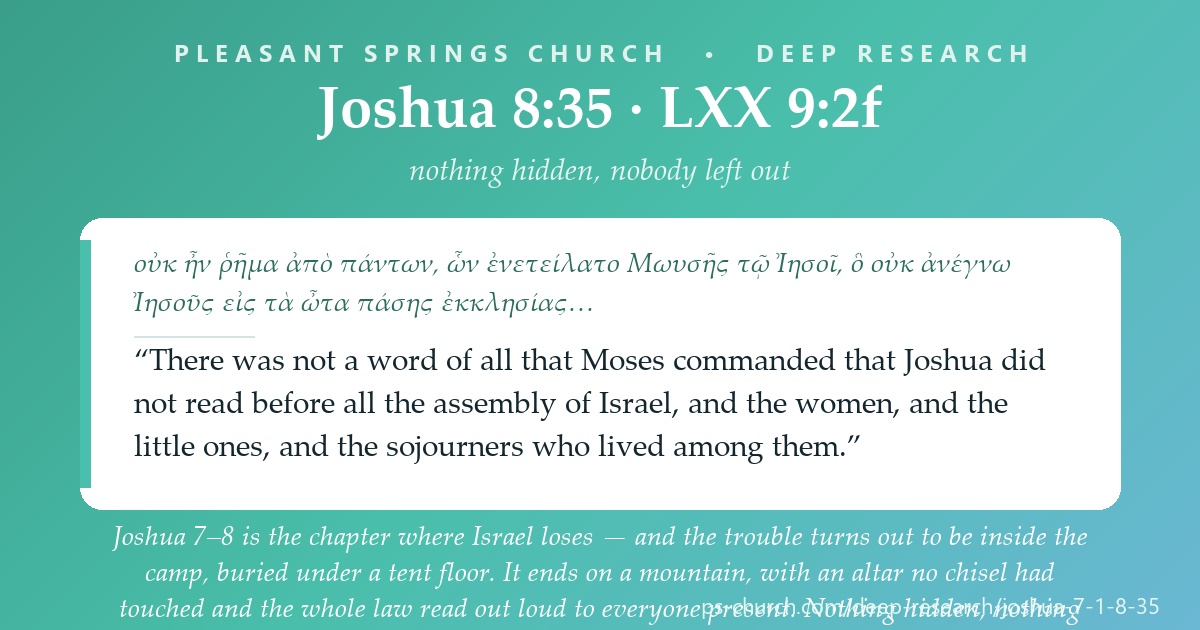
Jericho had fallen without a fight. Ai was smaller. And then the narrator does something he has not done before: he tells you what nobody in the story knows. “But the people of Israel broke faith in regard to the devoted things… and the anger of the Lord burned against the people of Israel” (7:1). So you watch the scouting party come back with a briefing that never mentions God — “do not have all the people go up… for they are few” — and you watch thirty-six men die, and you watch “the hearts of the people melt and become as water” (7:5), which is exactly what Rahab had said about Jericho. Joshua lies on his face until evening, and God interrupts him: “Get up! Why have you fallen on your face? Israel has sinned” (7:10–11). The lot narrows — tribe, clan, household, man — and Achan says it in three verbs that came out of Eden: “I saw… then I coveted them and took them” (7:21). What follows in 7:24–25 is the hardest thing in the book, and this study reports it plainly, sets it beside Deuteronomy 24:16, lays out the readings, and says which part stays hard. Then the valley is named Achor, “trouble” — the name Hosea will one day turn into “a door of hope.” Chapter 8 runs the campaign again, and Ai falls. And then the book stops the war to build an altar of uncut stones on Mount Ebal, write a copy of the law on the stones, and read every word of it aloud “before all the assembly of Israel, and the women, and the little ones, and the sojourners who lived among them” (8:35). This study works Joshua 7:1–8:35. See the method →
Joshua 7:1–8:35 (selections)
Hebrew · LXX · ESVThe Shape of the Passage
Parallel panelsThese two chapters sit between the fall of Jericho (ch 6) and the Gibeonite deception (ch 9). Behind them stand the crossing and the twelve stones (chs 3–4), Gilgal and the commander of the Lord’s army (ch 5), and, before all of it, the commission (ch 1). In front of them stands the instruction they finally obey: Deuteronomy 27.
Author
A narrator who withholds nothing from the reader and everything from the characters. The book of Joshua does not name its author, and the church has never needed it to. What it does have is one of the most controlled storytellers in Scripture. Chapter 7 opens with an aside to us — verse 1 tells you the cause before you see a single effect — and then makes you watch thirty-six men die while Joshua, who does not know, sends out a reconnaissance party and gets a briefing that never once mentions God. Robert Alter’s term for this is the deliberate use of reticence and the gap: the narrator’s silences are technique, not carelessness. Here he inverts it. The gap is not in front of the reader; it is in front of Joshua.
And he is writing about a memorial landscape. Four times in these two chapters something is named or piled up “to this day” — the heap over Achan (7:26), the name Valley of Achor (7:26), the ruin-mound of Ai (8:28), and the heap over its king (8:29). Joshua is a book that keeps pointing at things you could walk to. Chapters 3–4 had already done it with the twelve stones and the question a child would one day ask about them (4:6, 21). The author is not writing an epic; he is writing a guide to a country full of accusing and comforting rocks.
A note on how this page handles the text. Joshua’s Greek is a genuinely shorter book, and that shows up in this passage more sharply than almost anywhere (see the codex note). Where the Greek is shorter we say so; where the numbers diverge we print both. Nothing on this page depends on preferring one witness over the other, and where the two disagree about something that matters — 7:25 is the case in point — the difference is named rather than used.
Audience
A people who have just learned that they can lose. Whoever first heard this, they heard it as the sequel to Jericho. Everything in chapter 6 said you cannot be stopped. Chapter 7 says: yes you can, and here is how, and it will not be the Canaanites who do it. The scouting report at 7:3 is not cowardice; it is efficiency — “do not make the whole people toil up there, for they are few” — and it is the sound of a nation that has begun to think of itself as the reason for its own success. Nothing in it is wrong except that God is not in it.
The corporate framing is the text’s own, and it must be reported. One man takes; the narrator says “the people of Israel broke faith” (7:1); God says “Israel has sinned” (7:11); and thirty-six households bury someone. This is not a modern reader’s inference, and softening it empties the chapter. What the chapter does not say is equally important: it never says the thirty-six were guilty, and it never says that God was unable to tell one Israelite from another. It says that a covenant people is a body, and that what one member hides, the body carries.
And they were meant to end up at Ebal. The last six verses are the point of the arrangement. A nation that has just discovered it can be destroyed from the inside is taken to a mountain, given an altar no chisel has touched, and made to stand still while the entire law is read out — men, women, children, and the foreigners living among them, with no one excused and nothing abridged. The cure for a hidden word is a read one.
Orient on the devoted thing, corporate responsibility, the lot, the valley of Achor, and the Ebal ceremony.
Search by topic: herem / ban / devoted thing, maʿal (sacrilege, breach of faith), corporate solidarity and collective responsibility, lot (casting of), Achan / Achar, Achor (Valley of), Ai, Bethel and Beth-aven, ambush and warfare in the Old Testament, Ebal and Gerizim, altar (law of the), covenant renewal, ger (sojourner).
Which articles are relevant?
- Anchor Bible Dictionary — “Ban (Herem),” “Achan,” “Achor, Valley of,” “Ai,” “Ebal, Mount,” “Gerizim, Mount,” “Lots, Casting of,” “Joshua, Book of.”
- Dictionary of the OT: Historical Books (IVP) — “Joshua, Book of,” “Herem,” “Canaan, Canaanites,” “Warfare,” “Land,” “Covenant Renewal,” “Ethics.”
- NIDOTTE / TDOT — חֵרֶם (ḥerem), מָעַל (māʿal, break faith), לָקַח (lāqaḥ, take), חָמַד (ḥāmaḏ, covet), עָכַר (ʿāḵar, trouble), מָסַס (māsas, melt), גֵּר (gēr, sojourner).
Bibliography surfaced:
- Richard S. Hess, Joshua (TOTC); David M. Howard Jr., Joshua (NAC); Trent C. Butler, Joshua (WBC); Robert G. Boling, Joshua (Anchor Bible); Marten H. Woudstra, The Book of Joshua (NICOT); L. Daniel Hawk, Joshua (Berit Olam).
- Emanuel Tov and Leonard J. Greenspoon on the Greek of Joshua — the standard entry point for the shorter Old Greek text and what it implies.
- Studies of ḥerem in Israel and in the wider ancient Near East (the Mesha inscription is the usual comparison), and of corporate versus individual responsibility from Joshua 7 through Deuteronomy 24:16 to Ezekiel 18.
- Beale & Carson, Commentary on the New Testament Use of the Old Testament — for Acts and 1 Corinthians, where the vocabulary of this chapter resurfaces.
A devoted city on a Moabite stele, a son executed for his father’s bad masonry — and a tell with a dating problem.
Read the chapter against the ancient Near East’s own language of “devoting” a city, then against the ANE law codes that did punish a son for a father, then against the archaeology of Ai — and finally against how Second-Temple and rabbinic readers handled the very verses that trouble us.
Which parallels shed light on religion and worldview?
“Devoted” is not a uniquely Israelite word. The Moabite king Mesha, writing about 830 BC, uses the exact cognate. Of Nebo he says: “taking it and slaying all, seven thousand men, boys, women, girls and maid-servants, for I had devoted them to destruction for (the god) Ashtar-Chemosh” (Moabite Stone, ANET 320–321, Albright’s translation). The same stele boasts, in the same breath, “Israel hath perished for ever” — which is a useful reminder that royal conquest rhetoric in this world is characteristically sweeping and formulaic, and that Israel had been written off in exactly those terms by somebody else. That observation is a caution about register, and it is not an escape hatch: it does not make Joshua 8:24–26 say less than it says, and this page does not use it that way.
And the ANE really did execute children for their fathers. This matters for Joshua 7:24–25, because it locates the difficulty precisely. The Code of Hammurabi is explicit: “If that woman has died, they shall put his daughter to death” (§210, ANET 175); and “If it has caused the death of a son of the owner of the house, they shall put the son of that builder to death” (§230, ANET 176). Vicarious punishment was ordinary Mesopotamian jurisprudence. What is not ordinary is Deuteronomy 24:16, which forbids it outright — “nor shall children be put to death because of their fathers” — a law with no close parallel in the codes around it. So the tension a reader feels at Joshua 7:24–25 is not a modern squeamishness imported into an ancient text. It is a tension inside Israel’s own literature, and it is taken up directly at Stage 5.
The archaeology of Ai is genuinely unresolved, and honesty is the only useful posture. Ai is normally identified with et-Tell, north of Jerusalem. Excavations there by Judith Marquet-Krause (1933–35) and Joseph Callaway (1964–72) found a large fortified Early Bronze city violently destroyed around 2400 BC, then abandoned, with a small unwalled Iron I village appearing much later — and no Late Bronze occupation in between. Callaway’s conclusion was that there was no city at Ai for Israel to take. Others dispute the identification rather than the data: Bryant Wood and Associates for Biblical Research proposed Khirbet el-Maqatir and excavated it from 1995, arguing for a Late Bronze fortified site; David Livingston proposed relocating Bethel and, with it, Ai. Each proposal has been contested in print, and none is settled. It is also worth knowing that הָעַי (hāʿay) simply means “the ruin, the heap,” and that 8:28 says Joshua made the city “forever a heap of ruins” — which some read as an etiology and others as a plain report. We do not adjudicate this here, in either direction. Triumphalist claims that “archaeology proves the Bible” and dismissive claims that a tell has settled the matter are both larger than the evidence; and Christian faith has never rested on the stratigraphy of et-Tell.
- The Moabite Stone (Mesha Inscription), c. 830 BC (ANET 320–321) (a Moabite royal inscription — a witness, not Scripture) — the cognate of ḥerem in a neighbouring king’s mouth: a city “devoted to destruction” for Ashtar-Chemosh, with the standard sweeping formula (“Israel hath perished for ever”) in the same text.
- Code of Hammurabi §§209–210 (ANET 175) and §§229–230 (ANET 176) (Babylonian law — a witness, not Scripture) — a daughter put to death for her father’s offence, a builder’s son for his father’s bad work. The background against which Deuteronomy 24:16 stands out.
- Josephus, Antiquities 5.1.10, 14 (Second-Temple — a witness, not Scripture) — he calls him Achar, as the Greek Bible does; he has him steal “a royal garment woven entirely of gold” at Jericho; and — this is the datum — he reports that “this man was immediately put to death, and attained no more than to be buried in the night, in a disgraceful manner.” Josephus does not mention the sons and daughters at all.
- Josephus, Antiquities 5.1.19 (Second-Temple — a witness, not Scripture) — and he puts the Shechem ceremony not here but at the very end of the wars, after the tabernacle is set up at Shiloh: “he went to Shechem… and raised an altar where Moses had beforehand directed,” half the army on Gerizim and half on Ebal. (He had already reported an altar of the twelve stones near Jericho right after the crossing, Ant. 5.1.4.)
- Mishnah Sanhedrin 6:2 (rabbinic-era — a witness, not Scripture) — Achan’s confession becomes the model for every condemned man in Israel: ten cubits from the place of stoning he is told to confess, “for so we find with regard to Achan.” And the rabbis read “the Lord shall trouble you this day” (7:25) as a mercy — troubled today, not in the world to come.
- b. Sanhedrin 44a (rabbinic-era — a witness, not Scripture) — two readings that bear directly on this page. On why all Israel suffered for a hidden sin: “Achan’s offence was not a hidden matter, because his wife and children knew about it, and they did not protest.” And on 7:11: “even when the Jewish people have sinned, they are still called Israel.”
- Sirach 46:1–8 (Second-Temple — a witness, not Scripture) — the praise of Joshua “son of Nun… mighty in war,” which passes over Ai in silence and remembers him as Moses’ successor and as one of the two faithful spies.
Chapter 8 is a battle, and this page will not pretend otherwise. Ai is taken by ambush; the text says that all who fell that day were twelve thousand, men and women (8:25); it says Joshua did not draw back the javelin until every inhabitant had been devoted to destruction (8:26); it says the city was burned and the king hanged (8:28–29). That is the passage, and a summary that leaves it out is not a summary of this passage.
Where it belongs is where the Bible itself puts it: a bounded, divinely commanded judgment at one unrepeatable moment in redemptive history, on nations whose iniquity Genesis 15:16 says was “not yet complete” four centuries earlier — and under a standard that is immediately turned on Israel itself, in this very chapter, before a single Canaanite is mentioned. The book that reports Ai reports Achan first. Israel is not the exception to the judgment; Israel is its first defendant.
And it licenses nothing. No reader may use this text to justify violence, coercion, land-seizure, or hostility toward any people, ever. It has been used that way — in colonial expansion, in campaigns of dispossession, in sermons that mapped a modern nation onto ancient Israel and its neighbours onto Canaan — and every one of those uses was a lie about the text. The New Testament closes the door and locks it: our weapons are not of the flesh (2 Cor 10:4); we do not wrestle against flesh and blood (Eph 6:12); when the disciples proposed fire on a village, Jesus rebuked them (Luke 9:54–55); and “all who take the sword will perish by the sword” (Matthew 26:52). Report the text, locate it, own the difficulty, and stop. Do not linger over it, and do not enjoy it.
The devoted thing, the ordinary verb that ruins a nation, the covet of Eden, and the trouble that becomes a door.
Watch laqach (“take”) run from Achan’s hand at 7:1 to God’s command at 8:1; chamad pull Genesis 3 into the confession; masas turn Rahab’s words back on Israel; and ʿakhar become, in Hosea, a door.
The “devoted thing” — property or persons irrevocably transferred out of human use to God, by destruction or by dedication (LXX ἀνάθεμα, from which English gets anathema). Jericho was ḥerem; its silver and gold were to go to the treasury of the Lord (6:19). The horror of 7:12 is that the word turns around: Israel, having taken the devoted thing, “have become devoted for destruction” themselves. See the fence at Stage 2 for how this page handles the war-texts.
“Break faith, commit sacrilege” — not ordinary theft but the technical word for embezzling what is holy (Lev 5:15; Num 5:6–8), which is why the Chronicler uses it of Achan too (1 Chr 2:7). Rahlfs renders it twice over: ἐπλημμέλησαν… πλημμέλειαν (“they committed a trespass, a trespass”) and ἐνοσφίσαντο, “they pilfered.” That second verb is rare — and it is the verb Luke uses when Ananias “kept back” part of the price (Acts 5:2–3, ἐνοσφίσατο).
“Take” — the key word of the whole unit, and the cheapest, most ordinary verb in the language. Achan took (7:1); God says “they have taken” (7:11); Achan says “I took” (7:21); the goods are taken out of the tent (7:23); Joshua takes Achan (7:24); and then, on the far side of it, God says “Take all the fighting men with you” (8:1). Nothing about taking is wrong. Everything about this taking was.
“Covet, desire” — the verb of the tenth commandment (Exod 20:17; Deut 5:21), and the adjective used of the tree in Genesis 3:6 (וְנֶחְמָד, “to be desired”). Achan’s confession runs saw → coveted → took (וָאֶרְאֶה… וָאֶחְמְדֵם וָאֶקָּחֵם), which is the sequence of Eden with the middle term named out loud. The Greek keeps the psychology exactly: ἐνθυμηθεὶς αὐτῶν ἔλαβον, “having set my heart on them, I took.”
“Trouble” — a strong word for bringing ruin on someone. Joshua says it twice in one breath: “Why have you troubled us? The Lord troubles you today” (7:25), and the place is named Emeq ʿāḵōr, the Valley of Trouble. The Greek hears the force of it and renders with “destroy” (ὠλέθρευσας… ἐξολεθρεύσαι), and calls the man Αχαρ after the valley — as 1 Chr 2:7 does in Hebrew. Then Hosea 2:15 (MT/LXX 2:17) takes the name back: “I will give her… and make the Valley of Achor a door of hope.”
“Melt, dissolve.” Rahab said it of Jericho — “our hearts melted” (2:11) — and the narrator said it of the kings of the land (5:1). At 7:5 it is said of Israel, with an extra clause the earlier verses do not have: וַיְהִי לְמָיִם, “and became water.” The terror that was supposed to be running the other way has come home, and the Greek marks it with a different verb again, ἐπτοήθη, “was terrified.”
“A copy of the law” — literally a second or duplicate of the law, the same phrase the king is commanded to write out for himself in Deut 17:18. The Greek translators rendered it there and here with a single word, τὸ δευτερονόμιον, “the second law” — which is where the English name Deuteronomy comes from. So the book’s title was born in a translator’s choice at this verse and at Deut 17:18.
“Sojourner, resident alien” (LXX προσήλυτος). Twice in six verses the foreigner is written into the covenant assembly: “all Israel, sojourner as well as native born” (8:33, כַּגֵּר כָּאֶזְרָח), and the reading is done in the hearing of “the women, and the little ones, and the sojourners who lived among them” (8:35). The Greek of 8:35 (LXX 9:2f) adds a word the Hebrew leaves implicit and names four groups: τοῖς ἀνδράσιν καὶ ταῖς γυναιξὶν καὶ τοῖς παιδίοις καὶ τοῖς προσηλύτοις — the men, the women, the children, and the sojourners.
Where this vocabulary surfaces later:
- Acts 5:1–11 — Ananias and Sapphira “kept back” (ἐνοσφίσατο) part of the price, with the wife knowing; Peter says “you have not lied to man but to God.” It is the LXX verb of Joshua 7:1, in the first days of the new covenant community, and the parallels run deep: a hidden thing, a couple, the whole assembly affected, and great fear falling on everyone. Luke almost certainly intends it.
- 1 Corinthians 5:1–13 — “a little leaven leavens the whole lump… purge the evil person from among you” (quoting Deut 17:7 and its neighbours). The New Testament keeps the logic of Joshua 7 — a body is affected by what one member hides — while changing the remedy entirely: the church excommunicates, it does not execute, and the stated goal is that the man be saved (1 Cor 5:5).
- Hosea 2:15 (MT/LXX 2:17) — “I will give her… and make the Valley of Achor a door of hope.” Scripture itself turns the place-name around. (The Greek went a different way here: Rahlfs reads τὴν κοιλάδα Αχωρ διανοῖξαι σύνεσιν αὐτῆς, “the valley of Achor, to open her understanding” — the translator taking פֶּתַח as a verb.) Compare Isaiah 65:10, where Achor becomes a resting place for herds.
- Hebrews 12:14–17 — “See to it that no one fails to obtain the grace of God; that no root of bitterness springs up and causes trouble, and by it many become defiled.” The phrase is from Deut 29:18, which is itself the Torah’s warning about a single hidden heart in a whole assembly — see Deuteronomy 29.
- James 1:14–15 — “each person is tempted when he is lured and enticed by his own desire. Then desire when it has conceived gives birth to sin.” Achan’s three verbs, described as a process.
From Eden’s three verbs to Ebal’s uncut stones — the canon’s own threads.
Trace four: the saw/coveted/took sequence; the law of the altar and the Ebal command; the corporate-versus-individual question; and the Valley of Achor, which the prophets refuse to leave as a graveyard.
Which cross-references matter?
- Genesis 3:6 — “the woman saw… a delight to the eyes… and that the tree was to be desired (neḥmād) to make one wise… she took.” Achan’s confession is the same sequence, with Eden’s word for desire made a verb and spoken aloud (see Genesis 3:1–7). Cf. also David at 2 Sam 11:2–4 — saw, sent, took.
- Deuteronomy 27:1–8 — the command that Joshua 8:30–35 executes to the letter: on Mount Ebal, an altar of whole stones on which no iron tool has been used, burnt offerings and peace offerings, and “all the words of this law” written on the stones (see Deuteronomy 27). Behind it stands the law of the altar itself, Exodus 20:24–25 — no hewn stone, “for if you wield your tool on it you profane it.”
- Deuteronomy 31:9–13 — the law to be read “before all Israel… men, women, and little ones, and the sojourner within your towns.” Joshua 8:35 is that command obeyed, phrase for phrase (see Deuteronomy 31).
- Deuteronomy 24:16 — “Fathers shall not be put to death because of their children, nor shall children be put to death because of their fathers. Each one shall be put to death for his own sin” (see Deuteronomy 24). Read alongside Joshua 7:24–25 this is the hardest juxtaposition on the page, and it is handled openly at Stage 5. The law is later cited by name and obeyed at 2 Kings 14:6, and pressed to its limit by Ezekiel 18:20: “the son shall not suffer for the iniquity of the father.”
- Deuteronomy 21:22–23 — a hanged body must not remain on the tree overnight. Joshua 8:29 obeys it exactly (“at sunset Joshua commanded, and they took his body down”), as does 10:26–27 later (see Deuteronomy 21).
- Deuteronomy 7:25–26 — “You shall not covet the silver or the gold that is on them…” (7:25) … “and become devoted to destruction like it” (7:26). The exact scenario of Joshua 7, legislated in advance, with both key verbs (see Deuteronomy 7).
- Numbers 13–14 — the other great scouting report in the Torah, where the spies’ assessment also leaves God out of the arithmetic and the people’s hearts also fail (see Numbers 13–14). Joshua was there for that one.
- Hosea 2:15; Isaiah 65:10 — the Valley of Achor turned into a door of hope and a place where flocks lie down. The canon does not let the name stay a tombstone.
The Ebal ceremony has a curious history in the manuscripts, and it is a genuinely instructive case because you can check every witness yourself. In the Masoretic Text it stands where the ESV prints it, at 8:30–35, immediately after the fall of Ai. In the Greek it is not there at all: Rahlfs and the older printed editions place it after 9:2, as 9:2a–2f — after the coalition of kings gathers, before the Gibeonites arrive. In 4QJoshuaᵃ from Qumran the pericope stands earlier still, at the Jordan-crossing scene, before 5:1; Eugene Ulrich argued (in “4QJoshuaᵃ and Joshua’s First Altar in the Promised Land”) that this preserves the older sequence. And Josephus has it later than any of them, after the wars are over and the tabernacle is standing at Shiloh (Ant. 5.1.19) — though he also reports an altar built of the twelve stones right after the crossing (5.1.4).
Four positions, one ceremony. What should a reader do with that? First, notice how little varies: the MT and the Greek both have Joshua build the altar, write the law on the stones, and read it to the whole assembly, and Josephus has the altar and the blessings and curses. (4QJoshuaᵃ preserves only 8:34–35 — the reading — before Joshua 5, so the scroll shows us the placement rather than the whole scene.) What moves is the position, not the substance. Second, resist the two lazy conclusions — that a floating pericope means the text is unreliable, or that admitting the variation is a concession. Neither follows. Ancient books were copied and arranged by people who sometimes grouped by theme rather than by clock, and Joshua is a book that says “at that time” (8:30) without meaning “at 4 p.m. on the following Tuesday.” Third — and this is the payoff — the variation itself tells you what the ancient readers thought this scene was. Every one of them put it at a hinge: the crossing, or the first victory, or the end of the wars. They all understood that the altar and the reading are what the fighting is for.
The commentaries, the shorter Greek text, and the verse this page will not tidy up.
Hess, Howard, Butler, Boling, Woudstra and Hawk on Joshua; Tov and Greenspoon on the Greek; Ulrich on 4QJoshua; and, at length, Joshua 7:24–25 beside Deuteronomy 24:16.
Commentaries & studies:
- Richard S. Hess, Joshua: An Introduction and Commentary (TOTC); David M. Howard Jr., Joshua (NAC); Trent C. Butler, Joshua (WBC); Robert G. Boling, Joshua (Anchor Bible); Marten H. Woudstra, The Book of Joshua (NICOT).
- L. Daniel Hawk, Joshua (Berit Olam: Studies in Hebrew Narrative and Poetry) — the literary reading, and the one most attentive to the way chapters 7 and 8 are built to be compared.
- Emanuel Tov and Leonard J. Greenspoon on the Greek Joshua — the shorter Old Greek, the question of whether it reflects an earlier Hebrew Vorlage, and the pluses in MT that repeatedly reinforce Moses’ authority over Joshua.
- Eugene C. Ulrich, “4QJoshuaᵃ and Joshua’s First Altar in the Promised Land” (in New Qumran Texts and Studies, 1994) — the Qumran placement of the Ebal pericope at the crossing.
- Joseph A. Callaway’s excavation reports on et-Tell, and the publications of the Khirbet el-Maqatir excavation (Associates for Biblical Research) — read together, and read as a live disagreement rather than a settled result.
- Gordon Mitchell, Together in the Land: A Reading of the Book of Joshua — on the book’s own counter-currents, including its insistent inclusion of the sojourner.
Interpretation notes worth keeping:
- The corporate framing is the text’s, not the preacher’s. “The people of Israel broke faith” (7:1); “Israel has sinned” (7:11); “you cannot stand before your enemies” (7:13). Any exposition that reduces this to “Achan sinned and Achan suffered” has cut out the thing the chapter is about. A covenant people is a body. The New Testament says the same about the church, with a different remedy (1 Cor 5:6; 12:26).
- Note carefully what the corporate framing does not say. It does not say the thirty-six who died were guilty. It does not say God could not distinguish one Israelite from another. And it does not say guilt is inherited — the house position, held here as everywhere on this site, is ancestral sin, not inherited guilt. What the text describes is consequence flowing through a community, which is a different thing from culpability being transferred.
- The hard verse: 7:24–25 and Deuteronomy 24:16. The text says Joshua and all Israel brought Achan, his goods, and “his sons and daughters” to the Valley of Achor, and that they stoned and burned. Deuteronomy 24:16 says: “nor shall children be put to death because of their fathers. Each one shall be put to death for his own sin.” These two sentences are in the same Bible, a few chapters apart, and the tension is real. Four things can be said honestly, and then we stop.
- (1) The household plausibly knew. The goods were buried in the family tent, under the floor the family lived on. Concealment on that scale is hard to do alone, and the oldest Jewish reading says so outright: “Achan’s offence was not a hidden matter, because his wife and children knew about it, and they did not protest” (b. Sanhedrin 44a). If that is right, they were not being punished for him; they were accomplices. The text hints at it (the goods are in his tent) but does not say it, and we should not claim more certainty than the narrator gives. The same folio, however, answers the question this page is asking in the opposite direction: when the Exilarch asks Rav Huna whether Achan’s sons and daughters sinned too, Rav Huna replies that Joshua brought the household to the valley “not to stone them, but to chastise them” — just as he brought all Israel (b. Sanhedrin 44a). That is an ancient reading, not a modern one, and it belongs beside the first.
- (2) The Hebrew may not say what we assume. 7:25 says “all Israel stoned him” (singular) and then “they burned them… and stoned them.” Rashi takes the plurals as the tent and the movable goods, and then the animals — not the children. Whatever one makes of that, it is an ancient reading, not a modern evasion. And the Greek is shorter still: Rahlfs has only “and all Israel stoned him with stones,” with no burning and no second stoning at all. That is a genuine textual difference and it is reported here, not deployed — it does not remove the sons and daughters, who are brought up the valley in the Greek exactly as in the Hebrew (7:24).
- (3) This is narrative, not legislation. Joshua 7 reports what was done; Deuteronomy 24 prescribes what is to be done. Scripture frequently narrates without endorsing, and a report of an execution is not a statute authorizing it. That distinction is real and it carries some weight — but it does not carry all of it, because 7:15 has God himself prescribe that the man taken “shall be burned with fire, he and all that he has.” Honesty requires saying that out loud.
- (4) The ḥerem is not ordinary criminal law. Devoted property is not stolen goods; it has been transferred to God, and 7:12 says Israel itself “have become devoted for destruction.” The category behaves more like contagion than like a docket, which is why everything Achan touched goes into the valley — silver, cloak, gold, tent, oxen, donkeys, sheep. That explains the shape of the action. It does not, by itself, explain the children.
- And here is what remains hard. After all four points, the plainest reading of the Hebrew of 7:24–25 still has children brought up that valley and killed with their father, and no verse in Joshua condemns it, excuses it, or explains it. We will not manufacture a resolution. Scripture is willing to leave us standing in front of something we cannot square, and the honest response is the one the book itself models at 7:6–9: fall on your face and say so. What we can say with certainty is where the canon goes from here — Deuteronomy 24:16 is upheld and obeyed by name (2 Kgs 14:6), Ezekiel 18 hammers it, and the cross is God taking on himself the death that no one else may be made to bear for another.
- The Greek is shorter, and that is a fact about the book, not a threat to it. The Old Greek of Joshua runs some 4–5% shorter than the MT; many scholars judge it a faithful rendering of a shorter Hebrew text, with the longer Hebrew representing later expansion (much of it, notably, reinforcing Moses’ authority). Others argue the reverse. Both positions are held by careful people, and neither is a verdict on the book’s truthfulness. This page prints the ESV, notes every place the Greek is shorter in the verses quoted, and follows Rahlfs for the Greek column.
- The archaeology of Ai is unsettled and should be reported that way. See Stage 2. Christian confidence has never rested on the identification of a tell, and no honest reader should be asked to stake it there.
It is worth sitting with 7:10 for a moment, because it is one of the few places where God interrupts a prayer. Joshua is doing everything right by the book of piety — torn clothes, dust on the head, face to the ground before the ark, all afternoon — and God says: get up. There is nothing wrong with the posture. There is something wrong with the diagnosis. Joshua has been praying about the Amorites, and the problem is in his own camp, under a tent floor, three hundred yards away.
And notice what God does not say. He does not say “you should have asked me before you sent the men,” though Joshua obviously should have. He does not rebuke Joshua at all. He gives him a task: consecrate the people, and go find it. That is worth remembering for anyone who has ever prayed hard about the wrong thing. The answer to a misdirected prayer is not usually a lecture; it is information and a job.
The last thing to see is how the chapter ends. The Lord “turned from his burning anger” (7:26) — the same phrase, in reverse, as the anger that “burned” in verse 1. And then chapter 8 opens: “Do not fear and do not be dismayed.” The people whose hearts had turned to water are handed back the vocabulary of the commission (1:9). Failure did not end the campaign. It ended the pretending.
From a thing buried under a tent floor to a law read out loud to everybody.
Name what you learned, why it matters, and one concrete response.
What should we carry away — and do?
- The dangerous verse is 7:3, not 7:21. “Do not have all the people go up… for they are few” is a perfectly competent recommendation from perfectly competent men, and God’s name does not appear in it. Achan’s theft is the sin the chapter names; the confident briefing is the one most of us actually commit.
- Saw, coveted, took. Three moves, in that order, from Eden to Achan to David on a rooftop. The chain always has a middle link, and the middle link is where it can still be broken. James says the same thing in slower motion (Jas 1:14–15).
- What you hide, your people carry. That is the offensive claim of this chapter and it is the text’s own. In the church the remedy has changed completely — confession, discipline aimed at restoration, never violence — but the physics have not: a body is affected by what one member conceals (1 Cor 5:6; 12:26).
- Do not tidy up 7:24–25. If a passage of Scripture troubles you and every explanation you have been handed feels a size too small, you are allowed to say so. This study lays out the readings and then says plainly which part stays hard. A faith that can only survive by pretending is not being protected; it is being trained to flinch.
- Achor becomes a door. The valley named for the worst day in the campaign is the valley Hosea picks up and calls “a door of hope” (Hos 2:15, MT/LXX 2:17). God is in the habit of using the place where it went wrong as the entrance to something.
- And the page lands at Ebal, not at Ai. After the battle, an altar no chisel had touched, the law written on stones, and every word read to the women, the children and the foreigners in the camp. That is the counter-image to a thing buried under a tent floor: nothing hidden, nothing abridged, nobody excluded.
Step in response: two things this week. First, name one thing you have kept under the tent floor — and tell one person who is allowed to help you dig it up. Second, do an Ebal: read a whole book of the Bible out loud, in one sitting, with somebody who does not usually get read to — a child, a new believer, someone who was not raised in it. Joshua 8:35 says nobody was left out and nothing was skipped. Start there.
Joshua 8:35 · LXX 9:2f · to share
LXX + ESVEvery Deep Research page traces its passage across the whole sweep — the Old Testament, the Second-Temple world between the testaments (historical witnesses, not Scripture), and the New Testament. Follow the thread:
Pleasant Springs Church — Deep Research
Research method after Michael S. Heiser’s Bible Research Method (examine dictionaries → ancient literature → important words → textual connections → academic publications → share), with the Pleasant Springs “Author & Audience” foundation. Scripture set in the Hebrew, the Greek editions named on each page and the ESV (Old Testament), and the Greek New Testament and the ESV (New Testament), per the practice of Pleasant Springs Church. Joshua 7–8 research grounded in Hess (TOTC), Howard (NAC), Butler (WBC), Boling (Anchor), Woudstra (NICOT) and Hawk (Berit Olam), with Tov and Greenspoon on the Greek Joshua and Ulrich on 4QJoshuaᵃ. ANE background from the Moabite Stone / Mesha inscription (ANET 320–321), whose cognate of ḥerem and whose sweeping formula (“Israel hath perished for ever”) are the standard comparison, and the Code of Hammurabi §§209–210 (ANET 175) and §§229–230 (ANET 176) on vicarious punishment; Second-Temple and rabbinic witnesses (Josephus, Ant. 5.1.4, 10, 14, 19; Sirach 46:1–8; m. Sanhedrin 6:2; b. Sanhedrin 44a; Rashi at Josh 7:25), all read as witnesses, not Scripture. The archaeology of Ai (et-Tell; Khirbet el-Maqatir) is reported as an open question and not adjudicated. Numbering & text: Joshua 7:1–8:29 carries no chapter- or verse-offset — MT, LXX and English agree throughout — but the Old Greek is roughly 4–5% shorter than the MT overall, has no verse for 8:13 or 8:26, and places the Ebal pericope (MT 8:30–35) after 9:2 as LXX 9:2a–2f, which is printed as a double reference above; 4QJoshuaᵃ preserves 8:34–35 immediately before Joshua 5, which Ulrich argued (and Tov and van der Meer dispute) reflects an earlier placement. Hosea 2:15 English = MT/LXX Hosea 2:17. Greek from Rahlfs, with punctuation following the printed editions; every place the Greek is materially shorter within a quoted verse is flagged rather than smoothed. The conquest material of chapter 8 is reported in full and treated under the house’s conquest discipline — bounded, judicial, unrepeatable, and never a warrant for violence, coercion or ethnic hostility by anyone today; guilt is handled as ancestral, not inherited; and the tension between Joshua 7:24–25 and Deuteronomy 24:16 is stated rather than resolved.
Scripture quotations marked ESV are from the ESV® Bible (The Holy Bible, English Standard Version®), © 2001 by Crossway, a publishing ministry of Good News Publishers. ESV Text Edition: 2016. Used by permission. All rights reserved. The ESV text may not be quoted in any publication made available to the public by a Creative Commons license, and the ESV may not be translated in whole or in part into any other language. www.esv.org
|
Did this study bless you today? 💚 Give to Support PS Church100% of gifts go to the General Fund — thank you. |