A millstone. A doorway. A coat at sundown. A day’s wage. A sheaf left standing in a field. A strap counted out to forty and stopped. A bag of stones. Deuteronomy 24 and 25 look like a drawer of unrelated rules — and then the same sentence lands twice, four verses apart, sealing one paragraph and then the next: “you shall remember that you were a slave in the land of Egypt” (24:18, 22). That is the thread. Every case here stands on the side of whoever has least room to move: the debtor, the day-labourer, the immigrant, the orphan, the widow, the divorced woman, the childless widow, the convicted man who is still called your brother. This study works Deuteronomy 24:1–25:19 line by line — including the certificate of divorce and what Jesus said about it (Matt 19:8), and the verse that says no one is executed for another’s sin (24:16). See the method →
Deuteronomy 24:1–25:19 (selections) — MT = LXX = English
Hebrew · LXX · ESVThe Shape of the Passage
InclusioThese two chapters sit near the end of the central law code (chs 12–26). Behind them: worship at the one place (ch 12), the tithes and the year of release (chs 14–15), the feasts and the judges in the gate (ch 16), the offices of the nation (ch 17), innocent blood (chs 19–21) and household and assembly (chs 22–23). Ahead of them, the code’s quiet climax: the basket of firstfruits and the covenant sealed (ch 26). For the same mercies from the sanctuary side, see Leviticus 19.
Author
Moses, preaching on the plains of Moab. Deuteronomy is not a statute book read out by a clerk; it is preached law, delivered forty years on to the children of the generation that died in the wilderness. Its verbs are remember, hear, love, choose, today. The book as a whole carries the shape of an ancient suzerainty treaty — preamble, historical prologue, stipulations, witnesses, blessings and curses — and these chapters belong to the stipulations. That is an observation about the form of the book, and scholars on every side of the dating question have used it, so we report the shape and leave the date where the text leaves it.
Why the cases look so unsystematic. A modern code would gather divorce with marriage, wages with contracts, weights with commerce. Deuteronomy does not. It moves the way a sermon moves, one concrete situation to the next — a millstone, a doorway, a sheaf, a strap, a bag of stones — and every case is small enough to picture. The unity is not topical but moral, and Moses names it out loud twice in five verses: you were a slave in Egypt, and the Lord your God redeemed you from there; therefore I command you to do this (24:18, 22). A rescued people is being taught to legislate its own mercy so that mercy cannot quietly lapse.
Audience
People with something to lose, and people with nothing. Almost every case here has two sides, and the law consistently stands on the weaker one. The creditor with a legal right to a pledge is told where he may not stand (24:10–11) and when he must hand it back (24:13). The employer with a valid contract is told when he must pay (24:15). The landowner with a legal claim to his whole crop is told to leave the corner of it in the field (24:19–21). The court with a conviction in hand is told where to stop counting (25:3). The merchant with a bag of weights is told to carry only honest ones (25:13–15). Nobody in this chain is accused of a crime; they are simply being kept from the ordinary, legal cruelty that money and position make easy.
And the three who keep reappearing. “The sojourner, the fatherless, and the widow” are named four times in six verses (24:17, 19, 20, 21) — the immigrant with no clan, the child with no father, the woman with no husband. In a village economy those three had no legal muscle and no margin. Deuteronomy does not tell Israel to feel for them; it tells Israel to arrange its harvest so that they eat, and then to seal the arrangement with the memory of the brickyard. The book of Ruth is what this legislation looks like when it works: a foreign widow gleaning in a field she does not own, protected by a landowner who keeps the law and then goes past it, and the child born to her turns out to be in the line of David and of Christ (Ruth 2; 4:13–22; Matt 1:5).
Orient on divorce, pledge and debt, wages, gleaning, corporal punishment, levirate marriage, weights, and Amalek.
Search by topic: divorce and remarriage, marriage, pledge / surety / debt, usury, wages and hired labor, gleaning, poor and poverty, sojourner (ger), widow, orphan, corporal punishment / flogging, levirate marriage (yibbum) and halitzah, weights and measures, Amalek, retribution and corporate responsibility.
Which articles are relevant?
- Anchor Bible Dictionary — “Divorce,” “Marriage,” “Debt,” “Pledge,” “Wages,” “Gleaning,” “Poor,” “Sojourner,” “Widow,” “Orphan,” “Punishments and Crimes,” “Levirate Marriage,” “Weights and Measures,” “Amalek.”
- Dictionary of the OT: Pentateuch — “Marriage,” “Divorce,” “Slavery,” “Poor and Poverty,” “Aliens and Strangers,” “Widow, Orphan,” “Law,” “Ethics,” “Retribution.”
- NIDOTTE / TDOT — זָכַר (zāḵar, remember), שָׁכַח (šāḵaḥ, forget), חָבַל (ḥāḇal, take in pledge), שָׂכִיר (śāḵîr, hired worker), גֵּר (gēr, sojourner), אַלְמָנָה (ʾalmānāh, widow), יָבָם (yāḇām, husband’s brother), תּוֹעֵבָה (tōʿēḇāh, abomination).
Bibliography surfaced:
- Peter C. Craigie (NICOT), Daniel I. Block (NIVAC), J. G. McConville (Apollos), Jeffrey H. Tigay (JPS), Duane Christensen (WBC), Richard Nelson (OTL), S. R. Driver (ICC), Eugene Merrill (NAC) on Deuteronomy.
- Studies of debt and pledge law in Israel and the ancient Near East; of the ger and the “triad” of sojourner, orphan and widow; of levirate marriage and its relation to Genesis 38 and Ruth 4; and of Deut 24:16 in relation to Ezekiel 18.
- Bernard Levinson on Deuteronomy’s revision of earlier legal material (a genuine and contested line of scholarship, reported as such).
- Beale & Carson, Commentary on the NT Use of the OT (Matthew; Mark; 1 Corinthians; 1 Timothy; James).
Read the grammar before anything else, because almost every argument about this passage goes wrong here. Verses 1–3 are all protasis — one long “if” clause describing a situation: if a man marries and then dislikes his wife, and writes her a certificate and sends her away, and she marries another man, and that second husband either divorces her too or dies… The main clause does not arrive until verse 4, and it is a single prohibition: “then her former husband… may not take her again to be his wife.” The ESV makes this visible with the word “then” at the head of v. 4. The certificate, the sending away, the second marriage — none of these is commanded, permitted in so many words, or even approved. They are the assumed furniture of the case, the way “when you build a new house” assumes people build houses. The law regulates a wreckage it did not cause and forbids one particular outcome.
Why that outcome? The text says the woman “has been defiled” and calls the remarriage “an abomination before the Lord” that would “bring sin upon the land” — and then stops, without explaining. Interpreters have offered reasons (it treats a wife as property to be traded back and forth; it invites a man to profit from the second marriage’s settlement; it makes the first marriage a thing that can be resumed at will). Scripture gives no reason, and we will not invent one. What is clear is the effect: the certificate that was meant to end something is not allowed to become a revolving door, and a woman is not to be passed around a village and back. The one incidental protection the passage does provide is real — a written document put in her hand, which made her status public and her remarriage lawful rather than leaving her in a limbo no one would touch.
A pawned cloak, a day’s wage, a threshing floor, a bag of stones — and a real letter from a man whose garment was taken.
Set each case beside the ancient law that covers the same ground — Hammurabi, the Middle Assyrian and Hittite laws, Egyptian wisdom — and note honestly where Israel’s law is comparable and where it is not. Then read the one surviving Hebrew letter that puts a face on Deuteronomy 24:10–13.
Which parallels shed light on religion and worldview?
A real man, a real cloak. In 1960 Joseph Naveh excavated a small Judean fort on the coast between Jaffa and Ashdod — Meṣad Ḥashavyahu, near Yavneh-Yam — and found a large potsherd carrying fourteen lines of Hebrew, written about 630 BC, in the reign of Josiah. It is a petition. A field-worker tells the governor that he finished his reaping, that a supervisor named Hoshayahu came and took his garment, and that his fellow harvesters will testify he had done his quota; he asks for the garment back. This is not a copy of Deuteronomy; it is a working man in the seventh century BC appealing over exactly the situation 24:10–13 and Exod 22:26–27 legislate — a labourer’s outer garment seized and not returned. The law was not theoretical, and neither was the loss. (An ancient witness, not Scripture.)
Pledges and debt in the ancient world. Mesopotamian law also restrained the creditor, and saying so is not a concession. The Code of Hammurabi fines a man one-third mina of silver for distraining an ox as a pledge (§241; ANET 176) and the same amount for seizing a person as a pledge where no debt is owed (§114; ANET 170); if a distrained person dies of beating or abuse in the creditor’s house, the creditor forfeits everything and may lose his own son (§116). Israel’s law overlaps with all of that. What it adds is where the creditor may stand and what the object is: he may not cross the debtor’s threshold to pick the pledge himself (24:10–11), he may not take the hand-mill a family grinds its bread with — “for that would be taking a life in pledge” (24:6) — nor a widow’s garment at all (24:17), and whatever he does take must be back before dark. The Mesopotamian rule protects the debtor’s body; the Israelite rule protects his supper, his sleep and his dignity, and grounds it in God rather than in royal order.
Wages. Hammurabi sets rates — eight kur of grain a year for a hired cultivator, six for a cattle-herder (§§257–258; ANET 177), and a daily silver rate for a hired labourer (§273). That is a wage law about amount. Deuteronomy legislates timing, and gives the reason: “for he is poor and counts on it” — literally, he lifts up his soul to it — “lest he cry against you to the Lord, and you be guilty of sin” (24:15). A day-labourer with no reserves eats tonight from what he earned today. The employer’s convenience is simply overruled, and the cry of the unpaid man goes over the employer’s head.
Levirate marriage. The custom is not unique to Israel. Hittite Laws §193 (ANET 196) provides that when a man dies his brother shall take his widow, and after him his father, and after him his brother’s son, “there shall be no punishment” — a household’s duty to absorb a widow rather than let her fall out of it. The Middle Assyrian Laws (ANET 180–188) legislate at length for widows and for wives left without support. Deuteronomy 25:5–10 shares the institution and gives it a different centre of gravity: the point is the name of the dead man, which must “not be blotted out of Israel” (25:6), and the brother who refuses is not fined but publicly shamed — and, decisively, he may refuse. The widow, not a male relative, is the one who brings the case to the elders and speaks (25:7–9).
Honest stones. Egyptian wisdom presses the same command — the Instruction of Amenemope (ANET 421–425), the ANE text closest to Proverbs, warns against tampering with the balance and falsifying the weights. And the archaeology is unusually concrete: hundreds of dome-shaped limestone weights have been excavated across Judah from the eighth to the early sixth century BC, inscribed with a shekel sign and a numeral — small stones, carried in a pouch, exactly the “stone and a stone in your bag” the Hebrew of 25:13 describes. Raz Kletter’s catalogue of the Judean series shows a system standardized enough to be state-controlled — and, precisely because the standard existed, deviations from it could be recognised for what they were. The law is aimed at a real bag.
- The Meṣad Ḥashavyahu (Yavneh-Yam) ostracon (c. 630 BC; discovered by J. Naveh, 1960 — an ancient witness, not Scripture) — a Hebrew field-worker’s petition to the governor for the return of his seized garment, with witnesses named. The closest thing we have to a case file under Deut 24:10–13. (Printed in ANET’s third-edition supplement; that section lies past our local scan, so no page number is given here.)
- Code of Hammurabi §§114–116, 241 (ANET 170, 176) — distraint for debt regulated and penalised; the pledged person who dies of abuse. Comparable in kind to Deut 24:6, 10–13, and grounded in royal order rather than in redemption from slavery.
- Code of Hammurabi §§257–258, 273 (ANET 177) — fixed wages for hired workers. Amount is legislated; same-day payment is not.
- Code of Hammurabi §§137–141 (ANET 172) — divorce settlements: return of dowry, payment of the marriage-price, a graded scale by rank. The ANE world knew written divorce and its financial consequences; Deut 24:1–4 assumes such a world and restricts one move within it.
- Hittite Laws §193 (ANET 196) — the widow taken in turn by brother, father, or nephew: levirate custom outside Israel, with the household rather than the dead man’s name as its centre.
- Middle Assyrian Laws A §8 (ANET 181) — the nearest ANE parallel to Deut 25:11–12: a woman who injures a man in a brawl is penalised bodily. Noted for the parallel only.
- Instruction of Amenemope (ANET 421–425; Egyptian wisdom — a witness, not Scripture) — against the falsified weight and the tilted balance; the same conscience Deut 25:13–16 codifies.
- Elephantine Aramaic marriage contracts (5th c. BC Jewish garrison in Upper Egypt; e.g. TAD B2.6 — witnesses, not Scripture) — written marriage documents in which either party may declare the marriage ended, with a fixed payment. Evidence that the “certificate” of Deut 24:1 was a real legal instrument in Jewish practice, not a metaphor.
- Damascus Document (CD) 4:20–5:2 (Dead Sea Scrolls — a witness, not Scripture) — a Second-Temple Jewish group condemning the taking of “two wives in their lifetimes” and grounding the argument in “male and female he created them” (Gen 1:27) and the pairs entering the ark. Whatever exactly it targets, it shows that arguing from the creation account back against permissive divorce practice was in the air before Jesus did it in Matt 19:4–6.
- Josephus, Antiquities 4.231–239, 253–256, 267–270, 288; Philo, Special Laws 2–4 (Second Temple — witnesses, not Scripture) — gleaning and the unmuzzled ox, the divorce certificate and the levirate, the creditor kept outside the door and the millstone, and the wage paid that very day, all restated for Greek and Roman readers. Josephus also reports the flogging as “forty stripes save one” (Ant. 4.238), the practice Paul knew.
- Mishnah — Gittin 9:10 (the school of Shammai: divorce only for unchastity; the school of Hillel: for far less; R. Akiva: even if he found another more attractive), Peah 6–7 (the forgotten sheaf, defined case by case), Bava Metzia 9:11–13 (the same-day wage and the pledge), Makkot 3:10–14 (“forty less one”), Yevamot (levirate marriage and the drawing off of the sandal) (rabbinic-era — witnesses, not Scripture).
A poor man’s outer garment in the Iron Age Levant was a coat by day and a blanket by night; there was no second one. The law therefore does something strange: it lets the creditor have the pledge and then requires him to give it back every evening, which means the security is worth almost nothing as security. That is the point. The pledge survives as a token of the debt while ceasing to function as leverage over the debtor’s body. And the motive clause is not a threat but a picture: he will sleep in it, and he will bless you — the last thing a lender in any age expects from a borrower.
Then comes the line the Greek translators found so striking. The Hebrew says the returned cloak will be ṣəḏāqāh for you, “righteousness,” before God (24:13). The Septuagint renders it ἐλεημοσύνη — “mercy,” and by the first century simply “alms.” That is the road by which “righteousness” came in Jewish Greek to mean practical charity, and it is why the Sermon on the Mount can move from “beware of practicing your righteousness before other people” straight into “when you give to the needy” without changing the subject (Matt 6:1–2). Deuteronomy 24:13 is where that usage starts.
A certificate, two indeterminate words, a pledge, a cloak counted as righteousness, a refrain, a cap, and a muzzle.
Verse numbers on this page need no conversion — Hebrew, Rahlfs LXX and English agree throughout Deuteronomy 24–25 (the offset in this book falls on chapter 23: English 22:30 = MT/LXX 23:1). The one reference below that does need converting is flagged: Deut 23:14 English = MT/LXX 23:15.
“A document of cutting-off” — from kāraṯ, “to cut,” the same verb used for cutting a covenant. LXX βιβλίον ἀποστασίου, “a certificate of separation” — the very word the Gospels put in the Pharisees’ mouths (Matt 5:31; 19:7; Mark 10:4). God himself is pictured issuing one to unfaithful Israel (Isa 50:1; Jer 3:8). A written instrument, given into her hand: whatever else it was, it was not a man simply putting a woman out of the door.
“Some indecency” — literally “the nakedness of a thing.” The phrase occurs in the Torah only here and at Deut 23:14 (MT/LXX 23:15), where it describes something offensive left uncovered in the camp. It plainly is not adultery, which carried its own penalty. Beyond that the Hebrew is genuinely indeterminate, and the whole rabbinic argument (m. Gittin 9:10) and the Pharisees’ question to Jesus, “is it lawful to divorce one’s wife for any cause?” (Matt 19:3), are arguments about these two words. LXX: ἄσχημον πρᾶγμα.
“To take in pledge” and “the pledge” (LXX ἐνεχυράζω / ἐνέχυρον) — the security a lender holds. Deuteronomy hedges it four ways: not the millstone (24:6), not from inside the house (24:10–11), not overnight from a poor man (24:12–13), and not a widow’s garment at all (24:17). Note the reason given for the first: “for that would be taking a nep̄eš in pledge” — a life.
“Righteousness” — here, of a returned cloak. The LXX renders it ἐλεημοσύνη, “mercy / almsgiving,” and that translation choice shaped a whole vocabulary: by the New Testament era “righteousness” and “alms” sit side by side (Matt 6:1–2). Righteousness in Deuteronomy is not first a status or a feeling; it is what you did with a coat at sundown.
“And you shall remember” — the unit’s Leitwort, and the reason attached to case after case: “you shall remember that you were a slave in the land of Egypt” (cf. 5:15; 15:15; 16:12). LXX μνησθήσῆ. Its opposite, šāḵaḥ (“forget”), frames the same span: the sheaf you forgot is left for the poor (24:19), and Amalek is the one thing you must never forget (25:19).
“Be degraded, made light of” — from the root qālal, “to be light,” the opposite of kāḇōḏ, “weight, glory.” The cap on the stripes exists so that a convicted man is not made weightless in the community’s eyes. And the word Moses uses for him is ʾāḥîḵā — your brother. LXX ἀσχημονήσει, “he will be disgraced.”
“To muzzle” (LXX οὐ φιμώσεις) — an ox treading grain on the threshing floor walks over food all day; the law forbids strapping its mouth shut. Paul takes up the Greek of this verse twice and applies it to paying those who work in the gospel (1 Cor 9:9; 1 Tim 5:18) — in 1 Timothy with the words reordered, and in 1 Corinthians with a different verb for “muzzle” in the earliest manuscripts. In 1 Timothy he pairs it with “the laborer deserves his wages,” which is Deut 24:14–15’s concern exactly.
Where the New Testament picks these words up:
- Matthew 19:3–9 · Mark 10:2–12 — the Pharisees cite 24:1 as a command (“why then did Moses command…?”) and Jesus corrects the verb: “Moses allowed you to divorce your wives, but from the beginning it was not so.”
- 1 Corinthians 9:9–11 · 1 Timothy 5:17–18 — “You shall not muzzle an ox when it treads out the grain” (25:4), applied twice by Paul to the support of gospel workers.
- James 5:4 — “the wages of the laborers who mowed your fields, which you kept back by fraud, are crying out against you” — 24:14–15 with its cry intact, now reaching “the ears of the Lord of hosts.”
- 2 Corinthians 11:24 — “Five times I received at the hands of the Jews the forty lashes less one” — the cap of 25:3; the Mishnah derives “forty less one” from reading “by number, forty” as a number approaching forty (m. Makkot 3:10).
- Matthew 22:23–33 · Mark 12:18–27 — the Sadducees build their trap out of 25:5, “Moses said, if a man dies having no children…”
- Matthew 6:1–2 — “righteousness” sliding into “giving to the needy,” the usage the LXX of 24:13 helped create.
Gleaning into Ruth, 24:16 into Ezekiel, the ox into Paul, and the certificate into the Gospels.
Run four threads out of these chapters: the gleaning laws into the book of Ruth; 24:16 forward through the historical books and the prophets; the wage and the ox into the New Testament’s own use; and 24:1–4 into Jesus’ reading of it.
Which cross-references matter?
- Leviticus 19:9–10, 13; 23:22 — the same two mercies from the sanctuary side: leave the edges and the fallen grapes for the poor and the sojourner, and “the wages of a hired worker shall not remain with you all night until the morning” (see Leviticus 19 and Leviticus 23).
- Exodus 22:21–27 — the older form of the pledge law: “if ever you take your neighbor’s cloak in pledge, you shall return it to him before the sun goes down… and if he cries to me, I will hear, for I am compassionate” (see Exodus 22).
- Deuteronomy 15:12–15; 16:12; 5:15 — the same refrain doing the same work elsewhere in the book: the released servant furnished liberally, the feast kept with servants at the table, the Sabbath itself — each because “you were a slave in Egypt” (see Deut 14–15, Deut 16 and Deut 5).
- Ruth 2:2–23; 4:1–12 — the entire book runs on these two chapters. Ruth gleans behind the reapers under 24:19–21 (and Lev 19:9–10); Boaz redeems and marries under the logic of 25:5–10, “to perpetuate the name of the dead in his inheritance” (Ruth 4:10), and the sandal changes hands at the gate (Ruth 4:7–8) — there as an old custom of attestation between two men, not the widow’s act of 25:9. Compare also Genesis 38, where the levirate duty is refused and the story turns dark.
- 2 Kings 14:5–6 // 2 Chronicles 25:3–4 — the canon quoting 24:16 by name: Amaziah executes his father’s assassins “but he did not put to death the children of the murderers, according to what is written in the Book of the Law of Moses… ‘Fathers shall not be put to death because of their children.’” The law worked, and a king is on record obeying it against every instinct of dynastic politics.
- Jeremiah 31:29–30 · Ezekiel 18:1–4, 20 — the same principle pressed from courtroom into conscience: “they shall no longer say, ‘The fathers have eaten sour grapes, and the children’s teeth are set on edge’… the soul who sins shall die. The son shall not suffer for the iniquity of the father.”
- Exodus 34:6–7 · Deuteronomy 5:9 — “visiting the iniquity of the fathers on the children” — held together with 24:16 rather than played against it (see Exodus 34 and Deut 5).
- Numbers 26:9–11 — “But the sons of Korah did not die” — the narrative case in point (see Numbers 26).
- Amos 8:4–6 · Micah 6:10–11 · Proverbs 11:1; 20:10, 23 · Hosea 12:7 — the prophets and the sages on 25:13–16: “that we may make the ephah small and the shekel great and deal deceitfully with false balances… Shall I acquit the man with wicked scales and with a bag of deceitful weights?”
- Exodus 17:8–16 · 1 Samuel 15 · Esther 3:1 — the Amalek thread: the ambush at Rephidim (see Exodus 17), Saul’s commission and failure, and an “Agagite” still plotting genocide centuries later.
- Genesis 1:26–31; 2:18–25 — where Jesus goes when he is asked about 24:1: back past the case law to the making of male and female and the one flesh (see Genesis 1:26–31 and Genesis 2:18–25).
The Pharisees ask him, “Is it lawful to divorce one’s wife for any cause?” — a question about how loosely to read ʿerwaṯ dāḇār. Jesus does not answer inside their frame. He goes back before Moses: “Have you not read that he who created them from the beginning made them male and female… So they are no longer two but one flesh. What therefore God has joined together, let not man separate” (Matt 19:4–6). Only then do they push: “Why then did Moses command one to give a certificate of divorce and to send her away?” And the whole weight of his reply falls on that verb. “Because of your hardness of heart Moses allowed you to divorce your wives, but from the beginning it was not so” (Matt 19:8). Mark has it even more starkly: “Because of your hardness of heart he wrote you this commandment” (Mark 10:5). This is the controlling reading, and it matches the grammar of the passage exactly: Deuteronomy 24 legislates around divorce because divorce was happening, not because God designed it.
So two things are true at once, and the pastoral care of this page depends on holding both. The first is that God’s intention was never this. Divorce belongs to the category of things Scripture regulates because human hearts are hard — a concession to wreckage, and wreckage it remains. The second is that the concession is real, given by God through Moses, and the law’s instinct throughout these two chapters is protective: a written document rather than a whisper, a woman’s status made public, a limit on what may be done to her afterward.
If you are reading this page having been divorced, or having remarried, hear the text plainly and hear nothing added to it. Deuteronomy 24:1–4 forbids exactly one thing, and it is not your marriage. Jesus’ word about hardness of heart is a diagnosis of the human situation, not a verdict handed down on you personally; the man who spoke it is the same one who sat down at a well with a woman on her sixth relationship and offered her living water without one sentence of contempt (John 4:7–26). Where Scripture speaks — that God made marriage to be one flesh for life, and that he hates the treachery of a covenant broken (Mal 2:14–16) — we say so. Where it does not speak — about your particular history, or about who is beyond mercy — we do not fill in the silence. There is no sin here that the cross does not cover.
“You shall not muzzle an ox when it is treading out the grain” is four Hebrew words about a farm animal, and Paul builds an argument about ministerial support on it — twice. In 1 Corinthians 9:9–11 he asks, “Is it for oxen that God is concerned? Does he not certainly speak for our sake?” and reasons from the ploughman’s hope to the apostle’s right to eat. In 1 Timothy 5:18 he sets it beside “the laborer deserves his wages.” Readers sometimes hear this as Paul brushing the animal aside. He is not: he is reading the law the way Deuteronomy itself asks to be read, by its reason. The chapter before has just said that a hired man must be paid before sundown because he is poor and counts on it. Put the two together and the principle is one principle — the one who does the work eats from the work — and the ox is its most disarming instance. If God will not have a beast strapped away from the grain under its own feet, the church cannot leave the man who labours in the word unfed.
This is the New Testament’s own handling of the Old, done in front of us, and it is the only kind of application these pages will attempt: not a pattern we invent, but a reading the apostles perform.
The scholarship on the case laws, and the interpretive notes worth keeping.
Craigie, Block, McConville, Tigay, Christensen, Nelson, Driver and Merrill on Deuteronomy; Kline on the treaty form; Levinson on legal revision (reported as a contested proposal); Beale & Carson for the New Testament use; ANET and the Judean weight corpus for the ANE comparanda.
Commentaries & studies:
- Peter C. Craigie, The Book of Deuteronomy (NICOT); Daniel I. Block, Deuteronomy (NIVAC); J. G. McConville, Deuteronomy (Apollos); Jeffrey H. Tigay, Deuteronomy (JPS); Duane L. Christensen (WBC); Richard D. Nelson (OTL); S. R. Driver (ICC); Eugene H. Merrill (NAC).
- Meredith G. Kline, Treaty of the Great King, on the suzerainty-treaty shape of the book (reported as literary form; the dating debate is not settled by it).
- Bernard M. Levinson, Deuteronomy and the Hermeneutics of Legal Innovation — a major and contested account of how Deuteronomy handles earlier legal material; useful for the questions it raises about 24:1–4 and 25:5–10 whether or not one accepts its framework.
- Raz Kletter, Economic Keystones: The Weight System of the Kingdom of Judah — the catalogue of inscribed Judean shekel weights behind the archaeological note on 25:13–16.
- J. B. Pritchard, ed., Ancient Near Eastern Texts (ANET) — Code of Hammurabi (163–180), Middle Assyrian Laws (180–188), Hittite Laws (188–197), Amenemope (421–425).
- G. K. Beale & D. A. Carson, eds., Commentary on the New Testament Use of the Old Testament (Matthew; Mark; 1 Corinthians; 1 Timothy; James).
Interpretation notes worth keeping:
- 24:16 is one of the load-bearing verses for how we speak about sin and inheritance. The house position is ancestral sin, not inherited guilt: we are born into a race and a world bent by Adam, and we sin ourselves — but nobody is condemned for someone else’s act. Deuteronomy says it as a rule of court (“each one shall be put to death for his own sin”); the narrative shows it (“the sons of Korah did not die,” Num 26:11); a king obeys it (2 Kgs 14:6); and the prophets carry it into the conscience of exiles who thought they were being punished for their parents (Jer 31:29–30; Ezek 18). This does not cancel Exod 34:7 / Deut 5:9, “visiting the iniquity of the fathers” — that describes the real, observable way sin ruins households across generations, which anyone who has watched a family knows. What 24:16 forbids is imputing the guilt: consequences travel; culpability does not (see Exodus 34 and Deut 5).
- 24:1–4 does not institute divorce, and no one should preach it as if it did. The single command is the prohibition in v. 4. Jesus’ reading is controlling (Matt 19:3–9; Mark 10:2–12): permitted for hardness of heart, and “from the beginning it was not so.” Preach the text and Jesus’ word about it; do not add a scheme of grounds and exceptions the passage does not contain, and do not use it to sort a congregation into the acceptable and the disqualified.
- The flogging law (25:1–3) is judicial punishment in a covenant nation, and the cap is the point. Report it plainly: a court, a conviction, a sentence carried out before the judge. Then read what the text does with it — it sets a ceiling, and gives a reason that is not deterrence or proportion but dignity: “lest… your brother be degraded in your sight.” A guilty man is still called your brother. It is not a template for the church or for any modern state, and it licenses no one to strike anyone (2 Cor 10:4; Eph 6:12; Matt 26:52; Luke 9:54–55). The church’s own discipline is exhortation and, at the very most, exclusion from the table (1 Cor 5), always aiming at restoration.
- 25:11–12 should be stated once and not dwelt on. A woman intervening in a fight seizes a man’s genitals, and the penalty is the loss of her hand, with no ransom — the only case in the Torah where mutilation is prescribed as a penalty in its own right (the talion formula of 19:21 works differently). Scripture gives no reason beyond “your eye shall have no pity,” and we will not invent one; it is not a template for anyone today.
- Amalek (25:17–19) is a war text and gets the same fence. The indictment is specific and moral: Amalek attacked the exhausted at the back of the column, “and he did not fear God.” The command that follows is given to Israel, once, about one people, at a bounded moment in redemptive history, and the canon follows it through in 1 Samuel 15 — a chapter with its own difficulties that we do not adjudicate here. It is not a template for church or state, it authorises no violence, coercion or hatred by anyone today, and it has been abused when treated as a category into which modern enemies can be sorted. The honest difficulty is real and we do not dissolve it with a slogan.
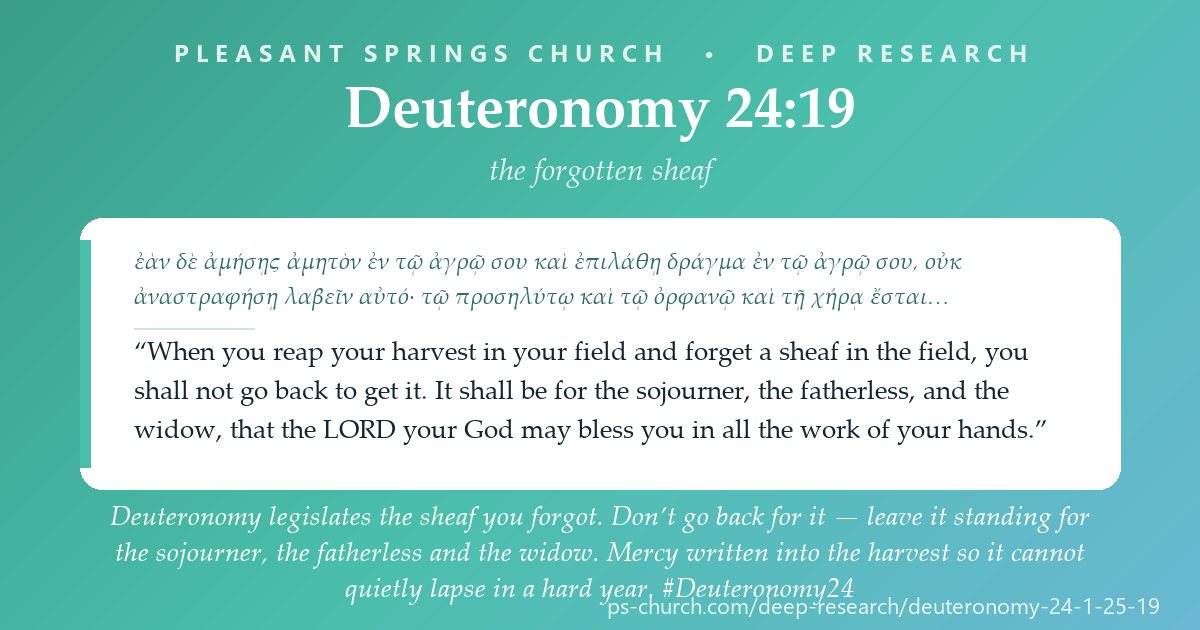
- The mercy is legislated, not left to goodwill. That is the design principle running through both chapters. Charity that depends on a landowner’s mood fails in a bad year; a law that says do not go back for the sheaf does not. Deuteronomy makes generosity structural — a fixed loss written into the harvest, a fixed deadline written into the payroll — precisely so that it cannot quietly lapse when times are tight.
- Israel’s civil order is not a constitution for anyone else. The moral substance here — the labourer paid, the debtor left his dignity, the poor fed from the edges of the field, the convicted man still a brother, honest weights, and guilt that is never inherited — carries entirely. The penalties, the courts and the land tenure belong to a covenant nation with God as its immediate King, and the New Testament does not transfer them.
A sheaf left standing, a coat given back, a wage paid before dark.
Name what you learned, why it matters, and one concrete response.
What should we carry away — and do?
- Go back and read the refrain into every case. “You shall remember that you were a slave in the land of Egypt.” It is not decoration; it is the reason. Israel is merciful to the cornered because Israel was cornered, and God came down. Christians have the same logic in a different key: we love because he first loved us.
- Mercy that depends on mood is not mercy yet. Every provision here is a rule, with a deadline or a boundary: back by sundown, on the same day, do not go back for it, forty and no more. Decide in advance, in writing if you must, what you will give and when you will pay — because the day you are stretched is the day generosity evaporates.
- Pay people on time. It is the least romantic command in the chapter and the one most likely to apply to you this week. “He is poor and counts on it.” A late payment you can absorb may be a missed meal for someone else, and Scripture says the cry goes straight over your head to God.
- Leave something in the field. Not the leftovers — the corner, and the sheaf you already forgot. Gleaning let a person eat by working, with dignity and without asking. Ask what in your budget, your calendar or your business could be deliberately left unharvested so that someone else can gather it themselves.
- A guilty man is still your brother. That is what the cap on the stripes is for. Whatever your church, your family, or you personally are entitled to do to someone who has genuinely done wrong — there is a line past which the point stops being justice and becomes degradation, and this text says stop counting before you get there.
- No one carries anyone else’s guilt. If you have been living under a verdict passed on your family — a name, a reputation, a father’s failure — 24:16 is in your Bible for you: each one shall be put to death for his own sin. Consequences may still have to be lived with; the guilt is not yours.
Step in response: pick one of the two edges. Either audit what you owe — a contractor, a babysitter, a teenager who mowed your lawn, a bill on a colleague’s desk — and clear it before sundown today. Or pick the “corner of the field”: one fixed, scheduled, unglamorous thing you will leave for someone who cannot pay you back, written into the calendar so it survives a hard month.
Deuteronomy 24:19 · to share
LXX + ESVEvery Deep Research page traces its passage across the whole sweep — the Old Testament, the Second-Temple world between the testaments (historical witnesses, not Scripture), and the New Testament. Follow the thread:
Pleasant Springs Church — Deep Research
Research method after Michael S. Heiser’s Bible Research Method (examine dictionaries → ancient literature → important words → textual connections → academic publications → share), with the Pleasant Springs “Author & Audience” foundation. Scripture set in the Hebrew, the Greek editions named on each page and the ESV (Old Testament), and the Greek New Testament and the ESV (New Testament), per the practice of Pleasant Springs Church. Deuteronomy 24–25 research grounded in Craigie, Block, McConville, Tigay, Christensen, Nelson, Driver and Merrill, with Kline on the treaty form (reported as the book’s literary shape, not as a settled argument about its date), Levinson on legal revision (reported as a contested proposal), Kletter’s catalogue of Judean weights, and Beale & Carson on the New Testament use (Matthew; Mark; 1 Corinthians; 1 Timothy; James). ANE comparanda from the Code of Hammurabi (ANET 170, 172, 176, 177), the Middle Assyrian Laws (ANET 181), the Hittite Laws (ANET 196) and the Instruction of Amenemope (ANET 421–425), with the Meṣad Ḥashavyahu / Yavneh-Yam ostracon (c. 630 BC; printed in ANET’s supplement, past our local scan, so cited without a page number), the Elephantine marriage contracts, the Damascus Document, Josephus, Philo and the Mishnah — all read as witnesses, never leveled with Scripture. Versification: Deuteronomy 24–26 have no MT/LXX offset — Hebrew, Rahlfs LXX and English number 24:1–22 and 25:1–19 alike, so nothing on this page needs converting; the offset in this book falls on the previous chapter (English 22:30 = MT/LXX 23:1, hence English 23:1–25 = MT/LXX 23:2–26), with English 12:32 = MT/LXX 13:1 earlier and English 29:1 = MT/LXX 28:69 later. Greek follows Rahlfs. Deuteronomy 24:1–4 is read as regulating, not instituting, divorce, with Jesus’ own reading (Matt 19:3–9; Mark 10:2–12) treated as controlling; 24:16 is read as an anchor for the house position of ancestral sin rather than inherited guilt; and the judicial, corporal and war provisions of chapter 25 are read as law for a covenant nation in its land at a bounded moment in redemptive history — not as a template for the church or any modern state, and licensing no violence or coercion by anyone today.
Scripture quotations marked ESV are from the ESV® Bible (The Holy Bible, English Standard Version®), © 2001 by Crossway, a publishing ministry of Good News Publishers. ESV Text Edition: 2016. Used by permission. All rights reserved. The ESV text may not be quoted in any publication made available to the public by a Creative Commons license, and the ESV may not be translated in whole or in part into any other language. www.esv.org
|
Did this study bless you today? 💚 Give to Support PS Church100% of gifts go to the General Fund — thank you. |