An ox is loose in the road and it is not yours. Deuteronomy’s first word about it is not “report it” but “you shall not hide yourself” — and if the owner lives too far away, you feed the animal in your own yard until he comes looking (22:1–4). Build a new house and put a railing around the roof, “that you may not bring the guilt of blood upon your house” (22:8). Then the hardest stretch in the book’s law code, the household cases (22:13–29), where a woman attacked in open country is declared guiltless because “there was no one to rescue her.” Then the question of the door: who may enter the assembly of the Lord — and, in the same paragraph, “you shall not abhor an Edomite, for he is your brother” (23:7 · MT/LXX 23:8). Then a runaway slave who is not to be handed back (23:15–16 · MT/LXX 23:16–17). Then a hungry man in a vineyard, eating his fill and leaving the bag empty. This study works Deuteronomy 22:1–23:25 — neighbour-love legislated down to a stray animal and a roof edge — with the Septuagint numbering shown throughout, because English 22:30 is Hebrew and Greek 23:1. See the method →
Deuteronomy 22:1–23:25 (selections) — ⚠ chapter 23 is offset by one
Hebrew · LXX · ESVThe Shape of the Passage
SequenceThese two chapters sit in the second half of the central law code (chs 12–26). Behind them: the one chosen place (ch 12), the tithes and the year of release (chs 14–15), the feasts and the judges (ch 16), and the four offices — judge, king, priest, and the prophet like Moses. Ahead of them, the chain of cases held together by “you shall remember that you were a slave in Egypt.” For the same neighbour-law from the sanctuary side, see Leviticus 19; for its older form, Exodus 23.
Author
Moses, preaching on the plains of Moab. Deuteronomy is not a code filed by a clerk; it is preached law, delivered forty years on to the children of the generation that died in the wilderness. Its verbs are remember, hear, love, choose, today. The book as a whole carries the shape of an ancient suzerainty treaty — preamble, historical prologue, stipulations, witnesses, blessings and curses — and these chapters belong to the stipulations. That observation is about the form of the book; scholars on every side of the dating question have used it, so we report the shape and leave the date where the text leaves it.
Why such small things. A modern reader opening chapter 22 is startled by the scale: an ox in a ditch, a bird on a nest, a railing around a roof, threads at the hem of a coat. Nothing here is grand. That is the point. Deuteronomy has just finished legislating kings, courts, prophets, cities of refuge and armies; it now turns and legislates the walk home. Loving your neighbour is not left as a sentiment to be felt — it is written down as a duty you owe to a stray animal you did not lose, and to a stranger who might one day climb onto your roof. Ancient Israel’s covenant reached the ditch and the roof edge.
⚠ A word about the numbers. This is one of the places where the Hebrew and Greek Bibles are shifted against the English. English 22:30 is Hebrew and Greek 23:1 — which means every verse of English chapter 23 stands one behind the MT and the Rahlfs LXX. Where this study cites chapter 23 it prints both. It is worth knowing because it is exactly the sort of thing that turns an otherwise careful footnote into a wrong reference.
Audience
Householders about to own something. Read the props: a roof you build (22:8), a vineyard sown (22:9), an ox and a donkey yoked to a plough (22:10), a cloak of wool and linen (22:11), a bag, a sickle (23:24–25 · MT/LXX 23:25–26). This is addressed to people who are about to have doors and fields and animals, and who will therefore have neighbours — which is to say, opportunities. The flat mud-and-timber roof of an Israelite house was living space: you slept there in the heat, dried figs there, prayed there. A parapet is not a building regulation dropped into Scripture by mistake; it is what love looks like when it has to be measured in cubits.
And the people standing at the edges. The other half of the audience never owned a roof. A woman whose husband has turned on her (22:13–19). A woman attacked in a field where no one could hear (22:25–27). A man whose body bars him from the assembly (23:1 · MT/LXX 23:2). An Edomite, an Egyptian, a Moabite. A slave who has just run for his life across a border (23:15–16 · MT/LXX 23:16–17). Deuteronomy speaks to the householder about these people while they are standing in the room. That is the pressure under the whole unit, and it is why the last word about the Egyptian is not “they enslaved you” but “you were a sojourner in his land.”
Lost property, roofs and parapets, mixtures and tassels, betrothal, the assembly, and asylum.
Search by topic: lost property and restitution, house and roof, parapet, mixtures (kilayim), tassels (tzitzit), betrothal and bride-price, elders and the city gate, assembly / congregation (qahal), eunuch, mamzer, Ammon, Moab, Edom, Egypt, Balaam, camp, holiness and purity, slavery and manumission, asylum, interest and usury, vows, gleaning.
Which articles are relevant?
- Anchor Bible Dictionary — “Law (Biblical and ANE),” “House, Israelite,” “Fringes,” “Marriage,” “Betrothal,” “Rape,” “Assembly,” “Eunuch,” “Ammon,” “Moab,” “Edom,” “Balaam,” “Slavery (Old Testament),” “Asylum,” “Interest,” “Vow.”
- Dictionary of the OT: Pentateuch — “Law,” “Ethics,” “Neighbor,” “Clean and Unclean,” “Women,” “Marriage and Sex,” “Aliens and Strangers,” “Slavery,” “Wealth and Poverty.”
- NIDOTTE / TDOT — עלם (ʿlm, hide), אָח (ʾāḥ, brother), מַעֲקֶה (maʿăqeh, parapet), קָהָל (qāhāl, assembly), תָּפַשׂ (tāp̄aś, seize), יָנָה (yānāh, wrong, oppress), גֵּר (gēr, sojourner).
Bibliography surfaced:
- Peter C. Craigie (NICOT), Daniel I. Block (NIVAC), J. G. McConville (Apollos), Jeffrey H. Tigay (JPS), Duane L. Christensen (WBC), Richard D. Nelson (OTL), S. R. Driver (ICC), Patrick D. Miller (Interpretation), Eugene H. Merrill (NAC) on Deuteronomy.
- Studies of Deuteronomy’s humanitarian laws; of the “assembly of the Lord” and membership in Israel; and of the biblical laws on sexual violence read against their ANE neighbours.
- Bernard M. Levinson on Deuteronomy’s reuse and revision of earlier law; Meredith G. Kline on the treaty form.
- G. K. Beale & D. A. Carson, eds., Commentary on the New Testament Use of the Old Testament (Matthew; Acts).
A flat roof, a found ox, a field with no witnesses, and a border a slave has just crossed.
Set four of these laws beside the ANE collections that legislate the same situations — lost property, the woman seized in the open, and the runaway slave — and let the comparison run in both directions. Where Israel’s law is genuinely different, show it from the texts; where it is not, say so. All ANE material below is quoted or summarized from the translations printed in ANET, and is an ancient witness, never leveled with Scripture.
Which parallels shed light on religion and worldview?
The found ox: a police problem, or a duty of love? The ancient world legislated lost property constantly, but usually as a way of catching thieves. The Code of Hammurabi §§9–13 (ANET 166) works out an elaborate procedure for a man who finds his lost goods in someone else’s hands — witnesses on both sides, testimony “in the presence of god,” and death for the seller if he turns out to be the thief, and death for the claimant if his claim proves false. The Hittite Laws get closer to Deuteronomy: §45 (ANET 191) says that “if anyone finds implements, he shall return them to their owner,” and the later version widens it to “implements or an ox, a sheep, a horse (or) an ass” — with the finder rewarded, and treated as a thief if he keeps them. So the duty to return is not Israel’s invention, and it should not be advertised as one. What is distinctive is the framing: Deuteronomy does not ask who is a thief. It says the animal belongs to your brother, that you may not “hide yourself” from it, and that if he lives too far away you keep the beast fed in your own yard until he comes looking (22:2). One code is protecting property; the other is teaching a man to love someone he has not met yet.
The roof. Israelite houses had flat roofs reached by an outside stair, and they were used: Samuel talks with Saul on the roof (1 Sam 9:25–26), David walks on his (2 Sam 11:2), Peter goes up to pray on one (Acts 10:9). Excavated four-room houses in the highlands show roof beams, packed clay and roller-stones for resurfacing after the rains. A maʿăqeh is a low wall around that living space. The reason given is startling for a building code: “that you may not bring the guilt of blood upon your house” — the same blood-guilt language that governs murder and the unsolved killing of Deut 21. Negligence that kills is not an accident in this law; it is blood.
The city and the open country. The distinction Deut 22:23–27 draws is not unique either, and the parallel is worth seeing plainly. Hittite Laws §197 (ANET 196) rules: “If a man seizes a woman in the mountains, it is the man’s crime and he will be killed. But if he seizes her in (her) house, it is the woman’s crime and the woman shall be killed.” Same geography, same presumption — and the law gives no reason. Deuteronomy takes the same distinction and does two things the Hittite text does not. It gives the reason, and the reason is about her and not about the place: “because he met her in the open country, and though the betrothed young woman cried for help there was no one to rescue her” (22:27). And it classifies the crime: “this case is like that of a man attacking and murdering his neighbor” (22:26). The Middle Assyrian Laws A §§55–56 (ANET 185 — whose translator cross-references Deut 22:23–27) handle the unbetrothed virgin: the father may compel the marriage, or may refuse it and take the silver and marry his daughter where he wishes; and the same law permits a retaliation in kind against the offender’s own wife — the punishment of an innocent woman for a man’s crime, which Israel’s law never allows (Deut 24:16).
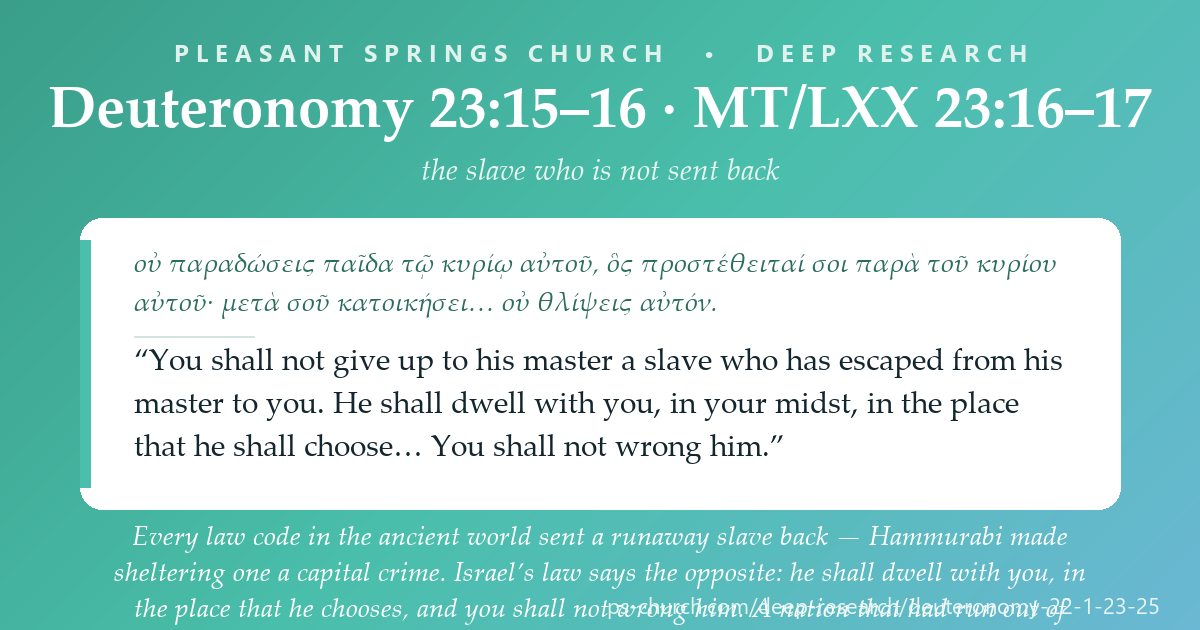
And the runaway. Here the difference is not a matter of framing. It is flat contradiction, and it is the single most remarkable line in these two chapters. Every neighbouring code assumes the slave goes back. The Code of Hammurabi §§15–20 (ANET 166–167) makes it capital: helping a slave out through the city gate is death (§15); harbouring a fugitive in your house and not producing him at the summons is death (§16); the man who catches one in the open and brings him to his owner is paid two shekels of silver (§17). The Hittite Laws §§22–24 (ANET 190) are gentler in tone and identical in direction — a sliding scale of rewards for bringing him back, shoes if you catch him nearby, six shekels if he got as far as Luwiya. Deuteronomy 23:15–16 (MT/LXX 23:16–17) says: you shall not hand him over. He shall live with you, in the place he chooses, in whichever of your towns suits him — the choice is his and not his host’s — and “you shall not wrong him.”
- Code of Hammurabi §§9–13 (ANET 166) — lost property recovered through witnesses and oath, with death for the false claimant: the ANE world’s version of Deut 22:1–3, aimed at theft rather than at neighbour-love (an ancient witness, not Scripture).
- Code of Hammurabi §§15–20 (ANET 166–167) — capital punishment for aiding or harbouring a runaway slave, and a two-shekel bounty for returning one. The exact opposite of Deut 23:15–16 (MT/LXX 23:16–17).
- Hittite Laws §§22–24 (ANET 190) — graded rewards for bringing back a runaway slave (“if he seizes him in the vicinity, he shall give him shoes”). Return is simply assumed.
- Hittite Laws §45 (ANET 191) — found property, and in the later version a found “ox, a sheep, a horse (or) an ass,” returned to its owner: a genuine near-parallel to Deut 22:1–3, and a caution against claiming the duty as unique to Israel.
- Hittite Laws §197 (ANET 196) — the woman seized “in the mountains” versus “in (her) house”: the same city/country presumption as Deut 22:23–27, without Deuteronomy’s stated reason or its verdict that the crime is like murder.
- Middle Assyrian Laws A §§55–56 (ANET 185) — the unbetrothed virgin, the father’s right to compel or refuse the marriage, and a retaliation visited on the offender’s wife. ANET’s own footnote points the reader to Deut 22:23–27.
- Temple Scroll (11Q19), cols. 45–46; 4QMMT; 1QSa (the Rule of the Congregation) (Dead Sea Scrolls — witnesses, not Scripture) — a Second-Temple community rewriting exactly this material: the camp-purity rules of Deut 23:9–14 (MT/LXX 23:10–15) applied to a holy city with its latrines set at a distance, and the question of who may or may not be admitted to “the assembly” pressed much harder than Deuteronomy presses it.
- Josephus, Antiquities 4.196–301 (Second Temple — a witness, not Scripture) — his systematic restatement of the Mosaic constitution for a Roman readership, which works through these very laws: found property, the parapet, the fringes, the marriage cases, and who belongs to the commonwealth.
- Philo, On the Virtues (the sections on humanity) and Special Laws 1 (Second Temple — a witness, not Scripture) — the lost beast and the fallen animal read as a school of φιλανθρωπία, “love of humankind”; and a long discussion of who may enter the assembly, in which the Edomite and the Egyptian clauses are treated as the law’s great act of gratitude.
- Mishnah, Bava Metzia 2 and Yadayim 4:4 (rabbinic-era — witnesses, not Scripture) — a whole chapter on returning lost property built out of Deut 22:1–3; and the report of Judah an Ammonite convert who stood before the academy and asked whether he might enter the assembly, and was told that Sennacherib had long since mixed the nations, so that the ban no longer identified anybody — “and they permitted him to enter.”
It is easy to say “the Bible is more humane than its neighbours” and hard to prove it, and much of the time the honest answer is that Israel shares the legal furniture of its world. Deut 23:15–16 (MT/LXX 23:16–17) is the place where the claim can actually be made, because the comparison is not a matter of tone. A runaway slave in Babylon was a fugitive from property, and the householder who sheltered him died for it. In Israel he is a person with a right of asylum, a free choice of town, and a standing protection against being wronged — the same verb (yānāh) used of the sojourner nobody must exploit (Exod 22:21; Lev 19:33).
Interpreters have long asked whether the law means a slave escaping from a foreign master into Israel, and that is the likelier setting; the text does not say so, and it does not restrict itself. What is beyond dispute is the direction: the whole legal weight of the ancient world pushed toward handing him back, and this text refuses. A nation that had itself run out of Egypt was not going to run an extradition service for slaveholders. That much the law does say, and that is the reason the American abolitionists reached for this verse against the Fugitive Slave Act — not as a proof-text stretched to fit, but because it is what the verse is about.
Hiding yourself, your brother, a crown for the roof, the assembly, two verbs, and one protection.
Watch hitallem (the sin of walking on), ach (the widening circle of “brother”), maaqeh (love measured in cubits), qahal (the assembly, Greek ekklesia), tapas beside hechezik (where interpreters divide), and yanah (the protection thrown over the runaway). ⚠ The verse numbers on chapter 23 need converting: English 23:1–25 = MT/LXX 23:2–26; chapter 22 needs no conversion through v. 29.
“To hide oneself” — the reflexive of a root meaning conceal. The ESV’s “ignore” is a good rendering of what it means; the Hebrew is more physical and more accusing: you shall not hide yourself from them, as if you had crossed the road and looked at the sky. It falls three times in four verses — on the stray ox, on any lost thing whatever, and on the beast collapsed under its load — and the LXX catches the flavour with ὑπερορᾶν, “to look past.” Sin here is not something you do. It is a route you take home.
“Brother” (LXX ἀδελφός) — the unit’s Leitwort. It is stacked six times in the four opening verses, so that the ox in the ditch is never “an ox” but always your brother’s. Then it reappears where you would least expect it: “you shall not abhor an Edomite, for he is your brother” (23:7 · MT/LXX 23:8) — Esau’s people, and no friends of Israel. And once more in the loan law, where the line between brother and foreigner is drawn and then, in the same breath, softened (23:19–20 · MT/LXX 23:20–21).
“Parapet, railing” — a word that occurs only here in the Hebrew Bible, for the low wall around a flat roof. The LXX calls it a στεφάνη, a “crown” for the house. Note the reason attached: “that you may not bring the guilt of blood upon your house” — the vocabulary of homicide, applied to a builder who could not be bothered. Later Jewish teaching generalized it into a rule about any known danger on your property, which is a fair reading of the logic.
“The assembly of the Lord” — the covenant people gathered as a body, not a building and not a congregation in the modern sense. The LXX renders it ἐκκλησία κυρίου — and that Greek word, ekklēsia, is the one the apostles will pick up for the church. Whatever else Deut 23:1–8 is doing, it is asking the question the New Testament will keep asking in different words: who belongs?
Two verbs, one page apart, and much rests on the difference. In 22:25, in the open country, the man heḥĕzîq-ed her — “seized, overpowered”; in 22:28 he tāp̄aś-ed her, a weaker verb meaning to “lay hold of.” Some read the change as marking a different, lesser case (compare Exod 22:16, where the verb is seduce); others read the two as near-synonyms. It is worth knowing that the Greek translators did not distinguish them: Rahlfs and Swete both render 22:25 and 22:28 with the same participle, βιασάμενος, “using force.” The ancient reading of 22:28 was the harder one.
“To wrong, oppress, take advantage of” — the last word spoken over the escaped slave: lōʾ tônennū, “you shall not wrong him” (LXX οὐ θλίψεις αὐτόν). It is the standing verb of the sojourner laws — “you shall not wrong a sojourner” (Exod 22:21), “you shall not do him wrong” (Lev 19:33) — and it names the particular sin of squeezing somebody because you can. Having refused to send him back, the law immediately forecloses the obvious next move: keeping him, and using him.
Where the New Testament stands in these laws:
- Matthew 12:1–8 — “His disciples were hungry, and they began to pluck heads of grain and to eat.” They are not stealing; they are doing exactly what Deut 23:25 permits (MT 23:26; LXX 23:25). The Pharisees’ complaint is about the Sabbath, not the grain — which is the quiet proof that this small, generous law was simply part of the landscape Jesus walked through.
- Acts 8:26–40 — an Ethiopian eunuch, reading Isaiah on a desert road, asks, “What prevents me from being baptized?” The question has a history: Deut 23:1 (MT/LXX 23:2) named exactly one class of person who could not enter the assembly, and Isa 56:3–5 had already answered on God’s behalf. Luke does not comment. He just lets the man go on his way rejoicing.
- Ephesians 2:11–22 — “you who once were far off have been brought near… you are no longer strangers and aliens, but you are fellow citizens with the saints.” The vocabulary of Deut 23:1–8 (MT/LXX 23:2–9) — who is inside, who is barred, how many generations — is answered here by a wall being pulled down (see Ephesians 2).
- Matthew 5:43–48; Luke 10:29–37 — “Who is my neighbor?” The parable of a man who does not hide himself from a stranger bleeding in a road is Deut 22:1–4 with the last restriction removed.
- 1 Corinthians 5:1 — “a man has his father’s wife”: Paul reaches for the exact case of Deut 22:30 (MT/LXX 23:1), and disciplines it with exclusion from the table rather than with the sanction the Torah names.
The neighbour laws across the Torah, and the door of the assembly across the canon.
Two threads. First, neighbour-love: the same laws in their older form and their sanctuary form. Second, the door — who may enter the assembly — traced honestly through the whole canon, including the places where it is shut harder before it is opened.
Which cross-references matter?
- Exodus 23:4–5 — the older form of the lost-animal law, and the wording is startling: “If you meet your enemy’s ox or his donkey going astray… if you see the donkey of one who hates you lying down under its burden… you shall rescue it with him.” Deuteronomy preaches the same law with “your brother” in place of “your enemy” — not a softening but a second front: the one you hate and the one you have never met (see Exodus 23).
- Leviticus 19:9–18, 33–34 — gleanings left, no grudge, “you shall love your neighbor as yourself,” and then the same command spoken again over the sojourner. Deut 22–23 is that command turned into cases (see Leviticus 19).
- Numbers 15:37–41 — the tassels commanded with their reason: “it shall be a tassel for you to look at and remember all the commandments of the Lord, to do them.” Deut 22:12 gives the same thread without the sermon (see Numbers 15).
- Genesis 3:8; Leviticus 26:11–12 — the verb of Deut 23:14 (MT/LXX 23:15) is miṯhallēḵ, the same reflexive used of God walking about in the garden and of his promise, “I will walk among you and will be your God.” The camp latrine law is not fussiness; it is what it means to have him in the middle of the tents (see Genesis 3 and Leviticus 26).
- Exodus 22:16–17 — the parallel case to Deut 22:28–29, and the one place the Torah states the father’s right outright: “If her father utterly refuses to give her to him, he shall pay money equal to the bride-price for virgins” (see Exodus 22). Read together, the two texts are the reason interpreters have argued for centuries about whether the marriage in Deut 22:29 could be declined.
- Numbers 22–24 — the reason given for the Moabite and Ammonite exclusion is a story the reader has already been told: “they hired against you Balaam the son of Beor… to curse you” (23:4 · MT/LXX 23:5). The ban is not about blood but about what they did (see Numbers 22).
- Ruth 4:9–17 — “Ruth the Moabite… I have bought to be my wife,” announced before the elders in the gate, and the child is Obed, “the father of Jesse, the father of David.” The canon does not repeal Deut 23:3 (MT/LXX 23:4); it tells this story next to it, and lets the reader do the arithmetic.
- Nehemiah 13:1–3 — the honest counterweight. “On that day they read from the Book of Moses… and in it was found written that no Ammonite or Moabite should ever enter the assembly of God… they separated from Israel all those of foreign descent.” The same text, applied hard, by people trying to be faithful. Any account of the “trajectory” that pretends this verse is not in the Bible is not worth having.
- Isaiah 56:3–8 — and then God’s own answer, addressed to the two groups Deut 23 named: “let not the eunuch say, ‘Behold, I am a dry tree’… I will give… a monument and a name better than sons and daughters… for my house shall be called a house of prayer for all peoples.”
- Matthew 12:1; Acts 8:26–40; Ephesians 2:11–22; Galatians 3:28 — the grain law kept, the eunuch baptized, the dividing wall broken down, and “there is neither Jew nor Greek… for you are all one in Christ Jesus.”
Deuteronomy 23:1–8 (MT/LXX 23:2–9) shuts a door on four groups and names a reason for two of them, and then, in the same paragraph, throws it open for two more: not the Edomite, “for he is your brother”; not the Egyptian, “because you were a sojourner in his land” — and their children of the third generation may enter the assembly (23:8 · MT/LXX 23:9). The Egyptian clause is the astonishing one. Egypt is the house of slavery, the whole book’s standing image of everything God rescued Israel from — and Israel is forbidden to hate an Egyptian, on the ground that Egypt once gave them somewhere to live. The law itself already contains the impulse that will eventually widen it.
Follow that impulse across the canon and you get Ruth the Moabite in David’s line, Isaiah’s promise to the eunuch of a name better than sons and daughters, and Luke’s Ethiopian going down into the water. That is what we mean by a trajectory, and the word matters: it is the canon’s own movement, read forward, not a modern decision to cancel an inconvenient verse. Nehemiah 13 is in the Bible too, and it shows what the law meant to those who kept it. The door is not argued open. It is opened — by the Lord, in Isaiah 56, and by the risen Christ, in Acts 8 — and the church receives it that way rather than granting it.
The commentaries, the ANE comparisons, and the questions that stay open.
Craigie, Block, McConville, Tigay, Christensen, Nelson, Driver, Miller and Merrill on Deuteronomy; Levinson on legal revision; Kline on the treaty form; Beale & Carson for the New Testament use; ANET for the comparanda.
Commentaries & studies:
- Peter C. Craigie, The Book of Deuteronomy (NICOT); Daniel I. Block, Deuteronomy (NIVAC); J. G. McConville, Deuteronomy (Apollos); Jeffrey H. Tigay, Deuteronomy (JPS); Duane L. Christensen (WBC); Richard D. Nelson (OTL); S. R. Driver (ICC); Patrick D. Miller (Interpretation); Eugene H. Merrill (NAC).
- Bernard M. Levinson on Deuteronomy’s revision of earlier Israelite law; Meredith G. Kline, Treaty of the Great King, on the covenant form (reported as the book’s literary shape, not as a settled argument about its date).
- J. B. Pritchard, ed., Ancient Near Eastern Texts (ANET) — the Code of Hammurabi (163–180), the Middle Assyrian Laws (180–188), the Hittite Laws (188–197).
- G. K. Beale & D. A. Carson, eds., Commentary on the New Testament Use of the Old Testament (Matthew; Acts; Ephesians).
Interpretation notes worth keeping:
- ⚠ Read chapter 23 with both numbers in front of you. English 22:30 = MT/LXX 23:1, so English 23:1–25 = MT/LXX 23:2–26. Anyone quoting a Hebrew grammar, a Greek concordance, a rabbinic source or a Qumran text on this chapter is working in the Hebrew numbers. Rahlfs adds a second wrinkle at the end, reversing the order of the vineyard and the grain field.
- The little laws are the argument. Deuteronomy does not defend neighbour-love; it drafts it. An animal you must feed until its owner turns up, a railing you must build for a guest who may never come, a field you may eat from and may not harvest. Preach the specificity, not a generalisation of it.
- On 22:13–29, name the cases and centre the woman. The unit runs: the slandered bride, tried on evidence before the elders (22:13–19), and — if the charge stands — stoned at the door of her father’s house (22:20–21); adultery, both parties put to death (22:22); the betrothed woman taken in the city, where the law presumes she could have called and did not, both put to death (22:23–24); the betrothed woman taken in the open country, where she is expressly declared guiltless and the crime classed as murder (22:25–27); and the unbetrothed virgin, where the man pays fifty shekels of silver to her father, marries her, and may never divorce her (22:28–29). Report all of that plainly; do not skip the hard half. These are capital, theocratic criminal statutes for a covenant nation with God as its immediate King, at a bounded moment in redemptive history — not a template for the church or for any modern state, and no warrant for coercion or punishment by anybody today (2 Cor 10:4; Eph 6:12; Matt 26:52; and the church’s own discipline in 1 Cor 5, which is exhortation and, at most, exclusion from the table). Note where the law restrains: the accusation must be brought before elders with evidence; the slanderer is fined and permanently barred from divorcing her; and the woman in the field is expressly declared guiltless, with a reason given.
- On 22:28–29, say plainly what is and is not known. The Hebrew verb (tāp̄aś, “lay hold of”) is weaker than the verb in the preceding case, and responsible interpreters divide over whether that marks a lesser offence; the Greek translators did not distinguish them. Whether the woman or her father could decline the marriage is likewise disputed, with Exod 22:16–17 — where the father may simply refuse — the strongest evidence that they could. In a world with no welfare and no second chances, a permanent, unbreakable obligation on the man was a provision for her; that is an explanation of the law, not a defence of anything. State clearly, every time, that no part of this text excuses or minimises sexual violence, that it is not a model for any modern law, church policy or counselling practice, and that the God who says “there was no one to rescue her” hates the violation of the powerless. Then stop; do not resolve what the text leaves open.
- The assembly laws are about the covenant nation, not about human worth. Deut 23:1–8 (MT/LXX 23:2–9) regulates who stands in Israel’s cultic and civic assembly. It is not a statement about anyone’s dignity, and it has no application whatever to who may be baptized, seated, welcomed or loved in a Christian congregation — Isaiah 56 and Acts 8 settle that. Any use of these verses to exclude a disabled, infertile, adopted or foreign-born person from a church is a straightforward abuse of the passage.
- Do not oversell the ANE contrast — except where it is real. Israel shares the legal furniture of its world on found property and on the city/country presumption. On the runaway slave it does not: Hammurabi makes harbouring capital, the Hittite laws pay a bounty for return, and Deuteronomy forbids extradition and gives the man his choice of town. Show the difference from the sources rather than asserting it.
- Deut 23:19–20 (MT/LXX 23:20–21) is about a brother in need, not about banking. The loan in view is a subsistence loan to a neighbour in trouble; the “foreigner” is the travelling merchant borrowing for trade. Reading the verse as a general economic doctrine, in either direction, asks it a question it is not answering.
- Vows: better not to promise. “If you make a vow… you shall not delay… But if you refrain from vowing, you will not be guilty of sin” (23:21–23 · MT/LXX 23:22–24). Ecclesiastes 5:4–5 says it again, and Jesus presses further (Matt 5:33–37). The pastoral use is exact: God is not impressed by an ambitious promise, and he does hold you to a small one.
From an ox in a ditch to a door that God himself opens.
Name what you learned, why it matters, and one concrete response.
What should we carry away — and do?
- The sin is walking on. You shall not hide yourself. Not “do no harm” — do not arrange your route so the trouble is behind you. Three times in four verses, over an animal. Somebody near you this week is standing beside their own fallen donkey.
- Love gets measured in cubits. A parapet is love with a tape measure on it: an expense you pay for a person who may never come, who will never know, and who would only have needed it if you had not built it. Ask what unbuilt railing is on your property, literal or otherwise.
- ‘For he is your brother.’ The word runs from the ox in the ditch to the Edomite at the border. Deuteronomy keeps widening it, and the people it widens to are not the easy ones — Esau’s children, and Egypt.
- He shall dwell with you, in the place that he shall choose. Against every code in the ancient world, Israel does not send the runaway back. Notice that the law gives him the choice — not a place assigned to him, but a place he picks. Then it forbids you to take advantage of him once he is there.
- Eat your fill; leave the sickle. A hungry traveller could feed himself in your field and not carry any away. It is a whole ethic of hospitality in two verses — enough for need, nothing for the bag — and Jesus’ disciples were living off it in Matthew 12.
- And where it is hard, be honest. Deut 22:13–29 is difficult to read and difficult to teach, and pretending otherwise helps nobody. Say what the text says, say what it does not say, centre the dignity of the woman it protects, and leave the unresolved parts unresolved.
Step in response: pick the one thing this week you have been quietly walking past — an unanswered message, a neighbour’s obvious trouble, a repair on your own property that could hurt somebody. Do not solve it in your head. Go and take hold of it, the way you would take hold of an ox by the halter. Then ask the second question: who is standing at the edge of your congregation waiting to be told whether they belong — and go tell them.
Deuteronomy 23:15–16 · MT/LXX 23:16–17 · to share
LXX + ESVEvery Deep Research page traces its passage across the whole sweep — the Old Testament, the Second-Temple world between the testaments (historical witnesses, not Scripture), and the New Testament. Follow the thread:
Pleasant Springs Church — Deep Research
Research method after Michael S. Heiser’s Bible Research Method (examine dictionaries → ancient literature → important words → textual connections → academic publications → share), with the Pleasant Springs “Author & Audience” foundation. Scripture set in the Hebrew, the Greek editions named on each page and the ESV (Old Testament), and the Greek New Testament and the ESV (New Testament), per the practice of Pleasant Springs Church. Deuteronomy 22–23 research grounded in Craigie, Block, McConville, Tigay, Christensen, Nelson, Driver, Miller and Merrill, with Levinson on Deuteronomy’s legal revision, Kline on the treaty form (reported as the book’s literary shape, not as a settled argument about its date), and Beale & Carson on the New Testament use (Matthew; Acts; Ephesians). ANE comparanda verified against the translations printed in ANET: the Code of Hammurabi §§9–13 and §§15–20 (ANET 166–167), the Middle Assyrian Laws A §§55–56 (ANET 185), and the Hittite Laws §§22–24, §45 and §197 (ANET 190, 191, 196), with Second-Temple and rabbinic witnesses (the Temple Scroll, 4QMMT and 1QSa; Josephus; Philo; the Mishnah’s Bava Metzia and Yadayim) — all read as witnesses, never leveled with Scripture. ⚠ Versification: chapter 22 runs alike in Hebrew, Rahlfs LXX and English through 22:29, but English 22:30 = MT/LXX 23:1, so English 23:1–25 = MT/LXX 23:2–26 — every chapter-23 reference in the body of this page carries both numbers; and Rahlfs (with Swete) further reverses the closing pair, so English 23:24 (vineyard) = LXX 23:26 and English 23:25 (standing grain) = LXX 23:25. Elsewhere in this book: English 12:32 = MT/LXX 13:1, so English 13:1–18 = MT/LXX 13:2–19; and English 29:1 = MT/LXX 28:69. The capital and household statutes of 22:13–29 are read as criminal law for a covenant nation under God as its immediate King at a bounded moment in redemptive history — never as a template for the church or any modern state, and licensing no coercion or punishment by anyone today; no part of that passage excuses or minimises sexual violence. Where the text leaves a question open (the force of tāp̄aś in 22:28; whether the marriage of 22:29 could be refused), the page reports the disagreement and does not resolve it.
Scripture quotations marked ESV are from the ESV® Bible (The Holy Bible, English Standard Version®), © 2001 by Crossway, a publishing ministry of Good News Publishers. ESV Text Edition: 2016. Used by permission. All rights reserved. The ESV text may not be quoted in any publication made available to the public by a Creative Commons license, and the ESV may not be translated in whole or in part into any other language. www.esv.org
|
Did this study bless you today? 💚 Give to Support PS Church100% of gifts go to the General Fund — thank you. |