Four things happen before a single battle — three of them at Gilgal, the fourth on the road to Jericho — and not one of them is military. The Torah is finished; the promise has been carried through five books and has still not been kept; and now Israel is across the river with Jericho in sight and the kings of the whole country gone to pieces at the news (5:1). And the first order is not draw your sword. It is make flint knives. The generation born in the wilderness is circumcised, and the whole army sits still until the wounds close — and the Lord says, “Today I have rolled away the reproach of Egypt from you,” so the place is called Gilgal, on the pun with galal, to roll (5:9). Then the Passover, kept on the fourteenth day of the month on the plains of Jericho — in the land, at last (5:10). Then they eat the produce of the country, and “the manna ceased the day after they ate of the produce of the land” (5:12): forty years of bread from heaven stopping the morning after ordinary bread was on the table. And then Joshua lifts his eyes and there is a man with a drawn sword, and he asks the only question a general knows — “Are you for us, or for our adversaries?” — and is told no. This study works Joshua 5:1–15. See the method →
Joshua 5:1–15
Hebrew · LXX · ESVThe Shape of the Passage
SequenceJoshua 5 sits in the seam between two books. Behind it is the whole Torah — the covenant sign given to Abraham (Genesis 17), the Passover in Egypt (Exodus 12), the manna (Exodus 16), the second Passover at Sinai (Numbers 9), and the sermon that said the wilderness was schooling (Deuteronomy 8). In front of it is Jericho. This chapter is the hinge, and it is made entirely of worship.
Author
An anonymous narrator, writing about the first days in the land. The book of Joshua never names its author. Jewish tradition assigned it to Joshua himself (b. Bava Batra 14b–15a, with the closing verses attributed to others); modern scholarship reads it within the larger history that runs from Deuteronomy to Kings. What the text itself tells us is narrower and more useful: it was written down at a point when Gilgal was still called Gilgal “to this day” (5:9) — a phrase that looks back across some distance — and it was written by someone who knew exactly which day of which month the Passover fell on.
And he is a narrator who withholds. Robert Alter’s word for this is reticence: biblical narrative reports action sparely and refuses to explain motive, leaving the reader to do the inferring. Joshua 5 is full of gaps that a modern writer would have filled. Why was the wilderness generation never circumcised — disobedience, or the impossibility of travel, or something the narrator simply does not tell us? Why here, three miles from a walled city, in the one week an army cannot fight? Who is the man with the sword? The text answers none of these. It is worth naming that plainly rather than papering over it: where Scripture gives no reason, we say so and stop.
He also tells the story in the shape of the exodus. Water divided; a Passover; unleavened bread; a manifestation at a holy place with the sandals coming off. Chapter 4 had already said it outright: the Lord dried up the Jordan “as he did to the Red Sea” (4:23; see Exodus 14). Chapter 5 finishes the pattern. Whatever else the book is doing, it is telling a generation that the God who got their parents out is the God who is getting them in, and that he has not changed method or character in forty years.
Audience
The generation that was born on the way. Every man in the camp under forty was born on the way, and — the text says it twice (5:5, 5:7) — not one of them carried the covenant sign in his body. The older men, born in Egypt and under twenty at the exodus, had been circumcised there (5:5). They had eaten miracle bread every morning of their lives. They had never planted anything, never harvested anything, never kept a Passover in a country of their own. They had watched the Jordan stand up in a heap the week before. And the first order they receive on the far bank is not draw your sword but submit to a knife.
Which makes them, militarily, insane. This has to be said and not smoothed over. To circumcise every man born in the wilderness — the bulk of the fighting force — in the week you enter hostile territory is to disable most of your army for days — the text itself says they “remained in their places in the camp until they were healed” (5:8) — within sight of a fortified city. Genesis knows exactly how that goes: at Shechem two of Jacob’s sons waited for the third day, “when they were sore,” and killed every male in the town (Genesis 34:25). The narrator does not explain the risk, does not say God protected them, and does not comment. The only cover mentioned in the chapter is the one already reported in 5:1 — the enemy kings have no fight left in them. Whether that is meant as the explanation, the reader has to decide; the text declines to say.
How they were meant to hear it. As identity before activity. Before this army is a fighting force it is a covenant people, a Passover congregation, and a household that eats what God gives. Everything that happens at Jericho in the next chapter happens to people who spent the previous week being marked, fed and stopped. A congregation that reads Joshua 5 first will not read Joshua 6 as a war story about brave men.
Orient on Gilgal, circumcision, Passover, manna, and the angel of the Lord.
Search by topic: Gilgal; circumcision; flint / stone tools; reproach (herpah); Passover and Unleavened Bread; manna; firstfruits; theophany and christophany; angel of the Lord; host / army of heaven; Jericho; holy ground.
Which articles are relevant?
- Anchor Bible Dictionary — “Gilgal,” “Circumcision,” “Passover,” “Manna,” “Angel of the Lord,” “Host of Heaven,” “Jericho,” “Joshua, Book of.”
- Dictionary of the OT: Historical Books — “Joshua, Book of,” “Conquest and Settlement,” “Cult and Worship,” “Angel of the Lord,” “Archaeology of the Conquest,” “Text and Textual Criticism.”
- NIDOTTE / TDOT — גָּלַל (gālal, to roll), חֶרְפָּה (ḥerpāh, reproach), מוּל (mûl, circumcise), צֹר / צֻרִים (ṣōr, flint), מָן (mān, manna), שָׁבַת (šāḇaṯ, cease/rest), צָבָא (ṣāḇāʾ, host/army).
- Reverse-index the Septuagint too — look up ἀρχιστράτηγος (commander-in-chief) and ὀνειδισμός (reproach) in Muraoka’s Greek-English Lexicon of the Septuagint and in Lust–Eynikel–Hauspie before assuming the Greek says what the English says.
Bibliography surfaced:
- Richard S. Hess, Joshua (TOTC); David M. Howard Jr., Joshua (NAC); Trent C. Butler, Joshua (WBC); Robert G. Boling, Joshua (Anchor Bible); Marten H. Woudstra, The Book of Joshua (NICOT); L. Daniel Hawk, Joshua (Berit Olam).
- Emanuel Tov and Leonard J. Greenspoon on the Greek Joshua — the standard entry point for the shorter Old Greek text.
- Studies of Gilgal as a sanctuary and of the “angel of the Lord” texts across the Old Testament.
Flint in a bronze age, circumcised Egyptians, a commander-in-chief, and the ground that takes your shoes.
Read the chapter against ANE practice (stone knives, circumcision as a regional custom, the pilgrim removing sandals), then against how Second-Temple and rabbinic readers handled it — and pay attention to what Josephus leaves out.
Which parallels shed light on religion and worldview?
Stone knives in an age of metal. Israel is well into the Bronze Age and has bronze tools; the Lord tells Joshua to make knives of flint (5:2, חַרְבוֹת צֻרִים; LXX μαχαίρας πετρίνας ἐκ πέτρας ἀκροτόμου, “stone knives from sharp-edged rock”). It is at least not backwardness: Egyptian embalmers went on using flint blades for centuries after metal was available, and Zipporah takes a flint (צֹר) to circumcise her son in Exodus 4:25. But the text gives no reason for the flint. The pattern most readers reach for — a ritual instrument keeping the older material long after daily tools have moved on — is a reasonable inference and not a statement of the passage; the narrator simply says flint.
“The reproach of Egypt” is not simply ‘being uncircumcised like Egyptians.’ Egyptians were circumcised. Herodotus says so plainly (Histories 2.104), listing the Egyptians among the peoples who have practised it “from the first,” and Egyptian tomb reliefs depict the operation. Jeremiah says so too, and puts Egypt at the head of the list of nations “circumcised merely in the flesh” (Jeremiah 9:25–26 · MT 9:24–25 — English Jeremiah 9:1 = MT 8:23, so the Hebrew carries a one-verse offset here, and Rahlfs follows the Hebrew: τίς δώσει κεφαλῇ μου ὕδωρ stands at Ieremias 8:23, so the oracle is LXX 9:24–25. Ziegler’s Göttingen edition and the Brenton/Elpenor text number it with the English, 9:25–26; the editions differ). So the phrase has to mean something else, and the honest answer is that commentators divide: the shame Egypt would have spoken over a people who died in the desert (Exod 32:12; Num 14:13–16); the condition of slavery itself; or the disgrace of the forty years now finally behind them. The text does not define it, and we will not pretend it does.
A commander-in-chief. The Greek renders שַׂר־צְבָא as ἀρχιστράτηγος — an ordinary Hellenistic military title for a supreme commander. The same word turns up in the Greek of Daniel 8:11 — in Theodotion, καὶ ἕως οὗ ὁ ἀρχιστράτηγος ῥύσηται τὴν αἰχμαλωσίαν, and in the Old Greek with the same title, ἕως ὁ ἀρχιστράτηγος ῥύσεται τὴν αἰχμαλωσίαν — rendering שַׂר־הַצָּבָא, the Prince of the host: a figure Daniel does not identify, whom some readers take to be an angel and some take to be God himself, and who in the Greek is the one who delivers the captives. Later the title became the standard Jewish and Christian one for Michael, the archangel “the great prince who has charge of your people” (Dan 12:1; cf. 10:13, 21) — but that association is later than Daniel (Testament of Abraham; 2 Enoch; the Byzantine liturgy), not Daniel’s own. The datum is real, and it cuts both ways in the identification question below; it does not settle anything by itself.
Bare feet on holy ground. Removing the sandals to enter a sacred precinct is widely attested in the ancient Mediterranean and Near East, and it survives in Islamic practice to this day. What matters here is narrower: the sentence spoken to Joshua is the sentence spoken to Moses at the bush (Exodus 3:5), and in Greek the two are nearly identical — λῦσαι τὸ ὑπόδημα ἐκ τῶν ποδῶν σου· ὁ γὰρ τόπος… in both. The Hebrew differs in one small, deliberate way: Moses is told to remove his sandals from his feet and the ground is “holy ground” (אַדְמַת־קֹדֶשׁ); Joshua is told, in the singular, to remove his sandal from his foot, and the place is simply “holy” (קֹדֶשׁ). It is a quotation, and the narrator expects you to hear it.
- Herodotus, Histories 2.104 (Greek historian — a witness, not Scripture) — the Egyptians among the peoples who practise circumcision “from the first.” The datum that makes “the reproach of Egypt” a real interpretive question rather than an obvious one.
- Josephus, Antiquities 5.1.4 (Second-Temple — a witness, not Scripture) — and here the silence is the datum. Josephus has Israel camp ten furlongs from Jericho, build an altar of the stones taken from the river, sacrifice, and “in that place celebrated the passover,” and he reports that “their former food, which was manna, and of which they had eaten forty years, failed them.” He says nothing whatever about the circumcision, and nothing about the man with the drawn sword. Writing up Israel’s history for a Greco-Roman readership, he kept the altar and the festival and quietly dropped the knife and the apparition.
- Sirach 46:1–8 (Second-Temple — a witness, not Scripture) — the Praise of the Fathers remembers Joshua as “mighty in war,” successor of Moses, the man for whom the sun stood still and the hailstones fell. Not one word about Gilgal, the circumcision, the Passover or the manna. Israel’s own memory kept the battles; the book itself opens with the liturgy.
- b. Yevamot 71b–72a (rabbinic-era — witnesses, not Scripture) — the Gemara asks the question the text leaves open, why did they not circumcise in the wilderness?, and offers two answers: the weariness of constant travel, and that “all those forty years that the Jewish people were in the wilderness, the north wind did not blow for them” — which made both circumcision and bloodletting dangerous. Ancient readers felt the gap too, and filled it with medicine rather than theology.
- Origen, Homilies on Joshua (early Christian — a witness, not Scripture) — preached c. 249–250, just before the Decian persecution, whose tortures he survived only to die of them a few years later, and the fountainhead of the “second circumcision” as a figure of the Christian’s inward cutting away, with “the reproach of Egypt” read as the sin that has not yet been taken away. Cite it for what it is: a third-century Christian reading of the chapter, not the chapter’s own claim. (Note in passing that Rahlfs’ Greek at 5:2 has no “second time”; the later ecclesiastical Greek does — …περίτεμε τοὺς υἱοὺς Ἰσραὴλ ἐκ δευτέρου — which is the text Origen would have had.)
- Dead Sea Scrolls — 4QJosha, 4QJoshb, and 4Q379 (“Apocryphon of Joshua”) (a witness, not Scripture) — the Joshua fragments bear directly on the shorter-Greek question, and 4QJosha is the manuscript that puts the Ebal altar at the Jordan crossing (see the codex note). 4Q379 is a retelling rather than a copy; a piece of it is quoted in 4QTestimonia (4Q175).
Read the sequence at face value and it is close to unbelievable. The kings of the whole hill country have just heard what happened at the river and have gone to pieces (5:1). Jericho is a couple of hours’ march away, shut up tight. And Israel’s first act on the enemy’s side of the border is to take a stone knife to every man born in the wilderness — the bulk of the fighting force — and then sit still until the wounds close.
Do not smooth this over with a slogan about faith. The narrator gives no explanation at all. He does not say God shielded them; he does not say the enemy could not have come; he does not comment on the risk, and Genesis 34 proves he knew perfectly well what happens to circumcised men on the third day. What he does say is that this generation had never been marked, and that a people who cannot keep the Passover — and an uncircumcised man may not eat it (Exod 12:48) — is not yet in a position to receive anything else. The order of operations is the argument: be the covenant people first; be an army afterward, if at all.
And notice how little of Joshua 5 anybody does. Israel is cut, waits, eats, and watches its bread stop. Joshua does exactly one active thing in the whole chapter — he walks up to a stranger and asks a question — and it turns out to be the wrong question. The chapter that opens the conquest is a chapter in which Israel is almost entirely passive.
The flint, the rolling, the reproach, the sabbath of the manna, and the commander of the host.
Watch four things: the wordplay that names the place (galal / Gilgal); the Sabbath verb used of the manna; the two blades in the chapter, one Israel's and one not; and the title sar-tseva, which is the hinge of the identification question.
“Knives of flints” — literally swords of flint, the same noun חֶרֶב that means a war-sword. The chapter’s first blade is turned on Israel, not on Canaan; the second blade in the chapter is the one in the stranger’s hand at 5:13. LXX μαχαίρας πετρίνας ἐκ πέτρας ἀκροτόμου, “stone knives from sharp-edged rock.”
“I have rolled away” / “Gilgal” — a pun the English can only point at. גָּלַל (gālal) is “to roll,” and Gilgal is from the same root: a circle, a wheel, a rolling. So the name of the place preserves the sentence. But keep paronomasia and philology apart: Hebrew narrative names places by sound as often as by derivation. Gilgāl most likely meant a circle — a ring of standing stones — before Joshua ever reached it (compare Deut 11:30, which speaks of a Gilgal already), and the narrator is doing what he does everywhere: hearing the sentence in the name. That is paronomasia, not a dictionary entry, and it is none the weaker for it. The Greek keeps the meaning and loses the play: ἀφεῖλον, “I have taken away,” and then simply Γαλγαλα, untranslated.
“Reproach, disgrace, taunt” (LXX ὀνειδισμός) — a public shame, the thing other people say about you. Whose reproach and about what, the text does not say (see Stage 2). What it does say is the tense: not “I will remove” but gallôṯî, a completed act — today. Something that had been true of them since Egypt stopped being true in a morning.
“Passover” — the third one Scripture records: Egypt (Exod 12), Sinai (Num 9), and now Gilgal. The Greek does not translate it either; it borrows the word, τὸ πασχα, indeclinable. Note what the Hebrew does not say: not “the first month,” just “the fourteenth day of the month.” The narrator assumes you know the calendar (Lev 23:5).
“And the manna ceased” — and the verb is שָׁבַת (šāḇaṯ), the Sabbath verb: it stopped, it rested, it came to its rest. Manna had been the one food that observed the Sabbath by not falling (Exod 16:26–27); now the manna itself keeps a sabbath, permanently. LXX flattens it to ἐξέλιπεν, “it gave out.”
“Produce” and “yield” — ordinary farm words, and this is the first time either can be used of Israel in its own country. They ate maṣṣōṯ and parched grain: standing crops somebody else had planted, which is a quiet reminder that the land is a gift and not a wage (Deut 6:10–11). LXX has ἄζυμα καὶ νέα, “unleavened and new,” and for “the land of Canaan” reads τὴν χώραν τῶν Φοινίκων, “the country of the Phoenicians.”
“Commander of the army of the Lord” (LXX ἀρχιστράτηγος δυνάμεως κυρίου). צָבָא (ṣāḇāʾ) is a host — the word behind “the Lord of hosts.” The title is the crux of the identification question: it names him as supreme commander of the Lord’s army, which sounds like a servant, and yet the ground under him is holy, which does not.
“Take off your sandal” — the imperative שַׁל, “slip it off,” the identical form used at Exodus 3:5. In Hebrew the two are close but not identical: Moses gets plurals and “holy ground”; Joshua gets singulars and simply “holy.” In Greek they are almost word for word. Either way, the narrator is putting Joshua where Moses stood.
How the rest of Scripture takes up Joshua 5:
- Exodus 12:48 — “no uncircumcised person shall eat of it.” This is the legal reason the knife must precede the Passover, and it explains the order of 5:2–10 without explaining the timing (see Exodus 12).
- Exodus 16:35 — “The people of Israel ate the manna forty years, till they came to a habitable land… till they came to the border of the land of Canaan.” Exodus wrote the ending of the manna story before Joshua reported it happening (see Exodus 16).
- Deuteronomy 8:3 — “man does not live by bread alone, but… by every word that comes from the mouth of the Lord.” The manna was never really about the manna, which is why its ending is not a loss (see Deuteronomy 8).
- Genesis 17:9–14 — the covenant sign given to Abraham and required of every generation. Joshua 5 is not an innovation; it is a repair (see Genesis 17).
- Deuteronomy 10:16; 30:6 — the same rite turned inward, first as command and then as promise: “the Lord your God will circumcise your heart” (see Deuteronomy 30). Colossians 2:11 and Romans 2:28–29 carry it forward; Romans 3:21–26 is where the argument lands.
- Exodus 3:1–6 — the sandals, the holy place, and a figure who both is and is not distinguished from God (see Exodus 3). Joshua 5:15 is a quotation of 3:5, and any account of the commander has to reckon with that.
- Judges 6:11–24 and Judges 13 — two further encounters where a figure called “the angel of the Lord” receives offerings and is spoken of interchangeably with the Lord himself. Cited here in text only; these chapters do not yet have pages in this library.
Bread that stops, a sign restored, and a stranger who will not take a side.
Trace three threads: the manna from Exodus 16 to Joshua 5 to the prophets; the covenant sign from Genesis 17 through Deuteronomy to the apostles; and the “angel of the Lord” texts, which is where the identification question actually has to be argued.
Which cross-references matter?
- Joshua 4:19 with Exodus 12:3 — Israel came up out of the Jordan “on the tenth day of the first month,” which is the day the Passover lamb was to be selected. Four days later they keep the Passover. The crossing was timed (see Joshua 3–4).
- Exodus 16:31–35; Numbers 11:6–9; Nehemiah 9:15, 20–21; Psalm 78:23–25 — the whole manna file. Nehemiah’s prayer is the one that says it plainly: “forty years you sustained them in the wilderness, and they lacked nothing” (see Numbers 11).
- Genesis 34:24–25 — the third day after circumcision, “when they were sore.” The one place Scripture shows what Joshua 5:8 risks (see Genesis 34).
- Leviticus 23:5–14 — Passover on the fourteenth, Unleavened Bread from the fifteenth, and the sheaf of firstfruits “when you come into the land… and reap its harvest,” with the rule that you eat no grain until the offering is brought. Joshua 5:10–12 is that legislation happening (see Leviticus 23).
- Deuteronomy 6:10–11 — “cities that you did not build… vineyards and olive trees that you did not plant.” The produce eaten in 5:11 is somebody else’s crop, and Deuteronomy had already named the danger in that (see Deuteronomy 6).
- Deuteronomy 32 and the divine council — “the army of the Lord” is not a metaphor for Israel’s militia; Scripture speaks of a real heavenly host under a real command (see the Deuteronomy 32 worldview).
- Isaiah 52:13–53:12 — for the trajectory the whole library is following, from a God who takes over to a Servant who is taken (see Isaiah 52:13–53:12).
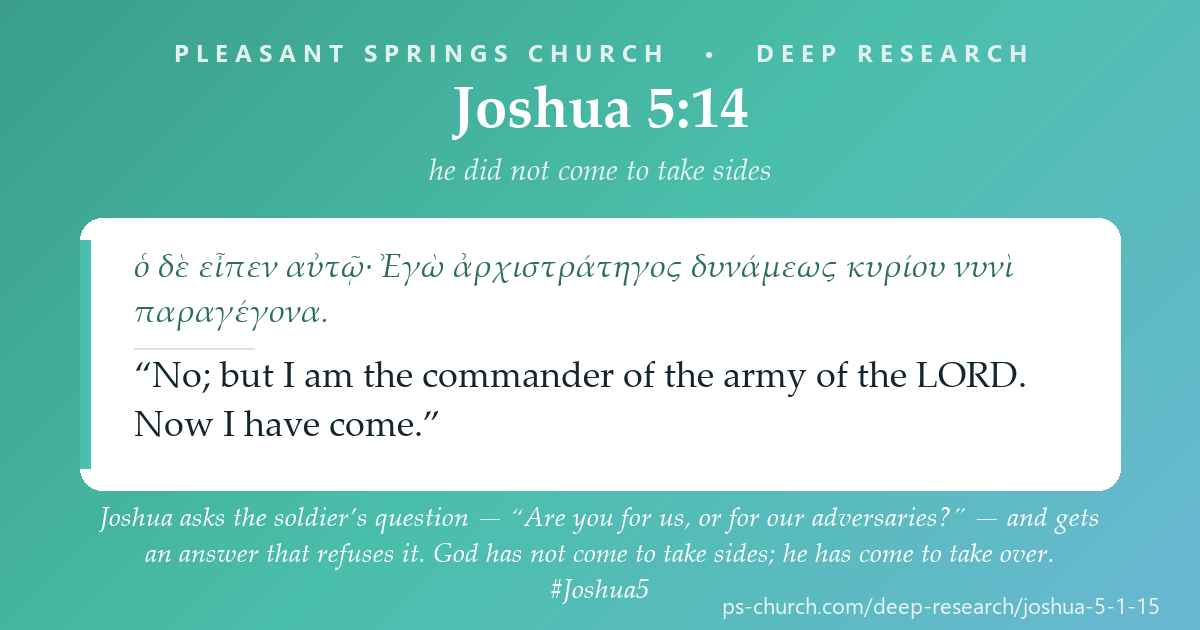
Joshua asks a perfectly reasonable question. It is the question every soldier asks of every stranger, and it is the question every partisan asks of God. Whose side are you on? The answer he gets is not yours and it is not theirs. In the Hebrew it is a flat לֹא — “No” — followed by a self-introduction: I am the commander of the army of the Lord. Now I have come. The question is refused and replaced. There are not two armies on that plain with God available to reinforce one of them. There is a third army, and it has just arrived, and it did not come to enlist.
That is the theological point the text actually makes, and it is available no matter how the identification question below is decided: God has not come to take sides; he has come to take over. Which is why the next thing that happens is Joshua on his face in the dirt asking for orders — he has stopped recruiting and started reporting. And it is why the fall of Jericho in the next chapter is narrated as a procession rather than a battle. The general of Israel is not the general of this operation, and he has just been told so to his face.
(A textual footnote worth having, because it is easy to over-read: the Greek does not have the “No.” Rahlfs reads simply “ὁ δὲ εἶπεν αὐτῷ Ἐγὼ ἀρχιστράτηγος δυνάμεως κυρίου” — he answers by identifying himself and lets the refusal be implied. The Hebrew, which is our base text here, states it.)
This is one of the genuinely open questions in the Old Testament, and it has been argued by serious Christians on both sides for eighteen centuries. Here is what the text gives, without a thumb on the scale.
Pointing toward a divine figure: Joshua “fell on his face to the earth and worshiped” (וַיִּשְׁתָּחוּ) and is not stopped — where angels elsewhere refuse exactly this (Revelation 19:10; 22:8–9). The place is declared holy, and in Scripture holiness of place attaches to divine presence. And the words spoken are the words of Exodus 3:5, where the speaker who begins as “the angel of the Lord” (3:2) is then plainly called God (3:4, 6). Joshua also addresses him as “my lord” (אֲדֹנִי; LXX δέσποτα, “Master”), and the pattern of the “angel of the Lord” passages — Judges 6 and Judges 13 above all — repeatedly blurs the line between the messenger and the sender. And the scene does not close at 5:15: after the parenthesis of 6:1, the speech resumes at 6:2 with “And the Lord said to Joshua” and no new speaker introduced — which many readers take as the narrator’s own identification of the commander.
Pointing toward a created being: he introduces himself by a title that places him under the Lord — commander of the Lord’s army, not the Lord of the army. Unlike Exodus 3 and Judges 6, the narrator never once calls him YHWH inside the scene itself, and the narrator of Joshua is perfectly willing to name YHWH when YHWH is speaking (5:2, 5:9) — so the resumption at 6:2 has to be read as a resumption, which is exactly what is disputed. The Hebrew verb translated “worshiped” is also used of deep reverence toward a human superior (Gen 23:7; 2 Sam 14:33), so it does not settle the matter by itself. And ἀρχιστράτηγος, the Greek title here, is the very word later Jewish and Christian tradition attaches to Michael — who in Daniel is a prince under God with charge of Israel.
And two honest complications. First, the Greek of 5:14 has neither the “No” nor the word “worshiped” — so one of the standard arguments for the christophany reading rests on a word that is present in the Hebrew and absent in Rahlfs. And a complication the other way: the Greek’s minuses take nothing from the two strongest data on the divine side — Joshua still falls facedown and still addresses him as Δέσποτα, and the declaration that the ground is holy (ὁ γὰρ τόπος, ἐφ᾽ ᾧ σὺ ἕστηκας, ἅγιός ἐστιν) stands in Rahlfs word for word. Second, the text simply never tells us, and it never tells us because the answer is not what the scene is for. We do not adjudicate this. Readers we respect land in different places, and the house rule holds: where Scripture gives no verdict, we say so and stop. What the passage does establish is not in doubt for a moment — that the Lord commands an army Joshua did not know he was standing in front of, that the ground is holy, and that the right posture is face-down.
The commentaries, the Greek Joshua, and the archaeology — reported, not settled.
Hess, Howard, Butler, Boling, Woudstra and Hawk on the chapter; Tov and Greenspoon on the shorter Old Greek; Ulrich, van der Meer and De Troyer on 4QJoshua; and the Jericho excavation reports, which are genuinely contested and must be reported as such.
Commentaries & studies:
- Richard S. Hess, Joshua: An Introduction and Commentary (TOTC); David M. Howard Jr., Joshua (NAC); Trent C. Butler, Joshua (WBC); Robert G. Boling, Joshua (Anchor Bible); Marten H. Woudstra, The Book of Joshua (NICOT); L. Daniel Hawk, Joshua (Berit Olam) — the standard range, and all of them discuss the identity of the commander at 5:13–15 without unanimity.
- Emanuel Tov on the textual history of Joshua, and Leonard J. Greenspoon, Textual Studies in the Book of Joshua — the entry points for the shorter Old Greek and what it implies about the Hebrew behind it.
- Eugene Ulrich, “4QJoshuaa and Joshua’s First Altar in the Promised Land” — the argument for the Qumran arrangement; Michaël N. van der Meer, Formation and Reformulation: The Redaction of the Book of Joshua in the Light of the Oldest Textual Witnesses, and Kristin De Troyer’s work on the older Hebrew text, for the counter-case.
- Gordon Mitchell, Together in the Land — on the tensions the book itself holds together, which matter more from chapter 6 onward than here.
- Robert Alter, The Art of Biblical Narrative — for the reading tools used in the structure block above (Leitwort, reticence, the gap). Cited for the literary observation only.
Interpretation notes worth keeping:
- The Greek Joshua really is a different-length book, and it matters more here than on most pages. Three of the sentences readers quote from this chapter — “a second time,” the “No,” and “worshiped” — are in the Hebrew and not in Rahlfs. That is not a reason to distrust the Hebrew, which is our base text for the Old Testament. It is a reason to know what you are standing on when you build an argument on a single word.
- The site of Gilgal has not been securely identified. The text places it between the Jordan and Jericho, on Jericho’s eastern border (4:19), and that is as far as certainty goes; the proposals are various and none commands consensus. Nothing in the chapter’s meaning depends on locating it, and it would be dishonest to imply otherwise.
- The archaeology of Jericho is genuinely contested, and this page does not adjudicate it either. John Garstang dated a destruction to the period that would suit a fifteenth-century conquest; Kathleen Kenyon’s stratigraphy revised that sharply downward and concluded the city was small or unoccupied at the relevant time; Bryant Wood has argued for a re-reading of Kenyon’s own evidence in Garstang’s direction. The dispute involves pottery chronology, erosion of the upper strata, and the wider Late Bronze dating debate. Report the state of the question; do not claim archaeology proves the Bible, and do not shrug the evidence off either. And do not let anyone tell you your faith is waiting on a trench report.
- The chapter says nothing about why the wilderness generation was uncircumcised. Was it judgment, neglect, or the practicalities of a moving camp? Commentators propose all three; 5:6 links the forty years to disobedience but does not say the lapse in circumcision was itself the punishment. The rabbis reached for medicine (b. Yevamot 71b–72a). Where Scripture gives no reason, say so and stop.
- The manna ends without failing. The verb is šāḇaṯ, “it ceased / came to rest” — not “it ran out.” Provision changed form the day after the new form was available — they ate the produce of the land the day after the Passover and the manna stopped the day after that (5:11–12), the fifteenth and the sixteenth on the ordinary reckoning from 5:10. God did not withdraw the old supply until the new one was in their hands and proved. Read pastorally, this is the answer to a very common fear: that when the extraordinary season ends, God has withdrawn. He has not. The bread is now grown instead of gathered, and it is still his.
- The chapter is liturgy, not strategy, and that is deliberate. Circumcision, Passover, firstfruits, theophany — four cultic acts in fifteen verses, and no fighting at all. Whatever else the book of Joshua is, it does not begin as a war story. Readers who find the later chapters hard should notice how the book opens its account of the land: with a knife, a meal, a harvest and a man on his face.
- A word on how this book has been used. Joshua has been quoted to justify conquest, dispossession and ethnic hostility in later centuries, and it must never be used that way. What God commanded at one bounded, unrepeatable moment in redemptive history is not a warrant for anyone at any later date; the church does not wrestle against flesh and blood (Eph 6:12; 2 Cor 10:4), and the one who reached for a sword on Christ’s behalf was told to put it away (Matt 26:52). That fence is set here, at the opening of the campaign, before a single wall falls — and the chapters that follow are handled under it.
From the reproach rolled away to the question that got refused.
Name what you learned, why it matters, and one concrete response.
What should we carry away — and do?
- Something can be true of you for years and stop being true in a morning. “Today I have rolled away the reproach of Egypt from you” — a completed act, announced. Israel did not roll it away; Israel held still and let it be done.
- God’s provision changes form without failing. The manna did not run out; it ceased — the day after ordinary bread was in hand. A grown loaf is not a downgrade from a miraculous one. If the extraordinary season of your life has ended, check whether what replaced it came from the same hand.
- Identity comes before activity. Before Israel was an army it was a circumcised people, a Passover congregation and a household eating what it had not planted. The order is not accidental, and it is not reversible.
- Stop asking whose side God is on. Joshua asked, and got a “No.” The question assumes God is a resource to be recruited for a cause already decided. The right question is the one Joshua asked second, from the ground: what do you say to your servant?
- Take your shoes off before you take a city. The last thing Joshua does before Jericho is not sharpen a weapon. It is get down and get his sandals off.
Step in response: name one thing you have been carrying as a reproach — something from your Egypt that you assume will always define you — and put 5:9 against it out loud. Then find the place where you have been asking God to endorse a decision you have already made, and change the question to Joshua’s second one. Then do the small ordinary thing you have been waiting on a miracle to make unnecessary; the produce of the land is food too.
Joshua 5:14 · to share
LXX + ESVEvery Deep Research page traces its passage across the whole sweep — the Old Testament, the Second-Temple world between the testaments (historical witnesses, not Scripture), and the New Testament. Follow the thread:
Pleasant Springs Church — Deep Research
Research method after Michael S. Heiser’s Bible Research Method (examine dictionaries → ancient literature → important words → textual connections → academic publications → share), with the Pleasant Springs “Author & Audience” foundation. Scripture set in the Hebrew, the Greek editions named on each page and the ESV (Old Testament), and the Greek New Testament and the ESV (New Testament), per the practice of Pleasant Springs Church. Joshua 5 research grounded in Hess (TOTC), Howard (NAC), Butler (WBC), Boling (Anchor), Woudstra (NICOT) and Hawk (Berit Olam), with Tov and Greenspoon on the Greek Joshua and Ulrich, van der Meer and De Troyer on the Qumran Joshua fragments; literary tools from Robert Alter, The Art of Biblical Narrative (cited for the literary observation only). Ancient witnesses — Herodotus Hist. 2.104 on Egyptian circumcision, Josephus Ant. 5.1.4 (which omits the circumcision and the commander entirely), Sirach 46:1–8, b. Yevamot 71b–72a, Origen’s Homilies on Joshua, and 4QJosha/4QJoshb/4Q379 — are read as witnesses, never leveled with Scripture. Numbering: Joshua 5 carries no chapter- or verse-offset; the Hebrew, the Greek and the English all read 5:1–15. Where an offset passage is cited it is printed both ways (Jeremiah 9:25–26 · MT 9:24–25 — Rahlfs follows the Hebrew there and numbers the oracle 9:24–25, while Ziegler and Brenton/Elpenor number it with the English). Text: Greek from Rahlfs, with the Elpenor (ecclesiastical) text consulted as a check at 5:14–15; the Old Greek of Joshua runs roughly 4–5% shorter than the Masoretic Text, and the specific minuses in this chapter (5:2 “a second time,” 5:9 “to this day,” 5:10 the encampment clause, 5:11 “the day after the Passover,” 5:12 “the day after,” 5:14 “No” and “worshiped,” 5:15 “and Joshua did so”) — together with the Greek’s contrary statement at 5:4 that some who came out of Egypt were uncircumcised — are flagged in the codex rather than smoothed over. The identity of the commander at 5:13–15 is presented as a genuinely open question with the evidence laid out on both sides and no verdict rendered; the archaeology of Jericho and the location of Gilgal are reported as contested and unresolved, and faith is not made to depend on either; and the book’s later warfare is fenced in advance — it licenses no violence, coercion or ethnic hostility by anyone today (2 Cor 10:4; Eph 6:12; Matt 26:52).
Scripture quotations marked ESV are from the ESV® Bible (The Holy Bible, English Standard Version®), © 2001 by Crossway, a publishing ministry of Good News Publishers. ESV Text Edition: 2016. Used by permission. All rights reserved. The ESV text may not be quoted in any publication made available to the public by a Creative Commons license, and the ESV may not be translated in whole or in part into any other language. www.esv.org
|
Did this study bless you today? 💚 Give to Support PS Church100% of gifts go to the General Fund — thank you. |