The Torah ended with Moses buried in Moab and the promise still on the other side of a river. Joshua opens with a commission — and then, before a single wall falls, the narrator takes us into a house in Jericho and lets a woman talk. She hides two spies under drying flax, sends the king’s search party the wrong way, and then says the thing the whole book has been waiting for someone to say: “I know that the Lord has given you the land… we have heard how the Lord dried up the water of the Red Sea… for the Lord your God, he is God in the heavens above and on the earth beneath” (2:9–11) — the last clause word for word out of Deuteronomy 4:39, in the mouth of a Canaanite prostitute. This study works Joshua 2:1–24 line by line: the secret mission, the confession, the oath, the scarlet cord, and a household delivered because one person believed a forty-year-old rumour about a sea. See the method →
Joshua 2:1–24 (selections)
Hebrew · LXX · ESVThe Shape of the Passage
InclusioThe Torah is finished. It ended with Moses buried in a valley in Moab and the land still on the far side of a river (Deuteronomy 34). Joshua opens with the commission — “arise, go over this Jordan” (Joshua 1) — and then, before a single wall falls, the narrator spends a whole chapter in a house in Jericho, listening to a Canaanite woman recite Deuteronomy’s creed back to Israel’s own spies.
Author
Joshua stands at the head of what the Hebrew canon calls the Former Prophets and what English Bibles call the Historical Books — Joshua, Judges, Samuel, Kings — a single long narrative told with Deuteronomy’s theology in its bones. Whoever gave the book its final shape was a deliberate storyteller. Having announced a conquest, he opens it with an anti-conquest scene: no army, no siege, no miracle. Two unnamed men, a woman with a name, a roof, some flax, a rope, and a confession.
The narrator’s reticence is the technique. He tells us Rahab is a זוֹנָה and then never mentions it again to condemn or excuse it. He reports that she lied to the king’s men and offers no verdict. He does not tell us what she felt or when she came to believe. Biblical narrative works this way on purpose — sparing with motive, generous with speech — and the gap it leaves is where the reader is meant to stand. What the author does give us at length is her words, and they are the longest and clearest statement of faith in the book of Joshua.
Audience
Israel on the wrong side of the Jordan — a second generation who had heard about the Red Sea the way children hear about a war their parents fought. Chapter 2 tells them that the report they half-remember has been travelling. It crossed the river ahead of them. It got into Jericho and lodged in a Canaanite house and did there what it had not always done at home: it produced faith. Forty years earlier ten spies looked at the same country and reported giants (Numbers 13–14); these two look at it and report a sentence they did not compose.
How they heard it. Uncomfortably, probably — which is the point. The one person in the chapter who confesses that the Lord is God of heaven and earth is an outsider by nationality, by religion, and by trade. Israel is told at the very threshold of the land that the God who is giving it to them is not theirs in the sense of being their possession, and that he is perfectly capable of finding faith in a house they would not have entered. That lesson is not a footnote to the conquest; the narrator puts it first.
Orient on Rahab, Jericho, spies, oath and ḥeseḏ, and the scarlet thread.
Search by topic: Rahab; Jericho; spies and reconnaissance; Shittim / Abel-shittim; oath and covenant loyalty; hesed; prostitution in the Old Testament; scarlet and crimson; Canaanite religion; the genealogy of Jesus.
Which articles are relevant?
- Anchor Bible Dictionary — “Rahab (person),” “Jericho,” “Shittim,” “Prostitution,” “Oath,” “Spy.” (Watch the entry names: the Bible dictionaries file the sea-monster “Rahab” of Isaiah 51:9 separately, and rightly — that is a different Hebrew word entirely, רַהַב against רָחָב, and has nothing to do with this woman.)
- Dictionary of the OT: Historical Books — “Rahab,” “Joshua: Book of,” “Canaan, Canaanites,” “Conquest,” “Faith,” “Women.”
- NIDOTTE / TDOT — זָנָה (zānāh, to prostitute), יָדַע (yādaʿ, to know), חֶסֶד (ḥeseḏ, covenant kindness), אֱמֶת (ʾemeṯ, faithfulness), מוּג (mūg, to melt), שָׁנִי (shānî, scarlet).
Bibliography surfaced:
- Richard S. Hess (TOTC), David M. Howard Jr. (NAC), Trent C. Butler (WBC), Robert G. Boling (Anchor), Marten H. Woudstra (NICOT), L. Daniel Hawk (Berit Olam) on Joshua.
- Emanuel Tov and Leonard Greenspoon on the Greek Joshua and its shorter text.
- Beale & Carson, Commentary on the NT Use of the OT (Hebrews; James; Matthew).
A house on a wall, a report that travelled, and how later readers handled Rahab.
First the world of the story — walled Late-Bronze towns, roofs used for drying flax, the ancient dread of an advancing army. Then how Second-Temple, rabbinic and early Christian readers handled a woman the Hebrew describes without euphemism.
Which parallels shed light on religion and worldview?
The physical world of the chapter is ordinary and exact. Flat mud-plaster roofs were working surfaces, and flax was laid out on them to dry before retting and spinning — the narrator does not explain this, because his first readers did not need it explained. City gates were shut at dark (2:5, 7). And 2:15 says her house was “built into the city wall, so that she lived in the wall” — a description that fits the casemate and outer-house construction known from fortified towns of the period, where dwellings were fitted against or into the defensive line. The Late-Bronze Levant of the Amarna Letters is exactly this: small, quarrelsome, walled city-states with their own kings, writing to Egypt about who is raiding whom.
“We have heard.” Rahab’s reason for believing is news. The exodus happened forty years before she says this, and in a foreign country, and it is still travelling. This is not a special revelation; it is a rumour that turned out to be true, believed by someone who had every reason to dismiss it. Ancient royal inscriptions routinely claim that the dread of the king falls on distant lands — it is standard propaganda language. Here the claim is made in reverse, from the far side: not the conqueror boasting that nations tremble, but a woman inside the doomed city saying so, and drawing a conclusion about God rather than about armies.
The archaeology of Jericho is genuinely disputed and this page will not pretend otherwise. Garstang, Kathleen Kenyon and Bryant Wood read the excavation of Tell es-Sultan to different conclusions about when (and whether) a Late-Bronze walled city there was destroyed, and the argument turns on pottery chronology and on which layers were dug by whom. That debate belongs with Joshua 6, and it is not settled. It is worth saying plainly here that faith in what this chapter reports does not hang on the outcome of a stratigraphy argument, and neither does honesty: “archaeology proves the Bible” and “archaeology disproves it” are both larger claims than the evidence carries.
- Amarna Letters (ANET 483–490) — Late-Bronze Canaan in its own words: petty kings, fortified towns, appeals to Egypt. The world Rahab’s Jericho belongs to.
- Merneptah Stele (Egyptian, c. 1208 BC) — the earliest mention of “Israel” outside the Bible, and a reminder that ANE victory language is sweeping and formulaic by convention (“Israel is laid waste, his seed is not”). Useful for calibrating how such accounts were written — never as an excuse for making a text say nothing.
- Josephus, Antiquities 5.1.2 (§§5–15) (Second-Temple — a witness, not Scripture) — retells the episode with the spies lodging at an inn kept by Rahab. Report it as Josephus’ handling: the Hebrew זוֹנָה is not ambiguous, and the Greek of the LXX renders it πόρνη.
- Targum Jonathan on Joshua 2:1; Rashi ad loc. (rabbinic-era — witnesses, not Scripture) — the same softening in Jewish tradition: Targum Jonathan renders זוֹנָה as pundeqîtāʾ, an innkeeper, and Rashi glosses it “a seller of various foodstuffs” (linking it to מָזוֹן, food).
- b. Megillah 14b (rabbinic-era — a witness, not Scripture) — honours her: eight prophets, all of them priests, are said to descend from Rahab; R. Yehuda adds Huldah the prophetess; and the passage links Huldah’s father “Tikvah” to “this cord (tiqwaṯ) of scarlet thread” in Joshua 2:18. Whatever one makes of the exegesis, note where the tradition lands: her house becomes a house of prophets.
- 1 Clement 12 (c. AD 95–96 — an early Christian writing, not Scripture) — the earliest surviving Christian reading of this chapter: Rahab is saved “for her faith and hospitality,” and of the scarlet thread Clement writes that by it the spies “made it manifest that redemption should flow through the blood of the Lord to all them that believe and hope in God,” adding, “Ye see, beloved, that there was not only faith, but prophecy, in this woman.”
The text calls her what it calls her, once, in the first verse, and then leaves it alone. It does not linger, it does not describe her house, and it does not moralize. Two opposite failures are possible here and both are failures of reading. The first is prurience — treating the word as an invitation to speculate about a woman the narrator declines to expose. The Hebrew of 2:1 says the men “lay down there” (וַיִּשְׁכְּבוּ־שָׁמָּה), a verb that ordinarily means simply to spend the night, and which the Greek translator read exactly that way (κατέλυσαν, “they lodged”); the ESV’s “lodged there” is right, and a reader who hears more than that is supplying it. The second failure is the sanitizing one — Josephus’ inn, the Targum’s innkeeper. Both are attempts to make her respectable enough to be commended, and both give away the point. The New Testament, which knew the word perfectly well, keeps it: Hebrews 11:31 and James 2:25 each say Ῥαὰβ ἡ πόρνη, “Rahab the prostitute,” and then commend her anyway. Grace is not embarrassed by the description; it is measured by it.
The vocabulary of knowing, melting, covenant kindness, and a scarlet cord.
Watch zonah (kept, not softened); cheresh (secretly — absent from the Greek); the yadaʿ ladder from “I do not know” to “I know”; mug (melt), which ties 2:9 and 2:24 back to the Song of the Sea; the covenant pair chesed we-emet; and tiqvat chut hashani, the scarlet cord.
“Prostitute” — the participle of זָנָה, and it is not a word with a second meaning. The LXX renders it πόρνη; so do Hebrews 11:31 and James 2:25. Later Jewish tradition (Targum Jonathan, followed by Rashi) reads it as innkeeper, and Josephus does the same — a softening worth knowing about and worth declining. Joshua 6:25 keeps the word too, in the sentence that says she “has lived in Israel to this day.”
“Secretly, silently” — a rare adverb, and a quiet signal that this mission is unlike the last one. Numbers 13 sent twelve princes openly by God’s command and the whole camp waited on their report; Joshua sends two men and tells nobody. The word has no equivalent in the Old Greek, which simply has Joshua saying “Go up and see the land.”
“To know” — the thread of the chapter. Rahab says lōʾ yādaʿtî, “I do not know,” twice to the king’s men, and then yādaʿtî, “I know,” to the spies (LXX ἐπίσταμαι). The same verb turned from a shield into a confession. What she knows is what Israel keeps forgetting.
“To melt, dissolve” — used of nerve, not of ice. Nāmōgû kol-yōshəḇê hāʾāreṣ, “all the inhabitants of the land melt away,” is the phrase the spies bring home in 2:24 — and it is almost word for word the Song of the Sea: nāmōgû kōl yōshəḇê kənāʿan, “all the inhabitants of Canaan have melted away” (Exodus 15:15). Israel sang it at the sea; Rahab reports it as her neighbours’ condition.
“Kindness and faithfulness” (LXX ἔλεος καὶ ἀλήθεια) — the paired covenant vocabulary of Exodus 34:6, used here between a Canaanite woman and two Israelite soldiers. She asks for ḥeseḏ because she has done ḥeseḏ (2:12); they answer with ḥeseḏ weʾemeṯ (2:14 MT) — in the Greek it is Rahab who names the pair. She negotiates in Israel’s own covenant language, and she uses it correctly.
“This cord of scarlet thread” (LXX τὸ σπαρτίον τὸ κόκκινον). תִּקְוָה here means a twisted cord; the identical form is Hebrew’s ordinary word for hope, and standard lexicons treat these as two roots that fell together in sound rather than one word with two senses. So this is a resonance, not an etymology — but the rabbis heard it too, and b. Megillah 14b builds an argument on exactly that overlap. She hangs her hope out the window and it is the colour of blood.
“Scarlet, crimson” — the dye of the tabernacle fabrics (Exod 25:4; 26:1) and of the scarlet yarn used in the cleansing rites for a healed skin disease and for the red-heifer water (Lev 14:4, 6, 49–52; Num 19:6). It is a cultic colour. Note carefully what the text does not say: the Passover instructions of Exodus 12 speak of blood on a doorframe, not of scarlet, and Joshua 2 never mentions Passover. The two scenes rhyme; the text does not equate them.
How the New Testament takes up Rahab:
- Hebrews 11:31 — “By faith Rahab the prostitute did not perish with those who were disobedient, because she had given a friendly welcome to the spies.” She stands in the roll of faith between Jericho’s walls (11:30) and the judges, kings and prophets (11:32).
- James 2:25 — “And in the same way was not also Rahab the prostitute justified by works when she received the messengers and sent them out by another way?” James names the same woman Hebrews names, and points at the opposite half of her story — not what she believed but what she did with it. Between the two apostolic writers she is the standing proof that faith and works are not rivals.
- Matthew 1:5 — “and Salmon the father of Boaz by Rahab.” She is one of only a few women mentioned in the genealogy of Jesus — Tamar (1:3), Rahab and Ruth (1:5), “the wife of Uriah” (1:6) — before Mary. An honest note: Matthew spells the name Ῥαχάβ while Hebrews and James have Ῥαάβ (the LXX’s form), and a few scholars have therefore asked whether Matthew means someone else. The overwhelming majority read them as the same woman, and the shape of Matthew’s list — outsiders and irregular histories, deliberately included — supports it.
- Joshua 6:22–25 — the promise kept: “Rahab the prostitute and her father’s household and all who belonged to her, Joshua saved alive. And she has lived in Israel to this day.” See Joshua 6.
Deuteronomy 4 in a Canaanite mouth, the Song of the Sea coming true, and a household saved.
Trace three threads: the creed Rahab quotes; the exodus report doing its work forty years later; and the oath that saves a family.
Which cross-references matter?
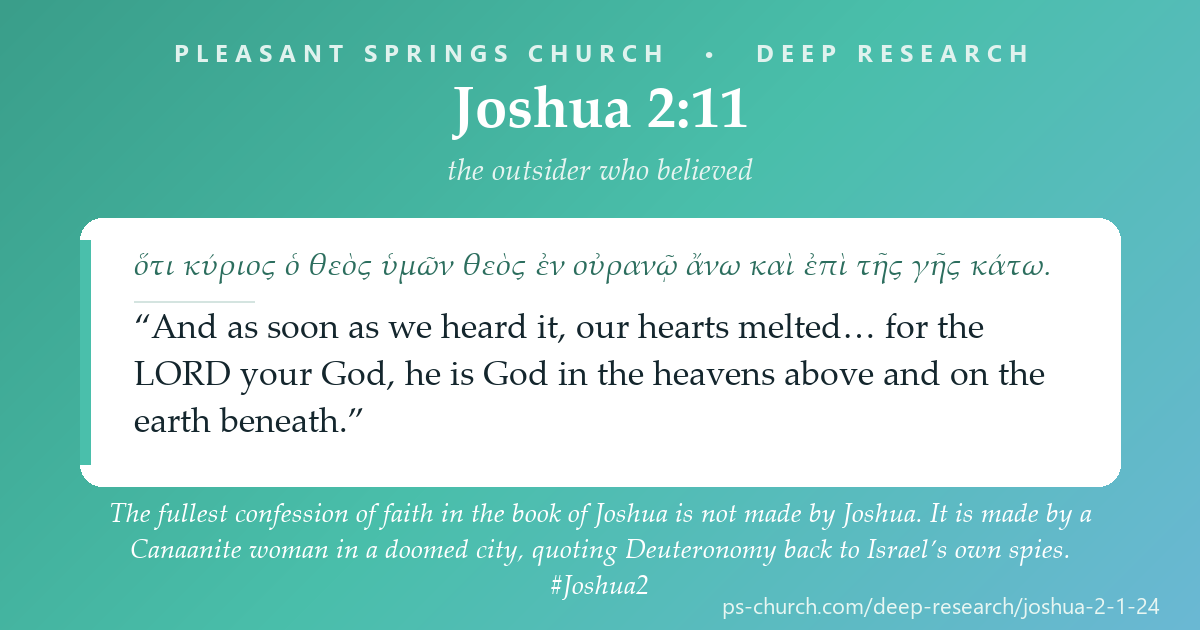
- Deuteronomy 4:39 — the source of her last line. Moses: “know therefore today, and lay it to your heart, that the Lord is God in heaven above and on the earth beneath; there is no other.” Rahab: “the Lord your God, he is God in the heavens above and on the earth beneath” (2:11). The final clause is identical in the Hebrew, word for word — בַּשָּׁמַיִם מִמַּעַל וְעַל־הָאָרֶץ מִתָּחַת — though the ESV varies its English (“heaven” at Deuteronomy 4:39, “the heavens” here) where the Hebrew does not; and the Greek is all but identical — Joshua has ἐν οὐρανῷ ἄνω καὶ ἐπὶ τῆς γῆς κάτω, Deuteronomy ἐν τῷ οὐρανῷ ἄνω καὶ ἐπὶ τῆς γῆς κάτω, differing only in the article. She does not add Moses’ “there is no other,” and the sentence she does say is framed with your God, not yet my God. What she has is real and it is not yet everything — and it is still more than the ten spies had.
- Exodus 15:14–16 — the Song of the Sea predicted precisely this: “The peoples have heard; they tremble… all the inhabitants of Canaan have melted away. Terror and dread fall upon them.” Joshua 2:9–11 is that song reported back from inside Canaan, in the same verb (mūg). Compare also Deuteronomy 2:25 and 11:25 — “I will begin to put the dread and fear of you on the peoples… who shall hear the report of you.”
- Exodus 14 — the event she cites. Note the detail: she does not mention Sinai, the tabernacle, or the law. She mentions the sea, and Sihon and Og — the two most recent and the two oldest pieces of news. Faith here begins with what God has actually done in public.
- Numbers 13–14 — the deliberate contrast. Twelve spies, forty days, a true report and a fatal “however”; here two spies, three days, and the report is a Canaanite’s confession. The book is telling you at the outset that the problem was never the size of the walls.
- Genesis 15:16 — “the iniquity of the Amorites is not yet complete.” Four centuries of patience stand behind Joshua, and Rahab is the proof that the patience was not theoretical: when the moment came, mercy was still available to anyone in Jericho who asked for it.
- Deuteronomy 7 and Joshua 9 — the two hard edges. Deuteronomy 7 forbids covenants with the peoples of the land; Joshua 2 records one, sworn by Israelites, honoured by Joshua (6:22–25), and commended by the New Testament. Joshua 9 will record another, extracted by deception, and it too is honoured. Neither text explains itself. Both are worth sitting with rather than harmonizing quickly.
- Hebrews 11:31; James 2:25; Matthew 1:5 — faith, works, and a place in the family line of Christ.
Rahab’s evidence in 2:10 includes a hard clause: the two Amorite kings “whom you devoted to destruction” — the ḥerem. This page will not print her speech and quietly drop the end of it. That is the same word that will govern Jericho in Joshua 6, and it needs to be located rather than softened: Scripture presents it as a bounded, divinely commanded judgment at one moment in redemptive history, on nations whose iniquity Genesis 15:16 had said four hundred years earlier was “not yet complete” — a delay that is itself an act of patience. That framing does not dissolve the difficulty, and we should not pretend it does; where Scripture gives no further reason, the honest thing is to say so and stop. What must be said without any hedging at all is this: these texts license no violence, no coercion, and no ethnic hostility by anyone today. They have been misused — in crusades, in colonial conquests, in the dispossession of peoples who were told they were Canaanites — and every such use has been a lie about this book. The church’s weapons “are not of the flesh” (2 Cor 10:4); the wrestling is “not against flesh and blood” (Eph 6:12); when the disciples proposed fire on a village Jesus rebuked them (Luke 9:54–55); and “all who take the sword will perish by the sword” (Matt 26:52). And notice where the narrator himself puts the emphasis in chapter 2: the first Canaanite the book introduces by name is one who is spared, with her whole household, by name, at her own request.
The commentaries, the Greek Joshua, and the question of the lie.
Hess, Howard, Butler, Boling, Woudstra and Hawk on Joshua; Tov and Greenspoon on the shorter Greek text; Beale & Carson on the New Testament use.
Commentaries & studies:
- Richard S. Hess, Joshua (TOTC); David M. Howard Jr., Joshua (NAC); Trent C. Butler, Joshua (WBC); Robert G. Boling, Joshua (Anchor); Marten H. Woudstra, The Book of Joshua (NICOT); L. Daniel Hawk, Joshua (Berit Olam).
- Emanuel Tov, Textual Criticism of the Hebrew Bible, and his and Eugene Ulrich’s edition of the Qumran Joshua manuscripts in DJD XIV (1995); Leonard Greenspoon on the Greek Joshua. The standard estimate that the Old Greek runs some 4–5% shorter than the MT comes from this literature.
- G. K. Beale & D. A. Carson, eds., Commentary on the New Testament Use of the Old Testament (Matthew; Hebrews; James).
Interpretation notes worth keeping:
- Her confession is the theological centre, not the rescue. Chapter 2 is usually remembered for the cord. The narrator spends far more space on the speech, and the spies’ report in 2:24 is a quotation of it. Preach the confession and the cord takes care of itself.
- ‘Your God,’ not yet ‘my God.’ 2:11 is generous and precise. Rahab confesses the Lord as God of heaven and earth while still speaking of him as Israel’s. Do not flatten that into a full conversion narrative the text does not give — and do not use it to withhold from her what Hebrews and James freely give.
- The Greek Joshua is a different-length book, and chapter 2 is a good place to see it. Six clauses of this chapter are absent from the Old Greek and one is added. That is a fact about the manuscript tradition, not a threat to it: it is why the church has always read Scripture with the versions in front of it, and why this study prints three columns.
- On the lie (2:4–5) — the honest answer is that Scripture does not give one. She deceived the king’s men and the narrator records it flatly, with no approval and no censure. Hebrews 11:31 commends her faith; James 2:25 commends her works, and specifies them as receiving the messengers and sending them out another way; neither mentions the deception. Three readings are current: that it was a real fault covered by the grace that commends her anyway; that misleading a hostile power in wartime is not what the ninth commandment forbids (the same question raised by the Hebrew midwives, Exod 1:15–21); and that a genuine conflict of duties leaves a lesser wrong. Each has weight. None of them is the text’s. Where Scripture gives no verdict, the discipline is to say so and stop — not to manufacture one and then preach it as though it were revealed.
- Do not read the scarlet cord as the passage’s own meaning. Joshua 2 gives one reason for it: it marks the house so the household inside is spared. That the church has heard more in it is a fact of Christian reading from the first century on, and it is worth knowing and worth labelling as what it is (see below).
The outsider who believed what the insiders forgot.
Name what you learned, why it matters, and one concrete response.
What should we carry away — and do?
- Faith showed up in the last house you would have looked in. Arguably the fullest confession of God in the book of Joshua is not made by Joshua. It is made by a Canaanite woman with a trade nobody wanted to name, and the book puts it in chapter 2 so you cannot miss it.
- The report was still working forty years later. She had no covenant, no priest, no scroll. She had news about what God had done at a sea, and she believed it. Do not underestimate what a true account of God, told once, is still doing in someone you will never meet.
- Grace reached a household through one person. Father, mother, brothers, sisters, “and all who belong to them” (2:13) — every one of them saved by being inside a house whose door one relative had marked. That is not a doctrine of family salvation; it is a fact about how mercy travelled that day, and it is worth praying over your own address.
- Say less than Scripture where Scripture says nothing. She lied, and the Bible neither excuses nor condemns it. Resist the itch to settle it. A church that can leave a silence unfilled is a church that can be trusted with the things Scripture does say.
- Her name is in the genealogy. Not as a footnote — as an ancestor. “Salmon the father of Boaz by Rahab” (Matthew 1:5). Whatever you think disqualifies you, take it up with the family tree of Jesus Christ.
A devotional analogy, clearly labelled as one: Christians have long looked at the scarlet cord in that window and thought of the blood of Christ — a house marked, and everyone inside it safe. This is not what Joshua 2 says it means; Joshua 2 says it is a sign so the spies’ comrades will know which house to spare. But the reading is very old: 1 Clement 12, written from Rome around AD 95, already says the spies “made it manifest that redemption should flow through the blood of the Lord to all them that believe and hope in God.” Take it as the church’s devotional reflection, offered by a Christian who was nearly a contemporary of the apostles — not as the meaning the author of Joshua encoded. Held that way, it is worth holding.
Step in response: think of one person you have written off as too far outside — by history, by reputation, by what everyone knows about them. Tell them, this week, one true thing about what God has actually done. That is all Rahab ever got, and it was enough.
Joshua 2:11 · to share
LXX + ESVEvery Deep Research page traces its passage across the whole sweep — the Old Testament, the Second-Temple world between the testaments (historical witnesses, not Scripture), and the New Testament. Follow the thread:
Pleasant Springs Church — Deep Research
Research method after Michael S. Heiser’s Bible Research Method (examine dictionaries → ancient literature → important words → textual connections → academic publications → share), with the Pleasant Springs “Author & Audience” foundation. Scripture set in the Hebrew, the Greek editions named on each page and the ESV (Old Testament), and the Greek New Testament and the ESV (New Testament), per the practice of Pleasant Springs Church. Joshua 2:1–24 research grounded in Hess, Howard, Butler, Boling, Woudstra and Hawk on Joshua, with Tov and Greenspoon on the Greek text and Beale & Carson on the New Testament use (Matthew; Hebrews; James). Hebrew from the Masoretic Text; Greek from Rahlfs; English ESV. Joshua 2 has twenty-four verses in the Hebrew and in Rahlfs alike and there is no versification offset here — but the Old Greek of Joshua runs roughly 4–5% shorter than the MT overall, and in this chapter it lacks “secretly” (2:1), the “melt away” clause (2:9), “a sure sign” (2:12), the rope and the house in the wall (2:15) and the tying of the cord (2:21), while adding “the sign” at 2:18; the Greek column is printed as it stands rather than filled out from the Hebrew. Josephus, the Targum and Rashi on zonah, b. Megillah 14b and 1 Clement 12 are cited as witnesses, not Scripture. Rahab’s deception is reported without a verdict because Scripture gives none; the scarlet cord is offered Christ-ward only as an explicitly labelled devotional analogy; and the ḥerem named in 2:10 is reported, located and fenced — it licenses no violence, coercion or ethnic hostility by anyone today.
Scripture quotations marked ESV are from the ESV® Bible (The Holy Bible, English Standard Version®), © 2001 by Crossway, a publishing ministry of Good News Publishers. ESV Text Edition: 2016. Used by permission. All rights reserved. The ESV text may not be quoted in any publication made available to the public by a Creative Commons license, and the ESV may not be translated in whole or in part into any other language. www.esv.org
|
Did this study bless you today? 💚 Give to Support PS Church100% of gifts go to the General Fund — thank you. |