Five kings raise an army, and they do not march on Israel. They march on Gibeon — “because the inhabitants of Gibeon had made peace with Israel” (10:1). So the first battle Israel fights in the southern hill country is fought to defend the people who had tricked them into a treaty one chapter earlier. The message comes down to Gilgal with the accuracy of people who know what they are owed: “Do not relax your hand from your servants” (10:6). Joshua marches all night, uphill, out of the Jordan valley. The Lord throws the coalition into a panic and throws down “large stones from heaven,” and more die by hail than by Israel’s swords (10:11). And then the lines everybody knows — with the detail almost everybody skips. The narrator stops to tell you he is quoting a poem: “Is this not written in the Book of Jashar?” (10:13). “Sun, stand still at Gibeon, and moon, in the Valley of Aijalon.” This study lays out the readings of that day fairly and refuses to adjudicate between them — and then points at what the text itself claims, which is not astronomical at all: “There has been no day like it before or since, when the Lord heeded the voice of a man” (10:14). Then the cave at Makkedah, the feet on the necks, and the southern campaign summary — including 10:40, which is printed here rather than skipped, and located and fenced rather than softened. This study works Joshua 10:1–43. See the method →
Joshua 10:1–43 (selections)
Hebrew · LXX · ESVThe Shape of the Passage
ConcentricChapter 10 is the direct consequence of chapter 9. The treaty Israel signed without asking counsel (9:14) is now a defence obligation, and it drags Israel into the southern hill country years before anyone planned to go there. Read it after Jericho and Ai — both of which 10:1 names — and before the northern campaign in chs 11–12.
Author
An anonymous narrator working with sources, and telling you so. Most biblical narrators hide their materials. This one stops mid-sentence and points at his: “Is this not written in the Book of Jashar?” (10:13). The סֵפֶר הַיָּשָׁר, the “Book of the Upright,” is cited once more in the Old Testament — 2 Samuel 1:18, for David’s lament over Saul and Jonathan — and both citations are poetry. Whatever the book was, it was a collection of verse, and it is lost. So the most famous sentence in Joshua is a quotation from an anthology we do not have, embedded by a prose writer who wanted his readers to know it was a quotation.
That changes how the sentence should be read, and it changes nothing about whether it is true. A narrator who quotes a poem is not thereby signalling that the event did not happen; he is signalling the register in which it was first told. Compare how the same Bible reports the same kind of day twice — Exodus 14 in prose, Exodus 15 in verse. Poetry in Scripture is not a lower grade of truth. It is a different instrument, and the first job of the reader is to notice which one is being played.
He also writes like a man with a map. He distinguishes the ascent of Beth-horon (10:10) from the descent of Beth-horon (10:11) — two halves of one ridge road, upper and lower. (The contrast is in the Hebrew, maʿălēh at 10:10 and môraḏ at 10:11, and in the Greek, ἀναβάσεως / καταβάσεως; the ESV printed above keeps “the ascent of Beth-horon” at 10:11 as the road’s proper name, so the English does not show the contrast the Hebrew and Greek do.) He also names Azekah and Makkedah down in the Shephelah, which is exactly where a broken army fleeing west off the watershed would end up. He knows Gilgal is down in the Jordan rift and Gibeon is up on the plateau, and he says the march took all night (10:9), which it would: roughly twenty miles, and something like a thousand metres of climb, in the dark.
Audience
Israelites who already knew the poem. “Is this not written in the Book of Jashar?” is a question you only ask people who can answer it. The narrator is not introducing new information; he is anchoring a story his hearers had already sung, the way a preacher today might say “you know the line.” That is also why the chapter can be so compressed at its most famous point and so leisurely about Libnah and Lachish: he is filling in what they did not have.
And they were meant to feel the first verse as a scandal. Israel had been tricked by Gibeon and had sworn an oath it could not undo. The oath is now cashed: come and die for us. Joshua goes. There is no speech about it, no reproach, no renegotiation — he marches all night to save the people who had lied to his face. Whatever else this chapter is, it opens with a promise being kept at cost to the one who made it, and that is not an accident of plot; it is the reason the chapter exists where it does.
They were also meant to hear 10:14 as the point. The narrator has just reported hailstones and a sun that would not set, and when he stops to say what was unrepeatable about the day, he does not say “the heavens stopped.” He says: the Lord listened to a man. Israel is being told that its God is the sort of God who can be spoken to in the middle of a battle by a man who is out of daylight — and that this, not the mechanism, is the thing without parallel “before or since.”
Orient on Gibeon and Beth-horon, the Book of Jashar, the ḥērem, and “the Lord fights.”
Search by topic: Gibeon; Beth-horon; Makkedah; Azekah; Lachish, Eglon, Hebron, Debir, Libnah; Amorites; Jashar, Book of; herem / ban; holy war and ‘Yahweh war’; hail and theophany; sun and moon in ancient Near Eastern religion; oath and treaty obligation.
Which articles are relevant?
- Anchor Bible Dictionary — “Gibeon,” “Beth-horon,” “Makkedah,” “Azekah,” “Lachish,” “Debir,” “Jashar, Book of,” “Amorites,” “War, Holy,” “Ban (herem),” “Sun,” “Moon.”
- Dictionary of the OT: Historical Books (IVP) — “Joshua, Book of,” “Conquest and Settlement,” “Canaanites,” “Herem,” “Miracles,” “Non-Israelite Written Sources,” “Historiography, Old Testament.”
- NIDOTTE / TDOT — עָמַד (ʿāmaḏ, stand), דָּמַם (dāmam, be still / silent), יָשָׁר (yāšār, upright), חֵרֶם (ḥērem, devoted thing), נְשָׁמָה (nəšāmāh, breath), הָמַם (hāmam, throw into panic), בָּרָד (bārāḏ, hail).
- Also worth the detour: articles on Adoni-zedek and on the element ṣedeq in Jerusalem’s royal names — compare Melchi-zedek, “king of Salem,” in Genesis 14 and Psalm 110. The dictionaries will tell you the connection is a shared naming element, not a claim about the same man.
Bibliography surfaced:
- Richard S. Hess, Joshua (TOTC); David M. Howard Jr., Joshua (NAC); Trent C. Butler, Joshua (WBC); Robert G. Boling, Joshua (AB); Marten H. Woudstra, The Book of Joshua (NICOT); L. Daniel Hawk, Joshua (Berit Olam).
- Emanuel Tov and Leonard J. Greenspoon on the Greek Joshua — the standard route into why the Old Greek is shorter, and what the Qumran Joshua fragments contribute.
- James B. Pritchard, Gibeon: Where the Sun Stood Still (Princeton, 1962) — the excavator’s own account of el-Jib.
- Studies of the Book of Jashar and of poetry embedded in Hebrew prose narrative.
A road, a jar handle with a city’s name on it, a Moabite king’s own words — and a foot on a neck.
Set the chapter against the real geography of the Beth-horon pass; then against the excavated Gibeon; then against how neighbouring kings narrated wars of this kind in their own inscriptions; then against how Second-Temple and rabbinic readers heard 10:12–14. Extra-biblical material is a witness, never levelled with Scripture.
Which parallels shed light on religion and worldview?
The road is real, and it kept being fought over. The Beth-horon ridge is the natural staircase between the coastal plain and the Jerusalem plateau, and the text’s distinction between the ascent (10:10) and the descent (10:11) is the distinction between Upper and Lower Beth-horon. The same pass shows up again in 1 Maccabees 3:16, 24, where Judas meets Seron “at the ἀνάβασις of Beth-horon” and pursues him “in the κατάβασις of Beth-horon” — the very words the Greek Joshua uses here (Second-Temple witness, not Scripture for us). A thousand years apart, two armies broke on the same slope.
Gibeon has been dug, and it gave up its name. James B. Pritchard’s excavations at el-Jib, north-west of Jerusalem, recovered jar handles stamped with the consonants גבען, gbʿn — one of the rare cases where a mound identifies itself. That settles the location; it does not settle the date or course of the conquest, which remains genuinely contested (see Stage 5). Both halves of that sentence matter.
The Amarna letters put us in the same room, cautiously. In the fourteenth century B.C. the rulers of these very towns — Jerusalem, Lachish, Gezer — wrote to Egypt begging for troops, and Abdi-Ḥeba of Jerusalem (EA 285–290) writes exactly the sort of letter Adoni-zedek would have written: the city-states are collapsing and no one is coming. Those letters also mention the ʿApiru, and the old equation of ʿApiru with “Hebrew” is a debated proposal and has never been established; the term is social rather than ethnic in most of its occurrences. We cite the letters for the political texture of the period, and for nothing more. (They lie beyond our local ANET scan, so no page reference is claimed here.)
How a neighbouring king told this kind of story in his own words. The Mesha Stele (the Moabite Stone, ANET 320–321), set up about 830 B.C. a few days’ travel east, is the fair and sober comparison. Mesha explains a national defeat as his god’s anger — “for Chemosh was angry at his land” — and a national victory as his god’s command: “And Chemosh said to me, ‘Go, take Nebo from Israel!’” He then reports what he did in language a reader of Joshua will recognize instantly: “taking it and slaying all… for I had devoted them to destruction for (the god) Ashtar-Chemosh” — the same root as Hebrew חֵרֶם. And he narrates in absolutes: “Israel hath perished for ever!” — written while Israel plainly had not. That last line is the most useful thing on the stone, because it shows, from outside the Bible, how totalizing this register is by convention. This is a caution about register; it is not an escape hatch, and it does not make Joshua 10:40 say nothing. The same caution can be read off Sennacherib’s prism (ANET 288), which claims 46 cities and 200,150 deportees and Hezekiah “like a bird in a cage” — and never claims to have taken Jerusalem.
The foot on the neck. Joshua’s command in 10:24 is a recognized ancient Near Eastern gesture of victory, familiar from Egyptian and Mesopotamian iconography, where the defeated are shown beneath the victor’s feet or as his footstool. It is reported here as what it was, and it is not dwelt on. Its long afterlife in Scripture is not military but royal and eschatological: “until I make your enemies your footstool” (Psalm 110:1 · LXX 109:1), a line the New Testament applies to the risen Christ, whose kingdom is not advanced by anyone’s foot on anyone’s neck.
- The Mesha Stele / Moabite Stone (ANET 320–321, tr. W. F. Albright — verified in our local scan) (a Moabite royal inscription — a witness, not Scripture) — divine command to war, defeat explained as the god’s anger, a whole town “devoted to destruction” for Ashtar-Chemosh, and the sweeping “Israel hath perished for ever.”
- Sennacherib’s annals, the Hezekiah passage (ANET 288) (Assyrian royal annals — a witness, not Scripture) — totalizing numbers alongside a conspicuous silence about the city he did not take.
- The Amarna letters, esp. Abdi-Ḥeba of Jerusalem (EA 285–290) (Late Bronze diplomatic correspondence — witnesses, not Scripture) — the same city-states, a generation or two either side of the events, pleading for help. The ʿApiru/Hebrew equation is contested and is not assumed here.
- Mesopotamian celestial-omen literature (the Enūma Anu Enlil series) (Babylonian divination texts — witnesses, not Scripture) — the background against which some scholars read 10:12 as a request for an omen rather than a mechanism (Holladay; Walton; see Stage 5).
- Sirach 46:1–6 (Second-Temple — a witness, not Scripture) — the earliest surviving retelling: οὐχὶ ἐν χειρὶ αὐτοῦ ἐνεποδίσθη ὁ ἥλιος καὶ μία ἡμέρα ἐγενήθη πρὸς δύο; — “Was not the sun held back by his hand, and one day became as two?” And then, remarkably, Ben Sira reads the chapter the way the narrator does: Joshua “called upon the Most High Sovereign… and the great Lord answered him” — with hailstones, “and at the descent he destroyed those who resisted” (46:5–6). Two centuries before Christ, the emphasis already falls on the prayer being heard.
- Josephus, Antiquities 5.1.17 (Second-Temple — a witness, not Scripture) — “the day was lengthened, that the night might not come on too soon,” hail “larger than usual,” and the claim that the lengthening “is expressed in the Books laid up in the temple” — Josephus’ own way of pointing at the Book of Jashar.
- b. Avodah Zarah 25a (rabbinic-era — a witness, not Scripture) — a whole sugya on this verse. “What is the book of Yashar? … This is Genesis, the book of Abraham, Isaac and Jacob, who were called yesharim” (R. Ḥiyya bar Abba in the name of R. Yoḥanan) — and then a debate about the length of the day, R. Yehoshua ben Levi saying twenty-four hours and R. Elazar thirty-six. The tradition argued about the mechanism too, and did not agree.
It is worth sitting with the shape of the first five verses before the miracle arrives. The coalition is not aimed at Israel. It is aimed at Gibeon, and the stated reason is that Gibeon “had made peace with Israel and were among them” (10:1). Adoni-zedek is not attacking an invader; he is punishing a defector. And the message that reaches Joshua at Gilgal is not a request from an ally he chose. It is a claim from people who had put on worn-out sandals and stale bread and lied to him, and who now write, with perfect and uncomfortable accuracy, “do not relax your hand from your servants” (10:6; cf. 9:23–27).
Joshua marches. All night, uphill, out of the rift. The text records no debate, no complaint, and no attempt to find a lawyer’s way out of an oath that had been obtained by fraud — the oath had been sworn by the Lord, and that settled it (9:19). Notice what follows from this for the whole chapter: the first battle in the southern hill country, the one with the hailstones and the long day and the divine intervention, is a battle Israel fought to keep its word to people who had cheated it. Whatever you conclude about the astronomy, do not miss that God fought this particular battle. He did not have to underwrite a treaty Israel entered by not asking him. He did anyway.
The verb that will not settle the argument, the lost book, and the sentence the narrator actually wants you to keep.
Watch ʿāmaḏ travel from the enemy to the sun to Joshua’s own troops; weigh the semantic range of dāmam without letting it decide more than it can; and notice that the phrase the narrator calls unique is not about the sun at all.
“Stand, take one’s stand, stop.” The chapter’s key word, and it moves. No enemy shall stand before you (10:8); the moon stood and the sun stood in the midst of heaven (10:13); and then Joshua to his own troops — ESV ‘do not stay there yourselves,’ Hebrew ʾal-taʿămōḏû, ‘do not stand’ (10:19). Greek keeps it at 10:13 and 10:19 (ἔστη … μὴ ἑστήκατε). The word does not by itself decide the astronomy — it means to halt, or to remain in place, or simply to be stationed.
The imperative addressed to the sun, and the verb that answers it. The root dāmam covers “be silent,” “be still,” “cease” — ESV renders it “stand still” and then “stood still.” That range is precisely where the modern debate lives: those who read a halt hear “stop moving”; those who read an eclipse or a darkening hear “stop doing what you do” (see Stage 5). The LXX translator, reading in Egypt two centuries or so before Christ, heard motion: στήτω ὁ ἥλιος, “let the sun stand.” That is early evidence of how the line was understood, and it is evidence, not proof.
“The Book of the Upright” (or “of Jashar”) — a lost collection quoted here and at 2 Samuel 1:18, both times for poetry. The Greek of Joshua does not have the citation at all. But the Greek of 3 Kingdoms 8:53a (a plus with no counterpart in Hebrew 1 Kings 8) ends a Solomon poem with οὐκ ἰδοὺ αὕτη γέγραπται ἐν βιβλίῳ τῆς ᾠδῆς;, “Is this not written in the book of the song?” — הַשִּׁיר (haššîr) rather than הַיָּשָׁר (hayyāšār), the same consonants reshuffled. Somewhere behind both citations stands an anthology of Israel’s war-and-lament poetry that no longer exists.
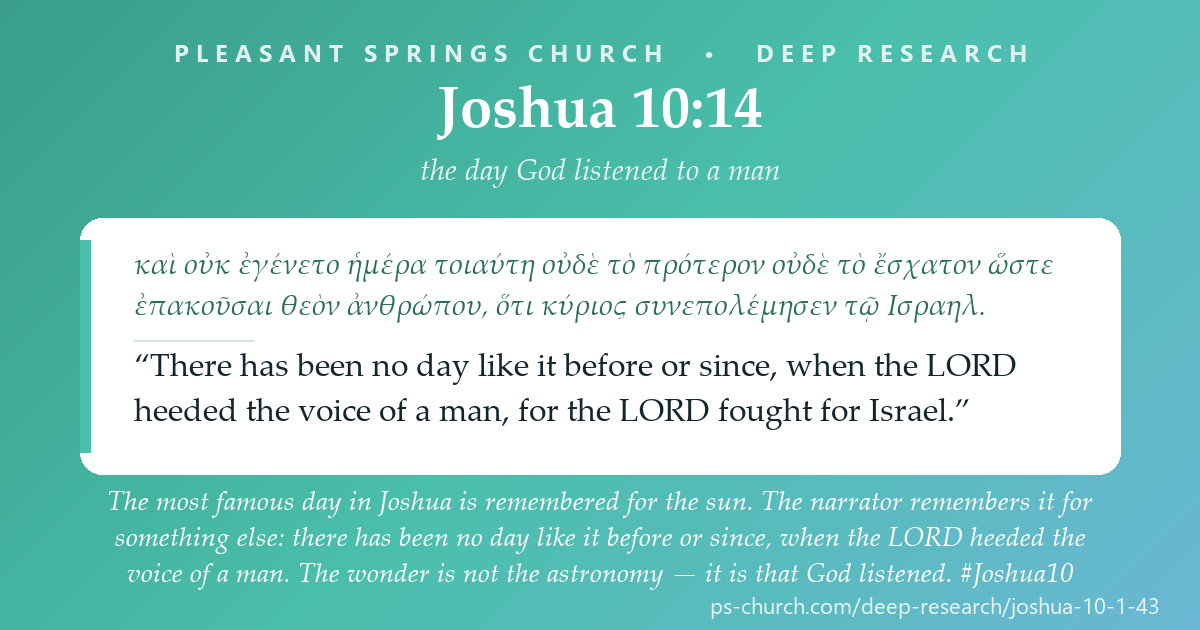
“To listen to the voice of” — the ordinary Hebrew idiom for obeying. It is normally what Israel is commanded to do toward God. Here the subject is the Lord and the object is a man, and the narrator flags it as unrepeatable: “there has been no day like it before or since.” The Greek renders it ἐπακοῦσαι θεὸν ἀνθρώπου, “that God gave ear to a man.” This is the sentence the chapter is built to deliver.
“Great stones” — the same two words three times, and they change hands. God throws them down from heaven on the fleeing army (10:11); Joshua has them rolled against the cave mouth to shut the kings in (10:18); and they are set there again, permanently, over the bodies (10:27). The Greek harmonizes the first to λίθους χαλάζης, “stones of hail,” where the Hebrew waits until the second half of the verse to say אַבְנֵי הַבָּרָד, ʾaḇnê habbārāḏ.
“Threw them into a panic” — a verb of divinely-caused confusion, and one of the standing markers of what scholars call “Yahweh war”: the same root is used of the Egyptians at the sea (Exod 14:24) and is promised in Exod 23:27. Note the sequence in this chapter: God panics them, hail kills more of them than Israel does, and God stops the sky. Israel’s contribution is the walking.
“Breath” — ESV “all that breathed.” It is the word for the breath God breathed into the first man in Genesis 2:7, and using it here is not softening but the opposite: the summary verse refuses a euphemism. The Greek is πᾶν ἐμπνέον ζωῆς, “everything breathing life.” This word is why the sentences in Stage 5 are written the way they are: the text is not describing the capture of empty buildings, and no reading that pretends otherwise is honest.
Where the vocabulary of this chapter surfaces elsewhere:
- Exodus 14:14, 25 — “The Lord will fight for you, and you have only to be silent.” Joshua 10:14 and 10:42 use the same verb, נִלְחָם (nilḥām) with לְ, “fought for” (see Exodus 14).
- Habakkuk 3:11 — “The sun and moon stood still in their place”; LXX ἐπήρθη ὁ ἥλιος καὶ ἡ σελήνη ἔστη ἐν τῇ τάξει αὐτῆς. A prophet writing poetry reaches for this imagery for a theophany — which is worth knowing before deciding how the Book of Jashar meant it.
- Judges 5:20 — “From heaven the stars fought, from their courses they fought against Sisera.” Israel’s oldest battle poetry puts the sky in the line. (No Judges page yet in this library; cited in text.)
- Isaiah 28:21 — “as in the Valley of Gibeon he will be roused.” Centuries later a prophet uses this day as shorthand for the Lord doing something strange and terrible — and, in Isaiah, doing it against his own people.
- Deuteronomy 21:22–23 — the bodies down from the trees before nightfall, “for a hanged man is cursed by God” (10:26–27; see Deuteronomy 19–21). Even in a chapter like this one, the law about corpses is kept to the hour.
- Joshua 1:6–9 — “Be strong and courageous… do not be frightened, and do not be dismayed.” At 10:25 Joshua says to his captains exactly what God said to him (see Joshua 1). The commission is being handed down.
The God who listens, the sky that fights, and the oath that had to be kept.
Trace three threads: prayers God is said to have heard in the middle of history; the storm and the heavenly bodies as God’s instruments; and the Gibeonite oath, which the canon keeps taking seriously long after Joshua is dead.
Which cross-references matter?
- Exodus 32:9–14; Numbers 14:11–20 — the other great occasions when the Lord is said to have listened to a man and changed the day’s outcome (see Exodus 32 and Numbers 13–14). Joshua 10:14 belongs in that company, and the narrator says it outdoes them.
- Exodus 9:13–35 — hail from heaven as God’s own artillery against an army and a king (see Exodus 9). Joshua 10:11 is the plague of hail turned on the Amorite coalition; Job 38:22–23 asks whether you have seen “the storehouses of the hail, which I have reserved… for the day of battle and war.”
- Joshua 9 — the treaty that causes this war. The Gibeonites’ “your servants” in 10:6 is the word they used when they were lying (9:8, 9, 11) and the word they were assigned when the truth came out (9:23, 27).
- 2 Samuel 21:1–14 — centuries later a famine is traced to Saul’s breach of this same oath, “because he put the Gibeonites to death.” The canon underwrites Joshua’s decision to honour a treaty obtained by fraud (cf. 2 Samuel 7 for David’s covenant world).
- Genesis 15:16; Deuteronomy 9:4–6 — the stated ground of the dispossession, and the explicit denial that it is Israelite merit: “the iniquity of the Amorites is not yet complete” (Genesis 15); “not because of your righteousness… for you are a stubborn people” (Deuteronomy 9). Joshua 10 is unintelligible without both.
- Deuteronomy 7:1–5; 20:16–18 — the command 10:40 says is being obeyed, with its stated reason (see Deuteronomy 7 and Deuteronomy 20). Reading 10:40 without those chapters produces a caricature in either direction.
- Joshua 11:23; 13:1; 21:43–45; 15:63 — the book’s own unresolved tension, which begins here at 10:40–42. See Joshua 11–12, 13–19 and 20–22, and Stage 5 below.
- Psalm 110:1 · LXX 109:1 — “until I make your enemies your footstool” (see Psalm 110). The gesture of 10:24 is taken up by Scripture only as a picture of Christ’s reign, never as a licence for his people’s hands.
Hebrew narrative quotes poetry at its high points and expects you to notice. The sea is crossed in Exodus 14 and then sung in Exodus 15; Deborah’s battle is told and then sung; and here the narrator does something rarer still — he quotes a poem from a named book in the middle of his prose, and tells you where it came from.
Two temptations follow, and both should be resisted. The first is to treat “it is poetry” as a polite way of saying “so nothing happened.” That is not how the rest of Scripture uses its poems: Exodus 15 sings about a sea that the narrative says was really crossed, and the Song of Deborah celebrates a rout that Judges reports as history. The second temptation is to insist that because it is Scripture, the poetic lines must be read with the flatness of a laboratory notebook — which is not how anyone reads “the stars fought from their courses” (Judg 5:20) or “the mountains skipped like rams” (Ps 114:4 · LXX 113:4), both of which are also Scripture and also true.
The honest position is the harder one: we are reading a genuine report, and the report at its centre is in verse, and verse means what verse means. The narrator plainly believes something extraordinary happened — he says so in his own prose voice at 10:14, outside the quotation. What he does not do is describe a mechanism. Neither, therefore, will this page.
The long day, laid out fairly; the archaeology, left open; and the hard verses, faced.
Hess, Howard, Butler, Boling, Woudstra and Hawk for the commentary tradition; Tov and Greenspoon for the Greek Joshua; Holladay and Walton for the omen reading; Humphreys and Waddington for the eclipse proposal; Pritchard for Gibeon and Ussishkin for Lachish. Positions are named, not adjudicated.
Commentaries & studies:
- Richard S. Hess, Joshua (TOTC); David M. Howard Jr., Joshua (NAC); Trent C. Butler, Joshua (WBC); Robert G. Boling, Joshua (AB); Marten H. Woudstra, The Book of Joshua (NICOT); L. Daniel Hawk, Joshua (Berit Olam).
- Emanuel Tov, on the shorter Old Greek of Joshua and its relation to the Hebrew traditions; Leonard J. Greenspoon, on the Greek text of Joshua — the standard route into why this chapter has 41 verses in Greek and 43 in Hebrew.
- John S. Holladay Jr., “The Day(s) the Moon Stood Still,” JBL 87 (1968): 166–78 — the classic argument that 10:12 asks for a celestial omen, sun and full moon opposed on the horizon, read against Mesopotamian omen practice.
- John H. Walton and J. Harvey Walton, The Lost World of the Israelite Conquest (IVP Academic, 2017) — develops the omen reading, and argues at length about what “devote to destruction” language is doing in this literature. Engage it; it is not the only responsible reading.
- Colin J. Humphreys and W. Graeme Waddington, “Solar eclipse of 1207 BC helps to date pharaohs,” Astronomy & Geophysics 58/5 (2017): 5.39–5.42 — the annular-eclipse proposal, dated 30 October 1207 B.C.
- James B. Pritchard, Gibeon: Where the Sun Stood Still (1962); David Ussishkin on the excavations at Lachish — two of the sites named in this chapter (Gibeon, 10:2–14, 41; Lachish, 10:31–35), and two of the places where the dating debate is sharpest.
The long day: the readings, laid out and not adjudicated
Before the options, three things the text itself supplies, which every option has to live with. First, 10:12b–13a is a quotation — the narrator says so, and names the book. Second, the narrator’s own prose comment is 10:14, and it says nothing about celestial mechanics: what had never happened before or since is that the Lord heeded the voice of a man. Third, the Greek is shorter here — no citation formula at all — so the earliest translators were working with a text that had the poem without the footnote.
- (a) A literal cessation. The sun and moon halted — on the older cosmology, in their courses; on a modern one, the earth’s rotation was arrested or slowed, with everything that implies. This is the plainest reading of the prose in 10:13b (“the sun stopped in the midst of heaven and did not hurry to set for about a whole day”), it is how the LXX translator took it (στήτω, “let it stand”), how Ben Sira took it (“one day became as two”), how Josephus took it, and how the rabbis argued about it (24 or 36 hours, b. Avodah Zarah 25a). Its cost is the physical one, which its defenders answer by saying that a God who made the system can suspend it — a coherent answer, whatever one makes of it.
- (b) An optical or refractive prolonging of the light. Not the halting of a body but the extension of usable daylight — unusual refraction, or light scattered by the storm that had just dropped hailstones. This keeps a real, observable event and a real answer to prayer while asking less of the solar system. Its cost is that 10:13b, read straight, says the sun stopped, not the light.
- (c) Poetic hyperbole of a kind ancient Near Eastern battle poetry uses freely. The poem asks for what victory feels like it needs — more day — and the answer is told in the register in which such answers were told: gods, storms, and the heavens taking sides. Compare Judges 5:20, and compare the Mesha Stele’s “Israel hath perished for ever.” Its cost is 10:13b again, which is prose, and 10:14, which insists something happened that had no precedent.
- (d) A celestial omen. Holladay (1968), developed by Walton, argues that sun over Gibeon and moon over Aijalon locates both bodies above opposite horizons at once — a lunar-calendar configuration read in the ancient world as an omen — so Joshua is asking not for extra hours but for the sky to declare against the enemy on a day when they would all see it. Its cost is that the narrator’s own gloss in 10:13b speaks of the sun not hurrying to set, which is a statement about duration.
- (e) An eclipse. Humphreys and Waddington (2017) argue that dāmam and ʿāmaḏ can describe the sun and moon ceasing to shine rather than to move, and identify an annular solar eclipse visible from Canaan on 30 October 1207 B.C., using it to tighten Egyptian chronology. It is recent and it is contested — the objection pressed hardest is philological, whether those two verbs can carry the sense “stop shining” at all (so, e.g., the Philologos column in Mosaic, November 2017), and the contextual objection is that a darkening is a strange thing to request when the complaint is that the day is running out.
This page does not choose. Each of these is held by serious readers who believe the text; none is a dodge; and none of them is caricatured above — if you find yourself able to dismiss one in a sentence, you have not yet stated it in its strongest form. And nothing in the Christian faith rests on which is right. The narrator did not think the mechanism was the marvel. He wrote his own verdict in his own voice, and it is a sentence about prayer: “There has been no day like it before or since, when the Lord heeded the voice of a man, for the Lord fought for Israel” (10:14).
The hard verses: 10:28–43, reported, located and fenced
- Report it plainly, and do not soften it by omission. This page prints 10:40 in full: “So Joshua struck the whole land… He left none remaining, but devoted to destruction all that breathed, just as the Lord God of Israel commanded.” The word is נְשָׁמָה, the word for the breath of life. The refrain “he left none remaining” falls at 10:28, 30, 33, 37, 39 and again in the summary at 10:40; six cities are taken in the sweep — Makkedah, Libnah, Lachish, Eglon, Hebron, Debir — with 10:32 and 10:35 saying it in other words. Every summary sentence on this page is meant to be true of that material too, and not only of the parts that are easier to preach.
- Locate it precisely. The text presents this as a bounded, divinely-commanded judgment at a unique moment in redemptive history: on named nations, for stated wickedness, after four centuries of forbearance (Gen 15:16, “the iniquity of the Amorites is not yet complete”), by explicit command (Deut 7:1–5; 20:16–18), with Israel placed under the identical standard and later suffering it (Lev 18:28; the exile). It is never presented as a policy, a principle, or a pattern.
- Acknowledge the difficulty honestly. It is hard. It is meant to be hard. Scripture does not offer a theodicy at this point, and neither will we: where the text gives no reason, the right thing is to say so and stop. What can be said is that the same book that reports 10:40 also reports Rahab saved alive with her whole family (6:25) and Gibeon spared and settled among Israel — and that in this very chapter Israel goes to war for Canaanites. The book itself refuses to be read as a document about a category of people.
- State the fence unmistakably. This licenses no violence, no coercion and no ethnic hostility by anyone today, in any cause. “The weapons of our warfare are not of the flesh” (2 Cor 10:4); “we do not wrestle against flesh and blood” (Eph 6:12); “put your sword back into its place” (Matt 26:52); and when two disciples asked whether to call down fire, Jesus turned and rebuked them (Luke 9:54–55). These texts have in fact been misused — to bless conquest, colonization and dispossession, with Canaan language pressed onto real peoples in later centuries. That is a real history and a real sin, and no reader of this page may repeat it.
- Register, hedged — and not an escape hatch. Ancient Near Eastern conquest accounts are characteristically sweeping and formulaic; Mesha writes “Israel hath perished for ever” while Israel continues, and Joshua itself says “he left none remaining” in towns whose inhabitants reappear a few chapters later. This is worth knowing about the conventions of the genre. It is not a way of making the text say nothing, and this page does not use it that way.
“The whole land” — and the land that is still there
10:40–42 is the first of the book’s great totalizing summaries: “Joshua struck the whole land… and Joshua captured all these kings and their land at one time.” 11:23 will say “so Joshua took the whole land… and the land had rest from war,” and 21:43–45 will say that not one word of all the good promises failed.
And the same book says “there remains yet very much land to possess” (13:1), then lists what was not taken. The sharpest instance starts right here: the first king named in this chapter is the king of Jerusalem, and he is killed (10:1, 23–26) — but Joshua 15:63 says plainly that Judah could not drive out the Jebusites from Jerusalem, “so the Jebusites dwell with the people of Judah at Jerusalem to this day.” Hebron and Debir are struck in 10:36–39, and in 14:12 and 15:13–19 they are still to be taken, by Caleb. Judges 1 opens by cataloguing the failures in detail.
- One reading: “all” is a summary of the campaign’s decisiveness, not an inventory — the field armies were broken and the kings killed, which is what 10:42 actually claims (“all these kings and their land… at one time”), while occupation is a separate and slower thing.
- A second: the gift is complete and the possession is progressive. The text itself holds both, often in the same breath — “I have given” beside “you shall drive out” — so the summaries are about God’s giving and the lists are about Israel’s follow-through.
- A third: the summaries and the lists speak about different things — the summaries assert that the covenant promise was kept, the lists record that Israel did not finish; and Scripture is content to say both without smoothing them, because the failure is Israel’s and the faithfulness is God’s.
- What remains in tension. Even granting all three, “he left none remaining” in a named city and “the Jebusites dwell there to this day” are not made identical by any of them. That is a real seam in the book, it is one of the most interesting things about Joshua, and this page reports it rather than sanding it down. Where the text does not resolve it, we stop.
Archaeology: what is actually settled, and what is not
- Settled: Gibeon is el-Jib — the site produced jar handles inscribed with its own name (Pritchard). The Beth-horon pass, Azekah, Lachish, Hebron and Debir are real places in the right relation to one another, and the chapter’s movements make topographic sense.
- Not settled: the date and character of Israel’s emergence in Canaan. The standing positions are a conquest model, a peaceful infiltration model, and a peasant-revolt or internal-transformation model, with a spread of dates and much argument over Late Bronze occupation at particular sites (Lachish, and further north Hazor, where Yadin and later Ben-Tor read the destruction differently from some of their colleagues).
- How this page handles it: we name the positions and do not adjudicate them, and we say clearly that faith does not depend on the outcome. Two errors are equally worth avoiding: “archaeology proves the Bible,” and a shrug that pretends the questions are not real. They are real, they are being worked on by serious people, and Christian confidence does not rest on the next season’s trench report.
From an oath kept at cost, to a God who listened to a man.
Name what you learned, why it matters, and one concrete response.
What should we carry away — and do?
- The battle began with a promise being kept. Joshua marched all night for people who had lied to him, because he had sworn. Before this chapter is about the sun, it is about a man who did not look for the loophole he was fully entitled to look for.
- The marvel the narrator names is that God listened. Not the mechanism — the hearing. “There has been no day like it before or since, when the Lord heeded the voice of a man” (10:14). If you have been taught that this chapter is a test of whether you will believe an impossible thing, you have been given the wrong test.
- You are allowed to hold the readings loosely. Serious, believing readers land in different places on 10:12–13, and the page above refuses to score them. Certainty about a mechanism is not a Christian virtue; honesty about a text is.
- Do not look away from 10:40. A faith that can only survive by not reading certain verses is a fragile faith. Read it, feel it, locate it where the text locates it, and then say out loud what Scripture says about your own hands: not flesh and blood, not the sword, not ever.
- Ask. Joshua spoke to the Lord in the middle of a running battle, out of daylight and out of options, and the answer is recorded as the most remarkable thing that happened that day. Whatever your Tuesday looks like, that door is not shut.
Step in response: find the promise you made that has become expensive — the visit, the debt, the commitment made before you knew what it would cost — and keep it this week, without renegotiating it. Then, before you do, pray about it out loud, in words, the way Joshua did. The chapter puts those two things side by side on purpose.
Joshua 10:14 · to share
LXX + ESVEvery Deep Research page traces its passage across the whole sweep — the Old Testament, the Second-Temple world between the testaments (historical witnesses, not Scripture), and the New Testament. Follow the thread:
Pleasant Springs Church — Deep Research
Research method after Michael S. Heiser’s Bible Research Method (examine dictionaries → ancient literature → important words → textual connections → academic publications → share), with the Pleasant Springs “Author & Audience” foundation. Scripture set in the Hebrew, the Greek editions named on each page and the ESV (Old Testament), and the Greek New Testament and the ESV (New Testament), per the practice of Pleasant Springs Church. Joshua 10 research grounded in Hess (TOTC), Howard (NAC), Butler (WBC), Boling (AB), Woudstra (NICOT) and Hawk (Berit Olam), with Tov and Greenspoon on the Greek Joshua. The long day is presented as five named readings — a literal cessation; an optical or refractive prolonging of light; poetic hyperbole of the kind ANE battle poetry uses; the celestial-omen reading of John S. Holladay Jr. (JBL 87 [1968]: 166–78) developed by John H. and J. Harvey Walton; and the annular-eclipse proposal of Colin J. Humphreys and W. Graeme Waddington (Astronomy & Geophysics 58/5 [2017]: 5.39–5.42), flagged as recent and contested — laid out without adjudication, with the explicit statement that faith depends on none of them. ANE background from the Mesha Stele (ANET 320–321, verified in our local scan) and Sennacherib’s annals (ANET 288); the Amarna letters (Abdi-Ḥeba of Jerusalem, EA 285–290) are cited without a page reference because they lie beyond our local scan, and the ʿApiru/Hebrew equation is reported as a contested proposal, never as established. Second-Temple and rabbinic witnesses — Sirach 46:1–6, Josephus Ant. 5.1.17, 1 Maccabees 3:16, 24 on the Beth-horon pass, and b. Avodah Zarah 25a on the Book of Yashar — are read as witnesses, not Scripture. Archaeology (Pritchard at el-Jib; Ussishkin at Lachish; the conquest / infiltration / internal-transformation debate) is reported with the positions named and not adjudicated. Numbering: Joshua carries no chapter- or verse-offset — MT, LXX and English agree throughout 10:1–43 — but the Old Greek is roughly 4–5% shorter than the Masoretic Text across the book, and in this chapter it has 41 verses to the Hebrew’s 43: Rahlfs prints no 10:15 and no 10:43 (the identical Hebrew sentence, both times), and no citation of the Book of Jashar at 10:13; every divergence noted on this page was checked verse by verse against Rahlfs rather than inferred. The conquest material is handled under the house’s conquest discipline — reported without omission, located as bounded and unrepeatable, its difficulty owned, and fenced explicitly against any use as a warrant for violence, coercion or ethnic hostility by anyone today — and the book’s own “whole land” / “very much land remains” tension is opened rather than harmonized.
Scripture quotations marked ESV are from the ESV® Bible (The Holy Bible, English Standard Version®), © 2001 by Crossway, a publishing ministry of Good News Publishers. ESV Text Edition: 2016. Used by permission. All rights reserved. The ESV text may not be quoted in any publication made available to the public by a Creative Commons license, and the ESV may not be translated in whole or in part into any other language. www.esv.org
|
Did this study bless you today? 💚 Give to Support PS Church100% of gifts go to the General Fund — thank you. |