Sarah dies at Hebron, and Abraham — the father of faith — mourns and weeps without shame. Then, at the city gate, he names his status (“a sojourner and foreigner among you”), refuses the borrowed tomb and the revocable gift, and weighs out the full price for the cave of Machpelah. After sixty-two years of promise, the only ground he owns in Canaan is a grave — and that is the confession: Sarah is buried inside the promise, hope’s first title-deed, staked by faith that God’s word is stronger than death. This study works Genesis 23:1–20. See the method →
Genesis 23:1–2, 4, 19–20
Hebrew · LXX · ESVThe Shape of the Passage
Parallel panelsChapter 23 looks like a real-estate record and reads like one — and that is the point: grief honored, a deed executed, and a promise quietly staked in the ground. The first inch of the inheritance is a tomb.
Author
Moses gives Sarah a distinction no other woman in Scripture receives: her lifespan is recorded — 127 years — and a whole chapter is devoted to her burial. The mother of the covenant line is honored in death as the matriarch she was. And Abraham’s grief is narrated without embarrassment: he “went in to mourn for Sarah and to weep for her” (23:2). The father of faith does not stride past the body quoting promises; he sits down beside his dead and weeps. Scripture never treats grief as unbelief. Only after the weeping does he rise “from before his dead” (23:3) to do what hope requires next.
The negotiation at the gate. The long middle of the chapter is a masterpiece of ancient courtesy with steel underneath. The Hittites offer honor: “you are a prince of God among us; bury your dead in the choicest of our tombs” (23:6). Ephron offers the field itself — “I give it to you” — in the era’s elaborate etiquette, where “gift” language opened a bargaining ritual and an unpurchased favor left the user forever a client. Abraham, bowing repeatedly, refuses both the borrowed tomb and the revocable gift: “I give the price of the field. Accept it from me” (23:13). When Ephron finally names his figure with studied nonchalance — “a piece of land worth four hundred shekels of silver, what is that between you and me?” — it is a steep sum, and Abraham does not haggle. He weighs out the silver “according to the weights current among the merchants” (23:16), before witnesses, in the gate. The narrator then records the deed with legal precision — field, cave, trees, boundaries, witnesses (23:17–18) — because everything hangs on this being owned, irrevocably, forever.
A grave as a foothold. Why does a chapter of funeral arrangements matter? Because of what Abraham does not do. He does not carry Sarah back to Ur or Haran, to the family tombs of Mesopotamia — the natural act for any ancient sojourner. He buries her in Canaan, in ground he insists on owning, because God has said this land will belong to his offspring (12:7; 15:18–21; 17:8). The purchase is a confession of faith in legal form: Sarah is not abandoned in a foreign country; she is laid down inside the promise, the first resident of the inheritance, waiting. Machpelah will receive Abraham himself, then Isaac and Rebekah, then Jacob and Leah (25:9; 49:29–32; 50:13) — the founding family gathered in the one deeded corner of a land their descendants would inherit four centuries on. The tomb is not a surrender to death; it is a stake driven into the ground of a promise stronger than death.
Audience
Israel, hearing this in the wilderness, held the deed to exactly one parcel of the land ahead of them — and their ancestors were buried in it. Machpelah was their legal and emotional anchor in Canaan: proof that the land was not merely promised but already, in first-fruits, possessed. Joseph’s bones, carried up from Egypt (Ex 13:19; Josh 24:32), made the same confession the cave had made for centuries: we bury our dead in the land of the promise, because we are going there. A landless, wandering people learned from a funeral that God’s word is title enough to act on.
Strangers and exiles — and the hope of the body. The New Testament hears Abraham’s self-description at the gate — “a sojourner and foreigner among you” — as the church’s own address. Hebrews 11 reads this very posture: the patriarchs “died in faith, not having received the things promised,” having acknowledged they were “strangers and exiles on the earth,” and therefore “God is not ashamed to be called their God, for he has prepared for them a city” (Heb 11:13–16). Peter writes to the church with the LXX’s exact pair: “Beloved, I urge you as sojourners and exiles” (1 Pet 2:11; cf. 1:1). And Christian burial has carried Machpelah’s logic ever since: we grieve really — Abraham wept; Jesus wept (Jn 11:35) — but not “as others do who have no hope” (1 Thess 4:13), for the body is sown like seed in purchased ground, waiting for the One who is the resurrection and the life (Jn 11:25; 1 Cor 15:42–44). The only land the father of faith owned was a grave — until his greater Son borrowed one, and gave it back empty.
Orient on Hebron, the Hittites, burial customs, and the sojourner.
Search by topic: Machpelah, Hebron, Hittites, burial, mourning, sojourner (ger), land purchase, city gate.
Which articles are relevant?
- Anchor Bible Dictionary — “Machpelah,” “Hebron,” “Hittites,” “Burial,” “Mourning.”
- Dictionary of the OT: Pentateuch — “Sarah,” “Land, Fertility, Famine,” “Burial and Mourning,” “Sojourner.”
- NIDOTTE / TDOT — ger (sojourner), toshav (settler), qavar (bury), achuzzah (possession), safad / bakah (mourn / weep).
Bibliography surfaced:
- Gordon Wenham (WBC), Victor Hamilton (NICOT), Kenneth Mathews (NAC), Bruce Waltke, Nahum Sarna (JPS) on Genesis.
- Studies of ancient Near Eastern land conveyance and gate transactions (with the older Hittite-parallel proposals weighed cautiously), and of Israelite burial and mourning practice.
- Beale & Carson, Commentary on the NT Use of the OT (Hebrews 11:8–16; Acts 7:16).
Grief honored, a deed executed, and a promise staked in the ground.
Read the mourning, the gate-negotiation, and the purchase against ancient legal custom and the theology of land and body.
Which parallels shed light on religion and worldview?
Mourning without despair. Ancient mourning was embodied and public — weeping, lament, torn garments, days of formal grief — and Genesis lets Abraham do all of it: “to mourn… and to weep.” Scripture nowhere asks faith to skip grief; the patriarchs weep, David laments, Jesus weeps at a tomb he is about to open (Jn 11:35), and the church is told to grieve — really, but not “as others do who have no hope” (1 Thess 4:13). What distinguishes covenant grief is not less sorrow but a different horizon: Abraham rises “from before his dead” and does something about the future. The funeral becomes an act of faith.
The etiquette of the gate. The negotiation follows the ancient conveyance ritual step by step: business done “at the gate” before the seated elders (the era’s notary public); the opening offers of “gift” that both parties understand as courtesy, not conveyance — an unbought favor would leave Abraham a permanent client, and a gifted field could be reclaimed by the giver’s heirs; the seller’s price named with a deprecating wave (“what is that between you and me?”) — four hundred shekels, a princely sum (compare Jeremiah’s seventeen, Jer 32:9); the buyer’s silence on the figure and immediate weighing-out “according to the weights current among the merchants”; and the closing formula listing field, cave, and “all the trees that were in the field, throughout its whole area” (23:17) — the boundary-and-appurtenances clause of a proper deed. Abraham pays full price precisely so that no Hittite heir can ever contest the title. The first parcel of the promised land enters the covenant family’s hands with a legally bulletproof deed — because it must hold for four hundred years.
The theology of a grave in the promise. Every ancient sojourner knew where he was to be buried: with his fathers, in the old country. Burial location was identity — your grave said where you belonged. That is what makes Abraham’s choice thunderous. Ur is closed; Haran is closed; by buying a tomb in Canaan he declares, in the most binding legal form the age possessed, this is now where my family belongs — because God has said so. The cave becomes the covenant’s down payment in reverse: not God giving Abraham a token of the land, but Abraham banking his dead in God’s promise like treasure deposited against a future he will not live to see. Jacob, dying in Egypt at the height of Joseph’s power, will invoke the deed almost clause by clause (49:29–32): whatever glory Egypt offers, the family belongs where Sarah lies. Hope, in Genesis, has an address.
- Genesis 25:7–10; 49:29–32; 50:12–13 — Machpelah receiving Abraham, then Jacob: the deed invoked across three generations.
- Jeremiah 32:6–15 — the other great faith-purchase: a field bought as Babylon closes in, “for houses and fields and vineyards shall again be bought in this land.”
- Exodus 13:19; Joshua 24:32; Hebrews 11:22 — Joseph’s bones carried to the land: burial as confession of the promise.
On its face, Genesis 23 is the least spiritual chapter in the Abraham story: no altar, no vision, no divine speech — only a funeral and a real-estate closing, recorded with the dry precision of a county clerk. But the dryness is the message. The chapter is the moment the promise of God stops being only words in the air and acquires a legal description: a field, a cave, trees, boundaries, witnesses, a price paid in full. Notice how deliberately Abraham refuses every easier path. He could borrow the choicest Hittite tomb — and remain a guest in the land forever. He could accept Ephron’s field as a gift — and hold it at the pleasure of another man’s heirs. Instead he insists on paying the full, even inflated, price, before the elders in the gate, because faith wanted a title no future generation could dispute. And then consider what the purchase says about death itself. Abraham buries Sarah not in the past — back in Mesopotamia with the ancestors — but in the future, in the land his descendants would one day inherit, as if to say: she has not fallen out of the promise; she has been planted in it. Four centuries later, when her children’s children crossed the Jordan, the one piece of Canaan that was already, incontestably theirs was a tomb in Hebron — hope’s first title-deed. Faith does not always look like fire from heaven. Sometimes it looks like a grieving old man, weighing out silver for a grave, betting the entire future on the word of God.
The vocabulary of the grief, the gate, and the deed.
Watch the mourning pair, the “sojourner and foreigner,” the achuzzah, the “full price,” and the gate.
“To mourn… and to weep for her” — formal lament and hot tears, both. The father of faith grieves without shame; Scripture never treats grief as unbelief. Hope changes grief’s horizon, not its reality (1 Thess 4:13).
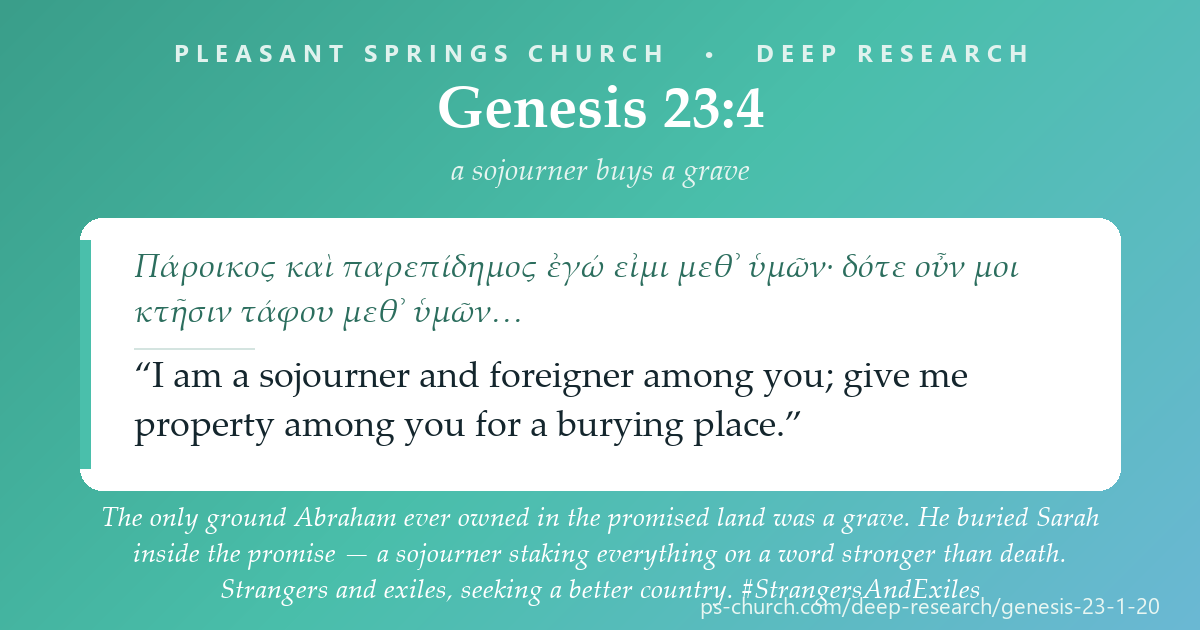
“A sojourner and foreigner” — LXX πάροικος καὶ παρεπίδημος, the exact pair Peter hands the church (1 Pet 2:11). Abraham names his status without bitterness and acts in hope within it: the resident-alien posture of faith.
“A possession for burying” — achuzzah is the technical term for permanent landed property (17:8). The word of the promise becomes a word on a deed: the covenant’s first inch of realized inheritance is a tomb.
“Machpelah” — the LXX renders it “the double cave” (τὸ σπήλαιον τὸ διπλοῦν). The family tomb of the covenant: Sarah, Abraham, Isaac, Rebekah, Jacob, Leah (49:31) — the founders gathered in the one deeded corner of the promise.
“Full price” — no gift, no discount, no future dispute. Four hundred shekels weighed “current among the merchants” (23:16): faith pays for a clear title because the deed must hold four hundred years.
“The gate of his city” (MT: “all who went in at the gate of his city”) — the ancient notary: elders seated, witnesses named, the transaction called out “in the hearing of the Hittites.” Covenant hope does its business in public, in proper legal form.
How the rest of Scripture fills out the scene:
- Genesis 12:7; 15:18–21; 17:8 — the promise the purchase leans on: the land sworn to the offspring, now holding its first covenant grave (see the covenant cut).
- Leviticus 25:23; Psalm 39:12; 1 Chronicles 29:15 — “you are strangers and sojourners with me”: Israel’s own tenure in the land held in Abraham’s posture.
- Hebrews 11:8–16; 1 Peter 1:1; 2:11 — strangers and exiles seeking a better country; the LXX pair of 23:4 become the church’s address.
- John 11:25–26, 35; 1 Thessalonians 4:13–14; 1 Corinthians 15:42–44 — the Lord who weeps and raises; grief with hope; the body sown toward resurrection (see the resurrection and the life).
From a purchased tomb to the borrowed tomb given back empty.
Trace the sojourner’s grave, the deeded promise, and the hope of the body toward their fulfillment.
Which cross-references matter?
- Genesis 25:7–10; 35:27–29; 49:29–33; 50:12–13 — Machpelah across the generations: Abraham, Isaac, Jacob each laid down inside the promise; Jacob’s deathbed recital of the deed.
- Jeremiah 32:6–15 — buying land in the teeth of judgment: the prophetic reprise of Abraham’s faith-purchase.
- Exodus 13:19; Joshua 24:32 — Joseph’s bones: four hundred years of burial-hope vindicated at last.
- Hebrews 11:13–16 — “these all died in faith, not having received the things promised… God has prepared for them a city”: the epistle’s reading of this very chapter.
- Matthew 27:57–60; John 19:41–42; 1 Corinthians 15:20 — the Messiah in a rich man’s new tomb — borrowed three days, returned empty: the firstfruits of everyone sleeping at Machpelah.
The letter to the Hebrews treats Abraham’s words at the Hittite gate as one of the most important confessions in the Old Testament. ‘I am a sojourner and foreigner among you’ — spoken by the man to whom the whole land had been promised on oath. Hold those two facts together and you have the very structure of biblical faith. Abraham does not resolve the tension the way we would: he neither despairs of the promise because he owns nothing, nor grasps at the land prematurely because he was promised everything. He lives as a resident alien inside his own inheritance — buying only a grave, trusting God with the rest — and Hebrews says it was exactly this posture that God found honorable: they confessed themselves strangers and exiles, they kept desiring a better country, ‘therefore God is not ashamed to be called their God.’ The church has always been meant to live at the same address. We are not tourists in this world, caring nothing for its cities; Abraham engaged Hebron’s elders with honor and full-priced honesty. But neither are we settlers who have quietly transferred citizenship. We grieve at real graves and buy real fields, yet with the exile’s open hand, because the deed that finally matters is held for us elsewhere — in the city with foundations, whose designer and builder is God. Sarah’s cave was the down payment of that hope in dirt and rock. The empty tomb outside Jerusalem is its guarantee.
The scholarship on Genesis 23:1-20.
The commentators on the Machpelah narrative; the studies of ancient land conveyance, the “Hittites” of Hebron, and burial in Israel.
Commentaries & studies:
- Gordon J. Wenham (WBC), Victor P. Hamilton (NICOT), Kenneth A. Mathews (NAC), Bruce K. Waltke, Nahum M. Sarna (JPS) on Genesis.
- Studies of ancient Near Eastern land-sale formulae and gate transactions; the debate over the “sons of Heth” at Hebron (Anatolian Hittites vs. a local Canaanite group); Israelite burial archaeology.
- G. K. Beale & D. A. Carson, eds., Commentary on the NT Use of the OT (Hebrews 11; Acts 7:15–16).
Interpretation notes worth keeping:
- Sarah’s honor. The only woman in Scripture with a recorded lifespan (23:1), and a full chapter for her burial: the matriarch of the promise honored in death. The dignity Scripture gives her should shape how the church honors its dead.
- Grief is not unbelief. “To mourn… and to weep” (23:2): Abraham’s tears precede his faith-purchase; Jesus’ tears precede Lazarus’s raising. Hope reorders grief; it does not cancel it (1 Thess 4:13).
- The ‘gift’ that wasn’t. Ephron’s triple “I give” (23:11) is bargaining courtesy, not conveyance; Abraham’s insistence on the “full price” secures an incontestable title. Read the scene by its ancient etiquette, not modern manners.
- ‘Hittites’ at Hebron. Whether Anatolian Hittites or (more likely) a local ethnic group called “sons of Heth,” the term is used precisely by the narrative; the old claims that the deed mirrors specifically Hittite law are held cautiously today — the conveyance ritual is broadly ancient Near Eastern.
- The first achuzzah. The word promised at 17:8 (“the land… for an everlasting possession”) is realized first at 23:20 — as a tomb. The inheritance begins at a grave and ends at an empty one: the Bible’s own arc of hope.
From a funeral in Hebron to a hope with a legal description.
Name what you learned, why it matters, and one concrete response.
What should we carry away — and do?
- Grieve really, hope really. Abraham mourned and wept — then rose and acted on the promise. Faith does not skip the tears; it gives them a horizon (1 Thess 4:13).
- Live at the sojourner’s address. “A sojourner and foreigner among you” — the posture God is “not ashamed” of (Heb 11:16): engaged, honest, full-price fair with the world, while holding it with an exile’s open hand.
- Bury in hope. The only land the father of faith owned was a grave inside the promise — and his greater Son gave a borrowed tomb back empty. Every believer’s grave is Machpelah now: purchased ground, waiting.
Step in response: if you carry a grief, bring it to the God who let Abraham weep first and act second — and take one concrete step of hope from within it, as he did. Honor the dead well: tend a grave, tell a saint’s story to the next generation, comfort a mourner with presence before words. And audit your address: where have you quietly become a settler — holding what you should hold with an open hand? The better country is not a metaphor; deal with this world honestly, and treasure it loosely.
Genesis 23:4 · to share
LXX + ESVEvery Deep Research page traces its passage across the whole sweep — the Old Testament, the Second-Temple world between the testaments (historical witnesses, not Scripture), and the New Testament. Follow the thread:
Pleasant Springs Church — Deep Research
Research method after Michael S. Heiser’s Bible Research Method (examine dictionaries → ancient literature → important words → textual connections → academic publications → share), with the Pleasant Springs “Author & Audience” foundation. Scripture set in the Hebrew, the Greek editions named on each page and the ESV (Old Testament), and the Greek New Testament and the ESV (New Testament), per the practice of Pleasant Springs Church. Genesis 23:1–20 research grounded in Wenham, Hamilton, Mathews, Waltke, and Sarna; Sarah’s unique recorded lifespan and the chapter’s legal precision honored as deliberate; the mourning (23:2) held as faith-compatible grief (1 Thess 4:13; Jn 11:35); the gate negotiation read by ancient conveyance etiquette — courtesy “gifts,” the deprecated price, full payment for incontestable title — with the older specifically-Hittite-law parallels weighed cautiously; “sojourner and foreigner” (23:4, LXX πάροικος καὶ παρεπίδημος) traced to Lev 25:23, Ps 39:12 (LXX 38:13), Heb 11:13–16, and 1 Pet 2:11; the first achuzzah (23:20) read against the promise of 17:8 — the inheritance beginning at a grave; and the arc completed at the borrowed tomb returned empty (Mt 27:57–60; 1 Cor 15:20).
Scripture quotations marked ESV are from the ESV® Bible (The Holy Bible, English Standard Version®), © 2001 by Crossway, a publishing ministry of Good News Publishers. ESV Text Edition: 2016. Used by permission. All rights reserved. The ESV text may not be quoted in any publication made available to the public by a Creative Commons license, and the ESV may not be translated in whole or in part into any other language. www.esv.org
|
Did this study bless you today? 💚 Give to Support PS Church100% of gifts go to the General Fund — thank you. |