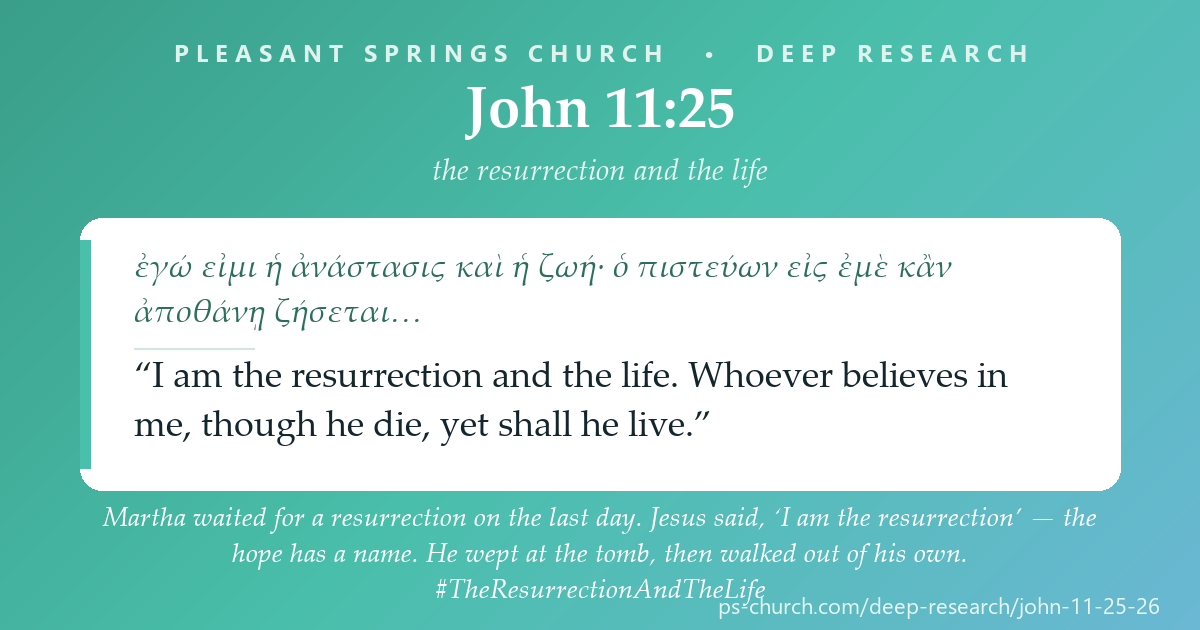
“I am the resurrection and the life.” Lazarus is four days dead, and Martha meets Jesus with a grief-worn faith and the standard hope: her brother will rise “on the last day.” Jesus takes that future doctrine and puts it in the present tense of his own person — he does not merely bring resurrection, he is it. Then a two-part promise: the believer who dies will yet live, and the one who lives and believes will never die. And a question for every reader: “Do you believe this?” This study works John 11:25–26 — the fifth “I am” saying — from the prophets’ hope to the empty tomb. See the method →
John 11:25–27
Greek NT · ESVText note: a few early witnesses (P45, part of the Old Latin, the Sinaitic Syriac) omit “and the life” in 11:25; the great weight of manuscripts (P66, P75, ℵ, B, and the rest) keeps it. NA28 and the ESV rightly read “the resurrection and the life.”
The Shape of the Passage
Parallel panelsOn the way to raise Lazarus, Jesus meets Martha in her grief. Before the miracle, he gives the word that interprets it: the fifth of his seven great “I am” sayings. The raising that follows is a sign — it points beyond itself to the One who is, in his own person, the resurrection and the life.
Author
John places this saying at the hinge of his Gospel. The raising of Lazarus is the seventh and greatest sign, and it is the act that finally moves the authorities to plot Jesus’ death (11:45–53) — life given to Lazarus costs Jesus his own. Before the tomb, Jesus reframes Martha’s hope. She believes in a resurrection, a future event “on the last day.” Jesus answers, “I am the resurrection and the life” — not a doctrine she waits for but a Person standing in front of her.
Two deaths, two promises. The saying has a deliberate two-part shape. “Whoever believes in me, though he die, yet shall he live” (11:25) — the believer really dies a bodily death (as Lazarus had), yet will rise. “Everyone who lives and believes in me shall never die” (11:26) — the one already alive in Christ will never die the second, eternal death. It is the Gospel’s already-and-not-yet: eternal life possessed now, bodily resurrection still to come.
Audience
Martha — and every believer who has stood at a grave. She is not a skeptic; she has real, if incomplete, faith. Jesus does not scold her hope but fills it: the resurrection she assigns to “the last day” is present in him. The question he puts to her, “Do you believe this?”, is put to every reader.
How to hear it. This is a predicated “I am” — a self-revelation of what Jesus is for us — distinct in form from the absolute divine Name, “before Abraham was, I am” (see John 8:58). Yet to be resurrection and life is a prerogative of God alone (“I kill and I make alive,” Deut 32:39; 1 Sam 2:6). The Son possesses it because the Father “granted the Son also to have life in himself” (5:26). Martha answers rightly: “you are the Christ, the Son of God” (11:27).
Orient on resurrection, eternal life, the I-am sayings, and the sign of Lazarus.
Search by topic: resurrection, life / eternal life, I am sayings, signs (John), last day / eschatology.
Which articles are relevant?
- Anchor Bible Dictionary — “Resurrection,” “Eternal Life,” “I Am,” “Signs (in John).”
- Dictionary of Jesus and the Gospels — “‘I Am’ Sayings,” “Life,” “Death,” “Lazarus.”
- NIDNTT / TDNT — ἀνάστασις (anastasis, resurrection), ζωή (zōē, life), πιστεύω (pisteuō, believe).
Bibliography surfaced:
- D. A. Carson (Pillar), Craig Keener (2 vols.), Raymond Brown (Anchor Yale), Andreas Köstenberger (BECNT), George Beasley-Murray (WBC), Herman Ridderbos on John.
- Studies of Johannine eschatology (realized and future), the “I am” sayings, and the seven signs.
- Beale & Carson, Commentary on the NT Use of the OT (John).
The resurrection hope of Israel, and the Person who embodies it.
Read the OT and Second-Temple resurrection hope behind Martha’s confidence, then hear how Jesus gathers it into himself.
Which parallels shed light on religion and worldview?
The hope Martha already held. By the first century, the resurrection “on the last day” was mainstream Pharisaic belief, and it had deep OT roots. Daniel is the clearest: “many of those who sleep in the dust of the earth shall awake, some to everlasting life, and some to shame” (Dan 12:2). Isaiah sang it: “your dead shall live; their bodies shall rise” (Isa 26:19). Job reached for it: “I know that my Redeemer lives… in my flesh I shall see God” (Job 19:25–26). And Ezekiel saw a valley of dry bones come to life as the Lord opened the graves of his people (Ezek 37:12–14; see the dry bones). Martha stands in this stream. Jesus does not correct her hope — he tells her its name.
Second-Temple witnesses. The vividness of that hope shows in the literature between the Testaments. In 2 Maccabees, a martyred brother tells his torturer, “the King of the universe will raise us up to an everlasting renewal of life” (2 Macc 7:9) — and denies the persecutor any “resurrection to life” (7:14), the same two-destinies logic as Daniel. A Dead Sea Scroll, the so-called Messianic Apocalypse (4Q521), even ascribes the raising of the dead to God’s Messiah: he “will heal the wounded, and make the dead live” — which is exactly the sign Jesus points John the Baptist to (“the dead are raised up,” Matt 11:5). These are witnesses to the age’s hope, not Scripture; but they show why raising the dead was heard as a messianic act, and why Martha rightly answers, “you are the Christ” (11:27).
Not mere immortality of the soul. Another Second-Temple stream stressed the soul’s survival: “the souls of the righteous are in the hand of God… their hope is full of immortality” (Wisdom 3:1–4, a witness, not Scripture). Jesus’ claim is larger and more concrete than that. He promises bodily resurrection (a four-days-dead corpse walks out of a tomb, 11:44) and a present, deathless life — not a disembodied afterglow but the God-kind of life given now and crowned with a risen body. Guard against shrinking “the resurrection and the life” into a comforting idea about the soul.
- Daniel 12:2; Isaiah 26:19; Ezekiel 37:12–14; Job 19:25–26; Hosea 13:14 — the OT hope of bodily resurrection and rescue from the grave (all thematic background, not quoted in John 11).
- 2 Maccabees 7:9, 14, 23; Wisdom 3:1–4 — Second-Temple resurrection and immortality hope (deuterocanonical witnesses, not Scripture for this church).
- 4Q521 (Messianic Apocalypse), Qumran — the Messiah who “makes the dead live” (a sectarian witness); cf. Jesus’ sign-answer to John, Matt 11:5 / Luke 7:22.
The heart of the saying is a structure preachers love to flatten, and it should not be flattened. Jesus makes two promises about two deaths. “Whoever believes in me, though he die, yet shall he live” (11:25) concedes the plain fact that believers die — Lazarus had; every Christian since has — and answers it with future, bodily resurrection: physical death is real but not final. “Everyone who lives and believes in me shall never die” (11:26) speaks of a different death, the eternal or “second” death (Rev 20:6): the believer, already sharing Christ’s life, will never fall under it. So the two clauses are not a stammering repetition but a careful gift — the not-yet of the resurrection body and the already of eternal life, held together in one Person. This is why over-realized teaching (that the resurrection is already wholly past, or that believers do not really die) misreads the verse as badly as bare materialism does. Jesus concedes the grave and conquers it; he grants deathless life and still weeps at the tomb. Both are true because both are his.
The vocabulary of resurrection, life, and living faith.
Watch the predicated “I am,” the two concessive-and-emphatic death clauses, and the present-tense “believing.”
“I am the resurrection and the life” — the fifth predicated “I am,” a self-revelation of what Jesus is for us; distinct from the absolute divine-Name “I am” of 8:58. The predicate nouns stand in apposition to his person: he does not grant resurrection from a distance, he is it.
“Resurrection, a rising up” (from anistēmi). The very word Martha used of the future (11:24, “the resurrection on the last day”). Jesus moves it from her calendar into his person — guaranteed in John by 5:28–29 (“all who are in the tombs… will come out”).
“Life” — in John, the God-kind of life that is Christ’s to give (1:4; 5:26; 20:31). Paired with anastasis it frames the two-part promise: resurrection answers bodily death; life answers the second, eternal death.
“Even if he should die” (crasis of kai ean + aorist subjunctive). Concedes real, physical death — as Lazarus had, as every believer does. So 11:25b is the promise of future bodily resurrection, not a denial that Christians die.
“Shall never die, unto the age” — the strongest Greek negation (ou mē). A different death from 11:25: the believer, already alive in Christ, will never die the eternal death (cf. 8:51; Rev 20:6). The already to 11:25b’s not-yet.
“The one believing” — a present participle: ongoing, living trust, not a single past decision. John’s “believe into me” is personal reliance. Continuous faith is the mark of those the Son keeps (10:28–29).
How the New Testament fills out the resurrection and the life:
- John 5:21, 24–29 — the Son gives life to whom he will; “has passed from death to life” (the already of 11:26); “all who are in the tombs will hear his voice” (the not-yet of 11:25b).
- John 11:43–44; 10:17–18; 2:19–22 — Lazarus called out of the tomb; Jesus’ authority to lay down his life and take it up; the temple of his body raised: he is the resurrection because he himself will die and rise.
- 1 Corinthians 15:20–26, 54–57 — Christ the firstfruits; “the last enemy… is death”; “Death is swallowed up in victory” — the bodily resurrection Paul unfolds.
- Revelation 1:18 — “I died, and behold I am alive forevermore, and I have the keys of Death and Hades”: the risen Christ who holds what he claimed.
From the graves opened in Ezekiel to the empty tomb.
Trace the resurrection hope from the prophets through the sign of Lazarus to Jesus’ own rising and ours.
Which cross-references matter?
- Daniel 12:2; Ezekiel 37:1–14; Isaiah 26:19 — awaking from the dust; the graves opened; the dead rising (see the valley of dry bones).
- John 5:24–29; 6:39–40 — life now and the raising “on the last day”: the already and not-yet Jesus gathers into himself.
- John 8:58; 6:35; 8:12; 10:11; 14:6; 15:1 — the “I am” sayings, absolute and predicated (see before Abraham was, I am and the bread of life).
- 1 Corinthians 15; Romans 8:11; Philippians 3:20–21 — the resurrection of the body, the Spirit who will raise us, the lowly body transformed.
- Revelation 1:18; 20:6; 21:4 — the keys of Death; the second death has no power; “death shall be no more.”
The raising of Lazarus is a sign, and a sign is not the same as the thing it signifies. Lazarus comes out bound in graveclothes (11:44), and he will one day die again; his rising is a resuscitation back into mortal life, not the resurrection body. That is precisely why Jesus speaks the word before he works the wonder: the miracle is a pointer, and the reality it points to is standing there speaking — “I am the resurrection and the life.” The sign says, in effect, look past me-the-miracle to me-the-Person. And the Person will shortly prove the claim in the only way that finally matters, not by calling another man out of a tomb but by walking out of his own. He can be the resurrection and the life for others because he has “authority to lay down” his life “and authority to take it up again” (10:18). So the Lazarus story is finally about Easter: the friend Jesus weeps for, the sisters he comforts, the crowd he astonishes — all of it is a rehearsal for the morning when death’s keys change hands for good.
The scholarship on John 11:25-26.
The commentators on John 11; the studies of Johannine eschalogy and the ‘I am’ sayings.
Commentaries & studies:
- D. A. Carson (Pillar), Craig S. Keener (2 vols.), Raymond E. Brown (Anchor Yale), Andreas J. Köstenberger (BECNT), George R. Beasley-Murray (WBC), J. Ramsey Michaels (NICNT), Herman Ridderbos on John.
- Studies of realized vs. future eschatology in John; the seven signs; the “I am” sayings and Johannine christology (Schnackenburg).
- Bruce Metzger and Philip Comfort on the “and the life” variant in 11:25.
Interpretation notes worth keeping:
- Predicated, not absolute. “I am the resurrection and the life” is a self-revelation metaphor (the fifth of seven), distinct from the absolute divine-Name “I am” of 8:58 — yet an implicit claim to a prerogative of God alone (Deut 32:39; 1 Sam 2:6; John 5:26).
- Keep the two clauses distinct. 11:25b = future bodily resurrection (“though he die, yet shall he live”); 11:26 = present deathless life with respect to the eternal death (“shall never die”). Two deaths, two promises.
- Literal bodily resurrection. The context is a corpse walking out of a tomb (11:39, 44); do not spiritualize the resurrection away. Beware, too, the opposite error of over-realized eschatology (2 Tim 2:18) — believers still die.
- Assurance in the participles. The present “believing” is living, continuing trust; assurance rests on Christ the life-giver who loses none of his own (10:28–29), not on the strength of the believer’s act.
- The text is secure. “And the life” (11:25) is read by the overwhelming weight of manuscripts; the P45 / Old-Latin / Syriac omission is an early minority reading, not the preferred text.
From the grave that holds us to the Lord who holds the keys.
Name what you learned, why it matters, and one concrete response.
What should we carry away — and do?
- Resurrection is a Person, not just an event. Martha waited for “the last day”; Jesus said, “I am the resurrection.” The hope has a name and a face, and he was standing in front of her — and he is risen.
- Your death is real, and it is not the end. “Though he die, yet shall he live.” Christians grieve at graves, yet not as those without hope; the body laid down will be raised.
- The second death has no claim on you. “Everyone who lives and believes in me shall never die.” The eternal death that ought to be ours cannot touch the one who is alive in Christ.
Step in response: answer Jesus’ own question — “Do you believe this?” Make Martha’s confession your own this week (“you are the Christ, the Son of God”), and carry it to a grave you grieve or a fear of death you carry: the One who wept at Lazarus’ tomb, and who walked out of his own, is your resurrection and your life.
John 11:25 · to share
Greek NT + ESVEvery Deep Research page traces its passage across the whole sweep — the Old Testament, the Second-Temple world between the testaments (historical witnesses, not Scripture), and the New Testament. Follow the thread:
Pleasant Springs Church — Deep Research
Research method after Michael S. Heiser’s Bible Research Method (examine dictionaries → ancient literature → important words → textual connections → academic publications → share), with the Pleasant Springs “Author & Audience” foundation. Scripture set in the Hebrew, the Greek editions named on each page and the ESV (Old Testament), and the Greek New Testament and the ESV (New Testament), per the practice of Pleasant Springs Church. John 11:25–26 research grounded in Carson, Keener, Brown, Köstenberger, and Beasley-Murray, with Beale & Carson on the OT resurrection background; the two-part promise (bodily resurrection and deathless life) held as the Johannine already/not-yet; Second-Temple witnesses (2 Maccabees, 4Q521) cited as background, not Scripture.
Scripture quotations marked ESV are from the ESV® Bible (The Holy Bible, English Standard Version®), © 2001 by Crossway, a publishing ministry of Good News Publishers. ESV Text Edition: 2016. Used by permission. All rights reserved. The ESV text may not be quoted in any publication made available to the public by a Creative Commons license, and the ESV may not be translated in whole or in part into any other language. www.esv.org
|
Did this study bless you today? 💚 Give to Support PS Church100% of gifts go to the General Fund — thank you. |