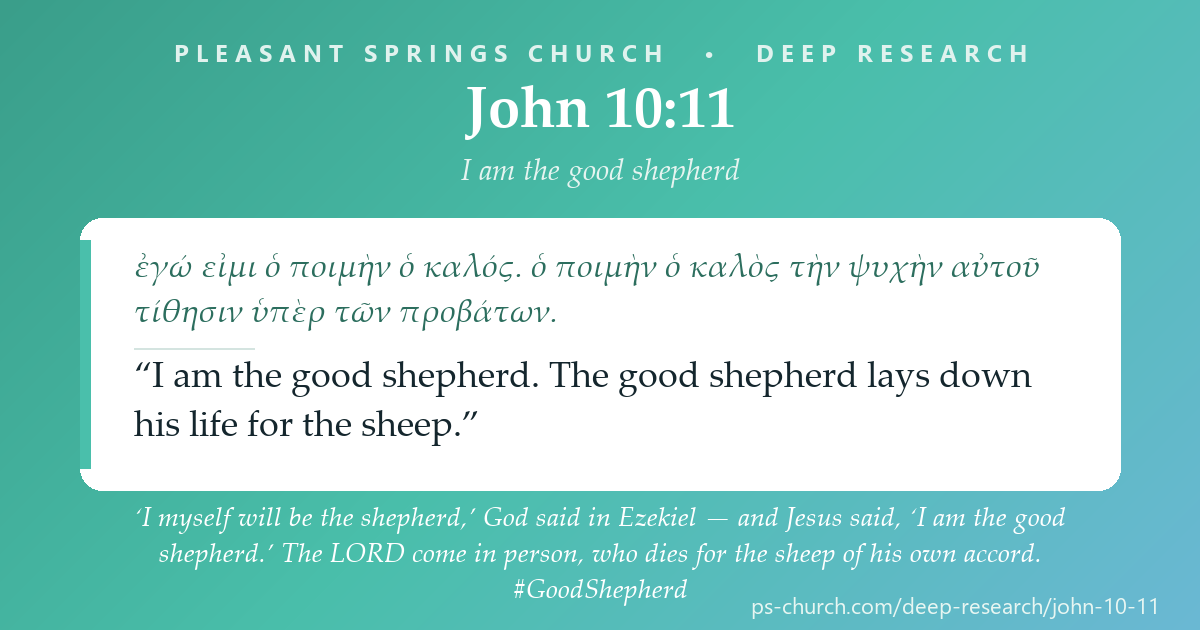
I am the good shepherd.” The claim is bigger than it sounds. In Ezekiel 34 the Lord denounced Israel’s false shepherds and vowed, “I myself will be the shepherd of my sheep” — and promised “my servant David” to lead them. Jesus takes up both: the Lord-shepherd of Ezekiel and Psalm 23 come in person, and the Son of David. And this shepherd is “good” not merely in being gentle but in the one thing a hireling never does — he “lays down his life for the sheep,” freely, and gathers the nations into one flock. This study works John 10:11 — the good shepherd — from Ezekiel to the cross. See the method →
John 10:11, 16, 18
Greek NT · ESVThe Shape of the Passage
LeitwortAfter healing a man born blind — whom the religious leaders cast out (John 9) — Jesus contrasts himself with those false shepherds. He is the door of the sheep and the good shepherd, over against thieves, robbers, and hirelings. The whole discourse rests on Ezekiel 34, the Lord against the shepherds who fed themselves.
Author
John frames the good-shepherd saying against the leaders who had just driven out the healed man. They are the bad shepherds — the hirelings who care nothing for the sheep and flee when the wolf comes (10:12–13). Against them Jesus says, “I am the good shepherd.” And the mark of the good shepherd is astonishing: not merely that he leads and feeds, but that he “lays down his life for the sheep.”
The Lord and David. The background is Ezekiel 34, where the Lord, indicting Israel’s shepherds, promises two things at once: “I myself will be the shepherd of my sheep” (34:15), and “I will set up over them one shepherd, my servant David” (34:23). In Jesus both come true — God himself has come to shepherd his people, in the person of the Son of David. To claim to be the good shepherd is, quietly, to claim to be the Lord of Psalm 23.
Audience
Sheep who had been failed by their shepherds — and everyone who has been used by those who should have cared for them. To them Jesus reveals a shepherd of a different kind: one who does not use the flock but dies for it, and who knows his own by name.
How to hear it. “Lays down his life for (hyper) the sheep” is sacrificial language: the shepherd dies in the sheep’s place, and he does it freely — “no one takes it from me… I lay it down of my own accord” (10:18). And he has “other sheep… not of this fold” — the nations — whom he will gather into “one flock, one shepherd.” The cross and the ingathering of the Gentiles are both in view.
Orient on the shepherd, Ezekiel 34, the atonement, and the one flock.
Search by topic: shepherd, Ezekiel 34, good shepherd, atonement / laying down life, Gentiles / one flock.
Which articles are relevant?
- Anchor Bible Dictionary — “Shepherd,” “I Am,” “Atonement,” “Gentiles.”
- Dictionary of Jesus and the Gospels — “‘I Am’ Sayings,” “Shepherd, Sheep,” “Death of Jesus,” “Gentiles.”
- NIDNTT / TDNT — ποιμήν (poimēn, shepherd), καλός (kalos, good/noble), τίθημι τὴν ψυχήν (lay down one’s life), ὑπέρ (hyper, for/on behalf of).
Bibliography surfaced:
- D. A. Carson (Pillar), Craig Keener (2 vols.), Raymond Brown (Anchor Yale), Andreas Köstenberger (BECNT), Herman Ridderbos on John.
- Studies of the shepherd motif (Ezekiel 34; Psalm 23) and the good-shepherd discourse; the “I am” sayings.
- Beale & Carson, Commentary on the NT Use of the OT (John 10 and Ezekiel 34).
The Lord-shepherd of Ezekiel, the good shepherd, and the one flock.
Read Ezekiel 34 behind the saying, weigh the deity-and-David together, then follow the shepherd to the cross and the nations.
Which parallels shed light on religion and worldview?
The shepherd who is the Lord. “Shepherd” was an ancient title for kings and gods, and in Israel it was above all a title for God: “The Lord is my shepherd” (Ps 23:1). Ezekiel 34 is the fullest form: the Lord denounces Israel’s shepherds for feeding themselves and scattering the flock, and vows, “I myself will search for my sheep… I myself will be the shepherd of my sheep” (34:11, 15). So when Jesus says “I am the good shepherd,” he is claiming to be the Lord come at last to shepherd his people in person. Yet Ezekiel also promises “my servant David” as the one shepherd (34:23–24) — and Jesus is that too, the Son of David. This study holds both strands together, as Ezekiel does: God himself shepherds, and he does it through the promised King.
‘Good’ means true. The word is kalos — not merely “kind” but “good, noble, model, genuine.” It sets Jesus against the counterfeits: the thief who comes to kill, the hireling who runs when the wolf comes because the sheep are not his own (10:12–13). The good shepherd is the real one, the worthy one — and the proof is that he does the one thing a hireling never will: he dies for the sheep.
He lays it down himself. “The good shepherd lays down his life for the sheep” — hyper, “on behalf of, in the place of” — the language of substitutionary sacrifice (cf. Isa 53:6; 1 John 3:16). And it is entirely voluntary: “no one takes it from me, but I lay it down of my own accord… This charge I have received from my Father” (10:18). The cross is neither an accident nor a tragedy forced on an unwilling victim, nor a Father coercing a helpless Son; it is the sovereign self-gift of the shepherd, in perfect obedience to the Father’s loving charge. And it reaches beyond one fold: “other sheep… not of this fold” — the nations — gathered into “one flock, one shepherd” (10:16).
- Ezekiel 34:1–24 — the Lord against the false shepherds; “I myself will be the shepherd”; “my servant David”: the whole background of John 10.
- Psalm 23; Isaiah 40:11; Micah 5:4 — “The Lord is my shepherd”; “he will tend his flock like a shepherd”; the Bethlehem ruler who shepherds (see Micah 5).
- Isaiah 53:6–7; Zechariah 13:7 — “all we like sheep have gone astray… the Lord has laid on him the iniquity of us all”; “strike the shepherd”: the smitten shepherd who dies for the sheep (see Isaiah 53, Zechariah 12).
- Ezekiel 37:24; John 10:16; Ephesians 2:11–22 — “one shepherd”; “one flock”; the two made one — the ingathering of the nations (see Ezekiel 37).
“I am the good shepherd” is a predicated “I am” — a self-revelation of what Jesus is for his people (see the absolute ‘I am’ of 8:58) — but it carries a quiet claim to deity, because in Ezekiel 34 the good shepherd who comes is the Lord himself, “I myself.” Jesus is God come to gather the scattered flock, and the Son of David promised to lead it — both at once. The heart of the saying, though, is the cross. A shepherd protecting sheep might risk his life; only this shepherd gives it, deliberately, “for the sheep.” That little word “for” is the gospel: he dies in their place, bearing the wolf’s attack himself. And he does it freely — “no one takes it from me” — in loving obedience to the Father, not as a victim but as the willing sacrifice. Two guardrails keep it true. The cross is not the Father abusing the Son: the same verse that names the Father’s charge insists the Son lays his life down “of my own accord,” with authority to take it up again — sovereign love, not coercion. And the “other sheep” are not a second flock saved a second way; they are the nations gathered by the same shepherd, at the same cost, into one people. The blind man cast out by the false shepherds is found by the true one — and so is everyone who hears his voice.
The vocabulary of the shepherd, the laying down, and the one flock.
Watch “good” (true), “for” (in their place), and “one flock” (the nations gathered).
“The good shepherd” — kalos = “good, noble, model, genuine” (not merely “nice”). The true shepherd, over against thieves and hirelings; the Lord-shepherd of Ezekiel 34 in person.
“To lay down one’s life” — the good shepherd’s mark: he dies for the sheep. Voluntary (“of my own accord,” 10:18), with authority to take it up again.
“For, on behalf of / in the place of” — sacrificial, substitutionary language: the shepherd dies for the sheep (cf. Isa 53:6; 1 John 3:16).
“Hired hand, hireling” — the false shepherd who flees when the wolf comes “because he cares nothing for the sheep”; the foil to the good shepherd who dies for them.
“One flock, one shepherd” — the “other sheep… not of this fold” (the nations) gathered with Israel into a single people under the one shepherd (cf. Ezek 37:24; Eph 2:14).
How the New Testament fills out the shepherd:
- John 10:14–18, 27–30 — “I know my own”; “I lay down my life of my own accord”; “no one will snatch them out of my hand.”
- Hebrews 13:20; 1 Peter 2:24–25; 5:4 — “the great shepherd of the sheep”; “you were straying like sheep… now returned to the Shepherd”; “the chief Shepherd.”
- Mark 14:27; Zechariah 13:7 — “I will strike the shepherd, and the sheep will be scattered”: the smitten shepherd at the cross.
- Revelation 7:17; Ephesians 2:11–22 — “the Lamb… will be their shepherd”; Jew and Gentile made one flock.
From the Lord-shepherd of Ezekiel to the Lamb who shepherds.
Trace the shepherd from Psalm 23 and Ezekiel 34 through the cross to the one flock.
Which cross-references matter?
- Psalm 23; Ezekiel 34:1–24; Isaiah 40:11 — the Lord the shepherd; “I myself… my servant David”: the deity and the Davidic shepherd together.
- Isaiah 53:6–7; Zechariah 13:7; Micah 5:2–5 — the sheep gone astray; the smitten shepherd; the Bethlehem shepherd-ruler (see Isaiah 53, Micah 5).
- John 10:11, 15, 17–18; 1 John 3:16 — the life laid down “for” the sheep, of his own accord: the voluntary, substitutionary death.
- Ezekiel 37:24; John 10:16; Ephesians 2:14–18 — the one shepherd; the other sheep; the two made one flock (see Ezekiel 37).
- Hebrews 13:20; 1 Peter 5:4; Revelation 7:17 — the great, chief Shepherd; the Lamb who shepherds his people.
The good-shepherd saying binds together the two things John most wants us to see about Jesus: who he is, and what he does. Who he is: the Lord-shepherd of Ezekiel 34 and Psalm 23, come in person to gather the flock his hired shepherds had scattered — and the promised son of David through whom God said he would do it. What he does: he lays down his life for the sheep. The genius of the image is that it makes the cross intrinsic to who Jesus is; he is not a shepherd who happens to die but the shepherd whose shepherding is the dying. And it is freely given — the repeated “of my own accord” guards against every caricature of an unwilling victim or a coerced Son; this is sovereign, self-giving love, in perfect union with the Father’s will. The reach of it is the nations: “other sheep… one flock, one shepherd” — the same salvation, the same voice, extended to the world. So the man the false shepherds threw out (John 9) is exactly the kind of sheep the true shepherd came to find. His voice still calls; his sheep still hear; and no one can snatch them from his hand.
The scholarship on John 10:11.
The commentators on John 10; the studies of the Ezekiel 34 background and the atonement.
Commentaries & studies:
- D. A. Carson (Pillar), Craig S. Keener (2 vols.), Raymond E. Brown (Anchor Yale), Andreas J. Köstenberger (BECNT), Herman Ridderbos on John.
- Studies of the shepherd motif (Ezekiel 34; Psalm 23) in John 10 and the “I am” sayings.
- G. K. Beale & D. A. Carson, eds., Commentary on the NT Use of the OT.
Interpretation notes worth keeping:
- Deity and David together. Ezekiel 34 promises both “I myself” (the Lord, 34:15) and “my servant David” (34:23); Jesus fulfills both. Hold the deity note and the Davidic under-shepherd together, not one at the expense of the other.
- Kalos = true/noble. “Good” contrasts the real shepherd with counterfeit thieves and hirelings — not merely a gentle shepherd but the genuine, worthy one.
- Substitution, freely given. “Lays down his life for (hyper) the sheep” is substitutionary; “of my own accord” (10:18) guards against reading the cross as coercion of an unwilling Son — sovereign self-gift under the Father’s charge.
- One flock. The “other sheep” are the Gentiles gathered into one flock (Ezek 37:24; Eph 2:14) — the same shepherd, the same salvation, not a second way.
From the shepherd who dies to the flock he keeps.
Name what you learned, why it matters, and one concrete response.
What should we carry away — and do?
- You have a shepherd who died for you. Not a hireling who flees, not a leader who uses you — the good shepherd who lays down his life “for the sheep.” That is how much he values you.
- He gave his life freely. The cross was not forced on a victim; the shepherd laid it down of his own accord, in love. You were not an afterthought but the joy set before him.
- His flock is one, and safe. Jew and Gentile, near and far, are gathered into one flock under one shepherd — and “no one will snatch them out of my hand.”
Step in response: if you have been failed by shepherds who should have cared for you, bring that wound to the good shepherd who dies rather than flees — and let his voice, not theirs, define you. Then listen for his voice this week in his Word, and follow; and, gathered into his one flock, welcome an “other sheep” the way he welcomed you.
John 10:11 · to share
Greek NT + ESVEvery Deep Research page traces its passage across the whole sweep — the Old Testament, the Second-Temple world between the testaments (historical witnesses, not Scripture), and the New Testament. Follow the thread:
Pleasant Springs Church — Deep Research
Research method after Michael S. Heiser’s Bible Research Method (examine dictionaries → ancient literature → important words → textual connections → academic publications → share), with the Pleasant Springs “Author & Audience” foundation. Scripture set in the Hebrew, the Greek editions named on each page and the ESV (Old Testament), and the Greek New Testament and the ESV (New Testament), per the practice of Pleasant Springs Church. John 10:11 research grounded in Carson, Keener, Brown, and Köstenberger, with Beale & Carson on the Ezekiel 34 background; the Psalm 23 and Ezekiel 34 shepherd motif as canonical context; the deity note and the Davidic-shepherd strand held together, and the atonement as sovereign self-gift.
Scripture quotations marked ESV are from the ESV® Bible (The Holy Bible, English Standard Version®), © 2001 by Crossway, a publishing ministry of Good News Publishers. ESV Text Edition: 2016. Used by permission. All rights reserved. The ESV text may not be quoted in any publication made available to the public by a Creative Commons license, and the ESV may not be translated in whole or in part into any other language. www.esv.org
|
Did this study bless you today? 💚 Give to Support PS Church100% of gifts go to the General Fund — thank you. |