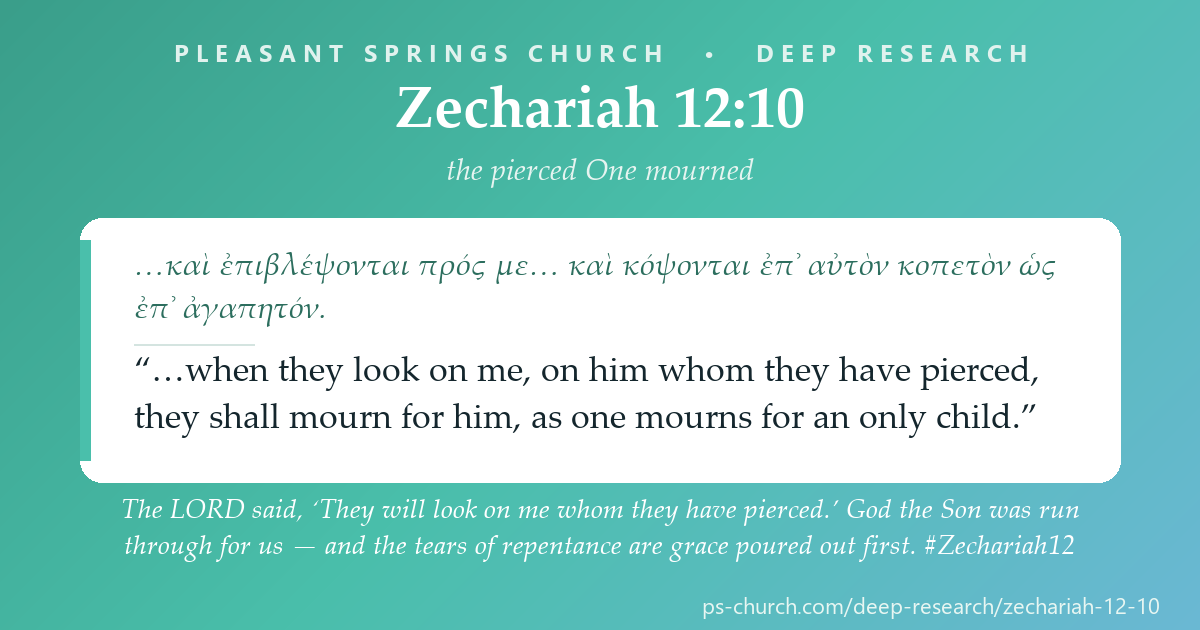
When they look on me, on him whom they have pierced…” God pours out “a spirit of grace and pleas for mercy,” and a people look on One they had pierced and mourn as for an only child. The speaker is the Lord — yet he is the pierced One — the mystery the cross unveils. John saw it fulfilled when a spear opened Jesus’ side (19:37); Revelation lifts it to his return (1:7). Behind it lies a text-critical drama: the Hebrew “pierced,” a Greek that mistakenly “danced,” and the corrected Greek the apostles quote. This study works Zechariah 12:10 from the pierced side to the coming King. See the method →
Zechariah 12:10 (same numbering in MT, LXX & English)
Hebrew · LXX · ESVThe Shape of the Passage
InclusioZechariah (late 6th c. BC) prophesied to the returned exiles rebuilding the temple. Chapters 9–14 look far ahead to God’s decisive future — the humble king (9:9), the struck shepherd (13:7), and here the pierced One his people will mourn. See the companion humble king of Zechariah 9.
Author
Zechariah’s later oracles (chs. 9–14) sweep past his own day to “that day” when God will deliver and purify Jerusalem. In 12:10 the Lord promises to pour out on the house of David “a spirit of grace and pleas for mercy” — a God-given repentance — so that they “look on” one they had pierced, and mourn for him with the deepest grief a family can know: as for an only child, as for a firstborn.
A staggering identification. The one speaking is God: “I will pour out… they will look on me… whom they pierced.” Somehow the pierced one and the Lord are bound together — and the sentence then speaks of him in the third person, “they shall mourn for him.” The mystery the New Testament unfolds is the incarnation: God pierced in the flesh of his Son.
Audience
The restored community of Judah — and, through them, the house of David and Jerusalem in God’s future. The promise is not first a threat but a mercy: the mourning is the fruit of grace poured out, the tears of a people brought to repentance and so to salvation. This is how God saves — he grants the very sorrow that turns the heart back to him.
How it was read. Later Jewish tradition heard here a lament over a slain Messiah (the Talmud’s “Messiah son of Joseph” — a much later rabbinic reading, but evidence the messianic hearing is not merely Christian). The apostles saw it fulfilled when a soldier pierced Jesus’ side (John 19:37) and reaching its climax at his return, when “every eye will see him, even those who pierced him” (Rev 1:7).
Orient on the spirit of grace, piercing, mourning, and the Messiah.
Search by topic: Zechariah, spirit of grace, piercing, mourning, Messiah, deity of Christ.
Which articles are relevant?
- Anchor Bible Dictionary — “Zechariah,” “Messiah,” “Mourning,” “Spirit of God.”
- Dictionary of the OT: Prophets — “Zechariah, Book of,” “Day of the Lord,” “Repentance,” “Messiah.”
- NIDOTTE / TDOT — דָּקַר (dāqar, pierce), נָבַט (nāḇaṭ, look), חֵן (ḥēn, grace), יָחִיד (yāḥîḏ, only child).
Bibliography surfaced:
- Carol & Eric Meyers (Anchor Yale, Zechariah 9–14), Mark J. Boda (NICOT), Anthony Petterson (Apollos), Al Wolters (HCOT) on Zechariah.
- Maarten J. J. Menken, Old Testament Quotations in the Fourth Gospel (the text-form of John 19:37).
- D. A. Carson (John, PNTC); G. K. Beale (Revelation, NIGTC) on Rev 1:7 as Daniel 7:13 + Zechariah 12:10; Beale & Carson, NT Use of the OT.
The pierced One, the Greek that danced, and the Greek that pierced.
Hold the deity of the pierced One, weigh the me/him and the daqar/raqad questions honestly, then follow the text to the cross and the return.
Which parallels shed light on religion and worldview?
Grace before grief. The mourning of Zechariah 12 does not earn God’s favor; it is produced by it. God first “pours out a spirit of grace and pleas for mercy” — a lovely Hebrew wordplay (ḥēn…taḥănûnîm) — and only then do the people look and weep. Repentance itself is his gift; the tears are the evidence of a heart he has already turned.
The verb, and the two Greek readings. The Hebrew verb is daqar — a violent, fatal piercing with a weapon (as in 1 Sam 31:4; Isa 13:15). The oldest Greek translation stumbled here: reading the consonants of daqar (דקר) as raqad (רקד, “dance”) by a slip of two letters, it rendered κατωρχήσαντο — “they danced in triumph over / mocked” — losing the piercing altogether. But later Jewish revisers of the Greek (the tradition behind Theodotion and Aquila) corrected it to ἐξεκέντησαν, “they pierced,” matching the Hebrew — and it is that Greek, not the Old Greek, that John and Revelation quote. So this page prints the Old Greek honestly (it really does read “danced”), while noting that the New Testament follows the pierced-reading that agrees with the Hebrew.
‘On me… whom they pierced.’ The Hebrew reads “they will look on me” (ʾēlai, first person) — the Lord speaking — “whom they pierced,” and then “they shall mourn for him.” A few Hebrew manuscripts ease the difficulty to “on him” (ʾēlaw), but “on me” is the harder and better-attested reading, almost certainly original. The verse does not confuse God with a man; it holds together, in one breath, the God who is pierced and the Son who is mourned — the very mystery of the incarnation.
- Zechariah 9:9; 11:12–13; 13:7 — the humble king, the thirty pieces of silver, the struck shepherd: Zechariah’s cluster of passion prophecies (see Zechariah 9).
- Theodotion & Aquila (early Jewish Greek revisions) (translation witnesses, not Scripture) — render ἐξεκέντησαν, “they pierced,” correcting the Old Greek; the reading John uses.
- Justin Martyr, Dialogue 14, 32, 64 (mid-2nd c. Christian witness) — quotes Zechariah 12:10–12 of the crucified and returning Christ with “whom they pierced.”
- b. Sukkah 52a (later rabbinic reception, not Second-Temple) — reads the mourning as lament over “Messiah son of Joseph”: the messianic hearing is not merely a Christian imposition.
John sets this verse at the foot of the cross. A soldier pierces Jesus’ side; blood and water flow; no bone is broken — and John writes, “again another Scripture says, ‘They will look on him whom they have pierced’” (19:37). His Greek is ἐξεκέντησαν (“pierced”), the reading that matches the Hebrew, not the Old Greek’s “danced” — and he shifts “on me” to “on him,” following the person-change already in Zechariah’s own sentence. Revelation then lifts the verse to Christ’s return, fusing it with Daniel 7:13: “Behold, he is coming with the clouds, and every eye will see him, even those who pierced him, and all tribes of the earth will wail on account of him” (Rev 1:7) — and just two verses earlier Revelation has called Jesus “the firstborn of the dead” (1:5), the very word Zechariah uses for the mourning (“as one weeps over a firstborn”). The One pierced is the One who returns; the looking that began in the grace-given tears of repentance ends in every eye beholding him. And the deepest note is the identity of the pierced One: the Lord said “they will look on me… whom they pierced” — and it was God the Son, incarnate, who was run through for us.
The vocabulary of piercing, looking, and grace-given grief.
Watch the pierced One, the “on me,” and the two Greek readings of one Hebrew verb.
“Pierce, run through” — a violent, fatal thrust with a weapon (1 Sam 31:4; Isa 13:15). The word John’s Greek renders ἐξεκέντησαν; the Old Greek misread it as raqad, “dance.”
“On me” — first person: the Lord is the speaker, so the pierced one is identified with God. The harder, better-attested reading (a few mss ease it to ʾēlaw, “on him”).
“A spirit of grace and pleas for mercy” — a wordplay (ḥēn/taḥănûnîm). God-given repentance: grace poured out first, mourning as its fruit.
“Only child” / “firstborn” — the sharpest grief a family knows. yāḥîḏ is Isaac’s word (Gen 22); the Greek πρωτότοκος (firstborn) titles Christ (Rev 1:5).
“Dance in triumph over, mock” — the Old Greek’s reading, from misreading daqar (pierce) as raqad (dance). Corrected by later revisers to ἐξεκέντησαν (“pierced”), the reading John quotes.
How the New Testament reuses Zechariah 12:10:
- John 19:37 — “They will look on him whom they have pierced”: fulfilled at the cross (the pierced side), quoting the Hebrew-matching Greek.
- Revelation 1:7 — “every eye will see him, even those who pierced him”: fused with Daniel 7:13 and applied to Christ’s return (see Daniel 7).
- John 19:34–36 — the pierced side and the unbroken bone (Ps 34:20; Exod 12:46): the Passover Lamb pierced (see the Passover).
- Matthew 24:30 — “all the tribes of the earth will mourn”: the same Zechariah mourning at the coming of the Son of Man.
From the pierced One mourned to the pierced One returning.
Trace the pierced and mourned One from Zechariah into the passion and the parousia.
Which cross-references matter?
- Zechariah 9:9; 11:12–13; 13:7 — the humble king, the price of a slave, the struck shepherd scattered (Matt 26:31): Zechariah’s passion cluster.
- Psalm 22:16–18; Isaiah 53:5 — “they have pierced my hands and feet”; “pierced for our transgressions” (see Psalm 22, Isaiah 53).
- John 19:34–37; Revelation 1:7 — the pierced side at the cross; the pierced One seen by every eye at his return.
- Daniel 7:13; Matthew 24:30 — coming with the clouds; the tribes mourning: the composite behind Revelation 1:7 (see Daniel 7).
- John 1:14, 18; Colossians 1:15–18 — the only Son, the firstborn: the only-child/firstborn grief of Zechariah answered in Christ.
The text-form of Zechariah 12:10 in John and Revelation is a small window into how the early church read its Bible. Both writers use ἐξεκέντησαν, “pierced” — independently of each other, which is strong evidence that a corrected, Hebrew-matching Greek of Zechariah was already circulating; neither follows the Old Greek’s “danced.” John frames the citation at the cross; Revelation folds it into the return, joining it to Daniel 7:13 so that the coming Son of Man is precisely the pierced One. The theology is seamless: the same Jesus who was lifted up and pierced is the one every eye will see. And the mourning is not only judgment but repentance — the grace-given tears of Zechariah 12, poured out on all who look. A word of care the text itself requires: this passage is about salvation coming to the house of David and Jerusalem (12:10), the beginning of their mourning-unto-life; it is never a warrant to blame a people, but a promise that the God who was pierced pours out grace on those who pierced him — which, in the end, is all of us.
The scholarship on Zechariah 12:10 and its New Testament use.
The commentators on Zechariah; the studies of the text-form in John and Revelation.
Commentaries & studies:
- Carol L. & Eric M. Meyers (Anchor Yale, Zechariah 9–14), Mark J. Boda (NICOT), Anthony R. Petterson (Apollos), Al Wolters (HCOT), David L. Petersen (OTL) on Zechariah.
- Maarten J. J. Menken, Old Testament Quotations in the Fourth Gospel; D. A. Carson, The Gospel According to John (PNTC).
- G. K. Beale, The Book of Revelation (NIGTC), on Revelation 1:7; Beale & Carson, eds., Commentary on the NT Use of the OT.
Interpretation notes worth keeping:
- The Old Greek is wrong here — and John does not follow it. The Old Greek reads “danced/mocked” (misreading daqar as raqad); John and Revelation quote the corrected “pierced” (ἐξεκέντησαν). Show both; don’t claim John cites the Septuagint.
- ‘On me’ is original. MT reads ʾēlai (“on me,” the Lord speaking); a few mss read ʾēlaw (“on him”). The harder “on me” is almost certainly original — a witness to the deity of the pierced One.
- Grace before grief. The mourning is the fruit of a “spirit of grace” poured out first — God-given repentance, not a human work.
- No versification offset. Zechariah 12:10 is 12:10 in MT, LXX, and English alike (the chapter-1–2 English/Hebrew shift is far away and irrelevant here).
From the pierced One to your own looking.
Name what you learned, why it matters, and one concrete response.
What should we carry away — and do?
- God was pierced for you. The Lord said “they will look on me whom they pierced” — and it was God the Son, in the flesh, run through at the cross. The wound is the measure of the love.
- Repentance is a gift. The mourning of Zechariah 12 is poured out, not worked up. If your heart is soft toward the crucified Christ, that softness is already grace at work in you.
- The pierced One is coming. The same Jesus lifted up will return, and every eye will see him. The looking that saves now is better than the looking that only wails then.
Step in response: do the one thing the verse commands — look. Look on the pierced One, and let the Spirit of grace do its work: name a sin honestly, and mourn it not in despair but in the hope of the One who bore it. Live this week facing the cross rather than your own record.
John 19:37 · to share
Greek + ESVEvery Deep Research page traces its passage across the whole sweep — the Old Testament, the Second-Temple world between the testaments (historical witnesses, not Scripture), and the New Testament. Follow the thread:
Pleasant Springs Church — Deep Research
Research method after Michael S. Heiser’s Bible Research Method (examine dictionaries → ancient literature → important words → textual connections → academic publications → share), with the Pleasant Springs “Author & Audience” foundation. Scripture set in the Hebrew, the Greek editions named on each page and the ESV (Old Testament), and the Greek New Testament and the ESV (New Testament), per the practice of Pleasant Springs Church. Zechariah 12:10 research grounded in the Meyers, Boda, Petterson, and Wolters commentaries, with Menken, Carson, and Beale on the text-form in John and Revelation; Theodotion/Aquila and the Old Greek as translation witnesses, Justin Martyr and b. Sukkah 52a as later reception.
Scripture quotations marked ESV are from the ESV® Bible (The Holy Bible, English Standard Version®), © 2001 by Crossway, a publishing ministry of Good News Publishers. ESV Text Edition: 2016. Used by permission. All rights reserved. The ESV text may not be quoted in any publication made available to the public by a Creative Commons license, and the ESV may not be translated in whole or in part into any other language. www.esv.org
|
Did this study bless you today? 💚 Give to Support PS Church100% of gifts go to the General Fund — thank you. |