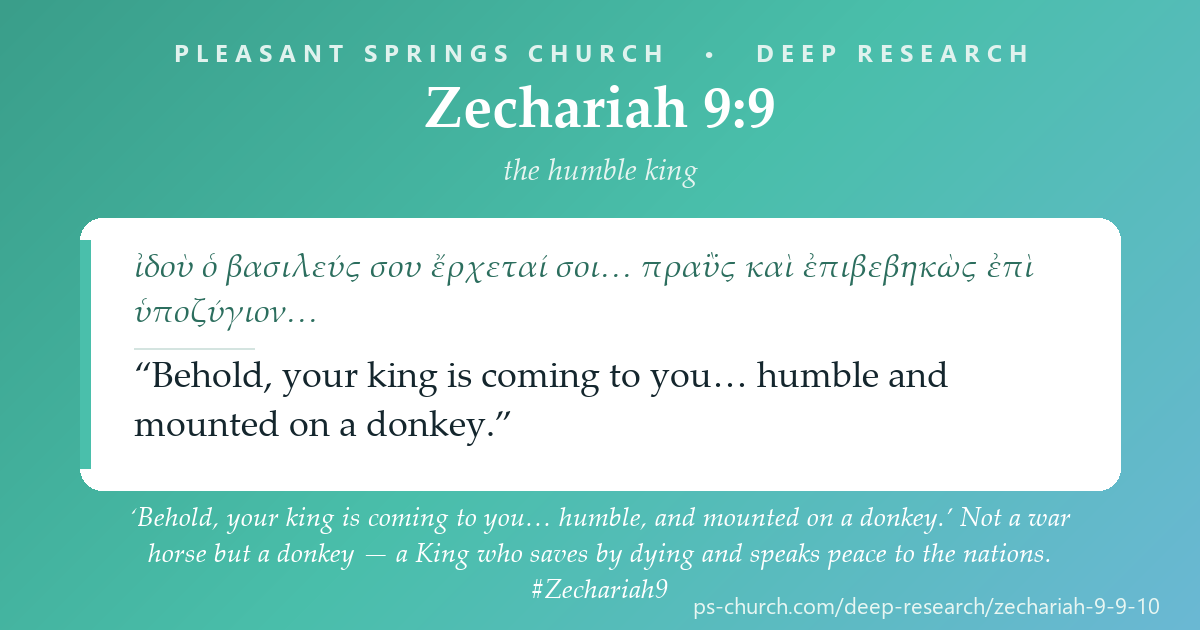
Rejoice greatly, O daughter of Zion… behold, your king is coming to you.” But not as the nations’ kings come: he is “righteous and having salvation,” yet “humble, and mounted on a donkey” — a mount of peace, not a war horse. He cuts off the weapons and “speaks peace to the nations.” On Palm Sunday Jesus deliberately rode this prophecy into Jerusalem. This study works Zechariah 9 from the donkey of peace to the reign that will fill the earth. See the method →
Zechariah 9:9–10
Hebrew · LXX · ESVThe Shape of the Passage
Parallel panelsZechariah prophesied to the returned exiles (c. 520 BC), urging them to rebuild the temple and hope for God’s coming king. Chapters 9–14 look ahead to a shepherd-king rejected and then triumphant.
Author
The prophet Zechariah encouraged the post-exilic community rebuilding Jerusalem. The book’s later chapters (9–14) unfold a startling portrait of the coming king: victorious yet humble, arriving on a donkey, disarming the instruments of war, and speaking peace to the nations — and, further on, a shepherd pierced and mourned (12:10), sold for thirty pieces of silver (11:12–13). Zechariah 9:9 sets the tone: God’s salvation comes not by the sword but by a lowly King.
Righteous, saved, and humble. The king is “righteous” and “having salvation” (or “saved / vindicated”), and yet “humble” (ʿānî, lowly/afflicted). His victory is real but paradoxical — achieved not by crushing enemies with a war horse but by a peace he speaks to the world.
Audience
Judah after the exile — a small, vulnerable community longing for the promised king. To them the vision of a righteous, peace-bringing ruler who comes gently was a call to hope without violence: their King would come, but he would come humbly, and his rule would reach “from sea to sea.”
How they heard it. The image of the donkey-riding king shaped messianic expectation and even created a famous puzzle for later interpreters: does the Messiah come humbly “on a donkey” (Zech 9:9) or in glory “with the clouds” (Dan 7:13)? The New Testament’s answer is both — first the humble King on the donkey, then the glorious Son of Man on the clouds. On Palm Sunday, the crowds who spread their cloaks were watching Zechariah 9:9 come true, whether they grasped it or not.
Orient on the coming king, humility, peace, and the donkey.
Search by topic: Zechariah, Messiah, king, peace, triumphal entry.
Which articles are relevant?
- Anchor Bible Dictionary — “Zechariah,” “Messiah,” “King,” “Triumphal Entry.”
- Dictionary of the OT: Prophets — “Zechariah, Book of,” “Messiah,” “Peace,” “Kingship.”
- NIDOTTE / TDOT — מֶלֶךְ (meleḵ, king), נוֹשָׁע (nôšāʿ, saved/having salvation), עָנִי (ʿānî, humble/afflicted), שָׁלוֹם (šālôm, peace).
Bibliography surfaced:
- Mark Boda (NICOT), Thomas McComiskey, Carol & Eric Meyers (Anchor) on Zechariah.
- Studies of Zechariah 9:9 in the Triumphal Entry (Matthew 21; John 12); the humble-king motif.
- Beale & Carson, Commentary on the NT Use of the OT (Matthew; John).
The donkey, the war horse, and the two comings.
Read the donkey-versus-horse contrast, weigh the donkey/colt wording, then follow the prophecy into Palm Sunday.
Which parallels shed light on religion and worldview?
A mount of peace. A conquering king rode a war horse; a king coming in peace rode a donkey. By choosing the donkey, Zechariah’s king announces that his reign is not built on military conquest — and in the next breath God “cuts off” the chariot, the war horse, and the battle bow (9:10). The King disarms war and “speaks peace to the nations.” (There is an old royal echo: Solomon rode his father’s mule to his anointing, 1 Kgs 1:33.)
One animal, or two? The Hebrew names the mount twice in synonymous parallelism — “a donkey… a colt, the foal of a donkey” — a single animal described in poetic pairs. Matthew, faithfully following the Hebrew’s doubled wording, mentions both the donkey and the colt (Matt 21:2–7); John, simplifying, names only the young donkey (John 12:14–15). Both are reading the same verse.
- 1 Kings 1:33–40 — Solomon riding to his anointing on the royal mule: a peaceful-accession echo behind the donkey-king.
- Genesis 49:10–11 — the ruler from Judah “binding his foal to the vine”: an early donkey-and-king image.
- b. Sanhedrin 98a (rabbinic-era) — the famous paradox: the Messiah comes “lowly, riding on a donkey” (Zech 9:9) yet “with the clouds of heaven” (Dan 7:13) — resolved in the two comings of Christ (see Daniel 7).
- ANE royal-entry ceremony — a victorious king welcomed into a city; Zechariah subverts it with a humble mount and a reign of peace.
On the day we call Palm Sunday, Jesus staged this prophecy on purpose. He sent for a donkey and its colt, rode into Jerusalem, and the crowds spread cloaks and branches, crying “Hosanna to the Son of David!” Matthew and John both stop to tell us why: “This took place to fulfill what was spoken by the prophet, saying, ‘Say to the daughter of Zion, Behold, your king is coming to you, humble, and mounted on a donkey’” (Matt 21:5; cf. John 12:15). Jesus deliberately chose the mount of peace, not the war horse of the conqueror the crowds wanted — declaring the kind of king he is. His “salvation” would come not by killing enemies but by dying for them; his “peace to the nations” would be made “by the blood of his cross” (Col 1:20). And the disarming reign “from sea to sea” awaits its fullness when the humble King who came on a donkey returns on the clouds.
The vocabulary of the humble king, the donkey, and peace.
Watch the “humble” king, the donkey of peace, and the “peace to the nations.”
“Humble / lowly” — also “afflicted, poor”; the king’s defining posture — not a conqueror’s pride but a servant’s lowliness (cf. Matt 11:29, “I am gentle and lowly”).
“Having salvation” — a passive form: “saved / vindicated,” or “endowed with salvation.” The king who brings salvation is himself upheld by God (ESV “having salvation”).
“Donkey” — a mount of peace, deliberately not a war horse; named twice in poetic parallelism (“a donkey… a colt, the foal of a donkey”) — one animal, doubled.
“And he shall speak peace” — to the nations; the king cuts off the weapons of war and proclaims a peace that reaches “from sea to sea” (cf. Eph 2:17).
How the New Testament reuses Zechariah 9:9:
- Matthew 21:1–9; John 12:12–16 — the Triumphal Entry: Jesus rides the donkey “to fulfill” Zechariah 9:9.
- Mark 11:1–10; Luke 19:28–40 — the same entry; the crowds hail the coming King.
- Ephesians 2:14–17; Colossians 1:20 — the King who “preached peace” and made peace “by the blood of his cross”: Zechariah’s “peace to the nations” fulfilled.
- Zechariah 12:10; John 19:37; Matthew 27:9 — the same book’s pierced shepherd and thirty pieces of silver, taken up in the Passion.
From the donkey of peace to the reign from sea to sea.
Trace the humble king through the Passion and toward the peace of his universal reign.
Which cross-references matter?
- Genesis 49:10–11; 1 Kings 1:33 — the ruler from Judah and the peaceful royal mount: roots of the donkey-king.
- Psalm 72:8; Zechariah 9:10 — the king’s dominion “from sea to sea… to the ends of the earth”: a reign of peace over the nations.
- Matthew 21:1–9; John 12:12–16 — the Triumphal Entry fulfilling Zechariah 9:9.
- Zechariah 11:12–13; 12:10; 13:7 — the shepherd sold, pierced, and struck: the same book’s Passion prophecies.
- Daniel 7:13–14 — the Son of Man on the clouds: the glorious second coming that answers the humble first (see Daniel 7).
Matthew and John both cite Zechariah 9:9 as consciously fulfilled in Jesus’ entry — and John admits the disciples only understood it later (John 12:16), which underlines that Jesus was enacting Scripture, not staging a coincidence. The point of the citation is the kind of king: “humble, mounted on a donkey.” Against a crowd hoping for a military liberator, Jesus chose the mount of peace, declaring a kingship that saves by suffering, not by the sword. Matthew’s mention of both animals simply follows the Hebrew parallelism; it is not a misunderstanding. And the prophecy’s wider frame — weapons cut off, peace spoken to the nations, a rule “from sea to sea” — is fulfilled in stages: inaugurated at the cross where peace was made, preached to the nations in the gospel, and consummated when the King returns. The donkey and the clouds belong to the one Lord, in his two comings.
The scholarship on Zechariah 9:9.
The commentators on Zechariah; the studies of the Triumphal Entry; the donkey/colt wording.
Commentaries & studies:
- Mark J. Boda (NICOT), Thomas E. McComiskey, Carol L. & Eric M. Meyers (Anchor) on Zechariah.
- Studies of Zechariah 9:9 in Matthew 21 / John 12 and the “donkey and colt” wording (Hebrew parallelism).
- G. K. Beale & D. A. Carson, eds., Commentary on the New Testament Use of the Old Testament.
Interpretation notes worth keeping:
- Donkey, not war horse. The mount is the message: a king of peace, not conquest — whose salvation is won by dying, not killing.
- One animal in two lines. “A donkey… a colt, the foal of a donkey” is Hebrew synonymous parallelism; Matthew follows the doubled wording, John simplifies — neither misreads.
- The two comings. Zechariah’s humble donkey-king and Daniel’s glorious cloud-borne Son of Man are held together in the New Testament as the first and second comings of the one Christ.
From the donkey of peace to your own King.
Name what you learned, why it matters, and one concrete response.
What should we carry away — and do?
- Your King is humble. He came not on a war horse but a donkey, and saved not by killing but by dying. The power at the center of the universe is cross-shaped and gentle.
- He is our peace-maker. He “speaks peace to the nations” and made peace by his blood. Reconciliation — with God and across human divisions — is his royal work, and ours to share.
- The two comings. He came once in humility; he will come again in glory. We live between the donkey and the clouds — serving a humble King who reigns and returns.
Step in response: welcome the humble King as he actually comes — not the conquering hero you might prefer, but the crucified Lord — and imitate his lowliness this week: take one concrete, unglamorous step of peace-making or servant-love, riding the “donkey” instead of the war horse in some conflict of your own.
Zechariah 9:9 · to share
LXX + ESVEvery Deep Research page traces its passage across the whole sweep — the Old Testament, the Second-Temple world between the testaments (historical witnesses, not Scripture), and the New Testament. Follow the thread:
Pleasant Springs Church — Deep Research
Research method after Michael S. Heiser’s Bible Research Method (examine dictionaries → ancient literature → important words → textual connections → academic publications → share), with the Pleasant Springs “Author & Audience” foundation. Scripture set in the Hebrew, the Greek editions named on each page and the ESV (Old Testament), and the Greek New Testament and the ESV (New Testament), per the practice of Pleasant Springs Church. Zechariah 9:9–10 research grounded in Boda, McComiskey, and the Meyers, with Beale & Carson on the Gospels’ use; ANE royal-entry background; Second-Temple/rabbinic material per b. Sanhedrin (read as a witness, not Scripture).
Scripture quotations marked ESV are from the ESV® Bible (The Holy Bible, English Standard Version®), © 2001 by Crossway, a publishing ministry of Good News Publishers. ESV Text Edition: 2016. Used by permission. All rights reserved. The ESV text may not be quoted in any publication made available to the public by a Creative Commons license, and the ESV may not be translated in whole or in part into any other language. www.esv.org
|
Did this study bless you today? 💚 Give to Support PS Church100% of gifts go to the General Fund — thank you. |