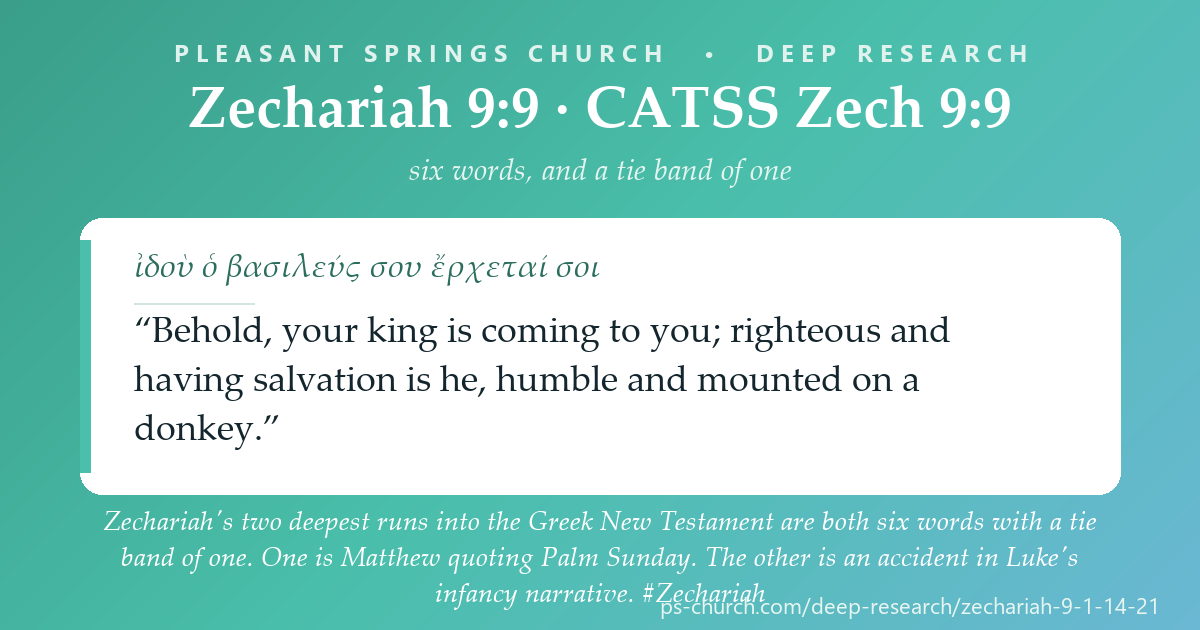
Two rows of Zechariah reach six consecutive shared words with a single New Testament verse. That is the deepest anything in this book goes, and each of the two has a tie band of one — no other New Testament verse carries the sequence. The first is Zechariah 9:9 against Matthew 21:5: ἰδοὺ ὁ βασιλεύς σου ἔρχεταί σοι, read on Palm Sunday, and Matthew says he is quoting. The second is Zechariah 13:3 against Luke 2:33: ὁ πατὴρ αὐτοῦ καὶ ἡ μήτηρ — a law about a father and mother putting a false prophet to death, and Joseph and Mary marvelling in the temple. Same depth, same tie band, and no relationship whatever. And of the four texts from these chapters that the Passion narratives use, only 9:9 matches this Greek column at all: at 11:13 the row has a smelting-furnace where the Hebrew has a potter, at 12:10 it has mockery where the Hebrew has piercing, and at 13:7 it has strike the shepherds where Matthew and Mark have I will strike the shepherd. See the method →
Zechariah 9:1–14:21 (selections)
Hebrew · Greek (CATSS, Rahlfs’ Septuaginta) · ESV⚠️ Two verses in this half carry the book’s deepest runs into the New Testament, and both reach six. One of them is a citation. The other is not. Stage 4 puts them side by side.
The Shape of the Passage
Two burdens, headed alike — and a third at the end of the TwelveChapters 9–14 carry no dates, no names and no visions. The first half of the book is dated to the month three times and full of an interpreting angel; this half has none of that. It is poetry and oracle, headed twice by the same three words. That difference is the whole of the authorship question, and the page states it rather than settling it.
Author
The book presents itself as one book. There is no second superscription naming anybody else, and the Twelve has transmitted it whole. Ancient and mediaeval readers took chapters 1–14 together, and so do many modern ones.
And there is a long discussion about these six chapters. The absence of dates, of Zerubbabel and Joshua, of the interpreting angel and of the temple-building concern has led many scholars to treat 9–14 as later material gathered under Zechariah’s name. This page takes no position. What it can show is the heading at 9:1 and 12:1, and that the same heading opens Malachi.
Audience
People who are not being told to build anything. Where chapters 1–8 address a community with a half-built temple and a governor, these chapters address a people among the nations, with bad shepherds over them and a siege ahead. The temple is standing here; the last verse is about what happens in it.
And the Passion narratives read them. Whatever the date, by the first century these six chapters were being used to say what was happening to Jesus in the last week of his life — the entry, the thirty pieces of silver, the struck shepherd, the pierced one. All four texts come from these chapters and none from chapters 1–8.
Orient on the burdens, the shepherd allegory, and the Passion citations.
Search by topic: Zechariah 9–14; Deutero-Zechariah; massa / burden; shepherd, shepherd allegory; thirty pieces of silver; pierced one; day of the Lord; Feast of Booths.
Which articles are relevant?
- Anchor Bible Dictionary — “Zechariah, Book of,” “Shepherd,” “Massa,” “Booths, Feast of.”
- Dictionary of the OT: Prophets (IVP) — “Zechariah, Book of,” “Apocalypticism,” “Messiah,” “Shepherd.”
- Dictionary of NT Use of the OT (Beale & Carson) — on Matthew 21:5, Matthew 26:31, Matthew 27:9–10, John 19:37 and Revelation 1:7. This is the one book of the Twelve where that volume has a great deal to say.
- NIDOTTE — מַשָּׂא, רֹעֶה, דָּקַר, יוֹצֵר.
Settle the numbering — and it is settled by the other half of this study
Zechariah’s offset is real but it is confined to chapters 1 and 2.
English 1:18–21 = MT/LXX 2:1–4, and English 2:1–13 = MT/LXX2:5–17; the table and the reasoning are on the first half of this study. From chapter 3 to 14:21 all three columns agree on every number, so nothing on this page needs converting — Zechariah 9:9 is Zechariah 9:9 in a Hebrew Bible, in the CATSS Greek and in the ESV alike.
Thirty pieces of silver, and a citation attributed to the wrong prophet.
Matthew 27:9 says Jeremiah
Matthew 27:9–10 quotes the thirty pieces of silver and the potter, and introduces the quotation as spoken by the prophet Jeremiah. The words are Zechariah’s.
Then was fulfilled what had been spoken by the prophet Jeremiah, saying, “And they took the thirty pieces of silver, the price of him on whom a price had been set by some of the sons of Israel, and they gave them for the potter’s field, as the Lord directed me.”Matthew 27:9–10 (ESV)
The proposals are old and well rehearsed, and this page lists them without choosing: (1) a composite citation, since Jeremiah 18–19 has the potter and the potter’s house and Jeremiah 32 has a field bought and paid for by weight, so the quotation may be Zechariah’s words in Jeremiah’s frame; (2) Jeremiah standing as the head of the prophetic collection, so that the name covers more than one book; (3) a slip somewhere in the transmission. None of these can be settled from the texts this page holds, and the page does not pretend otherwise.
The one thing the measurement adds. Whatever Matthew is doing, he is not copying this Greek column. His quotation shares one word with CATSS Zechariah 11:12 and two with 11:13. And the word potter, which is the hinge of his citation, is in the Hebrew column and not in the Greek one at all.
⚠️ The Greek of Isaiah, Jeremiah, Lamentations, Ezekiel and Daniel was added to this shelf on 19 August 2026, and proposal (1) can now be screened. Until then the CATSS Greek of Jeremiah was not held here, so the composite-citation proposal could only be reported. It is held now, and Matthew 27:9–10 has been run against all 1,298 of its verses by the same method used everywhere else on this page. Matthew is not copying the Greek Jeremiah either: 27:9 reaches a run of 2 with a tie band of 9, and 27:10 a run of 2 with a tie band of 42. Against the Greek Zechariah the same two verses reach 2 with tie bands of 1 and 7. Bands that wide are formulas, not citations, and no run anywhere reaches three. What does fall out is vocabulary rather than sequence. Matthew’s τὸν ἀγρὸν τοῦ κεραμέως, the potter’s field, breaks into two two-word runs, and both land in Jeremiah and in no verse of Zechariah: τοῦ κεραμέως at CATSS Jeremiah 18:2, 18:3 and 18:6 — ⚠️ and, this page having under-reported it, also at Isaiah 29:16, which was on this disk when the sentence was written and was missed; the phrase stands in four verses, not three, and three of the four are Jeremiah 18 — and τὸν ἀγρόν at CATSS Jeremiah 39:7–9 and in twenty-one other verses besides, a band re-counted over all 64 files on 30 August 2026: it is an ordinary two-word phrase standing in Genesis, Exodus, Leviticus, Deuteronomy, Judges, Samuel and Kings as well, and the page should never have let it stand unbanded, which is MT and English Jeremiah 32:7–9 — Hanamel’s field at Anathoth, bought and weighed out in silver. Those are the two passages proposal (1) names, and chapter 18 carries the same number in both columns. The noun κεραμεύς stands seventeen times in fourteen verses of the sixty-four Greek Old Testament files held here — this sentence read fifteen times in twelve verses of the forty-four until 30 August 2026, when twenty more CATSS files were fetched and the shelf went to 30,637 verse units; the two additions are Wisdom 15:7, the potter kneading soft earth and making vessels for clean uses and for the opposite out of the same clay, and Psalms of Solomon 17:23, the nations shattered like a potter's vessel — both witnesses, not Scripture — three of the fourteen verses in Jeremiah 18, and in none of Zechariah, whose row has τὸ χωνευτήριον instead. On the Hebrew side the definite הַיּוֹצֵר occurs eight times in the whole Hebrew Bible: six in Jeremiah 18–19 and two in Zechariah 11:13, and nowhere else. None of this says Matthew took his words from Jeremiah, and the page still gives no verdict on the attribution; it says the words stand there, that they do not stand in the Greek Zechariah, and that a contiguous-run screen was never going to see it.
The shepherd allegory, and the two broken staffs
Chapter 11 is the strangest passage in the book: the prophet is told to act out the part of a shepherd over a flock doomed to be slaughtered, and it ends badly.
He takes two staffs and names them נֹעַם, Favour, and חֹבְלִים, Union — and breaks both (11:10, 11:14). He asks for his wages and is paid thirty pieces of silver, the compensation for a slave gored by an ox in Exodus 21:32. He throws it into the house of the Lord. And the chapter closes with a worthless shepherd who does not care for the flock.
The allegory is not explained by the book, and interpretations of who the shepherds are — foreign rulers, Judean leaders, a sequence of historical figures — fill a great deal of the commentary literature. The page reports the acted sign and stops.
Zechariah 14 and the Feast of Booths
The last chapter ends with the nations coming up to Jerusalem year after year to keep one particular festival, and it names it: חַג הַסֻּכּוֹת, the Feast of Booths (14:16).
Of the three pilgrim feasts it is the one about living in temporary shelters, and the one Solomon dedicated the first temple at. Zechariah 14 has water going out from Jerusalem east and west and never drying up in summer — and the feast the nations come for is the one that ends the agricultural year.
The page notes the feast because the book names it and for no other reason. No Second-Temple liturgical source was consulted, and the connections often drawn between Booths and John 7 are not measured here.
Three words the two columns do not share, and one they do.
Zechariah 12:10. The Greek row does not have it. It has κατωρχήσαντο, they mocked — a verb for dancing in triumph over a fallen enemy. John 19:37 has a third word again, ἐξεκέντησαν. The same Hebrew root stands one chapter later at 13:3, of parents piercing a false prophet.
Zechariah 11:13, twice. The row has τὸ χωνευτήριον both times — the smelting furnace. The two Hebrew words differ by one letter (יוֹצֵר, potter; אוֹצָר, treasury), which is one of the things discussed about this verse. Matthew 27:10 has a potter’s field.
Zechariah 13:7 — singular imperative, singular shepherd. The row has πατάξατε τοὺς ποιμένας, plural imperative and plural shepherds. Matthew 26:31 and Mark 14:27 have πατάξω τὸν ποιμένα, first person singular — I will strike. Three forms, and the New Testament’s is not the row’s.
Zechariah 9:9, of the coming king. The row has πραΰς, meek, and Matthew 21:5 keeps it. It is the word of Matthew 5:5 and of Matthew 11:29, I am gentle and lowly in heart.
The last word of substance in the book, 14:21. The ESV takes it as trader; the row keeps it as a people, Χαναναῖος. Both readings are available in the Hebrew, and the verse means something different under each.
What Matthew 21:5 does with the row
Six consecutive words, and then Matthew goes his own way.
| the clause | |
|---|---|
| CATSS Zech 9:9 | χαῖρε σφόδρα θύγατερ Σιων… ἰδοὺ ὁ βασιλεύς σου ἔρχεταί σοι δίκαιος καὶ σῴζων αὐτός πραὺ̈ς καὶ ἐπιβεβηκὼς ἐπὶ ὑποζύγιον |
| Matthew 21:5 | εἴπατε τῇ θυγατρὶ Σιών· Ἰδοὺ ὁ βασιλεύς σου ἔρχεταί σοι πραῢς καὶ ἐπιβεβηκὼς ἐπὶ ὄνον |
| John 12:15 | μὴ φοβοῦ, θυγάτηρ Σιών· ἰδοὺ ὁ βασιλεύς σου ἔρχεται, καθήμενος ἐπὶ πῶλον ὄνου |
Matthew keeps the six words and πραΰς and ἐπιβεβηκὼς ἐπί, drops righteous and saving, opens with a line that is not from this verse, and moves ὑποζύγιον off the first animal and onto the second — the row has ὑποζύγιον καὶ πῶλον νέον, Matthew ὄνον καὶ… πῶλον υἱὸν ὑποζυγίου. John keeps five of the six and replaces the opening with fear not. This is what a real citation looks like when it is measured: deep in one place and free everywhere else.
Two sixes, and four Passion texts of which one matches.
The two deepest runs in the book
All 90 CATSS rows of Zechariah 9–14 were screened against all 7,927 verses of the Greek New Testament. Two rows reach six, which is the maximum for the whole book, and each has a tie band of one.
| row | NT partner | run | tie band | the shared words | is it a citation? |
|---|---|---|---|---|---|
| Zech 9:9 | Matthew 21:5 | 6 | 1 | ἰδοὺ ὁ βασιλεύς σου ἔρχεταί σοι | Yes — Matthew says so and names it a fulfilment |
| Zech 13:3 | Luke 2:33 | 6 | 1 | ὁ πατὴρ αὐτοῦ καὶ ἡ μήτηρ | No — a law about executing a false prophet, and Joseph and Mary in the temple |
The numbers are identical. The measurement cannot tell these two apart, and nothing about the measurement was ever going to. What tells them apart is that Matthew announces a quotation and Luke is describing a scene. That is the whole method in one table: the screen finds where words coincide, and a reader decides what a coincidence is.
Across the 90 rows: 88 reach two, 75 reach three, 33 reach four, 5 reach five, 2 reach six.
The four Passion texts, measured
The Passion narratives use four passages from these chapters. Against the Greek column printed here, one of them matches and three do not.
| Zechariah | used at | run with the row | why |
|---|---|---|---|
| 9:9 — the king on a donkey | Matthew 21:5; John 12:15 | 6 and 5 | the row and the Gospels agree; this is the citation the measurement finds |
| 11:12–13 — thirty pieces of silver | Matthew 27:9–10 | 1 and 2 | the row has a smelting furnace where the Hebrew has a potter, and Matthew has a potter's field |
| 12:10 — whom they pierced | John 19:37; Revelation 1:7 | 1 and 4 | the row reads they mocked; John reads they pierced, which is the Hebrew’s sense and not this Greek |
| 13:7 — strike the shepherd | Matthew 26:31; Mark 14:27 | 2 and 2 | the row has a plural imperative; the Gospels have a first-person future |
The 12:10 line is the sharpest. Revelation 1:7 shares four words with the row — καὶ κόψονται ἐπ' αὐτόν, and they will mourn over him — which is the second half of the verse, where the two columns agree. John 19:37 shares one, because John’s whole point is the first half, and there the row has κατωρχήσαντο where John has ἐξεκέντησαν. So the two New Testament verses that use Zechariah 12:10 stand in completely different relations to this Greek column, and the difference falls exactly on the word the verse is famous for.
⚠️ What this does and does not show. It shows that John 19:37’s wording is not the wording of the CATSS Greek row. It does not show where John’s wording did come from. The later Greek versions associated with Aquila, Symmachus and Theodotion are the usual candidates and no later Greek version of Zechariah is held on this disk, so that half of the question was not checked. ⚠️ Corrected on 19 August 2026. This note used to say that none of the three is held here at all. That is no longer true — the Theodotionic Greek of Daniel was added to this shelf on that date — but no Aquila, no Symmachus and no Theodotion of Zechariah is held, so the finding is unchanged and only the statement of scope was wrong. The page reports the divergence and names what it could not test.
And one place the two columns agree completely
Zechariah 14:9: יִהְיֶה יְהוָה אֶחָד וּשְׁמוֹ אֶחָד — ἔσται κύριος εἷς καὶ τὸ ὄνομα αὐτοῦ ἕν. The Lord will be one and his name one. The sentence Israel had said daily about God since Deuteronomy 6:4 is here said about a day, and about all the earth. Both columns carry it the same way, and no New Testament verse quotes it.
Where this page is weakest, and what was not reached.
The limits
The authorship of chapters 9–14 is the standing question about this half of the book, and the page does not enter it. The absence of dates, of named contemporaries and of the interpreting angel is real and this page notes it; what follows from it is argued at length and turns on evidence a word count cannot weigh.
The Matthew 27:9 attribution is reported with three proposals and no verdict. That is deliberate. The page can show that Matthew is not copying the CATSS Greek of Zechariah — and, since the Greek Jeremiah reached this shelf on 19 August 2026, that he is not copying that column either, both now screened and neither reaching a run above two — and it cannot show what he is doing instead. What the Jeremiah screen adds is vocabulary rather than sequence, and stage 2 sets it out.
And John 19:37’s source was not identified. Only that it is not this row. The versions that would settle it are not held here.
What could not be checked at all
No Hebrew or Greek critical apparatus. No Qumran material — Zechariah is present in the Minor Prophets finds, and none of it was consulted. No Aquila, Symmachus or Theodotion of Zechariah — the shelf holds Theodotion for Daniel only — which is a real gap on 12:10 specifically. No Targum, Syriac or Vulgate. No rabbinic material on the shepherd allegory or on the mourning of 12:11.
And chapter 11 was not interpreted. Who the three shepherds of 11:8 are has been answered dozens of ways since antiquity, and this page adds none of them.
Reading list
- Carol L. Meyers and Eric M. Meyers, Zechariah 9–14 (Anchor Bible 25C).
- Mark J. Boda, The Book of Zechariah (NICOT).
- Paul L. Redditt, Zechariah 9–14 (International Exegetical Commentary).
- Joyce G. Baldwin, Haggai, Zechariah, Malachi (Tyndale OT Commentaries).
- None of these were consulted for the measurements on this page, which were run on the text files named in the footer.
Two sixes, and the difference a reader has to make.
The same number, twice
A screen ran every verse of Zechariah against every verse of the Greek New Testament and came back with two results at the top, tied. Zechariah 9:9 and Matthew 21:5: six words, one match in the whole New Testament. Zechariah 13:3 and Luke 2:33: six words, one match in the whole New Testament.
One of them is Palm Sunday. The other is a verse about a father and mother killing their own son for prophesying falsely, sitting next to a verse about a father and mother marvelling over their son in the temple. The numbers are identical and the two are nothing alike.
That is why this shelf prints the tie band and the run together, and why it says over and over that a run is not an argument. The screen is very good at finding where words coincide. It cannot tell you which coincidences mean anything, and on this book it produces its clearest citation and its clearest accident at exactly the same depth.
And where the citations do run deep, the columns often do not. Matthew’s thirty pieces of silver come with a potter the Greek does not have. John’s pierced one is pierced in the Hebrew and mocked in the Greek. The shepherd is struck by a plural crowd in one column and by God himself in the Gospels. The New Testament writers were reading this book closely and they were not reading only this column of it.
⭐ This page completes the Book of the Twelve on this shelf. All twelve Minor Prophets now stand as whole-book studies: Hosea, Joel, Amos, Obadiah, Jonah, Micah, Nahum, Habakkuk, Zephaniah, Haggai, Zechariah and Malachi.
Every Deep Research page traces its passage across the whole sweep — the Old Testament, the Second-Temple world between the testaments (historical witnesses, not Scripture), and the New Testament. Follow the thread:
Pleasant Springs Church — Deep Research
Research method after Michael S. Heiser’s Bible Research Method (examine dictionaries → ancient literature → important words → textual connections → academic publications → share), with the Pleasant Springs “Author & Audience” foundation. Scripture set in the Hebrew, the Greek editions named on each page and the ESV (Old Testament), and the Greek New Testament and the ESV (New Testament), per the practice of Pleasant Springs Church. Zechariah 9–14 research grounded in Meyers & Meyers (Anchor 25C), Boda (NICOT), Redditt (IECOT) and Baldwin (TOTC). Text: Hebrew from the Masoretic text as printed in the editions consulted — Sefaria’s Miqra according to the Masorah; no critical apparatus was consulted for the Hebrew. Greek from Rahlfs’ Septuaginta as digitized by CATSS; Greek New Testament from the SBL edition. The standing caution for this shelf applies: these pages say “the CATSS Greek row reads…” and never call a Greek reading early or late. ⚠️ VERSE NUMBERING — no offset in these chapters. Zechariah’s four-verse offset falls in chapters 1–2 only (English 1:18–21 = MT/LXX 2:1–4; English 2:1–13 = MT/LXX 2:5–17). From chapter 3 through 14:21 the Masoretic text, the CATSS Greek and the ESVcarry identical numbers, so nothing on this page needs converting. ⚠️ The Greek measurement, in full. Greek against Greek. CATSS FORM column (cols 0–24), beta-code transliterated first; MorphGNT field 6, the normalised word (the column that already resolves elision and the movable nu). Both sides lowercased, accents and breathings dropped, final sigma folded, then filtered to Greek letters, and elided stubs finally expanded to their full spellings (επ → επι, δ → δε) — the same filter applied to both corpora. Contiguous runs of whole word FORMS, never lemmas. Corpus for this page: the 90 CATSS rows of Zechariah 9–14 against 7,927 verses across 27 MorphGNT files. ⚠️ The Greek Old Testament side of this shelf went from 44 CATSS files and 23,061 verse units to 64 files and 30,637 on 30 August 2026, when Exodus, Leviticus, Numbers, Joshua in both recensions and the deuterocanonical books were fetched. Every Greek Old Testament count on this page was re-run over all 64 files. The Zechariah-against-New-Testament figures below are unaffected — that screen never used the Old Testament corpus — and the counts that did move are printed in stage 2 beside what they replaced. Twenty of the sixty-four files are deuterocanonical: witnesses, not Scripture, and named as such wherever one carries a hit. Across those 90 rows: 88 reach two, 75 three, 33 four, 5 five, 2 six. The 121 CATSS rows of Zechariah 1–8 were screened the same way, to test the claim that six is the maximum for the whole book; they reach five at most, at CATSS 2:5 (English 2:1), 3:5, 5:3 and 8:4. Exhaustive and deterministic; nothing sampled, so no seed applies. ⚠️ The two maxima are tied, and one of them is an accident. Zechariah 9:9 against Matthew 21:5 and Zechariah 13:3 against Luke 2:33 both reach 6 with a tie band of 1. The measurement cannot distinguish them; only reading the two sentences can. The page prints both rather than reporting only the one that flatters the method. ⚠️ What was NOT checked on 12:10. The page shows that John 19:37’s ἐξεκέντησαν is not the CATSS row’s κατωρχήσαντο. It does not show what John’s source was. No later Greek version of Zechariah is held on this disk and none was consulted — the shelf carries no Aquila and no Symmachus at all, and Theodotion only for Daniel, added 19 August 2026 — and no manuscript evidence of any kind was examined. ⚠️ Matthew 27:9 attributes the citation to Jeremiah, and the page does not resolve it. Three standard proposals are listed — a composite citation with Jeremiah 18–19 and 32, Jeremiah as head of the prophetic collection, or an error in transmission — and no verdict is given. The CATSS Greek of Jeremiah reached this shelf on 19 August 2026, after this page was first published, and Matthew 27:9–10 was then screened against all 1,298 of its verses by the method set out above: 27:9 reaches 2 with a tie band of 9 and 27:10 reaches 2 with a tie band of 42, so Matthew is copying that Greek column no more than he is copying Zechariah’s, which gives 2 with tie bands of 1 and 7. The contact is lexical, not sequential: τοῦ κεραμέως stands at CATSS Jeremiah 18:2, 18:3 and 18:6 — and at Isaiah 29:16, which this page originally omitted — and nowhere in Zechariah; τὸν ἀγρόν stands at CATSS Jeremiah 39:7–9 = MT and English Jeremiah 32:7–9, and in twenty-one further verses across the 64 files, so it carries no weight on its own. ⚠️ Both counts were re-run on 30 August 2026 when the Greek Old Testament here went from 44 files and 23,061 verse units to 64 and 30,637, and both are corrected upward here rather than left as they stood. Matthew 27:9 and 27:10 were also screened against the whole enlarged corpus: 27:9 reaches 3 with a tie band of 13 — and among the thirteen are 2 Chronicles 36:12 and 1 Esdras 1:45, both carrying Ἰερεμίου τοῦ προφήτου, Jeremiah the prophet. Even Matthew's attribution formula is a stock phrase on this shelf, which is one more reason a run screen cannot settle the attribution. Direction of influence is not asserted. ⚠️ Direction of influence is never asserted. Nothing here says which text is prior, that any New Testament writer altered anything, or what produced any reading — including the furnace at 11:13, the mockery at 12:10, and the plural imperative at 13:7. Typology is handled per the house position: what the text says, what the New Testament itself draws, and what we see from this side of the cross — with the seeing left to the reader.
Scripture quotations marked ESV are from the ESV® Bible (The Holy Bible, English Standard Version®), © 2001 by Crossway, a publishing ministry of Good News Publishers. ESV Text Edition: 2016. Used by permission. All rights reserved. The ESV text may not be quoted in any publication made available to the public by a Creative Commons license, and the ESV may not be translated in whole or in part into any other language. www.esv.org
|
Did this study bless you today? 💚 Give to Support PS Church100% of gifts go to the General Fund — thank you. |