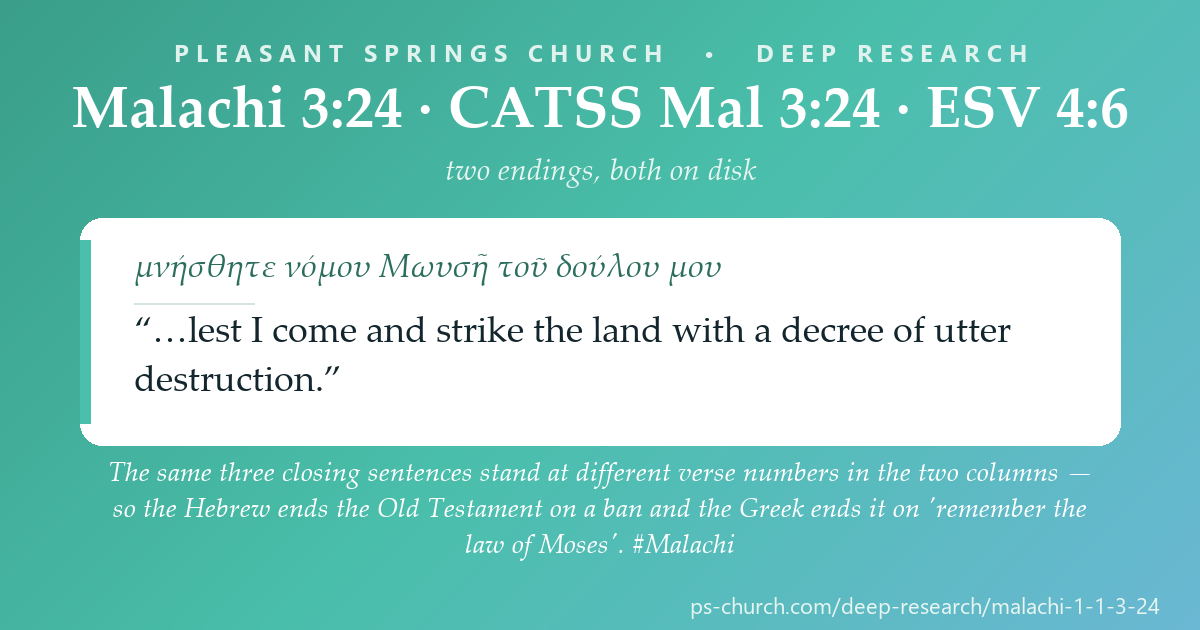
Malachi ends three times over, and the two columns do not put the endings in the same order. In the Hebrew the last three verse numbers carry Moses — Elijah — the turning of hearts, closing on a threat: lest I come and strike the land with a ban. In the CATSS Greek row the same three verse numbers carry Elijah — the turning of hearts — Moses, closing instead on μνήσθητε νόμου Μωυσῆ, remember the law of Moses. In a Christian Bible this is the last verse of the Old Testament, and the two columns disagree about what it says. The page prints both columns and explains neither. Two more things follow from the same stretch: Malachi's deepest run into the New Testament belongs to a verse that is quoting Joel, and at 3:1 all three Gospel forms read before your face where the Greek row reads before my face. See the method →
Malachi 1:1–3:24 (selections, Hebrew numbering)
Hebrew · Greek (CATSS, Rahlfs’ Septuaginta) · ESV⚠️ And the two columns do not close the book on the same sentence. The last three verses stand in one order in the Hebrew and another in the Greek row. Stage 2 lays them out.
The Shape of the Passage
Sequence — six disputes and a closing pairMalachi is built as a series of arguments, and the objections are quoted back. Six times the pattern runs: God asserts, the people answer how? or in what way?, and the assertion is spelled out. Nothing else in the Twelve is structured this way.
Author
The name may not be a name. מַלְאָכִי means my messenger — the same word that stands at 3:1. The Greek row of 1:1 has ἀγγέλου αὐτοῦ, his messenger, rather than a personal name.
Nothing dates the book directly. A governor is mentioned at 1:8, the temple is standing and its sacrifices are running badly, which places it after Haggai and Zechariah — but no king is named and no year is given.
Audience
The priests are addressed by name and at length. 1:6–2:9 is aimed at them directly, and 2:8 accuses them of having caused many to stumble by your instruction.
And the last unit turns outward. Whatever order the closing verses are read in, they end the book by pointing somewhere else — back to Horeb, or forward to Elijah. Both columns do that; they do not do it in the same sequence.
Orient on the disputation form, Elijah, and a chapter the English Bible adds.
Search by topic: Malachi, book of; disputation speech; Elijah redivivus; tithes; covenant of Levi; chapter and verse divisions, history of.
Which articles are relevant?
- Anchor Bible Dictionary — “Malachi, Book of,” “Elijah,” “Tithe,” “Levi, Covenant of.”
- Dictionary of the OT: Prophets (IVP) — “Malachi: Book of,” “Disputation,” “Marriage and Divorce,” “Day of the Lord.”
- Dictionary of NT Use of the OT (Beale & Carson) — on Mark 1:2, Matthew 11:10, Luke 7:27 and Romans 9:13.
- NIDOTTE — מַלְאָךְ, מַעֲשֵׂר, חֵרֶם, זֵד.
Settle the numbering — English Malachi has a chapter Hebrew Malachi does not
Only two of the twelve Minor Prophets have different chapter counts in Hebrew and English. Joel is one and Malachi is the other, and they go opposite ways.
| ch 1 | ch 2 | ch 3 | ch 4 | total | |
|---|---|---|---|---|---|
| Masoretic & CATSS | 14 | 17 | 24 | — | 55 |
| ESV | 14 | 17 | 18 | 6 | 55 |
Hebrew 3:19–24 = ESV 4:1–6. Established from content: Hebrew 3:19 and English 4:1 both begin behold, the day is coming, burning like an oven. So a reference to “Malachi 4:5” is an English reference, and the same sentence is Malachi 3:23 in Hebrew.
Joel runs the other way: four chapters in Hebrew and three in English. Between them these two books are the only places on this shelf where a chapter number and not merely a verse number has to be converted.
Three verses, two orders.
The last three verses, set side by side
Both columns contain the same three sentences. They do not contain them in the same sequence.
| verse number | Hebrew (and ESV) | CATSS Greek row |
|---|---|---|
| 3:22 (ESV 4:4) | Remember the law of Moses my servant… | Behold, I send you Elijah the Tishbite… |
| 3:23 (ESV 4:5) | Behold, I send you Elijah the prophet… | who will restore the heart of a father to a son… |
| 3:24 (ESV 4:6) | And he will turn the hearts of fathers… lest I come and strike the land | Remember the law of Moses my servant… |
So the Hebrew closes on a threat and the Greek row closes on a command. The Hebrew’s final word is חֵרֶם, a ban or devotion to destruction. The row’s final words are προστάγματα καὶ δικαιώματα, statutes and ordinances.
Two further differences inside the three verses: the Greek row calls Elijah τὸν Θεσβίτην, the Tishbite, where the Hebrew has הַנָּבִיא, the prophet; and the row turns καρδίαν ἀνθρώπου πρὸς τὸν πλησίον αὐτοῦ, a man’s heart to his neighbour, where the Hebrew turns children’s hearts to their fathers.
This page reports both columns and nothing more. Which arrangement is prior, and what produced the difference, are questions with a substantial literature and none of it was consulted here. Both columns are printed as the files on this disk have them.
Malachi’s deepest run belongs to a verse quoting Joel
Across all 55 CATSS rows against all 7,927 verses of the Greek New Testament, the deepest run in Malachi is seven — and it is not a Malachi citation.
CATSS Malachi 3:22 (the Elijah verse in that column) and Acts 2:20 share ἐλθεῖν ἡμέραν κυρίου τὴν μεγάλην καὶ ἐπιφανῆ — before the great and manifest day of the Lord comes. Acts 2:20 is quoting Joel — it stands inside the long Joel citation this shelf examined in the Joel study, where Joel 3:4 reaches eleven against the same verse.
The two Old Testament rows share the phrase with each other. A screen that reported only Malachi’s maximum would name Acts 2:20 as its closest New Testament relative, and that verse is looking at a different book.
| run reached | rows of the 55 |
|---|---|
| 2 or more | 55 — all of them |
| 3 or more | 43 |
| 4 or more | 15 |
| 5 or more | 2 |
| 7 | 1 |
What the measurement is, and its scope. Contiguous runs of word forms, Greek against Greek: the CATSS FORM column (cols 0–24, beta-code transliterated) across 30,348 verse units in the 63 .mlxx files screened (64 files and 30,637 units are held; the Odes are held and not screened), against the MorphGNT surface-word column across 7,927 verses in 27 files. Both sides lowercased, accents and breathings dropped, final sigma folded, then filtered to Greek letters — the same filter on both corpora. Word forms, never lemmas.
⚠️ THE SCOPE OF THAT “NOWHERE ELSE” GREW ON 2026-08-30, AND THE FINDING HELD. This paragraph used to read all 44 CATSS files are now held here, and it was true when it was written. It is no longer the whole story: on 2026-08-30 Exodus, Leviticus, Numbers, Joshua (A and B) and the entire deuterocanon — Judith, Tobit (BA and S), Wisdom, Baruch, the Letter of Jeremiah, 2–4 Maccabees, Susanna, Bel, Odes and Psalms of Solomon — joined the shelf, taking it from 44 files and 23,061 verse units to 64 files and 30,637. There is now no Greek Old Testament file missing from this disk. The seven-word phrase ἐλθεῖν ἡμέραν κυρίου τὴν μεγάλην καὶ ἐπιφανῆ was re-run over all 30,637 verse units and it stands in exactly the same two: CATSS Malachi 3:22 and CATSS Joel 3:4, and nowhere else. Twenty more files, 7,576 more verse units, and not one of them carries it — so “nowhere else in the Greek Old Testament held here” is now a considerably harder sentence than it was when this page first said it. The deuterocanonical books are held here as measurement WITNESSES and not as Scripture, exactly as Psalm 151 and Jubilees are on this shelf; none of them carries the phrase, and had one done so this page would have named the book and said what it is.
⚠️ AND ON THE SAME DAY THE SHELF GAVE ONE OF THOSE FILES BACK. HELD AND SCREENED ARE NOW DIFFERENT NUMBERS, AND THIS PAGE USES THE RIGHT ONE. The Odes — the fourteen liturgical canticles bound after the Greek Psalter, 289 verse units — came back out of the screening corpus a few hours after they went in. They stay on disk. The shelf HOLDS 30,637 verse units in 64 files and SCREENS 30,348 in 63, and the difference is exactly those 289. Two reasons, either sufficient. (1) Ten of the fourteen canticles are second copies of passages the corpus already holds — Ode 1 is Exodus 15, Ode 2 Deuteronomy 32, Ode 3 1 Samuel 2, Ode 4 Habakkuk 3, Ode 5 Isaiah 26, Ode 6 Jonah 2, Odes 7 and 8 Daniel (Theodotion) 3, Ode 10 Isaiah 5, Ode 11 Isaiah 38 — so a verse standing once appeared to stand twice and every tie band touching a canticle was doubled. (2) Two of them are New Testament text: Ode 9 is Luke 1, the Magnificat and the Benedictus, and Ode 13 is Luke 2, the Nunc Dimittis. Screened as Old Testament, Ode 9:48 matches Luke 1:48 at eighteen consecutive words — Luke measured against Luke under an Old Testament shelfmark.
Nothing on this page moved when they went, and the reason is worth knowing. Malachi’s own screen runs the other way — 55 CATSS rows against the Greek New Testament — and the New Testament did not change. The single Greek-Old-Testament-side claim on the page, the two rows carrying the seven-word day-of-the-Lord formula, was re-run a third time over the 30,348 screened units and returned CATSS Malachi 3:22 and CATSS Joel 3:4, and nothing else. No hit was removed from this page, so none of them was in Ode 9 or Ode 13. The corpus figure is the only thing that changed here, and it is printed rather than swapped: the screened corpus was 30,637 for a few hours on 30 August 2026 and is 30,348.
One pronoun, and three Gospels on the same side of it.
Malachi 3:1 — my face or your face
Three Gospels carry this sentence and all three share exactly the same three words with the CATSS row.
| the clause | run against the row | |
|---|---|---|
| Hebrew 3:1 | וּפִנָּה־דֶרֶךְ לְפָנָי — before me | — |
| CATSS row | ἐπιβλέψεται ὁδὸν πρὸ προσώπου μου | — |
| Mark 1:2 | πρὸ προσώπου σου ὃς κατασκευάσει τὴν ὁδόν σου | 3 |
| Matthew 11:10 | πρὸ προσώπου σου… | 3 |
| Luke 7:27 | πρὸ προσώπου σου… | 3 |
All three shared runs are the same three words, τὸν ἄγγελόν μου. The three Gospel forms agree with one another far more closely than any of them agrees with this row — they share the second-person pronoun and the verb κατασκευάσει, where the row has a first-person pronoun and ἐπιβλέψεται.
Malachi 3:1’s maximum of three is a tie band of eleven New Testament verses, most of which have nothing to do with it. At a depth of three this screen is not distinguishing anything, and the page prints the band rather than the three members that fit.
Four more places the columns carry different words
| verse | Hebrew | CATSS Greek row |
|---|---|---|
| 1:11 | גָּדוֹל twice | δεδόξασται then μέγα |
| 3:6 | לֹא כְלִיתֶם — you are not consumed | οὐκ ἀπέχεσθε — you have not kept away |
| 3:10 | הַמַּעֲשֵׂר — the tithe | τὰ ἐκφόρια — the produce |
| 3:19 | זֵדִים — the arrogant | οἱ ἀλλογενεῖς — the foreigners |
Each is printed as its file has it. Why any of them stands as it does is not something these columns can settle. The one at 3:10 is worth noting because the verse is preached on tithing and the word tithe stands in only one of the two columns.
Romans 9, and the end of the Twelve.
Malachi 1:2–3 and Romans 9:13
“Jacob I loved, but Esau I hated.” The CATSS row at Malachi 1:3 and Romans 9:13 share four consecutive words, and Romans 9:13 is Malachi 1:3’s deepest partner in the whole New Testament, a tie band of one.
Four is a modest run, and on this shelf runs of four have often turned out to be coincidence. This one is not shared with anything else — which is what the tie band is for, and why the page reports the band alongside the number.
Where this leaves the shelf
Malachi is the last book of the Twelve, and in a Christian Bible its last verse is the last verse of the Old Testament. Which verse that is depends on which column is being read: lest I come and strike the land with a ban, or remember the law of Moses my servant, statutes and ordinances.
Both are in the files on this disk, at the same verse number, and the page has no way to choose between them — nor any business doing so.
Where this page is weakest, and what was not reached.
The limits
The difference is reported and not explained. It is one of the better-known differences between the Hebrew and Greek traditions anywhere in the Twelve, with a long literature about which arrangement is earlier and what either implies. None of that literature was consulted for this page, which prints two columns and stops.
A maximum of seven on a formula is a weak headline and is labelled as one. Malachi’s deepest New Testament run belongs to a shared phrase about the day of the Lord, in a verse quoting a different book. The page says so rather than presenting it as a Malachi–Acts connection.
And 2:16 is genuinely contested. The Hebrew is hard enough that translations differ on who hates whom. The page prints both columns and does not adjudicate.
What could not be checked at all
No Hebrew or Greek critical apparatus. No Qumran material — there is Malachi among the Minor Prophets finds, and the scroll from Nahal Hever bears on the Greek of these books; neither was consulted. No Targum, Syriac, Vulgate, Aquila, Symmachus or Theodotion, and no manuscript evidence bearing on the closing verses.
And nothing about the name. Whether מַלְאָכִי at 1:1 is a personal name or the common noun my messenger is a question this page notes and does not settle.
Two endings, both in the files.
The last verse of the Old Testament, twice
Read the Hebrew column and Malachi ends on a warning: lest I come and strike the land with a ban. Read the Greek column and it ends on an instruction: remember the law of Moses my servant, the statutes and ordinances.
The same three sentences are in both. Moses, Elijah, and the turning of hearts — in one order in the Hebrew and another in the row, so the verse that stands last is not the same verse.
And at 3:1, the verse three Gospels take up, the pronoun that matters most is not the same either — the row prepares a way before my face; all three Gospels prepare it before yours. Three words is everything they share.
Eleventh study on the Minor Prophets shelf, and the whole of Malachi in one page. Eight books complete: Hosea, Joel, Amos, Jonah, Micah, Habakkuk, Haggai, Malachi.
Every Deep Research page traces its passage across the whole sweep — the Old Testament, the Second-Temple world between the testaments (historical witnesses, not Scripture), and the New Testament. Follow the thread:
Pleasant Springs Church — Deep Research
Research method after Michael S. Heiser’s Bible Research Method (examine dictionaries → ancient literature → important words → textual connections → academic publications → share), with the Pleasant Springs “Author & Audience” foundation. Scripture set in the Hebrew, the Greek editions named on each page and the ESV (Old Testament), and the Greek New Testament and the ESV (New Testament), per the practice of Pleasant Springs Church. Malachi research grounded in Hill (Malachi, Anchor), Petersen (OTL), Verhoef (NICOT) and Smith (WBC). Text: Hebrew from the Masoretic text as printed in the editions consulted — Sefaria’s Miqra according to the Masorah; no critical apparatus was consulted for the Hebrew. Greek from Rahlfs’ Septuaginta as digitized by CATSS; Greek New Testament from the SBL edition. The standing caution for this shelf applies: these pages say “the CATSS Greek row reads…” and never call a Greek reading early or late. ⚠️ VERSE NUMBERING — a whole chapter’s difference. Masoretic and CATSS Malachi run 14 / 17 / 24 = 55 verses in three chapters; the ESV runs 14 / 17 / 18 / 6 = 55 in four. Hebrew 3:19–24 = ESV 4:1–6. Established from content at the seam. Joel and Malachi are the only two of the Twelve whose chapter counts differ between Hebrew and English. ⚠️ THE CLOSING SENTENCES STAND AT DIFFERENT VERSE NUMBERS, AND BOTH COLUMNS ARE PRINTED. At verse numbers 3:22, 3:23 and 3:24 the Hebrew file carries Moses, Elijah, turning-of-hearts; the CATSS file carries Elijah, turning-of-hearts, Moses. So the two columns close the book — and, in a Christian Bible, the Old Testament — on different sentences. The page reports both orders and says nothing about which is prior or what produced the difference. No manuscript evidence was consulted. ⚠️ The run measurement, in full. Greek against Greek. CATSS FORM column (cols 0–24), beta-code transliterated first; MorphGNT field 6, the normalised word (the column that already resolves elision and the movable nu). Both sides lowercased, accents and breathings dropped, final sigma folded, then filtered to Greek letters — the same filter applied to both corpora. Contiguous runs of whole word FORMS, never lemmas. Corpus: 30,348 CATSS verse units across the 63 .mlxx files screened — 64 files and 30,637 units are held, and the 289 units of the Odes are held and not screened — and 7,927 verses across 27 MorphGNT files — enlarged from 23,061 across 44 on 2026-08-30, when Exodus, Leviticus, Numbers, Joshua and the deuterocanon arrived and every Greek figure on this page was re-run, and then trimmed to 30,348 the same day when the Odes came back off the screen (ten of the fourteen canticles duplicate passages already held, and Ode 9 and Ode 13 are Luke 1 and Luke 2). Nothing on this page moved at either step. Malachi’s 55 rows are screened against the Greek New Testament, which did not grow; the one Greek-Old-Testament-side claim — that the seven-word day-of-the-Lord formula stands in CATSS Malachi 3:22 and CATSS Joel 3:4 and nowhere else — was re-screened over all 30,637 held units and again over the 30,348 screened units, and returned the same two rows both times. Exhaustive and deterministic — nothing sampled, so no seed applies. ⚠️ The maximum is weak and is labelled as weak. Malachi’s deepest run is 7, at CATSS Mal 3:22 against Acts 2:20 — and Acts 2:20 is quoting Joel, not Malachi. The shared words are a day-of-the-Lord formula the two Old Testament rows also share with each other. Across the 55 rows: all 55 reach two, 43 reach three, 15 four, 2 five, 1 seven. Malachi 3:1’s maximum of 3 is a tie band of eleven; Malachi 1:3’s 4 against Romans 9:13 is a tie band of one. ⚠️ Direction of influence is never asserted. Nothing here says which text is prior, that anyone quoted, adapted, followed or altered anything, or why any reading stands as it does — including the order of the closing verses, the pronoun at 3:1, and the differences at 1:11, 3:6, 3:10 and 3:19. Typology is handled per the house position: what the text says, what the New Testament itself draws, and what we see from this side of the cross — with the seeing left to the reader.
Scripture quotations marked ESV are from the ESV® Bible (The Holy Bible, English Standard Version®), © 2001 by Crossway, a publishing ministry of Good News Publishers. ESV Text Edition: 2016. Used by permission. All rights reserved. The ESV text may not be quoted in any publication made available to the public by a Creative Commons license, and the ESV may not be translated in whole or in part into any other language. www.esv.org
|
Did this study bless you today? 💚 Give to Support PS Church100% of gifts go to the General Fund — thank you. |